
When you hear “marketing automation,” it’s easy to think of it as just software that sends emails on its own. But for a SaaS company, it’s so much more. It’s about taking repetitive, manual tasks off your team’s plate—think endless welcome emails, lead nurturing sequences, and user onboarding checklists—and turning them into smart, automated workflows.
This frees up your people to focus on what really matters: strategy, creativity, and building a better product. More importantly, it’s the only practical way to deliver a truly personal experience to every single user as you grow.
Why Marketing Automation Is Your SaaS Growth Engine
For any SaaS business, real growth comes from keeping customers happy and increasing their lifetime value, not just getting them in the door. As your user base expands, trying to manage every interaction manually becomes a recipe for burnout and missed opportunities. This is where a solid marketing automation for saas strategy shifts from a “nice-to-have” to a core part of your operations. It’s the engine that drives personalized communication at scale, from the first time a user signs up to the moment they become a power user.
The secret is out. By 2025, a massive 91% of company decision-makers expect their need for marketing automation to increase. Why the rush? Because creating a tailored experience across every touchpoint—from your website to in-app messages—is a huge challenge. Without automation, it’s nearly impossible to do well. You can find more details on this trend over at crop.ink.
Solving Core SaaS Challenges
So, how does this actually help your business? Marketing automation is tailor-made to tackle the biggest headaches in the SaaS world.
Let’s get practical. Common SaaS problems usually have a direct automation-based solution. Here’s a quick look at how they match up.
Core SaaS Challenges and Automation Solutions
| SaaS Challenge | Marketing Automation Solution |
|---|---|
| High Trial User Drop-Off | Trigger a timed onboarding sequence with tutorials and tips to guide new users to that “aha!” moment. |
| Leads Going Cold | Automatically nurture leads with targeted content based on their behavior, keeping them warm until they’re ready to buy. |
| High Customer Churn | Set up alerts for inactivity (e.g., no login for 14 days) and automatically send a re-engagement campaign. |
| Missed Upsell Opportunities | Segment users by feature usage and send personalized messages showcasing premium features they might love. |
| Generic User Communication | Use behavioral data to send relevant, timely messages that make each user feel understood and valued. |
As you can see, the goal is to create a system that responds intelligently to your users’ needs without constant manual intervention.
Scalable Onboarding: Instead of a single person trying to email every new trial user, you can design an automated flow. This sequence delivers welcome messages, product tips, and tutorials at just the right moments, drastically improving your trial-to-paid conversion rate.
Reduced Churn: Automation acts as your early-warning system. By tracking what users do (or don’t do) inside your app, it can spot customers who are at risk of leaving. For example, if someone’s activity drops, an automated workflow can kick in with helpful resources or a friendly check-in to bring them back.
Personalized User Journeys: Imagine being able to talk to different users differently based on their subscription plan, the features they use most, or how active they are. Automation makes this possible. This kind of hyper-targeted communication builds loyalty and naturally uncovers opportunities to upsell.
The biggest win here is a strategic shift. When you automate the right tasks, your team stops spending its days on tedious, repetitive work. Instead, they can dive into analyzing data, fine-tuning your messaging, and dreaming up creative campaigns that actually move the needle.
It’s all about building an efficient, powerful foundation that allows your SaaS to grow sustainably. This approach turns your marketing from a cost center into a predictable growth machine.
Setting the Stage for Automation That Actually Works

It’s tempting to jump straight into a new marketing automation tool. You feel productive clicking buttons and building workflows, but without a clear plan, you’re sailing without a map. You’ll end up adrift, wasting time and money. A solid, thoughtful setup is what separates a true success story from a cautionary tale.
This all starts with setting specific, measurable goals. An objective like “get more leads” is just too vague. You need tangible targets tied directly to business growth. For example, aim to increase trial-to-paid conversions by 15% in the next six months. Or, maybe you want to reduce customer churn by 5% over the next quarter. These concrete goals give your automation efforts real purpose and make it easy to see what’s working later on.
Get to Know Your Customer’s Journey, End-to-End
Before a single workflow gets built, you need to understand the path your customers take with your company. Mapping the customer journey isn’t just a fluffy marketing exercise; it’s an operational must. You need to visualize every single touchpoint, from the moment someone first hears about your SaaS to the day they become a raving fan.
This process forces you to step into your customer’s shoes. What are their biggest headaches at each stage? What piece of information do they need to take the next step?
A typical SaaS customer journey breaks down into a few key stages:
- Awareness: This is how prospects find you. It could be through a blog post they found on Google, a social media ad, or a recommendation.
- Consideration: They’re interested. This is when they sign up for a free trial or book a demo to see if you’re the right fit.
- Onboarding: These are the critical first few days. A new user is figuring out how to get real value from your tool.
- Adoption & Retention: Your product is now part of their routine. They’re using it regularly and, hopefully, sticking around.
- Advocacy: The holy grail. Happy customers start referring friends and leaving fantastic reviews.
Seeing this entire flow laid out shows you exactly where automation can make the biggest difference.
The real goal of journey mapping is to find the friction. Where do people get stuck or drop off? Those are your golden opportunities for an automated assist, like a perfectly timed email with a helpful tutorial or an in-app message pointing out a game-changing feature.
Your Data: Clean It, Then Segment It
Let’s be blunt: your automation is only as good as the data powering it. Sending the wrong message to the wrong person isn’t just ineffective—it’s actively harmful. It erodes trust and can push potential customers away for good. That’s why data hygiene and segmentation are non-negotiable first steps.
Start with a deep clean of your contact list. That means hunting down and merging duplicates, fixing typos in email addresses, and making sure all your data formats are consistent. It’s tedious work, but it’s essential for making sure your messages actually land in the right inbox.
Once your data is squeaky clean, it’s time to slice and dice it. Segmentation is just a fancy word for dividing your audience into smaller, logical groups based on who they are or what they do. For a SaaS business, you can get incredibly specific, which is where the real power lies. If you want to go deeper, you can explore more about general SaaS automation strategies and how they connect.
Here are a few powerful ways to segment your SaaS audience:
- By User Activity: Group people into buckets like “New Trials,” “Active Power Users,” or “Users Who Haven’t Logged in for 30 Days.”
- By Subscription Plan: Separate your free users from those on your Basic, Pro, or Enterprise tiers.
- By Feature Usage: Create a list of users who have engaged with a specific feature versus those who haven’t.
This level of detail lets you do smart things, like sending an upsell offer for a premium feature only to your most engaged users. Or you could trigger a re-engagement campaign for anyone who’s gone quiet. This prep work ensures that when you finally flip the switch on your automations, you’re primed for immediate wins.
Choosing the Right Marketing Automation Platform
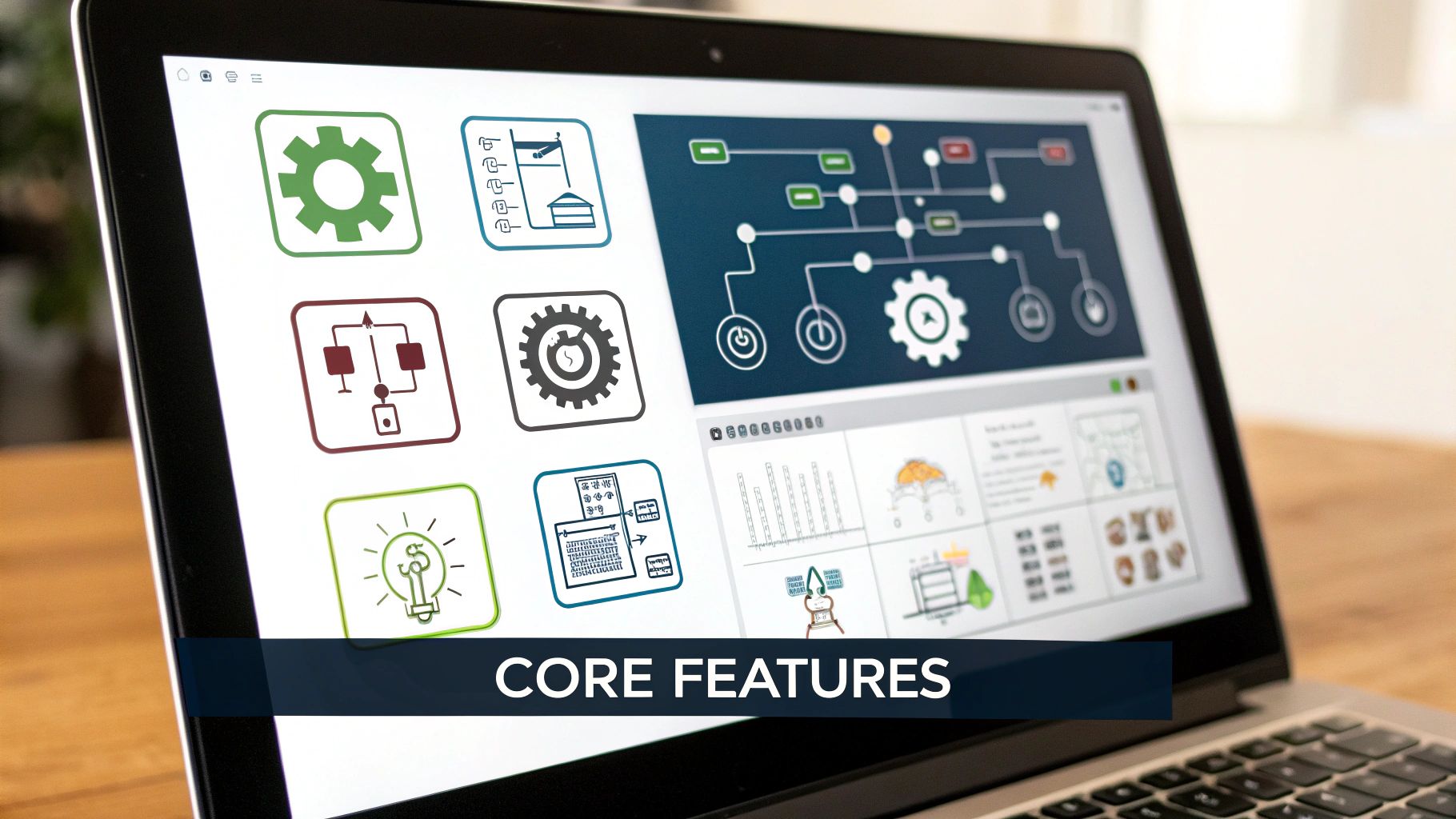
So, you’ve mapped out your strategy. Now comes the fun part: picking your tools. With all the options out there, this can feel like a massive undertaking, but for a SaaS company, the criteria are actually quite specific. You aren’t just buying a piece of software; you’re choosing a partner that will fuel your growth for years to come.
The market for these tools is booming. The global Marketing SaaS sector was valued at around $69.65 billion in 2024 and is on track to hit nearly $280.67 billion by 2033. You can dig deeper into the Marketing SaaS market trends to see why. More competition means more innovation, but it also means more noise to cut through to find the right fit.
Core Features SaaS Companies Cannot Ignore
A generic marketing platform simply won’t do the job. Your subscription-based model is unique, and your automation tool has to reflect that. Don’t let a vendor dazzle you with a long list of shiny features you’ll never touch. Instead, zoom in on the capabilities that directly support a SaaS business.
Native CRM Integration: This is table stakes. Your marketing automation platform and CRM need to be best friends, not distant acquaintances. Look for deep, native integrations that allow data to flow seamlessly in both directions. This is how you give your sales team the marketing insights they need and your marketing team the sales data to build smarter campaigns.
Behavioral and In-App Triggers: For a SaaS company, this is a non-negotiable. You need a platform that can kick off a workflow based on what a user actually does inside your product. Think about triggering an email when a user tries a new feature for the first time, or sending an in-app prompt if they haven’t logged in for 10 days. This is where the real magic happens.
Scalability for Growth: The tool that works for you at 1,000 users must also work at 100,000 users without bankrupting you. Scrutinize the pricing tiers and ask tough questions about how the platform supports a company as it scales. This kind of forward-thinking is fundamental to building sustainable SaaS growth strategies.
Comparing Different Tiers of Platforms
Marketing automation tools aren’t one-size-fits-all. They generally fall into a few different categories, and knowing where you fit is key to making a smart investment. You don’t need an enterprise-level sledgehammer to crack a startup-sized nut.
To make sense of the options, it helps to compare the features across different toolsets. This table breaks down what you can generally expect.
Feature Comparison for SaaS Automation Tools
| Feature | Entry-Level Tools (e.g., Mailchimp) | Mid-Tier Tools (e.g., ActiveCampaign) | Enterprise Tools (e.g., Marketo) |
|---|---|---|---|
| Ideal For | Startups and small teams with basic email needs. | Growing SaaS companies with defined processes. | Large organizations with complex, multi-channel needs. |
| Core Strength | Simple email campaigns and basic automation. | Robust workflow builders and strong CRM integration. | Advanced analytics, lead scoring, and multi-channel attribution. |
| SaaS Focus | Limited; often lacks deep behavioral triggers. | Good; supports in-app event tracking. | Excellent; built for deep product data integration. |
| Pricing | Affordable, often with a free tier to start. | Moderate, scales with contacts and feature usage. | A significant investment, usually with custom pricing. |
Ultimately, choosing the right tier comes down to your company’s current stage. A startup might get everything it needs from an entry-level tool to nail user onboarding, then graduate to a mid-tier solution once its customer journey requires more sophistication.
My two cents: The best platform isn’t the one with the most features. It’s the one that solves your specific SaaS challenges today while giving you a clear path to scale for tomorrow. Avoid overbuying on power you won’t use for years.
A Practical Checklist for Vendor Demos
When you’re ready to see some demos, go in prepared. Don’t let a sales rep run their standard pitch. You need to drive the conversation and ask targeted questions that reveal if their platform is truly built for a business like yours.
Walk into your next demo armed with these questions:
- Can you show me exactly how your platform tracks in-app user events?
- How does your system segment and manage data for trial users versus paying customers?
- Show me what your native integration with our CRM looks like in practice.
- Can we build custom lead scoring models based on both marketing engagement and product usage data?
- What does your pricing look like when we scale from 5,000 to 50,000 contacts?
Getting clear, confident answers here will quickly separate the true contenders from the generalist platforms. This diligence is what ensures you find a partner that will accelerate your growth, not hold you back.
Alright, you’ve got your strategy mapped out and you’ve picked your marketing automation platform. Now for the fun part: making it all work. This is where the rubber meets the road, where you’ll start seeing a real, tangible impact on your SaaS growth.
The key is not to boil the ocean. Don’t try to automate every single touchpoint from day one. Instead, pick a couple of high-impact sequences that address your most pressing business needs right now.
Think of it as an ongoing cycle. You’ll plan, build, integrate your systems, and then watch the data to see what needs tweaking. This simple diagram really nails it:
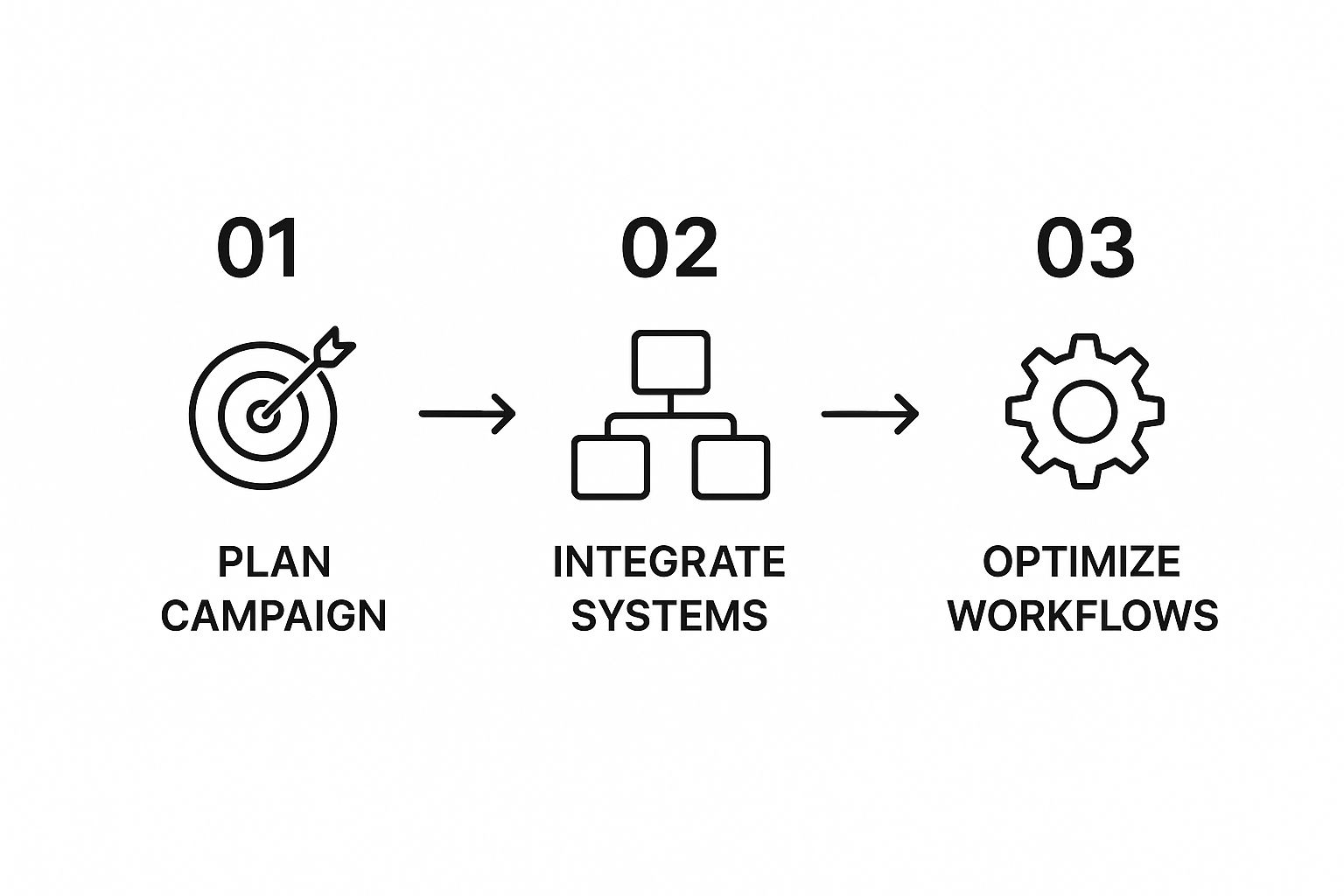
As you can see, launching is just the beginning. The real magic happens when your tools talk to each other and you’re constantly refining your automations based on what’s actually working.
Blueprint 1: The Trial User Onboarding Sequence
Let’s be honest, the first few days of a free trial are everything. If a new user doesn’t “get it” and find value quickly, they’re gone. The whole point of this workflow is to guide new signups to that “aha!” moment as smoothly as possible, which can massively boost your trial-to-paid conversion rate.
The Trigger: This whole sequence fires off the second a user signs up for a free trial.
Your goal is to send a helpful mix of educational content and gentle nudges over the next 7-14 days. Here’s what that might look like:
- Day 1 (Immediately): A warm welcome email is non-negotiable. Confirm their signup, give them their login info, and—this is crucial—suggest one single, clear first step to take in the app.
- Day 3: Check in. Did they complete that first step? If not, send a friendly reminder with a link to a quick tutorial video. If they did, great! Send a “congrats” email that points them to the next logical feature.
- Day 5: Time to highlight a power feature that solves a major headache for your ideal customer. A short email explaining the benefit, maybe with a link to a relevant case study, works wonders here.
- Day 7: Send a personal check-in. Have it come from a founder or a customer success manager, simply asking if they have any questions. That human touch builds a surprising amount of goodwill.
- Day 10: As the trial nears its end, gently remind them of what they’ll lose access to. This creates a bit of urgency without being pushy.
The secret to great onboarding isn’t just about sending a bunch of emails. It’s about using in-app behavior to make those emails feel personal and timely. If a user has already mastered Feature X, for heaven’s sake, don’t send them a tutorial about it.
Blueprint 2: The Content-Driven Lead Nurturing Workflow
Not everyone who downloads your ebook is ready to see a demo. Far from it. This workflow is all about warming up those top-of-funnel leads, using smart content to educate them and guide them closer to a sales conversation when they’re ready. The goal here is simple: increase the number of truly sales-qualified leads (SQLs) you hand over to your sales team.
The Trigger: A user downloads a lead magnet, like an ebook, whitepaper, or checklist from your site.
This sequence is all about giving, giving, giving before you ask. You’re building trust and positioning your company as an expert in the field.
Here’s a proven approach:
- Immediate Delivery: The first email should do one thing: deliver the content they asked for. No sales pitch, no fluff. Just be helpful.
- Follow-Up (3 days later): Send another piece of related content. If they downloaded an ebook on “SaaS Analytics,” a great follow-up is a blog post on “5 KPIs Every Founder Should Track.” See the connection?
- Value Add (7 days later): Mix it up. Offer a different format, like an invitation to an upcoming webinar or a link to a video case study. This keeps things interesting.
- The Ask (12 days later): After you’ve consistently provided value, it’s finally okay to make a soft ask. An email that says, “You seem pretty interested in improving X. Would a quick 15-minute chat to see how we solve that be helpful?” is worlds more effective than a hard pitch on day one.
Blueprint 3: The Customer Re-engagement Campaign
Churn is the silent killer of SaaS businesses. This workflow is your early warning system, designed to automatically spot and win back at-risk customers before they hit the cancel button. It all hinges on using behavioral data to notice when someone is drifting away.
The Trigger: A paying customer hasn’t logged into their account in the last 14 days.
This is where the true power of marketing automation for saas comes into play. You can act on inactivity almost instantly, and the key is to approach it with a helpful, not accusatory, tone.
A re-engagement flow could look something like this:
- Email 1 (Day 15): A simple “Is everything okay?” message works well. You could also highlight a new feature they might have missed or point them toward your help docs.
- Email 2 (Day 21): Remind them why they signed up. Share a success story or a case study from a customer in a similar industry to jog their memory about the value your product offers.
- Email 3 (Day 28): This is the final nudge. Offer a one-on-one session with a product specialist to help them get back on track. A personal offer like this can be incredibly powerful for keeping a customer who’s on the fence.
AI is making these automated campaigns even more intelligent. Modern platforms can segment users on the fly and trigger messages at the perfect time based on individual behavior, covering everything from onboarding to renewal reminders. As you can imagine, this can give your open rates a serious boost. You can dive deeper into how AI is shaping SaaS marketing at everything-pr.com.
Integrating Automation with Your CRM for a 360-Degree View
Here’s a hard truth: if your marketing automation platform and your CRM aren’t talking to each other, you’re leaving money on the table. It’s like having two different teams trying to build the same car without sharing blueprints. Marketing ends up flying blind without sales insights, and the sales team has no idea what journey a prospect took to get to them.
Connecting these two systems is about more than just flipping a switch. It’s about creating a single source of truth where data flows freely in both directions. This bi-directional sync transforms siloed information into a powerful engine for smarter marketing and more relevant sales conversations. In fact, companies that get this sales and marketing alignment right see an average 20% annual growth rate.
Establishing the Two-Way Data Flow
The first thing you need to do is map out exactly what information needs to move between the two platforms. A one-way data dump from marketing to your CRM just doesn’t cut it. You need a constant, real-time exchange that enriches both systems.
Think of it this way: when a salesperson updates a lead’s status to “Contacted” in the CRM, that information should immediately kick back to your marketing tool. This simple action can automatically pull that person out of a generic nurture sequence and slot them into a more sales-focused workflow. No more awkward “getting to know you” emails for leads who are already talking to sales.
The core principle is simple: marketing activities should inform sales, and sales outcomes should inform marketing. When this loop is closed, you stop wasting resources and create a seamless customer experience.
Essential Data Points to Synchronize
To make this integration truly powerful, you can’t just sync everything. That just creates noise. You have to be strategic. Focus on the data points that give both teams an edge. For any SaaS business, this is the foundation of effective marketing automation, as it ties your campaigns directly to user behavior and, ultimately, revenue.
Here are the critical data points I always recommend syncing:
- Lead Score: This is your sales team’s cheat code. A high score, pushed from the automation tool to the CRM, is a clear signal that a lead is hot and ready for a conversation.
- In-App Activity: For SaaS, this is pure gold. Syncing data like “last login date,” “key features used,” or “trial nearing expiration” gives sales reps incredible context for their outreach.
- Subscription Status: Is the contact a trial user, on a basic plan, or an enterprise customer? This info ensures marketing sends the right upgrade offers and sales understands the existing relationship.
- Marketing Engagement: Syncing email opens, clicks, and content downloads into the CRM helps a salesperson know what a prospect is interested in before they even pick up the phone.
- Support Ticket Information: You never want to send a cheerful upsell email to a frustrated user. Syncing support ticket status lets marketing know when to back off or change the message.
This constant flow of information creates a powerful feedback loop that sharpens your strategy over time.
Empowering Your Sales and Marketing Teams
Once you have a fully integrated system, the impact is almost immediate. Both your sales and marketing departments become more effective because they’re no longer working off assumptions. They’re operating from a shared playbook built on hard data.
Your sales team gets supercharged with:
- Timely Alerts: They can get instant notifications when a lead hits a certain score or takes a high-intent action, like visiting your pricing page three times in one day.
- Informed Conversations: Imagine a salesperson seeing that a prospect just downloaded an ebook on API integrations. They can tailor their pitch perfectly, making the call feel helpful instead of interruptive.
Meanwhile, your marketing team can:
- Build Hyper-Personalized Campaigns: They can now create incredibly specific segments using CRM data (like industry or company size) layered with in-app behavior.
- Automate Based on Customer Health: By syncing customer health scores from the CRM, marketing can trigger automated campaigns to re-engage at-risk users or, just as importantly, identify happy customers for case studies and testimonials.
This deep alignment is how you build a consistent and impactful customer experience—from the very first touchpoint all the way to long-term advocacy.
Measuring Success and Optimizing Your Strategy
Getting your first automation workflows live is a fantastic milestone, but the real work starts now. The true magic of marketing automation for saas isn’t in the initial setup; it’s in the continuous cycle of measuring, learning, and tweaking. Without this, even your most clever workflows will eventually lose their punch.
It’s tempting to get caught up in vanity metrics like email open rates or social media likes. While interesting, they don’t tell you if your efforts are actually moving the needle for the business. In SaaS, success is measured in revenue and happy, paying users. That means you need to zero in on the key performance indicators (KPIs) that connect directly to your bottom line.
Key SaaS Metrics to Track
Your automation dashboard shouldn’t be a dumping ground for every metric under the sun. Instead, think of it as a clean, focused command center showing you only the numbers that matter. For a subscription business, these are the heavy hitters.
- Trial-to-Paid Conversion Rate: This is the most honest measure of your onboarding workflow’s effectiveness. If this number is climbing, it means your automated guidance is successfully demonstrating your product’s value to new users.
- Customer Lifetime Value (CLV): Are your automated upsell and retention campaigns actually working? A rising CLV is solid proof that customers are sticking around longer and spending more—the ultimate sign of a healthy SaaS company.
- Feature Adoption Rate: This metric shows whether users are actually engaging with the features you’re highlighting. If adoption for a new premium feature is low, it might be time to rethink your automated announcement campaign.
- Net Revenue Churn: This tracks the revenue you’ve lost from cancellations and downgrades against the new revenue you’ve gained from upgrades. Automation is a powerful tool for minimizing churn by keeping customers engaged and successful.
Focusing on these actionable data points is where you’ll see a real return. In fact, businesses see an average ROI of $5.44 for every $1 spent on marketing automation, which underscores its power to generate revenue. And with AI now driving 77% of content creation in many automated systems, it’s easier than ever to create the personalized journeys that boost these core metrics. You can find more of these insights in these marketing automation statistics on cropink.com.
The Power of A/B Testing
Once you’re tracking the right KPIs, you can start making them better. A/B testing is your best friend for this. It’s a straightforward idea: pit one version of an email, landing page, or workflow against another to see which one performs best.
The golden rule of A/B testing is to change only one variable at a time. If you change the headline, the call-to-action, and the main image all at once, you’ll have no clue what actually caused the change in performance.
Start with small tests that have the potential for a big impact. In your trial onboarding sequence, for example, you could test:
- Email Subject Lines: Does a direct subject line like “Your First Step with [Product]” get more clicks than a benefit-driven one like “Solve [Problem] in 5 Minutes”?
- Call-to-Action (CTA) Button Copy: Test a simple phrase like “Start Your Project” against something like “Log In and Explore.”
- Timing: Does sending a follow-up email after two days of inactivity work better than waiting for three?
Each winning test might only give you a small lift, but over time, these small wins compound into massive improvements in your overall performance. This kind of data-driven optimization, often detailed in a customer success playbook, is what turns your marketing automation platform from a static tool into a dynamic engine for sustainable growth.
Got Questions About SaaS Marketing Automation?
You’re not alone. When you’re diving into marketing automation, a lot of questions come up. Let’s tackle some of the most common ones I hear from SaaS teams just like yours.
How Soon Will I Actually See Results?
It’s a mix. You’ll see immediate activity from simple things like welcome emails the moment you switch them on. That’s the easy part.
But for the results that really move the needle—like better trial-to-paid conversion rates or a noticeable drop in churn—you need to give it some time. Realistically, you’re looking at 3-6 months to gather enough data, see what’s working, and start fine-tuning your approach.
We’re a Small Startup. Can We Even Afford This?
Yes, you absolutely can. Don’t let the big, enterprise-level price tags scare you off. Many of the best automation platforms have startup-friendly plans designed specifically for smaller teams.
You don’t need to automate everything at once. Just start with the basics, like a solid user onboarding sequence. The time you save and the efficiency you gain often pay for the tool itself, delivering a solid ROI even when your team is tiny. In fact, nearly 40% of marketers already have fully or mostly automated their customer journeys, so it’s becoming standard practice. You can dig into more widespread automation trends at cropink.com.
What’s the Biggest Mistake I Should Avoid?
This one is easy: falling in love with the tool instead of the strategy.
I’ve seen it happen time and time again. A team gets excited about a powerful, feature-rich platform but has no clear plan for how to use it. A fancy tool can’t fix a broken or non-existent customer journey map.
Before you spend a dime on software, invest your time in understanding your users. Map out their entire journey, from the first touchpoint to becoming a power user. Create genuinely helpful content for each stage. Your foundation is everything, so make sure you’re clear on your goals and know which metrics truly define success. If you’re not sure where to start, getting a handle on the right SaaS KPIs is the perfect first step.
At SaaS Operations, we’re all about giving you proven, battle-tested playbooks and SOPs. Our goal is to help you implement effective automation so you can run a much more efficient business. Ready to save time and grow faster? Check out our frameworks. https://saasoperations.com