
Let’s get one thing straight: a customer success playbook isn’t some dusty, three-ring binder that sits on a shelf. In today’s world, it’s a living, breathing guide that empowers your team to handle just about any customer situation with confidence and consistency. Think of it as your team’s strategic framework for delivering real value at every single stage of the customer journey—from that initial onboarding call all the way to renewal and beyond.
So, What Exactly Is a Modern Customer Success Playbook?

A modern playbook is a centralized, digital resource. It’s not a rigid set of rules, but rather a collection of proven “plays” your Customer Success Managers (CSMs) can run to hit specific goals. The real magic here is creating a consistent customer experience.
When every CSM on your team tackles a critical event—like a dipping health score or a new executive joining the account—using the same battle-tested process, your customers feel it. That reliability builds an incredible amount of trust, which is your single best defense against churn.
The Foundation: Your Playbook’s Building Blocks
A truly effective playbook is built on clear goals and well-defined processes. You don’t need to overcomplicate it. Just focus on the moments that matter most. The best playbooks I’ve seen are designed for action, not just theory.
Here’s what every good play needs:
- A Clear Trigger: This is the specific event that kicks off a play. For example, a customer’s product usage dropping by 20% is a perfect trigger for a “Re-engagement Play.”
- A Defined Objective: What’s the goal? Is it to boost feature adoption, head off a potential churn risk, or maybe uncover an upsell opportunity? Every play needs a purpose.
- Actionable Steps: Your playbook should lay out the exact tasks a CSM needs to perform. It’s step-by-step guidance that removes all the guesswork.
- Necessary Resources: This is the CSM’s toolkit. Think email templates, call scripts, presentation decks, or even links to internal knowledge base articles that help them execute the play without a hitch.
A well-structured playbook ensures that even a brand-new CSM can perform like a seasoned pro. It essentially bottles up the wisdom of your top performers and shares it with the entire team.
To give you a clearer picture, I’ve put together a quick table outlining these core elements.
Essential Playbook Components At A Glance
This table breaks down the foundational elements every comprehensive customer success playbook should have. Think of these as the non-negotiables for building a system that drives consistency and value.
| Component | Objective | Key Stakeholders |
|---|---|---|
| Triggers | To identify specific customer events or health score changes that require action. | CS Ops, CSMs, Product Team |
| Objectives | To define the desired outcome for each play (e.g., reduce churn, increase adoption). | CS Leadership, CSMs |
| Actionable Steps | To provide a clear, step-by-step guide for CSMs to follow. | Senior CSMs, CS Leadership |
| Resources | To equip CSMs with the tools (templates, scripts) needed to execute the play. | CS Leadership, Marketing, CSMs |
| Success Metrics | To measure the effectiveness of each play and its impact on customer health. | CS Ops, CS Leadership |
Having these components clearly defined from the start makes the whole process smoother and ensures your playbook actually gets used.
It’s a Team Sport: Getting the Whole Company Aligned
One of the biggest wins you’ll get from a solid playbook is its power to break down those frustrating internal silos. Let’s be honest: customer success is everyone’s job, not just the CS team’s.
A classic example is the handoff from sales to customer success. A clunky handoff can sour the customer relationship from day one. Your playbook should map out this process perfectly, clarifying exactly what information the sales team needs to pass along so customers aren’t stuck repeating their goals and pain points.
This alignment also stretches to your product team. When you see multiple customers triggering plays related to the same missing feature, that data becomes a powerful, unified voice telling your product managers exactly where to focus.
Ultimately, a playbook is the connective tissue for your company. It documents goals, key touchpoints, and communication rules, getting sales, product, and success teams all rowing in the same direction. If you’re curious about how top companies are using playbooks to align their strategies, you can find some great insights on Onramp.us.
Designing Your Foundational Plays and Processes
Alright, you’ve got your strategy mapped out. Now for the fun part: bringing it to life. This is where we get into the nuts and bolts of designing the actual plays and processes your team will use every single day. The goal here is to build a library of proven, repeatable actions that ensure every customer gets a consistently great experience.
Think of each “play” as a specific game plan for a critical moment in the customer’s journey. You’re not just putting out fires; you’re proactively managing the relationship with a clear, defined plan. This takes the guesswork out of the equation for your Customer Success Managers (CSMs) and makes excellence the standard.
Defining Your Core Plays
First things first, you need to identify the most important interactions your team has with customers. These usually fall into a few key categories that form the foundation of any strong customer success program.
Your first set of plays should cover the absolute essentials:
- New Customer Onboarding: A play that takes a brand-new client from the sales handoff to being a confident, active user who’s already seeing value.
- Adoption and Engagement: These are plays you run when you notice low usage or when you need to introduce new features to help a customer get more out of your product.
- Health Checks and Business Reviews: Proactive plays scheduled at regular intervals (like quarterly) to review goals, prove ROI, and strengthen the partnership.
- Risk and Churn Prevention: These are the reactive plays that kick in when a health score drops, you get some tough survey feedback, or a key champion leaves.
- Renewal Management: A critical play that should start 90-120 days before the contract is up, focused on reinforcing value and locking in that renewal.
For every play, you must define the trigger and the desired outcome. The trigger is the event that sets the play in motion, and the outcome is what you’re trying to achieve.
I’ve seen so many teams make the mistake of creating plays that are way too complex. Start simple. A clear, five-step process for a quarterly business review is infinitely more effective than a convoluted 20-step monster that nobody ever follows.
Segmenting Your Approach
Not all customers are created equal, so your plays shouldn’t be a one-size-fits-all deal. That’s just inefficient and feels impersonal. The real key is to segment your customers and tailor your plays to fit each group.
Here are a few common segments I see work well:
| Customer Segment | Typical Approach | Playbook Focus |
|---|---|---|
| Enterprise | High-Touch | Deeply consultative. Think frequent strategic check-ins, custom reports, and maybe even on-site visits. Plays are very personalized. |
| Mid-Market | Mid-Touch | A smart mix of personal interaction and scaled communication. Business reviews might be semi-automated, with a bigger focus on group webinars. |
| SMB/Startup | Tech-Touch | This is all about automation and self-service. Plays are triggered by user behavior and delivered through in-app messages and email sequences. |
Let’s walk through a real-world scenario. Say the trigger is a big drop in how much a customer is using a certain feature.
- For an Enterprise client (High-Touch): The CSM gets an immediate alert. They dig into the account history, then schedule a call with their main contact to figure out what’s going on and offer some personalized training.
- For an SMB client (Tech-Touch): The system automatically fires off a targeted email with a “how-to” video for that feature, plus an invite to an upcoming office hours session.
This segmented approach means you’re focusing your most valuable resource—your CSMs’ time—on the accounts that justify it, while still delivering great support across the board. To really flesh this out, exploring different customer success strategies can give you some great ideas for tailoring these plays.
Detailing the Steps for CSMs
Once you’ve defined the play and its segment, you have to spell out the exact steps your CSMs need to take. This is the heart of the playbook. Be incredibly specific and give them all the templates and resources they need to succeed.
For an “At-Risk Customer” play, the steps might look something like this:
- Triage the Alert: The CSM gets an alert (e.g., health score plummets below 40). The first thing they do is review the customer’s recent activity, support tickets, and any notes in the CRM.
- Sync Internally: Before reaching out, the CSM quickly connects with the account executive and maybe a support lead to get the full story. No one likes surprises.
- Reach Out to the Customer: The CSM uses a pre-written email template to schedule a “check-in,” framing it as a proactive partnership review.
- Run the Call: They follow a call script that’s all about listening to the customer’s problems. The goal isn’t to be defensive; it’s to find the root cause.
- Build an Action Plan: Together, they document the next steps, assign owners, and set clear deadlines. This plan is then shared with the customer for full transparency.
- Monitor and Follow Up: The CSM tracks progress against the action plan and sends regular updates to the customer until their health score is back in the green.
By building out these foundational plays, you’re creating a powerful system that drives consistent results and empowers your team to stop reacting and start being truly proactive.
How to Use Automation to Scale Your Efforts

As your customer base grows, you’ll quickly hit a wall. Manually engaging every single user with a high-touch approach just isn’t sustainable. In fact, trying to do so is the fastest way to burn out your team.
This is where smart automation becomes your secret weapon.
A great customer success playbook isn’t just a list of manual tasks; it’s a strategy that identifies exactly where technology can do the heavy lifting. The point isn’t to replace your Customer Success Managers (CSMs). It’s to get them out of the weeds of repetitive, admin work so they can focus on strategic conversations that actually prevent churn and drive growth.
This isn’t just a theory—it’s a massive industry shift. The growth rate for automation in customer success is expected to climb by 37.3% annually through 2030. Teams that embrace this are managing larger portfolios while getting better at everything from solving issues to onboarding new users. It’s a clear signal of where the industry is heading.
Identifying What to Automate
First things first: you have to figure out which tasks are ripe for automation. Not everything should be automated. A good rule of thumb is to target tasks that are repeatable, driven by data, and don’t require complex problem-solving or a deep personal connection.
Here are a few prime candidates for automation in any playbook:
- Onboarding Email Sequences: Instead of a CSM manually sending welcome emails, set up an automated drip campaign that guides new users through key features and points them to helpful resources.
- Health Score Alerts: This is a big one. Automatically notify the assigned CSM the moment a customer’s health score dips, triggering a proactive play before the problem gets worse.
- Usage-Based Nudges: Has a customer not touched a critical feature in their first 30 days? An automated in-app message or a friendly email can give them the nudge they need to explore it.
- Feedback Collection: After a customer finishes onboarding or resolves a support ticket, automatically send a Net Promoter Score (NPS) or Customer Satisfaction (CSAT) survey to capture feedback while it’s fresh.
Automating these touchpoints creates a safety net. It ensures you’re communicating consistently and catching potential issues early, all without a human having to watch over every single action.
Maintaining the Human Element
Here’s the catch: relying too much on automation can feel cold and robotic. The real art is blending technology with a genuine human touch. Your playbook needs to draw a clear line in the sand between what a machine handles and what a person needs to do.
The best automation doesn’t replace human interaction—it makes it more meaningful. By taking care of the routine stuff, technology frees up your CSMs to build real relationships and become true strategic advisors.
For example, an automated alert might be the trigger, but the follow-up for a high-value, at-risk account should always be a personal call or a thoughtful email from their CSM. This hybrid approach gives you efficiency without sacrificing the quality of your customer relationships.
Let’s look at a few scenarios to see how this plays out.
| Scenario | Automated Action (Tech-Touch) | Human Intervention (High-Touch) |
|---|---|---|
| New Feature Announcement | Send a broadcast email to all users with a “What’s New” video. | A CSM personally reaches out to key accounts to show them how the new feature solves their specific problems. |
| Usage Dips Slightly | An automated email goes out with helpful tips and links to relevant articles. | For a major, sustained drop in usage, the CSM schedules a call to get to the root of the issue. |
| Successful Onboarding | A celebratory automated email marks the end of the setup process. | The CSM schedules a 30-day check-in to review initial wins and map out the next steps. |
If you’re looking for a high-impact place to start, automating your onboarding sequences is a no-brainer. For a deep dive, our guide on SaaS onboarding best practices gives you a solid framework to build from.
Choosing the Right Tools
Of course, your ability to automate hinges on your tech stack. You don’t need a dozen different tools, but you need the right ones that talk to each other. A good Customer Success Platform (CSP) that integrates with your CRM and product analytics tools is essential.
This integration is where the magic happens. It lets you create triggers based on data from different systems—like combining product usage data with contract details from your CRM. This is how you build a highly targeted and effective engagement play. Think of your playbook as the blueprint that tells all these tools how to work together to execute your strategy at scale.
Leveraging AI for Proactive Customer Engagement
Let’s talk about the real shift happening in customer success. It’s about moving beyond basic, rules-based automation and truly embracing Artificial Intelligence (AI). This is where your playbook evolves from a static guide to a dynamic, intelligent system. AI lets you stop putting out fires and start preventing them, often spotting trouble long before a customer even thinks about complaining.
The magic of AI is its ability to process a staggering amount of data in the blink of an eye. Every single day, your customers are leaving clues: clicks within your product, support tickets, survey responses, even the tone of their emails. An AI-powered tool can dig through all that information and find the critical patterns—the kinds of insights a human could never spot on their own.
Moving from Guesswork to Predictive Insights
Instead of a CSM just having a “gut feeling” about an account, AI brings real predictive analytics to the table. It helps build intelligent customer health scores that are leagues ahead of old-school, static models. These scores aren’t just a snapshot; they’re alive, updating constantly to give you a true picture of customer health.
For instance, an AI model might discover that customers who don’t touch a key feature in their first 45 days and log more than two support tickets about integration are 85% more likely to churn. The moment a new account fits this profile, your playbook can automatically launch a high-priority “Intervention Play,” getting the CSM involved immediately.
You’re no longer just reacting to a red health score. You’re getting ahead of the problem to keep the account from ever turning red.
This is what turns a good playbook into a great one, driving tangible business results.
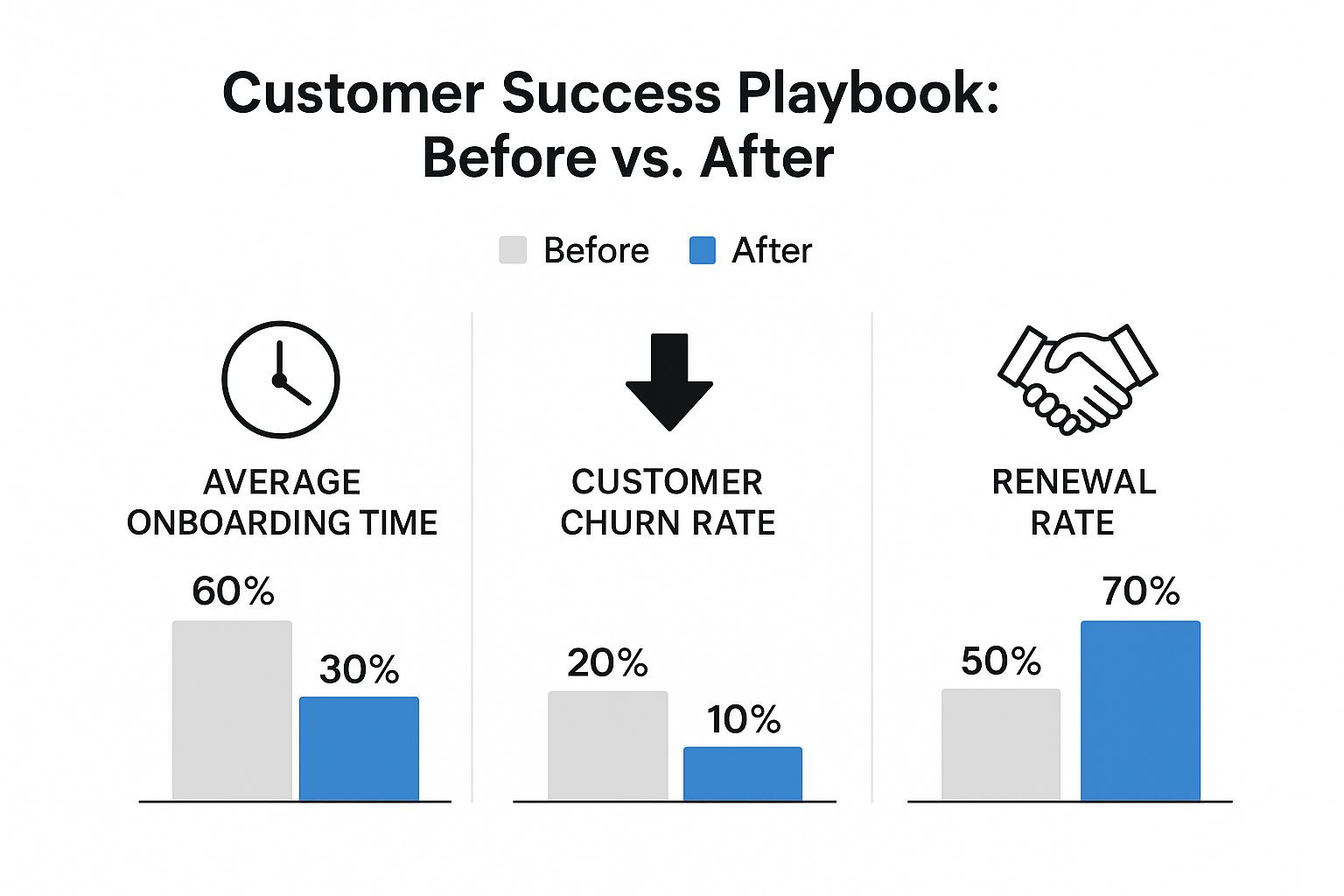
The data here is clear. A well-designed playbook directly impacts everything from how quickly customers get up and running to how likely they are to stick around and renew.
Personalizing Engagement at Scale
One of the toughest hurdles for any growing customer success team is providing personal, one-on-one attention when you have hundreds or thousands of customers. This is where AI really shines. By analyzing a customer’s specific behavior, job title, and history with your company, AI can deliver incredibly relevant outreach without anyone lifting a finger.
Think about what this looks like in practice:
- Smart Nudges: An AI can trigger an in-app guide for a feature a customer hasn’t used yet, but that’s popular with others in their same role.
- Intelligent Prioritization: AI can scan incoming support tickets, instantly flagging those from high-value, at-risk accounts so they jump to the front of the queue.
- Proactive Recommendations: Based on how a customer is using your product, an AI might email them a link to a knowledge base article that solves a problem they didn’t even know they had.
AI isn’t a futuristic concept; it’s becoming the standard. In fact, more than 51% of customer success teams were projected to have invested in AI by 2025 to analyze customer sentiment and product usage signals in real time.
Key Takeaway: AI doesn’t replace your CSMs; it gives them superpowers. It handles the heavy lifting of data analysis, freeing up your team to focus on what they do best: building strategic relationships and solving complex problems.
The difference between standard, rule-based automation and a smarter, AI-driven approach is significant. One follows simple instructions, while the other learns and adapts.
Standard Automation vs AI-Driven Engagement
| Task | Standard Automation Approach | AI-Driven Approach |
|---|---|---|
| Onboarding Emails | Sends a fixed sequence of emails at predetermined intervals (Day 1, Day 7, Day 30). | Triggers personalized emails based on user actions, such as completing a key setup step or ignoring a feature. |
| Health Scoring | Calculates a score based on a few static inputs like login frequency or support tickets logged. | Continuously updates the health score using dozens of signals, including product usage depth and sentiment analysis. |
| Churn Alerts | Flags an account only after a customer becomes inactive or manually requests to cancel. | Predicts churn risk weeks or months in advance by identifying subtle negative changes in behavior. |
| Upsell Opportunities | Suggests an upgrade to all customers who approach a usage limit. | Identifies customers whose behavior indicates a strong fit for a higher-tier plan and alerts the CSM. |
As you can see, the AI-driven approach is far more nuanced and proactive, enabling your team to engage customers with the right message at precisely the right time.
Building AI-Driven Plays into Your Framework
When you start weaving AI into your playbook, the very nature of your plays will change. The triggers are no longer basic events like “30 days since signup.” They become sophisticated alerts based on predictive insights.
Let’s imagine a SaaS company with an AI-powered customer success platform. Their playbook might feature plays like these:
- A “Predicted Churn Risk” Play: This is triggered the moment the AI model flags an account’s churn probability as crossing a 70% threshold. The play gives the CSM a full rundown, including the specific usage gaps the AI found, so they can have a highly targeted conversation.
- An “Expansion Opportunity” Play: The AI spots an account that’s blowing past its usage limits and actively using features typically associated with a premium plan. This triggers a play for the CSM to start a strategic conversation about upgrading.
This kind of intelligent automation is absolutely essential for running a modern, effective SaaS operation. If you’re looking to build out these more advanced processes, our SaaS implementation checklist is a great resource for making sure you’ve got the right foundation. By adding AI, you make your entire playbook smarter, faster, and far more effective at driving the customer outcomes that grow your business.
Building Your Measurement Framework and Scorecards

Let’s be honest: a playbook without results is just a collection of nice ideas. To make it a powerful tool and prove its worth, you need a solid way to measure its impact. This is how you shift the conversation from “how many calls did we make?” to “how did those calls affect our bottom line?”
Your customer success playbook can’t operate in a vacuum. It has to be directly wired into the key performance indicators (KPIs) that your leadership team actually cares about. This is what turns your playbook from a simple guide into a data-driven engine for business growth.
Focusing on Business-Critical Metrics
While tracking things like CSM activity or ticket response times has its place, your main scorecard needs to shine a spotlight on the numbers that directly impact company revenue and stability. These are the metrics that justify your team’s existence and secure your budget for next year.
Here are the top-tier metrics your framework should be built around:
- Net Revenue Retention (NRR): This is the king of SaaS metrics. It tells you the story of your existing customers by measuring revenue growth from expansions while accounting for churn and downgrades. If your NRR is over 100%, it means your customer base is actively growing in value.
- Gross Revenue Retention (GRR): This metric gives you a pure look at customer loyalty. It measures how well you hold onto your original contract value, completely ignoring any expansion revenue. It’s a stark indicator of product stickiness.
- Customer Churn Rate: You need to track this in two ways: by logo (the number of customers you lost) and by revenue (the amount of MRR that walked out the door). Each tells a different but equally important part of the story.
- Customer Lifetime Value (CLV): This is a forward-looking metric that predicts the total revenue you can expect from a single customer over their entire relationship with you. Driving CLV up is a direct result of successful retention and expansion plays.
These are just the headliners. For a deeper dive into the financial indicators that truly drive a SaaS business, our full guide on the most important SaaS KPIs is a must-read. This knowledge is crucial for aligning your playbook with what the C-suite is watching.
Designing a Comprehensive Customer Health Score
Think of a customer health score as your playbook’s early warning system. It’s a single, digestible metric designed to predict whether a customer is about to churn or is ripe for growth. But be careful—a poorly constructed health score can be worse than having none at all, sending you on wild goose chases.
A truly effective score blends different data points to paint a complete picture. It’s not just about one thing, like how often a customer logs in.
The best health scores tell a story. They don’t just say a customer is “at-risk”; they explain why. This is the difference between a simple alert and an actionable insight that a CSM can use to save an account.
To build a balanced scorecard, you need to pull data from a few key areas.
| Data Category | Example Metrics | Why It Matters |
|---|---|---|
| Product Usage | Login frequency, key feature adoption rate, session duration. | Shows if customers are actively engaged and getting real value from the product. |
| Support History | Number of tickets, severity of issues, resolution time. | A surge in tickets or unresolved critical issues are classic red flags. |
| Relationship | Last contact date, NPS/CSAT scores, exec sponsor engagement. | Gauges the strength of the human connection and overall sentiment. |
| Financials | Overdue invoices, recent downgrades, contract renewal date. | Points to financial distress or dissatisfaction that often comes before churn. |
When you combine these elements, you get a much richer, more accurate view of customer health. For instance, a customer with high product usage might look great on paper. But if they also have a low NPS score and an overdue invoice, they are a huge flight risk—a fact that usage data alone would completely miss.
This multi-faceted approach ensures your playbook’s triggers are based on reality, empowering your team to step in with the right message at the right time.
Common Questions About Customer Success Playbooks
Whenever I talk to teams about building a customer success playbook, the same handful of questions always seem to surface. They’re usually practical, “on the ground” concerns about getting the team to buy in, keeping things from getting too complicated, and actually seeing a return on the effort.
Let’s dive into some of those common questions.
One of the biggest hurdles I hear about is, “How do I create a playbook my team will actually use?” Honestly, the secret is to not build a massive, 500-page manual right out of the gate. That’s the fastest way to make sure it gets ignored.
Instead, think small and stay agile. Zero in on one or two of the most critical moments in your customer’s journey. This could be the initial onboarding process or what to do at the first sign of a churn risk. Build simple, straightforward plays for just those events. Once your team starts using them and sees how much easier it makes their jobs, they’ll be asking you what’s next.
How Often Should I Update My Playbook?
Your playbook isn’t a “set it and forget it” document. It’s a living, breathing guide that has to change as your product, your customers, and your team evolve. A good baseline is to schedule a formal review at least twice a year.
That said, some plays will need attention much more often. For example, if you roll out a major new feature, your onboarding and adoption plays need to be updated immediately to include it. The same goes for any changes to your pricing or packaging.
A playbook is only as good as it is relevant. An outdated playbook is worse than no playbook at all. It becomes a liability. Create a simple way for your team to flag things that are broken or suggest improvements they discover in the field.
What’s the Difference Between a Play and a Process?
This is a fantastic question, and it’s easy to get these two mixed up. Here’s how I think about it:
A process is the “what.” It’s the high-level, standardized flow of activities. Your Quarterly Business Review (QBR) process is a great example. It defines the major steps from start to finish.
A play is the “how.” It’s the specific, tactical set of actions a CSM takes to execute one part of that bigger process. So, within your QBR process, you might have a “Prepare for QBR” play that details exactly how to pull the right data, build the deck, and set the agenda.
A well-designed customer success playbook is really a collection of plays that bring your processes to life. For instance, you could use a great monthly business review template to structure the meeting itself (the process), but you’d still need specific plays for the prep work and the follow-up actions.
At SaaS Operations, we provide battle-tested playbooks, templates, and SOPs to help you build efficient processes and scale your business. Stop guessing and start accelerating your growth today. Learn more at https://saasoperations.com.