
Picture your most dependable team member—the one who’s always on, never drops the ball, and knows exactly what to do next. That’s the essence of SaaS marketing automation. It’s a smart system that works 24/7, guiding users from their very first click all the way to becoming your biggest fans. It connects what people do with the right message, delivered at the perfect moment.
What Is SaaS Marketing Automation, Really?
Think of SaaS marketing automation as the central nervous system of your entire growth strategy. It’s so much more than just scheduling a few emails. We’re talking about building a responsive, intelligent system that handles crucial touchpoints along the customer journey, all on its own. This frees up your team from the grind of repetitive tasks so they can focus on the big-picture thinking a machine can’t handle.
This technology creates a scalable engine for predictable growth by automating tasks that are essential for any modern software company. For a SaaS business, this goes way beyond simple lead capture. It’s about getting a deep understanding of user behavior inside your product and reacting to it in real-time.
Moving Beyond Generic Definitions
So, what does this look like day-to-day? Instead of blasting every new signup with the same generic “welcome” email, automation lets you be far more helpful and relevant.
- Smart Trial Nurturing: A user who is actively exploring your dashboard should get a completely different set of messages than someone who signed up but never came back.
- Behavioral Segmentation: You can automatically group customers based on the features they use most, their subscription plan, or how active they are.
- Proactive Churn Prevention: The system can spot at-risk accounts—like a user whose activity suddenly drops off—and trigger a campaign to bring them back before they’re gone for good.
Trying to manage this level of personalized communication manually is simply impossible once you have more than a handful of customers. It’s the secret to making every user feel seen and supported.
At its core, SaaS marketing automation is about using technology to be more human, not less. It allows you to deliver a consistently helpful and relevant experience to every single user, no matter how quickly you grow.
The industry is clearly betting big on these tools. The global marketing SaaS market was valued at around $69.65 billion in 2024 and is expected to climb to over $280 billion by 2033. That’s a massive shift, showing just how much companies are relying on smart, cloud-based solutions to run their marketing. You can dig into the numbers in the full marketing SaaS market report.
Ultimately, putting a solid SaaS marketing automation strategy in place is how you build a powerful, self-sustaining growth loop. It’s the bridge between what your users do and what they need, making sure you deliver real value at every turn.
Why Automation Is a Must-Have for SaaS Growth

In a crowded software market, trying to do all your marketing by hand is like trying to fill an ocean with a bucket. It might work for a little while, but you’ll quickly find you just can’t keep up with your own growth goals. This is exactly why SaaS marketing automation has moved from a “nice-to-have” tool to a core part of any smart growth strategy.
It’s all about building a reliable engine that runs in the background, freeing you up while delivering real results that hit your bottom line. Let’s move past the buzzwords and look at the tangible ways automation pushes a SaaS business forward.
Transforming Lead Nurturing at Scale
Think about all your trial users for a second. Every single one signs up with a different problem they’re trying to solve and a unique level of comfort with technology. Trying to personally guide each one to that “aha!” moment is simply not scalable.
This is where automation comes in. It turns a monumental chore into an efficient, personalized system. You can build out communication flows that react to what users actually do inside your app, making sure they get the right message at the right time. That consistency is what turns curious trial users into happy paying customers.
The real power of automation lies in its ability to maintain a personalized conversation with thousands of users simultaneously. It ensures no lead is forgotten and every user feels supported on their journey.
This kind of targeted communication really pays off. The marketing automation market was valued at $6.65 billion in 2024 and is expected to reach $15.62 billion by 2030. On average, for every dollar spent, companies see a return of $5.44—that’s a pretty powerful ROI.
Identifying Your Most Valuable Users
Let’s be honest: not all leads are created equal, especially in the SaaS world. A person who downloads an ebook is one thing, but someone who has already used a key feature inside your product? That’s gold. Automation is how you find that gold.
By tracking in-app actions, you can automatically pinpoint your Product Qualified Leads (PQLs). These are the folks who have already experienced the core value of your software firsthand.
A smart SaaS marketing automation setup can then:
- Flag PQLs for your sales or customer success teams to follow up with.
- Trigger upgrade campaigns the moment a user gets close to their plan’s limits.
- Group users based on the features they use to send them super-relevant tips and content.
This completely shifts your team’s focus. Instead of chasing cold leads, they can spend their time engaging with warm, high-intent prospects who are far more likely to buy—and stick around.
Driving Revenue and Reducing Costs
At the end of the day, every business decision boils down to money. For a SaaS company, this is where automation truly proves its worth. By making the entire customer journey smoother, it directly impacts your most critical growth metrics.
When you nurture leads more effectively, you shorten the sales cycle and lower your Customer Acquisition Cost (CAC). At the same time, by improving onboarding and proactively re-engaging customers, you boost their Customer Lifetime Value (CLV). This one-two punch is essential for building a healthy Annual Recurring Revenue (ARR) and achieving sustainable growth. For more on this, check out this guide to understanding Annual Recurring Revenue.
Building Your SaaS Automation Tech Stack
An effective SaaS marketing automation strategy isn’t about buying one giant, complicated piece of software. It’s much more about picking a few core tools that talk to each other perfectly, like a well-oiled pit crew for your business. This group of tools is your tech stack, and getting it right is the foundation for everything else.
Think of it like this: each tool has its own specific job, but its true power is unlocked by how well it connects with the others. If your tools are disconnected, you end up with scattered data and a clunky customer experience. But a well-integrated stack gives you one clear, unified picture of your customer’s entire journey.
The Core Three Components
For almost any SaaS company, a solid automation stack is built on three key pillars. These are the non-negotiables you’ll need to run the playbooks that actually move the needle on growth.
Customer Relationship Management (CRM): This is your command center, your single source of truth. The CRM is the central hub for all your customer information—contact details, deal stages, every conversation, and subscription status. Everything should flow into and out of the CRM, making sure your entire team is on the same page.
Email Marketing & Automation Platform: This is your communication engine. It’s where you design and run automated email campaigns that react to what your users do. For SaaS, you need a platform that does more than send newsletters; it has to be able to trigger messages based on what people are actually doing inside your app.
In-App Event Tracking: This tool is your eyes and ears inside your product. It tells you when a user does something important, like activating a key feature, inviting a colleague, or getting close to a usage limit. This behavioral data is the fuel for truly powerful SaaS marketing automation.
Without these three pieces working together, your automation efforts are just guesswork. You might see that a user opened an email, but you’ll have no idea if they took the critical next step inside your product.
How These Tools Connect
The real magic happens when you link these tools together. Let’s say a new user signs up for a free trial. Your event tracking tool spots this and pings your automation platform. Instantly, a welcome email sequence is triggered.
When the CRM, email platform, and event tracking are properly integrated, you stop seeing disconnected data points and start seeing a complete story. A user’s marketing engagement and product behavior are viewed together, providing a full picture of their journey.
As that user starts clicking around your app, the tracking tool keeps notes. Did they finish the onboarding steps? Did they use that new collaboration feature? Each of these actions can trigger a new, super-relevant email designed to guide them toward that “aha!” moment. Best of all, this entire history gets logged back into the CRM, giving your sales or customer success team the perfect context for any conversation they might have later.
Additional Stack Components
Beyond the core three, a couple of other tools can give your stack a serious boost.
Lead Scoring Models: These systems assign points to users based on what they do. Visiting the pricing page might be worth 5 points, but inviting a teammate could be worth 25 points. This is how you automatically spot your most engaged users (your Product Qualified Leads, or PQLs) and know who needs a personal touch.
Landing Page Builders: These tools let you spin up and test new pages for signups, webinars, or feature announcements without needing a developer. When you integrate them with your CRM, every new lead is captured and dropped right into the correct automation workflow, no manual data entry needed.
Putting this stack together is a crucial step in turning your growth strategy into a reality. For a step-by-step guide on rolling out these systems, our comprehensive SaaS implementation checklist offers a clear roadmap to get everything connected and running smoothly. This structured approach helps ensure no detail gets missed as you build your automation engine.
Actionable Automation Playbooks for SaaS
Alright, knowing the theory behind SaaS marketing automation is a solid first step. But the real magic happens when you put that knowledge into practice. It’s time to move from planning to doing. This is where automation playbooks come in—they’re essentially pre-built recipes for handling the most critical moments in a SaaS customer’s journey.
Think of them not as abstract concepts, but as specific, proven sequences of triggers and actions you can set up right now. Each playbook is designed to tackle a key business goal, so you can build momentum and see real results, fast. Let’s walk through four essential playbooks that every growing SaaS company should have in its arsenal.
The infographic below really drives home the benefits of putting these systems to work, highlighting major wins in efficiency, lead generation, and accuracy.
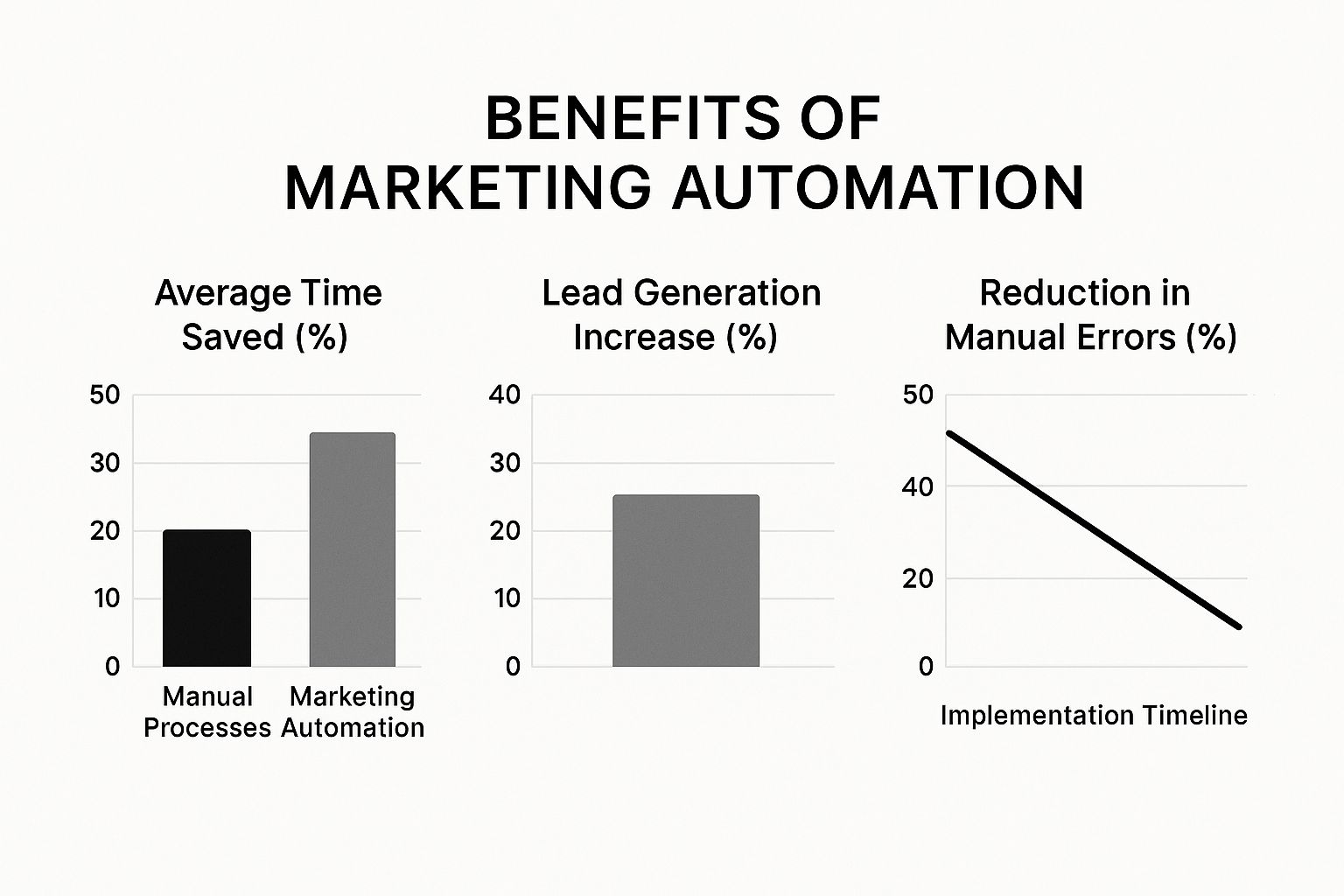
As you can see, automation isn’t just a time-saver. It’s a powerful engine for generating more leads and cutting down on the simple human errors that can chip away at the customer experience.
The Trial-to-Paid Conversion Playbook
A free trial isn’t just a product tour. Its true purpose is to guide users to their “aha!” moment—that instant they truly grasp your product’s value and can’t imagine working without it.
This playbook is all about engineering that moment. Here’s a simple breakdown:
- Trigger: A user signs up for a free trial.
- Action 1 (Immediate): Send a welcome email that not only confirms their signup but also points them to the single most important first step they need to take.
- Action 2 (Day 2): Follow up with a helpful tip about a core feature. Something like, “Here’s how to create your first project in 60 seconds.”
- Action 3 (Day 5): Check if they’ve completed that key activation step. If not, send a gentle nudge or a case study showing what others have achieved.
- Goal: Get the user to complete one specific, high-value action within the first 7 days.
The New Customer Onboarding Playbook
The moment a user becomes a paying customer, a new clock starts ticking. Those first few weeks are absolutely crucial for driving adoption and proving your product’s worth. After all, poor onboarding is one of the biggest reasons for early churn.
This playbook ensures every new customer feels supported and set up for success from day one.
A great onboarding experience doesn’t just show users how to use features; it shows them why those features matter to their success. It’s about building habits and confidence.
A typical workflow might look like this:
- Trigger: A user’s subscription status changes to “Active” or “Paid.”
- Action: Launch a 3-week onboarding email series. The first week could cover basic setup, the second could introduce advanced features, and the third might focus on collaboration or reporting.
- Goal: Increase the number of core features adopted by new customers by 25% in their first 30 days.
Building a solid onboarding process is a cornerstone of customer success. If you want to go even deeper, you can explore the ultimate customer success playbook for more detailed frameworks.
The Expansion Revenue Playbook
Your happiest, most active customers are your biggest growth opportunity. This playbook automatically flags chances to upsell or cross-sell to users who are already getting a ton of value from your product.
- Trigger: A user consistently hits 80% or more of their current plan’s usage limit (like contacts, projects, or storage).
- Action 1: Send a timely in-app notification suggesting an upgrade.
- Action 2: Follow up with an email explaining the specific benefits of the next tier, tailored to how they’re actually using the product.
- Goal: Grow Expansion MRR by automatically converting your most engaged users.
The Churn Prevention Playbook
Let’s be honest: it’s far cheaper to keep a customer than to find a new one. This playbook helps you get ahead of churn by proactively spotting users who are starting to drift away and re-engaging them before they hit the cancel button.
- Trigger: A user’s login frequency drops by 50% over a 14-day period, or they haven’t used a key feature in over 30 days.
- Action 1: Send a friendly “We miss you” email, perhaps highlighting a new feature or a helpful guide.
- Action 2: If there’s still no activity, automatically create a task in your CRM for a customer success manager to reach out personally.
- Goal: Reduce monthly revenue churn by saving at-risk accounts before it’s too late.
To make these concepts even clearer, here’s a quick summary of the playbooks we’ve discussed.
Essential SaaS Automation Playbooks
| Playbook Name | Primary Goal | Example Trigger |
|---|---|---|
| Trial-to-Paid Conversion | Guide trial users to their “aha!” moment and convert them to paid customers. | User signs up for a new free trial. |
| New Customer Onboarding | Drive feature adoption and prove product value in the first 30 days. | User subscription status changes to “Paid.” |
| Expansion Revenue | Identify and convert engaged customers to higher-tier plans. | User hits 80% of their current plan’s usage limits. |
| Churn Prevention | Proactively re-engage at-risk customers who show signs of inactivity. | User login frequency drops by 50% in 14 days. |
These playbooks provide a powerful starting point. By implementing even one or two of them, you can start building a more scalable, efficient, and customer-centric SaaS business.
Launching Your First Automation Workflow

All the theory in the world is great, but confidence comes from actually doing. I know that getting started with SaaS marketing automation can feel like a massive project, but it really doesn’t have to be. The best way to learn is by building something simple and effective right away.
So, let’s walk through creating your very first automation workflow, step-by-step. We’re going to build a high-impact welcome series for new trial signups. Trust me, this single workflow can make a huge difference in how users see your product, and it’s the perfect way to get your feet wet.
Step 1: Define Your Goal
Every great automation has one crystal-clear purpose. If you don’t have a goal, you’re just sending emails into the void.
For a new trial user, your goal shouldn’t be something vague like “get them to convert.” That’s way too broad. Instead, you need to focus on the one key action that signals a user is on the path to becoming a happy, long-term customer.
We often call this the “activation event.” For a project management tool, it might be “Create First Project.” For a social media scheduler, it’s probably “Connect First Social Account.” Your goal for this first workflow is simple and measurable: get every new user to complete that one critical action.
Step 2: Map the Workflow Sequence
Before you even think about logging into your software, grab a whiteboard or a piece of paper. Sketching out the user’s journey first makes the technical setup a thousand times easier. A solid welcome series doesn’t need to be complicated.
Here’s a simple, proven structure to start with:
- Trigger: User signs up for a free trial.
- Email 1 (Sent Immediately): A warm, personal welcome with a clear call-to-action that points directly to that activation event.
- Delay (Wait 2 Days): Give them a little breathing room to explore on their own.
- Email 2: Send a genuinely helpful tip or a short guide that helps them complete the activation event.
- Delay (Wait 3 Days): Another pause. Don’t be needy.
- Email 3: Share a quick case study or testimonial showing them what’s possible once they get going.
- End Workflow: The sequence is complete.
This simple map is your blueprint. It creates a logical flow that guides new users without overwhelming them.
Step 3: Write Compelling and Human Copy
Just because it’s automated doesn’t mean it has to sound robotic. In fact, the best automated emails feel personal and one-on-one. When you sit down to write, picture yourself as a helpful guide, not a machine.
The most effective automated messages are written from one human to another. Use a conversational tone, address a specific need, and always focus on how you can help the user achieve their goal.
A few quick tips for your email copy:
- Keep it focused: Each email should have exactly one job. Don’t cram five different features into a single message.
- Write like you talk: Ditch the corporate jargon. Use simple, direct language you’d use with a colleague.
- Use a clear call-to-action (CTA): Make it painfully obvious what you want them to do next. A button that says “Create Your First Project Now” is perfect.
Step 4: Set Up the Technicals
Alright, now it’s time to build this thing in your automation tool. Using the map you drew in Step 2, you’ll simply recreate that logic. This means setting the entry trigger (a new trial signup) and then adding the sequence of actions (send email) and delays (wait X days).
Most modern SaaS marketing automation platforms have a visual builder, letting you drag and drop these elements into place. The only critical part is making sure your tool is properly connected to your product so it knows when a new trial actually starts.
Step 5: Identify Key Metrics for Success
Finally, how do you know if any of this is actually working? You have to track the right metrics. For this welcome series, forget about vanity stats like open rates for a moment and focus on what truly matters.
The two most important numbers for this workflow are:
- Activation Rate: What percentage of users who enter this workflow successfully complete your defined goal (e.g., create their first project)?
- Workflow Conversion Rate: Of all the users who finished this workflow, what percentage converted to a paid plan within 30 days?
These two metrics will tell you everything you need to know about how effective your very first automation really is.
How to Measure and Optimize Your Automation Engine
Getting your automation workflows up and running is just the start. The real work—and the real results—come from constantly tweaking and refining your setup based on cold, hard data. This is how you transform a simple tool into a true growth engine for your SaaS.
You have to look beyond the obvious, surface-level numbers. Sure, open rates and click-through rates are nice to know, but they don’t tell you if your automation is actually making you money or keeping customers around. You need to zero in on the metrics that directly reflect the health of your business.
Focusing on Revenue-Driving Metrics
For any SaaS business, optimization means connecting every automated touchpoint back to a real business goal. It’s about cutting through the noise and focusing on a handful of critical numbers.
- Trial-to-Paid Conversion Rate: This is the ultimate report card for your trial nurturing playbook. What percentage of people who go through your automated onboarding actually become paying customers?
- Feature Adoption Velocity: How fast are new users discovering and using your most important features? Great automation should speed this up, creating stickier, more successful users.
- Expansion MRR: Are your automated upgrade prompts actually convincing customers to move to a higher-tier plan? This metric tracks the new monthly recurring revenue you’re generating from the customers you already have.
- Net Revenue Retention (NRR): This is a powerhouse metric. It rolls up revenue from existing customers and expansions, then subtracts any revenue lost to churn. Good automation is one of the biggest levers you can pull to boost NRR.
These are the numbers that tell you if your hard work is paying off. The entire SaaS world is moving in this direction. After hitting $197 billion in 2023, the global SaaS market is expected to climb to $232 billion by 2025. A huge part of that growth comes from companies getting smarter with their data. You can discover more insights about SaaS market growth and see for yourself how data-focused marketing is paving the way.
Practical Optimization Techniques
Once you know what you’re measuring, you can start testing. The aim here isn’t to build the “perfect” workflow on day one, but to get a little bit better every single week.
A/B testing is your best friend. But don’t just fiddle with button colors—test the fundamentals of your message. Pit a subject line that highlights benefits against one that sparks curiosity. See what happens when you send a three-email welcome series instead of five. You’d be surprised how small changes can create big lifts in your key metrics.
Optimization isn’t about finding a single “perfect” workflow. It’s about creating a system of continuous learning where you’re always analyzing data to make your messaging more relevant and effective.
Another fantastic technique is to look for drop-off points in your workflows. Where are people bailing on your onboarding sequence? If you notice a massive number of users disappear after the second email, that’s a flashing red light. Something about that message is causing friction, and that’s your next opportunity for a test. This is a core part of improving customer retention in SaaS, because smoothing out these rough patches keeps users on track and moving toward success.
Frequently Asked Questions
It’s natural to have a lot of questions when you’re first diving into SaaS marketing automation. Getting clear answers is the best way to feel confident and build a strategy that actually works. Let’s tackle some of the most common questions we hear from SaaS founders and operators.
When Is the Right Time to Start with Marketing Automation?
A lot of founders fall into the trap of thinking they need thousands of users before they can even think about automation. That’s a myth. The perfect time to start is the moment you have a consistent trickle of new trial signups, even if it’s just a few every day.
Starting early lets you build good habits and scalable systems from the get-go. You can set up a simple welcome email sequence to see what messages connect with your very first users. This creates an incredible feedback loop, allowing your processes to grow with your user base, not scramble to catch up after it’s already a huge, unmanageable list.
Will Marketing Automation Make My Communication Feel Robotic?
This is a totally fair question. The short answer is: only if you do it badly. When done right, good automation should feel personal, relevant, and genuinely helpful. The whole idea is to use what you know about a user’s behavior to send them the right message at the exact moment they need it. It makes them feel understood, not spammed.
The goal of great automation isn’t to blast generic messages; it’s to be incredibly helpful at scale. It’s about solving a user’s immediate problem or guiding them to their next successful step inside your product.
What’s the Difference Between a PQL and an MQL?
Understanding this difference is absolutely critical for any SaaS business. They represent two very different types of leads.
- Marketing Qualified Lead (MQL): This is someone who has engaged with your marketing content. Think of the person who downloaded your latest ebook or signed up for a webinar. They’re interested in the topic, but not necessarily your product yet.
- Product Qualified Lead (PQL): This is someone who has taken meaningful actions inside your product. They aren’t just reading about the solution; they’re actively using it. A PQL is someone who has experienced that “aha!” moment firsthand, like inviting a teammate or completing their first key project.
For a SaaS company, a PQL is a far more powerful buying signal. It proves the user is already getting real-world value from your tool, making them a top-priority lead for your sales or customer success teams. Nurturing these PQLs is a core part of building effective customer success strategies.
How Much Does a Marketing Automation Tool Cost for a Startup?
The price can range quite a bit, but you definitely don’t need to break the bank to get started. Many of the best modern platforms are designed specifically for startups, offering plans that start under $100 per month and grow with you as your contact list expands.
When you’re just starting, look for a tool that bundles the essentials: email marketing, simple automation workflows, and basic event tracking. This gives you everything you need to run high-impact campaigns without paying for a bunch of advanced features you won’t touch for months.
Ready to implement battle-tested frameworks in your business? SaaS Operations provides plug-and-play playbooks, templates, and SOPs to help you save time and accelerate growth. Get started today at https://saasoperations.com.