
Calculating your Customer Acquisition Cost (CAC) is more than a routine task; it's a strategic necessity. To help you get it right, we’ve developed a free cac calculator that will also use AI analysis based on your CAC. Forget basic formulas. This tool is designed to pinpoint the hidden leaks in your marketing and sales funnel, giving you the clarity you need to scale your business with confidence.
Why Your CAC Calculation Is Probably Wrong
Let's be blunt. If you're still just dividing last month's total marketing spend by the number of new customers you landed, you're operating with a dangerously incomplete picture.
That simple formula is a relic. For a modern SaaS business, it's not just a little off—it’s misleading. It has a nasty habit of hiding major inefficiencies and can make a failing marketing channel look like a runaway success.
This isn't just theory. I once worked with a B2B SaaS founder who was thrilled with their "blended" CAC of around $450. On paper, everything looked great. But when we dug into the channel-specific numbers, the reality was brutal. One of their main ad channels was secretly costing them over $1,200 per customer, while their humble content marketing efforts were bringing in new users for less than $50 a pop.
That blended average was masking a money pit that was actively draining their runway. Without a more nuanced calculation, they would have kept pouring cash into the wrong channel, scratching their heads and wondering why growth was so sluggish. This is a classic operational pitfall that the right tool can help you avoid.
The Rising Cost of Guesswork
Getting this right has never been more critical. The cost of acquiring a customer has been rising steadily. Industry reports showed that the average CAC shot up by about 60% in just the five years between 2014 and 2019. More recently, that number has climbed to an average of $29 per new user for many digital businesses, and fierce competition keeps pushing it higher. This trend means that actionable, precise insights are no longer a luxury—they are a requirement for survival.
Moving Beyond Blended Averages
The core issue is that a single, blended CAC number tells you virtually nothing about the health of your individual channels, campaigns, or customer segments. It’s like checking the average temperature of a hospital and declaring every patient healthy.
To make genuinely smart decisions, you need exact next steps based on real data:
- Channel-Specific CAC: What does it really cost to land a customer from Google Ads versus your blog?
- Time-Delayed Conversions: How do you account for a 90-day sales cycle when you're looking at last month's spend?
- Fully-Loaded Costs: Are you factoring in the salaries of your sales team and the subscription cost for your CRM?
Trying to answer these questions manually is a nightmare of messy spreadsheets and pure guesswork. That's why we built a tool to do the heavy lifting for you.
Here’s a quick peek at how our free tool provides clarity by breaking down your inputs for a much more accurate calculation.

This detailed approach makes sure you're not overlooking hidden costs that are quietly inflating your true CAC. It gives you a reliable number to build your strategy around.
You can get this level of insight instantly by using our free CAC calculator. It analyzes your inputs and delivers the actionable insights you need to grow more efficiently. And if you're looking to pull these metrics into a bigger picture, our guide on building a KPI dashboard in Excel is a great next step.
Gathering the Right Data for an Accurate CAC

Let's be clear: your CAC calculation is only as good as the numbers you feed it. Garbage in, garbage out. If you want a reliable result from any free CAC calculator, you have to be meticulous when gathering your inputs.
This means looking way beyond just what you spent on Google Ads last month. A truly accurate, or "fully loaded," CAC includes every single dollar you spent to bring in new customers. We're talking about the total, all-in cost of your entire go-to-market engine.
Identifying Your Total Sales and Marketing Spend
For a SaaS company, sales and marketing expenses are often intertwined. To see what a proper accounting looks like, let's walk through an example with a hypothetical B2B SaaS called 'SyncUp' as they tally their costs for a single quarter. This process is a foundational step for any SaaS operator looking to gain control over their growth levers.
Their expenses fall into three main buckets:
- People Costs: This is usually the biggest expense and, surprisingly, the one most often forgotten. It covers salaries, commissions, and bonuses for anyone touching marketing and sales.
- Tool & Software Costs: This is your entire tech stack—everything from your CRM and marketing automation platform to the smaller tools that power your acquisition efforts.
- Direct Ad & Campaign Spend: This is the obvious one, covering your spend on advertising platforms like Google or LinkedIn and other promotional activities.
It's no secret that acquiring customers has gotten way more complex and expensive. In fact, over the last decade, CAC has skyrocketed by about 222%, according to a deep dive into global marketing data. This is exactly why you need more than a simple "ad spend divided by customers" formula to get actionable insights.
To give you a real-world picture of what this looks like, let’s dig into how our example company, SyncUp, organizes its numbers. Before they even touch a calculator, their team pulls together a comprehensive list of every relevant expense for Q3 (July 1 – September 30).
The table below breaks down exactly what you should be looking for.
Essential Inputs for Your SaaS CAC Calculation
| Expense Category | What to Include | Example ('SyncUp' SaaS) |
|---|---|---|
| People Costs | Salaries, commissions, and bonuses for all sales and marketing staff. Don't forget payroll taxes! | Marketing Salaries: $60,000 Sales Salaries: $75,000 Commissions: $25,000 |
| Tool & Software Costs | Monthly or annual subscription fees for your entire GTM tech stack. | CRM (Salesforce): $4,500 Automation (HubSpot): $3,000 Analytics (Mixpanel): $1,200 |
| Ad & Campaign Costs | Direct spend on paid channels, content promotion, and creative production. | Google Ads: $30,000 LinkedIn Ads: $20,000 Content Syndication: $5,000 |
| Overhead & Other | A prorated portion of office rent, utilities, and other general expenses for the GTM team. | SyncUp includes this in salaries for simplicity, but more mature companies should break it out. |
When SyncUp adds everything up, their total sales and marketing expense for Q3 comes to a comprehensive $225,200. This is the number they’ll plug into the "cost" part of their CAC equation.
Actionable Insight: Don't just count ad spend. A fully-loaded CAC must include the salaries of your go-to-market teams and the cost of the software they use. This is the only way to understand the true cost of growth and make informed budget decisions.
Of course, that’s only half the story. SyncUp also needs the other piece of the puzzle: the number of new customers acquired during that same period. For Q3, they signed 210 new logos.
This number is just as critical as the cost side. If you're looking to better understand how customer count and revenue intertwine, our guide on what monthly recurring revenue is is a great next step. It explains why MRR is such a vital sign for any SaaS business.
Let's Talk About SaaS CAC (It's Not as Simple as You Think)
The SaaS world plays by different rules. Your customers don't just make a one-and-done purchase; they subscribe. This simple fact completely changes how we need to think about customer acquisition cost. A generic formula just won't give you the real story.
If you just run the basic numbers, you might get a dangerously misleading picture. Things like freemium conversions, long sales cycles, and the vast difference between your organic and paid acquisition efforts can throw your entire calculation off track if you're not paying close attention.
The Blended CAC Trap
One of the first and most common mistakes I see founders make is relying only on a blended CAC. This is where you just throw all your marketing and sales expenses into one big pot, then divide it by every single new customer you got, no matter how they found you.
So, why is this a problem? It completely masks what's actually working.
Imagine your blog is quietly bringing in new customers for just $25 a pop through organic search. At the same time, you're running paid ads that are costing you $800 for every new customer. Your blended CAC would come out to $412.50, making both channels look mediocre. You'd have absolutely no idea which engine to pour fuel into. This lack of clarity is where SaaS operators lose money and opportunity.
To make smart, data-driven decisions, you have to split things up:
- Paid CAC: Look only at the money you spent on paid channels (Google Ads, social media ads, sponsorships, etc.) and the customers that came directly from those campaigns.
- Blended CAC: This is your total cost—paid ads, content team salaries, SEO software, you name it—divided by all new customers from every channel.
Isolating your paid CAC is the only real way to know if your ad budget is actually turning a profit or just burning cash.
Don't Forget About Your Sales Cycle
Another classic pitfall, especially for B2B SaaS, is ignoring the sales cycle. Let's say it typically takes you 90 days from first touch to a signed contract. If you calculate your CAC by dividing this month's spending by this month's new customers, your number will be flat-out wrong. And probably terrifying.
You're mismatching the investment with the return. The customers you just closed this month are the result of the marketing and sales efforts you made three months ago.
I once worked with a B2B operator who was ready to kill their entire paid ads program because their monthly CAC looked astronomical. The problem was simple: they had a 90-day sales cycle but were looking at monthly reports. Once we shifted the calculation to match that 90-day lag, their real CAC dropped by almost 40%. The channel wasn't broken; their math was.
Actionable Insight: Your CAC calculation window must match your average sales cycle. If deals take 60 days to close, you need to measure your spend from 60 days ago against the customers you're closing today. This is a critical adjustment for accurate financial modeling.
This timing adjustment is a must-have feature in any decent free CAC calculator. One case study showed that simply adjusting for a 60-day sales cycle slashed a company’s perceived CAC from $148 all the way down to $84. It’s a perfect example of why you need the right tools to get an accurate read on your finances.
The Nuances of Freemium and Free Trials
So what happens if you have a freemium or free trial model? Is a new free user an "acquired customer"?
No. Not until they pay.
In a freemium or trial model, your true CAC includes all the costs to get someone to sign up for free plus all the costs associated with converting them into a paying customer. This means factoring in the expense of onboarding emails, the time your support team spends with trial users, and any product marketing aimed at driving upgrades.
This is where cohort analysis becomes an operator's best friend.
Instead of looking at a single, broad number, you start tracking groups (or cohorts) of users who all signed up in the same month. For instance, you might see that your January cohort of 1,000 free signups cost you $10,000 in marketing spend (a $10 Cost Per Acquisition for a free user). If 50 of those users eventually convert to a paid plan by the end of March, your actual CAC for that cohort is $200 ($10,000 / 50 paying customers).
This method gives you a much clearer, more honest view of your funnel's real-world performance. You can find more business estimation and calculation tools over at microestimates that can help with this kind of deeper analysis.
Getting these nuanced SaaS KPIs is crucial for sustainable growth. They all work together to give you a complete picture of your business's health, and nailing your CAC calculation is a huge piece of that puzzle.
How to Make Sense of Your CAC
So, you’ve run the numbers through our free CAC calculator, and a figure is staring back at you. Let's say it's $350. Is that good? Bad? What's your next move?
On its own, a CAC number is just data. It only becomes a strategic weapon when you put it in context with other key SaaS metrics.
Your CAC doesn’t live in a vacuum. Think of it as the "cost" side of an equation. To really understand its impact, you have to compare it to the "value" side. This is where you graduate from simply calculating expenses to making genuinely smart decisions about your business. For SaaS operators, two critical relationships tell you almost everything you need to know about the health of your acquisition engine.
The All-Important LTV to CAC Ratio
First up, and most importantly, is the LTV to CAC ratio. This metric compares your Customer Lifetime Value (LTV) against your Customer Acquisition Cost. It answers the simple, yet profound, question: "For every dollar we spend to get a customer, how many dollars do they generate for us over their entire lifetime?"
This ratio is your true north for sustainable growth. A healthy LTV is the bedrock of any successful SaaS, and understanding its relationship to CAC is non-negotiable. If you need a refresher on the LTV side of things, check out our deep dive on how to perform a lifetime value calculation for SaaS.
The gold standard for a healthy LTV:CAC ratio in SaaS is 3:1. This means for every dollar you spend on acquisition, you get three dollars back in lifetime value. This 3:1 benchmark is widely seen as the sweet spot, signaling a business model that's both profitable and ready to scale. It tells you that you're not just clawing back what you spent; you're generating a healthy return to cover overhead, fund R&D, and still turn a profit.
So, what story is your ratio telling you?
What Your LTV to CAC Ratio Is Telling You
This table breaks down the common scenarios. It's not just about knowing the number; it's about knowing the exact next step to take.
| LTV:CAC Ratio | What It Means | Recommended Action |
|---|---|---|
| Below 1:1 | You're losing money. Every new customer is a net loss for the business. This is an urgent, five-alarm fire. | Immediately pause unprofitable ad spend. Re-evaluate your pricing, target audience, and marketing channels. |
| 1:1 to 2:1 | You're in the danger zone. You're barely breaking even on each customer, leaving no room for error or other business costs. | Focus on increasing LTV through retention and upsells. Simultaneously, work on optimizing marketing channels to lower CAC. |
| 3:1 or Higher | You have a healthy business model. Your acquisition engine is efficient, and you're well-positioned for growth. | Time to hit the gas! Invest more aggressively in the marketing and sales channels that are delivering this strong ratio. |
| 5:1 or Higher | You might be growing too slowly. An extremely high ratio can signal that you're underinvesting in marketing and leaving growth on the table. | Test new channels, scale your budget, and be more aggressive. You have the margin to acquire customers faster. |
A ratio of 5:1 or higher might seem like a dream, but it often means you're being too conservative. You have a green light to acquire customers more aggressively and capture more market share.
Your CAC Payback Period
The second key metric to watch is your CAC Payback Period. This tells you exactly how many months it takes for a new customer to generate enough revenue to "pay back" what you spent to acquire them.
It's a direct measure of your capital efficiency. The faster you recoup your CAC, the faster you can reinvest that cash into acquiring the next customer. It’s the engine of your growth flywheel.
I once spoke with a founder who was getting nervous about their CAC, which was nearly $5,000 for enterprise clients—a huge jump from their mid-market CAC of $800. But when we looked at the payback period, the story changed completely.
Their mid-market customers paid back their CAC in 6 months. Their enterprise clients, however, paid it back in 12 months. While a year feels long, those enterprise clients had an LTV that was 10x higher and churned far less. The longer payback period was a strategic trade-off for massive long-term value.
This insight gave him the confidence to double down on his enterprise sales team. He knew that even with a higher upfront cost, the long-term payoff was a fantastic bet.
The big shift to digital sales has made tools like a free CAC calculator absolutely essential for this kind of analysis. A McKinsey & Company report found that going digital can boost acquisition efficiency by 30%, but only if you're accurately measuring performance. As explained in a report on customer acquisition cost from Zendesk, these tools are crucial for turning raw expense data into strategic clarity, helping you see the critical relationships between CAC, LTV, and payback period.
Time for Action: Playbooks to Lower Your CAC
Alright, you've got your numbers. That's the first step, but insight without action is just trivia. Now for the fun part: actually making those numbers better. Forget the generic advice like "optimize your funnel." We're going to dig into specific, proven playbooks you can execute to slash your CAC and grow more efficiently.
This whole process is a simple loop: calculate, analyze, and act.
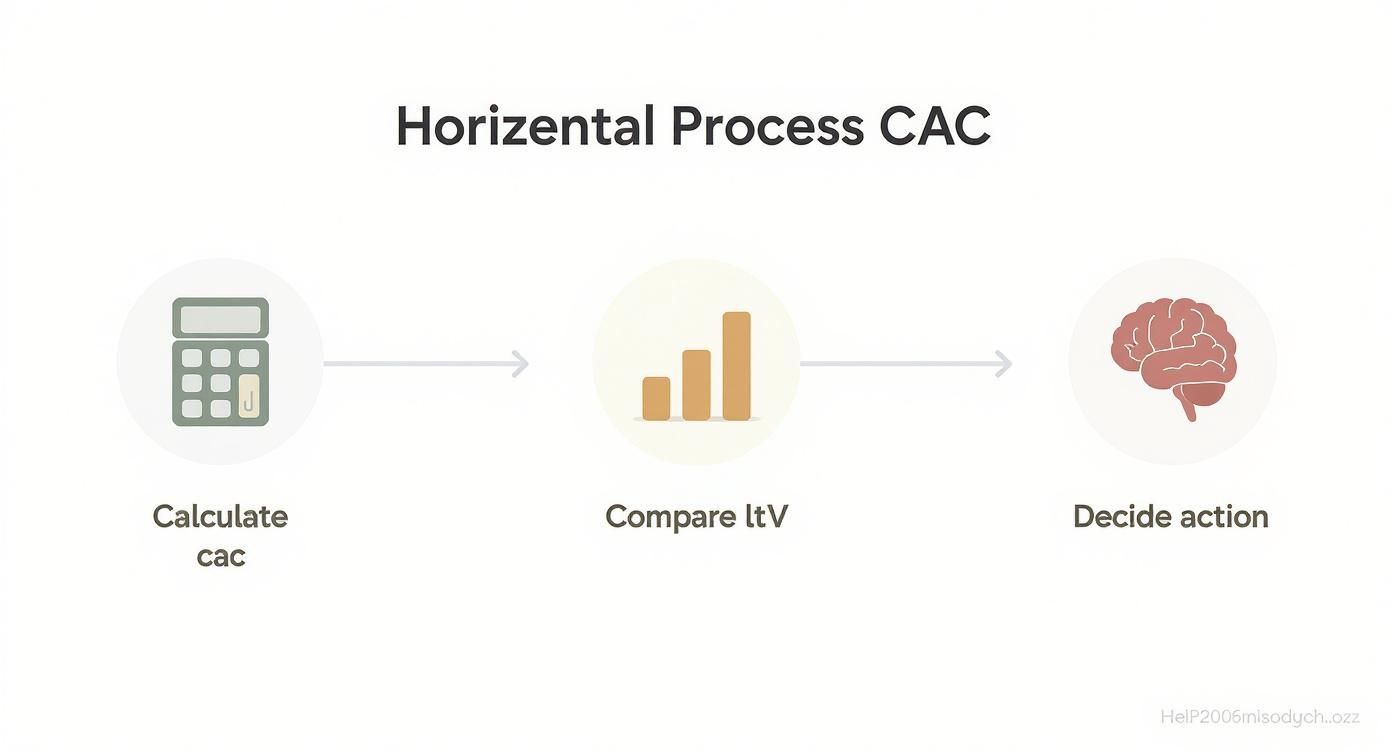
Our free CAC calculator gives you the starting point. The real magic happens in what you decide to do with that number.
The Channel Dissection Playbook
The quickest way to fix your overall CAC is to stop lighting money on fire. You need to find your marketing money pits and kill them, while simultaneously identifying your winners and doubling down. It sounds simple, but you'd be surprised how many SaaS operators don't do the channel-by-channel math.
Here's the playbook:
- Get Granular: Use your analytics to calculate a separate CAC for each acquisition channel—think Google Ads, LinkedIn, SEO, Affiliates, the works. Be absolutely ruthless in how you attribute costs.
- Compare Apples to Apples: Now, pit each channel's CAC against the LTV of the customers it brings in. A channel might have a high CAC but attract absolute whales, making it a huge winner.
- Cut and Reallocate: If a channel's LTV:CAC ratio is below 3:1, it's on the chopping block. Pause it, cut the budget, and immediately reallocate that cash to your top-performing channels.
I once worked with a B2B SaaS that was spending a fortune on flashy trade show sponsorships. Their CAC from those events was over $3,000, but the LTV was only $5,000—a scary 1.6:1 ratio. At the same time, their quiet, unassuming SEO efforts had a CAC of just $250 and an LTV of $4,000. That’s a monster 16:1 ratio. The decision was easy: they killed the trade shows, hired two more content writers, and dropped their blended CAC by 30% in six months. This is the kind of decisive action that separates top-tier operators.
The Onboarding Overhaul Playbook
Your acquisition cost doesn't just stop when someone signs up for a trial. It includes every single thing it takes to get them to pull out their credit card. If your onboarding process is leaky, you're essentially paying to acquire trial users who ghost you, which sends your CAC straight through the roof.
Actionable Insight: Improving your trial-to-paid conversion rate is one of the most powerful levers for lowering CAC. If you spend $1,000 to get 100 trial users and only 5 convert, your CAC is $200. But if you can get 10 of them to convert? You just halved your CAC to $100 without spending a single extra dollar on marketing.
Here's the process to plug the leaks:
- Find the "Aha!" Moment: Pinpoint the exact action or feature that makes a new user's eyes light up. This is when they truly "get" your product's value.
- Create a Beeline to It: Rework your entire onboarding flow—in-app guides, welcome emails, checklists—to guide every single user to that "aha!" moment as fast as humanly possible.
- Personalize the Journey: Don't give a solo founder the same tour you give an enterprise team. Use the data you have to tailor the onboarding experience, showing them the features that matter most to them.
The Content Flywheel Playbook
Paid ads are like renting an audience; content is like buying it. Building a library of valuable, SEO-optimized content is definitely a long game, but it’s the most surefire way to bring your blended CAC down for good. Every customer you get from an organic search is basically "free," which helps subsidize the cost of your paid channels.
Look at Groove. They famously documented their entire startup journey on their blog, growing from nothing to $5 million in annual revenue. That radical transparency built a massive audience and an organic acquisition engine that made their CAC sustainable. This is one of many killer https://saasoperations.com/saas-growth-strategies/ you can use to build a business that lasts.
If you're looking for more tactical advice, this guide on how to reduce your Customer Acquisition Cost has some excellent, practical strategies you can get started with right away. It's a fantastic resource for digging even deeper.
Your Burning CAC Questions, Answered
Alright, so you’ve got the basics down. But I know from experience that once you start digging into CAC, a whole new set of questions pops up. Let's tackle the most common ones I hear from SaaS founders and marketing leads.
What’s a Good CAC for a B2B SaaS Company?
This is the question everyone asks, and the honest-to-goodness answer is: it totally depends on your LTV. There’s no magic number.
A $500 CAC could put a $49/month productivity tool out of business. But for an enterprise platform pulling in an average of $50,000 per customer? That $500 is an absolute steal.
Instead of hunting for a universal "good" CAC, you need to look at your LTV:CAC ratio. The gold standard for a healthy, growing SaaS business is a ratio of 3:1 or better. So, if your average LTV is $3,000, then any CAC under $1,000 is putting you in a great spot.
I once worked with a founder of a project management tool who was convinced their $250 CAC was way too high. We ran the numbers and found their LTV was actually $1,250, giving them a killer 5:1 ratio. That insight gave them the green light to double down on their best channels, knowing every dollar they spent was coming back fivefold.
How Often Should I Calculate My CAC?
The right cadence really hinges on how long it takes you to close a deal. A good rule of thumb is to sync your calculation frequency with your average sales cycle.
- Fast Sales Cycle (under 30 days): Go for a monthly calculation. This will give you a real-time pulse on how your acquisition efforts are performing.
- Longer Sales Cycle (60-90+ days): Looking at CAC monthly will just give you whiplash. It’s much smarter to calculate it quarterly. This way, you’re accurately matching the marketing spend from Q1 with the new customers who actually signed up in Q2 because of it.
Whatever you do, don't just calculate it once a year. The market moves way too fast for that. A 12-month-old CAC is a historical artifact, not a useful tool for making decisions today.
How Does Churn Mess With My CAC?
This is a great question. While churn doesn't technically show up in the CAC formula itself, it's the silent killer of your unit economics. Churn absolutely demolishes your LTV:CAC ratio.
If customers are heading for the exit ramp too quickly, they never stick around long enough to pay back what you spent to get them in the door, let alone become profitable.
Think of it like this:
- A low churn rate is a value multiplier on every single customer you acquire.
- A high churn rate is like trying to fill a leaky bucket. You're forced to spend more and more on acquisition just to stand still.
Honestly, one of the best ways to improve your CAC is to focus on retention. By reducing churn, you make every customer you acquire more valuable, which makes your acquisition spend far more sustainable.
To get a grip on all these moving parts, you need a reliable way to measure your numbers. Using our free cac calculator that will also use AI analysis based on your CAC is the perfect first step to getting the clarity you need to make these kinds of critical business decisions.
At SaaS Operations, we build battle-tested playbooks and templates to help you grow a more efficient and profitable business. Stop guessing and start scaling with our free AI-powered CAC calculator.