
A solid lifetime value calculation in SaaS is the bedrock of sustainable growth. It’s how you measure the total profit you can expect from a customer over their entire relationship with your company. Thinking in terms of LTV shifts your focus from just getting customers in the door to building long-term, profitable relationships.
Why LTV Is Your Most Important SaaS Growth Metric
Let’s get real for a moment. Customer Lifetime Value (LTV) isn’t just another number to track on your dashboard—it’s the compass for your entire growth strategy. For years, the prevailing wisdom in SaaS was to acquire customers at any cost. We all saw companies pour endless cash into marketing, often without a clear picture of the long-term return.
That’s a recipe for disaster. The game has changed.
The smartest SaaS companies have moved on. They’ve realized the real money is in maximizing the value of the customers they already have. When you truly understand your LTV, you start making sharper, more profitable decisions across every part of your business.
From Acquisition to Retention
The modern SaaS playbook is all about retention. Why? Because loyal customers are worth so much more than their monthly subscription fee.
- They drive expansion revenue. Happy customers don’t just stick around; they grow with you. They’re the ones who upgrade to higher-tier plans or buy new add-ons.
- They become your best marketers. Nothing beats a customer who genuinely loves your product. They tell their friends, write great reviews, and refer new users—all of which dramatically lowers your Customer Acquisition Cost (CAC).
- They give you priceless feedback. Your most engaged users are a goldmine of insights. They’ll tell you what’s working, what’s not, and what you should build next.
This shift is precisely why LTV is so critical. By 2025, the focus for successful SaaS firms has moved decisively away from pure acquisition. Instead, it’s about maximizing value from existing customers through smart retention and expansion strategies. Industry reports consistently show this trend is what separates the winners from the rest.
LTV as a Strategic Tool
Before diving into the math, it’s helpful to see how each piece fits into the bigger picture. These are the core metrics you’ll be working with.
Core Components of SaaS LTV
| Metric | Description | Why It Matters for LTV |
|---|---|---|
| ARPA | Average Revenue Per Account | This is your starting point—the average monthly revenue each customer generates. |
| Gross Margin | The percentage of revenue left after the cost of goods sold (COGS). | LTV should reflect profit, not just revenue. This ensures you’re calculating a profitable lifetime value. |
| Churn Rate | The percentage of customers who cancel their subscription in a given period. | Churn is the direct enemy of LTV. A lower churn rate means a longer customer lifetime and higher value. |
Understanding these components individually is the first step. When you combine them, you get a powerful, forward-looking view of your business’s health.
A precise lifetime value calculation for SaaS acts like a diagnostic tool for your business. It shines a light on the health of your revenue model and helps you answer critical questions. For example, if you know the average LTV of customers from your Google Ads campaign, you know exactly how much you can afford to spend to get more of them. You can check out our detailed lifetime value of a customer guide for more on this.
A high LTV is the clearest signal you have that your product is delivering real, sustained value. It tells you that you’ve found a strong product-market fit and built a healthy relationship with your customers—the two pillars of long-term success.
In the end, LTV is what separates the companies that scale successfully from those that just get by. It gives you the clarity to invest your resources wisely, prioritize the right product updates, and build a customer success program that actually creates loyalty. To dig even deeper into this crucial metric, check out this comprehensive guide to calculating Lifetime Value SaaS.
How to Gather the Data for Your LTV Calculation

Any lifetime value calculation for your SaaS is only as good as the data you feed it. We all know the old saying: garbage in, garbage out. It’s never more true than with financial metrics. Your LTV number lives or dies by the quality of your inputs.
So, let’s get practical. Forget theory for a moment and focus on where you can actually find these numbers inside the tools you already use every day.
Sourcing Your Core LTV Metrics
Your tech stack is a goldmine of the financial and behavioral data you need. The trick is knowing which tool holds the most accurate number for each part of the LTV formula.
Here’s a quick rundown of where to look for the three essential inputs:
- Average Revenue Per Account (ARPA): This is your bread and butter—the average revenue you bring in from each customer account, usually on a monthly basis. Your billing platform is the definitive source here. Tools like Stripe, Chargebee, or Recurly typically calculate this for you and often feature it right on the main dashboard.
- Customer Churn Rate: This is the percentage of customers who say goodbye over a certain period. Your CRM (think HubSpot or Salesforce) or your billing system will have this data. Just look for reports on subscription cancellations or status changes.
- Gross Margin: This shows you what’s left of your revenue after accounting for the Cost of Goods Sold (COGS). For SaaS, COGS includes direct service delivery costs like hosting, third-party software licenses, and customer support salaries. Your accounting software, whether it’s QuickBooks or Xero, is where you’ll crunch these numbers.
Pro Tip: Don’t just do this once. Put a recurring reminder on your calendar—either monthly or quarterly—to pull this data. Consistent tracking is the only way you’ll spot trends and see how your business decisions are actually affecting LTV over time.
The Power of Granular Data Segmentation
Calculating one big LTV number for your whole company is a fine start. But the real magic happens when you start segmenting your data. A single average can be incredibly misleading because it mixes your best, most loyal customers with your least profitable ones, completely hiding critical patterns.
When you break down the data, you can run a more detailed lifetime value calculation for SaaS on specific groups. This immediately shows you which customer segments are your champions and which might be costing you more than they’re worth.
Try segmenting your LTV calculations by these common factors:
- Pricing Tiers: Are customers on your “Pro” plan sticking around longer and spending more than those on your “Basic” plan? This directly informs your pricing and upgrade strategy.
- Acquisition Channel: Do customers from organic search have a higher LTV than those from paid social ads? This tells you exactly where to put your marketing dollars for the best return.
- User Personas: If you cater to different customer profiles, like small businesses versus enterprise clients, calculating LTV for each will show you which persona your business is built to serve best.
Segmenting is more work upfront, there’s no doubt about it. But the strategic clarity it provides is immense. For example, if you discover your enterprise clients have a 3x higher LTV, you now have a rock-solid case for building a dedicated sales team to go after more of them. Proper data parsing and management is crucial for making this kind of analysis manageable.
Avoiding Common Data-Gathering Pitfalls
As you start pulling everything together, you’ll almost certainly hit a few snags. Knowing about them ahead of time can save you from major headaches and flawed calculations.
One of the most common issues is inconsistent tracking. For instance, if your sales team marks a customer as “won” in the CRM on the 15th, but your billing platform doesn’t start their subscription until the 1st of next month, which date do you use to calculate their lifetime? You have to define a single source of truth for these key events.
Another tripwire is not having a clear definition for your metrics. When you calculate ARPA, are you including one-time implementation fees, or are you sticking to pure recurring revenue? It makes a big difference. If you’re wrestling with this, our guide on what ARR is can help clarify things. Decide on one clear definition for every metric, write it down, and make sure your whole team is on the same page.
Alright, you’ve got your data lined up. Now for the fun part: running the numbers to calculate your SaaS Lifetime Value. There are a couple of ways to do this, and I’ll walk you through two of the most practical formulas I’ve used over the years.
One is a quick, back-of-the-napkin calculation for a fast pulse check. The other is a more traditional approach that gives you a much truer, more strategic picture of your business’s health. Think of them as different tools for different jobs, both aimed at helping you make smarter decisions.
This visual is a great way to see how all the pieces—your revenue, churn, and gross margin—fit together.
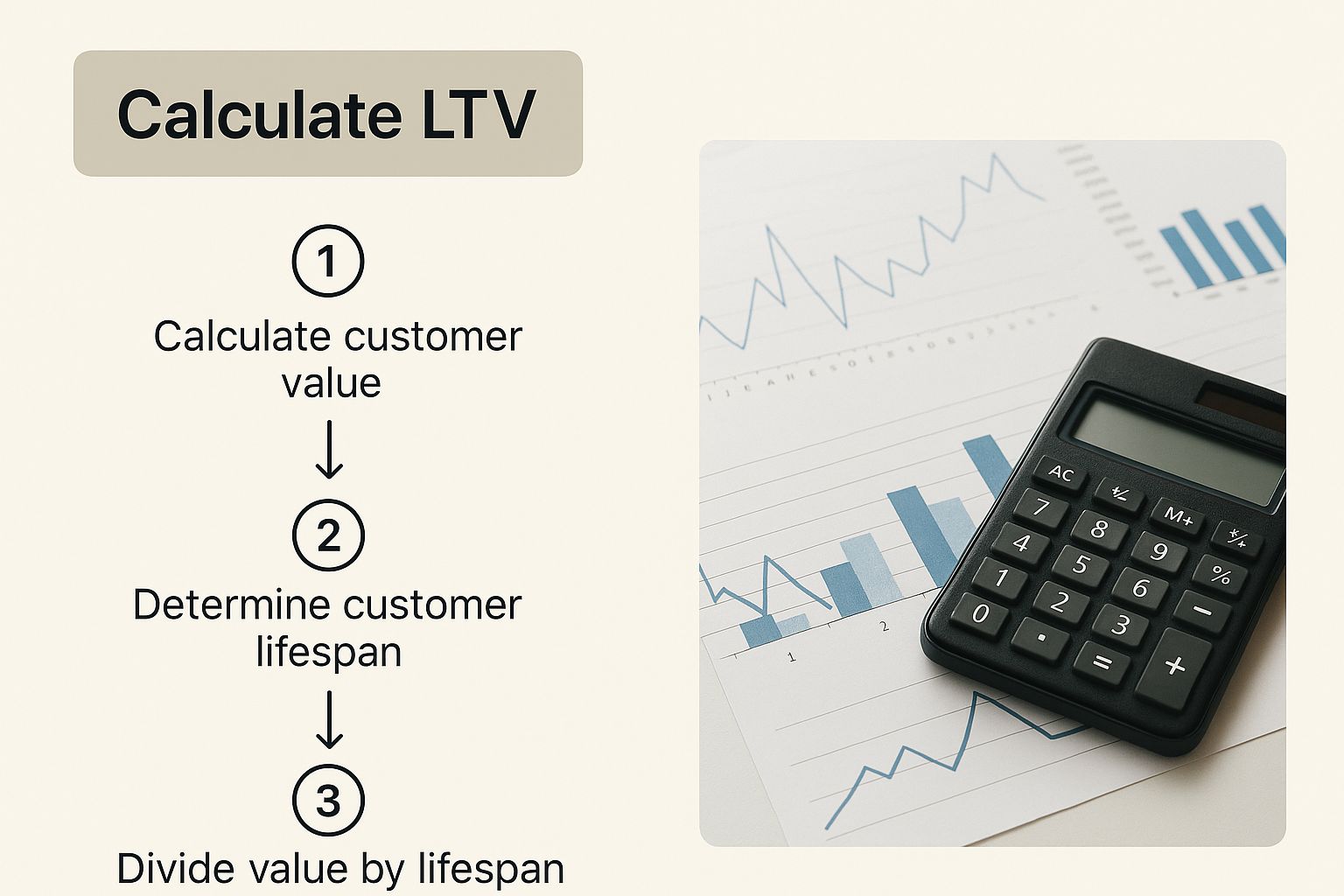
As you can see, it’s all about combining your core revenue and retention metrics to produce that final LTV number that will guide your financial strategy.
The Quick and Simple LTV Calculation
Need a number fast? The simple LTV formula is your go-to. It’s perfect when you need a high-level estimate for a meeting or just want a baseline to work from without getting too deep in the weeds.
Here’s the formula:
LTV = Average Revenue Per Account (ARPA) / Customer Churn Rate
Let’s plug in some real-world numbers. Imagine your SaaS company has:
- An ARPA of $150 a month.
- A monthly Customer Churn Rate of 4% (which you’ll use as 0.04 in the formula).
Running that through the formula is simple:
LTV = $150 / 0.04 = $3,750
This tells you that, on average, a new customer is worth $3,750 in revenue over their entire lifecycle. It’s a solid starting point, but it comes with a major caveat: this formula completely ignores your costs. It’s calculating revenue LTV, not profit LTV.
The Traditional LTV Formula for Deeper Insights
To get a number you can actually bet your budget on, you need to factor in your Gross Margin. This brings you from a revenue-based figure to a profit-based one, which is what really matters for building a sustainable business.
The traditional LTV formula adds just one more variable:
LTV = (ARPA * Gross Margin %) / Customer Churn Rate
Let’s stick with our example. We still have the $150 ARPA and 4% churn. Now, let’s say your Gross Margin is 80% (or 0.80), which is pretty typical for a software company.
Here’s how that changes things:
LTV = ($150 * 0.80) / 0.04
LTV = $120 / 0.04 = $3,000
See the difference? By accounting for the cost of delivering your service, the LTV drops from $3,750 to $3,000. This is a much more honest number, and it’s the one you should be using to assess your LTV to Customer Acquisition Cost (CAC) ratio.
The key takeaway here is pretty clear: while the simple formula is handy for a quick check, the traditional formula tells you the financial truth. It forces you to think in terms of profitability, not just top-line revenue—a critical shift for smart, long-term planning.
Choosing the Right LTV Formula for Your Needs
So, which one should you use? It really depends on what you’re trying to accomplish.
| Formula Type | Pros | Cons | Best Used For |
|---|---|---|---|
| Simple LTV | Quick and easy to calculate. | Overstates LTV by ignoring costs. | Getting a fast baseline or for internal discussions where precision isn’t paramount. |
| Traditional LTV | More accurate and reflects true profitability. | Requires you to calculate Gross Margin. | Making strategic decisions about marketing spend, budgeting, and financial forecasting. |
For almost any serious strategic conversation, the traditional formula is the winner. It gives you a number you can trust to steer the ship.
It’s also worth remembering why this is so important right now. While 89% of companies say LTV is key to driving loyalty, a surprising 42% admit they can’t measure it accurately. That gap is a huge problem, especially when you consider that customer acquisition costs have skyrocketed by 222% in recent years.
Ultimately, a precise lifetime value calculation for your SaaS is more than just a math problem. It’s a core part of a healthy operational rhythm. It’s a metric that belongs right alongside your annual recurring revenue and other KPIs, because together they tell the story of your company’s growth. Tracking LTV consistently is what empowers you to build a more resilient and profitable business.
Making Sense of Your LTV to CAC Ratio
So, you’ve calculated your LTV. That’s a huge step, but the number itself doesn’t tell you the whole story. An LTV of $5,000 might be fantastic for one company and disastrous for another. Its real power comes alive when you compare it to another crucial metric: your Customer Acquisition Cost (CAC).
Think of the LTV to CAC ratio as the ultimate health check for your SaaS business. It answers one simple, critical question: Are the customers you’re fighting so hard to win actually profitable over the long haul? If you’re spending more to get a customer than they’ll ever give back, you’re not building a business—you’re just burning cash.
Calculating Your Customer Acquisition Cost
First things first, you need a solid handle on your CAC. This is the total cost of all your sales and marketing activities divided by the number of new customers you brought in during that same period.
The formula itself is pretty straightforward:
CAC = (Total Sales & Marketing Expenses) / (Number of New Customers Acquired)
Be brutally honest here. Your “Total Sales & Marketing Expenses” should include everything. I’m talking about salaries and commissions for your team, ad spend, content creation, software subscriptions—the works. Skimping on these details will only give you a dangerously rosy picture of your business’s health.
For example, let’s say you spent $50,000 on sales and marketing last quarter and signed up 100 new customers. Your CAC would be $500. Simple as that.
The Gold Standard 3-to-1 Ratio
Now that you have both LTV and CAC, you can figure out the ratio that really matters. For years, the benchmark for a healthy, growing SaaS company has been an LTV:CAC ratio of 3:1 or higher. This means for every dollar you invest in acquiring a customer, you’re getting at least three dollars back in lifetime value.
This isn’t just some arbitrary number. In 2025, a 3:1 ratio remains the standard for a reason. While some high-flying sectors like Adtech might see ratios closer to 7:1, most B2B SaaS companies see 3:1 as a clear sign of an efficient growth engine. If you want to dive deeper into these benchmarks, you can discover industry-specific insights at eqvista.com.
The 3:1 ratio is the sweet spot. It gives you enough margin to cover all your other operational costs (like R&D and G&A) and still leaves a healthy profit to reinvest into your product, your team, and future growth.
Interpreting Your LTV to CAC Ratio
Your ratio is more than just a number; it’s a powerful diagnostic tool. It tells a story about your company’s efficiency and where you should focus your energy.
Here’s a quick guide to understanding what your ratio is trying to tell you and how to respond.
Interpreting Your LTV to CAC Ratio
This table breaks down different LTV:CAC ratios and what they signal about a SaaS business’s health and strategy, providing actionable insights for each scenario.
| LTV:CAC Ratio | What It Means | Recommended Action |
|---|---|---|
| Below 1:1 | You’re losing money on every customer. Your business model is fundamentally unsustainable. | Stop everything. You need to immediately cut acquisition costs, improve your LTV, or both. |
| 1:1 to 2:1 | You’re likely breaking even or making very little profit. You have no room for error and very little cash to reinvest in growth. | Diagnose the problem. Is your CAC too high? Is your churn rate hurting your LTV? Focus on improving one of these levers. |
| 3:1 | You have a healthy, efficient business model. This is the target for most SaaS companies. | Maintain and optimize. Continue to monitor the ratio and look for small ways to improve efficiency. |
| 4:1 or higher | You have an excellent business model, but you might be underinvesting. A very high ratio could mean you’re not being aggressive enough with your marketing and sales. | Consider pressing the accelerator. You may be missing out on a huge growth opportunity by not investing more to acquire valuable customers. |
At the end of the day, understanding this relationship is a core part of any lifetime value calculation for your SaaS strategy. It’s what turns LTV from a vanity metric into a clear, actionable guide that can steer your entire company toward sustainable, profitable growth.
Actionable Strategies to Increase Your SaaS LTV

Knowing your LTV is one thing, but making it grow is where the real work begins. A higher LTV is more than a vanity metric; it directly fuels your business, giving you a bigger budget for customer acquisition and building a far more resilient company.
But there’s no single magic trick to boosting LTV. The whole game comes down to pulling two main levers: getting customers to stick around longer (that’s reducing churn) and getting them to spend more while they’re with you (that’s increasing expansion revenue).
Let’s break down some proven, real-world strategies for pulling both of those levers.
Fortify Your Defenses by Reducing Churn
Customer churn is the quiet killer of LTV. Every time a customer walks away, it drags down your average customer lifetime and shrinks the potential value you can capture. The numbers don’t lie—improving retention by just 5% can rocket your profits by 25% or more. The impact is enormous.
Too many companies treat churn as something to react to, scrambling only when a customer is already halfway out the door. The best in the business are proactive, focusing on building loyalty from the moment a user signs up.
One of the most powerful things you can do is nail your customer onboarding. I’m not talking about a simple feature tour. The real goal is to get new users to their first “aha!” moment—that magical point where they truly grasp your product’s core value. A user who gets a win early is infinitely less likely to churn.
Key Insight: Don’t confuse a product tour with successful onboarding. Onboarding isn’t finished until the customer has achieved their first meaningful outcome using your product. It’s all about the result, not just the features.
Another fantastic tactic is to set up proactive customer check-ins. Don’t just sit back and wait for support tickets. Use your product analytics to spot accounts where activity is dipping. Sometimes, a simple, automated email asking, “Hey, just checking in, is there anything we can help with?” is all it takes to re-engage a user and prevent them from silently slipping away. To really get this right, you can use SaaS marketing automation to trigger these nudges based on specific user behaviors.
Drive Growth with Smart Expansion Revenue
For high-growth SaaS companies, expansion revenue is the secret weapon. This is the extra recurring revenue you generate from your existing customers through upsells, cross-sells, or add-ons. It’s almost always cheaper and easier to sell more to a happy customer than it is to find a new one.
This is where your pricing and packaging strategy really shines.
1. Design Intelligent Pricing Tiers
Your pricing shouldn’t be static. Structure it so that as a customer’s business grows, upgrading their plan becomes the natural next step. You can do this by tying your tiers to a value metric that scales with use, like the number of users, contacts, or projects.
- For example: A project management tool might offer a free plan for up to 3 projects, a team plan for up to 20, and a business plan with unlimited projects. As a small agency starts winning more clients, they have a built-in reason to upgrade.
2. Offer Valuable Add-on Features
Instead of stuffing every single feature into all your plans, identify specialized tools that only a fraction of your users need. Offer these as optional, paid add-ons. This lets you capture more revenue from your power users without making your core plans bloated and confusing for everyone else.
- For example: An email marketing platform could sell an “Advanced Analytics Suite” as an add-on. Most users might not need it, but the data-driven marketers who do will gladly pay for it.
3. Master the Art of the Cross-Sell
If you have more than one product, you’re sitting on a goldmine of cross-sell opportunities. Dig into your customer data to figure out which customers of Product A are the most likely to get huge value from Product B.
- For example: A company that sells CRM software might notice that customers who frequently use the sales reporting feature are prime candidates for their separate sales forecasting tool.
Creating a System for LTV Growth
Increasing your LTV isn’t a one-and-done project. It’s a continuous discipline that requires you to deeply understand your customer’s journey and deliver value at every turn.
Here’s a quick look at how these strategies come together:
| Strategy | Primary Goal | Key Action |
|---|---|---|
| Refined Onboarding | Reduce early churn | Guide users to their first “aha!” moment fast. |
| Proactive Check-ins | Prevent silent churn | Use data to spot at-risk users and reach out. |
| Tiered Pricing | Encourage upgrades | Tie pricing to a value metric that scales with customer growth. |
| Feature Add-ons | Increase ARPA | Monetize specialized tools for your power users. |
| Strategic Cross-selling | Expand account value | Offer related products to solve your customers’ other problems. |
When you start methodically applying these tactics, you stop just measuring LTV and start actively shaping it. This strategic focus is what separates a good SaaS business from a truly great one.
Frequently Asked Questions About SaaS LTV
Even when you have the formulas down cold, putting SaaS lifetime value into practice always brings up a few tricky questions. It’s a powerful metric, but the real world is full of nuance.
Let’s walk through some of the most common sticking points we see. These are the kinds of gray areas that can trip up even seasoned founders and operators.
What Is a Good LTV for a SaaS Company?
This is the million-dollar question, but the answer isn’t a specific number. A $500 LTV might be fantastic for a simple, self-serve product with a tiny marketing spend. On the flip side, a $10,000 LTV could spell trouble for an enterprise platform that relies on a large, expensive sales team.
The real benchmark for a “good” LTV is how it stacks up against your Customer Acquisition Cost (CAC). A healthy LTV to CAC ratio of 3:1 or higher is what most successful SaaS businesses aim for. This means for every dollar you invest to win a customer, you’re making at least three dollars back over their lifespan. That ratio is your true north star, not the LTV number itself.
Your LTV doesn’t exist in a vacuum. Its health is always relative to what it costs you to earn that value. A high LTV is meaningless if your CAC is even higher. Focus on the ratio, not just the LTV figure itself.
How Often Should I Calculate LTV?
Your LTV isn’t a “set it and forget it” metric. Think of it as a living number that reflects the current health of your business. Your pricing, product, and customer base are always evolving, and your LTV will, too.
For most SaaS companies, running a full lifetime value calculation for SaaS on a quarterly basis is the sweet spot. It’s a great rhythm.
- It’s frequent enough to catch important trends and measure the results of your recent initiatives.
- But it’s not so often that you’re overreacting to minor statistical noise.
If you’re in a high-growth phase or a particularly fast-moving market, you might want to bump that up to a monthly calculation. Whatever you choose, the key is to be consistent.
Can My LTV Ever Go Down?
Yes, absolutely—and when it does, it’s a critical signal you need to pay attention to. A falling LTV is almost always a symptom of deeper issues. It generally points to one of two culprits: your Average Revenue Per Account (ARPA) is shrinking, or your customer churn is climbing.
Maybe a new competitor is forcing you into a price war, pushing your ARPA down. Or perhaps a buggy product release is frustrating users and driving up your churn rate. When you see LTV drop, you need to dig in and find the root cause immediately. It’s a clear call to action to double down on retention. Exploring different customer success strategies is a great way to proactively protect and grow your LTV.
Ready to move beyond spreadsheets and guesswork? SaaS Operations provides proven playbooks and SOPs to help you master your most important metrics. Our battle-tested frameworks from 10+ years of growing 8-figure businesses will help you run a more effective and efficient company. Learn how to accelerate your growth at saasoperations.com.