
At its core, Monthly Recurring Revenue (MRR) is the predictable, stable income your subscription-based business can count on every single month. It’s the sum of all recurring fees from your active customers, acting as the financial heartbeat for any SaaS or subscription company.
Why Monthly Recurring Revenue Matters

Think about your favorite streaming service. A single $15 monthly subscription might not seem like much on its own. But when you multiply that by millions of users, it creates a powerful, predictable river of cash flow. That’s the essence of Monthly Recurring Revenue (MRR). It’s more than just a sales number; it’s a vital sign that tells you a lot about your company’s financial health, stability, and potential for growth.
Unlike old-school business models that chase one-time sales, MRR gives you a clear, forward-looking view of your business’s trajectory. This predictability is its superpower. It allows you to stop reacting to last month’s numbers and start making proactive, data-informed decisions about the future.
The Strategic Value of MRR
The subscription economy has exploded, and with it, the importance of MRR. In fact, this business model, built on the foundation of recurring revenue, was projected to be worth a staggering $1.5 trillion by 2025. That’s a 435% jump in just nine years, which shows why getting a handle on MRR is a must for any modern company.
By tracking MRR, you can accurately forecast cash flow, justify new hires, budget for marketing campaigns, and demonstrate a sustainable business model to investors and stakeholders. It turns your revenue from a guessing game into a reliable metric.
For a quick reference, here’s a simple breakdown of what makes up MRR.
MRR At a Glance
| Component | Description | Example |
|---|---|---|
| Recurring Charges | The core monthly subscription fees your customers pay. | A customer pays $50/month for a software plan. |
| Upgrades/Downgrades | Changes in subscription plans that affect the monthly fee. | A customer upgrades from a $50 plan to a $75 plan. |
| Add-Ons | Optional, recurring purchases added to a base plan. | A customer adds a $10/month feature to their plan. |
| Discounts | Any recurring discounts applied to a customer’s subscription. | A customer gets a 10% discount, reducing their $50 fee to $45. |
Ultimately, keeping a close eye on your MRR gives any subscription business a real competitive edge.
- Improved Financial Forecasting: It gives you a reliable baseline to project future income, making your budgeting and planning far more accurate and a lot less stressful.
- Clear Growth Measurement: When your MRR is consistently climbing, it’s one of the clearest signals that your business is growing in a healthy, sustainable way.
- Enhanced Strategic Decision-Making: Armed with a clear view of your predictable income, you can invest confidently in things that matter—like product development, expanding your team, and other big growth moves.
Alright, let’s move from theory into practice. Calculating your Monthly Recurring Revenue is actually more straightforward than you might think. The whole point is to isolate the predictable, recurring part of your income. This gives you a clear, stable baseline you can rely on for financial planning.
Think of it as getting a clean snapshot of your company’s financial health every month.
The Simple MRR Calculation
At its heart, the formula is simple. You just multiply the number of customers you have by how much they pay on average.
Total Active Customers × Average Revenue Per Customer = Monthly Recurring Revenue
This is great for a quick, back-of-the-napkin estimate. But let’s be real—most SaaS businesses have multiple pricing plans, so a simple average won’t cut it. To get a truly accurate number, you need to dig a little deeper.
A More Accurate, Step-by-Step Example
Let’s cook up a fictional SaaS company to see how this works. We’ll call it “SyncUp,” and it offers three subscription plans.
To figure out its total MRR, SyncUp can’t just average everything together. That would muddy the waters. Instead, the team needs to calculate the revenue from each plan and then add it all up.
Here’s a breakdown of how SyncUp calculates its MRR for the month:
- Basic Plan: 100 customers are paying $20/month. That’s $2,000.
- Pro Plan: 50 customers are paying $50/month. That’s $2,500.
- Enterprise Plan: 10 customers are paying $200/month. That’s another $2,000.
Now, they just add up the revenue from each tier:
$2,000 (Basic) + $2,500 (Pro) + $2,000 (Enterprise) = $6,500 Total MRR
This bottom-up approach is the gold standard. It makes sure every single recurring dollar gets counted, giving you a far more precise figure than a simple average ever could.
What Not to Include in Your MRR Calculation
Knowing what to leave out of your MRR calculation is just as important as knowing what to put in. If you start including the wrong kinds of revenue, you’ll artificially inflate your MRR. This creates a dangerously misleading picture of your company’s stability and can lead you to make some really poor decisions down the road.
To keep your MRR metric clean and trustworthy, you absolutely must exclude any revenue that isn’t recurring. These are one-off payments you can’t count on seeing again next month.
Here are the usual suspects you need to exclude from your MRR:
- One-Time Setup Fees: That initial fee for getting a customer onboarded? It’s a one-and-done deal, not a subscription.
- Consulting or Training Charges: Any professional services you bill for on a project basis need to be tracked separately.
- Annual Contracts (in full): This is a big one. If a customer pays $1,200 for a year-long subscription, you should only count $100 toward your MRR for each month of that contract. Booking the entire $1,200 in a single month is a common mistake that will throw off your numbers completely.
If your business leans heavily on annual contracts, you might find that tracking Annual Recurring Revenue (ARR) makes more sense. For a deeper dive, check out our complete guide on Annual Recurring Revenue.
By carefully separating these one-time payments from your true recurring income, you ensure your MRR remains the reliable health indicator it’s meant to be.
The Three Key Drivers of MRR Growth
Just looking at your total Monthly Recurring Revenue (MRR) gives you a snapshot, but it doesn’t tell you the whole story. To really get a feel for your company’s momentum, you need to understand the forces pushing that number up or down.
Think of it like this: knowing your car is moving at 60 MPH is useful. But knowing how hard you’re pushing the accelerator, the tailwind helping you along, and the friction from the road gives you real control. In SaaS, these forces are the three key drivers of MRR. Tracking them separately is how you diagnose the health of your business and make smart decisions.
New MRR: The Engine of Acquisition
New MRR is the most straightforward piece of the puzzle. It’s simply the total monthly recurring revenue you bring in from brand-new customers. This metric is a direct report card on how well your sales and marketing efforts are performing.
For example, if a company signs up for your $300/month Pro plan, you’ve just added $300 in New MRR. Simple as that. This is the fuel that comes from landing new logos, and it’s a primary signal of your growth and market fit.
Expansion MRR: The Power of Upselling
Expansion MRR is where things get really interesting. This is the extra monthly revenue you generate from your existing customers. This growth comes from a few key places: customers upgrading to a higher-tier plan, buying recurring add-ons, or adding more user seats.
Let’s say one of your current customers on that $300/month Pro plan realizes they need more features and upgrades to the $800/month Premium plan. That $500 difference is pure Expansion MRR. Many would argue this is the best kind of revenue because it means your product is delivering so much value that customers are willing to pay more for it. High expansion is often a sign of a “sticky” product and a fantastic customer success team.
The infographic below shows how breaking down your revenue into these components gives you a much clearer picture for forecasting and ensuring stability.
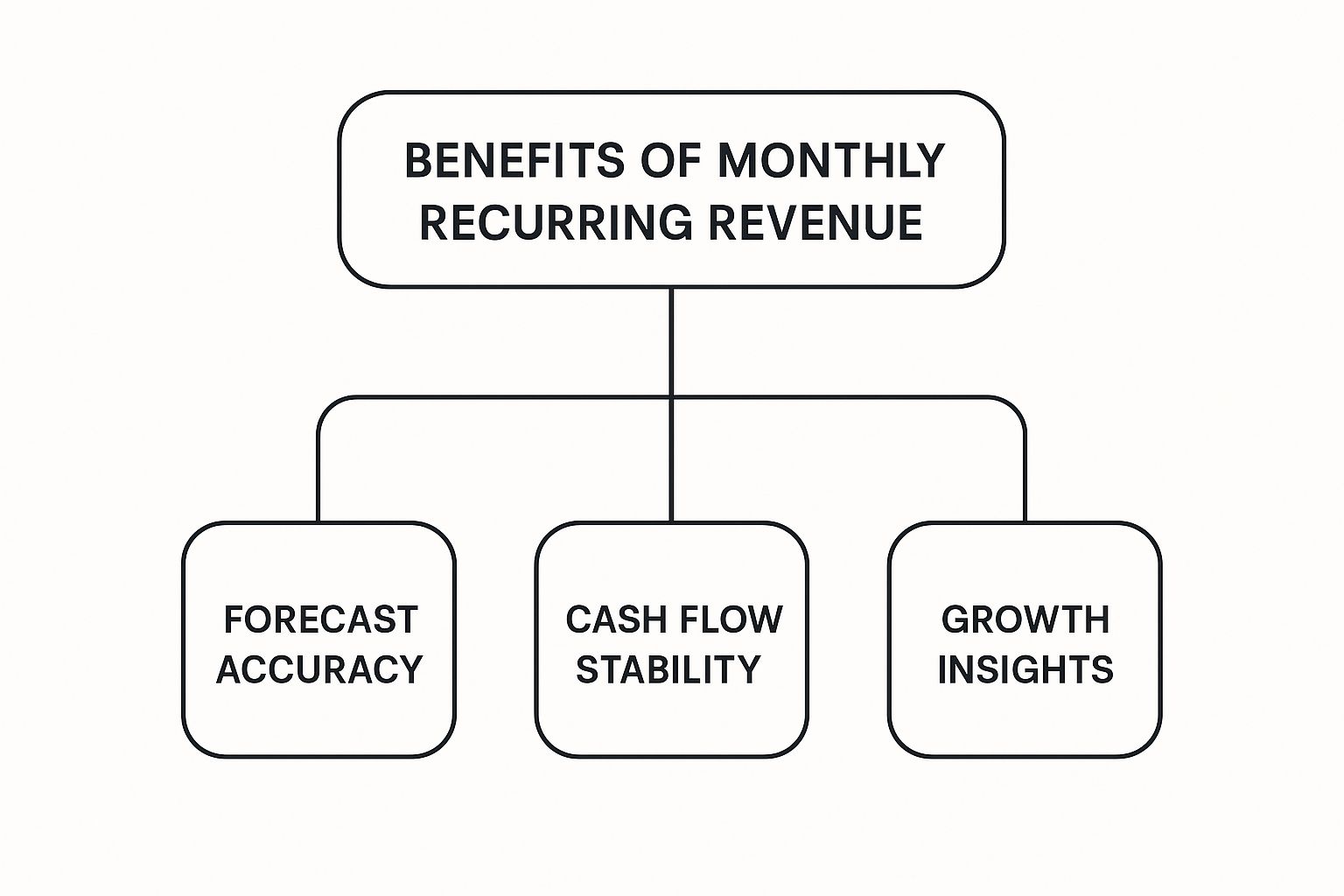
As you can see, understanding these individual streams is what leads to better financial planning and deeper insights into what’s truly driving your growth.
Churned MRR: The Unavoidable Leak
Churned MRR represents the revenue you lose each month. This happens when existing customers either cancel their subscriptions entirely or downgrade to a cheaper plan. Every subscription business on the planet deals with churn; the name of the game is keeping it as low as humanly possible.
So, if a customer on your $300/month Pro plan decides to cancel, you’ve just lost $300 in Churned MRR.
A high churn rate can silently sink a business, even if you’re signing up new customers left and right. It’s like trying to fill a bucket with a giant hole in it—you have to run the tap at full blast just to keep the water level from dropping.
To give you a better sense of how these components fit together, here’s a quick breakdown:
Types of MRR Explained
| MRR Type | What It Measures | Strategic Importance |
|---|---|---|
| New MRR | Revenue from brand-new customers in a given month. | Indicates sales and marketing effectiveness and new customer acquisition. |
| Expansion MRR | Additional revenue from existing customers (upgrades, add-ons). | Proves product value and customer satisfaction. The most efficient growth lever. |
| Churned MRR | Revenue lost from customers who cancel or downgrade. | Highlights potential issues with your product, pricing, or customer service. |
These three drivers don’t operate in a silo; they work in tandem to shape your overall growth trajectory.
A healthy SaaS business with strong Expansion MRR can often completely offset its Churned MRR, creating a powerful engine for sustainable, long-term success. Getting a firm grip on these components is fundamental to managing your most important SaaS KPIs.
Common Mistakes to Avoid When Tracking MRR

Tracking your Monthly Recurring Revenue is crucial, but it’s surprisingly easy to get wrong. A single misstep can throw off your entire financial picture. Honestly, having a flawed MRR figure is often worse than having no number at all, as it can give you a false sense of security and lead to some really bad decisions.
To make smart moves, you need clean, reliable data. Let’s walk through some of the most common pitfalls I’ve seen trip up even seasoned SaaS founders. Getting these right will ensure your MRR is a true measure of your company’s health, giving you a solid foundation for forecasting and growth.
Including Non-Recurring Revenue
This is, without a doubt, the biggest mistake people make. They muddy their MRR numbers by including one-time payments. It’s important to remember what the “R” in MRR stands for: recurring. If a payment isn’t guaranteed to come in again next month, it doesn’t belong here.
Why is this so important? Because it’s the difference between predictable, stable income and a temporary cash bump. Lumping one-off fees into your MRR inflates your numbers and hides the reality of your business’s core health.
By keeping your MRR pure, you maintain a clear view of your company’s sustainable income stream. This discipline prevents poor financial planning and ensures you’re not making commitments based on revenue that won’t be there next month.
Be on the lookout for these common culprits that should be kept separate:
- One-Time Setup Fees: These are charges for getting a new customer started. They happen once, so they aren’t recurring.
- Consulting or Training Services: Unless you sell these as an ongoing subscription, they are professional services revenue, not MRR.
- Hardware Sales: If you sell any physical gear alongside your software, that revenue is completely separate from your subscription base.
Mismanaging Annual Contracts
This one is so common it needs its own section. When a customer pays you for a full year upfront, it’s incredibly tempting to count all that cash in the month you receive it. For instance, if a client pays $2,400 for an annual plan, it’s a huge error to add $2,400 to that month’s MRR.
Doing this creates a massive, artificial spike in your revenue chart. Your MRR will look amazing for one month and then crash back down, making your growth look chaotic and unpredictable.
The right way to handle this is to normalize the contract value over its entire term. That $2,400 annual contract actually contributes $200 to your MRR for each of the next 12 months. This method smooths out your growth curve and gives you a true picture of your monthly earnings.
Handling annual contracts correctly does more than just clean up your metrics; it helps you build smarter financial habits. By focusing on your actual recurring income, you can align your spending more effectively—a core concept we cover in our guides on SaaS cost optimization. This ensures your operational costs are supported by predictable revenue, not just temporary cash from prepaid deals.
Understanding the Difference Between MRR and ARR
While Monthly Recurring Revenue (MRR) gives you a high-resolution, month-to-month view of your business, it has a close cousin that you’ll hear about just as often: Annual Recurring Revenue (ARR). These two metrics are deeply connected, but they tell different stories and are used for different strategic reasons. Knowing when to pull out each one is crucial for painting an accurate picture of your company’s financial health.
Think of it like this: MRR is like checking your car’s speedometer. It tells you exactly how fast you’re going right now. It’s immediate, tactical, and great for making quick adjustments.
ARR, on the other hand, is like looking at your GPS to see the total distance you’ll cover on a long road trip. It gives you the big-picture view of your progress over a year, smoothing out the bumps and turns you might hit in any single month.
The math connecting them is straightforward. In most cases, ARR is simply your MRR multiplied by 12.
When to Focus on MRR vs. ARR
So, which metric should you focus on? The answer really depends on your business model and who you’re talking to.
MRR is your go-to metric for: Businesses that live and breathe on monthly billing cycles. This is common for B2C subscriptions or SaaS companies that offer flexible month-to-month plans. It’s perfect for tracking day-to-day operational performance, managing cash flow, and seeing the immediate results of a new marketing campaign.
ARR is the standard for: B2B SaaS companies, especially those that primarily sell annual or multi-year contracts. For these businesses, ARR offers a much more stable and meaningful benchmark for long-term growth. It’s the language investors, boards, and potential acquirers speak.
This focus on recurring revenue isn’t just a trend; it’s a massive market shift. The global subscription billing market was projected to reach $10.77 billion by 2025, a clear sign that mastering these metrics is essential for long-term planning and staying competitive.
For a great real-world example, check out this story of bootstrapping a SaaS to 500K in Annual Recurring Revenue, where a clear focus on annual goals was key to their success.
Ultimately, you don’t have to choose just one. Most successful SaaS companies track both. They use MRR for their internal, operational pulse and ARR for their strategic, long-term vision.
If your business model leans heavily on annual contracts, it’s worth digging deeper into how this metric works. You can learn more about the specifics in our detailed guide on what is ARR.
Actionable Strategies to Grow Your MRR

Alright, you know what MRR is and how to calculate it. That’s the groundwork. Now comes the important part: actually making that number go up.
Growing your MRR isn’t about luck. It’s about being deliberate and focusing your energy on three core areas. Think of it like a three-legged stool—you need all three for a stable, growing business. Those legs are: getting new customers, getting more revenue from the customers you have, and keeping those customers from leaving.
Let’s break down how to tackle each one.
Attract High-Value Customers
First up, new customer acquisition. The key here isn’t just getting more customers, but getting the right ones. You want to attract users who see your product’s value, stick around for the long haul, and are likely to upgrade as their business grows.
- Focus on Problem-Aware Audiences: Go after people who already know they have a problem and are actively looking for a solution like yours. They’re much closer to making a purchase and will appreciate the value you offer right away.
- Refine Your Pricing Tiers: Your entry-level plan should be a compelling starting point, not a final destination. Make it valuable enough to hook them, but with clear limits that naturally guide them toward an upgrade when they’re ready.
New-age tools can also give you a serious edge in finding new subscribers. For instance, exploring how chatbots can directly boost your sales and overall revenue can open up a completely new channel for customer acquisition.
Boost Expansion MRR
Your existing customer base is a goldmine. Seriously. It’s almost always cheaper and easier to increase revenue from a happy customer than it is to find a brand new one. This is where Expansion MRR becomes your secret weapon for efficient growth.
It’s all about growing with the people who already know and trust your brand. In fact, a 5% increase in customer retention can boost your profitability by 25% to 95%.
Growing revenue from your current users comes down to proving your ongoing value and anticipating their needs. Here’s how:
- Strategic Upselling: Don’t just ask for more money randomly. Prompt users to upgrade at the perfect moment—right when they hit a feature limit or a usage cap. The need is real, and the solution is a click away.
- Cross-Selling Add-Ons: Introduce valuable, complementary features as optional, recurring add-ons. This lets customers tailor their own plans while increasing their monthly spend without needing a full-blown upgrade.
Reduce Customer Churn
Last but definitely not least, you have to plug the holes in your bucket. Customer churn can quietly kill your growth. Every customer you lose is revenue you have to fight to replace.
Retention isn’t something you think about when a customer threatens to leave; it starts the second they sign up. A fantastic onboarding experience is your first and best defense, helping users find that “aha!” moment as quickly as possible.
Building out a full retention strategy is a must, and this customer success playbook is a great place to start. Don’t forget the low-hanging fruit, either. A simple dunning management system that automatically handles failed payments can recover a surprising amount of revenue you’d otherwise lose to involuntary churn.
Got Questions About MRR? We’ve Got Answers.
As you start to work with Monthly Recurring Revenue, you’re bound to have some questions. It’s a fundamental metric, but some nuances can be tricky. Let’s clear up a few of the most common ones.
What’s a Good MRR Growth Rate?
Honestly, there’s no single number that fits everyone. The “right” answer really depends on where your business is in its lifecycle.
For early-stage startups scrambling for traction, a 10-15% month-over-month growth rate is a fantastic target. But for more established companies with a larger customer base, a steady and sustainable 5-7% is considered very healthy. If you’re growing faster than that, you’re doing exceptionally well.
Does MRR Include One-Time Fees?
A hard no on this one. It’s a common mistake, but the “R” in MRR is the key—it stands for recurring.
One-time setup fees, consulting projects, or any other non-recurring payments don’t belong in your MRR calculation. Including them will only inflate your numbers and create a misleading picture of your company’s stability. Always track those separately.
How Does MRR Differ from Revenue?
Think of it like this: revenue is the big picture. It’s all the money your business brings in from every single source, whether it’s a one-time product sale or a service contract.
MRR, on the other hand, is a very specific slice of that pie. It focuses only on the predictable, subscription-based income you can confidently expect to receive month after month.
MRR is your company’s financial pulse. It cuts through the noise of one-off payments to give you a clear, honest look at the health and stability of your core subscription business.
Can MRR Go Down?
Absolutely, and it’s critical to understand why when it does. Your MRR can dip for two main reasons:
- Churned MRR: This is what happens when customers cancel their subscriptions outright.
- Contraction MRR: This occurs when existing customers downgrade to a cheaper plan.
Keeping a close eye on these decreases is just as important as tracking your growth. It tells you where the leaks are in your business so you can start plugging them.
Ready to stop guessing and start growing with confidence? SaaS Operations provides the battle-tested playbooks, templates, and scorecards you need to build a more efficient and profitable business. Get the proven frameworks to accelerate your growth at https://saasoperations.com.