
Let’s get straight to it. Annual Recurring Revenue (ARR) is the predictable, yearly income your business can consistently expect from customer subscriptions. It’s the financial bedrock that allows a company to plan, grow, and maintain stability. Think of it as the reliable salary your business earns, year in and year out.
Understanding Annual Recurring Revenue

While the idea seems straightforward, really getting what ARR is all about is crucial for any company that runs on subscriptions, especially in the SaaS world. It’s a snapshot of the value from your term-based subscription contracts, but normalized to show what that revenue looks like over a single year. This gives you a clean, consistent way to track your company’s financial momentum.
This is worlds apart from the unpredictable nature of one-time sales. ARR gives you a long-term view of your business’s health by focusing on the ongoing customer relationship, not just a single purchase. That distinction is huge—it fundamentally changes the business model from chasing short-term wins to building long-term value and keeping customers happy.
Annual Recurring Revenue (ARR) is the key financial metric for subscription businesses. It measures the predictable revenue you can expect from all your customers over a 12-month period. It smooths out the noise from one-off payments to give you a clear, annualized picture of your income stream, making it much easier to forecast for the future.
ARR vs One-Time Revenue at a Glance
To truly appreciate its value, it helps to put ARR side-by-side with traditional, one-time revenue. This quick comparison table shows the fundamental differences and makes it obvious why one is about building a predictable empire while the other is focused on the immediate transaction.
| Attribute | Annual Recurring Revenue (ARR) | One-Time Revenue |
|---|---|---|
| Revenue Stream | Predictable and recurring | Unpredictable and transactional |
| Time Horizon | Long-term and ongoing | Short-term and finite |
| Customer Focus | Relationship and retention | Acquisition and single sale |
| Forecasting | Reliable and stable | Volatile and difficult |
Seeing it laid out like this makes it crystal clear why investors, founders, and operators are so obsessed with growing ARR. It’s the engine that powers sustainable growth. To see how this plays out in the real world, it’s worth checking out different subscription model examples that are built on this very principle of consistent income.
At the end of the day, a strong ARR is the sign of a healthy, scalable business with a loyal customer base. As you work on building your company, you’ll see that this single number influences decisions in every department, from marketing to product development. To dig deeper into how to use this for planning, check out our complete guide on https://saasoperations.com/annual-recurring-revenue/.
Why ARR Is Your Business North Star

Think of ARR as more than just a number on a spreadsheet. For any subscription business, it’s the compass that points you in the right direction. The most successful SaaS companies live and breathe by their ARR, treating it as their “North Star” metric for a simple reason: a healthy, growing ARR speaks volumes about the fundamental strength of your business.
When your ARR is climbing, it’s a clear sign that you’ve found a strong product-market fit. It tells you that customers aren’t just making a one-time purchase; they’re committing to your solution for the long run. This kind of loyalty is the ultimate proof that you’re solving a real, ongoing problem for them.
Guiding Strategic Business Decisions
Tracking ARR helps you shift from making reactive, gut-based decisions to smart, data-driven ones. It lets you build a predictable future instead of constantly putting out fires in the present.
Suddenly, you have a much clearer picture of what you can do. It directly impacts your ability to:
- Plan Market Expansion: A stable ARR gives you the financial confidence to explore new regions or industries.
- Invest in Product Development: When you know what revenue to expect, you can strategically funnel resources into building new features that matter.
- Hire Top Talent: A compelling ARR growth story shows potential hires that your company is stable and on an exciting trajectory.
Your business is like a ship at sea. Without ARR, you’re sailing blind, hoping you end up somewhere good. With it, you can chart a deliberate course toward your goals, confident you have the fuel to make the journey.
A Beacon for Investors and Valuation
For investors and venture capitalists, ARR is the language they speak. It’s one of the first things they look at to gauge a company’s health, scalability, and long-term potential. An early-stage company might not be profitable yet, but a strong ARR growth rate proves the business model is working.
Investors often see ARR growth as the most reliable sign of a scalable business. A company that can consistently grow its predictable revenue is a far safer and more valuable bet than one relying on volatile, one-time sales.
This intense focus on ARR growth is what often separates the companies that scale successfully from those that fizzle out. For a real-world example, you can see how Customer.io achieved 1M ARR by relentlessly zeroing in on the metrics that fueled their predictable revenue. This isn’t just an accounting exercise; it’s about building a resilient and valuable company.
A great way to turn these metrics into actionable insights is by creating effective business scorecards and dashboards.
Calculating ARR The Right Way
Thinking you can just multiply your monthly revenue by 12 to get your ARR is a common mistake. A real, accurate ARR calculation goes much deeper. It’s about understanding the true financial momentum of your business by accounting for all the moving parts—the wins, the losses, and everything in between.
Essentially, the goal is to standardize all your recurring revenue into a single, one-year figure. This starts with your ARR from the beginning of a period and then adjusts for every change that happened along the way. Getting this right is absolutely critical for understanding your company’s health.
This diagram lays out the basic flow for calculating ARR.
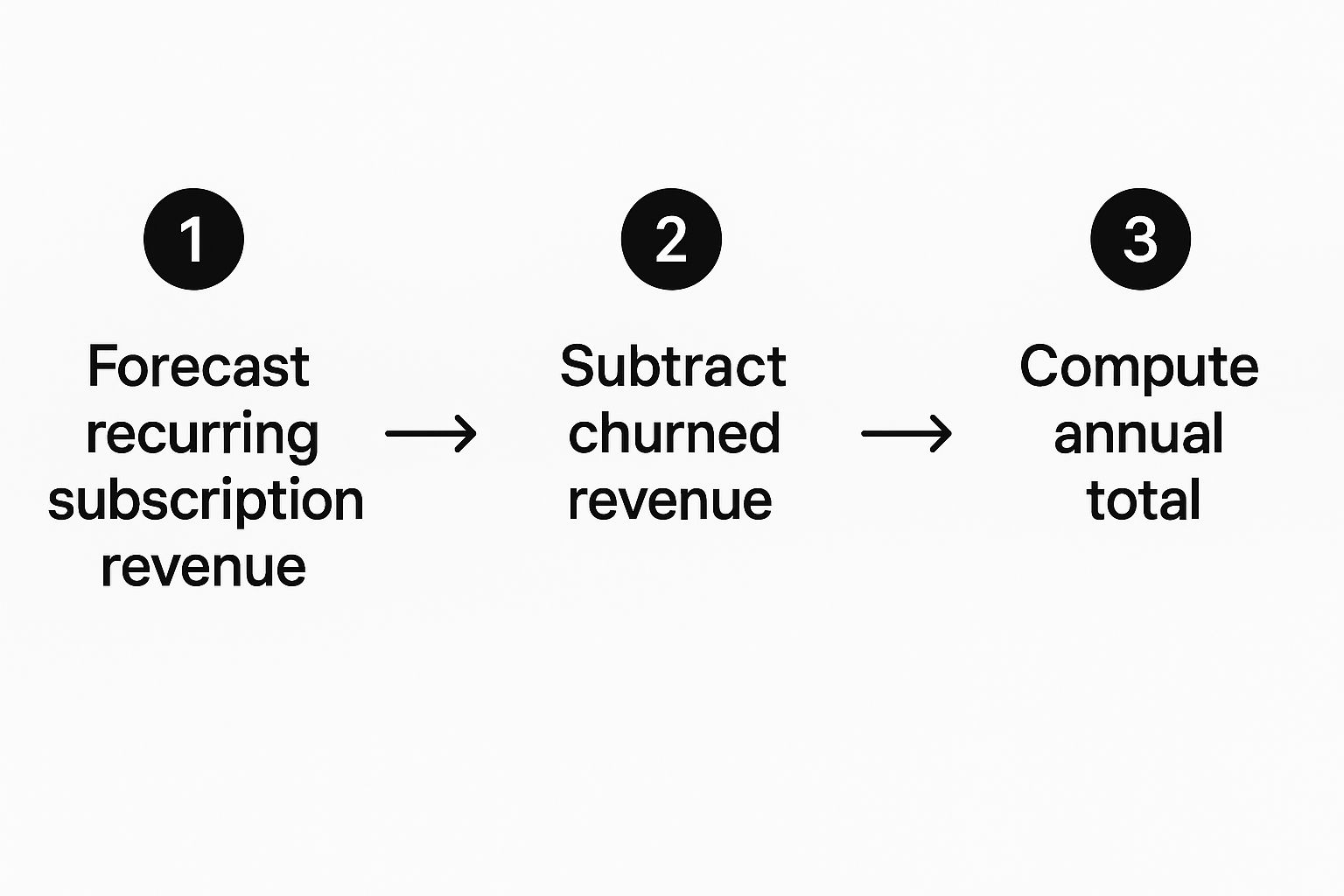
As you can see, the process begins with the recurring revenue you already have, subtracts what you’ve lost from customer churn, and adds in new business to land on your final annual total. Now, let’s unpack the individual pieces you’ll need to track.
The Ingredients of Your ARR Calculation
To get to your Net New ARR, you need to be tracking four key revenue streams. Think of them as the building blocks that, when you put them all together, tell the complete story of your growth.
- New ARR: This is straightforward—it’s the annualized revenue from brand-new customers you brought on board during a specific period. It’s a direct measure of your sales and marketing success.
- Expansion ARR: Also called upgrade revenue, this is money from existing customers who decide to spend more with you. Maybe they upgraded to a higher plan, added more users, or bought a new add-on. This is a fantastic sign of product-market fit.
- Contraction ARR: This is the flip side of expansion. It’s the revenue you lose when current customers downgrade to a cheaper plan or reduce the number of seats they’re paying for.
- Churned ARR: This is the total annualized revenue you lose when customers cancel their subscriptions and leave for good.
Keeping an eye on these components separately is crucial. For instance, strong Expansion ARR shows that your product is sticky and that customers are finding more and more value in it. These levers are fundamental to managing your business, and our guide on essential SaaS KPIs can help you build an even more complete financial dashboard.
A Practical Example
Let’s make this real. Imagine a SaaS company called “InnovateSphere” wants to calculate its ARR for the year. They kick off the year with $2,000,000 in ARR.
Here’s what happened over the next 12 months:
- They landed new deals, adding $500,000 in New ARR.
- Happy existing customers upgraded, generating $150,000 in Expansion ARR.
- A few customers downsized their plans, resulting in -$50,000 in Contraction ARR.
- Some clients unfortunately churned, leading to -$100,000 in Churned ARR.
First, let’s calculate their Net New ARR by combining all the new revenue and subtracting the losses:
$500,000 (New) + $150,000 (Expansion) – $50,000 (Contraction) – $100,000 (Churn) = $500,000 Net New ARR
Now, we add that to their starting ARR to find their end-of-year total:
$2,000,000 (Starting ARR) + $500,000 (Net New ARR) = $2,500,000
This detailed view doesn’t just show that InnovateSphere grew—it shows how they grew. They successfully brought in new business while also proving their value to their current customers, more than making up for the inevitable drag of churn and downgrades.
For those who want to get serious about tracking these numbers without the headache, tools like Baremetrics, a leading financial analytics platform for SaaS can be a lifesaver. These platforms automate all of this, giving you a real-time pulse on your financial health.
ARR vs. Annualized Run Rate

In the world of SaaS metrics, a few terms get thrown around that sound almost identical but mean very different things. The classic mix-up is between ARR and its close cousin, Annualized Run Rate. While they seem similar, treating them as the same thing is a common mistake that can seriously mess up your financial planning and leave you explaining some awkward numbers to investors.
The real difference comes down to one simple concept: commitment.
True Annual Recurring Revenue (ARR) is built on the solid ground of legally binding contracts. It’s the predictable, locked-in revenue you know is coming over the next year because customers have signed on the dotted line. It’s a measure of stability.
Annualized Run Rate, on the other hand, is more of a snapshot—a forward-looking guess. You calculate it by taking the revenue from a single month (your MRR) and simply multiplying it by 12. It’s handy for a quick “what if” scenario, but it’s a projection, not a promise.
An Analogy to Make It Stick
To really get the difference, let’s think about it in terms of your personal finances.
ARR is like your annual salary. It’s the fixed amount written into your employment contract. You can count on it, plan around it, and take it to the bank.
Annualized Run Rate is like basing your entire year’s income on a great bonus month. Imagine you’re a salesperson and you land a massive, one-time commission in January. If you multiply that month’s total earnings by 12, you’d get an exciting but completely unrealistic picture of your yearly income.
This is exactly why experienced investors and operators focus so heavily on true ARR. It shows them confirmed, long-term customer value, not just a momentary spike.
Why Does This Distinction Matter So Much?
Getting these two metrics mixed up almost always leads to an over-inflated view of a company’s financial health. An Annualized Run Rate can include one-off payments and other revenue fluctuations that aren’t guaranteed to repeat. This is where the danger lies. You can dig deeper into how these metrics are defined and used with these valuable SaaS metric resources on ChartMogul.
Key Takeaway: ARR is a measure of revenue you’ve already secured through contracts for the next year. Annualized Run Rate is a forecast based on a single moment in time (usually last month).
The difference becomes crystal clear for businesses with any kind of seasonality. Think about a tax software company. Their revenue in March and April is going to be massive. If they calculated their Annualized Run Rate based on that peak, it would paint a wildly misleading picture of their actual year-round performance.
Investors will always dig into your numbers to separate what’s committed from what’s speculative. By focusing on building true, contractually obligated ARR, you’re showing them you have a stable, predictable, and genuinely scalable business.
Comparing ARR and Annualized Run Rate
To make it even clearer, let’s break down the core differences between these two metrics side-by-side.
| Factor | Annual Recurring Revenue (ARR) | Annualized Run Rate |
|---|---|---|
| Foundation | Based on signed, term-based contracts. | A projection based on a single period’s revenue (usually one month). |
| Nature | A measure of historical, committed revenue. | A forward-looking forecast or snapshot. |
| Purpose | Measures long-term stability and predictable growth. | Provides a quick, hypothetical picture of annual scale. |
| Reliability | High. Reflects actual, legally binding agreements. | Lower. Can be volatile and misleading, especially with seasonality. |
| Best For | Strategic planning, investor reporting, and valuation. | Quick internal temperature checks and trend spotting. |
Ultimately, both metrics have their place, but knowing which one to use for what purpose is crucial. ARR is your rock-solid foundation for making big decisions, while Annualized Run Rate is more like a quick glance at the speedometer.
Common ARR Mistakes You Need to Avoid
Getting your ARR figure wrong is honestly more dangerous than not having one at all. When your number is off, you start building strategies on a shaky foundation, making bad forecasts, and maybe even hiding serious problems in the business. Knowing what ARR is also means knowing what it isn’t.
Getting this metric right comes down to discipline. It forces you to be honest about what’s truly “recurring” revenue versus what’s just a one-time payment. Dodging these common pitfalls is the first step toward building a financial compass you can actually trust.
Confusing One-Time Fees with Recurring Revenue
One of the most common—and damaging—mistakes is lumping one-time charges into your ARR. It’s a huge error because these fees, by their very nature, aren’t recurring. They just puff up your numbers and give you a false sense of stability.
These non-recurring fees often look like:
- Setup or Implementation Fees: What a new customer pays to get up and running.
- Consulting or Training Services: Extra, paid help to get the most out of your product.
- Hardware Sales: Any physical gear you sell alongside your software.
The Fix: Be ruthless here. Exclude every single one-time fee from your ARR calculation. This revenue is absolutely valuable, but it belongs in its own bucket, like “non-recurring revenue” or “professional services.” This keeps your ARR pure, reflecting only the predictable, subscription income you can count on.
Miscalculating Multi-Year Contracts
Multi-year contracts are fantastic for locking in revenue, but they’re a classic tripwire for ARR calculations. The rookie mistake is booking the entire contract value in the first year. For instance, if a customer signs a three-year deal for $30,000, it’s just plain wrong to count that full amount as this year’s ARR.
Your Annual Recurring Revenue must reflect the revenue normalized over a 12-month period. Booking a multi-year deal’s total value upfront drastically overstates your current ARR and sets you up for a massive “downsell” when the contract renews.
The Fix: Always, always annualize the total contract value. For that $30,000, three-year deal, the correct ARR contribution is $10,000 per year. This approach gives you a true, sustainable picture of your revenue base. It’s also exactly how any savvy investor or potential acquirer will look at it.
Ignoring Discounts and Trial Periods
It’s tempting to just look at your sticker price and plug that into your ARR formula, but that’s rarely what customers actually pay. Most sales cycles involve some kind of discount to get the deal over the line, and you have to account for it.
Counting a $1,000/year plan at its full value when the customer really paid $800 after a discount will quietly inflate your numbers. It might seem small on one deal, but it adds up fast.
The Fix: Your ARR must be based on the actual, final price the customer pays after all discounts are applied. This grounds your calculations in the cash you can realistically expect. Getting this right is also critical for good financial hygiene and is a key part of effective SaaS cost optimization and accurate planning.
Frequently Asked Questions About ARR
Even after we’ve walked through the calculations and common pitfalls, a few practical questions always seem to pop up. Let’s tackle some of the most common ones head-on to make sure you’re confident in how you use ARR in the real world.
Does ARR Include One-Time Fees?
The answer is a hard no. Never mix one-time fees—like setup, installation, or professional services—into your ARR calculation. It’s tempting, but it completely defeats the purpose.
The “R” in ARR stands for recurring. By definition, a one-time charge isn’t recurring. Including these fees will seriously inflate your numbers and give you a false sense of your company’s actual, sustainable revenue. Track them, absolutely, but keep them separate in a category like “Services Revenue” or “Non-Recurring Revenue.”
What Is the Difference Between MRR and ARR?
Think of Monthly Recurring Revenue (MRR) and Annual Recurring Revenue (ARR) as two different lenses for looking at the same thing: your predictable revenue stream. MRR gives you the monthly snapshot, while ARR gives you the yearly view.
The math is simple: ARR = MRR x 12.
So, which one should you focus on?
- Lean on MRR if your business primarily uses monthly subscriptions or contracts shorter than a year. It offers a more immediate, granular look at things like monthly growth and churn.
- Focus on ARR if your business is built on annual or multi-year contracts, which is common for B2B SaaS companies. ARR aligns much better with longer sales cycles and customer commitments.
Ultimately, they both measure the health of your subscription base. Your primary metric just depends on the rhythm of your business model.
Understanding the nuance between MRR and ARR helps you pick the metric that best reflects your cash flow and customer lifecycle, which is the foundation of smart strategic planning.
Can a Non-SaaS Company Use ARR?
Absolutely. While ARR got its fame in the SaaS world, any business with a subscription or recurring revenue model can—and should—use it. If your company relies on predictable income from contracts over a year, ARR is a critical health metric.
This applies to a whole range of businesses:
- Subscription box services (like meal kits or beauty boxes)
- Managed Service Providers (MSPs) in the IT world
- Media companies with recurring memberships
- Gyms and fitness centers with annual plans
If your revenue comes from ongoing customer relationships instead of one-off purchases, ARR is one of the best ways to gauge your financial stability and growth potential.
What Is Considered a Good ARR Growth Rate?
This is the classic “it depends” question. A “good” growth rate varies wildly based on your company’s size, stage, and market. What’s fantastic for a market leader could be a sign of trouble for a startup.
Still, here are some general benchmarks to give you a sense of scale:
- Early-Stage Startups ($1M – $10M ARR): It’s common to see goals of 100%+ year-over-year growth. The name of the game is capturing the market, and fast.
- Growth-Stage Companies ($10M – $50M ARR): A growth rate between 40-60% is often seen as very strong and healthy.
- Established Companies ($50M+ ARR): At this scale, maintaining a consistent 20-30% growth rate is a massive achievement.
The key isn’t hitting one magic number. It’s about showing consistent, positive growth that handily beats your churn rate. Investors want to see that clear, sustainable upward trend. Exploring different SaaS growth strategies is the best way to find the right levers to hit your target growth.
At SaaS Operations, we provide the proven playbooks and templates to help you streamline your business and accelerate growth. Stop guessing and start implementing battle-tested frameworks from operators who have built multiple 8-figure businesses. Get started with our proven playbooks today.