Template for a Strategy Document That Your SaaS Will Actually Use
 Published By: Alex
December 27, 2025
Published By: Alex
December 27, 2025
Let's get real. A good template for a strategy document shouldn't be a 50-page monster that collects digital dust. It needs to be a lean, mean, one-page machine that connects your big-picture goals directly to what your team is doing every single day. Think of it as a living system for getting things done, not some static plan that gets forgotten the moment it's finished.
Why Your Strategy Document Is Probably Gathering Dust
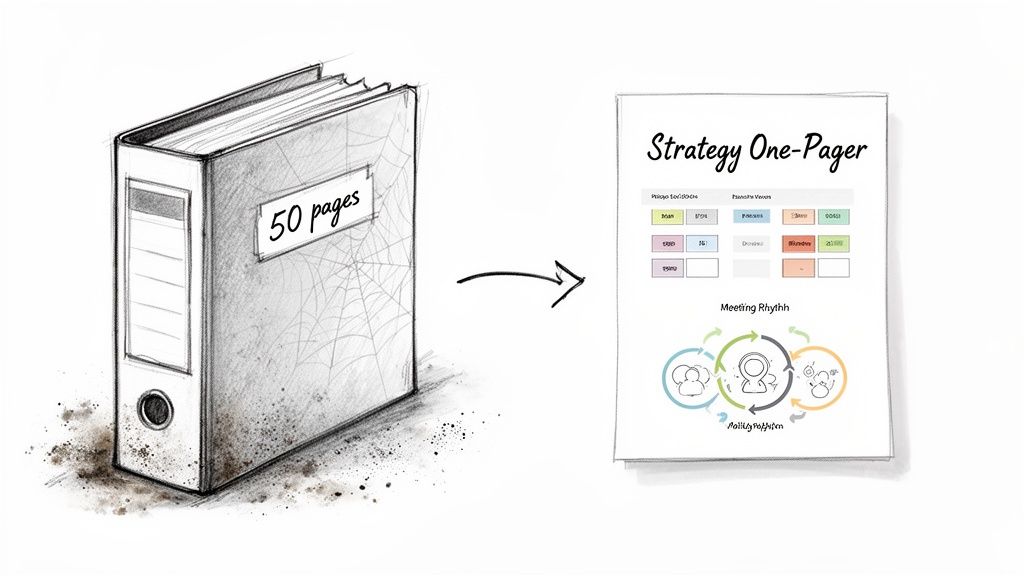
We've all been there. You spend a week in offsite meetings, fueled by coffee and ambitious brainstorming. The result? A beautiful, comprehensive strategy document that promptly dies a quiet death in a forgotten Google Drive folder.
This happens for a reason. Most of these documents are way too academic, bloated with jargon, and nobody actually owns any part of them. I worked with an 8-figure SaaS founder who had a gorgeous, 50-page strategic plan that was his pride and joy. The problem? No one ever looked at it. His big breakthrough came when he torched the whole thing and replaced it with a simple one-pager the entire company could rally behind.
That’s the exact principle this guide is built on. We’re not just creating a document; we’re building a living, breathing operational system.
The Execution Gap is Real
The biggest problem in most SaaS companies isn't a lack of ideas—it's the massive gap between planning and actually doing. The stats back this up. For instance, while a whopping 96% of SaaS content marketers say they have a strategy, only 40% have bothered to write it down.
Is it any surprise that just 29% of them feel their strategy is "very effective"? This isn't just a content problem; it's an execution crisis that a solid, usable strategy document can fix.
A great strategy doc is a bridge. It connects your lofty vision to the nitty-gritty weekly tasks your team is grinding on, ensuring every single action serves a purpose. Without that bridge, even the most brilliant plans fall flat.
From Static Plan to Living System
Our whole approach here is to turn your strategy from a theoretical exercise into a practical tool. We’re going to walk through building a template that has all the right ingredients to drive action and hold people accountable.
This isn't for people who like to write reports; it's for operators who need to get results.
Here’s a quick look at the essential parts of our template and why they matter for real-world SaaS operations.
| Component | Why It Matters for SaaS Operators | Actionable Example |
|---|---|---|
| One-Page Overview | Forces clarity and focus. If it doesn't fit on one page, it's too complicated for your team to execute. | "Increase enterprise MRR by 25% by Q4" |
| Quarterly Priorities | Breaks down the annual vision into manageable, 90-day sprints. Keeps the team from getting overwhelmed. | "Launch v2 of our integration marketplace" |
| KPI Scorecard | Provides a real-time pulse on performance. Answers the question, "Are we winning or losing?" at a glance. | Customer Churn Rate < 2% monthly |
| Meeting Cadence | Establishes a rhythm of review and accountability, ensuring the strategy stays on track and adapts. | Weekly 25-min tactical meeting |
| Ownership | Assigns a single, directly responsible individual (DRI) for every goal and initiative. No more finger-pointing. | "John Smith – Head of Product" |
This system is all about making the strategy impossible to ignore. It becomes part of the company's DNA.
The purpose of a strategy document isn't to be created; it's to be used. If your team isn't referencing it in their weekly meetings to make priority calls, it has already failed.
Ultimately, a well-designed strategy document is one of the most powerful tools you have for driving performance. It aligns the entire company, sharpens focus, and builds a culture where things actually get done. By focusing on these core elements, you can build a framework that helps you improve operational efficiency and ensures your strategy gets implemented, not just filed away.
Build a Foundation That Actually Guides Decisions
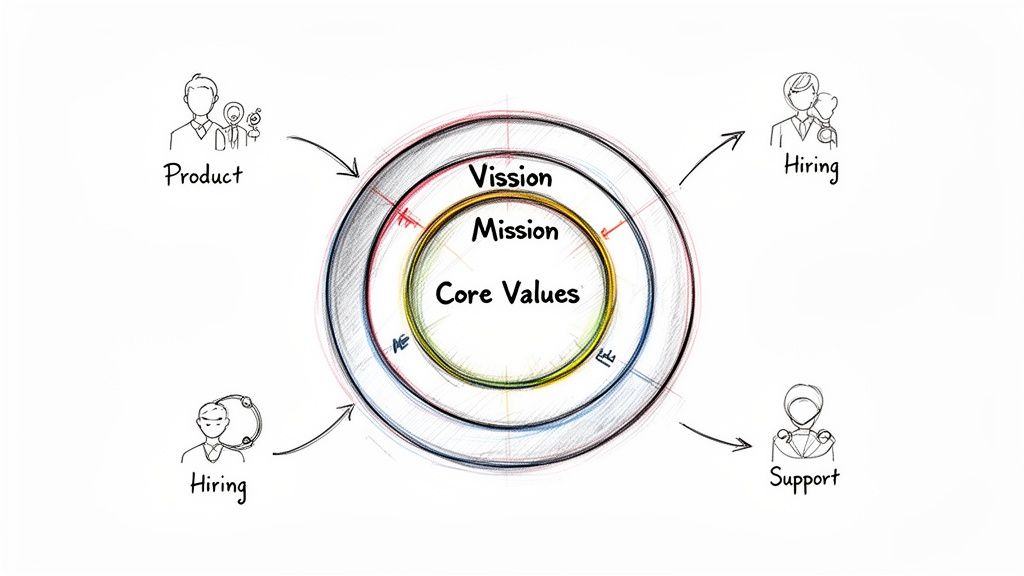
Before we even whisper the words "KPIs" or "roadmaps," let's get one thing straight. A great template for a strategy document starts with its soul. This is your foundation—your Vision, Mission, and Core Values—and it's what separates a plan that people rally behind from a document that collects digital dust.
Too many SaaS operators blow past this part, treating it like a fluffy, check-the-box exercise. Big mistake. This is the bedrock of your entire strategy.
Think of your vision statement as the North Star. It’s that big, audacious "why" that gets your team fired up to come to work. Slack’s early vision to "make work life simpler, more pleasant, and more productive" wasn't just a nice tagline. It was a filter for every single product decision they made.
Your mission, then, is the "how." It’s the focused, practical game plan for making that vision a reality. It tells everyone what you’re doing for customers right now. Without it, your team is just guessing, and guesswork in a SaaS business is expensive.
Turning Values into Operational Rules
Here’s where the rubber really meets the road, and honestly, where most companies stumble. They print their core values on cool posters and call it a day. But values aren't just for decoration; they should be the operating system for your entire business. They're the guardrails that make day-to-day decisions almost automatic.
Take HubSpot's famous value, "Solve for the Customer." That's not a suggestion—it's a directive. It gives a support rep the green light to spend an extra hour on a call to truly fix an issue. It tells a product manager to kill a pet project in favor of a feature that removes a tiny bit of user friction.
So, how do you make your values less… well, vague? You tie them to concrete actions.
- Customer Obsession: Don't just say it. Define it. "All tier-1 support tickets get a first response within one hour." Boom. That's a rule.
- Transparency: Turn it into a process. "All product roadmap changes and the 'why' behind them are shared in our monthly all-hands."
- Bias for Action: Make it a cultural habit. "We run small, reversible experiments instead of getting stuck in 'analysis paralysis' for new feature ideas."
Your core values are only real if they cost you something. They should force you to make hard choices—like firing a rockstar salesperson who's a toxic teammate or passing on a huge customer who doesn’t fit your mission.
If you're looking for inspiration on how high-level goals connect to tactical execution, checking out a solid content marketing strategy template can be surprisingly helpful. You can see the direct line from a big idea to a specific action plan.
Aligning Your Entire Operation
When your foundation is this solid, everything else just clicks into place. Hiring gets easier because you know exactly the kind of person who will thrive in your culture. Your product team stops debating every little feature because they have a clear filter for what matters.
It’s a powerful chain reaction. Your vision sets the long-term direction, your mission defines the path, and your values guide every single step your team takes along the way. Get this right, and building out the rest of your strategy becomes infinitely easier. For a deeper dive, check out our guide on strategic planning for growth.
Define the 3-5 Strategic Pillars That Matter Most
Alright, you’ve got your Vision, Mission, and Values nailed down. That’s the soul of your company. Now, it’s time to give it some muscle. A big, hairy, audacious goal is fantastic, but it won't tell your team what to do on Monday morning. You need to break that grand vision down into a few major bets for the year.
This is where your 3-5 strategic pillars come in. Think of these as the main load-bearing walls for your business over the next 12 months. They aren’t fuzzy goals like “improve marketing.” They're bold, clear directives that signal to the entire company where the real focus is.
Simply put, your pillars answer one critical question: "If we can only crush a few things this year, what are they?"
From Vision to Actionable Bets
This is the bridge between your high-level dream and the day-to-day grind. A vision to "democratize data analytics for small businesses" is inspiring, but it's not a product roadmap. Strategic pillars make it one.
Let's see how that vision translates into real, actionable pillars:
- Pillar 1: Dominate the E-commerce Niche. Boom. Now your marketing and sales teams know exactly who to go after. This dictates ad spend, content, and partnership outreach.
- Pillar 2: Achieve Best-in-Class User Onboarding. This is a direct order to your product and success teams. Their mission? Relentlessly kill friction for new users because that's how you win the market.
- Pillar 3: Build a Partner-Driven Ecosystem. This signals a major shift in strategy. Instead of just direct sales, you’re now focused on integrations and channel partners as a core growth engine.
Each of these is a massive, all-hands-on-deck commitment. They provide the clarity every department needs to align their own goals and stop pulling in different directions.
The Power of Ruthless Focus
Why only three to five? Because any more than that isn't a strategy—it's a wish list. The real power here is forcing tough decisions. What are you explicitly not going to do this year? For most founders, this is the hardest part.
I once worked with a SaaS operator whose company was completely stalled out. They were trying to do it all: move upmarket, expand to Europe, launch a new product, and build a services arm. All at once. It was a classic case of being a master of none, and their progress on every front was painfully mediocre.
The breakthrough came when we sat down and brutally chopped their strategy down to just three pillars:
- Win the mid-market segment in North America.
- Slash customer churn by 50%.
- Get product-market fit for their new AI add-on.
That was it. Anything that didn't directly push one of those pillars forward was cut or shelved. The change was almost immediate. You could feel the energy shift. With resources no longer spread thin, the team found a new gear, and their key metrics started climbing within two quarters.
Trying to be great at everything guarantees you’ll be good at nothing. Your strategic pillars are a public declaration of what you will be great at this year. Everything else is just noise.
Defining Your Own Pillars
To figure out your pillars, you have to get real about where you stand right now. A solid first move is to map out where your business is today versus where you want it to be. Using a framework like our gap analysis template is perfect for this—it will help you uncover the biggest threats and opportunities staring you in the face.
For every pillar you add to your strategy doc, you need to define two things:
- The Why: A short, punchy statement explaining why this is critical to your mission. Why this? Why now? You need this rationale to get your team fired up and bought in.
- The Desired Outcome: What does victory look like in 12 months? Make it measurable. For "Dominate the Mid-Market Segment," a great outcome would be: "Become the #1 rated solution for mid-market teams on G2 and hit $2M in new ARR from this segment."
This simple structure ensures every pillar is an objective with a clear purpose and a finish line, not just a bunch of busywork. It’s how you make sure every task and project ties back to a core priority, eliminating wasted effort and creating powerful alignment across the board.
Turn Your Strategy Into a Scorecard You Can't Ignore
A strategy without numbers is just a nice idea. Once you've defined your core strategic pillars, you have to translate them into a scorecard that tells you, in 30 seconds or less, if you're winning or losing. This isn't about vanity metrics; it's about creating an undeniable source of truth that drives real accountability and focus across the entire company.
A world-class strategy document acts as your central command for operations. I've consulted with SaaS companies buried under a mountain of disconnected tools and processes—a common symptom of "SaaS sprawl." They had redundant software, conflicting data, and teams pulling in opposite directions. The core problem was a lack of a central, documented strategy.
As the global SaaS market barrels toward $300 billion in 2025, companies without a templated framework are getting left in the dust. Research shows they can waste up to 14% more on sales and marketing for every new dollar of ARR because nobody is aligned. A unified strategy document prevents this chaos.
Lagging vs. Leading Indicators
This is where most SaaS operators get it wrong. They build scorecards that only track lagging indicators. A lagging indicator is an output metric—it tells you what already happened.
- Monthly Recurring Revenue (MRR): The ultimate lagging indicator. It's the final score from all your past sales and marketing plays.
- Customer Churn Rate: This shows you how many customers you lost last month, not how many you're about to lose next month.
- Net Revenue Retention (NRR): A fantastic metric for overall health, but it's a reflection of past success with your existing customer base.
These numbers are absolutely crucial, but they don't predict the future. To actually steer the ship, you have to obsess over leading indicators. These are the input metrics that forecast what's coming. They're the activities and behaviors that, if you nail them today, will make your lagging indicators go up tomorrow.
A great scorecard tells a story. The leading indicators are the plot points that determine the ending—your lagging indicators. If you don't like the ending, you have to go back and change the plot.
This is how your big-picture vision breaks down into actionable pillars, which then become the very foundation of your scorecard.
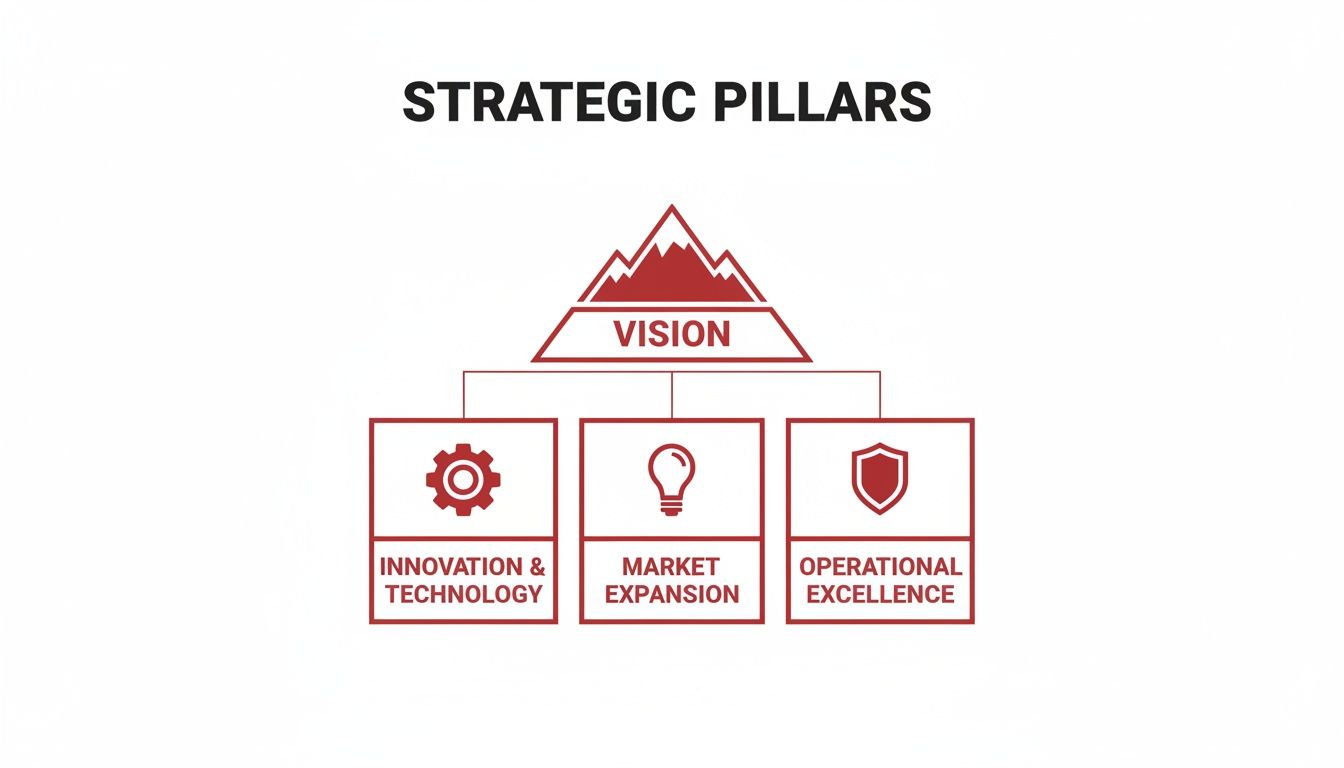
This visual shows exactly how it should work. Every single KPI on your scorecard has to directly support one of these pillars, and every pillar has to serve the company's ultimate vision. No exceptions.
Building Your Plug-and-Play Scorecard
For each of your 3-5 strategic pillars, you're going to define a handful of KPIs. The magic trick here is to assign one leading and one lagging indicator to each pillar. This creates an incredibly powerful feedback loop.
Let's use our earlier pillar, "Dominate the E-commerce Niche," as a real-world example.
Pillar: Dominate the E-commerce Niche
- Owner: Head of Marketing
- Lagging Indicator: New MRR from E-commerce Segment
- Target: Increase by $50k/month by Q4
- Leading Indicator: # of Qualified Demos with E-commerce Leads
- Target: 40 demos per week
See what happens? The Head of Marketing now has a crystal-clear mission. If the team is hitting their 40 demos a week (the leading metric), it’s almost a given that the new MRR (the lagging metric) will follow. If they're missing the demo target, they can see it in real-time and fix it, instead of waiting until the end of the quarter to find out they blew their revenue goal.
Here’s another one for a product-focused pillar.
Pillar: Achieve Best-in-Class User Onboarding
- Owner: Head of Product
- Lagging Indicator: Trial-to-Paid Conversion Rate
- Target: Increase from 15% to 25%
- Leading Indicator: Activation Rate (Users complete 3 key actions)
- Target: 60% of new signups activated within 24 hours
This structure forces total operational clarity. The product team knows their day-to-day focus isn't some vague goal like "improving the product." It's specifically about driving users to complete those three key actions. Their success on that front directly predicts an increase in paid conversions.
A well-designed scorecard makes your strategy tangible and non-negotiable. For more in-depth ideas, our guide on performance scorecard examples has some battle-tested templates you can steal. The goal is simple: anyone in your company should be able to look at the scorecard and know, instantly, if you’re on track to win.
Install an Operating Rhythm That Drives Execution
Look, a killer strategy document and a sharp-looking scorecard are great. But let's be honest—on their own, they're just artifacts. They’ll gather digital dust if you don't build a consistent operating rhythm to bring them to life. A plan only works when you work the plan, and that means installing a disciplined cadence of meetings and reviews.
This isn’t about jamming more meetings onto everyone’s calendar. It’s about being deliberate and installing the right meetings that make execution practically unavoidable. We're building a system where your strategy is constantly front and center—being reviewed, debated, and acted on. This rhythm is what turns a static document into the living, breathing engine of your growth.
You have to get this right. Each meeting in this cadence has a very distinct purpose, a specific guest list, and a razor-focused agenda. If you mess up any of those ingredients, you just get more noise and less signal.
The Weekly Tactical Check-In
Think of this as your front-line, in-the-trenches meeting. It’s fast, it's focused, and it's all about tactics. The one and only goal here is to review progress against the week’s priorities and bulldoze any immediate obstacles out of the way.
This is absolutely not the place for big, philosophical debates about strategy. It's a 25-minute huddle, not a two-hour workshop.
- Attendees: Department heads and key project owners. Keep the invite list lean.
- Purpose: Review weekly KPI progress and clear roadblocks.
- Core Question: Are we on track to hit this week's numbers, and if not, what do we need to do right now to get back on track?
The agenda is brutally simple. Everyone shares their top priority for the week, gives it a status—red, yellow, or green—and states what they need to succeed. It’s a powerful way to keep the team aligned and accountable on a micro-level. We've seen SaaS operators completely transform their execution speed just by implementing this one simple ritual.
If you want to make this meeting hyper-effective, check out our guide on crafting the perfect weekly team meeting agenda.
The Monthly Strategic Review
If the weekly meeting is about the trees, the monthly review is your chance to look at the whole forest. This is where you zoom out. You’ll pull out that company scorecard you built and make it the undeniable centerpiece of the conversation.
This meeting is for analysis and course correction, not just status updates.
I see so many SaaS leaders fall into this trap: they use monthly meetings for show-and-tell. The scorecard isn't a report card to be presented; it's a diagnostic tool to be debated. The most important question you can ask is 'why?'—why are we off track, and what's the real story hiding behind the numbers?
An operator I know at a fast-growing FinTech SaaS has a brilliant rule for this meeting: "No surprises." If a metric is trending red, it should have been flagged in the weekly check-ins long before it shows up on the monthly scorecard.
Here’s a simple but effective agenda that works:
| Section | Time Allotted | Purpose |
|---|---|---|
| Scorecard Review | 20 minutes | Run through each KPI against its target. Only discuss the reds and yellows. |
| Pillar Deep-Dive | 25 minutes | Focus on one strategic pillar. The owner presents key insights and progress. |
| Key Risks & Issues | 10 minutes | Surface any new threats to the plan that weren't on the radar. |
| Action Items | 5 minutes | Clearly define who is doing what by when. No ambiguity allowed. |
This structure keeps every conversation tethered directly to your strategy and scorecard, ensuring you’re always talking about what actually moves the needle.
The Quarterly Planning Deep-Dive
This is your big reset. Once a quarter, you and your leadership team need to pull yourselves out of the day-to-day grind and really pressure-test the entire strategy. It’s your chance to ask the tough questions.
Are our strategic pillars still the right bets? Has the market shifted under our feet? What did we really learn from the last 90 days?
This session isn't just a retrospective on the last quarter; it's about setting clear, ambitious priorities for the next one. This is where you'll update your scorecard targets and define the major initiatives that will get you there. When you install this consistent rhythm of execution, your strategy document stops being just a plan and becomes the very heartbeat of your operation.
Your Questions Answered
Look, building a strategy doc is one thing. Actually getting it to work inside your company, day in and day out? That’s a whole different beast. SaaS operators tend to hit the same walls over and over again. Here are a few of the most common questions I get, along with some straight talk from the trenches.
How Often Should We Update Our SaaS Strategy Document?
You have to think about your strategy doc in layers. The big stuff—your vision and mission—that’s your North Star. It shouldn't be changing all the time. A quick check-in once a year to make sure it still feels right is usually enough.
But your strategic pillars and your scorecard? That’s your active game plan. It needs to be alive.
I’m a huge believer in a quarterly refresh for your main pillars and KPIs. That 90-day cycle is the magic number for a scaling SaaS company. It gives you enough time to actually get something significant done, but it’s short enough that you can still pivot based on new customer feedback, a competitor's move, or just plain old data telling you you’re on the wrong track.
Think of it this way: your weekly meetings are for tackling the small stuff and clearing roadblocks. The quarterly review is where you zoom out and make the big, strategic course corrections. It’s that mix of long-term vision and short-term agility that really sets successful companies apart.
What's the Biggest Mistake Founders Make With Strategy Docs?
Easy. They make it way too complicated and then stuff it in a drawer to die. I’ve seen it a hundred times. Founders treat their strategy doc like some kind of sacred text they have to perfect. They cram it full of SWOT analyses, five-year financial models, and buzzwords until it's a 50-page masterpiece that no one on the team can actually use.
A strategy document is not a business school project; it's a tool. It's a hammer, not a trophy.
The goal isn't to create the perfect document—it's to create clarity and a system for execution. If your team isn't referencing the strategy document in their weekly meetings to make priority calls, it has already failed.
Keep it simple. Keep it visible. Use it constantly. A scrappy one-pager that your team actually uses every single day is infinitely more valuable than a perfect, laminated binder that collects dust. The second it becomes a "set it and forget it" exercise, you've already lost.
How Do I Get My Team to Actually Buy Into the Strategy?
You can’t force buy-in with a rah-rah all-hands meeting or a motivational email. It just doesn't work that way. Real, lasting buy-in comes from two things and two things only: involvement and clarity.
First, pull your leaders into the process from the very beginning. When you're hashing out your big strategic goals for the year, get your department heads and even some key individual players in the room. Don't just lecture them—ask for their honest, unfiltered take on the biggest challenges and opportunities they see. People support what they help create.
Second, and this is the part most founders miss, you have to connect the dots for every single person on your team. Show them exactly how their daily work ties back to the company’s main goals.
- For your engineer: "Hey, that feature adoption metric you’re focused on? It directly fuels our 'World-Class Onboarding' pillar, which is how we’re going to crush our trial-to-paid conversion goal."
- For your marketer: "Every qualified demo you generate for the e-commerce segment is the #1 leading indicator for our primary company objective this year. You're at the tip of the spear."
When an employee sees precisely how their work moves the big needle, the strategy stops being "the CEO's plan" and becomes "our plan." That's the moment you get real alignment, and that's when things really start to take off.
At SaaS Operations, we provide battle-tested playbooks and templates just like this to help you build a more efficient and effective business. Stop reinventing the wheel and start implementing proven systems for growth. Get the frameworks you need to scale.