How to Improve Operational Efficiency: Proven Strategies
 Published By: Alex
September 1, 2025
Published By: Alex
September 1, 2025
Improving your operational efficiency isn't just about cutting costs. It's about striking a powerful balance between the resources you invest—time, effort, and money—and the results you get back in value, quality, and speed.
The path forward is clear: first, you have to pinpoint where things are breaking down. From there, you can start refining and automating your core processes, empowering your people, and tracking what actually works. This guide breaks down that exact four-pillar approach.
What Operational Efficiency Really Looks Like
So many leaders hear "operational efficiency" and immediately think "slash the budget." While saving money can certainly be a nice side effect, the real goal is much bigger and more strategic than that.
It's about building a well-oiled machine where every ounce of effort produces the maximum possible result. You're not just eliminating wasted budget; you're cutting out wasted time and unlocking your team's true potential. This is the engine that actually drives sustainable growth.
Think of it as the classic difference between being busy and being productive. A team can stay incredibly busy manually entering data, sitting in back-to-back meetings, and chasing down approvals. They’re definitely working, but the company isn't getting a great return on all that activity. An efficient operation, on the other hand, funnels that same energy into high-impact work that customers notice and that moves the needle on revenue.
The Sneaky Signs of Inefficiency
Inefficiency is a master of disguise, often hiding in plain sight as "the way we've always done things." Learning to spot the subtle red flags is the first real step toward making things better. These problems might seem minor on their own, but together, they create a massive drag on the entire business.
Keep an eye out for these common symptoms:
- High Employee Burnout: When good people spend their days wrestling with clunky processes or drowning in repetitive, mind-numbing tasks, frustration is guaranteed. So is turnover.
- Inconsistent Client Experiences: If a customer’s experience depends entirely on which person they happen to talk to, it’s a dead giveaway that your processes aren't standardized or reliable.
- Painfully Slow Decision-Making: Delays pile up when data is stuck in different systems, hard to access, or has to be manually stitched together. It ties leadership's hands and stalls progress.
This isn't just a problem inside company walls; it's a global economic issue. On a macro level, labor productivity is the ultimate measure of operational efficiency. In 2023, the average labor productivity growth across all OECD countries was a sluggish 0.6%, which highlights just how common this struggle is. For a closer look at these trends, you can explore the data directly on OECD.org.
At its core, operational efficiency is about removing friction. It’s about making it easier for your team to do their best work and for your customers to get the value you promise.
For a deeper look into high-level approaches, check out this guide on proven strategies to improve operational efficiency. Here, we’re going to get tactical and focus on the playbooks you can run, starting with the four foundational pillars.
Before we dive into the specific playbooks, it's helpful to see how these four pillars fit together to create a modern, efficient operating model.
Four Pillars of Modern Operational Efficiency
| Pillar | Core Focus | Primary Goal |
|---|---|---|
| Processes | Defining and documenting the "how" for repeatable tasks. | Create consistency, reduce errors, and make work scalable. |
| Automation | Using technology to handle manual, repetitive work. | Free up human talent for strategic, high-value activities. |
| Rhythms | Establishing a cadence for meetings and communication. | Ensure alignment, accountability, and proactive problem-solving. |
| People | Empowering the team through clear roles and scorecards. | Drive ownership, measure what matters, and foster growth. |
Each of these pillars builds on the others. Strong processes are the blueprint for effective automation, while clear rhythms and empowered people ensure the whole system runs smoothly. Now, let's get into how to build them.
Finding Your Hidden Operational Bottlenecks
You can't fix what you can't see. Before you can start improving things, you have to play detective and uncover the hidden friction points that quietly drain time, money, and morale from your business. Guesswork and gut feelings just won't cut it—you need a structured way to diagnose what's really going on.
This means moving past assumptions with a deliberate "inefficiency audit." This isn't about pointing fingers. It's about getting a clear, unbiased picture of how work actually gets done by stepping back from the daily grind and looking at your workflows with a fresh, critical eye.
Too many companies skip this part and jump straight to buying new software, hoping for a quick fix. This is a classic mistake. It often means you just automate a broken process, which only helps you do the wrong things faster. A methodical approach ensures you’re targeting the actual problem, not just a symptom.
Visualize Your Workflows with Process Mapping
The most powerful first step is process mapping. This is just a fancy way of saying you create a flowchart of a process from start to finish. It forces you to document every single step, decision point, and handoff.
You'd be surprised what you find. Process mapping immediately exposes redundancies, unnecessary delays, and confusing steps that team members have just learned to live with. It turns an abstract complaint like "onboarding takes too long" into a concrete map where you can pinpoint the exact source of the hold-up.
This visual shows just how much clarity you can get when you map things out.
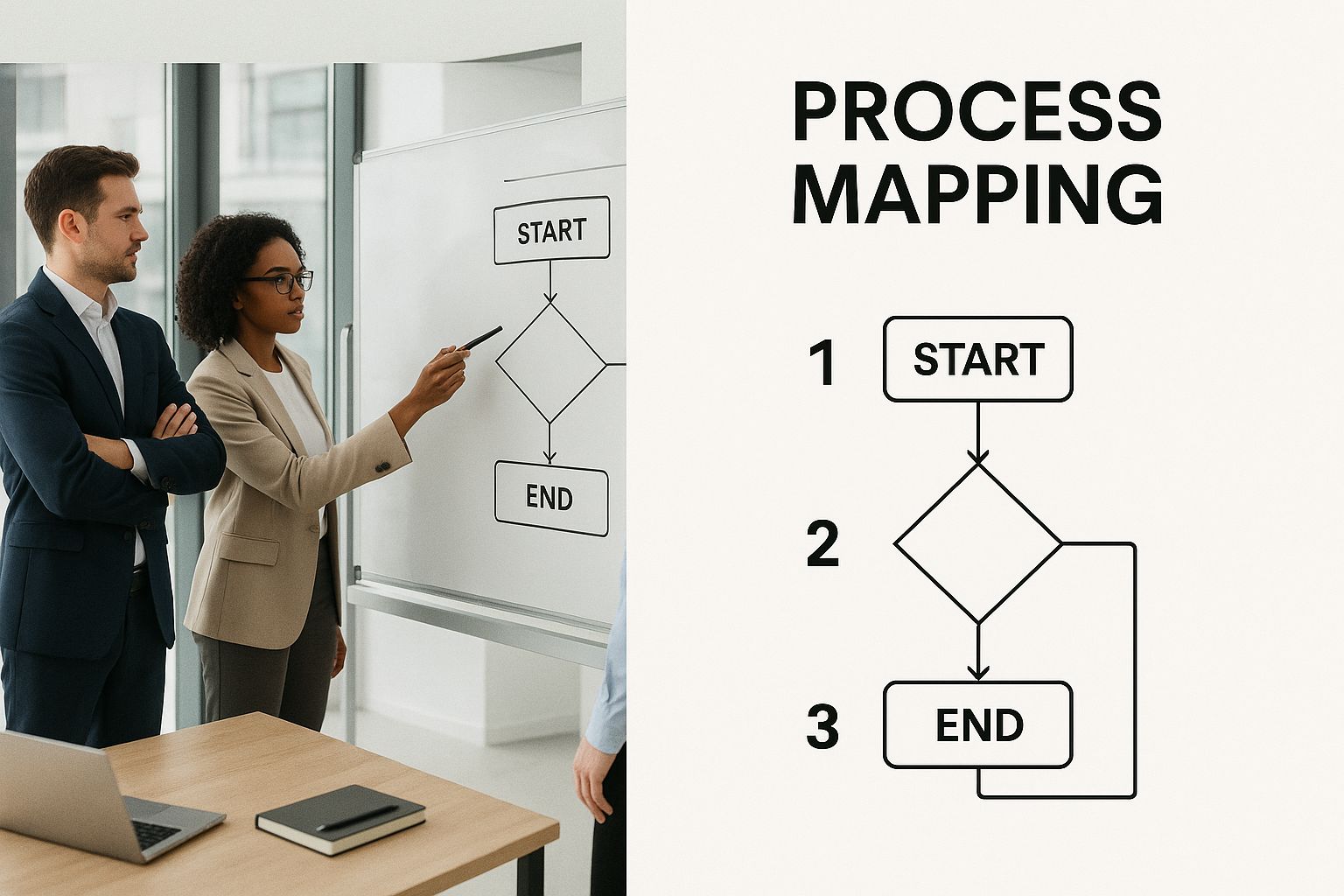
When every action and decision is laid out, teams can instantly see where communication breaks down or where work is being duplicated.
Documenting these workflows is a foundational piece of the puzzle. For a deeper guide on how to do this right, check out our article on effective business process documentation.
The goal of process mapping isn't to create a perfect diagram. The real value comes from the conversations and discoveries that happen when your team collaborates to build the map itself.
Get to the Root Cause with the Five Whys
Once your process map highlights a problem, the next step is to figure out why it's happening. The Five Whys is a simple but incredibly effective technique for digging past surface-level issues to find the real root cause.
You just state the problem and ask "Why?" five times. Each answer becomes the starting point for the next question.
Let's walk through a real-world SaaS scenario:
- Problem: Customer onboarding is consistently delayed.
- Why? Because the support team isn't getting the setup information on time.
- Why? Because the sales team isn't filling out the handoff form correctly.
- Why? Because the form is confusing, and they don't know which fields are critical.
- Why? Because their training barely covered the handoff process.
- Why? Because sales and support never actually sat down together to design the process.
See what happened? Without this exercise, the company might have blamed the support team for being slow or spent a fortune on new project management software. The real issue, a communication and process gap between two departments, was a much cheaper and more impactful problem to fix.
Gather On-the-Ground Intelligence
Finally, no diagnosis is complete until you talk to the people who do the work every day. Your frontline employees know the real story—they understand the nuances, the workarounds, and the frustrations of a process better than anyone.
Conduct some informal stakeholder interviews to get their insights. The key is to ask open-ended questions that encourage honest feedback.
Here are a few questions I like to use:
- "If you could wave a magic wand and fix one thing about this process, what would it be?"
- "What's the most frustrating or time-consuming part of your day?"
- "Where do you find yourself waiting for information or approval from someone else?"
These conversations do more than just uncover problems; they make your team part of the solution. When people feel heard, they become far more invested in improving the processes they own. By combining process maps, the Five Whys, and direct feedback, you build a complete picture of your operational reality, letting you focus on the changes that will truly move the needle.
Building Smarter Workflows with Automation
Once you’ve hunted down your operational bottlenecks, it’s time to design smarter, more efficient ways of working. This is where process refinement and automation come together, and it’s absolutely critical to tackle them in that order.
I can't stress this enough: never automate a broken process. It's a classic mistake. I’ve seen teams jump straight to a fancy new tool, hoping it will fix their messy workflow. All it does is help them do the wrong things faster.
Think of it like paving a road. You wouldn't just pour asphalt over a bumpy, winding dirt path, right? You'd straighten it out and grade it first. The same logic applies here. You have to simplify and fix the process before you ever bring software into the picture. A clean, logical manual process is the perfect blueprint for great automation.

First Refine, Then Automate
Let's look at a real-world example. I once worked with an accounts payable team that was completely swamped with manual invoice processing. Their workflow was a chaotic mix of emails, spreadsheets, and printed papers that needed to be hand-delivered for signatures.
Before even looking at a single automation tool, the Operations Manager wisely decided to map out exactly what was happening.
- Mapping the "As-Is": She discovered that a single invoice touched seven different people, lived in three separate spreadsheets, and required an average of four follow-up emails. It was a mess.
- Finding the Waste: It quickly became obvious that two of the approval steps were completely redundant. Plus, manually typing data from PDF invoices into a spreadsheet was causing a ton of errors.
- Designing the "To-Be": With this insight, the manager redesigned the entire flow. The new process had just one point of data entry and a simple two-step approval—first the department head, then finance. Clean and simple.
Only after they had this streamlined process on paper did the team start looking at software. Because their needs were so clear, they knew exactly what to look for: a tool that could pull data from an invoice, send it through their new two-step approval flow, and sync the final info with their accounting system.
This saved them from buying a bloated, overly complex system. Instead, they got a lean, effective tool that perfectly matched their needs. For a deeper dive on these strategies, our guide on implementing workflow automation for SaaS is a fantastic starting point.
The Rise of Low-Code and No-Code Platforms
Automation has become a massive lever for improving operational efficiency. When done right, these tools can take over the predictable, time-sucking tasks that bog your team down. But again, their success hinges on solid process mapping before you start building.
In the past, building any kind of custom automation meant getting in a long queue for the engineering team. Today, things are different. Low-code and no-code platforms have completely changed the game, putting the power to automate directly into the hands of the people doing the work.
These tools let non-technical team members build their own simple apps and workflows using intuitive drag-and-drop interfaces. The impact on a company’s culture is huge.
- Empowerment: Frontline employees can now solve their own problems, which creates a powerful sense of ownership.
- Speed: Instead of waiting months for IT, teams can build and launch a solution in a matter of days.
- Relevance: The people who know the process best are the ones building the solution, which means it’s almost always more practical and effective.
When your team can build its own tools to be more efficient, you create a culture of continuous improvement that bubbles up from the ground floor. Technology stops being a bottleneck and starts being an enabler.
This shift helps make efficiency everyone's job. It’s no longer some top-down initiative. When a marketer can build a quick automation to sort new leads or a support agent can create a workflow to track escalations, the whole organization gets faster and smarter.
Of course, with more people building things, you need to stay organized. Keeping clear records of these projects is key. Using an effective meeting minutes template for any cross-functional projects ensures that action items are clear and everyone knows who is responsible for what.
By combining sharp process refinement with accessible automation, you build a company that not only runs better today but is built to adapt and improve for whatever comes next.
Building a Culture of Continuous Improvement

While optimized processes and shiny new automation tools are great, they're only half the story. The real engine behind operational excellence is your people. To make any efficiency gains last, you have to build a culture where everyone—from the CEO to the newest hire—is actively looking for ways to make things better, every single day.
This isn't about top-down mandates or chasing some abstract metric on a dashboard. It’s about creating an environment where your team feels valued, heard, and genuinely empowered to spot and fix inefficiencies themselves. When your people are engaged, they become your greatest source of innovation and your first line of defense against wasted time and effort.
The link between employee well-being and productivity is rock-solid. Burnout isn't just a personal problem; it’s a massive operational drag. It leads to mistakes, absenteeism, and high turnover—all of which kill efficiency. A supportive culture, on the other hand, unlocks what I call "discretionary effort." That's the extra bit of care and creativity people choose to give when they actually feel connected to their work and their team.
Empowering Your Team with Ownership
Real empowerment starts with trust. The people on the front lines have a ground-level view of your processes that leadership can never quite get. They know all the workarounds, the frustrating extra clicks, and the daily friction points. Your first move is to create a clear, simple way for them to share these insights.
Try setting up a dedicated "inefficiency report" channel in Slack or whatever project management tool you use. Encourage team members to flag processes that feel clunky or slow, making it clear there's no blame involved. Frame it as a collective problem-solving opportunity, not just complaining. When someone points out an issue, celebrate it! This shows you’re serious about improving and that you value their perspective.
This simple shift changes the dynamic from "management fixes problems" to "we fix problems together." It’s a foundational principle of effective SaaS operations management, where agility and team-wide input are critical for growth.
A culture of continuous improvement doesn't just happen. It's the direct result of leaders who actively listen, empower their teams, and treat every problem as a chance to get better together.
The global cost of a disengaged workforce is staggering, estimated at around $8.9 trillion in lost GDP. It’s a stark reminder of the massive inefficiency that comes from a lack of motivation. When you also consider that poor employee health costs U.S. businesses an estimated $575 billion in lost productivity, the business case for investing in your team’s well-being is undeniable. You can dig into more of these productivity statistics for 2025 on myhours.com.
Investing in Skills as a Force Multiplier
Giving your team a voice is crucial, but giving them the skills to act on their ideas is where the real magic happens. Investing in training isn't just a perk; it's a direct investment in your company's operational horsepower. When you teach your team how to analyze a workflow, identify a root cause, or use a new automation tool, you create a force multiplier for efficiency.
And this doesn't have to mean expensive, off-site training sessions. Some of the best skill-building happens right in the flow of work.
- Lunch-and-Learns: Ask a team member who's a whiz at a certain software or process to share their shortcuts with the group over lunch.
- Cross-Training: Let employees from different departments shadow each other for a day. A marketer who truly understands the sales handoff process is far more likely to spot ways to improve it.
- "Fix-It Fridays": Set aside a few hours every other week for teams to tackle small process improvements they've identified themselves.
This kind of investment pays off in ways that go far beyond the specific skills learned. It sends a powerful message that you trust your people to be part of the solution and are willing to bet on their growth.
Creating Psychological Safety
At the end of the day, a culture of continuous improvement can only thrive in an environment of psychological safety. This simply means creating a space where people feel safe enough to take risks, ask questions, and admit mistakes without fear of being punished or shamed.
When teams feel psychologically safe, they're much more willing to:
- Challenge the status quo: They’ll question "the way we've always done it" and bring new ideas to the table.
- Report problems early: Instead of hiding small issues that can snowball into big ones, they'll bring them up when they're still easy to fix.
- Collaborate honestly: Team members will give and receive candid feedback, which leads to faster learning and better results for everyone.
Leaders can build this environment by modeling vulnerability themselves, celebrating what was learned from failures, and consistently reinforcing that the goal is to fix the process, not blame the person. By focusing on the human element, you turn the quest for operational efficiency from a mechanical task into a shared, energizing mission.
How to Measure and Sustain Your Progress
Fixing a broken process feels great, but that's just the first step. The real test is making sure those improvements actually stick. Without a way to measure your progress and hold the line, it’s all too easy for teams to slip back into old, comfortable habits.
This is where you move from one-off fixes to building a true operating rhythm for the business. The goal is to make monitoring, analyzing, and iterating a core part of your company’s DNA. When this becomes second nature, you stop doing efficiency projects and simply become an efficient organization.
This final piece of the puzzle turns your hard-won gains into a lasting advantage. It’s all about creating the feedback loops that keep your team aligned, accountable, and laser-focused on what really drives the business forward.
Beyond Vanity Metrics with Operational Scorecards
To know if your changes are actually working, you have to measure them. Simple enough, right? But it's dangerously easy to get lost tracking metrics that look impressive on a chart but don’t mean a thing for the health of the business. These are "vanity metrics."
The antidote is an operational scorecard. Think of it as a curated dashboard of Key Performance Indicators (KPIs) tied directly to your operational goals. It’s not a data dump; it's a focused, at-a-glance view of your company's vital signs.
For a SaaS company, this means looking past basic website traffic and zeroing in on metrics that tell the real story of your efficiency.
Here are a few examples of operational KPIs that actually matter:
- Customer Onboarding Time: How many days does it take for a new customer to be fully set up and seeing value? A downward trend here is a massive win.
- Average Ticket Resolution Time: How fast is your support team closing customer issues? This is a direct reflection of your support workflows and tooling.
- Sales Cycle Length: How long, on average, does it take to close a new deal? Shortening this is a clear sign of an efficient sales process.
- Feature Adoption Rate: After a new feature launch, what percentage of relevant users try it within the first 30 days? This tells you how effective your product-to-market handoff is.
These aren't just numbers; they tell a story about how well your machine is running. They expose friction points and prove where your process improvements are paying off. Most importantly, they give your teams a clear, objective target to hit.
Establishing Your Meeting Rhythms
Scorecards give you the data, but meeting rhythms are where you turn that data into action. A consistent cadence of meetings ensures everyone stays aligned and small problems get squashed before they spiral into big ones.
This isn't about jamming more meetings onto the calendar. It's about having fewer, more effective meetings, each with a crystal-clear purpose.
A simple yet powerful cadence could look like this:
- Daily Huddle (15 mins): A quick stand-up for teams to sync on the day's priorities and flag any immediate blockers. No fluff.
- Weekly Operations Review (60 mins): This is the heart of your operating rhythm. You review the scorecard, dig into what’s on or off track, and assign clear action items.
- Monthly Deep Dive (90 mins): A dedicated session to analyze longer-term trends and brainstorm solutions for bigger, more complex operational challenges.
- Quarterly Strategy Review (Half-day): A chance to zoom out. Review the quarter’s performance against goals and set the operational priorities for the next 90 days.
Don’t just track numbers on a dashboard. Create a dedicated time and space for your team to talk about those numbers, understand the story they tell, and agree on the next chapter.
The Weekly Operations Review Agenda
The Weekly Ops Review is the most critical meeting in this entire rhythm. It's the drumbeat that keeps the whole company in sync. To keep it focused and productive, you need a tight, repeatable agenda.
Here’s a simple structure that just works:
- KPI Scorecard Review (15 mins): Run through the operational scorecard. Celebrate the green, but spend your time on the red and yellow. The owner of each metric gives a quick, no-nonsense summary of the result.
- Root Cause Analysis (25 mins): For any metric that's off track, the team digs into the "why." This isn't about blame; it's about collaborative problem-solving. What happened? What did we learn from it?
- Action Item Planning (15 mins): Based on the discussion, define specific, concrete action items. Every single action needs one owner and a firm due date. No exceptions.
- Recap and Close (5 mins): The meeting leader quickly summarizes the key decisions and assigned actions so everyone walks out knowing exactly what comes next.
This structure forces the conversation to be data-driven and action-oriented. Over time, it trains your whole team to think like operators—always looking at the data, asking why, and finding ways to improve. It’s this sustained focus that separates companies that get a little better from those that achieve lasting operational excellence. Tracking these changes alongside financial metrics is crucial, and you can learn more about how operational improvements impact your bottom line by understanding key SaaS metrics like Annual Recurring Revenue.
Got Questions About Operational Efficiency? (You’re Not Alone)
As you start digging into how to make your operations run smoother, it's completely normal for questions and roadblocks to pop up. Everyone hits the same sticking points. Let’s walk through some of the most common questions I hear from leaders when they begin this work.
"Where On Earth Do I Start?"
This is always the first question. Looking at everything at once is a recipe for paralysis. You can’t boil the ocean.
My advice? Start small. Pick one single, high-friction process that’s a constant headache for either your customers or your own team. Use a simple tool like process mapping to find the most obvious bottleneck and focus all your energy there. Nail one small win, and you’ll build the momentum—and credibility—you need to tackle the next one.
"Is This Just a Fancy Way to Cut Costs?"
Many people hear "operational efficiency" and immediately think it's just corporate-speak for budget cuts. While saving money is often a happy side effect, it’s not the main goal.
The real prize is increasing your company's output and value without burning out your team or hiring an army. It’s about getting a better return on every dollar and every hour you invest. Think of it as creating more capacity for your team to focus on innovation and growth, not just trimming the fat.
The best operational improvements don’t just cut costs—they free up your team’s time and mental energy to focus on the high-impact work that actually moves the business forward.
"How Do I Get My Team on Board With This?"
This is a huge one. If your team thinks "efficiency" is a threat, you're dead in the water. They might worry about their jobs or feel like they're being watched.
The key is to bring them into the process from day one. Frame it as a mission to eliminate the annoying, repetitive tasks and roadblocks that make their jobs harder. Ask them directly: "What's the most frustrating part of your workflow?" They know the real problems better than anyone. When they see you're genuinely trying to fix things for them, you’ll get buy-in.
"How Often Should We Be Reviewing Our Processes?"
Building an efficient operation isn't a one-and-done project; it's an ongoing discipline. A process that’s perfect today could be a bottleneck in six months as the business scales or new tech comes out. So what’s the right rhythm?
I recommend doing deep-dive process reviews as part of your regular strategic planning. A structured review can be a powerful part of your leadership offsites. To keep these sessions on track, you can build them around a quarterly business review template to make sure you're asking the right questions and measuring what matters.
On a daily basis, you need to create a culture where people feel safe—and are even rewarded—for pointing out things that are broken. When you combine those strategic check-ins with constant, real-time feedback from the front lines, you build a powerful engine for continuous improvement.
At SaaS Operations, we give you the battle-tested playbooks and templates to run a more effective business. Stop reinventing the wheel and start using proven frameworks to accelerate your growth. Learn more at https://saasoperations.com.