8 Top Performance Scorecard Examples for SaaS in 2025
 Published By: Alex
September 4, 2025
Published By: Alex
September 4, 2025
In the fast-paced world of SaaS, what gets measured truly gets managed. Moving beyond vanity metrics to a structured performance scorecard is the difference between stagnant growth and predictable success. A well-designed scorecard aligns your entire team, clarifies strategic priorities, and transforms raw data into an actionable roadmap. It’s the essential tool that connects daily tasks to your most important business objectives.
This guide is designed for SaaS operators, founders, and marketing leaders who need a clear blueprint for implementation. We will break down 8 powerful performance scorecard examples, providing the context, key metrics, and strategic insights needed to build your own. You won't just see a list; you'll get a detailed playbook for each type of scorecard, from high-level Balanced Scorecards to specific customer satisfaction trackers.
We'll move past theory and dive straight into practical application. For each example, you’ll find:
- Detailed Templates: Replicable structures you can adapt for your business.
- Strategic Analysis: A breakdown of why certain KPIs are chosen and how they impact growth.
- Actionable Takeaways: Specific tactics to implement a system that drives measurable results.
Let’s explore the performance scorecard examples that can help you enhance efficiency and accelerate your company’s growth.
1. Balanced Scorecard (BSC)
The Balanced Scorecard (BSC) is a strategic management framework that moves beyond purely financial metrics to give leaders a comprehensive view of business health. It organizes performance measures across four distinct but interconnected perspectives: Financial, Customer, Internal Business Process, and Learning & Growth. This approach helps align day-to-day work with long-term strategy, ensuring that operational improvements directly contribute to financial outcomes and customer satisfaction.
For SaaS companies, the BSC is one of the most effective performance scorecard examples because it connects employee development and process efficiency directly to customer retention and, ultimately, revenue growth. Companies like UPS have used the BSC to pivot their entire business model from simple delivery to complex supply chain solutions, proving its power in driving strategic transformation.
How to Implement the Balanced Scorecard
A successful BSC implementation relies on creating clear cause-and-effect links between the four perspectives. For example, investing in employee training (Learning & Growth) should lead to more efficient product development cycles (Internal Processes), which results in a better user experience (Customer), and finally, lower churn and higher revenue (Financial).
- Start with Strategy: Define your high-level strategic objectives first.
- Limit Measures: Keep the scorecard focused with 20-25 key metrics total.
- Link Perspectives: Ensure each metric logically connects to an objective in another quadrant.
- Involve Your Team: Collaborate with employees to build buy-in and select meaningful KPIs.
The following concept map illustrates the fundamental cause-and-effect relationships that drive the Balanced Scorecard's strategic value.
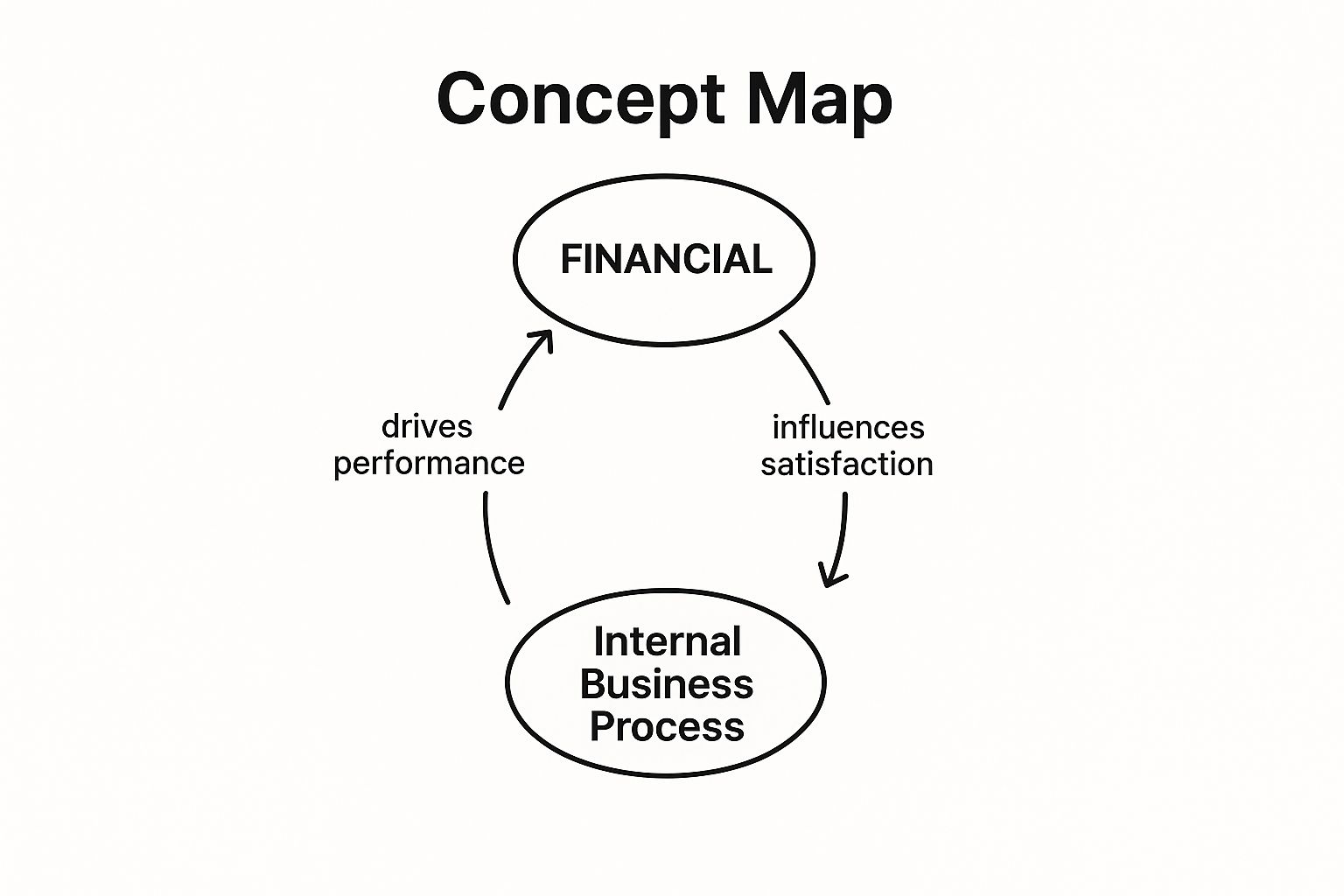
This visualization highlights how improvements in internal operations are the foundation for creating customer value, which in turn drives financial success. To dive deeper into specific metrics and frameworks, you can explore these detailed balanced business scorecard examples. The BSC provides a clear roadmap, showing how internal efforts translate into market-facing results.
2. OKRs (Objectives and Key Results)
OKRs (Objectives and Key Results) is a goal-setting framework that connects ambitious goals with measurable results. It creates alignment and engagement by linking company, team, and personal objectives within a defined timeframe, typically a quarter. The structure is simple: the Objective is a qualitative, aspirational goal, while the Key Results are the quantitative metrics that prove the objective has been achieved.
For fast-growing SaaS companies, OKRs are one of the most powerful performance scorecard examples because they foster agility and focus. This framework, famously used by Google to scale from 40 to over 100,000 employees, ensures that every team is pulling in the same direction. Companies like Spotify and Airbnb use OKRs to maintain momentum and align global teams around a shared vision, proving its effectiveness in high-growth environments.
How to Implement OKRs
Successful OKR implementation depends on setting ambitious-yet-achievable goals and fostering transparency. The goal isn't necessarily 100% achievement; hitting 60-70% on a "stretch goal" often indicates significant progress. For instance, an objective to "Enhance User Onboarding Experience" could have key results like "Increase user activation rate from 40% to 60%" and "Reduce support tickets in the first week by 25%." To streamline this process, using an OKR generator can simplify the task of defining and managing your objectives and key results.
- Start with Why: Define inspirational Objectives that motivate your team.
- Make KRs Measurable: Key Results must be specific, quantifiable, and verifiable.
- Promote Transparency: Make all OKRs visible across the organization to improve alignment.
- Check In Regularly: Conduct weekly or bi-weekly check-ins to track progress and remove roadblocks.
- Separate from Compensation: Keep OKRs separate from performance reviews initially to encourage ambitious goal-setting.
3. KPI Dashboard
A KPI Dashboard is a visual management tool that consolidates and displays the most important key performance indicators (KPIs) for achieving specific business objectives. Unlike broader scorecards that connect different strategic perspectives, a dashboard provides a real-time, at-a-glance view of operational performance, enabling quick, data-driven decisions.
For SaaS teams, a well-designed KPI dashboard is one of the most practical performance scorecard examples because it turns complex data into actionable insights. For example, a HubSpot marketing dashboard immediately shows lead generation and conversion rates, while a Salesforce dashboard provides a clear view of the sales pipeline. These tools are crucial for monitoring day-to-day activities and making rapid adjustments to strategy.

How to Implement a KPI Dashboard
A successful dashboard focuses on clarity and relevance, ensuring that every metric displayed is directly tied to a team's or individual's goals. The key is to avoid "data dumping" and instead curate the most critical information. For a SaaS company, this means tracking metrics like Monthly Recurring Revenue (MRR), Customer Acquisition Cost (CAC), and Churn Rate in a way that is immediately understandable.
- Follow the 'Rule of 7': Limit each dashboard view to 5-7 key metrics to avoid overwhelming the user.
- Provide Context: Include benchmarks or historical trends for each KPI to show performance over time.
- Customize for Roles: Tailor dashboards to specific roles; a CEO needs different data than a sales manager.
- Ensure Accessibility: Design dashboards to be mobile-friendly for on-the-go decision-making.
The main value of a dashboard is its ability to translate raw data into a clear performance narrative. To see practical applications, explore these Top Business Intelligence Dashboard Examples which offer insights into data visualization for performance tracking. While scorecards set the long-term strategic direction, dashboards provide the tactical, real-time feedback needed to navigate it effectively. Understanding the difference between business scorecards and dashboards is essential for a comprehensive performance management system.
4. Employee Performance Scorecard
An Employee Performance Scorecard is a structured evaluation tool that measures an individual's performance against predetermined criteria, goals, and competencies. It moves beyond simple task completion to provide a comprehensive view of an employee's contributions, development needs, and alignment with company values. This scorecard typically combines quantitative metrics (like sales targets) with qualitative assessments (like teamwork and problem-solving skills).
For SaaS companies, this is one of the most critical performance scorecard examples because it directly links individual contributions to team and company-wide objectives. Companies like Microsoft and Adobe have famously shifted from traditional annual reviews to more dynamic systems. Adobe’s “Check-In” process, for example, emphasizes frequent goal-setting and continuous feedback, fostering a culture of ongoing improvement and agility that is vital in the fast-paced SaaS industry.
How to Implement an Employee Performance Scorecard
A successful employee scorecard system is built on clarity, fairness, and a commitment to development. It should be a tool for growth, not just judgment. The key is to connect individual goals directly to broader organizational objectives, ensuring every employee understands how their work impacts the company's success. For example, a support agent's goal to improve their First Contact Resolution rate directly impacts the company's Customer Satisfaction Score (CSAT).
- Set SMART Goals: Define specific, measurable, achievable, relevant, and time-bound objectives at the start of each review period.
- Include Behaviors: Assess not just what was achieved, but how it was achieved by including core competencies and company values.
- Provide Regular Feedback: Ditch the annual review ambush. Implement regular check-ins to discuss progress, provide coaching, and adjust goals.
- Link to Company Objectives: Ensure every individual goal clearly cascades down from a team or departmental objective.
This approach transforms performance management from a bureaucratic chore into a strategic driver of growth. To build a robust scorecard, you need to select the right metrics. You can learn more about defining metrics for individuals by exploring these detailed employee key performance indicators. By focusing on both results and development, the Employee Performance Scorecard helps build a high-performing and engaged workforce.
5. Project Performance Scorecard
A Project Performance Scorecard is a specialized monitoring tool used to track project success against its most critical objectives. It moves beyond simple timeline and budget tracking to provide a holistic view of a project's health, covering dimensions like scope, schedule, budget, quality, and stakeholder satisfaction. This allows project managers and leadership to spot deviations early and take corrective action before they derail the entire initiative.
For SaaS companies undertaking complex initiatives like a major platform migration or a new product launch, this scorecard is invaluable. It is one of the most effective performance scorecard examples for translating high-level strategic goals into measurable project outcomes. For instance, government agencies like NASA use a similar approach with Earned Value Management to monitor massive space programs, ensuring that taxpayer funds are used efficiently to achieve monumental goals.
How to Implement a Project Performance Scorecard
Effective implementation requires defining success before the project even begins. The scorecard should link tactical execution directly to strategic business value. For a new feature launch, this means tracking not only the development timeline (Schedule) and R&D costs (Budget), but also the feature's adoption rate post-launch (Stakeholder/Business Value) and bug report volume (Quality).
- Define Success Criteria First: Establish clear, measurable success criteria for scope, schedule, budget, and quality at the project outset.
- Use Leading Indicators: Track metrics that predict future success, such as team velocity or the number of open critical risks, not just lagging metrics like budget spent.
- Standardize the Format: Use a consistent template across all projects to enable portfolio-level comparisons and simplify reporting for stakeholders.
- Integrate with Risk Registers: Connect scorecard metrics to the project's risk and issue logs to provide context for performance dips.
This scorecard acts as a single source of truth, keeping cross-functional teams aligned and focused on the ultimate project goals rather than isolated tasks. To build your own, you can explore various templates and learn more about creating a scorecard format in Excel. By standardizing this process, organizations can ensure that every project, no matter its size, directly contributes to the company's strategic vision.
6. Customer Satisfaction Scorecard
A Customer Satisfaction Scorecard is a dedicated performance management tool that consolidates key metrics related to the customer experience. It moves beyond a single metric like Net Promoter Score (NPS) to provide a holistic view of customer sentiment, loyalty, and engagement across various touchpoints. This scorecard combines quantitative data (like CSAT and Customer Effort Score) with qualitative feedback to pinpoint specific areas for improvement in service and product delivery.
For SaaS businesses, a Customer Satisfaction Scorecard is one of the most vital performance scorecard examples because it directly measures the leading indicators of churn and retention. Companies like Zappos built their entire brand on exceptional service, using detailed scorecards to measure call resolution and customer happiness, proving that a relentless focus on satisfaction drives long-term loyalty and business success.
How to Implement the Customer Satisfaction Scorecard
A successful implementation involves tracking metrics across the entire customer journey, from onboarding to support interactions and product usage. The goal is to identify friction points and moments of delight, allowing teams to take targeted action. For example, a low CSAT score after a support ticket is resolved indicates a need for better training or more efficient processes.
- Select Diverse Metrics: Combine leading indicators (e.g., Customer Effort Score) with lagging indicators (e.g., NPS, churn rate).
- Segment Your Data: Analyze feedback by customer segment, such as plan type, user tenure, or company size, to uncover deeper insights.
- Automate Feedback Collection: Use automated surveys at key touchpoints, like after an onboarding session or a support interaction, to gather real-time data.
- Close the Feedback Loop: Act on the insights you gather and communicate back to customers what changes you have made based on their feedback.
This scorecard provides a clear, actionable view of customer health, ensuring your teams are focused on activities that genuinely improve the user experience. To build a robust framework for managing these interactions, you can leverage a detailed customer success playbook. A well-designed scorecard is the foundation for turning customer feedback into a strategic advantage.
7. Financial Performance Scorecard
The Financial Performance Scorecard is a specialized management tool designed to monitor the fiscal health and profitability of an organization. Unlike broader frameworks, it zeroes in on key financial metrics and ratios, offering a clear, data-driven view of economic performance, efficiency, and sustainability. It combines historical data with forward-looking indicators to guide strategic financial decisions and satisfy stakeholder reporting requirements.
For SaaS companies, this is one of the most critical performance scorecard examples because it translates operational metrics into financial reality. While a startup might track user growth, a financial scorecard grounds that data by tracking metrics like Annual Recurring Revenue (ARR), Customer Acquisition Cost (CAC), and Lifetime Value (LTV). It answers the ultimate question: is our growth profitable and sustainable? Public companies use similar scorecards in quarterly earnings reports to summarize performance for investors.
How to Implement the Financial Performance Scorecard
A successful Financial Performance Scorecard provides context, not just raw numbers. It achieves this by comparing current data against historical performance, industry benchmarks, and future targets. For a SaaS business, this means tracking not just MRR growth but also the efficiency of that growth, often represented by the LTV:CAC ratio.
- Focus on Core Drivers: Select metrics that directly reflect business model health, such as ARR, gross margin, net revenue retention, and cash flow.
- Include Ratios and Trends: Track key ratios like the Magic Number (sales efficiency) and use rolling averages to smooth out seasonal fluctuations.
- Segment Your Data: Analyze financials by product line, customer segment, or geographic region to uncover hidden performance drivers.
- Benchmark Externally: Compare your metrics against industry peers to understand your competitive standing and identify areas for improvement.
The strength of this scorecard lies in its focus. By concentrating purely on the financial outcomes of business activities, it provides an unfiltered look at viability and value creation. It forces leaders to connect every strategic initiative back to tangible financial results, ensuring operational discipline and long-term stability.
8. Supplier/Vendor Performance Scorecard
The Supplier/Vendor Performance Scorecard is a systematic evaluation tool used to assess and manage vendor performance. It moves beyond simple cost analysis to track metrics across multiple critical areas, including quality, delivery timeliness, service levels, and compliance. This framework provides a structured, data-driven approach to managing supplier relationships, mitigating supply chain risks, and ensuring that vendors consistently meet business needs.
For SaaS companies, a supplier scorecard is one of the most vital performance scorecard examples for managing third-party technology providers, data centers, or critical service partners. It ensures that vendors upholding SLAs directly contribute to your platform’s reliability and customer satisfaction. Walmart’s famous supplier scorecard, which emphasizes cost, sustainability, and compliance, demonstrates how this tool can align a vast supply chain network with core strategic priorities, driving efficiency and brand integrity.
How to Implement a Supplier/Vendor Performance Scorecard
A successful supplier scorecard relies on clear, mutually understood criteria that are weighted according to their strategic importance. For a SaaS company, a vendor providing infrastructure might have reliability and security weighted heavily, while a marketing agency vendor might be judged more on lead quality and ROI. The goal is to create an objective basis for partnership discussions and procurement decisions.
- Align with Strategy: Define scorecard criteria that directly support your core business objectives, such as uptime, data security, or speed-to-market.
- Weight Your Criteria: Assign a weight to each category (e.g., Quality 40%, Delivery 30%, Cost 20%, Service 10%) to reflect its importance.
- Provide Regular Feedback: Use the scorecard as a basis for quarterly business reviews (QBRs) to discuss performance and create action plans for improvement.
- Integrate with Procurement: Link scorecard results directly to contract renewals, volume allocation, and future purchasing decisions to reward high-performing vendors.
Performance Scorecard Comparison Table
| Framework / Tool | Implementation Complexity 🔄 | Resource Requirements ⚡ | Expected Outcomes 📊 | Ideal Use Cases 💡 | Key Advantages ⭐ |
|---|---|---|---|---|---|
| Balanced Scorecard (BSC) | High – 6-18 months, complex cause-effect linkages | High – requires strong leadership and tech | Comprehensive organizational performance view, strategic alignment | Large organizations in manufacturing, government, healthcare | Balanced strategic view, proactive management |
| OKRs (Objectives and Key Results) | Low to moderate – quarterly cycles, flexible process | Moderate – culture change and regular check-ins | Goal alignment and transparency, outcome focus | Tech companies, startups, fast-growing teams | Simplicity, flexibility, promotes ambitious goals |
| KPI Dashboard | Moderate – requires reliable data infrastructure | Moderate to High – ongoing maintenance | Real-time performance visibility, quick decision making | Any data-driven organization needing monitoring | Immediate insights, customizable views |
| Employee Performance Scorecard | Moderate – structured evaluations, regular reviews | Moderate – manager time and training needed | Clear performance tracking, development planning | HR management across industries | Fair, consistent evaluations, career development |
| Project Performance Scorecard | Moderate to High – detailed metrics and reviews | Moderate – data collection & integration needed | Holistic project health monitoring, early issue detection | Project management in IT, construction, aerospace | Standardized reporting, stakeholder transparency |
| Customer Satisfaction Scorecard | Moderate – continuous feedback, multi-methods | Moderate to High – survey tools, analysis | Improved customer experience and retention | Customer-centric businesses, retail, services | Actionable insights, predictive customer behavior |
| Financial Performance Scorecard | Moderate – financial data accuracy essential | Moderate – finance team and software needed | Financial health monitoring, supports strategic decisions | Finance departments, public/private firms | Comprehensive financial analysis, benchmarking |
| Supplier/Vendor Performance Scorecard | Moderate – multi-criteria evaluations, quarterly reviews | Moderate – data collection, supplier engagement | Improved supplier performance, reduced supply chain risks | Manufacturing, supply chain management | Objective supplier assessment, supports partnerships |
From Examples to Execution: Implementing Your SaaS Scorecard
We've explored a comprehensive suite of performance scorecard examples, from the strategic high-level view of the Balanced Scorecard to the granular focus of an Employee Performance Scorecard. Each template and framework offers a distinct pathway to transform raw data into strategic action, but the true value lies not in the examples themselves, but in the principles they represent: clarity, alignment, and accountability.
The journey from viewing these examples to executing your own scorecard can feel daunting. The key is to avoid analysis paralysis. Instead of trying to build a perfect, all-encompassing system from day one, start with the area of your SaaS business that needs the most immediate attention. Is your team misaligned on strategic goals? A Balanced Scorecard or OKR framework might be your answer. Are you struggling to monitor the daily pulse of your operations? A focused KPI Dashboard is your best starting point.
Your Actionable Roadmap to Implementation
The most effective scorecards are not static documents; they are living systems that evolve with your business. To get started, focus on these critical next steps:
- Identify Your Core Challenge: Pinpoint the single most pressing strategic question you need to answer. Is it customer churn, project delivery delays, or financial unpredictability? This will dictate which scorecard model is the best fit.
- Start Small and Iterate: Choose one department or a single strategic objective to build your first scorecard around. Success here will create momentum and provide a proven template to expand across the organization. For example, implement a Customer Satisfaction Scorecard for your support team before rolling out a company-wide system.
- Define "What" and "Why": For every metric you select, ensure you can clearly articulate what it measures and why it matters to your strategic goals. If a KPI doesn't directly connect to a desired business outcome, it’s just noise.
- Assign Clear Ownership: Every key result or KPI needs a designated owner. This simple act of assignment transforms a scorecard from a passive reporting tool into an active accountability mechanism.
Ultimately, the power of these performance scorecard examples is in their ability to translate your company’s vision into a measurable, operational reality. By adopting a structured approach, you move beyond reactive decision-making and into a proactive state of strategic management. This shift enables you to anticipate challenges, capitalize on opportunities, and build a scalable foundation for sustainable growth. Mastering this process is not just an operational upgrade; it's a fundamental competitive advantage.
Ready to move from theory to practice without reinventing the wheel? At SaaS Operations, we provide battle-tested playbooks, templates, and systems designed to help you implement powerful scorecards quickly and effectively. Stop guessing and start building a truly data-driven organization by exploring our resources at SaaS Operations.