
Good strategic planning isn’t about carving a five-year plan into a stone tablet. For a modern SaaS company, it's about building a living, breathing roadmap—one that’s ambitious but realistic, and flexible enough to handle whatever the market throws at you.
Building Your Foundation for SaaS Growth
Before you start chasing those big, hairy, audacious goals, you need to get real about where you stand today. The old way of creating a static plan and just hoping for the best is a recipe for disaster. Successful SaaS leaders think in sprints and iterative cycles, allowing them to pivot quickly.
This isn't about lowering your ambitions. It's about aiming them in the right direction, based on what your company can actually achieve. And that all starts with a brutally honest look in the mirror.
Performing an Honest Internal Audit
First things first, look inward. A candid self-assessment is the only way to find the hidden strengths you can lean into and the roadblocks that will trip you up later. Now is not the time to be overly optimistic.
Ask yourself these tough questions:
- Product Maturity: Is our product solid and loved by users, or are we still figuring out product-market fit?
- Team Capabilities: Do we have the right people in engineering, marketing, and sales to make this happen? Where are the gaps?
- Financial Health: What’s our runway look like? What are our MRR and CAC telling us?
- Customer Feedback: What are our customers really saying? Dig into those support tickets and churn surveys for the unfiltered truth.
A clear view of your internal world stops you from building a strategy on a house of cards. For example, if you want to land huge enterprise deals but don't have a dedicated sales team, you're just setting yourself up for failure. Spotting that gap now means you can build hiring into the plan from day one.
A solid foundation for growth is often built on strong internal capabilities; this is where an effective knowledge management strategy for innovation can make a real difference.
Understanding Your Market Position
Okay, you’ve got a handle on your internal reality. Now it’s time to look outside and figure out where you fit in the bigger picture. This is more than just making a list of your competitors. It's about truly understanding the forces shaping your industry and carving out your unique space.
A great strategy is a story about the future that your team can believe in and execute against. It articulates where you are, where you're going, and how you'll get there, turning ambiguity into clarity.
There's a reason so many companies are getting serious about this. The global strategic planning software market shot up to $1.14 billion in 2021 and is on track to hit nearly $1.97 billion by 2025. It’s not just a trend; it's a fundamental shift in how businesses operate. You can read the full research about this market growth to see how digital tools are making this easier.
To get this clarity, you have to focus on the core pillars that hold up any sustainable growth strategy. These pillars are what ensure every department—from product to sales—is pulling in the same direction. Speaking of which, tight alignment between your teams is non-negotiable. If you need help there, check out our guide on customer success strategies.
The table below breaks down the essential pillars that form the bedrock of a solid SaaS growth plan.
Core Pillars of a SaaS Growth Strategy
| Pillar | Key Focus Area | Example Metric |
|---|---|---|
| Product-Led Growth | Making the product itself the main engine for acquiring and keeping customers. | Product-Qualified Leads (PQLs) |
| Market Expansion | Finding and moving into new geographic or demographic markets to grow your TAM. | Market Share Percentage (%) |
| Customer Retention | Working to reduce churn and increase the lifetime value (LTV) of your current customers. | Net Revenue Retention (NRR) |
| Operational Efficiency | Streamlining internal work and automating tasks to improve margins as you scale. | Customer Acquisition Cost (CAC) Payback Period |
By taking a hard, honest look at these pillars, you create a solid launchpad for your entire strategy. It ensures that every move you make is grounded in self-awareness and a real understanding of the market.
Defining a Vision That Inspires Action

A company vision can feel like a fluffy, inspirational quote you stick on the office wall. But in reality, it's the single most important tool in your arsenal. It’s the compass that guides every single decision your company makes, from a tiny feature on the product roadmap to the headline on a new marketing campaign.
Without a crystal-clear destination, strategic planning for growth just becomes a list of random tasks that don't add up to anything meaningful. So, ask yourself: where do you really see your SaaS in three years? Think beyond revenue—what impact do you want to make? That’s the "why" that will fuel your team and keep everyone pointed in the same direction.
From Aspirational to Actionable
Here's where most founders go wrong. They create a big, exciting vision statement like "To empower creative professionals," and then they stop. That sounds nice, but it doesn't tell your head of engineering what to build or your marketing lead who to target.
The real work is in translating that high-level dream into concrete objectives. This is where a framework like SMART (Specific, Measurable, Achievable, Relevant, Time-bound) is incredibly useful. It forces you to get specific. For example, a vague goal like "Increase user engagement" becomes a sharp, actionable objective: "Increase the daily active user to monthly active user (DAU/MAU) ratio from 25% to 35% by the end of Q3."
A vision without a plan is just a daydream. A plan without a vision is a nightmare. This process connects your biggest dreams to the daily grind, ensuring every task has a purpose.
When you break your vision down into these measurable chunks, you create a direct line of sight from a developer’s weekly sprint right up to the company's three-year goal. That clarity is what turns a cool idea into a scalable business.
Aligning Every Department Toward a Single Goal
Think of your company as a rowing team. If everyone is paddling at their own pace and in their own direction, you're just going to spin in circles. The same thing happens in a SaaS company when product, marketing, and sales are all chasing different priorities.
A well-defined vision, backed by clear objectives, is the ultimate alignment tool. It becomes the north star that every department uses to set its own goals and measure its own success.
- Product Team: Instead of just building features they think are cool, they prioritize the roadmap based on what moves the needle on the core company objectives. If the goal is retention, they'll focus on improving the customer experience, not just shipping new stuff.
- Marketing Team: Campaigns and content become laser-focused on attracting the right customers—the ones who are most likely to stick around and help you achieve the long-term vision. This directly impacts critical metrics like customer acquisition cost and lifetime value. To get this right, you have to know your numbers, which is why a solid lifetime value calculation for SaaS is non-negotiable.
- Sales Team: The team knows exactly which deals to chase. If the strategic goal is to move upmarket, they won't waste time on smaller, low-value accounts, even if they’re an easy win this quarter.
This shared focus kills "siloed thinking," where departments hit their individual targets but the company as a whole suffers. When everyone knows where the boat is headed, they can finally start rowing in sync.
Real-World Vision in Action
Let’s make this tangible. Imagine a SaaS company called "ScheduleFlow," an appointment scheduling tool for small service-based businesses.
Their big-picture vision: Become the go-to operational hub for solo entrepreneurs.
From that vision, they create specific, tactical objectives for each team:
- Objective 1 (Product): Launch a basic invoicing and payment processing feature within the platform by Q4. This isn't just a new feature; it's a strategic move to increase user stickiness and make the tool indispensable.
- Objective 2 (Marketing): Increase sign-ups from freelance photographers and consultants by 40% in the next six months. They'll achieve this through targeted content partnerships, not just generic ads.
- Objective 3 (Customer Success): Reduce first-month churn by 15% by creating a personalized onboarding flow for new users, making sure they see value immediately.
See how that works? The broad vision is now a concrete, interconnected plan. Every team’s actions are purposeful and build on each other, driving the entire business forward. This is what effective strategic planning for growth looks like in the real world.
Mapping Your Competitive Landscape

You can't really win a game if you don't know the players or the rules. When it comes to strategic planning for growth, you need a deep, almost obsessive, understanding of your market. Just knowing your top three competitors is the bare minimum. True insight comes from mapping out the entire competitive world you live in.
This means you have to go way beyond a simple SWOT analysis. For a SaaS business, the landscape is always shifting under your feet. A small, scrappy competitor you ignored six months ago could suddenly become the new market leader.
Look Beyond the Obvious Rivals
One of the biggest mistakes I see founders make is focusing only on the companies that look just like them. They get fixated on direct competitors—the ones with a nearly identical feature set who are chasing the same customers. While you absolutely have to watch them, this narrow view can leave you completely blind to bigger threats.
Your real competition is much broader. You need to be tracking three different kinds of rivals:
- Direct Competitors: These are the ones everyone thinks of. If you sell a project management tool, you're looking at Asana and Trello. They're fighting for the same customer dollars with a very similar product.
- Indirect Competitors: These guys solve the same core problem, just in a totally different way. For that same project management tool, an indirect competitor could be a simple spreadsheet or even a shared note-taking app. They get the job done for the customer, just not with your kind of software.
- Emerging or Substitute Competitors: This is where the real curveballs come from. These are new players, often popping up in adjacent markets, who could make your entire solution seem outdated overnight. Think about how Canva’s dead-simple design tools became a substitute for complex Adobe software for a massive chunk of the market.
By mapping all three, you start to see the full picture of who is competing for your customer's attention and budget. A founder's guide to competitive landscape analysis is a great resource for digging into the specifics here.
Deconstruct Their Go-To-Market Strategy
Once you’ve identified your competitors, the real detective work starts. You need to take apart their entire go-to-market strategy, piece by piece. The goal isn't to copy them; it's to find the cracks in their armor that you can exploit.
Don't just look at what your competitors do. Figure out why they do it. Understanding the strategic thinking behind their pricing, features, and marketing is how you’ll find your own unique edge.
The best way to start is to become their customer. Sign up for a free trial. Sit through a demo call. Read every single one of their onboarding emails. As you do, pay close attention to a few key areas:
| Area of Analysis | What to Look For |
|---|---|
| Pricing and Packaging | Is their pricing based on value or features? Do they offer a freemium plan? Are they built for small businesses or giant enterprises? |
| Feature Set | What are their absolute must-have features? What's clearly missing? Where does it feel like they're investing their development time? |
| Marketing Channels | Are they all-in on paid ads, content, or social media? Where is their traffic and lead flow actually coming from? |
| Customer Voice | What are people saying in G2 or Capterra reviews? What do users absolutely love, and what drives them crazy? |
This deep dive gives you a tactical map of how they operate. You might find out their customer support is notoriously slow, creating an opening for you to win with amazing service. Or maybe their pricing is too confusing for small businesses, giving you a chance to offer a simpler, more transparent option.
Find the Customers Nobody Else Is Serving
Ultimately, all this analysis is about one thing: finding a group of customers that everyone else is either ignoring or serving badly. This is where you can build a real, lasting advantage. And the best clues for this don't come from your competitors' websites—they come directly from customers.
Getting this intel doesn't have to be a huge production.
- Read the Reviews: Seriously, dig through the review sites for your competitors. Look for comments that start with "I just wish it could…" or "It's great, but…". These are basically feature requests and pain points being handed to you on a silver platter.
- Conduct "Switch" Interviews: Find customers who recently left a competitor for your product (or the other way around!). Ask them what the final straw was that made them switch.
- Lurk in Online Communities: Join the Slack channels, subreddits, and Facebook groups where your ideal customers hang out. Just listen. You'll hear all about their frustrations and the clunky workarounds they've invented.
This kind of intelligence helps you build a product and a marketing message that truly connects with a specific audience. It lets you sidestep a brutal head-to-head fight with bigger, better-funded companies.
Creating Your Actionable Growth Roadmap
An ambitious vision is exciting, but let's be honest—without a concrete plan, it's just a wish. This is where the rubber meets the road, where your big-picture thinking gets translated into a tangible roadmap that guides your team's day-to-day work. The goal here is to create a clear blueprint that connects your high-level ambitions directly to the tasks your teams will tackle every single week.
Good strategic planning for growth isn’t about crafting a rigid document that collects dust in a shared drive. It’s about building a living, breathing guide that gives everyone clarity and focus. This roadmap becomes the single source of truth for what actually matters, preventing teams from getting pulled into low-impact activities.
The old way of doing things—creating a rigid five-year plan—just doesn't cut it anymore. Today's market demands more flexibility. We're seeing a shift towards shorter, iterative cycles and quarterly reviews, which allows companies to adapt their priorities and resources on the fly. This agility is key to responding to sudden market shifts and new technologies. You can find more on these evolving strategic planning trends.
Translating Goals into Key Initiatives
First things first, you need to break down your high-level strategic goals into a handful of major initiatives. Think of these as the big-ticket projects that will actually move the needle.
For example, if your objective is to "Increase market share in the enterprise segment by 20%," your initiatives might look something like this:
- Initiative A: Launch a dedicated enterprise pricing tier with a new feature set.
- Initiative B: Build out a small, focused outbound sales team to target Fortune 1000 companies.
- Initiative C: Develop a content marketing program specifically for enterprise-level decision-makers.
These initiatives are still fairly broad, but they provide the structure your plan needs. They act as the main buckets that will hold all the smaller, more specific tasks. I've found that sticking to three to five initiatives per major objective is the sweet spot—it keeps things manageable.
Implementing OKRs for Clarity and Ownership
Once you have your key initiatives, you need a way to measure them and assign clear accountability. This is where a framework like OKRs (Objectives and Key Results) is incredibly powerful. It’s a beautifully simple system for setting and tracking goals.
OKRs give everyone a shared language for execution. They force you to define what success looks like in clear, quantifiable terms, which gets rid of ambiguity and makes sure everyone is pulling in the same direction.
Here’s a quick breakdown of how it works:
- Objective: This is the what—the qualitative goal you want to achieve. It should be aspirational. For example: "Successfully launch our new enterprise product offering."
- Key Results: These are the how—the quantitative metrics that prove you've actually hit your objective. They have to be measurable. For instance:
- KR1: Secure 25 new enterprise customers on the new plan by the end of Q3.
- KR2: Achieve a Customer Satisfaction (CSAT) score of 90% or higher for our new enterprise users.
- KR3: Generate $500,000 in new Annual Recurring Revenue (ARR) from the enterprise tier.
Every key result needs a clear owner. This is the single person responsible for tracking and reporting on its progress. That doesn't mean they do all the work, but they are the one accountable for the outcome. This clear ownership is what makes a roadmap truly actionable. It's important not to confuse this level of planning with daily operational tasks; we cover that in more detail in our guide on strategic vs operational plans.
Mapping Out Resources and Timelines
With your initiatives and OKRs defined, you can start building a timeline that’s actually realistic. A classic mistake I see all the time is creating an aggressive schedule without considering the team's real capacity. That's a surefire recipe for burnout and missed deadlines.
This visual helps frame how to think about resource planning—a critical step before you commit to any timeline.
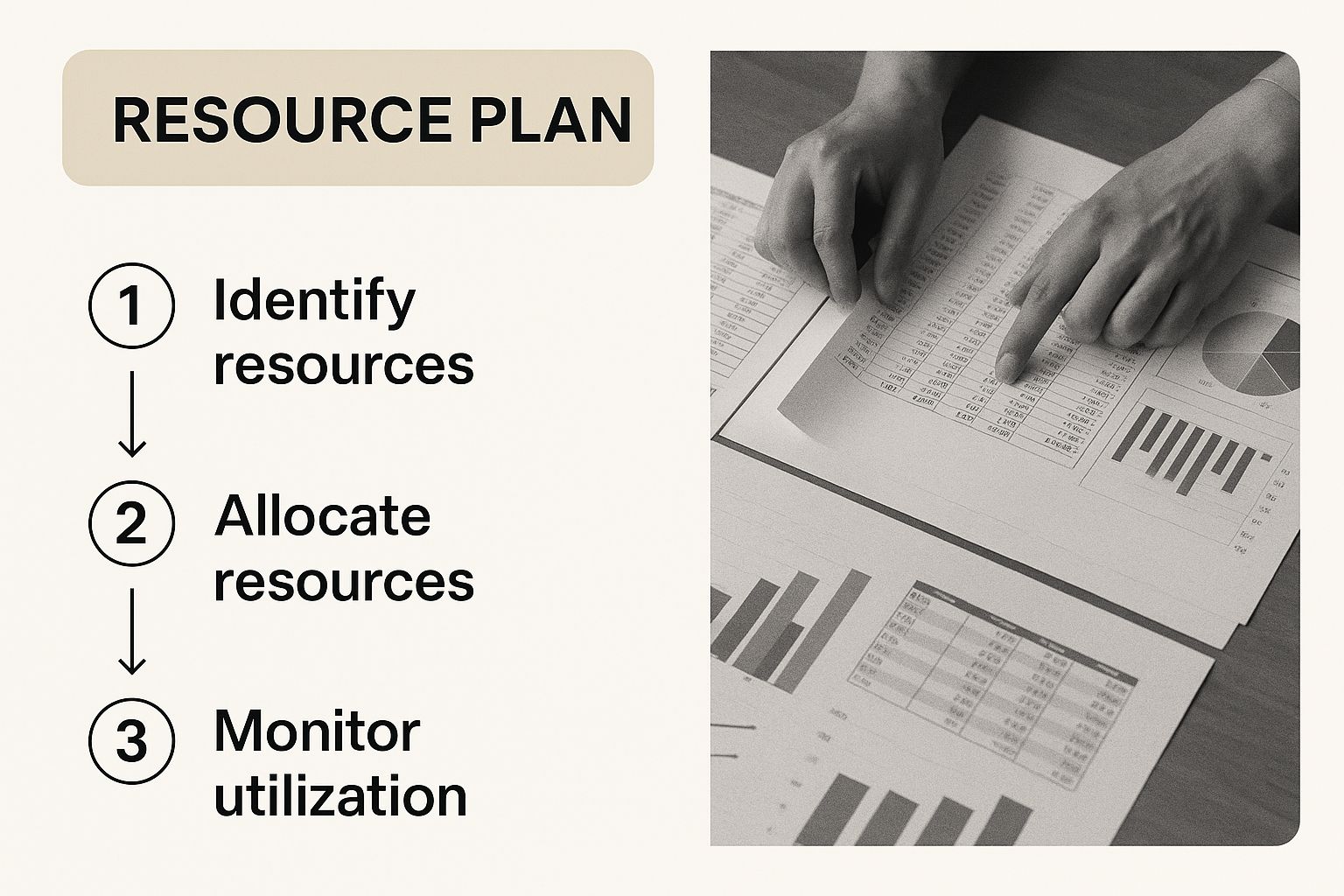
As the image shows, you have to align your financial forecasts and team capacity with your strategic goals first.
To avoid the over-commitment trap, map out your major initiatives on a quarterly basis. Forget trying to plan every single task for the entire year. Just focus on getting the next 90 days right.
Here’s a simple way to do it:
- List the initiatives: Get all your major projects onto a virtual whiteboard.
- Estimate the effort: Do a quick sizing of each one (e.g., Small, Medium, Large) based on the people and budget needed.
- Prioritize and sequence: Figure out what needs to happen first and what can wait.
- Assign to quarters: Slot the top-priority initiatives into a Q1, Q2, Q3, and Q4 roadmap, making sure not to overload any single quarter.
This approach gives you a flexible roadmap that bridges the gap between your long-term vision and what your team needs to do this quarter. It turns an abstract strategy into a clear, actionable plan that everyone can get behind.
How to Monitor and Adapt Your Strategy
Getting your strategic plan launched feels like crossing the finish line, but in reality, you're just getting started. The real magic in strategic planning for growth happens when you consistently monitor your progress and make smart adjustments along the way. A plan that just sits there is nothing more than a document collecting digital dust.
The idea is to get into a rhythm of review, weaving your strategy into the day-to-day fabric of the company. This isn't about micromanaging your team. It’s about building a feedback loop that tells you what’s working, what’s a complete dud, and where you need to pivot. Without it, you're just flying blind.
Building Your SaaS Growth Dashboard
You can't manage what you don't measure. The first thing you need is a simple, at-a-glance dashboard that tracks your most critical SaaS Key Performance Indicators (KPIs). Resist the urge to cram every metric you can think of onto one screen. Focus on the vital few that truly reflect the health of your strategy.
Think of this dashboard as the single source of truth for your growth plans. For most SaaS companies I've worked with, this usually boils down to:
- Monthly Recurring Revenue (MRR): The absolute lifeblood. You'll want to track new, expansion, and churned MRR separately to see the full picture.
- Customer Acquisition Cost (CAC): How much are you actually spending to land a new customer? Is that cost going up or down over time?
- Lifetime Value (LTV): What's a customer worth to you over their entire relationship with your company? A healthy business needs an LTV that is multiples higher than its CAC.
- Net Revenue Retention (NRR): This shows how much revenue you’re keeping from existing customers, factoring in both upgrades and churn. An NRR over 100% is a powerful sign that your business can grow even without adding a single new customer.
These metrics give you that high-level, 30,000-foot view of your progress. They tell you if the initiatives you're pouring time and money into are actually moving the needle. A sudden dip in NRR, for instance, might be a red flag that a new feature designed to improve retention isn't hitting the mark. That's a crucial insight you'd never get from just a gut feeling.
Fostering a Culture of Accountability
Having the data is one thing, but it's useless without open and honest conversations. To make your strategy truly agile, you have to build a culture where people feel safe talking about what's not working, not just celebrating the wins. This is where a regular review cadence becomes essential.
A classic mistake is letting strategy reviews turn into a parade of good news. The most valuable discussions I've ever been in have come from picking apart failures and roadblocks. That’s where the real learning happens.
Set a predictable rhythm for these check-ins. A monthly review of your dashboard metrics, paired with a deeper quarterly dive into your strategic initiatives, is a great place to start. During these meetings, the goal isn't to point fingers. It's to ask better questions:
- What did we learn from this initiative not hitting its target?
- Which of our initial assumptions turned out to be wrong?
- Based on this data, what should we do differently next quarter?
This approach reframes every outcome—good or bad—as a learning opportunity. It makes your team more resilient and your strategy far more dynamic.
Making Smart, Data-Informed Adjustments
The final piece of the puzzle is turning those insights into action. Monitoring tells you what is happening; adaptation is deciding what to do about it. This often means looking at the entire customer journey. You might find that your marketing team is crushing it and driving tons of leads, but your conversion rates are tanking. That insight allows you to shift resources toward improving specific touchpoints, a core concept we break down in our complete guide to building a sales funnel.
Let's say your strategic goal is to move upmarket and land bigger accounts. After a quarter, you look at your dashboard and see that while you're getting more enterprise demos, your sales cycle has doubled and your close rate has dropped by a painful 50%.
The data is screaming at you. Instead of just pushing harder, you can adapt. Your adjustment might be to invest in better sales training for handling complex enterprise deals or to fast-track a product update to meet enterprise-grade security requirements. This is how a strategic plan stops being a static document and becomes a powerful, living tool that guides your company toward real, sustainable growth.
Common Questions About Strategic Planning
Even with a perfect plan on paper, the real world always throws a few curveballs. It’s only natural for questions to come up as you start putting your strategy into action. Let’s tackle some of the most common ones I hear from SaaS leaders to help you sidestep a few pitfalls and keep things moving.
How Often Should We Revisit the Strategic Plan?
Think of your strategic plan as a living, breathing document, not something you carve in stone.
Your big-picture vision might hold steady for years, but the roadmap to get there absolutely needs regular check-ups. For a fast-growing SaaS business, I always recommend a deep-dive, full-scale review annually. This is your chance to take everything you've learned over the last 12 months and reset your priorities.
But you can't just let it sit on a shelf for a year. The real magic happens with quarterly reviews. This rhythm lets you stay agile. You can react to a new competitor, a shift in the market, or a wave of customer feedback without derailing your long-term goals. Don't be shy about adjusting your tactics every 90 days if the data tells you to.
What Are the Biggest Mistakes to Avoid?
I've seen a few common traps that can sink even the most promising strategies.
The number one mistake is creating the plan in an executive echo chamber. When you don't involve people from across the company—product, sales, support—you miss critical insights from the front lines. Worse, you'll face an uphill battle getting their buy-in when it's time to execute.
Another classic error is setting fuzzy, feel-good goals. "Become a market leader" sounds great in a meeting, but what does it actually mean? It’s not measurable. If you can't track it, you can't achieve it.
A brilliant strategy that collects dust on a server is useless. A plan only works if it's part of your company's daily pulse, with regular check-ins and clear ownership for every single objective.
Finally, the most frequent failure I see is a disconnect between the plan and daily operations. The strategy has to inform what people do every day, or it's just a document.
How Can I Ensure My Team Buys Into the Plan?
Getting your team on board isn't about a big announcement or a motivational speech. It's about involvement.
Bring people into the process early. Ask your product managers, marketers, and customer success reps for their thoughts during the initial discovery phase. Their perspective is gold and will make your plan much more realistic.
Once you’ve locked in the high-level company objectives, let the individual teams define their own key results (KRs). This gives them a real sense of ownership over how the goals get met. It’s their plan, too.
To keep everyone pulling in the same direction, you have to constantly communicate the "why." Connect the dots between a developer's daily coding task and the company's grand vision. When people see how their work matters, their engagement goes through the roof. And don't forget to celebrate the wins along the way, both big and small! It builds momentum and proves the plan is working.
Making sure everyone has what they need to succeed is also a huge part of this, which ties directly into smart resource allocation. You can dig deeper into this with our guide on SaaS cost optimization strategies.
At SaaS Operations, we provide battle-tested playbooks and SOPs to help you build and execute a winning growth strategy. Stop guessing and start accelerating your success with our proven frameworks. https://saasoperations.com