
When we talk about SaaS lead generation, we’re really talking about building a reliable system that turns complete strangers into qualified prospects. It’s about creating a predictable pipeline that doesn’t just bring in leads, but moves them from a vague awareness of their problem all the way to becoming happy, paying customers.
Building Your SaaS Lead Generation Foundation

Before you even think about spending a dollar on ads or an hour creating content, you need to get your foundation right. This is where so many ambitious SaaS companies go wrong. A powerful lead generation engine isn’t built on wishful thinking; it’s constructed from a deep, almost obsessive understanding of who you’re actually selling to.
Nailing this foundational work ensures every marketing dollar and every piece of content hits its mark. If you skip this, you’re just guessing. You’ll waste time and money on campaigns that don’t connect, attracting leads who will never become the long-term, high-value customers you need.
Define Your Ideal Customer Profile
The absolute cornerstone of any good lead generation strategy is a razor-sharp Ideal Customer Profile (ICP). This isn’t just a vague idea; it’s a detailed picture of the company that gets the most out of your product. It goes way beyond simple details like industry or company size.
A truly useful ICP includes things like:
- Technographics: What other tools are they already using? What does their tech stack look like?
- Pain Points: What specific, expensive problems are they dealing with that your SaaS can actually fix?
- Buying Triggers: What event—internally or in their market—makes them start looking for a new solution now?
- Organizational Goals: What are the big business outcomes they’re trying to hit?
Getting a handle on the foundational principles and common lead generation best practices is a great starting point. It helps you sidestep common mistakes and focus your energy where it counts from the very beginning.
Develop Data-Driven Buyer Personas
While your ICP defines the company, buyer personas bring the people inside those companies to life. These are the actual individuals your marketing needs to speak to. The key here is to not make them up. Build them from real data.
Go talk to your best customers. Interview them. Ask your sales team about the conversations they have every day and the questions they always get. Dig into your CRM data and look for the common threads among your most valuable accounts. This is where the gold is.
A classic mistake is creating flimsy personas like “Marketing Mary.” Get specific. Think about their role in the purchase. A “Decision-Maker” persona is worried about ROI and security. An “End-User” persona cares a lot more about how easy the tool is to use and whether it has the features they need for their daily job.
Let’s be real, the SaaS market is incredibly crowded. Knowing your customer is more important than ever. The market is projected to reach $300 billion in 2025, and the average business is juggling around 275 different SaaS apps. Here’s a powerful stat: reducing churn by just 5% can boost your profitability by as much as 95%. This is exactly why attracting the right kind of lead is everything.
Map the Customer Journey
Okay, so you know who you’re targeting. Now you have to figure out their path to buying your product. The B2B SaaS buying journey is never a straight line. It’s messy. It involves multiple people, tons of research, and a whole series of touchpoints with your brand that can stretch over weeks or even months.
Mapping this journey is how you deliver the right message at the right time. Your goal is to create content and offers that make sense for each stage:
- Awareness: The prospect is just starting to realize they have a problem. This is the perfect time for helpful blog posts and educational webinars.
- Consideration: Now they’re actively looking at different solutions. This is where case studies, comparison guides, and product demos shine.
- Decision: They’re ready to make a choice. Free trials and one-on-one consultations can help get them across the finish line.
When you can visualize this entire process, you can build a smooth, cohesive experience that guides a prospect from a simple Google search to signing on the dotted line. This journey data is also critical for building dashboards that actually tell you something useful. In fact, you can learn more about this in our guide on how to design effective business intelligence scorecards. Getting this foundation in place sets the stage for everything else you’ll do.
Mastering Inbound to Attract Qualified Leads

Sure, outbound tactics can get you some quick wins. But if you’re playing the long game, sustainable growth comes from a solid inbound engine that’s working for you 24/7. When done right, your website stops being a static brochure and starts becoming a reliable, automated source of high-intent leads.
This isn’t about just churning out a few blog posts. I’m talking about building a real system. A system where you create content that speaks directly to the biggest pains of your Ideal Customer Profile (ICP), pulling them toward your solution organically.
Develop High-Value Content Assets
The heart of any great inbound strategy is content so good that people are happy to trade their email for it. Ditch the generic listicles. We need to create substantial assets that solve real-world problems and establish your brand as the expert in the room.
Think bigger than just a weekly blog post. Focus on creating “pillar” content—major assets that can anchor your entire marketing strategy.
- In-Depth Guides: Walk readers step-by-step through solving a complex, nagging problem they face.
- Original Research: Poll your industry, gather unique data, and publish reports that get you cited and earn valuable backlinks.
- Problem-Solving Webinars: Host sessions that actually teach a valuable skill, not just deliver a thinly veiled sales pitch.
If you really want to go deep on using content, SEO, and social media to pull in the right people, check out this in-depth guide on inbound lead generation mastery.
Master SEO for Your Niche
Creating brilliant content is half the battle; the other half is making sure people actually find it. That’s where Search Engine Optimization (SEO) comes in. It’s the bridge connecting your content to your ICP’s search queries. For SaaS, this means getting laser-focused on long-tail, high-intent keywords.
Don’t just chase a broad term like “project management.” A much smarter play is to target a specific phrase like “best project management software for remote engineering teams.” You’ll capture folks who are much further down the buying path and know exactly what they need.
One of the most effective SEO tactics I’ve seen is embedding product screenshots directly into your guides and articles. Don’t just tell them how to solve a problem—show them how your tool does it. This simple move connects the dots between their problem and your solution, demonstrating value right in the flow of the content.
The biggest mistake I see is when companies wall off their product from their content. Your content should be the guide, and your product should be the tool that makes the guide’s advice a reality. This approach turns someone just looking for information into a product-led discovery.
Design Landing Pages That Convert
So, all your hard work on content and SEO has led a visitor to your landing page. This is the moment of truth. They either become a lead, or they bounce. A great landing page has one single, crystal-clear goal, whether that’s signing up for a free trial, downloading an ebook, or booking a demo.
Here’s what your landing page absolutely must have:
- A Compelling Headline: It needs to instantly confirm they’re in the right place by speaking to their exact pain point.
- Benefit-Oriented Copy: Ditch the feature lists. Focus on the results and outcomes they’ll achieve.
- Social Proof: Nothing builds trust faster. Use testimonials, customer logos, or case study snippets.
- A Frictionless Form: Only ask for the information you absolutely need. Every extra field is another reason for them to leave.
By nailing these three pillars—high-value content, targeted SEO, and high-converting landing pages—you build a resilient inbound machine. This system doesn’t just get you more leads; it gets you the right leads. You can find more detail on this in our complete guide to lead generation for SaaS. The end result is a predictable flow of Marketing Qualified Leads (MQLs) and Product Qualified Leads (PQLs) who are already convinced you understand their problem and see your product as the answer.
Sometimes, you just can’t wait for inbound marketing to work its magic. You need to spark pipeline growth right now. That’s where smart outbound and paid campaigns enter the picture. When done right, they can deliver immediate results without draining your budget or alienating your ideal customers.
The trick is to stop thinking in terms of mass outreach and start thinking like a surgeon. This isn’t a numbers game; it’s about making relevant, timely connections. This approach transforms outbound from a robotic, high-volume task into a genuine relationship-building exercise, one carefully chosen prospect at a time.
Hitting the Mark With Cold Emails That Actually Get Read
Let’s be honest: cold email has a terrible reputation, and for good reason. Most of it is awful. A generic, self-obsessed email is a one-way ticket to the trash folder. A successful cold email, on the other hand, feels personal and helpful because it’s built around the recipient’s world, not yours.
Remember, the goal of the first email isn’t to sell anything. It’s simply to start a conversation. To do that, you have to prove you’ve done your homework.
- Go beyond the first name. Reference a recent company milestone, a specific point from a LinkedIn post they shared, or a challenge unique to their role. This is hyper-personalization.
- Lead with their problem. Open your email by acknowledging a pain point common for someone in their position. This shows you get it.
- Make your “ask” small. Don’t jump straight to a 30-minute demo request. End with a simple, low-friction question like, “Is solving this on your radar right now?”
A great sequence is a patient conversation unfolding over several emails. You can provide value at each step—maybe share a relevant case study in a follow-up or a helpful article in another. It’s about being persistent without being a pest.
Using LinkedIn for Precision Prospecting
LinkedIn is an absolute goldmine for SaaS lead generation, but only if you use it correctly. It’s so much more than a digital rolodex; it’s a living, breathing database of professional activity and intent. Tools like Sales Navigator let you build incredibly specific lead lists based on company size, technologies used, recent job changes, and more.
But the real magic happens when you move beyond just building lists and sending connection requests.
The most effective LinkedIn strategy is to “give before you get.” Engage with a prospect’s content for a week or two before you ever try to connect. Like their posts, leave thoughtful comments, and just show up in their notifications as someone who adds value to the conversation.
By the time you reach out, your name is already familiar. This simple shift turns a cold approach into a warm one, dramatically boosting your chances of a positive response. Personalize your connection request by referencing your prior engagement or a shared interest. This tiny act separates you from the 90% of automated, generic requests that people immediately ignore.
Running Paid Campaigns That Don’t Break the Bank
Paid advertising lets you put your solution right in front of people who are actively searching for it. The key to making this profitable is picking the right channels and watching your budget like a hawk.
For most SaaS companies, the platforms that matter most are:
- Google Ads: Focus on high-intent keywords that signal someone is ready to buy. Think “best CRM for small agencies” instead of a broad term like “CRM.”
- LinkedIn Ads: This is the best place to target people by job title, industry, and company size. It’s perfect for reaching specific decision-makers.
- Capterra/G2: These software review sites are where buyers go to compare their final options. Being visible here captures leads at the very last stage of their research.
To help prioritize your efforts, it’s useful to understand the trade-offs between different channels.
SaaS Lead Generation Channel Comparison
Choosing where to invest your marketing dollars can feel overwhelming. This table breaks down some of the most common channels, giving you a clearer picture of what to expect in terms of cost, quality, and your ability to scale.
| Channel | Average CPL (Cost Per Lead) | Typical Lead Quality | Scalability |
|---|---|---|---|
| Google Ads | $50 – $300+ | High (user has intent) | High |
| LinkedIn Ads | $60 – $400+ | High (precise targeting) | Medium to High |
| Content/SEO | $20 – $150 | Varies (top-of-funnel vs. bottom) | High (long-term) |
| Review Sites (G2, Capterra) | $100 – $500+ | Very High (comparison stage) | Medium |
| Cold Email | $10 – $100 | Low to Medium | High |
This comparison isn’t set in stone, as your specific industry and audience will cause these numbers to vary. However, it provides a solid starting point for deciding where to run your first experiments. High-CPL channels like review sites often deliver leads that are much closer to buying, justifying the upfront cost.
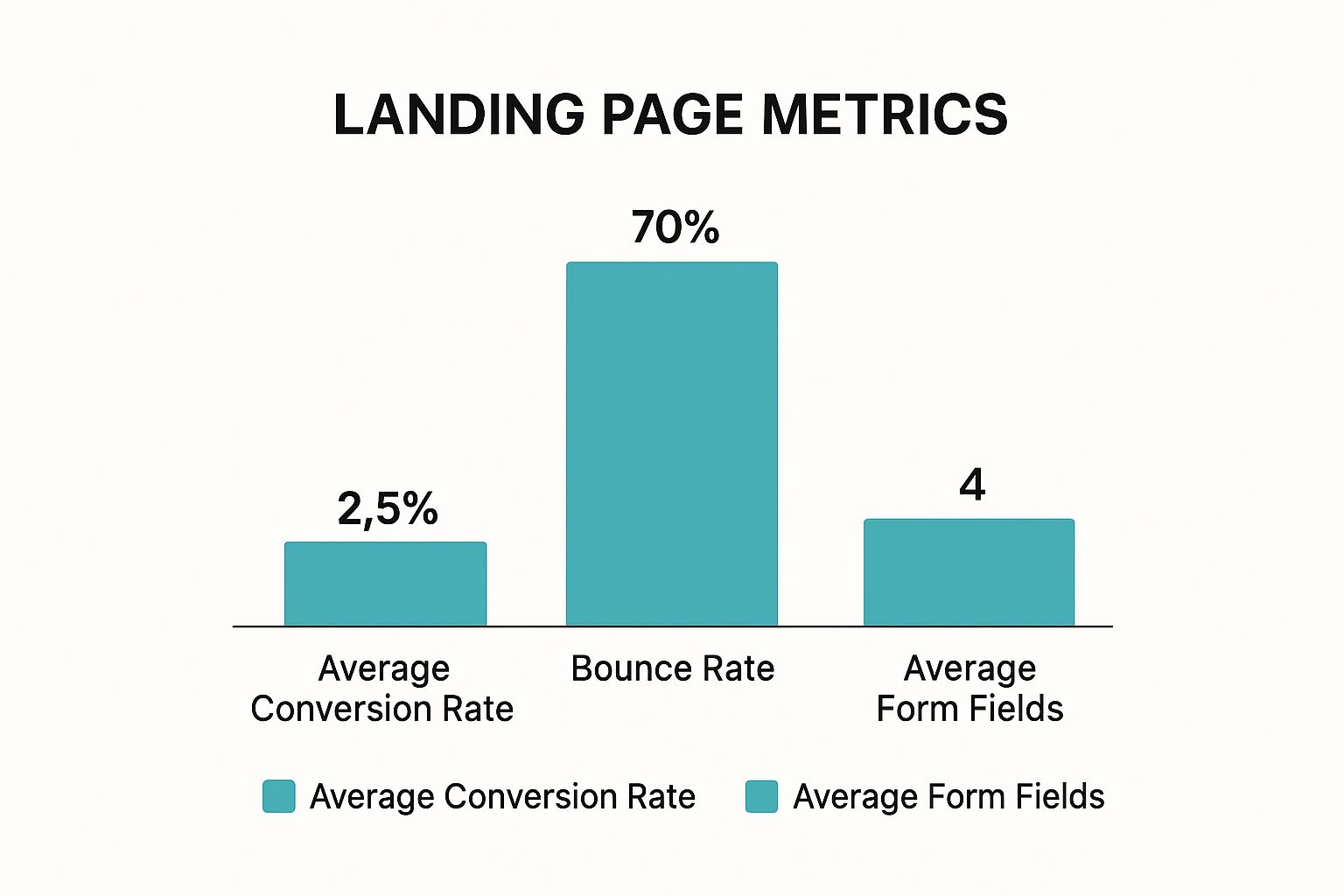
The data in this chart drives home a crucial point: conversion is tough. Even a small bump in your landing page’s conversion rate can have a massive impact on your campaign’s ROI. That’s why tracking your metrics is completely non-negotiable. Your Cost Per Lead (CPL) and Customer Acquisition Cost (CAC) are your guiding stars; they tell you if your campaigns are actually making money.
In the world of B2B tech, the average CPL hovers around $208. This might seem high, but it reflects the significant lifetime value of a SaaS customer. While much higher than in retail, the cost is often justified by larger, longer-term contracts. Understanding this benchmark is vital for setting your budget and judging how well your paid strategies are performing. You can explore more data on how CPL varies across industries with these lead generation statistics from DesignRush.com. By keeping a close eye on your CPL and weighing it against your Customer Lifetime Value (LTV), you can make sure every dollar you spend is a smart investment in your company’s growth.
Automating Lead Management for Scalability
Getting a steady stream of leads is fantastic, but it’s only half the battle. A big pile of unmanaged leads quickly turns into organized chaos. The real magic happens when you build an efficient, automated system to manage and nurture those leads, turning that initial spark of interest into revenue without burning out your team.
This is where you graduate from manual grunt work to a scalable machine. It’s all about creating a seamless handoff from marketing to sales, making sure no promising prospect ever slips through the cracks. Automation is the engine that powers this, letting you grow your lead volume without having to proportionally grow your headcount.
Building Your Automated Nurturing Engine
At the heart of scalable lead management is marketing automation. Now, this isn’t about blasting out robotic, generic emails. It’s about delivering the right message to the right person at exactly the right time, all based on their behavior. A powerful CRM like Salesforce paired with a marketing automation platform like HubSpot is the typical backbone for this kind of system.
Your goal is to build workflows that gently guide prospects along their journey. For instance, when someone downloads an educational ebook, they’re probably not ready for a hard sales pitch. Instead, an automated workflow can send them a few helpful emails over the next couple of weeks, sharing a related blog post, a relevant case study, and maybe an invitation to a product webinar.
Your automation should feel like a helpful conversation, not a one-way broadcast. Every touchpoint should be triggered by a prospect’s action, which makes the communication feel relevant and timely. This is how you build trust at scale.
This approach is quickly becoming the standard. By 2025, it’s estimated that 44% of all companies will use marketing automation, with adoption among B2B firms even higher at 55%. The results speak for themselves: 80% of businesses using automation see an increase in leads, and 77% report higher conversion rates. You can find more data in these lead generation statistics at AdamConnell.me.
Implementing a Practical Lead Scoring Model
Let’s be honest: not all leads are created equal. A student downloading a whitepaper for a research project is worlds away from a Director of Engineering at a target company who just watched your full demo video. A lead scoring model is how you automatically tell the difference, assigning points to leads based on who they are and what they do.
This simple process separates the window shoppers from the serious buyers. It empowers your sales team to stop chasing dead ends and focus their valuable time exclusively on prospects who are showing clear buying signals.
Here’s a simple lead scoring framework you can start with and tweak:
| Category | Action or Attribute | Points Assigned |
|---|---|---|
| Demographics | Job Title (e.g., Director, VP) | +10 |
| Company Size (matches ICP) | +10 | |
| Industry (matches ICP) | +5 | |
| Engagement | Visited Pricing Page | +15 |
| Watched a Demo Video (>75%) | +20 | |
| Attended a Webinar | +10 | |
| Downloaded a Case Study | +5 |
Once a lead hits a certain score—let’s say 50 points—they can be automatically flagged as a Marketing Qualified Lead (MQL) and routed to a sales rep for immediate follow-up. This system ensures your team is always working on the hottest leads first. For a deeper look at building these systems, check out our guide on marketing automation for SaaS.
This combination of automated scoring and routing is what allows you to handle a high volume of leads, even with a small team. It creates a predictable, scalable process that turns your marketing efforts into a reliable pipeline of sales-ready opportunities, preventing chaos as you grow.
Measuring Performance to Optimize Your Funnel

Here’s a hard truth: a great saas lead generation strategy is never finished. It’s a living, breathing system that needs constant attention and refinement. Far too many teams get bogged down in vanity metrics—the kind that look impressive on a slide deck but do nothing to actually grow revenue. We need to cut through that noise.
Real success comes from focusing on the Key Performance Indicators (KPIs) that directly map to business outcomes. It’s about building a system that not only brings in leads but gets smarter and more efficient over time, turning your marketing spend into predictable revenue.
Defining Your Most Important KPIs
You can’t fix what you don’t measure. The first order of business is building a simple, clean dashboard that gives you a real-time pulse on your lead generation health. Don’t fall into the trap of tracking dozens of metrics. Just focus on the few that tell the most important story.
This isn’t just about counting leads; it’s about understanding their quality and, ultimately, their value to the business. A good dashboard connects the dots between marketing campaigns and sales wins, giving you the clarity you need to make smart decisions.
To help you get started, I’ve put together a table of the essential KPIs that should form the core of your measurement framework. These metrics move beyond basic lead counts to give you a true financial picture of your funnel’s performance.
Essential SaaS Lead Generation KPIs
| KPI (Key Performance Indicator) | What It Measures | Why It Matters |
|---|---|---|
| Lead-to-Customer Rate | The percentage of leads that convert into paying customers. | This is the ultimate test of lead quality. A low rate signals a disconnect between your marketing and your ideal customer. |
| Customer Acquisition Cost (CAC) | The average total cost to acquire one new customer (sales + marketing expenses / new customers). | This tells you exactly how efficient your growth engine is. Keeping CAC low is key to profitable scaling. |
| Customer Lifetime Value (LTV) | The total projected revenue a single customer will generate for your business. | A healthy business model needs a high LTV to justify acquisition costs. The goal is an LTV:CAC ratio of at least 3:1. |
| CAC Payback Period | The number of months it takes for a customer’s revenue to pay back their acquisition cost. | A shorter payback period means faster growth and a healthier cash flow, allowing you to reinvest in growth sooner. |
By tracking these core numbers, you move beyond guesswork. You gain a clear, financial understanding of how your lead generation efforts are performing, which is the foundation for systematic improvement.
The real magic happens when you look at these metrics together. A low CAC is great, but not if those customers have an equally low LTV and churn quickly. The goal is a balanced ecosystem where you acquire high-value customers efficiently.
Systematically Improving with A/B Testing
Once you have your KPIs on lock, you can start the real work of optimization. A/B testing (or split testing) is your best friend here. It’s a simple, scientific way to compare two versions of something—a headline, an email, a button—to see which one performs better.
This disciplined approach takes the guesswork out of marketing. Instead of debating what headline will work best, you let the data decide. Over time, these small, incremental wins compound into massive improvements in your conversion rates.
Here are a few high-impact areas to start testing right away:
- Email Subject Lines: Pit a straightforward, benefit-driven subject line against one that sparks curiosity. See what gets you more opens.
- Landing Page Headlines: Your headline is everything. Test different value propositions to see which one grabs attention and keeps people from bouncing.
- Call-to-Action (CTA) Copy: Experiment with the text on your buttons. Does “Start My Free Trial” outperform “Sign Up”? Does “Get a Demo” beat “Contact Sales”?
- Form Length: Try a short form (just an email) against a longer one that asks for more info. You might get fewer leads with the longer form, but they could be much higher quality.
Building a culture around A/B testing is what separates good marketing teams from great ones. It’s the engine that powers continuous improvement. Of course, building a robust system for capturing and converting leads is a multi-stage process. For a complete overview, explore our detailed guide to building a high-performing SaaS sales funnel.
This cycle of measure, test, and repeat is what ensures your saas lead generation machine becomes more powerful and profitable over time.
Answering Your SaaS Lead Generation Questions
Jumping into SaaS B2B lead generation always brings up a ton of questions. I’ve seen countless founders and marketers wrestle with the same uncertainties, especially when they’re just getting started. Let’s tackle some of the most common ones I hear to give you some clarity and confidence.
How Much Should I Budget for Lead Generation?
This is the big one, isn’t it? Truthfully, there’s no magic number that fits everyone. A good rule of thumb for early-stage SaaS is to earmark somewhere between 40% and 60% of your annual recurring revenue (ARR) for your total sales and marketing efforts. As your company grows and finds its footing, that number usually settles into a more sustainable 20-30%.
But a percentage is just a starting point. The real secret is in how you spend that money. In the beginning, your budget will likely be pulled in two different directions:
- Building Your Foundation: A good chunk of your budget should go toward creating solid content and working on your SEO. This isn’t a quick fix; it’s a long-term investment that builds a valuable, lasting asset for your business.
- Getting Quick Wins: The rest of your funds can be used for channels that deliver faster results. Think targeted LinkedIn ads or getting listed on software review sites. These are great for generating immediate feedback and bringing in your first few leads.
As you start to see what’s working and what isn’t, you can start shifting your budget toward the channels that give you the best bang for your buck.
What Is a Good Lead Conversion Rate for SaaS?
Conversion rates are all over the map. They can change drastically based on your industry, how much you charge, and how complicated your sales process is. Trying to hit a generic “industry average” can send you on a wild goose chase.
That being said, it helps to have some general benchmarks to know if you’re playing in the right ballpark.
For your website, a visitor-to-lead conversion rate of 2-5% is generally considered pretty solid. The metric that really matters, though, is your lead-to-customer rate.
If you have a self-service or product-led model, you might see 25-50% of your free trial users convert to paying customers. For a more traditional sales-led approach, hitting a 10-15% lead-to-customer rate is a fantastic goal.
The most important thing? Establish your own baseline and focus on improving it every single month. A “good” conversion rate is one that keeps getting better because you’re constantly refining who you’re talking to and what you’re saying.
Inbound vs. Outbound: Which Is Better for a New SaaS?
Ah, the classic debate. The honest answer from my experience is that you’ll probably need both, but where you put your energy will shift depending on how far along you are.
Inbound marketing (your blog, SEO, social media) is all about building a sustainable machine that works for you 24/7. It has a powerful compounding effect—the work you do today will keep bringing in leads for years to come. The catch? It takes time to get going.
Outbound marketing (like cold email or direct outreach) can get you much faster feedback and land you your first customers. It’s the perfect way to test your messaging and make sure you’ve nailed your Ideal Customer Profile (ICP) by talking directly to them.
For a brand-new SaaS, I’ve found the smartest approach is to use outbound to get some early wins and market intelligence. At the same time, you should be investing in building your inbound engine in the background, so it’s ready to take over as you scale.
How Long Does It Take to See Results from Content Marketing?
Patience is key here. Content marketing and SEO are marathons, not sprints. You might get a few small wins early on, but you’re typically looking at 6 to 12 months before you see a truly significant and measurable impact on your lead generation.
I always tell people to think of it like planting a tree. It takes consistent watering and care at the start, but once it takes root, it grows on its own and provides more and more value over time. Every article you publish is a new door for customers to find you. Don’t get discouraged if you’re not swimming in leads after three months. Just stay consistent, and the results will come.
At SaaS Operations, we give you the battle-tested playbooks, templates, and SOPs to build a lead generation engine that actually works. Our frameworks are built from over a decade of hands-on experience growing multiple 8-figure SaaS businesses. https://saasoperations.com