
When people talk about SaaS lead generation, they’re really talking about one thing: filling your sales pipeline with high-quality prospects. The goal isn’t just to find anyone, but to attract the right people who are likely to become happy, paying customers for the long haul. This means blending different strategies—both inbound and outbound—to build awareness and capture real interest.
Building Your SaaS Lead Generation Foundation

Before you even think about launching a campaign or designing a landing page, you have to get your foundation right. So many SaaS companies get this backward. They jump straight into tactics, throwing money at ads and hoping something sticks, which is a fast track to burning cash and getting frustrated.
A solid foundation ensures every dollar and hour you invest is targeted, measurable, and actually moves the needle. Think of it like building a house—you’d never put up walls without pouring a solid concrete foundation first. For SaaS, that foundation rests on three pillars: knowing exactly who your best customer is, having a message that grabs them, and having the right tech to make it all work.
Define Your Ideal Customer Profile (ICP)
Having a vague idea of your customer is a recipe for wasted effort. An Ideal Customer Profile (ICP) isn’t just about basic demographics; it’s a detailed picture of the specific companies that get the most value from your software. You’re looking for your best-fit customers, not just any customer.
To build a truly useful ICP, dig into these areas:
- Firmographics: What does the company look like? This covers their industry, size (both in revenue and employee count), location, and typical budget. A project management tool, for example, might target marketing agencies with 10-50 employees in North America.
- Technographics: What software are they already using? Knowing their tech stack can reveal easy integration wins or tell you they might be unhappy with a competitor. A company using HubSpot could be a perfect fit for a SaaS with a native HubSpot integration.
- Behavioral Triggers: What events signal they might be ready to buy? This could be a company that just hired a new VP of Sales, announced a new round of funding, or is expanding its team. These moments often create new problems your software is built to solve.
A well-defined ICP is your north star for every single marketing and sales decision. It tells you where to find your audience, what to say to them, and which leads are actually worth your time. Without it, you’re just flying blind.
Craft a Compelling Value Proposition
Once you know who you’re talking to, you need a sharp, clear answer to their first question: “What’s in it for me?” Your value proposition is a simple, powerful statement that explains the real-world benefits your product delivers.
A strong value proposition does three things well:
- Names the Pain: It speaks directly to a major challenge or frustration your ICP is dealing with.
- Presents the Gain: It explains exactly how your product makes that pain go away.
- Shows the Difference: It highlights what makes your solution better or different from the competition.
For example, a SaaS for expense tracking could go from a generic “easy expense reports” to something much stronger: “We help finance teams at mid-sized tech companies eliminate manual receipt entry, cutting month-end closing time by 50%.” See the difference? It’s specific, benefit-focused, and aimed at a clear audience. For a deeper dive into how this fits into your overall strategy, our guide on https://saasoperations.com/lead-generation-saas/ provides more context.
Set Up Your Core Marketing Tech Stack
Your tech stack is the engine that powers and tracks everything. You don’t need a dozen expensive tools from day one, but a few key pieces are non-negotiable if you want to scale your lead generation.
Here’s the essential stack you should have in place:
- Customer Relationship Management (CRM): This is your single source of truth for all lead and customer data. A CRM like HubSpot or Salesforce is where you track conversations, manage your pipeline, and see the full customer journey.
- Marketing Automation Platform: This tool puts your outreach on autopilot. It handles things like email nurture sequences and lead scoring, letting you engage with hundreds of leads at once without losing that personal touch.
- Analytics and Tracking: You can’t improve what you don’t measure. Tools like Google Analytics are crucial for seeing where your traffic comes from and what people do on your site, which is vital for optimizing your campaigns.
Choosing High-Impact Lead Generation Channels
Once you’ve got your foundation set, it’s time to decide where to actually spend your time and money. I’ve seen so many SaaS companies make the same mistake: they try to be everywhere at once. This just burns through your budget and leaves you with lackluster results.
The real secret to lead generation for SaaS isn’t about blanketing the internet. It’s about making smart, deliberate choices and showing up where your Ideal Customer Profile (ICP) is already looking for solutions. Think quality over quantity. A handful of truly qualified leads will always be more valuable than a flood of contacts who will never buy.
Master LinkedIn for B2B SaaS Leads
For any B2B SaaS business, LinkedIn is non-negotiable. It’s not just another social network; it’s the primary hub where decision-makers connect, research products, and talk shop. Simply posting company updates won’t get you very far. You need a focused strategy that builds your authority and opens doors with your target accounts.
Here’s how you can move beyond the basics and get real results:
- Become a Voice in Niche Groups: Find the LinkedIn groups where your ideal customers are discussing their biggest headaches. Don’t just spam links. Answer questions, offer real advice, and be part of the conversation. This positions you as a helpful expert, not just another salesperson.
- Go Deep with Sales Navigator: This tool is an absolute powerhouse for targeted outreach. Use its advanced filters to create super-specific lead lists based on company size, job titles, and even recent company news. It helps you connect with the right person at the perfect time.
- Personalize Your Connection Requests: Ditch the generic “I’d like to connect” message. It rarely works. Instead, mention a shared group, a post they recently commented on, or a mutual connection. It shows you’ve actually done your homework.
The numbers don’t lie. LinkedIn has been shown to be 277% more effective for lead generation than other social platforms. In fact, about 40% of B2B marketers say it’s their number one source for high-quality leads. Features like LinkedIn Lead Gen Forms supercharge this, boasting an impressive 13% average conversion rate—miles ahead of the typical 2.35% for website landing pages. You can dive deeper into these numbers with these LinkedIn lead generation statistics.
Drive Intent with Content Marketing and SEO
Content marketing is the engine that powers your inbound lead generation. This is how you attract prospects who are actively typing their problems into Google—problems your software can solve. The trick is to create content that speaks directly to their needs at every stage of their buying journey, which is a core part of building a solid SaaS sales funnel.
A fantastic way to do this is by building topic clusters. You start with a big, comprehensive “pillar page” on a broad topic (like “The Ultimate Guide to Project Management Software”). Then, you create smaller “cluster” posts that dive into specific sub-topics (like “Best Tools for Agile Teams” or “How to Reduce Meeting Overload”) and link them all back to the main pillar page.
This strategy does two things beautifully. First, it tells search engines you’re an authority on the subject, which helps you rank higher. Second, it gives your visitors a clear path to follow, guiding them from a general interest to a specific solution.
Here’s a look at how different types of content tend to convert.
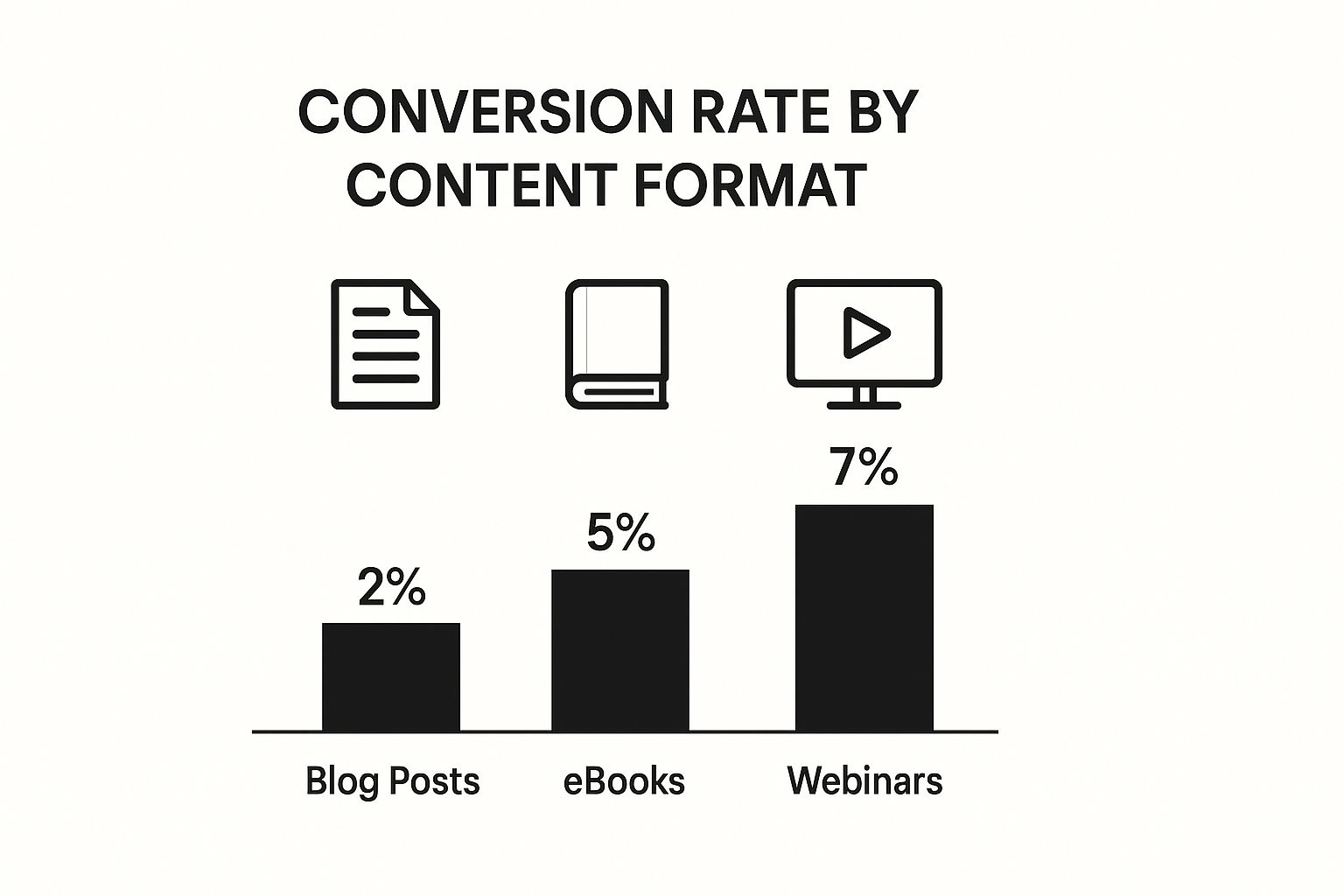
As you can see, more interactive and in-depth content like webinars and guides often have higher conversion rates. That’s because they attract a more engaged and committed audience.
To help you decide where to focus first, here’s a quick comparison of the most common channels.
Comparing Top SaaS Lead Generation Channels
This table compares key lead generation channels for SaaS based on typical lead quality, cost, and primary use case, helping you prioritize your efforts.
| Channel | Typical Lead Quality | Average Cost | Best For |
|---|---|---|---|
| SEO & Content Marketing | High | Low to Medium | Attracting users with high purchase intent and building long-term authority. |
| High | Medium | Direct B2B outreach, networking, and targeting specific decision-makers. | |
| Paid Ads (Google/Social) | Medium to High | High | Generating leads quickly, testing messaging, and targeting specific demographics. |
| Strategic Partnerships | Very High | Low | Tapping into established, relevant audiences and building trust through association. |
| Cold Email Outreach | Low to Medium | Low | Reaching a large volume of potential leads for top-of-funnel awareness. |
Ultimately, the best approach is a balanced one. Start with one or two channels that feel like a natural fit for your business, master them, and then expand from there.
Forge Strategic Partnerships and Co-Marketing
Why struggle to build an audience from scratch when you can borrow someone else’s? Strategic partnerships let you put your brand in front of a relevant, ready-made community of potential customers. The ideal partners are other companies who serve your same ICP but aren’t direct competitors.
Here are a few co-marketing ideas that work wonders:
- Co-hosted Webinars: Team up with a complementary business to host a webinar on a shared topic. You both promote it to your email lists and social followers, effectively doubling your reach overnight.
- Guest Blogging: Offer to write an article for a partner’s blog. It’s a great way to share your expertise, get in front of a new audience, and earn valuable backlinks for your own site’s SEO.
- Integration Partnerships: This is a no-brainer. If your software integrates with another popular tool, that company is your natural partner. You can create joint marketing campaigns specifically for users of both products.
The secret to a great partnership is finding a true win-win. Your offer has to provide real value to your partner’s audience, and in return, their collaboration should give you access to qualified prospects who are a perfect fit for your SaaS. This approach to lead generation for SaaS is powerful because it’s not just about getting more reach; it’s about building trust by association.
Creating Lead Magnets That Actually Convert
It doesn’t matter how great your channels are if your offers fall flat. A generic ebook just doesn’t cut it anymore for busy SaaS operators. Your lead magnet—that valuable resource you trade for contact info—has to solve a real, pressing problem for your ideal customer.
The point isn’t just to snag an email address. It’s about starting a relationship by providing genuine value right out of the gate. This is how you build trust and start qualifying leads from the very first interaction. Think about it: someone who downloads a detailed ROI calculator is a much warmer lead than someone who just skims a blog post.
Match Your Offer to the Buyer’s Journey
Not all leads are created equal, and your offers shouldn’t be either. The real trick is to map your lead magnets to where your prospect is in their buying journey. This way, you’re giving them exactly what they need, when they need it most.
Top of Funnel (Awareness): These folks are just figuring out their problem. They’re in research mode, so they need broad, educational content. Checklists, industry reports, or comprehensive guides are perfect here.
Middle of Funnel (Consideration): They get the problem now and are actively hunting for solutions. This is where you can go deeper with practical content like webinar recordings, detailed case studies, or interactive templates.
Bottom of Funnel (Decision): At this point, they’re ready to pull the trigger. Your offers should be product-focused to help them make a final choice. This is the prime spot for free trial sign-ups, demo requests, and clear pricing guides.
When you think this way, your content becomes a natural pathway, guiding people from initial curiosity to making a decision. It’s a fundamental part of smart lead generation for SaaS.
Move Beyond the Basic Ebook
Sure, a well-written ebook can still have its place, but the most powerful lead magnets today are interactive and deliver immediate, tangible value. They take more work to create, but the payoff is a much higher quality of lead.
Try thinking about these high-impact alternatives:
Interactive Tools & Calculators: An ROI calculator or a pricing comparison tool gives users personalized answers instantly. For instance, a marketing automation platform could build a “Lead Nurturing ROI Calculator” to show a prospect exactly how much revenue they could generate with the software.
Original Research & Data: Run an industry survey and publish the results as an exclusive report. This move instantly positions you as an authority and gives you a unique asset no one else has. Plus, this kind of content is a magnet for backlinks, which is great for your SEO.
Templates & Playbooks: Give your audience something they can use right now. If you’re targeting SaaS founders, a “Board Meeting Slide Deck Template” or a “Hiring Scorecard” is incredibly practical. It directly demonstrates the kind of value you provide.
A great lead magnet doesn’t just tell someone how to solve a problem; it gives them the tool to actually start solving it. This immediate utility is what makes an offer truly irresistible.
Real-World Examples of Great SaaS Lead Magnets
Let’s look at a company that has absolutely mastered this: HubSpot. They offer a massive library of free tools and templates, from their “Website Grader” to the “Buyer Persona Generator.” Each tool solves a real pain point for marketers (their ideal customer) and subtly introduces the value of their main product suite.
Here’s another great example: imagine a project management tool offering a free “Project Kickoff Checklist” template. This simple PDF is immediately useful for its target audience—project managers. By using the checklist, the prospect gets a small taste of the organization and efficiency the full software promises.
Your lead magnet should be a mini-version of your product’s core promise. If your SaaS helps teams improve communication, your lead magnet could be a “Guide to Running More Effective Meetings.” It delivers on the promise of better communication and makes the prospect think, “If their free stuff is this good, imagine what the paid product can do.” That connection is what turns a casual visitor into a genuinely qualified lead.
Bring Your Lead Nurturing to Life with Automation
Getting a lead is just the first step. The real magic happens in the follow-up. Without a solid plan to stay in touch, even your most promising leads will eventually forget about you. This is where automation becomes your secret weapon for lead generation for SaaS, helping you scale your outreach without losing that essential human connection.
The idea isn’t to just bombard everyone with the same generic sales pitch. It’s about being a helpful guide. You want to send the right piece of information at just the right moment, gently leading prospects from being mildly curious to being genuinely ready to talk business. When done right, this automated process builds trust and educates potential customers, so by the time they hop on a call with your sales team, they’re already halfway sold.
Build Smart, Automated Email Sequences
Email is still the undisputed king of lead nurturing. An automated email sequence, often called a drip campaign, is simply a series of emails that go out automatically based on a prospect’s actions. Think of it as a pre-planned conversation.
Let’s say someone downloads your “Ultimate Guide to Project Management.” That’s the trigger. Your automated sequence could then unfold like this:
- Email 1 (Right Away): “Here’s the guide you requested!” A simple, helpful delivery email.
- Email 2 (2 Days Later): “Thought you might like this…” Share a quick case study showing how a similar company nailed their project management with your tool.
- Email 3 (4 Days Later): Offer a short video tutorial on a key feature you touched on in the guide.
- Email 4 (7 Days Later): Invite them to a live webinar you’re hosting on advanced project management tips.
This keeps you on their radar in a valuable way. You become a resource, not just another vendor trying to sell something. For any SaaS business getting started with this, digging into the basics of marketing automation for SaaS is the perfect first move.
The best automation never feels robotic. It anticipates what the lead needs next and provides it before they even think to ask. That kind of proactive support builds incredible trust and immediately sets you apart.
Put a Lead Scoring Model in Place
Let’s be honest: not all leads are created equal. Some people are just browsing, while others have their credit cards out, ready to go. A lead scoring model is how you tell the difference. You assign points to leads based on who they are and what they do, which helps your sales team focus their energy where it counts most.
You can assign points for things like:
- Who they are: A lead that fits your Ideal Customer Profile (ICP) to a T—say, a VP of Marketing at a 100-person tech company—gets a bunch of points.
- What they do: Actions that show they’re serious get higher scores. Visiting your pricing page might be worth +10 points, but requesting a demo? That’s a hot lead, easily worth +50 points.
Once a lead hits a certain score, maybe 100 points, they’re automatically flagged as a Marketing Qualified Lead (MQL) and sent straight to your sales team for a real conversation.
Marketing automation isn’t just a nice-to-have anymore; it’s fundamental. By 2025, about 49% of companies were already using automation, and that number jumps to 55% for B2B businesses. The proof is in the pudding: 80% of companies using automation see more leads, and 77% report better conversion rates. It all comes down to sending personalized, automated follow-ups that engage people at the perfect time.
Connect Your Automation to Your CRM
For any of this to work smoothly, your marketing automation tool and your Customer Relationship Management (CRM) system need to talk to each other. When they’re tightly integrated, you get a single, clear picture of every single lead.
This connection makes the handoff from marketing to sales completely seamless. The moment a lead becomes an MQL, all their information—contact details, engagement history, and their lead score—instantly syncs to their profile in the CRM. Your salesperson can see every email they’ve opened and every page they’ve visited. Imagine how much more personal and effective that first sales call will be.
This turns your lead generation process from a bunch of separate tasks into one powerful, cohesive engine for growth.
Measuring What Matters for Sustainable Growth
Running campaigns and getting leads feels great, but without the right metrics, it’s just busywork. You simply can’t improve what you don’t measure. For sustainable lead generation for SaaS, you have to look beyond surface-level stats like website traffic or social media likes and zero in on the key performance indicators (KPIs) that actually signal business health.
These are the numbers that connect your marketing spend directly to your bottom line. They tell you what’s working, what’s broken, and where your biggest opportunities for growth are hiding. Adopting a data-first mindset is what separates the SaaS companies that stall from those that build predictable, long-term success.
Moving Past Vanity Metrics
It’s so easy to get caught up in vanity metrics. These are the numbers that look impressive in a report but don’t tell you a thing about your actual business performance. Think total website visitors or the number of new email subscribers. While they aren’t totally useless, they don’t show intent or quality.
The real story is in the metrics that track the entire journey from a curious visitor to a paying customer. These are the KPIs that should be front and center on your dashboard:
- Cost Per Lead (CPL): How much are you spending to get one new lead? This is your baseline for understanding the efficiency of different marketing channels.
- Marketing Qualified Leads (MQLs): How many of those leads actually fit your ideal customer profile? This tells you if your top-of-funnel efforts are attracting the right crowd.
- Sales Qualified Leads (SQLs): How many MQLs does your sales team agree are ready for a real conversation? This is the ultimate test of lead quality and sales-marketing alignment.
- Customer Acquisition Cost (CAC): What’s the total sales and marketing cost to land one new paying customer? This is the ultimate measure of your go-to-market efficiency.
By focusing on these numbers, you draw a straight line from your ad spend to your new monthly recurring revenue (MRR). This is the bedrock of all effective SaaS growth strategies.
Understanding Your Funnel Economics
Your sales funnel isn’t just a pretty graphic; it’s a mathematical equation. Knowing the conversion rates between each stage is the key to spotting weaknesses and making smart bets on where to invest your time and money.
A straightforward funnel analysis means tracking how leads move from one stage to the next. For instance, you should be asking:
- Lead to MQL Rate: What percentage of new leads are a good fit for us? If this is low, your targeting is probably off.
- MQL to SQL Rate: What percentage of those “good fit” leads does sales actually accept? A low number here points to a disconnect between what marketing thinks is a good lead and what sales knows is a good lead.
- SQL to Customer Rate: What percentage of qualified opportunities end up closing? A low conversion rate here could signal problems with your sales process, pricing, or even product-market fit.
A funnel analysis transforms your lead generation from a guessing game into a clear, predictable system. It shows you exactly where leads are getting stuck, so you can fix the biggest bottleneck instead of wasting resources elsewhere.
Calculating Your Cost Per Lead
Knowing your Cost Per Lead (CPL) is non-negotiable for budgeting and judging channel performance. The formula itself is simple: Total Marketing Spend / Total New Leads = CPL. But the story behind that number is what really matters.
In SaaS, it’s normal to see a higher CPL compared to other industries. This is driven by longer sales cycles and fierce competition. According to 2025 benchmarks, the average CPL for B2B tech companies, including SaaS, hovers around $208. That figure is significantly higher than in sectors like retail, where you might see a CPL under $50. SaaS businesses can stomach this premium because a single customer can bring in thousands of dollars in lifetime value (LTV). You can get a deeper look at industry benchmarks by reviewing the latest lead generation statistics.
Think of it this way: a high CPL from a channel like LinkedIn might seem expensive on the surface. But if those leads become customers at a much higher rate than cheaper leads from another source, the higher initial cost is more than justified. The goal isn’t to find the cheapest leads; it’s to find the most profitable ones. This kind of data-driven thinking is what truly fuels a powerful lead generation engine.
Common SaaS Lead Generation Questions
Even with the best-laid plans, questions always come up. The world of lead generation for SaaS is constantly shifting, and a strategy that crushed it last quarter might need a refresh today. Let’s dig into some of the most common questions and roadblocks SaaS leaders run into when they’re trying to keep their pipeline full.
Think of this as a quick-reference troubleshooting guide. The goal is to give you straightforward answers so you can make smarter decisions and get back to growing.
How Much Should I Spend on Lead Generation?
Ah, the million-dollar question. While “it depends” is the technically correct answer, it’s not very helpful. Let’s get more practical.
For a young SaaS company in aggressive growth mode, it’s not unheard of to spend 20% to 50% of your Annual Recurring Revenue (ARR) on marketing and lead gen. That’s a huge range, I know.
A much better way to think about it is to work backward from your revenue goals.
- First, nail down your revenue target for the quarter or year.
- Next, figure out how many new customers you need to get there.
- Then, using your historical lead-to-customer conversion rate, calculate the total number of leads required.
- Finally, multiply that number by your average Cost Per Lead (CPL). Boom, you have a budget.
This approach anchors your spending to actual business outcomes, which makes it much easier to defend to your board and track your ROI.
Which Lead Generation Channel Is Best for My SaaS?
There’s no magic bullet here. The “best” channel is completely dependent on your Ideal Customer Profile (ICP). The rule is simple: go where your customers live and work.
- If you’re a B2B SaaS selling to corporate decision-makers, you pretty much have to be on LinkedIn. Its targeting capabilities for job titles, company sizes, and industries are second to none.
- Got a SaaS with a cool visual interface or a product that targets a younger crowd? Don’t sleep on platforms like Instagram or even YouTube. You might be surprised.
- Is your SaaS a solution to a problem people are actively typing into Google? Then SEO and Google Ads are non-negotiable. You need to be there when that high-intent search happens.
The most reliable strategy is usually a multi-channel approach. Pick one or two channels that are a dead-on match for your ICP. Get really good at them. Once you’ve got a system that works, use that data to slowly branch out.
How Do I Know if My Leads Are Actually Good?
A flood of leads is a great ego boost, but it’s worthless if none of them close. The real measure of lead quality is seeing how they move through your funnel. If you have tons of sign-ups that never become Marketing Qualified Leads (MQLs) or Sales Qualified Leads (SQLs), you’ve got a quality problem, not a volume problem.
This is where a lead scoring system becomes your best friend. Set one up to automatically flag your best prospects based on who they are (demographics, company size) and what they do (visiting your pricing page, downloading a case study).
This data-first approach takes the guesswork out of prospecting and ensures your sales team spends their valuable time on leads that are actually likely to buy. Integrating these scores with your CRM is a core part of building a smooth, efficient system. You can get a deeper understanding of how to set up these workflows by exploring SaaS marketing automation.
At the end of the day, the ultimate test of a good lead is simple: do they become a paying customer who sticks around?
At SaaS Operations, we provide proven playbooks and SOPs to help you build and scale your lead generation engine without the guesswork. Our frameworks, developed over a decade of growing 8-figure SaaS businesses, are ready to plug and play so you can accelerate growth. Start building a more effective business today.