
So, what exactly is SaaS B2B lead generation? At its core, it’s the entire system you build to find and attract other businesses that could become paying customers for your software. This isn’t about chasing one-off sales or quick wins. It’s about creating a predictable, sustainable pipeline of qualified prospects who truly need what you’re selling.
For any SaaS company looking to grow, getting this right is everything.
Why SaaS B2B Lead Generation Is Different
Forget the textbook definitions for a moment. Instead of thinking about casting a wide net and hoping for the best, picture SaaS B2B lead generation as building a powerful magnet. This magnet is carefully designed to pull in only your ideal customers, guiding them methodically through your pipeline.
This approach is worlds away from selling to individual consumers (B2C) because the stakes are much higher and the buying decisions are far more involved. A B2B SaaS purchase isn’t a simple click-to-buy transaction; it’s a major business investment, and that changes the entire game.
The Challenge of Longer Sales Cycles
The path from a curious lead to a happy, paying customer in the B2B space is a marathon, not a sprint. Sales cycles often stretch over weeks, if not months, packed with demos, calls, and deep-dive evaluations. You aren’t just selling a piece of software—you’re building a compelling business case and nurturing a relationship founded on trust.
One of the biggest mistakes you can make is trying to force a decision too early. Patience is a virtue here. Your job is to educate, address every concern, and consistently demonstrate your value over the long haul.
This extended timeline means your strategy has to be built for endurance. It requires a steady stream of valuable content, consistent follow-ups, and personalized touches that guide prospects along their journey without ever feeling pushy.
Navigating Multiple Decision-Makers
In the B2B world, you almost never sell to a single person. A purchase decision often rests in the hands of a committee, and each member has a different set of priorities.
- The End-User: The person who will actually be using your software day-to-day. They care about features and ease of use.
- The IT Manager: This person worries about security, integration headaches, and whether your tool will play nice with their existing tech stack.
- The Finance Head: The executive with the budget. Their focus is purely on the numbers: cost, ROI, and financial risk.
- The Department Head: The leader who needs to know how your software aligns with their bigger strategic goals and helps their team hit its targets.
A smart saas b2b lead generation strategy speaks to all of them. You need to craft messages that address each person’s specific pain points and show them exactly how your solution makes their life easier. To explore this further, take a look at our complete guide on effective lead generation for SaaS.
The High Stakes of Customer Lifetime Value
Bringing a new B2B customer on board isn’t cheap. The average cost per lead (CPL) for B2B SaaS and tech companies hovers around $208. This number reflects the fierce competition and the detailed, high-touch sales process involved. For comparison, many B2C industries see CPLs well under $50, as you can see in data from sources like Designrush.com.
With acquisition costs this high, you can’t afford to lose customers. Your lead generation has to do more than just bring in new business; it has to attract the right business. You need customers who are a great fit from day one and are set up to be successful and loyal for years to come. Nail this, and you’ve built the foundation for predictable revenue and a strong position in the market.
Mapping Your Lead Generation Funnel
Think of your saas b2b lead generation process less like a single action and more like a well-planned journey for your future customers. The classic way to visualize this is with a sales funnel. It maps out the path a person takes, from first hearing about you all the way to signing up. This model is crucial for saying the right thing at the right time.
A structured funnel stops you from making the classic mistake: trying to pitch a complex software demo to someone who only just realized they have a problem. Instead, you guide them. You build trust and show them your value, one step at a time. Each stage has its own goal, the prospect is in a different mindset, and you’ll need a unique type of content to connect with them.
Top of the Funnel (ToFU): Building Awareness
At the very top, people know they have a problem, but they don’t know the solution exists yet. They might be struggling with messy workflows or poor team communication, but they aren’t Googling for software… yet. Right now, their only goal is to understand the challenge they’re facing.
Your job here is to attract a wide—but still relevant—audience with helpful, educational content. You are not selling. You are teaching. This is how you start to build a reputation as a helpful authority in your space.
Content that works wonders at this stage includes:
- Insightful Blog Posts: Articles that tackle common industry headaches or answer the questions your audience is searching for on Google.
- Engaging Social Media Content: Shareable graphics, quick videos, and posts that get your name in front of a much larger network.
- High-Level Guides or Ebooks: Offer foundational knowledge on a topic they care about. This establishes your expertise without any kind of hard sell.
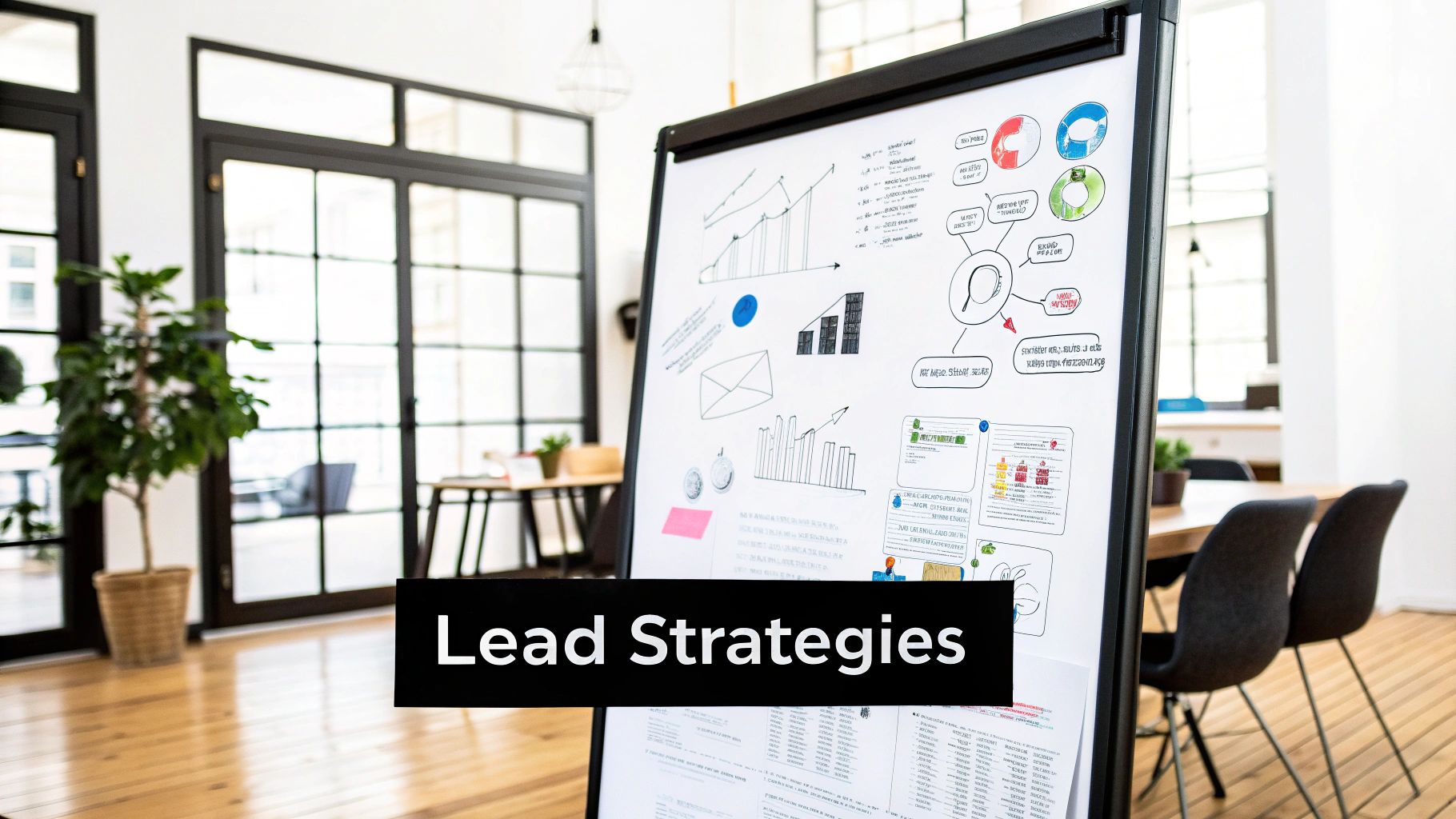
This image shows a team working together to define their ideal customer—a critical first step for any funnel.

As you can see, a successful funnel is built on a deep understanding of your customer. That understanding is what tells you exactly what content you need to create for each stage.
Middle of the Funnel (MoFU): Building Trust
Once someone moves into the middle of the funnel, things get more serious. They’ve put a name to their problem and are now actively looking for solutions. They’re comparing different tools and approaches, and your goal is to earn their trust and convince them your solution is the best one for the job. You have to prove it.
This is where you switch from general advice to more solution-focused content. You need to get more specific, providing resources that show exactly how your software solves their particular problems.
The middle of the funnel is where real relationships are forged. Prospects are stacking you up against your competitors, and your content has to be compelling enough to show them you’re a credible partner, not just another vendor.
Content that really shines in the MoFU includes:
- Compelling Case Studies: Real-world stories showing how customers just like them found success with your product. Nothing beats this kind of social proof.
- In-Depth Webinars: Live or recorded sessions that take a deep dive into a specific feature or strategy, showing your product in action.
- White Papers and Data Reports: Offer original research or a detailed analysis that helps them make a smart, informed decision and positions you as an expert.
Bottom of the Funnel (BoFU): Driving Conversion
By the time a lead reaches the bottom of the funnel, they are highly qualified. They’ve done the research, they trust your brand, and they’re this close to making a decision. Now they’re looking at the practical details: pricing, specific features, and how hard it will be to get started.
Your goal here is simple: convert this lead into a paying customer. Your content and offers need to be laser-focused on the product and remove any last-minute hesitation. It’s time to make an offer that’s too good—and too easy—to refuse. This is where all your saas b2b lead generation work pays off, turning genuine interest into actual revenue.
Common BoFU offers that seal the deal:
- Free Trials: Letting people experience your product for themselves is one of the most powerful conversion tools in your arsenal.
- Live Demos: A personalized, one-on-one walkthrough of your software that’s tailored to the prospect’s specific needs and questions.
- Pricing Pages and ROI Calculators: Clear, transparent pricing and tools that help a prospect build a business case to present to their team.
Winning with High-Value Inbound Strategies
Think of inbound marketing as a powerful magnet for the exact B2B SaaS leads you want. Instead of chasing people down, you create genuinely helpful resources that draw them right to you. This approach is all about building a lead generation engine that runs on its own, cutting down your reliance on paid ads and building a brand that people trust for the long haul.
The idea is pretty simple: become the definitive, go-to source in your niche. When you consistently publish content that solves your audience’s real-world problems, you build authority and trust way before they’re even thinking about making a purchase. So, when the time comes to find a solution like yours, you’re the first name that pops into their head. This is the bedrock of a powerful SaaS B2B lead generation machine.
Dominate Search with SaaS SEO
Search Engine Optimization (SEO) is really just the craft of making sure you show up when potential customers are Googling for answers. For a SaaS company, this means digging deeper than just the obvious, super-competitive keywords. The real magic happens when you target long-tail keywords.
These are longer, more specific phrases that show someone is much closer to buying.
For example, a person searching for “project management” is probably just window shopping. But someone searching for “best project management tool for remote marketing teams”? That person has a specific problem and is actively looking for a solution. That’s exactly where you need to be.
A solid SaaS SEO plan includes:
- Keyword Research: Getting into your customers’ heads to uncover the exact problems, questions, and “jobs-to-be-done” they type into the search bar.
- On-Page Optimization: Fine-tuning your website’s content, headlines, and descriptions to perfectly align with what those searchers are looking for.
- Technical SEO: Making sure your site is fast, secure, and easy for search engines to crawl. A smooth user experience is a non-negotiable part of good SEO.
Build Authority with Pillar Content
Content marketing is the fuel for your entire inbound strategy. When you create truly valuable and insightful content, you naturally become seen as an expert. One of the best ways to structure this effort is by creating pillar pages and topic clusters. A pillar page is your ultimate, one-stop guide on a major topic your audience cares about.
A pillar page acts as the central hub for a broad topic, replacing the need for dozens of short, disconnected blog posts. It’s supported by a “cluster” of related articles, each diving deep into a specific sub-topic and linking back to the main pillar. This structure tells search engines you’re an authority on the subject.
This approach doesn’t just do wonders for your SEO. It gives your visitors incredible value, encouraging them to stick around, explore, and learn from you.
Generate MQLs with Webinars and Events
Webinars and virtual events are absolute gold for generating Marketing Qualified Leads (MQLs). They give you a unique chance to connect with a captive audience, demonstrate your expertise, and show off your product’s value in a live, interactive setting.
A great webinar isn’t just an educational presentation; it’s a tool for moving prospects through your funnel. The registration form alone captures crucial lead data. Then, during the event, you can use polls, live Q&A, and demos to see who’s paying attention. The most engaged attendees are your hottest leads.
From there, you can segment them for personalized follow-up. To really nail this process, you should explore more about how marketing automation for SaaS can transform your process. By connecting your webinar platform directly to your CRM, you can automate the entire workflow. This ensures no lead gets missed and your sales team gets instant alerts about the most promising opportunities, creating a clear line from your content to your bottom line.
Driving Growth with Smart Outbound Tactics
While inbound marketing is your long-term magnet for attracting leads, a smart outbound strategy is your accelerator. Think of it as a way to jump the queue.
But let’s be clear: this isn’t about blasting out thousands of generic emails. Modern outbound is about precision. It’s about carefully selecting the right people at the right companies and starting a conversation that they actually want to have. You’re shifting from being an interruption to becoming a welcome resource.
Instead of playing a numbers game, you’re focusing on relevance and genuine personalization. The goal is to reach a hand-picked list of perfect-fit companies and talk to them about their problems, not your product’s bells and whistles.
Building Hyper-Targeted Lead Lists
The entire foundation of a great outbound campaign is your lead list. A generic, purchased list is a one-way ticket to low response rates and a trashed sender reputation. Your success boils down to building a list of prospects who perfectly match your Ideal Customer Profile (ICP).
This is where tools like LinkedIn Sales Navigator become your best friend. They let you slice and dice a massive professional database to find exactly who you’re looking for.
When building your list, focus on filters like:
- Company Size: Are you targeting scrappy startups or established enterprises? Make sure they have the team and budget to actually use your software.
- Industry: Zero in on the specific verticals where you know your product solves a painful, expensive problem.
- Job Title: Pinpoint the exact decision-makers. You want to talk to the “VP of Marketing” or “Head of Operations,” not someone who can’t sign a check.
- Technology Used: Look for companies using software that works well with yours (or a competitor’s tool you can replace). This is often a huge buying signal.
Getting this part right means every single email you send has a much higher chance of hitting home.
Crafting Personalized Cold Email Sequences
With your list ready, it’s time to write emails that feel like they were written just for one person. Ditch the generic templates that scream “I’m a robot!” The secret is to make it all about them—their challenges, their goals, and their world.
A great cold email doesn’t list your software’s features. It shows you truly understand the prospect’s problem and offers a credible way to solve it. It’s a conversation starter, not a sales pitch.
Build your email sequence around giving value first. Instead of opening with “Let me tell you about my product,” try sharing a useful insight, a surprising piece of data, or a link to a resource that could genuinely help them. This builds goodwill and positions you as a helpful expert, not just another salesperson.
To keep these campaigns organized and effective, it helps to follow a structured approach. You can learn more by checking out our proven SaaS Playbooks for outreach.
Integrating Social Selling on LinkedIn
Email is a fantastic tool, but you can seriously boost your response rates by adding LinkedIn to the mix. It creates a multi-channel approach that’s hard to ignore.
Before you even think about sending that first email, go warm up the relationship on LinkedIn. Like their posts. Leave a thoughtful comment on an article they shared. This simple “warm-up” puts your name on their radar.
When your email finally arrives, it’s not from a total stranger. It’s from that person they’ve seen around their professional network. This small step can make a huge difference in getting your email opened and read.
The world of saas b2b lead generation is constantly evolving. Today, success means blending AI-powered tools for efficiency with a real commitment to authentic, human connection. While technology helps you do more, faster, it’s the genuine engagement through high-quality, helpful content that builds the trust needed to close a deal. For more on this, you can discover additional insights into the 2025 B2B landscape on dux-soup.com. This balanced approach will ensure your outbound efforts are both efficient and truly effective.
Building Your Lead Generation Tech Stack
Technology is the engine that powers modern SaaS B2B lead generation. It’s what allows you to scale up your efforts without completely overwhelming your team. Think of your tech stack not as a random collection of software, but as a finely tuned ecosystem. Each tool has a specific job, and they all work together to automate tedious tasks, give you a clearer picture of what’s working, and ultimately drive growth.
A well-built stack is your safety net—it prevents leads from falling through the cracks. More importantly, it frees up your people to focus on what they do best: building relationships and closing deals. It’s the essential framework for creating a predictable and efficient pipeline of new business.
Your CRM: The Single Source of Truth
At the very heart of any good tech stack is your Customer Relationship Management (CRM) system. It’s the central hub for every single interaction you have with leads and customers. Without one, you’re basically flying blind, with crucial information scattered across spreadsheets, email inboxes, and random notepads. That’s a recipe for chaos and missed opportunities.
A CRM brings every touchpoint—from a prospect’s first visit to your website to the final sales call—into one unified profile. This gives both your marketing and sales teams a complete, 360-degree view of every lead. It ensures everyone is on the same page, which cuts down on confusion and creates a much smoother experience for your potential customers.
Marketing Automation: The Lead Nurturing Powerhouse
While a CRM is great for storing data, a marketing automation platform is what puts that data to work. This technology has completely changed the game for B2B lead generation. In fact, the latest data shows that 55% of B2B companies now use marketing automation, with many platforms adding AI to help capture, score, and nurture leads. These tools take the manual work out of outreach by managing key processes for you. Research shows it pays off: 80% of businesses using this tech generate more leads, and 77% see higher conversion rates. You can explore more lead generation statistics and trends to see the full picture.
These platforms are the key to nurturing leads effectively, especially when you have a lot of them. They let you:
- Segment Your Audience: Group leads based on their behavior, demographics, or engagement so you can send them content that actually resonates.
- Automate Nurture Sequences: Set up email campaigns that automatically guide prospects through your funnel, delivering the right message at just the right time.
- Implement Lead Scoring: Assign points to leads based on their actions (like visiting your pricing page or downloading a case study) to pinpoint who is ready for a sales conversation.
A strong marketing automation system ensures that no lead is left behind. It systematically warms up prospects until they are hot enough to be handed over to your sales team, maximizing the value of every single lead you generate.
Inbound vs Outbound Lead Generation Strategies
To get the most out of your tech stack, you need to understand the two main approaches it will support: inbound and outbound lead generation. Inbound is about attracting leads by creating valuable content and experiences, while outbound involves proactively reaching out to potential customers. Most successful SaaS companies use a mix of both.
Here’s a simple breakdown of how they compare:
| Attribute | Inbound Strategy | Outbound Strategy |
|---|---|---|
| How It Works | Attracts leads with helpful content like blogs, SEO, and social media. | Proactively contacts potential leads through cold emails, calls, or ads. |
| Lead Quality | Generally higher quality and more engaged, as they came to you first. | Can be a mixed bag; requires strong qualification to find good fits. |
| Cost & Effort | Higher upfront investment in content creation; lower cost per lead over time. | Can be expensive and time-consuming; cost per lead can be high. |
| Time to Results | Slower to build momentum, but creates a sustainable long-term asset. | Can generate leads quickly, but stops when you stop the campaigns. |
| Best For | Building brand authority, generating long-term, qualified leads. | Targeting specific accounts, penetrating new markets quickly. |
Ultimately, the right strategy isn’t about choosing one over the other. It’s about finding the right balance that aligns with your business goals, target audience, and budget. Your tech stack should be flexible enough to power both inbound nurturing and outbound campaigns seamlessly.
Essential Tools for Data and Scheduling
Beyond your core CRM and automation platform, a few other tools can really round out a high-performing stack. Data enrichment tools are fantastic for fleshing out your lead profiles. When someone signs up with just an email address, these tools can automatically pull in more details like their company size, job title, and industry. This helps you qualify leads and personalize your outreach much more effectively.
Finally, appointment scheduling tools get rid of the frustrating email back-and-forth of trying to book a demo. By letting prospects pick a time directly on your team’s calendar, you remove a major point of friction in the sales process. This simple addition can significantly boost the number of demos you book and speed up your sales cycle, turning interested leads into qualified opportunities with far less effort.
Measuring What Matters for Real Growth
In SaaS B2B lead generation, feeling busy doesn’t pay the bills. What matters is seeing real, measurable results that tie directly back to revenue. If you’re not tracking your efforts, you’re just guessing—and that’s a risky way to run a business. It’s time to look past vanity metrics like social media likes and zero in on the numbers that actually move the needle.
Good data shows you what’s working, but more importantly, it shines a light on what’s broken. It helps you find the bottlenecks in your process, test out new ideas with confidence, and constantly tweak your approach to get the best possible return. This isn’t just about collecting data; it’s about making smarter decisions.

From MQLs to SQLs: A Critical Distinction
To really understand how well your funnel is performing, your marketing and sales teams need to speak the same language. It all starts with having a crystal-clear, shared definition of what a “lead” actually is at each stage. When these definitions are fuzzy, marketing ends up tossing unqualified prospects over the fence, and the sales team wastes precious time chasing dead ends.
Marketing Qualified Lead (MQL): Think of an MQL as someone who has raised their hand to show interest. They might have downloaded your latest ebook or sat in on a webinar. They’re curious, but they’re not quite ready for a sales pitch.
Sales Qualified Lead (SQL): An SQL is a different beast entirely. This person has been properly vetted and is ready for a direct conversation with sales. They match your ideal customer profile, have a real need you can solve, and have shown strong buying intent—like requesting a demo.
The handoff from MQL to SQL is one of the most crucial moments in your entire lead generation process. Get this transition right, and high-potential leads move smoothly toward a sale. Get it wrong, and you risk losing them forever.
The Metrics That Drive Your Bottom Line
With your lead stages clearly defined, you can start tracking the key performance indicators (KPIs) that connect your day-to-day activities to the bottom line. For any serious SaaS company, these three metrics are absolutely essential.
1. Cost Per Lead (CPL)
This is straightforward: How much does it cost to get one new lead in the door? You figure this out by dividing your total campaign cost by the number of leads it brought in. A high CPL isn’t necessarily a red flag, but you have to look at it alongside your other numbers to know for sure.
2. Lead-to-Customer Conversion Rate
This metric tells you what percentage of your leads eventually become paying customers. It’s a direct measure of both your lead quality and your sales team’s effectiveness. If this number is low, it could mean you’re attracting the wrong crowd or there’s a crack in your sales process.
3. Customer Lifetime Value (CLV)
CLV is the holy grail. It’s the total amount of revenue you can realistically expect to earn from a single customer over their entire relationship with you. Knowing your CLV is critical because it tells you exactly how much you can afford to spend to acquire a new customer and still turn a healthy profit.
When you track these numbers together, you get a complete, honest picture of your funnel’s health. For a closer look at the data you should be watching, check out this guide on the most important SaaS KPIs. By keeping a close eye on these metrics, you can turn your lead generation from a cost center into a predictable, revenue-driving machine.
Frequently Asked Questions
Let’s tackle some of the most common questions that come up when you’re deep in the trenches of SaaS B2B lead generation. Getting these answers right can help you sharpen your strategy and build a much healthier pipeline.
What Is a Good Lead to Customer Rate for B2B SaaS?
There’s no single magic number, as it really depends on your specific industry, price point, and how long your sales cycle is. That said, a solid benchmark for B2B SaaS is a lead-to-customer conversion rate between 1% and 3%.
What does that mean in practice? For every 100 qualified leads that enter your pipeline, you can realistically expect to sign one to three of them as new customers.
Of course, companies with really dialed-in funnels—we’re talking precise lead scoring and a killer sales process—can push that number to 5% or even higher. The real goal isn’t just to pump up the volume of leads; it’s to improve the quality of those leads so they perfectly match your ideal customer.
A low conversion rate paired with a high lead volume is often a red flag. It usually means your marketing is casting too wide a net and attracting the wrong people. Focusing on quality over quantity is the secret to efficient saas b2b lead generation.
Should I Focus on Inbound or Outbound Lead Generation?
This is a classic “either/or” question, but the truth is, you shouldn’t choose. The most resilient SaaS companies don’t pick a side; they blend both into a powerful “all-bound” strategy.
- Think of inbound marketing as your long-term engine for growth. It’s how you build a trusted brand and draw in prospects who are actively looking for a solution like yours. It’s sustainable and builds momentum over time.
- Outbound marketing, on the other hand, is your accelerator. It lets you go out and find opportunities by directly targeting high-value accounts that you know are a perfect fit. You’re not waiting for them to find you; you’re creating the conversation.
The smartest way to start is by leaning into what you’re already good at, but you should always have a plan to build out your capabilities in both areas. This creates a much more dependable and robust flow of leads.
How Long Does It Take to See Results from SaaS Lead Generation?
How quickly you see results comes down to which strategy you’re using.
Outbound tactics, like a targeted cold email campaign or a paid ad blitz, can start generating conversations and new leads in just a few weeks. They’re built for speed and predictability once you crack the code on what works.
Inbound strategies like SEO and content marketing are a different beast—they’re a long-term investment. You’ll likely need to put in 6 to 12 months of consistent work before you start seeing a steady stream of high-quality organic leads. It requires patience, but the payoff is huge. The compounding returns from a strong inbound machine can power your growth for years.
To get a better handle on the key numbers you should be tracking throughout this journey, check out these top metrics dashboard examples to boost SaaS growth.
Ready to implement proven, battle-tested frameworks in your business? SaaS Operations provides plug-and-play playbooks, templates, and SOPs to help you save time and accelerate growth. Get started with SaaS Operations today.