10 Actionable Product Led Growth Examples From Top SaaS Operators in 2025
 Published By: Alex
December 31, 2025
Published By: Alex
December 31, 2025
Everyone's talking about Product-Led Growth (PLG), but what does it actually look like in practice, day-to-day? It's more than just a freemium tier or a slick onboarding flow. True PLG is a company-wide operating model where the product itself is the primary driver of customer acquisition, conversion, and expansion. Forget the high-level theory. We're cutting through the noise to show you exactly how the biggest names in SaaS built their empires by putting their product at the center of their growth engine.
This isn't another list of surface-level descriptions. We're diving deep into the specific, actionable product led growth examples that define the modern SaaS landscape. For a foundational understanding, you can delve into a comprehensive playbook for Product-Led Growth to explore its core definitions and strategic frameworks. Here, however, we’re reverse-engineering the operational playbooks behind giants like Slack, Figma, and Calendly.
You'll get a behind-the-scenes look at the specific tactics, key metrics, and internal processes they used to achieve explosive growth. We'll break down not just what they did, but how you can replicate their success. You will leave with clear, battle-tested frameworks, scorecards, and replicable steps to implement these PLG tactics in your own SaaS operations. Let's get started.
1. Slack: Freemium Model with Viral Team Adoption
Slack is a poster child for product led growth examples, mastering the art of the freemium model combined with viral, team-based adoption. Instead of selling to a CIO, they gave their powerful collaboration tool away for free, letting individual teams experience its value firsthand.
The "aha!" moment came quickly. A developer would start a workspace for their team, invite a few colleagues, and within days, the entire department was hooked on channels, integrations, and emoji reactions. This organic, bottom-up adoption created internal champions who did the selling for Slack. By the time IT or procurement got involved, dozens or even hundreds of employees were already active users, making an enterprise-wide deal a no-brainer.
The Strategic Playbook
Slack's strategy was built on removing friction and embedding virality directly into the product experience. They understood that the true customer wasn't a single user, but the team.
The Core Insight: Stewart Butterfield and his team recognized that the value of a communication tool increases exponentially with each new user who joins. Their entire growth model was engineered to facilitate and accelerate this network effect within organizations.
Actionable Takeaways You Can Steal
- Define Your "Activation" Metric: For Slack, a key metric was a team sending 2,000 messages. They found this was the magic number where a team was unlikely to ever churn. Find your equivalent metric that signals a user is truly "hooked."
- Engineer Viral Loops: Slack's core loop is simple: User A invites User B to a channel, making the product more valuable for both. Build features that require collaboration, like shared dashboards, team projects, or multiplayer editing.
- Product-Qualify Leads (PQLs): Don't just track signups. Set up dashboards to monitor usage patterns that signal expansion potential. Track things like the number of users from a single corporate domain or the number of integrations used. This data tells your sales team exactly when to engage for an enterprise sale. You can learn more about how this fits into wider SaaS growth strategies.
2. Figma: Design Tool with Network Effects
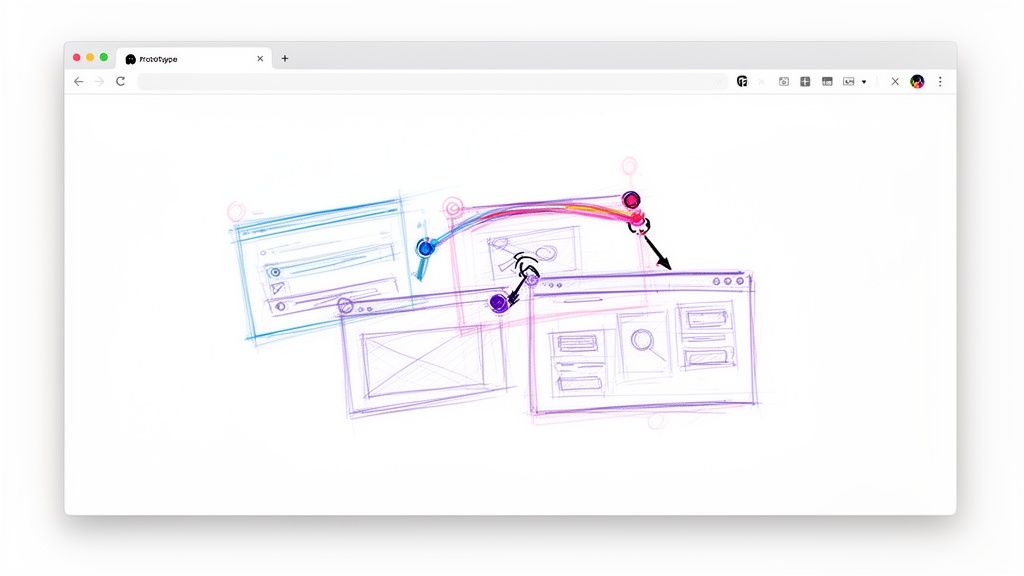
Figma fundamentally changed the design software landscape by building a collaborative, web-based tool that obliterated traditional barriers. Instead of selling expensive licenses to design leads, they offered a powerful free tier that allowed individual designers to start creating immediately. This made it incredibly easy for one person to adopt the tool and then invite others to view or edit their work.
The "aha!" moment for teams was witnessing real-time, "multiplayer" design sessions. A designer would share a link with a product manager or developer, who could now leave comments directly on the canvas, eliminating endless email chains and version control nightmares. This bottom-up adoption, driven by cross-functional collaboration, made Figma indispensable. Soon, entire product teams were living in Figma, making an enterprise upgrade a logical next step to manage permissions and scale design systems.
The Strategic Playbook
Figma’s playbook was centered on leveraging network effects, not just within the design team, but across the entire organization. They understood that a design file's value isn't just in its creation but in its consumption by developers, marketers, and product managers.
The Core Insight: Dylan Field and the Figma team realized that design is a team sport. By building a tool in the browser, they made design accessible to everyone involved in the product development lifecycle, turning a solitary activity into a collaborative hub and creating powerful network effects.
Actionable Takeaways You Can Steal
- Make Collaboration the Core Loop: Figma’s core loop is viral: a designer creates a file and shares it with a collaborator, who must sign up to comment. This makes the product inherently more valuable with each new user. Build features that are better when used with others.
- Target Cross-Functional "Aha!" Moments: The magic wasn't just designers collaborating; it was the streamlined handoff to developers. Identify the points of friction between departments that your product can solve, and build features that create value for multiple user personas simultaneously. For a deeper dive into this, consider reading up on the evolving landscape of design tools and philosophy, specifically referencing Figma.
- Track Collaborative PQLs: Don't just count designers. Your most valuable Product-Qualified Leads (PQLs) are organizations showing cross-functional adoption. Create dashboards that track the ratio of "Creator" to "Viewer" roles within a single company domain. When you see PMs, engineers, and marketers joining a workspace, it’s a massive signal for your sales team to engage.
3. Notion: Open-Ended Product with User-Generated Content
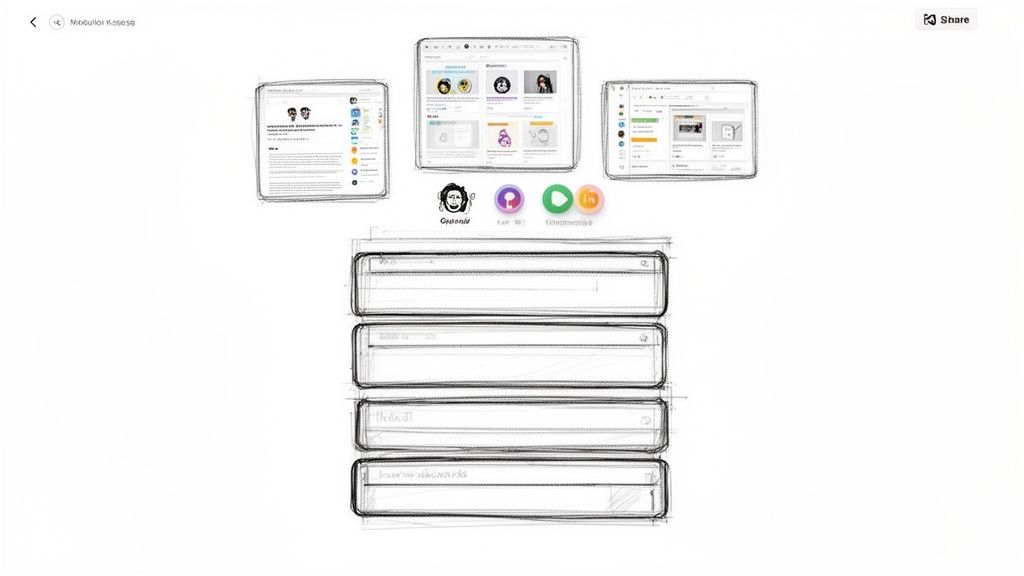
Notion represents a masterclass in product led growth examples by creating a flexible, all-in-one workspace that users shape to their own needs. Instead of prescribing a rigid workflow, Notion gave users a set of powerful building blocks-databases, pages, and embeds-and let them build their own solutions, turning the product into a blank canvas for productivity.
The "aha!" moment is deeply personal and creative. A student discovers they can build the perfect class notes and study planner. A startup founder designs a custom company wiki and project tracker. This user-generated utility, combined with a generous free plan, meant that the product itself became its most powerful marketing engine. Users didn't just adopt Notion; they became creators and evangelists, sharing their templates and workflows across social media and YouTube.
The Strategic Playbook
Notion's growth strategy was to weaponize its own community. They understood that the most compelling use cases wouldn't come from their marketing team, but from the creativity of their user base. This turned every user into a potential content creator and distribution channel.
The Core Insight: Ivan Zhao and the Notion team realized that by building a platform instead of just a tool, they could harness network effects through user-generated content. A template created by one user could solve a problem for thousands of others, creating an organic, self-sustaining acquisition loop.
Actionable Takeaways You Can Steal
- Foster a Creator Ecosystem: Your most passionate users are your best marketers. Nurture this by building a template gallery, promoting community leaders, and creating ambassador programs. Notion's success is inseparable from the vibrant community that creates tutorials and templates.
- Define Activation by Creation, Not Just Consumption: For Notion, a key metric isn't just viewing a page, but creating one or duplicating a template. Your activation metric should reflect the user taking a step to make the product theirs. Monitor the creation of dashboards, reports, or custom workflows.
- Leverage Templates for Onboarding: Reduce the "blank canvas" paralysis by offering pre-built templates for common use cases. This immediately shows value and teaches users the product's capabilities. Use this data to identify which templates lead to higher team collaboration and signal an opportunity for a sales-led conversation about an enterprise plan.
4. Airtable: Low-Code Platform with Creator Economy Focus
Airtable is a prime example of product led growth fueled by flexibility and a creator-centric ecosystem. It presents itself as a spreadsheet-database hybrid, but its real power lies in empowering non-technical users to build sophisticated, custom applications and workflows without writing a single line of code. The generous free tier acts as a sandbox for individuals and small teams to solve immediate business problems.
The "aha!" moment happens when a user replaces a clunky spreadsheet or an overly complex legacy tool with a simple, elegant Airtable base. A marketer builds a content calendar, an operations manager creates a project tracker, or a freelancer designs a custom CRM. This initial success often leads them to share their creations as templates, sparking viral adoption as others copy and adapt these solutions for their own needs, creating a powerful network effect.
The Strategic Playbook
Airtable’s strategy focused on becoming the underlying infrastructure for a new generation of builders and creators. They didn't just provide a tool; they provided a platform for innovation, where the users themselves became the primary drivers of growth and value creation through a vibrant template marketplace.
The Core Insight: Howie Liu and the Airtable team understood that the most powerful growth engine is user creativity. By giving users lego-like building blocks, they enabled an infinite number of use cases and turned their most active users into evangelists and de facto product marketers.
Actionable Takeaways You Can Steal
- Foster a Template Ecosystem: Don't just show users what your product can do; let them build and share their own solutions. Create a public gallery for user-generated templates for common workflows like sales pipelines, OKR trackers, or bug tracking. This provides immediate value to new users and showcases the product's versatility.
- Track Complexity as an Expansion Signal: Monitor metrics that indicate a user is building mission-critical systems. Key signals for Airtable include the number of bases per workspace, complexity of formulas, rows per base, and especially API usage. These are your Product-Qualified Leads (PQLs) that are ready for an upgrade or a sales conversation.
- Lean into the Creator Economy: Empower your power users. Airtable did this brilliantly with its Creator Fund, paying creators to build and share useful Airtable apps and extensions. Consider launching similar programs, affiliate partnerships, or expert marketplaces to reward users who build on top of your platform and bring new audiences into your ecosystem.
5. Calendly: Single Problem Solver with Seamless Integration
Calendly is a masterclass in product led growth examples, built on solving one frustrating problem exceptionally well: scheduling meetings. Instead of a complex platform, they offered an elegant, free tool that eliminated the endless back-and-forth emails. Its genius was turning every user into a promoter.
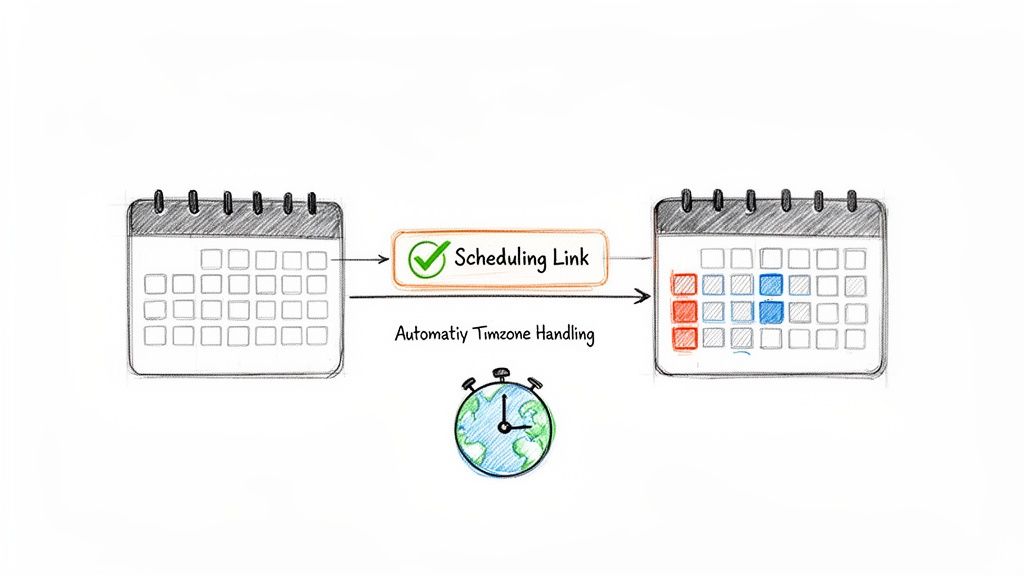
The "aha!" moment is instant. A sales professional shares a link with a prospect, a consultant sends one to a client, and the recipient experiences the friction-free process of booking a time. This interaction exposes them to the product's value, turning them into a new user. This viral loop is so powerful that it fueled Calendly’s early 700%+ year-over-year growth, driven entirely by the product itself.
The Strategic Playbook
Calendly's strategy was to embed itself into existing workflows and create a viral growth loop that operates outside its own application. They understood that the product's primary function, sharing a link, was also its primary growth engine.
The Core Insight: Founder Tope Awotona realized that the act of scheduling is inherently social and multi-sided. By making the experience seamless for the recipient of a scheduling link, Calendly turned a simple utility into an exponential growth machine where every user interaction is a product demo.
Actionable Takeaways You Can Steal
- Make Your Product the Marketing Channel: Calendly's growth comes from its core function. Every time a link is shared, the brand and value prop are exposed to a new potential user. Identify a core action in your product that can be shared externally and embed your brand within it.
- Focus on Time-to-Value for Everyone: The value for the link recipient is immediate: no registration required, just click and book. This frictionless experience is key to converting them. Minimize barriers to entry for anyone who interacts with your product, even if they aren't a registered user yet.
- Track Viral Metrics, Not Just Signups: Instead of only tracking new users, monitor metrics like "sharing velocity" (how often links are sent) and "meeting completion rate." This data offers a deeper view into engagement and the health of your viral loop. For more ideas on improving efficiency, you can read our guide on how to automate repetitive tasks.
6. Typeform: User Experience Obsession Driving Adoption
Typeform is a masterclass in how a relentless focus on user experience can fuel product-led growth. Instead of competing on features alone, they revolutionized the boring world of online forms by making them beautiful, conversational, and genuinely pleasant to fill out. The free tier gave this powerful design tool to everyone, from marketers to small business owners.
The magic was in the product's inherent shareability. A user would create a stunning form and embed it on their website or share it on social media. Every person who answered the survey was not just a respondent; they became exposed to the superior Typeform experience. This created a powerful viral loop driven by user delight, turning every form into a discreet advertisement and making organic adoption their primary growth engine.
The Strategic Playbook
Typeform's strategy was to transform a utilitarian tool into a desirable experience, making the product itself the main marketing channel. They bet that if they made the end-user experience delightful for the respondent, the form creator would see better results (higher completion rates) and become a loyal advocate.
The Core Insight: David Okuneva and the team understood that a form has two users: the creator and the respondent. By optimizing for the respondent's experience, they made the product more valuable and inherently viral for the creator, as each completed form served as a demonstration of the product's power.
Actionable Takeaways You Can Steal
- Weaponize Your "Freemium" Branding: Typeform subtly includes a "Powered by Typeform" badge on free forms. This turns every shared form into a lead-generation tool. Find a non-intrusive way to brand your free product experience to drive awareness and new signups.
- Measure Engagement as a Virality Proxy: Don't just track signups; track form completion rates and share velocity. Set up dashboards to monitor how engaging your users' creations are. High engagement is a leading indicator that the end-user experience is creating new potential customers.
- Build Your Product's Aesthetic into its Value: Typeform’s core value is not just data collection, it's beautiful data collection. Identify the aesthetic or experiential component of your product that users love and double down on it. Make it a core reason why users choose you over a more feature-rich but clunky competitor.
7. Intercom: Product-Led Growth Through Product Itself
Intercom is a fascinating product led growth example because it used its own product as the primary vehicle for distribution and adoption. By offering a powerful in-app messaging tool, Intercom embedded itself on its customers' websites, gaining massive exposure to millions of end-users every single day.
The "aha!" moment for Intercom's customers wasn't just using the product, but seeing their customers benefit from it. A support team would install the chat widget to reduce email tickets and suddenly see customer satisfaction soar. This created a powerful flywheel: the more value Intercom's customers provided to their customers, the more indispensable Intercom became. This approach turned a B2B product into a B2B2C growth engine.
The Strategic Playbook
Intercom's strategy was to make its product a visible and valuable part of its customers' user experience. They understood that the best way to sell a customer engagement tool was to engage customers with it directly, turning every client website into a new sales channel.
The Core Insight: Co-founders Des Traynor and Eoghan McCabe realized that by placing their product at the frontline of their customers' businesses, they could demonstrate value directly to end-users. The "Powered by Intercom" branding on free plans created a viral loop that drove awareness and sign-ups.
Actionable Takeaways You Can Steal
- Make Your Product the Salesperson: Intercom’s free chat widget acted as a lead-generation machine. If your product can be seen or used by your customers' customers, find a way to brand it subtly. This creates a natural, low-cost acquisition channel.
- Align Upgrade Triggers with Customer Value: Intercom's pricing tiers unlock features as a company's needs grow, like adding automation for support or targeted messages for marketing. Structure your plans so that upgrading is the logical next step when a customer achieves a specific business outcome, such as reducing support costs or improving user engagement.
- Use Your Own Product for Onboarding: Intercom uses its own product bots and messages to guide new users. This not only teaches them how to use the tool but also demonstrates its power in real-time. This tactic is crucial and fits perfectly within a structured user journey. You can explore more ideas on how to improve this process with SaaS onboarding best practices.
8. HubSpot: Educational Content Driving Product Adoption
HubSpot flipped the traditional sales model on its head, pioneering a unique flavor of product led growth fueled by inbound marketing. Instead of pushing demos, they pulled in potential customers with high-value educational content, offering their genuinely useful free CRM as the ultimate "free sample."
The strategy was brilliant. A marketing manager would download an ebook on SEO, then discover HubSpot's free tools to track leads. As their business grew using the free CRM to manage contacts, the value of upgrading to paid Marketing or Sales Hubs became self-evident. HubSpot educated the market on a problem and then offered their product as the seamless solution, turning readers into users and users into paying customers.
The Strategic Playbook
HubSpot’s strategy was to become the undeniable authority on inbound marketing and sales, using content as the primary acquisition channel for its product. They proved that educating your audience builds trust and creates a natural pathway to product adoption.
The Core Insight: Dharmesh Shah and Brian Halligan understood that by teaching people how to do their jobs better for free, they could build immense brand equity and a massive top-of-funnel. Their product wasn't just a tool; it was the logical next step in the educational journey they created.
Actionable Takeaways You Can Steal
- Build an Educational Moat: Don't just blog; create a comprehensive resource center. HubSpot Academy's free certifications became an industry standard, training a generation of marketers and salespeople on their platform before they ever paid a dime. Create your own certifications or in-depth courses.
- Align Content to Product Value: Map every piece of content to a corresponding product feature. If you write an article on "How to Improve Email Open Rates," it should naturally lead the reader to your email marketing tool. This turns your content into a product-led onboarding flow.
- Track Education as an Activation Metric: Monitor metrics like HubSpot Academy course completions or content downloads from specific companies. These signals identify highly engaged, educated users who are prime candidates for a sales conversation, forming a key part of your SaaS lead generation engine. This creates a powerful list of Product-Qualified Leads (PQLs) based on content consumption.
9. Stripe: Developer Experience Obsession
Stripe turned the world of online payments on its head by treating its API as the primary product and obsessing over the developer experience. Instead of forcing businesses through lengthy sales cycles and complex bank approvals, Stripe gave developers the tools to integrate a powerful payment gateway in minutes, for free.
The "aha!" moment for a developer using Stripe is legendary. A developer could sign up, grab their API keys, and successfully process a test transaction with just a few lines of code copied from Stripe’s immaculate documentation. This frictionless, self-serve onboarding created legions of developer evangelists. They recommended Stripe in tech communities and used it as the default for their startups, making it the bedrock of the modern internet economy before the finance department even knew what was happening.
The Strategic Playbook
Stripe's core strategy was to win the hearts and minds of the builders. They understood that if they made the developer's life incredibly easy, developers would bring Stripe into their organizations and champion it from the ground up.
The Core Insight: Patrick and John Collison recognized that developers, not executives, were the key decision-makers for integrating new technology. By creating an elegant, well-documented, and powerful API, they empowered developers to become the primary drivers of adoption and revenue growth.
Actionable Takeaways You Can Steal
- Treat Your Docs Like a Product: Don't just write documentation; design it. Stripe’s docs are interactive, version-controlled, and include copy-pasteable code snippets. Invest heavily in making your documentation the single best onboarding tool you have.
- Measure Time-to-First-Value: A critical metric for Stripe is "time-to-first-successful-API-call." Your goal should be to shrink this window as much as possible. Build automation to monitor API usage and identify where developers get stuck, then use that data to improve your product and documentation.
- Build a Developer-Centric PQL Model: Your Product-Qualified Leads (PQLs) are developers showing signs of scaling. Create scorecards that track metrics like API call volume, transaction growth, and the use of advanced features. This data tells your team which accounts are ready for a conversation about custom pricing or premium support.
10. Mixpanel: Product Analytics Driving Product-Led Growth
Mixpanel is a unique case among product led growth examples because its product is the engine of PLG for its customers. It pioneered the idea that by giving away powerful analytics tools for free, it could embed itself into the core operational fabric of other growing tech companies.
The "aha!" moment for a Mixpanel user is seeing a real, actionable insight about their own product for the first time. A startup founder could suddenly visualize their user activation funnel, a product manager could track adoption of a new feature, and a growth marketer could measure campaign effectiveness without needing an engineering degree. This bottom-up adoption meant Mixpanel became the source of truth, making the upgrade to a paid plan inevitable as the company's data volume and analytical needs scaled.
The Strategic Playbook
Mixpanel’s strategy was to become an indispensable utility by democratizing data. They bet that if they empowered teams to make data-driven decisions, their tool would grow alongside the companies that relied on it. This made their own product the primary driver of expansion revenue.
The Core Insight: Suhail Doshi understood that product teams were flying blind. By providing a self-serve tool to measure user behavior, Mixpanel wasn't just selling software; it was selling clarity and the ability to build better products, which is the core of product-led growth itself.
Actionable Takeaways You Can Steal
- Make Your Product the "Source of Truth": Mixpanel became the system of record for user behavior. Find a way for your product to be the central, undeniable hub for a critical business function, whether it's customer communication, financial reporting, or design assets.
- Align Pricing with Customer Value: Mixpanel's pricing often scales with data points or tracked users. This aligns their revenue directly with their customers' success and growth. If your customer's usage increases (meaning they are getting value), your revenue grows too. This is a core PLG principle.
- Product-Qualify with Usage Metrics: Monitor for signals that a free user is maturing into an ideal paid customer. For Mixpanel, this could be the number of dashboards created, the complexity of queries run, or the volume of data ingested. These are powerful signals for your sales team to engage with a warm, product-qualified lead. You can learn more about which metrics to track by building out your own list of SaaS key performance indicators.
Comparison of 10 Product-Led Growth Examples
| Product | 🔄 Implementation Complexity | ⚡ Resource Requirements | ⭐ Expected Outcomes | 📊 Ideal Use Cases | 💡 Key Advantages / Tips |
|---|---|---|---|---|---|
| Slack: Freemium Model with Viral Team Adoption | Medium‑High — real-time messaging, integrations | High — infra, support, integrations | ⭐⭐⭐⭐⭐ — rapid viral team growth; strong upsell | Team collaboration, cross‑functional adoption | Make core value free; track DAU/MAU and upgrade triggers |
| Figma: Design Tool with Network Effects | High — real‑time sync and multiplayer | High — low‑latency infra, plugins ecosystem | ⭐⭐⭐⭐ — strong retention via network effects | Collaborative design, design‑to‑dev handoff | Web‑based multiplayer; monitor concurrent sessions |
| Notion: Open‑Ended Product with UGC | Medium — flexible data model, customization | Moderate — community management, templates | ⭐⭐⭐⭐ — high organic discovery via templates | Knowledge bases, custom workflows, creators | Encourage template sharing; track template duplication |
| Airtable: Low‑Code Platform with Creator Economy Focus | Medium‑High — low‑code UI + API surface | Moderate‑High — integrations, developer relations | ⭐⭐⭐⭐ — expansion from automations & templates | Workflow automation, SMBs, creator tools | Build automation scorecards; track base complexity |
| Calendly: Single Problem Solver with Seamless Integration | Low — focused single feature set | Low — calendar integrations, simple infra | ⭐⭐⭐ — exceptional virality for scheduling; limited expansion | Scheduling for sales, services, client meetings | Measure share velocity and time‑saved metrics |
| Typeform: UX Obsession Driving Adoption | Low‑Medium — design/UX investment | Moderate — design, integrations, maintenance | ⭐⭐⭐ — viral sharing via delightful UX | Surveys, lead capture, embedded forms | Track completion & share rates; automate workflows |
| Intercom: PLG Through Product Itself | High — behavior targeting, messaging infra | High — realtime messaging, data platform | ⭐⭐⭐⭐ — product as distribution; lowers support costs | Customer support, onboarding, product announcements | Use in‑product triggers; monitor convo volume & CSAT |
| HubSpot: Educational Content Driven Adoption | Medium — product + content ecosystem | High — content production, academy, sales ops | ⭐⭐⭐⭐ — inbound education → module expansion | SMB CRM, marketing enablement, training programs | Invest in education; track academy completions & expansion |
| Stripe: Developer Experience Obsession | Medium — robust APIs and SDKs | Moderate‑High — docs, SDK maintenance, tooling | ⭐⭐⭐⭐ — developer virality; long‑term revenue as volume grows | Payments integrations, developer‑first products | Prioritize docs and time‑to‑first‑integration metrics |
| Mixpanel: Product Analytics Driving PLG | Medium‑High — event model + dashboards | Moderate — instrumentation + query infra | ⭐⭐⭐ — analytics enable optimization and expansion | Product/marketing analytics, growth experiments | Build dashboards; automate insight‑driven triggers |
Your Next Move: Turning These Examples into Your Growth Engine
So, we've just journeyed through a masterclass of product-led growth examples, from Slack's viral team loops to Stripe's developer-first obsession. It's easy to look at these titans and feel a mix of inspiration and intimidation. But the biggest mistake you can make is thinking their success is just magic or a stroke of genius locked away in a Silicon Valley vault.
The truth is much more practical and, frankly, more exciting. The common thread weaving through every single one of these stories isn't a secret sauce; it's a systematic, data-driven approach to delivering user value. They didn't guess their way to the top. They built repeatable engines for growth, fueled by a deep understanding of what their users actually do and want.
This is where the real work begins for you. It's time to shift from admiring these examples to actively stealing their foundational principles.
The Core Playbook: From Insight to Action
Let's boil it all down. If you want to replicate the success of these product led growth examples, you need to stop thinking in terms of one-off tactics and start building an operational system. What does that look like?
-
Obsess Over the Onboarding "Aha!" Moment: Calendly nails this by making its core value (scheduling a meeting) achievable in under 60 seconds. You need to instrument, measure, and relentlessly optimize the first five minutes of your user experience until that moment of value is undeniable and immediate.
-
Instrument Everything: Mixpanel didn't just build a PLG company; they built the tool that powers PLG companies. The lesson is clear: you cannot grow what you cannot measure. You need a clear scorecard of key activation, engagement, and conversion metrics that your entire team lives and breathes.
-
Build Viral Loops, Not Just Features: Figma and Slack are perfect case studies. Their growth isn't just about acquiring one user; it's about acquiring one user who then needs to invite their team to get value. Ask yourself: how can my product become the central hub for a team's workflow, making collaboration a core, viral feature?
-
Lower the Barrier to Value: Airtable and Notion win by letting users start small. They provide templates and simple use cases that solve an immediate problem, building trust and familiarity before asking for a credit card. Focus on delivering a tangible win for free users that naturally leads them toward paid features.
Your Actionable Next Steps
Feeling fired up? Good. Now, let’s channel that energy into execution. Don't try to boil the ocean. Pick one area and build momentum.
Here’s your 30-day challenge:
- Week 1: Define Your "Aha!" Moment & Key Metrics. Get your team in a room and debate this until you have a crystal-clear definition. What single action best predicts a user will become a long-term, happy customer? Then, build a simple scorecard to track it daily.
- Week 2: Analyze Your Onboarding Funnel. Where are users dropping off before they reach that "aha!" moment? Use a tool like Mixpanel or Amplitude to watch session recordings and identify the exact point of friction.
- Week 3: Ship One Onboarding Improvement. Don't overthink it. Launch a better welcome modal, add an interactive tutorial, or simplify the UI. The goal is a quick win to prove you can move the needle.
- Week 4: Talk to Your Power Users. Identify users who have seamlessly integrated your product into their workflow. Get on a call and ask them: "What was the moment you knew this product was for you?" Their language is your best marketing and product development copy.
These aren't just suggestions; they are the foundational steps every successful PLG company has taken. Mastering these concepts is the difference between a product that people use and a product that people can't live without. It's how you build a business with lower acquisition costs, higher retention, and a growth trajectory that scales with your user base. The playbook is right in front of you, proven by the best product led growth examples in the industry. Now it's your turn to execute.
At SaaS Operations, we turn this exact theory into practice. Our library of pre-built playbooks, automation templates, and scorecards gives you the battle-tested systems from operators who've already built 8-figure SaaS businesses. Stop guessing and start implementing a proven PLG engine today by visiting SaaS Operations.