Mastering the Core Principles of SEO for SaaS Growth
 Published By: Alex
December 4, 2025
Published By: Alex
December 4, 2025
The principles of SEO aren't about tricking Google. They are a methodical playbook for building a sustainable growth engine for your SaaS business by making your site genuinely valuable for both people and search engines.
Your Blueprint for Mastering SEO Principles
For a SaaS business, SEO isn’t about getting eyeballs; it's about attracting qualified visitors actively looking for your solution who are likely to become paying customers.
To make that happen, your strategy must be built on a solid foundation. These aren't one-off tactics but proven principles that work together to turn your website into a powerful customer acquisition machine. A great starting point is understanding how to create an effective SEO strategy—this is your operational blueprint.
SEO has evolved dramatically since its early days. Back when Google’s PageRank algorithm launched in 1998, high-quality backlinks became the name of the game, shifting the focus from simple keyword stuffing to authority signals. The tactics have changed, but the core goal remains: you must prove to search engines that your site is authoritative and relevant.
The image below gives you a visual breakdown of the pillars holding up any solid SEO strategy.
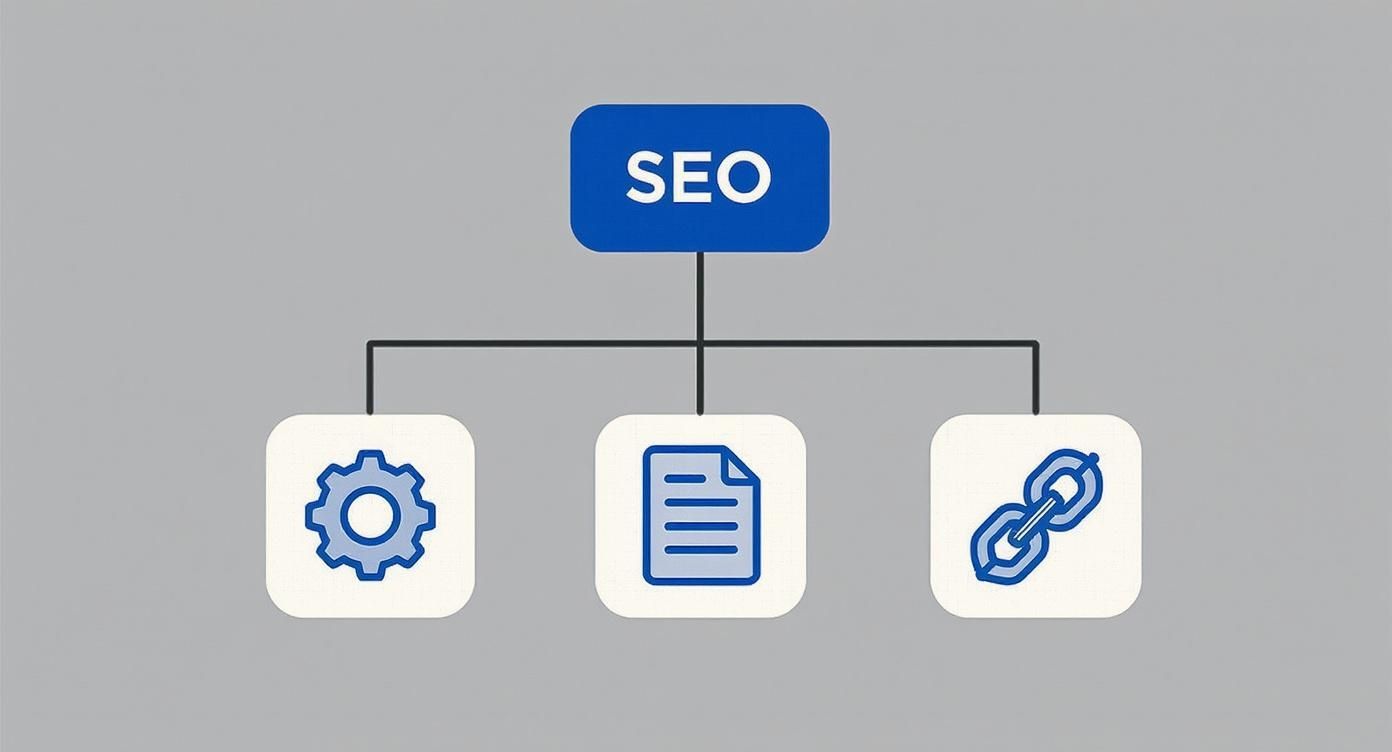
As you can see, a winning strategy is a three-legged stool: your site's technical health, the quality of your content, and the authority you build with backlinks. If one leg is wobbly, the whole operation becomes unstable.
The Six Core Principles of SEO at a Glance
This table breaks down the six pillars that are the absolute bedrock of a successful SEO strategy for any SaaS business. Think of it as your quick-reference guide.
| SEO Principle | Core Focus | Key SaaS Goal |
|---|---|---|
| Technical SEO | Ensuring search engines can crawl, index, and understand your site. | Maximize discoverability and prevent technical roadblocks from hurting rankings. |
| On-Page SEO | Optimizing individual page elements (titles, content, etc.) for target keywords. | Clearly signal relevance to search engines for specific user queries. |
| Content Strategy | Creating valuable, problem-solving content for your ideal customer. | Attract qualified leads, build authority, and fuel the entire marketing funnel. |
| Link Building | Earning backlinks from other reputable and relevant websites. | Build domain authority and earn "votes of confidence" in Google's eyes. |
| User Experience (UX) | Making your site fast, intuitive, and easy to use on any device. | Increase engagement, lower bounce rates, and send positive quality signals to Google. |
| Measurement & Analytics | Tracking KPIs to measure performance and tie efforts to business outcomes. | Prove ROI, make data-driven decisions, and turn SEO into a predictable channel. |
Each of these principles is a critical component. Neglecting one will undermine all your hard work on the others.
A Deeper Look at the Six Pillars
Think of your website like a high-performance race car. To win, every single part needs to be perfectly tuned and working together. That’s exactly how you should view these six interconnected SEO principles:
- 1. Technical Health: This is your car's engine. It’s all about making sure search engines can easily crawl, index, and make sense of your site's content. No engine, no race.
- 2. On-Page Optimization: This is the fine-tuning. We're talking about optimizing individual pages with the right keywords, clear headings, and compelling meta descriptions to tell Google exactly what each page is about.
- 3. Content Strategy: This is the high-octane fuel. Creating genuinely helpful content that solves your ideal customer's problems is what powers your entire SEO engine and brings people to your site.
- 4. Link Building: Think of these as endorsements from other respected drivers. Earning backlinks from reputable sites is like getting a vote of confidence that seriously boosts your website's authority.
- 5. User Experience (UX): This is the aerodynamics and driver comfort. A fast, intuitive, and mobile-friendly site keeps visitors on the page longer, which sends a huge signal to Google that your site is a quality result.
- 6. Measurement: This is your dashboard and telemetry. Tracking the right KPIs is the only way to know if you're winning. It ensures your efforts are actually hitting business goals and turns SEO into a predictable growth lever.
A huge mistake I see all the time is companies going all-in on just one of these pillars—like churning out blog posts—while completely ignoring major technical issues holding them back. True, sustainable success only comes from a holistic approach where all six principles are working in harmony. This is a non-negotiable part of any strategic planning for growth.
Building a Rock-Solid Technical SEO Foundation
Think of your website as a house. You can have beautiful furniture and stunning interior design, but if the foundation is cracked, the whole structure is compromised. Technical SEO is that foundation. For any SaaS business, it's about ensuring search engines like Google can find, understand, and rank your site without hitting any roadblocks.
This is SEO 101, but it's often pushed aside in the rush to publish more content. The reality is, if Google's crawlers can't easily navigate your pages, your brilliant content might as well be invisible.
Can Google Actually Find Your Content?
This boils down to two key ideas: crawlability and indexability.
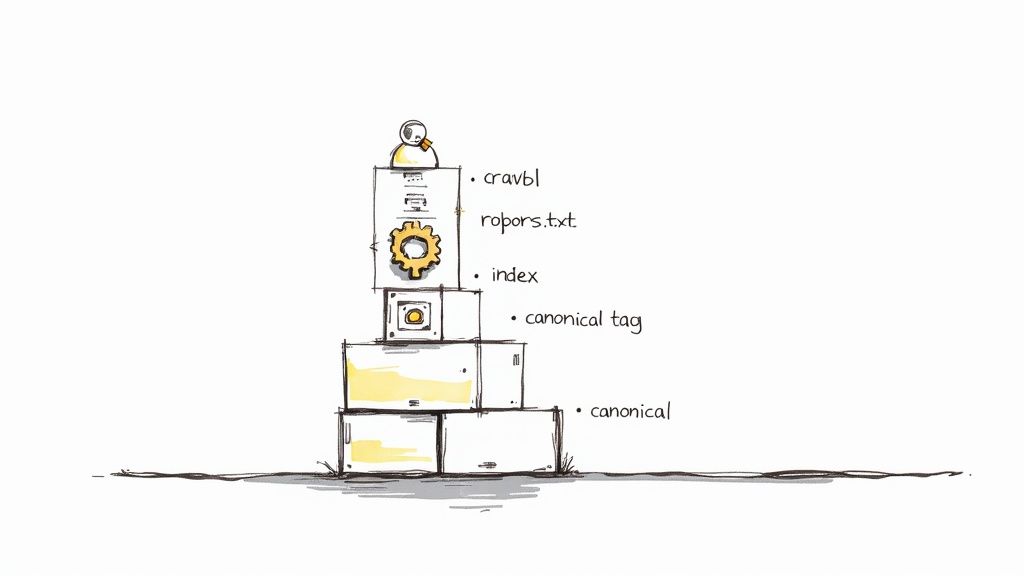
First, Google needs a clear path through your site—that's crawlability. Then, it needs to add your pages to its massive library so they can appear in search results. That's indexability. You need both. No exceptions.
I saw this firsthand with a B2B project management SaaS. They were publishing fantastic articles but getting zero traffic. A quick audit revealed the culprit: a misconfigured robots.txt file was blocking Google from their entire blog. One line of code was strangling their growth. After fixing it, their organic traffic shot up by 40% in just three months.
The whole point of technical SEO is to make life easy for search engines. You want to roll out the red carpet for crawlers, letting them find your best stuff, figure out what it's about, and confidently serve it to users. Any little bit of friction can stop that process cold.
To execute this, you must control three critical components:
- Robots.txt: This text file gives search engine crawlers instructions on where they can and can't go. It's powerful, but a typo can accidentally make your entire site invisible.
- XML Sitemaps: Think of this as a detailed map of your website that you hand directly to Google. It lists all the important URLs you want it to find. You can submit it directly through Google Search Console.
- Index Control: Sometimes you don't want a page to show up in search results—like a login page or internal thank-you page. A "noindex" tag tells Google to ignore it, keeping your search presence clean.
Your Action Plan for a Technical Health Check
Don't wait for your traffic to nosedive to look under the hood. Running a regular technical audit is a non-negotiable operational process. Here’s a playbook you can implement today.
- Crawl Your Site: Use a tool like Screaming Frog (the free version crawls up to 500 URLs). This lets you see your website exactly as a search engine does and will quickly flag major errors.
- Analyze the Crawl Report: Start with the big issues. Look for response codes. Are key pages showing a 404 (Not Found) or a 5xx (Server Error)? These are urgent red flags that need immediate attention.
- Check for Indexability Issues: Scan the report for any pages with a "noindex" tag. Ensure your important landing pages and blog posts aren't accidentally being hidden from Google.
- Review Canonical Tags: Canonical tags are your best defense against duplicate content issues. They tell Google which version of a page is the "official" one. Make sure they’re set up correctly, especially for pages with similar content.
- Audit Your Site Architecture: A messy site structure confuses users and search engines. Your most important pages should be easy to find, ideally just a couple of clicks from your homepage. A logical structure helps spread authority across your site more effectively.
Run this check quarterly. It will help you catch problems before they do real damage. Google Search Console is also your best friend here; its free "Index Coverage" report tells you exactly which pages Google is having trouble with. By making these checks a routine, you keep your foundation strong, ensuring all your work on content and links pays off.
Crafting Content and On-Page SEO That Actually Converts
If your technical SEO is the foundation, then your content and on-page SEO are the structure and interior design. This is where you solve your customer's problems and make it crystal clear to search engines that you're doing so. For a SaaS operator, this isn't just "blogging." It's a strategic function that pulls in qualified, ready-to-buy traffic.
Here's the truth: great content isn't about what you want to say. It's about what your ideal customer needs to hear. That's why the Jobs to be Done (JTBD) framework is one of the most powerful SEO tools you can use. Instead of vague demographics, JTBD forces you to focus on the "job" a customer is trying to get done.
A project manager isn't just searching "project management software." Their real job is to "reduce missed deadlines and stop communication breakdowns." Content built around that job will always connect better and rank higher because it matches what people are actually searching for. Every article and landing page should map directly to a specific job your customer needs to accomplish.
Stop Chasing Keywords, Start Building Topic Clusters
SaaS giants like HubSpot and Ahrefs don't just target random keywords; they build impenetrable fortresses of topical authority using topic clusters. This is one of the most effective ways to demonstrate expertise to Google.
Here's the playbook: create a massive, in-depth "pillar page" on a broad topic. Then, surround it with multiple "cluster pages" that dive deep into specific subtopics, all linking back to that main pillar. For example, a pillar page on "SaaS Lead Generation" would be the central hub, supported by cluster articles on "cold email templates for B2B," "how to run a high-converting webinar," and "scaling with B2B content syndication." This structure signals deep expertise to Google.
You've seen this in action with HubSpot. Their entire content library isn't a random collection of posts; it's a masterfully architected web of pillar pages and cluster content. It’s why they've become the default answer for almost any marketing or sales question you can think of.
Your On-Page SEO Playbook
On-page SEO is about ensuring both people and search engine bots can instantly understand your page's purpose. It's not about keyword stuffing—that's an outdated tactic that will get you penalized. It's about creating clarity and a smooth user journey.
Here's a simple checklist to run for every piece of content you ship:
- Title Tag: Make it compelling, place your primary keyword near the front, and keep it under 60 characters so it doesn’t get truncated in search results.
- Meta Description: Think of this as the ad copy for your page. While not a direct ranking factor, a great meta description increases your click-through rate.
- Header Structure (H1, H2, H3): Use one H1 per page—that's your headline. Use H2s and H3s to break content into logical, scannable chunks. Weave in keyword variations where they sound natural.
- Internal Linking: Link out to other relevant articles and resources on your site, especially your pillar content. This helps spread SEO authority and keeps visitors on your site longer.
- Image Optimization: Name image files descriptively (e.g.,
saas-lead-gen-funnel.jpg, notIMG_1234.jpg). Always add alt text with relevant keywords so search engines understand the image content.
The Actionable Content Brief: Your Secret Weapon
To get consistently high-ranking content, use a detailed content brief. It's the single best tool for bridging the gap between your SEO strategy and the final published article.
A great brief is a blueprint. It eliminates guesswork and ensures every piece is optimized from the start. This improves quality and speeds up your entire content pipeline. When your content engine is solving problems and optimized correctly, it becomes a predictable machine for SaaS lead generation.
Here’s a barebones template you can steal and expand on:
| Section | Description | Example |
|---|---|---|
| Primary Keyword | The main phrase we're aiming for. | "saas customer onboarding" |
| Secondary Keywords | Related terms to sprinkle in naturally. | "user onboarding best practices," "saas trial conversion" |
| Target Audience | Who are we talking to? What's their pain? | SaaS product managers who are fighting high churn rates. |
| Search Intent | Why did they search this? (Learn, buy, find) | Informational – they need a step-by-step playbook. |
| Core Questions | The questions this article MUST answer. | What are the key stages of onboarding? How do we measure success? |
| Internal Links | List 2-3 other articles on our site to link to. | Link to our posts on "SaaS KPIs" and "Reducing Churn." |
Earning Authority with Strategic Link Building
If your technical SEO is the foundation and content is the house, then backlinks are the five-star reviews telling everyone it's the best house on the block. Backlinks—links pointing to your website from other sites—are one of the most powerful authority signals Google uses. Think of them as votes of confidence. The more high-quality, relevant sites that "vote" for you, the more Google sees you as a trusted source.
The game has changed completely. The old goal was to get as many links as possible, from anywhere. Today, that’s a fast track to a Google penalty. Modern SEO is about earning links from websites that are relevant to your niche and have strong authority themselves. One great link from a respected industry publication is worth more than a thousand sketchy links from random directories.
This is all about building a web of authority, with high-quality content at the center.
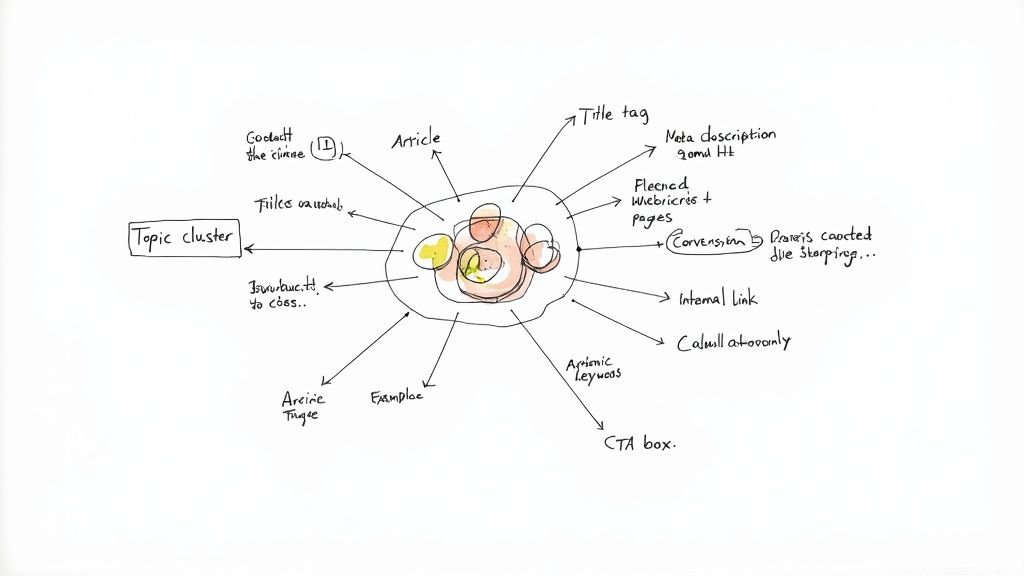
The image above shows how a central piece of content is supported by internal links and, crucially, external backlinks. This is how you build real authority.
Your Playbook for High-Quality Link Earning
Forget about spammy tactics. Sustainable link building is about creating genuine value and building real relationships. For SaaS operators, here are three proven strategies that work.
- Digital PR with Proprietary Data: This is the champion of link building. Instead of begging for links, you create an asset so valuable that journalists want to link to it. Run a unique survey, analyze your own platform data (anonymized), and publish an industry report full of insights nobody else has.
- Resource Page Link Building: This is a classic for a reason. Authoritative sites (universities, industry organizations, top blogs) maintain "resource" pages where they list helpful links. Your job is to find these pages and make a compelling case for why your guide or tool deserves a spot.
- Strategic Guest Posting: This isn't about spamming blogs with low-quality articles. It's about writing a genuinely insightful piece for a respected publication in your niche. You provide real expertise to a new audience and earn a relevant, contextual link back to your site.
SaaS in Action: A fintech SaaS analyzed thousands of anonymized transactions to publish "The 2024 State of Small Business Payment Trends." By pitching this unique data to finance journalists, they landed backlinks from Forbes and Business Insider, sending their domain authority through the roof.
Vetting Opportunities and Crafting Outreach That Works
Not every link is a good link. Before you reach out, vet every prospect to protect your site’s reputation. A bad link can do more harm than no link at all.
Use tools like Ahrefs or Moz to check a site's Domain Rating (DR) or Domain Authority (DA). A solid rule of thumb is to only target sites with a higher authority score than your own.
When you do reach out, personalization is everything. Nobody replies to generic, copy-pasted emails. Show them you’ve read their stuff and clearly explain why your resource is a perfect fit for their specific audience.
Here’s a simple, non-salesy email framework you can adapt:
| Section | Content | Purpose |
|---|---|---|
| Subject | Quick question about your [Article Title] | Get straight to the point and spark curiosity. |
| Opener | "Hi [Name], I loved your recent article on [Topic]. Your point about [Specific Detail] was spot on." | Prove you're a human who did their homework. |
| The Ask | "While reading, I noticed you linked to [Competitor's Resource]. We just published a more current guide on [Your Topic] that includes [Unique Value Prop]." | Give them context and a compelling reason to consider your link. |
| Closing | "Would you be open to adding a link? Either way, keep up the great work!" | This is a low-pressure close that makes it easy for them to say yes. |
By focusing on quality over quantity and providing undeniable value, link building becomes one of your most powerful SaaS growth strategies. You're not just getting links; you're building a defensible moat of authority.
Making Friends with Google: User Experience & Core Web Vitals
Ultimately, Google wants to make its users happy. The happiest users are those who land on a website they genuinely enjoy using. This is why user experience (UX) has become a massive piece of the SEO puzzle. A fast, easy-to-use, mobile-friendly website isn't just a nice feature—it’s a giant signal to search engines that your site is a quality result.
Think of it this way: technical SEO gets Google to your door, and great content invites them in. But it's your UX that convinces them to stay instead of leaving immediately.
When users bounce, it tells Google they didn't like what they found. That signal can torpedo your rankings. For a SaaS company, a clunky UX doesn’t just cost you rankings; it costs you customers.
What the Heck are Core Web Vitals?
To quantify "good user experience," Google introduced Core Web Vitals (CWV). They sound technical, but the concepts are simple and measure what a real person experiences on your site.
- Largest Contentful Paint (LCP): This measures loading speed. How fast does the most important thing on the page appear? For your SaaS landing page, that's probably your main headline or hero image.
- Interaction to Next Paint (INP): This measures responsiveness. When someone clicks a button or fills out a form, does the page react instantly, or is there a frustrating lag? That lag is bad INP.
- Cumulative Layout Shift (CLS): This measures visual stability. You know when you try to tap a link, but an ad suddenly loads and pushes everything down? That infuriating jumpiness is a layout shift, and CLS tracks it.
One of our portfolio companies, a project management SaaS, saw a 15% jump in trial sign-ups by focusing on UX. They compressed images to improve LCP and streamlined their sign-up form to fix INP. Conversions went up, and their rankings for critical keywords followed.
Mobile-First Isn't a Suggestion—It's a Rule
Assuming your visitors are at a desktop is a surefire way to get left behind. We live in a mobile-first world. This means you should design the experience for a phone screen first, then adapt it for bigger screens—not the other way around.
A bad mobile experience is a conversion killer, especially for a SaaS tool. If that first touchpoint is a struggle, the potential customer is gone for good. A smooth journey is critical, and you can learn more about perfecting it in our guide to SaaS onboarding best practices.
Your Actionable UX Audit Checklist
You don't need to be a design genius to spot bad UX. Just pull out your phone, go to your website, and run through this quick audit.
- Take a Speed Test: Pop your URL into Google's PageSpeed Insights. If your site doesn't load in under three seconds, the report will give you a punch list of fixes, like compressing images or leveraging browser caching.
- Try to Get Around: From your homepage, can you find your pricing page or key features in three taps or less? If you get lost, your users will too.
- Test Your Own Forms: Go through your sign-up form on your phone. Is it a breeze, or a nightmare of tiny text boxes and buttons?
- Can You Actually Read It?: Look at your blog posts on a small screen. Is the font big enough? Are you using short paragraphs and clear headings? No one wants to pinch and zoom to read your content.
Measuring SEO Success with the Right SaaS KPIs

If you can't measure it, you can't improve it. This is the final principle, and it’s the one that matters most to the business. All the technical fixes, content, and links are just noise if they don't move the needle. For a SaaS operator, that means tying every SEO effort directly to your bottom line.
It’s easy to get excited about a traffic spike, but raw traffic is a vanity metric. It doesn’t pay the bills. The real game is tracking the key performance indicators (KPIs) that signal genuine business growth.
Moving Beyond Vanity Metrics
A winning SEO program drives conversions, not just clicks. Your job is to build a dashboard that tells the full story, from first Google search to paying customer. This is how you prove ROI.
Instead of getting hung up on overall organic traffic, focus on metrics that matter:
- Organic Sign-Ups and Demo Requests: This is where the rubber meets the road. How many people from a Google search are starting a trial or asking for a demo? This is a direct line to lead generation.
- High-Intent Keyword Rankings: Zero in on keywords that scream "I'm ready to buy," like "best project management software for small teams" or "[Your Competitor] alternative."
- Lead-to-Customer Conversion Rate (from Organic): Of all the leads that organic search brought in, what percentage became customers? This number tells you if you're attracting the right kind of traffic.
Focusing on these KPIs gives you a much sharper view of what’s working. For a deeper look, check out our complete guide on the most important SaaS KPIs to track.
One of the biggest mistakes I see is treating all organic traffic the same. A visitor from a top-of-funnel blog post is valuable, but they aren't the same as someone who searched for your brand by name. You have to segment your data to see the true impact of your content.
Building Your SaaS SEO Dashboard
To measure what really matters, you need the right tools. Using Google Analytics (specifically GA4) is non-negotiable. You can set up "Events" to track every important user action, turning your analytics into a business intelligence tool.
Here’s a quick playbook to get you started:
- Define Your Conversion Goals: First, decide what actions are most valuable. For most SaaS companies, this means trial sign-ups, demo bookings, or contact form submissions.
- Set Up Event Tracking in GA4: Next, create a corresponding event in Google Analytics for each goal. This lets you count exactly how many people complete these actions.
- Filter by Traffic Source: Once data is flowing, build reports that isolate these goals and show you how many were completed by users from organic search.
- Analyze and Iterate: This data is your feedback loop. Is a specific blog post driving a ton of demo requests? Great, write more content like it. Is a landing page getting traffic but no sign-ups? It’s time to A/B test that page.
This process turns measurement from a reporting task into an active part of your growth strategy. You’re no longer guessing what works—you’re using hard data to make smarter decisions and find new keyword opportunities that drive revenue.
Frequently Asked Questions About SEO Principles
Even with a solid game plan, you're going to have questions. Let's tackle some of the most common ones we hear from SaaS founders trying to get a handle on the core principles of SEO.
How Long Does SEO Take To Show Results?
SEO is a long game. While you might see small wins in the first few months, you're realistically looking at 4-6 months before you see meaningful, traffic-driving results.
Think of it like planting a tree. You do the hard work upfront, and for a while, it feels like nothing is happening. But if you stick with it, that effort compounds and grows into a massive, dependable asset. For a B2B SaaS starting from scratch, you might see some keywords start to rank in month two, but don't expect qualified leads from that traffic until month five or six. Patience is your superpower.
Can I Do SEO Myself, Or Do I Need An Agency?
You can absolutely get started on your own. If you're an early-stage SaaS with more time than cash, it's the best way to do it. Just focusing on the basics we've covered—like writing genuinely helpful content for your niche and cleaning up simple technical hiccups—will put you miles ahead of most.
As you grow, the game gets more complicated. That’s when bringing in an agency or an in-house expert makes sense. When you need to go after bigger competitors, untangle thorny technical problems, or build links at scale, a specialist is worth their weight in gold. The key is to start with what you can handle right now.
The most successful SaaS operators I know didn't wait for the perfect budget. They started by mastering one core principle, like creating ridiculously helpful blog content, and then expanded their efforts as revenue grew. It proves that starting small is better than not starting at all.
Which SEO Principle Is The Most Important?
This is like asking which part of a car engine is the most important. They all have to work together. You can write the best content on the planet, but if your site is a technical mess, nobody will find it.
But if you twisted my arm and made me pick one place to start, it would be this: focus on content that solves a painful problem for your ideal customer. Amazing, relevant content is the fuel for your entire SEO engine. It gives Google something to rank, gives other sites a reason to link to you, and gives your visitors a great experience.
At SaaS Operations, we provide the proven playbooks and SOPs to turn these principles into a repeatable growth engine for your business. Stop guessing and start scaling with frameworks from operators who have built multiple 8-figure businesses. Learn more at SaaS Operations.