10 Actionable Operational Planning Examples to Scale Your SaaS in 2025
 Published By: Alex
December 10, 2025
Published By: Alex
December 10, 2025
Tired of operational plans that are all theory and no action? We get it. Too many SaaS companies get bogged down in abstract strategies that never translate into daily execution. Effective operations aren't about reinventing the wheel; they're about implementing proven, battle-tested systems that just work. This isn’t another high-level guide filled with vague advice. We're diving deep into the exact operational planning examples used by top SaaS operators to build predictable, scalable businesses.
This article is a playbook, not a lecture. We're tearing down the walls and showing you the behind-the-scenes mechanics of how successful SaaS teams run. You'll get more than just ideas; you'll get actionable frameworks you can copy and deploy immediately.
Here’s what we’re unpacking:
- Plug-and-play templates: From quarterly ops plans to new-hire onboarding checklists.
- Real-world data: See the scorecards and KPIs that actually move the needle.
- Step-by-step processes: Detailed SOP snippets for everything from meeting rhythms to automation rollouts.
The goal is to move from reactive firefighting to proactive, system-driven growth. A core part of this is building efficiency directly into your workflows. To further visualize how battle-tested operational plans utilize efficiency, explore top business process automation examples that can transform your operations.
Get ready to leave with a clear roadmap to make your SaaS business more efficient, effective, and predictable. Let's get into the weeds.
1. Sales Department Operational Plan
A sales department operational plan is the tactical blueprint that translates high-level revenue goals into daily, weekly, and monthly actions for your sales team. It’s more than just a list of quotas; it’s a detailed guide covering everything from lead management and territory assignments to sales methodologies and performance tracking. For SaaS companies, this plan is the engine that drives predictable revenue growth.
This is one of the most fundamental operational planning examples because it directly connects strategy to cash flow. By defining the how behind the what (the revenue target), it ensures every sales rep, manager, and leader is rowing in the same direction. It turns abstract goals like "increase ARR by 40%" into concrete tasks like "conduct 10 demos per week" and "maintain a 25% close rate."
Strategic Breakdown
Companies like Salesforce and HubSpot didn't just build great products; they built legendary sales operations. Their frameworks, now widely adopted, are rooted in operational plans that standardize the sales process. For instance, a HubSpot-style plan would detail every stage of the buyer's journey within the CRM, complete with automated lead scoring and handoff triggers for sales reps. This removes guesswork and ensures a consistent customer experience.
The core benefit is alignment and predictability. When everyone follows the same playbook, you can accurately forecast revenue, identify bottlenecks in your sales funnel, and pinpoint precisely where reps need coaching.
Key Insight: A strong sales operational plan treats the sales process like a manufacturing assembly line. Each stage is defined, measured, and optimized for efficiency and quality, leading to a predictable output: closed deals.
Actionable Takeaways & Implementation
Ready to build your revenue engine? Here's the playbook:
- Reverse-Engineer Your Quotas: Start with your annual revenue target and work backward. If you need $2M in new ARR and your average deal size is $20k, you need 100 new customers. If your close rate is 20%, you need 500 qualified opportunities. This data-driven approach creates realistic and defensible targets.
- Define Your Sales Cadence: Outline the exact sequence of touchpoints for new leads. For example: Day 1: Email + LinkedIn connect. Day 3: Phone call. Day 5: Follow-up email with a case study. Document this cadence as a non-negotiable playbook in your sales enablement tool.
- Establish a "Deal Desk" Function: Create a clear escalation path for non-standard deals. Define who needs to approve discounts, custom terms, or unique security requests in a dedicated Slack channel or SOP. This prevents stalled deals and empowers reps to know exactly how to get help.
2. Manufacturing Operations Plan
A manufacturing operations plan is the master guide that orchestrates the entire production process, from raw material intake to finished goods shipment. It’s a comprehensive framework detailing production schedules, quality control checkpoints, inventory levels, equipment maintenance, and workforce management. For companies producing physical goods, this plan is the backbone of operational excellence and profitability.
This is a classic example of operational planning examples because it transforms strategic goals like "reduce cost per unit" into tangible shop-floor activities. It breaks down high-level objectives into the intricate how of daily production, ensuring every machine, process, and team member contributes efficiently to the final output. It's the difference between chaotic, reactive manufacturing and a smooth, predictable production system.

Strategic Breakdown
Companies like Toyota revolutionized manufacturing with the Toyota Production System (TPS), an operational plan focused on eliminating waste (Muda) and creating a "just-in-time" flow. This system, now a global standard for lean manufacturing, meticulously plans every step to ensure parts arrive exactly when needed, minimizing inventory costs and maximizing efficiency. Similarly, Intel's semiconductor fabrication plans are models of precision, managing hyper-complex processes with near-perfect quality control.
The key benefit here is efficiency and quality control. A well-documented plan creates a highly predictable environment, which allows for systematic process improvement, drastic reduction in defects, and minimized downtime.
Key Insight: An elite manufacturing operations plan treats the factory not just as a place of production, but as a living system to be continuously optimized. It focuses on flow, waste elimination, and empowering workers to solve problems in real-time.
Actionable Takeaways & Implementation
Ready to build a world-class manufacturing operation? Here's your playbook:
- Map Your Value Stream: Before optimizing, you must visualize. Document every single step from raw material order to customer delivery. Identify where value is added and, more importantly, where delays, waste, and bottlenecks occur. This map becomes your improvement roadmap.
- Implement a "Kanban" System for Inventory: Use visual signals (cards, bins, or digital dashboards) to trigger the movement of materials. This pull-based system prevents overproduction and ensures you only have the inventory you need, right when you need it. This forms the basis of many standard operating procedures you can learn about.
- Schedule Predictive Maintenance: Don't wait for machines to break. Use equipment data and predictive analytics to schedule maintenance before a failure occurs. This proactive approach turns costly, unplanned downtime into manageable, scheduled service windows.
3. IT Operations Plan
An IT operations plan is the nervous system of a modern SaaS company, detailing how technology infrastructure, security, and systems will be managed to ensure business continuity. It's a comprehensive guide covering everything from server maintenance and cybersecurity protocols to incident response and vendor management. For any company relying on technology (which is every SaaS company), this plan keeps the digital lights on.
This is a critical addition to any list of operational planning examples because it directly supports every other department's ability to function. It translates strategic goals like "achieve 99.99% uptime" into tangible actions, such as defining server patch schedules, running disaster recovery drills, and implementing multi-layered security defenses. It ensures technology is an enabler, not a bottleneck.
Strategic Breakdown
Tech giants like Microsoft and Amazon Web Services (AWS) have turned IT operational excellence into a science, creating frameworks like ITIL (Information Technology Infrastructure Library) that are now industry standards. An IT ops plan modeled on these best practices would map out every process, from how a new employee gets a laptop to how a critical system failure is resolved. It defines Service Level Agreements (SLAs) and automates routine maintenance to free up engineers for high-impact work.
The primary benefit is resilience and scalability. A well-documented plan ensures the platform can handle growth without falling over and can recover quickly from incidents, protecting revenue and customer trust. A deeper look at capacity planning is a key part of this strategic foresight.
Key Insight: A world-class IT operational plan treats infrastructure like a product. It is continuously monitored, iterated upon, and improved with a focus on reliability, security, and performance to deliver a seamless experience for both internal teams and external customers.
Actionable Takeaways & Implementation
Ready to formalize your IT operations? Here’s the playbook:
- Implement an Incident Response Protocol: Don't wait for a crisis. Define roles (e.g., Incident Commander), communication channels (e.g., a dedicated Slack channel), and a clear escalation matrix. Document the "first five steps" anyone should take when a critical alert fires.
- Create System Runbooks: For every critical piece of your infrastructure, create a "runbook" in Confluence or Notion that details its architecture, dependencies, common failure points, and step-by-step recovery procedures. This is invaluable when an issue arises at 3 AM.
- Schedule Quarterly Disaster Recovery Drills: Theory isn't enough. Once a quarter, conduct a simulated outage to test your response plan, runbooks, and backups. These drills will reveal weaknesses in your processes before a real incident does.
4. Human Resources Operations Plan
A Human Resources operations plan is the strategic roadmap for managing a company’s most valuable asset: its people. This plan translates high-level business goals like "reduce churn" or "improve innovation" into concrete HR functions, including recruitment, onboarding, performance management, and compliance. For a SaaS company, where talent is the primary driver of product development and growth, a strong HR ops plan is non-negotiable.
This is a critical entry in our list of operational planning examples because it directly impacts company culture, employee retention, and overall productivity. It turns abstract objectives like "foster a great culture" into specific actions like "implement a 30-60-90 day onboarding program" and "launch a peer recognition system." This plan ensures that HR is not just an administrative function but a strategic partner in business growth.
Strategic Breakdown
Companies like Google, with its renowned "People Operations" framework, have shown that data-driven HR can be a massive competitive advantage. Instead of relying on gut feelings, they built operational plans around analytics to understand what truly drives performance and satisfaction. An HR ops plan in this vein would detail everything from the competencies required for each role to the specific cadence of performance check-ins, creating a system that nurtures and retains top talent.
The core benefit is creating a scalable and positive employee experience. A well-defined plan ensures consistency in how people are hired, managed, and developed, which is crucial for maintaining culture as a company scales.
Key Insight: A modern HR operations plan treats the employee lifecycle like a customer journey. Every stage, from the first recruitment email to the exit interview, is intentionally designed, measured, and optimized to maximize engagement and retention.
Actionable Takeaways & Implementation
Ready to build a more strategic HR function? Here's your playbook:
- Map the Entire Employee Lifecycle: Document every single touchpoint an employee has with the company, from their application to their last day. Identify friction points and opportunities for improvement in each stage: recruitment, onboarding, performance management, development, and offboarding.
- Systematize Your Onboarding: Create a standardized, role-specific onboarding playbook in your HRIS or a tool like Notion. Define the key knowledge, relationships, and skills a new hire must acquire in their first 90 days and assign owners to each training module or introductory meeting.
- Define Your Performance Management Cadence: Move away from the dreaded annual review. Establish a rhythm of regular, lightweight check-ins and formal reviews. For a practical starting point, you can explore various performance review templates on saasoperations.com to find a structure that fits your culture and helps managers provide meaningful, consistent feedback.
5. Customer Service Operations Plan
A customer service operations plan is the definitive guide that translates a company's commitment to "customer obsession" into a structured, repeatable, and scalable process. It details everything from support channel management and ticket escalation protocols to agent empowerment guidelines and customer satisfaction metrics. For a SaaS business, this plan is the bedrock of customer retention and brand loyalty.

This is one of the most critical operational planning examples because it directly impacts churn and lifetime value. The plan codifies the how behind the what (the promise of great service), ensuring every customer interaction is consistent, efficient, and reinforces your brand's values. It turns a vague goal like "improve customer satisfaction" into concrete actions like "achieve a 95% CSAT score" and "maintain a first-response time under 1 hour."
Strategic Breakdown
Companies like Zappos and Amazon built empires not just on products but on legendary service operations. Their plans empower agents to solve problems on the first contact, often without needing managerial approval for reasonable solutions. For example, a Zappos-style operational plan would explicitly state that an agent's primary goal is not ticket volume but creating a positive emotional connection, even if it means staying on a call for an extended period.
The core benefit is consistency and scalability. A well-documented plan ensures that the 100th support hire provides the same level of service as the first, creating a predictable and high-quality customer experience that builds trust. This structure also helps in organizing the team, which is a key component to success. For deeper insights on this, you can learn more about building a customer success team structure on saasoperations.com.
Key Insight: A world-class customer service operational plan treats support not as a cost center, but as a revenue driver. Every resolved ticket and positive interaction is an investment in customer retention, brand reputation, and future expansion revenue.
Actionable Takeaways & Implementation
Ready to elevate your customer service operations? Here's the playbook:
- Define Tiers of Support: Create a clear, multi-level support structure (e.g., Tier 1 for basic inquiries, Tier 2 for technical issues, Tier 3 for engineering escalations). Document the exact criteria for when and how a ticket moves between tiers, including the required information and expected resolution times for each.
- Establish Agent Empowerment Rules: Don't let bureaucracy block good service. Create clear guidelines on what agents can offer without approval, such as a one-month credit, a small discount on a renewal, or a complimentary feature upgrade. This empowers agents to resolve issues instantly.
- Create Canned Response Playbooks: Build a library of pre-approved responses for common questions and issues in your helpdesk software (like Zendesk or Intercom). Organize them by category (e.g., billing, technical bug, feature request) to ensure consistency and dramatically speed up response times.
6. Finance Operations Plan
A finance operations plan is the nervous system of your company, translating strategic goals into financial reality. It’s a detailed framework covering everything from budgeting and forecasting to cash flow management, internal controls, and financial reporting. For a SaaS business, this plan is what ensures the lights stay on, investors stay happy, and growth is sustainable, not just aspirational.
This is a critical addition to any list of operational planning examples because it provides the fiscal guardrails for every other department. It transforms high-level objectives like "achieve profitability" into tangible actions like "reduce customer acquisition cost by 15% by Q3" and "maintain a 3-month cash runway at all times." It ensures financial discipline and operational rigor are baked into your company's DNA.
Strategic Breakdown
Companies like Microsoft and Oracle have built empires on the back of incredibly robust financial operations. Their plans don't just track money; they model the entire business. A modern SaaS finance plan, for instance, would detail the specific procedures for revenue recognition under ASC 606, automate accounts receivable follow-ups, and establish a clear framework for managing departmental budgets within a tool like NetSuite or SAP.
The primary benefit is stability and strategic foresight. With a solid plan, you move from reactive financial management to proactive decision-making. You can accurately model the impact of a pricing change, understand the ROI of a new marketing channel, and confidently navigate audits or fundraising rounds.
Key Insight: An elite finance operational plan treats the company’s finances like a finely tuned engine, not just a rearview mirror. It focuses on leading indicators (like pipeline and churn forecasts) rather than just lagging ones (like last quarter's revenue), enabling the business to steer its future.
Actionable Takeaways & Implementation
Ready to fortify your financial foundation? Here's the playbook:
- Implement Rolling Forecasts: Scrap the static annual budget. Instead, build a rolling 12-month forecast that you update monthly or quarterly. This makes your financial plan a living document that adapts to market changes, providing a much more accurate picture of the future. You can learn more about effective revenue forecasting methods.
- Create a Procedures Manual: Document every key financial process in a central location—from invoice processing to expense reimbursement and month-end close. This creates consistency, simplifies onboarding, and is non-negotiable for establishing strong internal controls and passing audits like SOC 2.
- Establish Segregation of Duties: Even in a small team, ensure no single person controls an entire financial transaction. For example, the person who approves a vendor payment should not be the same person who executes it. This is a simple but powerful fraud prevention mechanism.
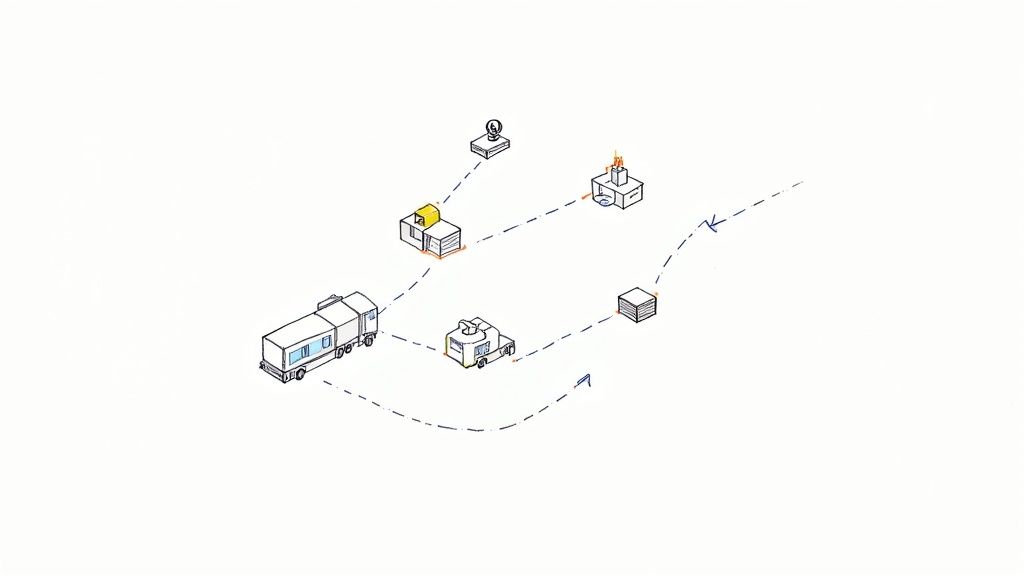
7. Supply Chain Operations Plan
A supply chain operations plan is the tactical execution framework for managing the end-to-end flow of goods, data, and finances. It breaks down high-level business objectives like cost reduction and customer satisfaction into daily activities covering procurement, inventory management, logistics, and demand forecasting. For SaaS, this might seem less relevant, but it's critical for companies dealing with hardware components or physical product delivery.
This is a powerful operational planning examples because it manages the physical backbone of a business. It translates strategic sourcing goals into specific supplier performance metrics and distribution center workflows. A goal like "reduce shipping costs by 15%" becomes concrete actions like "consolidate weekly shipments to West Coast hubs" and "renegotiate carrier contracts based on Q3 volume."
Strategic Breakdown
Companies like Dell and Amazon revolutionized their industries through brilliant supply chain operations. Dell’s build-to-order model, for instance, relied on an operational plan that minimized inventory by only procuring components after a customer placed an order. This was achieved through deep integration with suppliers and a hyper-efficient assembly process, keeping cash flow positive and waste near zero.
The key benefit here is resilience and efficiency. A well-defined plan ensures you can anticipate disruptions, optimize inventory levels to avoid stockouts or overages, and maintain strong supplier relationships. It transforms your supply chain from a cost center into a competitive advantage.
Key Insight: An elite supply chain operational plan treats inventory as a liability and information as an asset. By synchronizing demand data with supplier capacity and logistics, it enables a "just-in-time" flow that maximizes capital efficiency and customer satisfaction.
Actionable Takeaways & Implementation
Ready to fortify your supply chain? Here's your playbook:
- Map Your Value Stream: Visually chart every step from raw material procurement to final customer delivery. Identify every handoff, lead time, and potential bottleneck. This clarity is the first step to optimization and shows exactly where to focus your efforts.
- Implement a Supplier Scorecard: Don't just track price. Create a scorecard to evaluate key suppliers on metrics like on-time delivery, quality acceptance rate, and communication responsiveness. Review these scorecards quarterly to drive performance and strengthen partnerships.
- Develop a Diversification Playbook: Identify your single-source risks for critical components or services. Create an operational plan to qualify at least one alternative supplier for each. This isn't just a backup; it's a strategic move that provides leverage and protects against unexpected disruptions.
8. Marketing Operations Plan
A marketing operations plan is the system that turns your creative marketing strategies into a well-oiled, scalable machine. It’s the blueprint that governs how your team manages campaigns, allocates budgets, produces content, and tracks performance. For SaaS businesses, this plan is the critical infrastructure that connects marketing activities directly to pipeline and revenue.
This is a cornerstone among operational planning examples because it transforms marketing from a cost center into a predictable revenue engine. It shifts the focus from just creating content to building an entire system for generating and nurturing leads. Abstract goals like "increase MQLs by 50%" become tangible tasks like "launch three targeted webinar campaigns per quarter" and "maintain a 4% landing page conversion rate."
Strategic Breakdown
Companies like HubSpot built their empires not just on great content, but on an impeccable inbound marketing operations methodology. Their plans detail every step of the lead lifecycle, from the first blog post visit to the final MQL handoff, all managed within an automated system. This operational excellence ensures no lead falls through the cracks and that the sales team receives consistently high-quality opportunities. To further develop your understanding of how to streamline these activities, consult a detailed guide to B2B marketing operations that outlines how to turn your team into an operational engine.
The primary benefit is efficiency and accountability. When your marketing processes are standardized, you can launch campaigns faster, measure ROI accurately, and clearly demonstrate marketing's contribution to the bottom line.
Key Insight: A world-class marketing operations plan treats lead generation like a supply chain. Each stage, from awareness to conversion, is defined, automated, and optimized to produce a consistent flow of qualified leads for the sales team.
Actionable Takeaways & Implementation
Ready to build your marketing machine? Here's the playbook:
- Create a Centralized Marketing Calendar: Use a tool like Asana, Monday.com, or even a detailed shared spreadsheet to plan all campaigns, content, and promotional activities. This single source of truth prevents overlaps and aligns all team members on priorities.
- Define Your Lead Management SLA: Create a formal Service Level Agreement (SLA) with the sales team. Define what constitutes a Marketing Qualified Lead (MQL) and a Sales Qualified Lead (SQL), and establish rules for lead handoff, follow-up times, and dispositioning criteria within the CRM.
- Establish Tiered Content Production: Not all content is created equal. Create a simple framework for content production (e.g., Tier 1: Major research report; Tier 2: Webinar or guide; Tier 3: Blog post). Allocate different levels of resources, promotion, and time to each tier to maximize the impact of your biggest bets.
9. Retail Store Operations Plan
A retail store operations plan is the master playbook for running a physical storefront, detailing everything from staff scheduling and inventory management to visual merchandising and customer service protocols. While it seems far from the SaaS world, its principles of creating a predictable, high-quality customer experience are directly applicable to user onboarding and customer success. For any business with a physical touchpoint or even a "digital storefront," this plan ensures consistency and efficiency.
This is a critical addition to a list of operational planning examples because it masters the art of the tangible customer journey. It translates brand strategy into the physical actions and environmental details that shape customer perception. The plan breaks down lofty goals like "enhance brand experience" into concrete tasks like "refresh window display every two weeks" and "maintain a customer checkout time of under 3 minutes."
Strategic Breakdown
Retail giants like Apple and Zara have perfected this. An Apple Store’s operational plan isn’t just about selling products; it’s about engineering an experience. It dictates the exact flow from a customer entering the store, to being greeted by a Specialist, to hands-on product time at the display tables, and finally to a seamless checkout process anywhere in the store. This meticulous planning removes friction and creates a consistent, premium feel.
The primary benefit is experience consistency and operational efficiency. When every store and every employee follows the same core operational plan, you guarantee a baseline level of quality for every customer, while also optimizing inventory turnover and labor costs. It turns the chaotic art of retail into a predictable science.
Key Insight: A world-class retail operations plan treats the store as a product. Every element, from the lighting and product placement to staff interactions and checkout speed, is an engineered feature designed to optimize the user (customer) experience.
Actionable Takeaways & Implementation
Ready to apply retail excellence to your operations? Here’s the playbook:
- Create a Visual Merchandising Playbook: Document your standards with photos and diagrams. Define exactly how products should be displayed, how signage should look, and what the overall "feel" of the space should be. For SaaS, this translates to designing a consistent and intuitive UI/UX across your platform.
- Optimize Customer Flow: Map the ideal customer journey through your store, identifying potential bottlenecks or points of friction. Use this map to place key displays, staff members, and checkout points strategically. This is analogous to mapping and optimizing a user’s journey through your app.
- Implement a Staffing and Training Cadence: Use scheduling software to align staffing levels with peak customer traffic. Develop clear customer service standards and use role-playing exercises to train staff on handling common scenarios, ensuring a consistent and high-quality interaction every time.
10. Project Management Operations Plan
A project management operations plan is the master framework that governs how projects are initiated, planned, executed, and closed within an organization. For a SaaS company, this isn't just for big engineering sprints; it dictates how a new marketing campaign is launched, a major feature is rolled out, or a new customer success playbook is implemented. It standardizes everything from resource allocation and risk management to stakeholder communication.
This is a critical one of our operational planning examples because it brings order to the controlled chaos of innovation and growth. It transforms ad-hoc efforts into a predictable, repeatable system for delivering value. Instead of every team lead reinventing the wheel, the plan provides the templates, tools, and processes needed to ensure projects are completed on time, on budget, and to the required quality standard.
Strategic Breakdown
Consulting giants like Deloitte and major tech players like Google built their reputations on consistent, high-quality project delivery. Their secret is a deeply ingrained project management operational plan. For a tech company using an Agile framework, this plan would define sprint lengths, the function of daily stand-ups, the process for backlog grooming, and the criteria for a "done" user story. This operational layer makes frameworks like Scrum or Kanban actually work at scale.
The primary benefit is consistency and organizational learning. When every project follows a similar governance structure, you can compare performance across initiatives, identify systemic risks, and, most importantly, learn from both successes and failures through structured post-mortems.
Key Insight: An effective project management operations plan treats project delivery like a scientific process. It creates a controlled environment with standard variables, allowing you to experiment, measure outcomes, and systematically improve your ability to execute complex initiatives.
Actionable Takeaways & Implementation
Ready to bring structure to your project execution? Here’s the playbook:
- Standardize Your Project Kick-Off: Create a mandatory project charter template that every project must complete before it begins. This document should clearly define the project's scope, objectives, key stakeholders, budget, and success metrics. No charter, no project.
- Implement a "Right-Sized" Methodology: Don't force a heavyweight process on a small task. Define different project tiers (e.g., Tier 1 for major product releases, Tier 3 for small marketing updates) and match them with an appropriate level of process rigor. A Tier 3 project might only need a simple Asana board, while a Tier 1 requires a full steering committee.
- Conduct Rigorous Post-Project Reviews (PPRs): Make a blame-free post-mortem a non-negotiable step for every significant project. Document what went well, what went wrong, and what the team learned. Store these lessons in a central repository (like Confluence or Notion) to inform future operational plans.
Operational Plan Comparison — 10 Departments
| Plan | Complexity (🔄) | Resources & Efficiency (⚡) | Expected outcomes (⭐) | Ideal use cases (📊) | Key tips (💡) |
|---|---|---|---|---|---|
| Sales Department Operational Plan | Medium 🔄: cross-functional processes, CRM integration | Moderate ⚡: CRM, training, incentives; 3–6 months | ⭐⭐⭐⭐: improved revenue predictability & KPI visibility | Sales-led organizations, quota-driven teams | Base quotas on data; monthly reviews; mentorship |
| Manufacturing Operations Plan | High 🔄: facility, production scheduling, quality systems | High ⚡: capital, IIoT, staff training; 6–18 months | ⭐⭐⭐⭐⭐: higher uptime, consistent quality, lower waste | Factories, mass production, regulated manufacturing | Use real-time monitoring; predictive maintenance; cross-functional teams |
| IT Operations Plan | Medium–High 🔄: infrastructure, security, change management | High ⚡: skilled staff, monitoring tools, automation; 4–12 months | ⭐⭐⭐⭐: improved availability, security, compliance | SaaS, enterprise IT, regulated sectors | Adopt ITIL; automate tasks; run DR drills; maintain runbooks |
| Human Resources Operations Plan | Medium 🔄: policy, compliance, talent processes | Moderate ⚡: ATS, L&D programs, HRIS; 3–9 months | ⭐⭐⭐⭐: better retention, consistent hiring, engagement | Scaling orgs, talent-centric companies | Use ATS; 360° feedback; mentorship and career paths |
| Customer Service Operations Plan | Medium 🔄: multichannel routing, SLAs, knowledge management | Moderate ⚡: omnichannel platform, AI for routine tasks; 2–6 months | ⭐⭐⭐⭐: higher CSAT, faster resolution, reduced churn | B2C, subscription services, high-touch support | Implement omnichannel view; empower agents; use chatbots smartly |
| Finance Operations Plan | Medium–High 🔄: controls, reconciliations, compliance | High ⚡: ERP, automation/RPA, skilled accountants; 6–12 months | ⭐⭐⭐⭐: accurate reporting, better cash management, compliance | Large enterprises, regulated orgs, FP&A functions | Automate reconciliations; enforce segregation of duties; rolling forecasts |
| Supply Chain Operations Plan | High 🔄: global coordination, demand planning, logistics | High ⚡: TMS/WMS, analytics, supplier networks; 8–24 months | ⭐⭐⭐⭐: lower costs, improved fill rates, resilience | Retail, manufacturing, distribution networks | Use visibility tools; diversify suppliers; scenario planning |
| Marketing Operations Plan | Medium 🔄: martech stack, workflows, attribution | Moderate ⚡: automation, content resources, analytics; 3–8 months | ⭐⭐⭐⭐: better ROI tracking, consistent campaigns, scalable lead gen | Demand generation, growth marketing, cross-channel campaigns | Centralize calendar; automate nurturing; align KPIs with sales |
| Retail Store Operations Plan | Low–Medium 🔄: staffing, merchandising, POS procedures | Moderate ⚡: POS, scheduling tools, inventory systems; 2–4 months per store | ⭐⭐⭐⭐: improved customer experience and sales consistency | Brick-and-mortar chains, omnichannel retailers | Use scheduling software; create merchandising playbooks; do floor walks |
| Project Management Operations Plan | Medium–High 🔄: governance, resource allocation, change control | Moderate ⚡: PM tools, templates, trained PMs; 4–12 months | ⭐⭐⭐⭐: higher on-time/on-budget delivery, better risk control | PMOs, project-driven firms, cross-functional initiatives | Use PM templates, balance rigor with agility; capture lessons learned |
Turn These Examples into Your Operational Reality
We've just walked through a whole suite of operational planning examples, from the nitty-gritty of a sales department’s quarterly goals to the strategic cadence of a company-wide meeting rhythm. It's easy to look at these detailed plans, templates, and scorecards and feel a bit overwhelmed. But here's the secret: world-class operations aren't built overnight with a single, massive, complicated document. They are built one clear, consistent process at a time.
The most powerful takeaway from all these examples isn't a specific template or metric. It's the underlying principle that connects them all: proactive design over reactive chaos. Whether it's an IT automation rollout or a customer service onboarding playbook, each plan is a deliberate attempt to control the inputs to get a predictable output. You're not just hoping for a great quarter; you're building the machine that manufactures great quarters.
Great operational planning is fundamentally about creating leverage. It’s about building a system where your team can execute with clarity and autonomy, freeing up leadership to focus on the next big strategic move instead of fighting fires.
Your Roadmap from Examples to Execution
Feeling inspired is great, but taking action is what matters. Don't try to boil the ocean and revamp your entire company’s operations this week. Instead, focus on creating a single point of leverage. Here’s a simple, actionable framework to get started today.
- Identify Your Biggest Bottleneck: Where is the most friction in your SaaS right now? Is it in customer onboarding? Lead handoffs from marketing to sales? Inefficient team meetings? Pick the one area that, if improved, would have the biggest ripple effect across the business.
- Choose Your Weapon: Look back at the operational planning examples we covered. Find the one that most closely matches your bottleneck. If customer handoffs are messy, start with the Sales Department or Customer Service Operations Plan. If meetings are a time-suck, grab the meeting rhythm and scorecard framework.
- Document the "As-Is" Process: Before you can improve something, you have to understand it. Spend 30 minutes mapping out the current, messy reality of your chosen process. Who does what? What tools are used? Where do things break down? Be honest and unflinching.
- Implement One Small Change: Using the templates and tactics from this article, introduce a single improvement. Don't rewrite the entire playbook. Maybe you just implement a 5-minute scorecard review at the start of a meeting or create a one-page SOP for a specific task.
- Measure and Iterate: Define one or two key metrics to track the impact of your change. Did it reduce time spent? Did it improve a key conversion rate? Did it lower customer support tickets? Review the data in a week, get feedback from your team, and make another small adjustment.
This iterative loop-identify, document, implement, measure-is how you turn these theoretical examples into your operational reality. You build momentum one small, tangible win at a time. It’s not about finding the "perfect" plan; it’s about starting the process of continuous, incremental improvement. That’s how you build an operational engine that scales, allowing your SaaS to grow predictably and sustainably, freeing you to work on the business, not just in it.
Ready to skip the trial-and-error and implement systems that work from day one? The templates, SOPs, and playbooks featured in these operational planning examples are just a glimpse of what’s inside our full library at SaaS Operations. We provide the battle-tested frameworks from 8-figure SaaS operators so you can build your operational engine faster. Check out SaaS Operations to get instant access.