
Think of revenue forecasting as your company’s financial GPS. It’s the process you use to look ahead and estimate how much money you’ll bring in over the next month, quarter, or year. This isn't just about pulling a number out of thin air; it’s a data-backed map for your entire business.
A solid forecast helps you set realistic growth targets, manage your cash, and decide where to invest your hard-earned capital.
What Is Revenue Forecasting and Why It Matters
At its heart, revenue forecasting is your best-educated guess on future income. It’s a strategic blend of past performance data, what’s happening in your sales pipeline right now, and broader market trends. It turns a hopeful guess into a clear financial roadmap.
For anyone running a SaaS company, this is absolutely non-negotiable. It's not just some finance team exercise—it’s a fundamental tool for survival and growth. Without a reliable forecast, you’re flying blind.
How do you know if you can afford that new developer? Or if that big marketing push is a good idea right now? Should you be tightening the belt for a slow quarter ahead? A good forecast gives you the answers.
The Strategic Value of Accurate Forecasts
Getting your forecast right has a direct impact on your ability to make smart, confident decisions. It gives you the clarity you need to steer the ship.
- Make Better Decisions: A solid forecast lets you decide on hiring, expansion, or new product features with a clear picture of your future financial health.
- Allocate Resources Wisely: When you know what revenue to expect, you can put your money where it will have the most impact without accidentally overspending.
- Set Performance Baselines: Your forecast becomes the yardstick you measure your actual performance against. This helps you quickly see what’s working and what needs fixing.
- Build Investor Confidence: If you're looking for funding, a thoughtful forecast shows investors you have a deep understanding of your business and the market. It builds serious credibility.
In short, forecasting moves you from a reactive mindset to a proactive one. It helps you get ahead of challenges and jump on opportunities, instead of just dealing with things as they happen.
Ultimately, getting good at revenue forecasting is one of the most important skills you can develop as a leader. It gives you the financial visibility to navigate the road ahead with confidence.
Predicting the Future with Past Performance
Quantitative forecasting is a bit like driving while looking in the rearview mirror. You're using what's behind you—your historical sales data—to get a sense of the road ahead. This approach is all about the numbers, relying on statistical patterns to map out future revenue instead of just going with a gut feeling.
The core idea is simple: what happened in the past is a pretty good predictor of what will happen in the future. This holds especially true if your market is stable and your business has a consistent track record.
The Straight-Line Method
The most basic way to do this is with the straight-line method. It works on the assumption that your business will keep growing at the same steady pace it has recently. If you've had predictable growth without any wild swings, this is a great starting point.
Let’s say your SaaS business grew its monthly recurring revenue (MRR) by a clean $10,000 every single month for the last six months. The straight-line method says you can reasonably project that same $10,000 bump for each of the next few months. It's simple, clean, and effective for stable businesses.
If you want to get a better handle on this all-important metric, we have a complete guide on what is monthly recurring revenue.
More Advanced Quantitative Methods
Of course, the real world is rarely that simple. The straight-line approach is a blunt instrument; it doesn't account for things like seasonality or changing market trends. For a more refined view, you need to pull some more advanced tools out of the box.
Think of a retailer getting ready for the holidays. They know from years of experience that sales will go through the roof in November and December. A simple straight-line forecast would be a disaster, leaving them with empty shelves and angry customers.
This is exactly why businesses often lean on more sophisticated models.
- Moving Averages: This technique helps you see the forest for the trees. It smooths out the short-term bumps and dips in your data to reveal the real, underlying trend. Instead of just looking at last month, you might average the revenue from the last three or six months to get a much more stable baseline for your forecast.
- Time Series Analysis: This is where things get really powerful. Time series models are smart enough to break your historical data down into its core components: the long-term trend, seasonal patterns (like that holiday rush), and any random, one-off events. By identifying these recurring cycles, it can build them into future predictions for a much more accurate picture.
These number-crunching methods are fantastic when you have solid historical data to work with. They give you an objective, evidence-based foundation for your financial planning. The big catch, however, is that they all assume the future will look a lot like the past. For a startup with no history or a company in a rapidly shifting market, they can be much less reliable.
Relying on Human Judgment and Expertise
Sometimes, the best look forward comes from people, not spreadsheets. While crunching historical data is essential, some of the most effective forecasting methods are built on human experience and intuition.
This is the heart of qualitative forecasting. Think of it as asking a seasoned guide about the terrain ahead instead of just staring at a map. Their gut feeling and on-the-ground knowledge can be invaluable.
This approach is a lifesaver when you can't just look in the rearview mirror. For new startups with zero sales history or for companies in a market that's changing by the day, past data is often irrelevant or simply doesn't exist.
How to Gather Expert Opinions
Qualitative forecasting is all about turning opinions and observations into something you can act on. It recognizes that your sales team, industry veterans, and even customers hold critical clues about where your revenue is headed. The trick is to collect this information in a structured way that minimizes bias.
Here are a few proven ways to do it:
- Market Research: Go straight to the source. Use surveys and interviews to ask your target audience about their plans to buy. This is a great way to gauge demand for a new product before you’ve spent a dime on the launch.
- Expert Panels (The Delphi Method): Bring together a group of internal and external experts. They all submit their forecasts anonymously. Then, you share the combined results and ask them to forecast again. You repeat this until everyone lands on a general consensus, which prevents one loud voice from dominating the conversation.
- Input From the Sales Team: Your sales reps are on the front lines every single day. They have a real-time feel for customer moods, what competitors are up to, and which deals are likely to close. Gathering their individual forecasts gives you a fantastic bottom-up view of the pipeline.
For new companies, qualitative forecasting isn't just an option—it's a necessity. When you have no historical data, the collective wisdom of experienced people is the most powerful tool you have.
Turning Gut Feelings into a Real Strategy
The real power here is the ability to see the nuance that data often misses. A sales rep might know a key contact at a huge prospect is about to quit, putting the deal in jeopardy. No algorithm can tell you that.
It's also about looking beyond the next quarter. Understanding what keeps customers around is key, which is why a solid guide to lifetime value calculation for SaaS is so critical for long-range planning. For many businesses, good revenue forecasts also depend on strong project estimation techniques.
Of course, the biggest hurdle is human bias. An overly optimistic sales team or a single executive with a strong opinion can throw the whole forecast off. That’s why you have to use structured methods like the Delphi technique and constantly challenge the assumptions behind the numbers.
When you get it right, that human insight becomes your secret weapon.
Using Your Sales Funnel for Real-Time Forecasts

While looking at past data gives you a solid baseline, your active sales pipeline offers something far more immediate: a live view of your future revenue. This is the heart of pipeline forecasting, one of the most hands-on and dynamic methods out there.
Think of it as a real-time snapshot of your entire sales process. It’s not about what you did last quarter; it’s about what your sales team is working on right now and which deals are likely to close soon.
This approach forges a direct link between your team's daily grind and the company's bottom line. It turns forecasting from a backward-glancing chore into a forward-looking, proactive strategy.
How Pipeline Forecasting Works
At its core, the mechanics are pretty simple. You track every potential deal as it moves through the stages of your SaaS sales funnel, from the first "hello" to the final signature.
Based on historical data, you assign a closing probability to each stage. To get your forecast, you just multiply the value of each deal by the probability of its current stage. It's a weighted average of your pipeline.
Of course, this only works if you have up-to-the-minute data, which is where powerful real-time reports become indispensable. For example, let's say your pipeline shows $500,000 in deals that have reached a stage with a 60% closing probability. You also have another $300,000 in deals at a 30% stage. Your weighted forecast would be $390,000 (($500,000 * 0.60) + ($300,000 * 0.30)).
Here’s a more detailed breakdown for a typical software company:
- Stage 1: Initial Contact (10% Probability) – 10 deals, each worth $5,000
- Stage 2: Demo Scheduled (30% Probability) – 5 deals, each worth $10,000
- Stage 3: Proposal Sent (60% Probability) – 3 deals, each worth $20,000
- Stage 4: Negotiation (80% Probability) – 2 deals, each worth $25,000
By calculating the weighted value for each stage and adding them all up, you get a clear, data-backed forecast.
An Early Warning System for Sales Leaders
Pipeline forecasting is much more than just a math problem; it's an early warning system. It gives sales leaders the hard data they need to spot trouble long before it can derail a quarter.
When a forecast shows a potential gap, you can act immediately. You can coach your team on struggling deals, reallocate resources to promising opportunities, or launch a targeted campaign to fill the pipeline.
This method reveals the quantifiable link between sales activities and revenue. Is one stage in your funnel a bottleneck where deals go to die? Are reps having a tough time moving prospects from the demo to the proposal stage? The forecast data makes these issues impossible to miss.
By truly mastering your pipeline, you gain a powerful level of control over your sales outcomes, turning ambitious targets into predictable, repeatable revenue.
How to Choose the Right Forecasting Method
Picking the right revenue forecasting method isn’t about finding one magic bullet. It’s about building a toolkit that fits your business like a glove. The best approach really boils down to your company's stage, the data you have on hand, and how much your market tends to jump around.
Think about it: a brand-new startup has zero historical sales data to work with. Trying to run a numbers-heavy, quantitative forecast would be useless. It's like trying to predict tomorrow's weather by looking at last year's almanac for a different country. For them, qualitative and pipeline-based methods are the only game in town.
On the flip side, a mature company with years of steady growth has a goldmine of historical data. For them, past performance is an incredibly reliable compass for pointing toward future results.
Assess Your Business Stage and Data Quality
First thing's first: you need to get real about where your company stands today. The biggest factor in this decision is the amount and quality of the data you've collected.
-
For Startups and New Ventures: With little or no history to look back on, you have to rely on human intelligence. Qualitative forecasting—gathering insights from your sales team, advisors, and other experts—is your go-to. As soon as you have deals in motion, pipeline forecasting becomes your lifeline, giving you a live look at what's coming.
-
For Established Businesses: If you're sitting on at least two years of clean, reliable sales data, you can confidently lean into quantitative methods. A time series analysis can reveal seasonal patterns you might not have noticed, while a regression analysis can show you exactly how things like your marketing spend or new feature launches actually impact revenue.
This simple decision tree can help you visualize the best path forward based on your data and how far out you need to look.
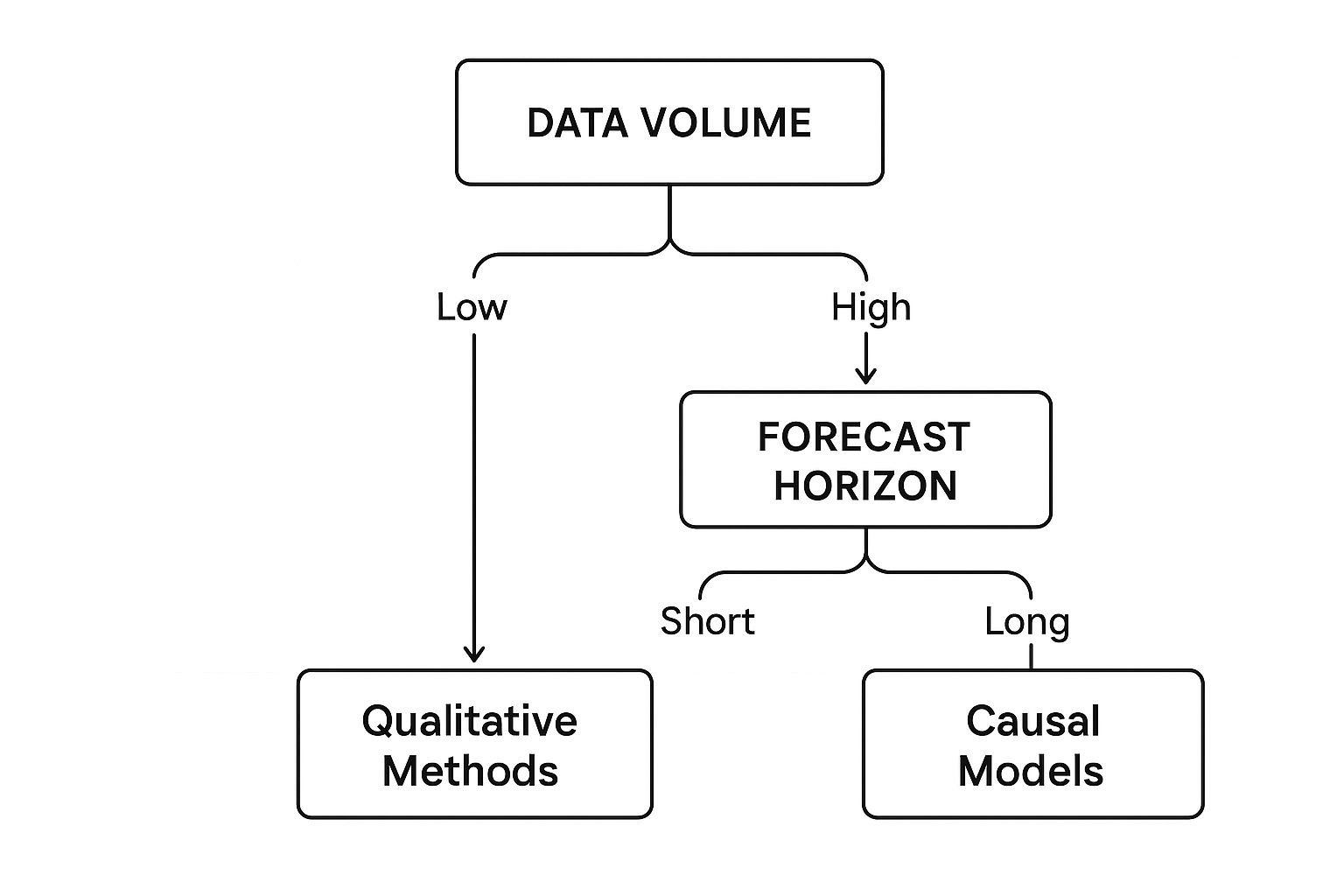
As you can see, if you're light on data, you’ll naturally gravitate toward qualitative approaches. The more data you have, the more sophisticated and quantitative your models can become.
Create a Powerful Hybrid Model
Here’s a secret the best operators know: the most accurate forecasts almost never come from a single method. The strongest, most resilient predictions come from a hybrid model that blends different techniques, creating a natural system of checks and balances. This layered approach helps smooth out the blind spots inherent in any one method.
Think of it like building a court case. You start with the hard, quantitative evidence (your historical data), bring in eyewitness testimony (your sales pipeline), and then add expert commentary to tie it all together (your leadership's qualitative insights).
A hybrid model grounds your forecast in both data and reality. It balances what your numbers say should happen with what your team on the ground knows is happening.
For example, a solid hybrid approach could look like this:
- Start with a quantitative forecast to get a baseline number rooted in historical performance.
- Layer on your pipeline forecast to tweak that baseline with up-to-the-minute information from active deals.
- Finally, apply qualitative insights from sales and marketing to account for things the data can't see yet—like a new competitor entering the market or a planned pricing change.
This combination gives you a far more robust and defensible number. It’s also crucial for accurately projecting key metrics like annual recurring revenue over longer time horizons. At the end of the day, blending these methods gives you the clearest possible view of the road ahead.
Matching the Forecasting Method to Your Business
Still not sure which method is the best fit? This table breaks down the ideal scenarios for each of the core approaches based on common business factors. Use it as a quick guide to align your forecasting strategy with your company's reality.
| Business Factor | Quantitative (Historical) | Qualitative (Expert Opinion) | Pipeline Analysis |
|---|---|---|---|
| Company Stage | Mature, stable businesses with years of data. | Early-stage startups or companies entering new markets. | Growth-stage companies with an active sales process. |
| Data Availability | High volume of clean, historical sales data is required. | Minimal historical data needed; relies on experience. | Requires a well-managed CRM with deal-stage data. |
| Market Volatility | Best for stable, predictable markets. | Excellent for rapidly changing or unpredictable markets. | Good for moderately stable markets where deal flow is key. |
| Sales Cycle Length | Works for any cycle length, as long as it's consistent. | Most useful when cycles are new or inconsistent. | Most accurate for short-to-medium sales cycles. |
Ultimately, you can start with the method that most closely matches your current situation and then layer in others as your business evolves and your data matures. The goal is to build a forecasting process that grows with you.
Common Forecasting Mistakes and How to Avoid Them
Knowing the different forecasting methods is one thing, but actually producing a reliable forecast is another. Even the most sophisticated models can fall apart if you stumble into a few common traps. Frankly, this is where many companies go wrong—they learn the "how" but forget to sidestep the obvious pitfalls.
One of the biggest culprits? Messy data. If you’re using historical sales forecasting, your entire prediction hinges on past performance. The whole idea is that history gives you clues about the future, but if your data is a jumbled mess of duplicates, missing deal values, and inconsistent entries, your "clues" are useless. Garbage in, garbage out. For more on this, check out these winning tactics for historical sales forecasting on akucast.com.
Another classic mistake is unchecked optimism. It's easy for sales teams to get excited and project a best-case scenario for every single deal in the pipeline. But hope isn't a strategy. Without grounding those gut feelings in hard data like historical win rates or current market conditions, your forecast quickly turns into a wishlist.
Building a More Resilient Forecast
So, how do you build a forecast that’s both accurate and credible? It comes down to creating a disciplined process and proactively addressing these weak spots. A few good habits can make all the difference.
A forecast is a tool for smart decision-making, not a guarantee of future results. The goal is to be directionally correct and to understand the assumptions behind the numbers, not to predict the future with perfect accuracy.
Here are a few practical ways to fix the most common forecasting problems:
-
Create a Data-Cleaning Checklist: Before you even think about running the numbers, get your data in order. Make a simple checklist: Are there duplicate entries? Does every deal have a value? Is the whole sales team using CRM stages the same way?
-
Schedule Regular Forecast Reviews: A forecast isn't a "set it and forget it" document. You need to review it constantly. Hold weekly or bi-weekly meetings to see how your predictions are tracking against actual performance. This keeps everyone accountable and lets you fix small problems before they become big ones.
-
Account for Market and Seasonal Trends: Don't just assume this quarter will be a carbon copy of the last. Did you factor in the summer slowdown? The end-of-year budget flush? Major industry events? These things matter, and they will absolutely impact buying behavior.
Putting these simple practices into place helps you build a much more durable forecasting process. It’s not just about getting the number right; it’s about giving your team the clarity it needs to plan effectively, which is a huge part of any successful set of customer success strategies.
Frequently Asked Questions About Forecasting
Even after you've got a handle on the different forecasting methods, you'll still run into questions when it's time to put it all into practice. It's totally normal.
Let’s walk through a few of the most common questions that pop up for leaders when they start building out their forecasts.
How Often Should I Update My Forecast?
There's no single right answer here—it really comes down to the speed of your business and market. For a fast-moving SaaS company, a monthly review is pretty much the standard. It keeps you from getting caught flat-footed. For businesses in a more stable, predictable industry, a quarterly update might be all you need.
The most important thing is to think of your forecast as a living, breathing document. You absolutely need to revisit it anytime something significant happens, like launching a new product, overhauling your pricing, or a major new competitor popping up.
Is It Better to Use One Method or Combine Them?
Combining methods is almost always the smarter play. Think of it as a hybrid approach that gives you a much more reliable and accurate picture. It creates a natural system of checks and balances.
For instance, you could start with your historical data to create a baseline. Then, you layer on your current sales pipeline data to see what’s in motion. Finally, you can adjust those numbers with qualitative insights from your sales team about what they're hearing from customers on the ground.
A hybrid model gives you a much more robust and well-rounded view of your financial future. It balances what your data says should happen with what your team on the ground knows is happening.
What Tools Can I Use for Revenue Forecasting?
You don't need to overcomplicate this. Start with something simple and add more powerful tools as your business grows and your forecasting gets more sophisticated.
- Spreadsheets: For getting started, you can't go wrong with Google Sheets or Microsoft Excel. They’re flexible, accessible, and perfect for basic models.
- CRM Software: Once you’re serious about pipeline forecasting, a CRM like HubSpot or Salesforce is a must. They track your deal stages and potential values automatically, which does a lot of the heavy lifting for you.
- FP&A Tools: For really deep, complex analysis, dedicated Financial Planning and Analysis (FP&A) software can be a game-changer. But honestly, most businesses don't need this level of firepower right away.
At SaaS Operations, we provide the proven playbooks and templates to help you build efficient, data-driven processes that accelerate growth. Our battle-tested frameworks save you time and give you the clarity to make smarter decisions. Learn more by visiting our official website.