
Think of capacity planning like a popular restaurant gearing up for a big Saturday night. The manager doesn't just hope for the best; they look at past weekends, check for any local events, and estimate how many diners will walk through the door. Based on that, they make sure they have enough ingredients, chefs on the line, and servers on the floor.
In the SaaS world, it’s the exact same principle, just with different resources. Instead of food and staff, you're juggling server power, database capacity, software licenses, and even customer support agents to handle user demand.
What Is Capacity Planning, Really?

At its core, capacity planning is a strategic balancing act. It’s all about looking into the future to predict your needs and then making sure you have the right resources in place to meet them—without overspending or falling short.
For a SaaS company, getting this right is non-negotiable. It’s what prevents your app from crashing during a traffic spike and what keeps load times snappy. It's the difference between a smooth user experience and a frustrating one.
Imagine your product gets a shout-out from a huge influencer. Suddenly, thousands of new users are flocking to sign up. Without a solid capacity plan, your servers would buckle under the pressure, your app would slow to a crawl, and that amazing PR opportunity would fizzle into a customer service nightmare. With a plan, you're ready for the influx, delivering a flawless experience that turns curious visitors into happy, paying customers.
The Three Pillars of Capacity Planning
To really wrap our heads around this, it helps to break capacity planning down into three core components. Think of these as the foundation for any good strategy. They help you move from guesswork to smart, data-backed decisions.
This framework is built on understanding what you'll need, what you have, and what it will take to bridge the gap.
The Three Pillars of Capacity Planning
| Pillar | What It Means | Example in SaaS |
|---|---|---|
| Demand Forecasting | Predicting the resources your customers will need in the future. | Analyzing user growth trends and marketing campaigns to estimate server load for the next quarter. |
| Resource Supply | Auditing the resources you currently have available. | Calculating your current server CPU, memory, and storage limits across your entire infrastructure. |
| Gap Analysis | Identifying the difference between what you have and what you'll need. | Determining you need 20% more server capacity to handle the projected traffic from a Black Friday sale. |
Taking this proactive approach is more important than ever. As tech stacks get more complex, the need for smart resource management is skyrocketing.
In fact, the global capacity management market was valued at USD 1.64 billion in 2023 and is expected to hit nearly USD 7.91 billion by 2031. You can dig into market trend forecasts to see the numbers for yourself. This isn't just a niche IT task anymore; it's a fundamental business strategy for staying agile and profitable.
Why Capacity Planning Is a Game Changer for SaaS

In the SaaS world, capacity planning isn't just an item on an IT checklist. It's a core business strategy that directly impacts your bottom line. This is the foresight that separates companies that thrive under pressure from those that simply crumble.
Ever heard of the "hug of death"? It’s that bittersweet moment when a viral marketing hit sends a massive, unexpected wave of traffic your way. Without a solid plan, this golden opportunity quickly turns into system crashes, slow load times, and a PR nightmare. With a plan, you handle the surge smoothly, converting curious visitors into paying customers.
This kind of proactive thinking is what truly protects and elevates the user experience. A well-thought-out capacity plan keeps your application fast, dependable, and always online—all of which are non-negotiable for keeping customers around. Remember, a single major outage can convince users to leave and never come back, hitting your revenue for the long haul.
The Financial Upside of Smart Planning
Beyond just keeping the lights on, getting capacity planning right delivers some serious financial wins. It's all about striking that perfect balance between being ready for growth and not wasting a fortune on resources you don't actually need.
A common and costly mistake is buying a ton of server capacity "just in case." This often leads to huge cloud bills for infrastructure that just sits there, collecting dust. Capacity planning flips that script by using data and smart forecasting to help you provision only what you need, right when you need it. This approach is a game-changer for optimizing your cloud spend and boosting profitability.
By aligning your infrastructure costs directly with forecasted demand, you can stop budget blowouts in their tracks and free up cash for other critical areas like product development or marketing.
This financial discipline is what sustainable scaling is all about. Every dollar you don't spend on an idle server is a dollar you can reinvest into finding and winning new customers. This directly improves your customer acquisition cost (CAC) and, ultimately, your company's valuation.
From Reactive Firefighting to Proactive Growth
At its core, capacity planning is your roadmap for sustainable growth. It shifts your entire operations team from a state of constant, stressful firefighting to one of calm, proactive strategy. You stop worrying about whether you can handle next month’s user sign-ups and start planning for it with total confidence.
This process gives you the kind of clarity that informs smarter business decisions across the board:
- Customer Retention: A stable, fast platform keeps users happy and subscribed. This is a massive piece of the puzzle when you dig into the details of lifetime value calculation for SaaS and its impact on your company's health.
- Strategic Hiring: When you can see future resource needs coming, you know exactly when it’s time to hire that next support agent or DevOps engineer.
- Product Launches: You can roll out that exciting new feature knowing your infrastructure is more than ready to handle the increased load.
Instead of just guessing, you have a data-backed model guiding your next move. It’s how you scale smoothly and profitably without ever sacrificing the quality of your service. Think of it as the engine that powers confident, long-term success.
A Four-Step Capacity Planning Process
Feeling overwhelmed by the idea of creating a capacity plan? Don't be. Think of it less as a daunting technical challenge and more as a practical, four-step journey.
By breaking it down into manageable actions, any SaaS team can stop putting out fires and start building for strategic growth. It all begins with understanding what you have, predicting what you'll need, and then building a smart bridge between the two.
Step 1: Measure Your Current Capacity and Performance
You can't map out a route to your destination if you don't know where you're starting from. The first step is all about getting a crystal-clear picture of your current reality. This means conducting a thorough audit of your existing resources.
This isn't just about counting servers; it’s about understanding how they perform under real-world pressure. Start by gathering key performance metrics:
- CPU Utilization: How much processing power are your servers consistently using during peak and off-peak hours?
- Memory Usage: Are you constantly bumping up against memory limits when your users are most active?
- Database Performance: How fast are database queries running? Are there bottlenecks?
- Support Tickets: What's the average time it takes your support team to respond and resolve customer issues?
This data gives you a baseline. It tells you exactly how much your current infrastructure and team can handle before things start to slow down and customers feel the pain.
Step 2: Forecast Future Demand
With a solid baseline in hand, it's time to look to the horizon. Forecasting future demand is part science, part art, and it absolutely requires collaboration across different teams. Your goal here is to anticipate what’s coming down the pike that will drive user activity and, in turn, resource consumption.
Look at your historical user data to spot seasonal trends. Even more importantly, sit down with your marketing and sales teams. Are they gearing up for a big product launch? Planning a major promotional campaign? Entering a new market? Each of these initiatives will directly impact your resource needs and your ability to grow your company's annual recurring revenue.
The following infographic shows how these forecasts feed into an actionable plan.
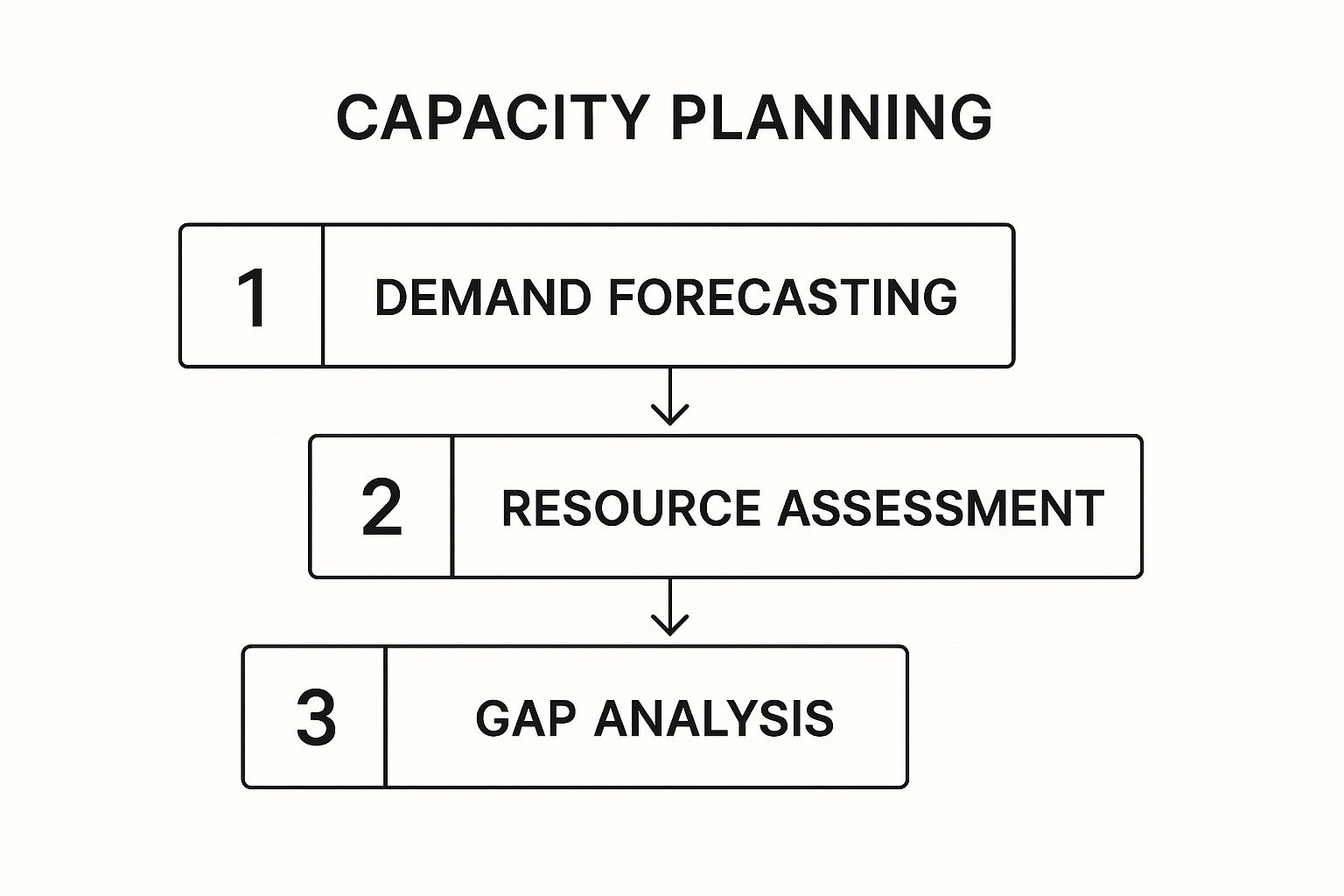
As you can see, forecasting demand is what allows you to assess your resources and pinpoint the critical gaps you'll need to fill.
Step 3: Analyze and Bridge the Gap
This is where the rubber meets the road. You take your audit of current resources (Step 1) and hold it up against your forecast for future demand (Step 2). The gap analysis asks a simple question: "Do we have what we need to get where we're going?"
Let’s say your forecast predicts a 30% increase in user sign-ups after an upcoming marketing campaign, but your servers are already running hot at 85% CPU capacity. You’ve just found a critical gap. Your analysis might reveal you need more server power, extra software licenses, or even to hire another customer support agent. Using effective task estimation techniques is crucial here, as it helps you reliably forecast workloads and define the exact size of that gap.
Step 4: Monitor and Adjust Continuously
Capacity planning isn't a "set it and forget it" task—it's a living, breathing process. Your forecasts won't always be perfect, and markets can shift in a heartbeat. The final, and perhaps most important, step is to constantly monitor your performance metrics against your plan and make adjustments on the fly.
The core idea is simple: capacity planning is how organizations make sure they have the right amount of resources—people, equipment, and technology—ready to meet future demand.
The growing importance of this discipline is clear from market trends. The capacity planning software market was valued at USD 1.5 billion in 2022 and is projected to hit USD 2.5 billion by 2033. This shows just how seriously businesses are investing in these capabilities. Regularly reviewing your plan is what keeps your business agile and ready for whatever comes next.
Choosing Your Capacity Planning Strategy
Once you have a good handle on your capacity needs, the next big question is: how will you meet them? There's no one-size-fits-all answer here. The right move for your company really boils down to your business goals, your budget, and your appetite for risk.
Most SaaS companies tend to lean into one of three core strategies. Think of it like planning a party. Are you the type to have everything set up weeks in advance, or do you make a run to the store only when the first guests are ringing the doorbell? Your answer probably says a lot about which capacity strategy feels right for you.
The Proactive Approach: Lead Strategy
The lead strategy is all about staying ahead of the game. You add capacity before you actually need it, based on forecasted demand. Picture a streaming service like Netflix spinning up extra servers a full month before a huge show finale drops. They’re anticipating the rush and building the capacity to handle it in advance.
This proactive approach is fantastic for businesses where user experience is everything. You're always ready for a traffic spike, so performance remains snappy and reliable. The trade-off? It’s expensive. You're paying for resources that might sit idle for a while, which can be a tough pill to swallow if that predicted growth doesn't show up right on schedule.
The Reactive Approach: Lag Strategy
On the flip side, the lag strategy is purely reactive. You only add capacity after you see a sustained increase in demand. This would be like a helpdesk software company hiring more support agents, but only after their ticket response times have been slipping for a couple of weeks.
The main advantage here is cost control. You don’t spend a dime on resources until you’re positive they’re needed, which keeps waste to a minimum. But it’s a risky game. A sudden surge in demand can catch you completely off-guard, leading to slowdowns, outages, and unhappy customers who might not stick around for you to fix things.
The strategy you choose has a direct and lasting impact on both your budget and customer satisfaction. It's a critical decision that should be reviewed regularly, often as part of your company's planning cycle. For more on this, check out our guide on building a comprehensive quarterly business review template.
The Hybrid Approach: Match Strategy
The match strategy is the happy medium, designed to balance the pros and cons of the other two. Here, you add capacity in smaller, more frequent steps that closely follow the actual growth in demand. Think of a project management tool like Asana adding a few servers every time they see a steady 5% uptick in active users.
This method is far more flexible and less financially risky than going all-in with the lead strategy, yet it’s much more responsive than waiting around with the lag strategy. It does require constant monitoring and fine-tuning, but for many, it offers the best of both worlds.
Comparing Capacity Planning Strategies
Choosing between lead, lag, and match isn't always straightforward. Each approach has distinct advantages and potential pitfalls that can significantly impact your operations and bottom line.
The table below lays out these three strategies side-by-side to give you a clearer picture of which one might be the best fit for your SaaS business.
| Strategy | Description | Best For | Risk |
|---|---|---|---|
| Lead | Proactively add capacity before demand increases. | Businesses where uptime and user experience are non-negotiable. | High cost if forecasts are wrong; paying for unused resources. |
| Lag | Reactively add capacity after demand has already risen. | Startups or budget-conscious companies with predictable growth. | Poor performance, system overloads, and customer churn from sudden spikes. |
| Match | Add capacity in small increments that closely track actual demand. | Companies wanting a balance of cost-efficiency and responsiveness. | Requires constant monitoring and can be complex to manage. |
Ultimately, the goal is to find a strategy that aligns with your company’s financial reality and its promises to customers. Picking the right one sets the foundation for scalable, sustainable growth.
Capacity Planning in Action: Real-World SaaS Scenarios
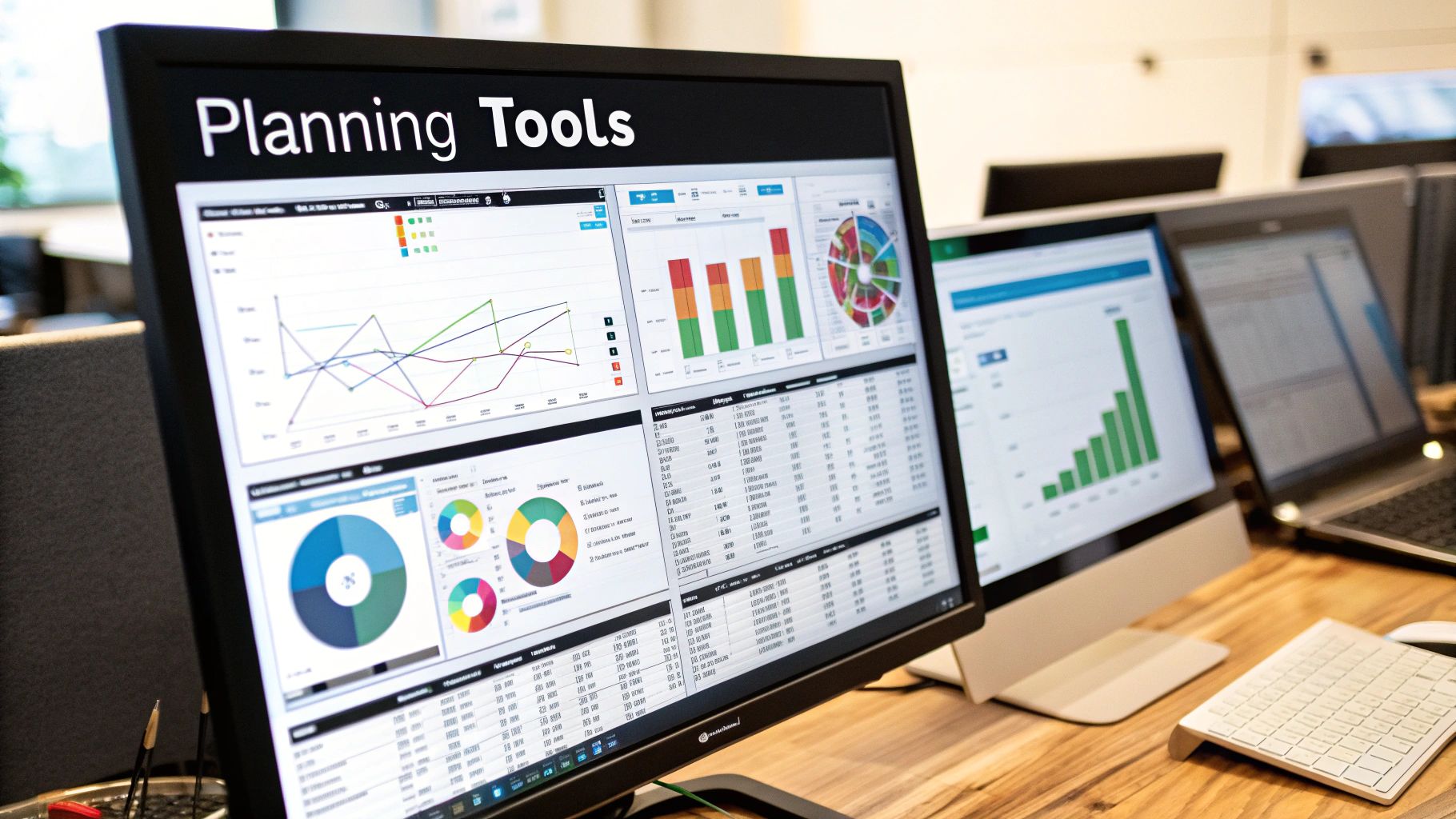
It's one thing to talk about theories and strategies, but where capacity planning really comes to life is in the trenches. Let's look at how this plays out for a couple of fictional SaaS companies facing huge, but entirely predictable, spikes in demand.
These examples highlight how getting ahead of the curve is the only way to turn a potential disaster into a record-breaking success.
Scenario 1: Streamly Prepares for a Season Finale
Imagine a popular video streaming platform we'll call 'Streamly'. Their biggest original show is airing its season finale in a few weeks, and all signs point to a viewership spike of 300% during the live broadcast. If their service goes down, it's not just a technical glitch—it's a full-blown PR nightmare.
The operations team springs into action.
- Forecasting the Surge: They dig into viewership data from past season premieres and finales. They don't stop there, though. They also layer in social media buzz and marketing projections to get a sharp, accurate picture of the coming traffic wave.
- Scaling in Advance: Adopting a lead strategy, they start spinning up extra server capacity in key regions two full weeks before the finale. They'd rather be over-prepared than caught off guard.
- Finding the Breaking Points: A week before the big night, they hammer their systems with stress tests, simulating the exact traffic load they expect. This helps them find and patch any hidden bottlenecks in their delivery network before they can cause real problems.
Thanks to this careful planning, the finale goes off without a hitch. Viewers get a crystal-clear, buffer-free stream. Streamly turns a high-risk moment into a huge win, cementing its reputation for rock-solid reliability.
Scenario 2: ShopCartify Tackles Black Friday
Now, let’s consider 'ShopCartify,' an e-commerce platform that hosts thousands of online stores. For them, Black Friday is the Super Bowl of their year. If their platform crashes, it’s not just one business going down—it’s thousands of their customers losing out on crucial sales.
Planning for this doesn't start in November; it begins months earlier. They know that trying to react in the moment is a recipe for failure. The goal isn't just to keep the lights on but to make sure every single storefront is snappy and responsive under extreme pressure.
Their capacity plan is a complex, multi-layered operation. They start by analyzing last year’s transaction data to forecast order volumes and API calls. From there, they use a match strategy to incrementally scale up their database resources and processing power, keeping costs in check. They even reach out to their biggest merchants to get a heads-up on their specific promotion plans.
This level of detailed preparation is central to how they operate. Building a plan this thorough is a lot like following a comprehensive guide, such as our SaaS implementation checklist, to make sure nothing is overlooked.
The result? When the Black Friday tsunami of traffic hits, their systems don't even flinch. They flawlessly process millions in sales, helping their clients have their most profitable day of the year.
Best Practices for Effective Capacity Planning
Moving from theory to practice means adopting a smart, disciplined mindset. The key is to treat capacity planning not as a one-time project, but as a continuous part of your operational rhythm. A great plan isn't a static document you file away; it's a living guide that adapts as your business grows and changes.
The foundation of any good plan is solid data. Guesswork is a recipe for disaster, leading to either overspending on servers that sit idle or under-provisioning that puts your entire system at risk. Instead, ground every forecast in historical performance data, real user behavior trends, and concrete projections from your sales and marketing teams about what's coming down the pipeline.
Foster Cross-Functional Collaboration
Capacity planning is far too important to be left solely to the engineers. Your marketing team’s next big launch or a major sales promotion can create a huge spike in demand, and your infrastructure needs to be ready for it.
Set up a simple, regular process where these teams can feed their plans into your forecasts. This collaborative approach ensures everyone is on the same page and that your resource plan genuinely supports the company's goals. When teams operate in silos, you're just flying blind.
Effective capacity management has become indispensable for modern IT. The global capacity management market was projected to grow to USD 1.55 billion by 2023, driven by the urgent need to prevent service outages and optimize infrastructure spending. You can learn more about the growth of this critical market and its impact on enterprises.
Build in a Buffer and Stay Agile
Even the most accurate forecasts can't predict a sudden viral tweet or an unexpected mention in the news. These things happen, and they can send a flood of traffic your way in minutes. That’s why you always build a safety net into your plan.
A buffer of 15-20% extra capacity above your forecasted peak is a standard best practice. This cushion gives you the breathing room to handle surprises without your service falling over.
This approach aligns perfectly with the principles of Service Reliability Engineering, which is all about building proactive, resilient systems. It also has a direct impact on your bottom line. By maintaining a smart buffer instead of massively over-provisioning, you're practicing effective SaaS cost optimization. The goal, after all, is to build a system that can absorb shocks and scale gracefully when you need it to.
Frequently Asked Questions About Capacity Planning
Even when you've got the basics down, a few practical questions always pop up when it's time to put capacity planning into action. Let's tackle some of the most common ones to clear up any confusion and get you moving forward.
How Often Should We Review Our Capacity Plan?
There isn't a single magic number here. For a stable business, a quarterly review is a solid starting point. But if your SaaS is in a high-growth spurt or you're gearing up for a big feature launch, you need to be checking in monthly, or maybe even every other week.
Think of your capacity plan as a living document, not a dusty binder on a shelf. The goal is to stay nimble and react to what's happening in your business, not to stick to a plan that's already out of date.
Your capacity plan's review cycle should match the speed of your business. Faster growth demands more frequent check-ins to avoid being caught off guard by a sudden surge in demand or a shift in user behavior.
What Are Some Good Tools for Capacity Planning?
Spreadsheets can get you by when you're just starting out, but they quickly run out of steam. As you grow, you'll want to look at dedicated tools that are built for this. They make a huge difference with better data visualization, forecasting, and team collaboration.
Look for platforms that give you:
- Real-time monitoring dashboards to keep an eye on critical metrics like CPU and memory usage.
- Forecasting capabilities that can project future demand based on your past performance.
- Scenario planning features to game out "what-if" situations, like a sudden flood of traffic from a marketing campaign.
What Is the Difference Between Capacity and Resource Planning?
This is a classic point of confusion, but the distinction is pretty simple.
Capacity planning is the big-picture, strategic work. It’s about making sure you have enough of the right resources—servers, people, software licenses—to handle what's coming in the future.
Resource planning, on the other hand, is tactical and immediate. It's about assigning specific resources to specific tasks right now.
Here’s an analogy: Capacity planning is about designing the kitchen and deciding how many ovens and chefs you'll need for the dinner rush. Resource planning is about deciding which chef is cooking which dish on which stove tonight.
Ready to stop reacting and start planning for growth? The playbooks at SaaS Operations provide battle-tested templates and SOPs to build efficient, scalable processes. Get started today at https://saasoperations.com.