Customer Success Team Structure: Build a Scalable Model
 Published By: Alex
September 9, 2025
Published By: Alex
September 9, 2025
Your customer success team structure is the game plan that outlines who does what to help customers win. It’s far more than just an org chart—it’s the operational blueprint that dictates how your team delivers value, nurtures relationships, and ultimately drives retention and growth.
What Is a Customer Success Team Structure
Think of your customer success department like a well-oiled machine. Each part has a specific job, and they all work together to produce a fantastic result. A solid customer success team structure does the same thing, assigning specialized roles to guide customers toward achieving their goals with your product. It’s the framework that defines who is responsible for what, when, and for which specific customers.
This structure is what allows a company to shift from a reactive, one-size-fits-all support model to a proactive, value-driven engine. Instead of just putting out fires, a structured team can focus on critical moments in the customer journey, like nailing the onboarding experience, driving deeper product adoption, and securing renewals. This clarity ensures you have the right people with the right skills focused on the right customer needs at the right time.
Why Structure Is Non-Negotiable
Let's be honest: without a formal structure, most CS teams descend into organized chaos. You’ll have a single Customer Success Manager (CSM) trying to juggle onboarding for a brand-new client, handling an angry escalation from a frustrated user, and simultaneously trying to negotiate a renewal with an at-risk account.
That "jack-of-all-trades" approach is a recipe for burnout and churn. No single area gets the focused attention it truly needs to be successful.
A defined structure, on the other hand, brings immediate benefits:
- Clarity of Roles: Everyone knows exactly what they’re responsible for. This cuts down on confusion and ensures nothing falls through the cracks.
- Improved Scalability: As your customer base grows, you can scale the team logically by adding specialists, not just more generalists who are stretched thin.
- Enhanced Customer Experience: Customers get expert guidance at each stage of their journey, from a dedicated onboarding specialist to a strategic account manager.
- Data-Driven Decisions: When roles are specialized, you get cleaner data on what’s working and what isn’t, allowing you to pinpoint weak spots and opportunities in the customer lifecycle.
A great CS structure isn't just an internal document; it's a promise to your customers that you have a dedicated plan for their success. It tells them their journey is understood, managed, and optimized by experts every step of the way.
Ultimately, the goal is to create a system that runs efficiently and delivers real results. For a deeper dive into the nuts and bolts of this, check out this guide on building a powerful customer success operation. A well-thought-out blueprint adapts as you grow, which sets the stage for the specific models we'll explore next.
The Foundational Roles of a CS Team
Before you can build an effective customer success team structure, you have to know who's on the field. Think of a high-performing CS team less as a single department and more like a mission control center. Every person has a specific console, and they all work together to make sure every customer’s journey is smooth, valuable, and successful.

Let's move past generic job titles and get into what these people actually do. Here are the core specialists who form the backbone of any proactive customer success department.
The Customer Success Manager (CSM)
At the heart of it all is the Customer Success Manager (CSM), who acts as the strategic quarterback for the customer relationship. Don’t confuse them with support agents. CSMs own the long-term health of a portfolio of accounts, acting as trusted advisors who understand their customers’ business goals inside and out.
Their entire mission is to make sure the customer is constantly getting real value from your product. This means they are always:
- Building strong relationships as the main point of contact for strategic conversations.
- Driving deep product adoption by guiding customers to the features that will actually move the needle for them.
- Spotting expansion opportunities, identifying upsells or cross-sells that genuinely solve a customer's growing needs.
- Managing renewals, which is the ultimate measure of their success in keeping customers happy and growing.
The Onboarding Specialist
First impressions are everything, right? The Onboarding Specialist is the master of ceremonies for a customer’s first 90 days. Their job is laser-focused on one thing: getting new customers set up for success as quickly and painlessly as possible. A clunky onboarding process is one of the fastest ways to lose a customer, which makes this role absolutely critical.
They guide new users through setup, training, and configuration, all with the goal of getting them to that first "aha!" moment without any friction.
The Onboarding Specialist sets the trajectory for the entire customer lifecycle. A great onboarding hands off an engaged, educated, and confident customer to the CSM, paving the way for long-term loyalty.
The Customer Support Advocate
While the CSM’s work is proactive, the Customer Support Advocate is the expert in reactive problem-solving. They are the front-line heroes who handle inbound technical questions, troubleshoot bugs, and provide fast, accurate answers. Their work is essential for keeping customers happy and maintaining trust when things go wrong.
A well-designed customer success team structure keeps CSMs from getting buried in day-to-day support tickets. This separation of duties is a hallmark of a mature CS organization—it frees up CSMs to focus on strategy while Support Advocates crush immediate problems with speed and expertise.
The CS Operations Manager
Behind every great CS team, there's a CS Operations Manager making sure the whole machine runs smoothly. This person is the architect of the team's efficiency, managing the tech stack, data, and processes that let everyone else do their best work.
Their world revolves around:
- Managing the CS platform (like Gainsight or Catalyst) and other essential tools.
- Building and analyzing reports on customer health, churn risk, and team performance.
- Developing and refining playbooks for everything from onboarding to renewals.
Their leadership style in business management is what turns raw data into actionable insights, making the entire organization more strategic. This role is a true force multiplier.
To give you a clearer picture of how these roles fit together, here’s a quick breakdown.
Core Customer Success Roles and Responsibilities
| Role Title | Primary Focus | Key Performance Indicators (KPIs) |
|---|---|---|
| Customer Success Manager (CSM) | Proactive relationship management, value realization, and strategic guidance for a portfolio of accounts. | Net Revenue Retention (NRR), Gross Revenue Retention (GRR), Customer Health Score, Upsell/Cross-sell Revenue |
| Onboarding Specialist | Getting new customers set up, trained, and to their first point of value as quickly as possible. | Time to First Value (TTFV), Product Adoption Rate (in first 90 days), Onboarding CSAT/NPS |
| Customer Support Advocate | Reactive troubleshooting, technical issue resolution, and answering inbound customer questions. | First Response Time (FRT), Ticket Resolution Time, Customer Satisfaction (CSAT) |
| CS Operations Manager | Building and maintaining the systems, processes, and data infrastructure that the CS team runs on. | Team Efficiency Metrics, Data Accuracy, Time Saved via Automation, Adoption of CS Tools |
As you can see, each role has a distinct purpose and is measured by different outcomes, ensuring the entire customer journey is covered from all angles.
Key Models for Your Customer Success Team Structure
Choosing the right customer success team structure is a lot like picking the right tool for a job. There’s no single "best" option, but three proven frameworks are fantastic starting points for SaaS companies, no matter their stage of growth. The first step is to really understand each model—its strengths, weaknesses, and where it shines—so you can build a team that scales right along with your business.
Each structure is built to solve a different set of problems. An early-stage startup needs to be nimble and learn fast. A growing enterprise, on the other hand, needs efficiency and deep expertise.
Let's break down these foundational models to see which one makes the most sense for you right now.
The Generalist Model
The Generalist model is the classic "all-hands-on-deck" approach, and it’s perfect for early-stage startups. In this setup, each Customer Success Manager (CSM) is a jack-of-all-trades. They handle the entire customer journey, from onboarding and adoption to renewals and even some light support.
Think of each CSM as a personal guide for a small group of customers. This structure builds incredibly strong, personal relationships and gives the company raw, unfiltered feedback straight from the front lines. It’s scrappy, flexible, and exactly what a young business needs while it's still finding its footing.
- Pros: It’s simple to get started, builds deep customer bonds, and gives you a 360-degree view of the customer experience.
- Cons: This model just doesn't scale. As your customer base grows, CSMs get stretched way too thin, which can lead to burnout and a drop in service quality.
- Best For: Startups typically under $2 million in ARR with a small, fairly uniform customer base.
The Segmented Model
As your company grows, you’ll naturally start attracting different kinds of customers. A small business has completely different needs than a global enterprise, and that’s where the Segmented model comes into play. It’s all about organizing the CS team around specific customer tiers.
This is the most common next step after outgrowing the Generalist model. You might split your teams into segments like SMB (Small and Medium-sized Business), Mid-Market, and Enterprise. A CSM focused on enterprise accounts might only manage 10-25 high-touch clients, while an SMB-focused CSM could handle hundreds using more automated, tech-touch methods. This ensures every customer gets the right level of attention. It also helps you accurately calculate your annual recurring revenue by better understanding retention and growth potential within each tier.
Segmentation lets you align your most valuable resources—your people—with your most valuable customers. It’s a strategic play that balances cost with a high-quality customer experience.
The Specialist Model
The Specialist model takes things a step further by organizing the team by function or by a specific stage in the customer’s journey. Instead of one CSM handling everything, you build a team of experts who each own a piece of the lifecycle. Think of it like a well-oiled assembly line, where each specialist executes their part with precision before handing the customer off to the next expert.
A typical Specialist customer success team structure might look like this:
- Onboarding Specialists: True experts at getting new customers up and running for a fast, successful start.
- Adoption Specialists: Focused on driving deeper product usage and helping customers realize value after they're onboarded.
- Renewal Managers: Dedicated to securing contract renewals and handling all the commercial conversations.
- Account Managers: Laser-focused on spotting and closing expansion and upsell opportunities.
This division of labor allows for deep expertise and super-efficient processes at each stage. It's the go-to model for large-scale operations where predictability and process are everything. The biggest challenge? Making sure the handoffs between specialists are seamless so the customer doesn’t feel bounced around.
Here’s a simple way to visualize how a team can be structured, showing a clear path from an associate role up to a manager.
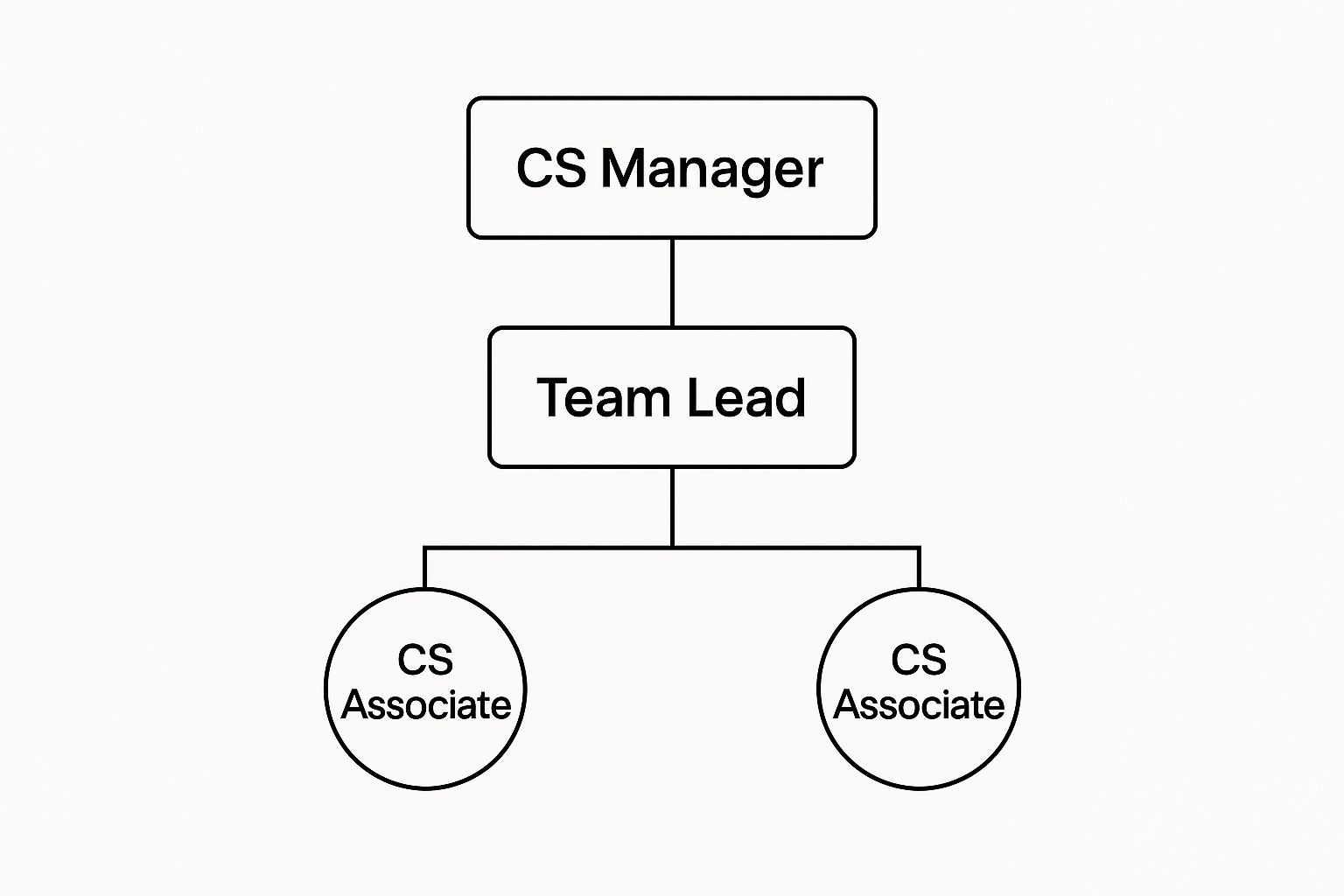
This kind of hierarchy creates a clear reporting structure and career path within a customer success department, regardless of which operational model you choose.
Ultimately, the best customer success team structure is the one that serves your customers and business goals today, while being flexible enough to change tomorrow. Many companies end up blending these models, creating a hybrid approach that fits their unique situation. For instance, a company might use a Segmented model for its enterprise clients but a Specialist model for its high-volume SMB segment. The key is to start with a solid framework and be ready to adapt as you grow.
How to Evolve Your Team Structure As You Scale
Your customer success team structure isn't something you can set once and forget. Think of it more like a living thing—it needs to adapt and grow right alongside your business. The scrappy, all-hands-on-deck approach that works for a five-person startup will absolutely buckle under the weight of a 500-person company.
So, how do you know when it's time for a change? You'll see the warning signs. Maybe churn is creeping up. Or your CSMs seem perpetually burned out, juggling a million different tasks. These are signals that your current model is stretched thin. Being proactive and evolving your structure helps you stay ahead of these problems, ensuring your team is always set up to deliver real value.
Let's walk through the three most common stages of this evolution.

Stage 1: The Startup Stage (Under $2M ARR)
In the very beginning, customer success is everyone’s job. More often than not, it lands squarely on the shoulders of a founder or one or two early hires who wear many hats. At this point, you're running a Generalist model.
This small team does it all: onboarding, support calls, renewal chats, and strategic check-ins. This isn't a weakness; it's a huge advantage for an early-stage company. The direct, unfiltered feedback you get from being that close to your first customers is pure gold for refining your product and nailing your messaging. The goal isn't perfect efficiency—it's about learning as much as you can.
Trigger to Evolve: You hit a wall. One person can no longer give every customer the attention they need. Response times are slipping, and you're always putting out fires instead of preventing them. That's your cue to hire your first dedicated Customer Success Manager (CSM).
Stage 2: The Growth Stage ($2M to $20M ARR)
As you start to scale, the one-size-fits-all approach begins to crack. Your customer base isn't a small, uniform group anymore. Now you've got a mix of tiny businesses and much larger, more demanding accounts. This is the perfect time to shift to a Segmented model.
You start grouping your CSMs around customer tiers—think SMB, Mid-Market, and Enterprise. This is a game-changer. A CSM focused on enterprise clients can provide the deep, strategic partnership those big accounts need. Meanwhile, another CSM can manage a larger portfolio of SMB customers with a more efficient, tech-driven approach.
This is also when you should start adding your first specialist roles to the mix. Two common ones are:
- Onboarding Specialists: They own the crucial first 90 days, creating a smooth and standardized welcome for every new customer.
- Customer Support: This team takes on the reactive, technical questions, freeing up your CSMs to focus on proactive, value-driven conversations.
This division of labor keeps your CSMs from burning out and ensures every type of customer gets the right kind of attention.
Stage 3: The Enterprise Stage ($20M+ ARR)
Once you hit enterprise scale, it's all about efficiency and deep expertise. Your Segmented model will naturally mature into a more robust Specialist model, with teams organized by function and customer lifecycle stage. Think of it like a customer value assembly line, where every station is staffed by an expert.
At this level, your customer success team structure gets more complex and is heavily guided by data. You’ll have teams dedicated to nearly every part of the customer journey:
- Renewal Managers: A team focused purely on the commercial side of renewals, taking that pressure off your CSMs.
- Account Managers: This group is dedicated to finding and closing expansion opportunities, like upsells and cross-sells.
- CS Operations: A pivotal role that manages the team’s tech stack, crunches the data, and optimizes workflows. This team is the engine that helps you scale.
- Digital Success: A team that uses technology—like automated campaigns, webinars, and online communities—to manage the long tail of smaller customers.
Making all these moving parts work together requires rock-solid systems. This is where investing in comprehensive https://saasoperations.com/saas-operations-management/ becomes non-negotiable. The right tools and processes ensure all these specialized teams are aligned and working from the same playbook. As you continue to scale, it's also worth exploring AI's role in empowering customer support to see how new tech can boost your team's effectiveness.
The move between these stages is rarely a clean break. The real key is to listen—to your customers and to your team. When you see the signs of strain, don't wait for things to fall apart. Use it as an opportunity to build a structure that’s ready for your next phase of growth.
Navigating Common Structural Challenges
Even with the perfect org chart on paper, your customer success team is going to hit some bumps in the road. Building a great CS organization is less about drawing lines and boxes and more about navigating the real-world challenges that can derail your efforts. Two hurdles pop up more than any others: communication silos and tight budgets.
If you don't get ahead of these, you're in for a world of hurt. We're talking fragmented customer experiences, a burned-out team, and churn rates that'll keep you up at night. Basically, your growth engine will sputter before it even gets a chance to rev up.
Breaking Down Communication Silos
One of the fastest ways to frustrate a customer is to make them feel like they're dealing with three different companies instead of one. They don't know (or care) that your sales, support, and success teams are separate departments. When those teams don't talk to each other, the customer pays the price by repeating their story over and over or getting conflicting advice.
It's no surprise that communication breakdowns and resource shortages consistently rank as the top challenges for CS teams worldwide. This disconnect doesn't just create a clunky customer journey; it leads to wasted effort internally and makes delivering a smooth, proactive experience nearly impossible. You can dig into more of these common CS challenges on customersuccesscollective.com.
So, how do you tear down these walls? You build bridges, and those bridges are built on shared goals.
Here are a few practical ways to do it:
- Share Your Metrics: Get Sales, CS, and Product all rowing in the same direction by tying them to a single, critical goal like Net Revenue Retention (NRR). When everyone's bonus is tied to keeping and growing customer revenue, you’d be surprised how quickly they start collaborating.
- Create Cross-Functional Pods: For your most important (or most at-risk) accounts, pull together a "tiger team." This small, focused group should have a representative from CS, Sales, Product, and Support, ensuring everyone is aligned on the strategy and can jump on issues fast.
- Nail the Handoff: The transition from Sales to CS needs to be more than just a forwarded email. It should be a formal, structured process where the salesperson transfers all their knowledge about the customer's goals, pains, and expectations. Your customer success playbook should map this out in painstaking detail.
Overcoming Budget and Resource Constraints
Almost every CS leader has said, "We need more people." And almost every CFO has replied with a skeptical look. If you want to get the budget and headcount you need, you have to change the conversation. Stop talking about CS as a cost and start proving its value as a revenue engine.
Don't ask for budget because your team is overworked. Ask for it because of the revenue opportunity you're leaving on the table. Build a business case that’s impossible to ignore.
Instead of saying, "My CSMs are swamped," you need to frame it in dollars and cents. Try this instead: "Right now, each of our CSMs manages $2M in ARR. If we hire a dedicated Renewals Manager for $80k, we can free up 15% of their time. We project that extra time, focused purely on expansion, will generate $300k in new upsell revenue this year."
See the difference? That's not an expense request; it's a strategic investment with a clear, compelling ROI. When you tie every request—whether for a new hire or a new piece of software—to hard numbers like churn reduction and expansion revenue, you make it easy for finance to say yes.
The Tech Stack That Powers Modern CS Teams
A brilliant customer success team structure is only as good as the tools you give them. Without the right tech, even the most talented team will drown in manual data pulls and reactive fire-fighting instead of proactively guiding customers to value. Think of your tech stack as the engine that drives your entire CS organization, turning your grand strategy into scalable, everyday action.

The heart of this engine is almost always a dedicated Customer Success Platform (CSP). A CSP acts as the team's central nervous system. It pulls in data from all over the place—product usage, support tickets, survey feedback, contract details—and organizes it into a single, coherent view of customer health.
This unified view is a total game-changer. It’s what allows your team to automate workflows, set up alerts for at-risk accounts, and engage with customers in a personalized way, even as you scale. Instead of just guessing which customers are struggling, your CSMs can use data-driven health scores to focus their time and energy where it matters most.
Core Components of a CS Tech Stack
While the CSP is the centerpiece, it can't do the job alone. A truly effective tech stack connects several key systems, creating a smooth flow of information across your entire company. This is how you break down silos and make sure everyone from sales to support is on the same page.
Key integrations usually include:
- CRM (e.g., Salesforce): This gives your CSMs the full backstory from the sales process, including what was promised and what the customer’s goals were from day one.
- Communication Tools (e.g., Slack): Essential for real-time collaboration when a customer issue needs immediate attention from multiple teams.
- Survey Platforms (e.g., SurveyMonkey): Pulling in feedback like Net Promoter Score (NPS) helps you track customer sentiment over time and tie it to actual behavior.
This interconnected system is vital for efficient SaaS operations. It allows you to not only serve your customers better but also learn from their actions. Analyzing this data helps you refine your CS strategies and build a solid business case for future investments. Our guide on how to reduce churn rate dives deeper into using data to hang on to more customers.
The ROI of Investing in CS Technology
Putting money into a dedicated CSP isn't just a "nice-to-have"—it's a direct investment in growth and efficiency. Teams that use specialized platforms simply perform better and are far better equipped to scale. In fact, organizations with a CSP were 41% more likely to have grown their team over the past year.
This points to a crucial truth: technology doesn't replace people in customer success. It makes them more effective, which in turn justifies growing the team.
These tools are also fundamental for proving the team's financial impact. An impressive 63% of CSP users said the platform helped them secure a bigger budget. When you can draw a straight line from your CS activities to revenue outcomes, you shift the conversation entirely. Customer success stops looking like a cost center and starts proving itself as an undeniable growth engine. You can find more stats on this over at the Vitally blog.
Frequently Asked Questions
When you're building a customer success team from the ground up, a few common questions always seem to pop up. Nailing these fundamentals is key to creating a team that can actually scale and keep your customers happy for the long haul. Let's dig into some of the most frequent challenges we see SaaS operators run into.
What’s the Right CSM-to-Customer Ratio?
Honestly, there’s no silver bullet here. The perfect ratio really comes down to how complex your product is and who you're selling to. The whole point is to give customers the right level of attention they need to get real value out of your product.
A good starting point looks something like this:
- High-Touch Enterprise: For your biggest, most complex accounts, you'll want a tight ratio. Think 1 CSM for every 10 to 25 customers. These clients expect and need a deep, strategic partnership.
- Mid-Market: In the middle tier, one CSM can usually handle a portfolio of around 50 to 100 customers. Engagement is still personal, but a bit less intensive.
- Tech-Touch SMB: For your smaller customers, it's all about one-to-many. A single CSM might support hundreds of accounts, relying heavily on automation, webinars, and digital check-ins to provide value at scale.
Who Should the Customer Success Team Report To?
It's pretty common for CS to start out tucked under the sales team, but that's a mistake in the long run. The best practice today is to have Customer Success stand on its own as an independent department. This keeps the team laser-focused on creating long-term customer value and driving retention, not just hitting a quarterly sales number.
Ideally, your head of Customer Success should report directly to a Chief Customer Officer (CCO) or even the CEO. This gives the customer a real voice at the leadership table and cements CS as a strategic, revenue-focused part of the business, right alongside Sales and Marketing.
How Should We Pay Our CS Team?
Your compensation plan should mirror what you want the team to do: keep and grow your customers. A solid approach is to offer a competitive base salary paired with a variable bonus tied directly to retention and growth.
This setup motivates CSMs to focus on the things that actually prevent churn and uncover real opportunities for expansion. The most common metrics for these bonuses are Net Revenue Retention (NRR) and Gross Revenue Retention (GRR). Sometimes, you might also tie in customer satisfaction scores like NPS or key product adoption rates.
At SaaS Operations, we've built playbooks and SOPs based on what actually works in the real world. Our frameworks come from operators who have been in the trenches and scaled multiple 8-figure SaaS businesses. Start accelerating your growth with proven processes.