Mastering Leadership Style in Business Management for Success
 Published By: Alex
July 26, 2025
Published By: Alex
July 26, 2025
Your leadership style in business management is simply how you consistently behave when you’re guiding, motivating, and managing your team. It’s your default setting. Think of it like a ship’s captain: some captains bark orders and manage every single detail, while others trust their crew to navigate the waters. The best leaders know how to switch up their style to match the crew, the specific challenge, and where the company is headed.
Why Your Leadership Style Matters More Than You Think

Pinpointing your leadership style isn’t just a box-ticking exercise. It’s the very foundation of how you build a team, make decisions, and get things done. It sets the entire rhythm for your group’s day-to-day operations.
Your approach has a direct, measurable impact on how engaged, productive, and innovative your people are. Study after study has drawn a straight line between effective leadership and business success. When employees check out, poor leadership is almost always one of the top reasons they eventually walk out the door.
A leader’s methods create a ripple effect that touches everything. A top-down, authoritarian style might get you fast results in a crisis, but it can crush creativity over the long haul. On the flip side, a very democratic style can spark amazing ideas but might drag out urgent decisions. The real skill isn’t finding the one “perfect” style—it’s knowing which one to pull out of your toolkit for the right situation.
The Impact on Company Culture
Your leadership style is the single biggest influence on your team’s culture. It establishes the unwritten rules of how people talk to each other, work together, and feel about taking risks.
For example, a leader who naturally leans into a servant leadership approach will build a supportive, people-first environment. This creates what experts call “psychological safety,” where team members feel safe enough to pitch wild ideas or admit mistakes without fearing blame.
A leader’s style is the blueprint for their team’s culture. It’s not just about what you do, but how you do it that shapes employee behavior, engagement, and ultimately, performance.
This link between style and culture is absolutely critical. A positive, empowering culture can slash employee turnover by over 50% and seriously boost profitability. To truly grasp the benefits of a good leadership style, it helps to understand the common traits of ineffective leaders. Spotting these bad habits in yourself or others is often the first step toward building a better way forward.
To help you get a quick overview, here’s a simple table summarizing some of the most common leadership styles we’ll be discussing.
Quick Guide to Common Leadership Styles
| Leadership Style | Core Approach | Best For |
|---|---|---|
| Autocratic | Top-down control, leader makes all decisions. | Quick decision-making, crisis situations, or with inexperienced teams. |
| Democratic | Collaborative decision-making, seeks team input. | Fostering innovation, building team consensus, and complex problem-solving. |
| Laissez-Faire | Hands-off, gives team full autonomy. | Highly skilled, self-motivated teams that don’t need supervision. |
| Transformational | Inspires and motivates the team toward a shared vision. | Driving significant change, inspiring growth, and building a strong culture. |
| Transactional | Focuses on structure, rewards, and punishments. | Clear, routine tasks where performance goals are straightforward. |
| Servant | Puts the needs of the team first to help them grow. | Creating a positive, supportive culture and developing employee skills. |
This table provides a starting point, but the real magic happens when you learn to blend and adapt these approaches.
Adaptability as a Core Competency
The most effective leaders today don’t stick rigidly to one style. They practice what’s often called situational leadership, which means they adjust their approach based on a few key factors:
- The Team’s Experience: A group of junior employees might need more direct, hands-on guidance (a more directive style). In contrast, a team of seasoned experts will do their best work with more freedom (a delegative style).
- The Task’s Complexity: A straightforward, repeatable task can be managed well with a transactional, reward-based approach. A messy, innovative project, however, calls for a more transformational, inspiring touch.
- The Business Context: A company staring down a market crisis needs someone who can make decisive calls, and fast. A stable, growing business has the luxury of using a more collaborative, democratic process for its decisions.
This guide will walk you through the major leadership styles you’ll encounter in business management, from the classic models to more modern, people-focused frameworks. By the end, you’ll understand their definitions, pros, and cons, and have the tools to build a flexible leadership approach that delivers results in any environment.
Understanding the Foundational Leadership Styles
To really get a handle on leadership in business, you have to start with the three classic models: Autocratic, Democratic, and Laissez-Faire. These aren’t just dry, academic concepts; they’re the blueprints for how real leaders make decisions and guide their teams every day. Think of them as the primary colors of leadership—almost every other style you’ll encounter is a mix of these three.
Getting to know these core styles gives you a powerful lens to see your own tendencies and understand the dynamics at play in your organization. Each one has its moment to shine, but in the wrong situation, each can also cause a lot of friction.
The Autocratic Leadership Style
Imagine a fire chief at the scene of a blaze—that’s the autocratic leader in their element. They make the decisions, give clear commands, and expect them to be followed without question. All the power and responsibility for the outcome rests squarely on their shoulders.
The name of the game here is control. Decisions happen fast because there’s no back-and-forth or debate. This top-down approach works best when speed is everything, the task is simple, or the team is green and needs a firm hand. A factory floor manager, for instance, might use this style to enforce critical safety rules where there’s zero room for interpretation.
This image shows you just how this structure works, with the leader firmly in control to keep things moving quickly.
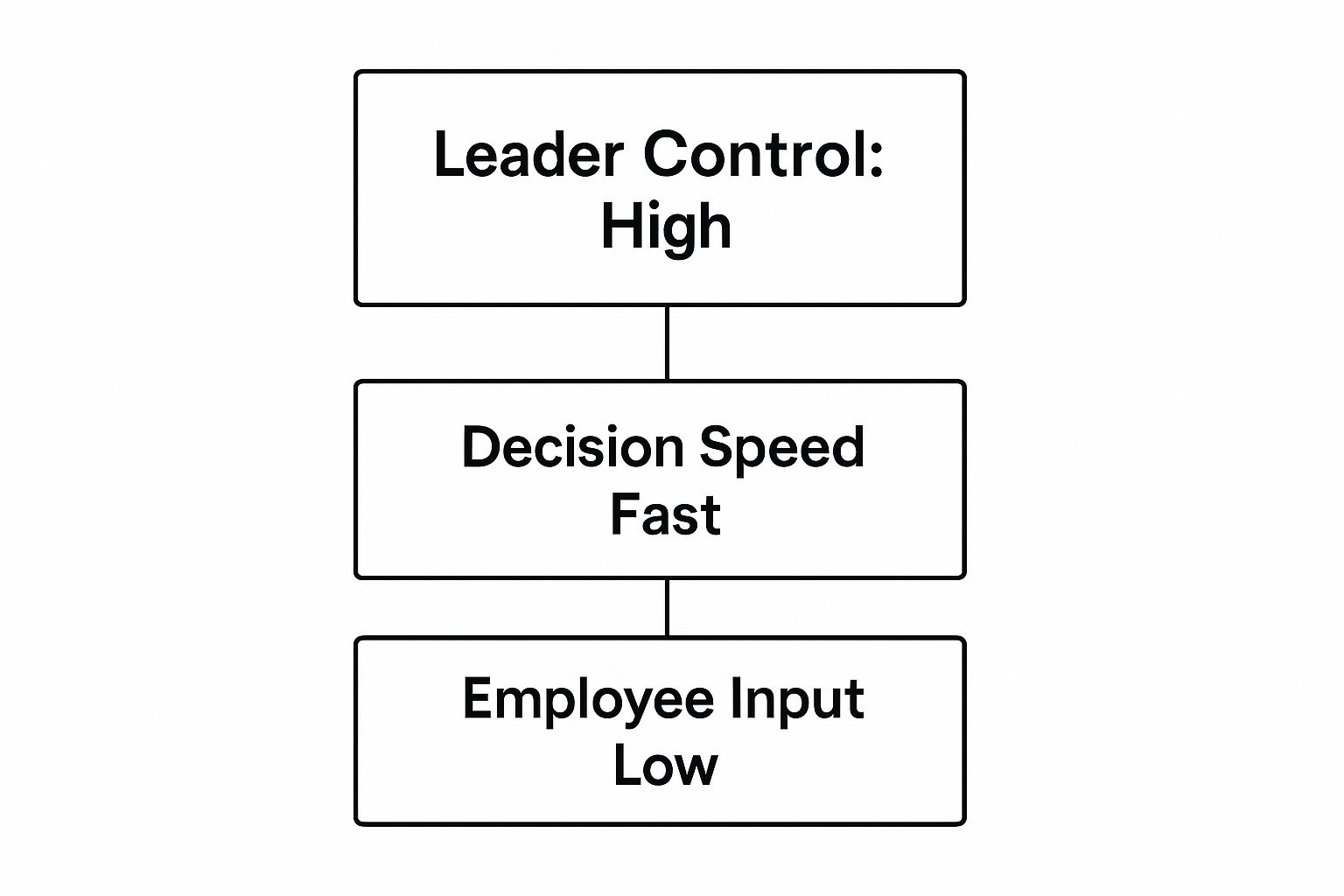
As you can see, the focus is all on efficiency. Employee input is intentionally limited to maintain that rapid pace.
But there are serious downsides. This approach can easily crush creativity and leave employees feeling like cogs in a machine, which often leads to poor morale and people heading for the door. In fact, one study found that 77% of employees have dealt with a “toxic boss,” a behavior that often stems from an overly autocratic style. It might save the day in a crisis, but rely on it long-term, and you’ll snuff out any spark of innovation.
The Democratic Leadership Style
On the complete opposite end of the spectrum, you have the democratic leader. Think of them as a great workshop facilitator who draws ideas out of the group. This leader actively asks for input, encourages open discussion, and gets the team involved in the decision-making process. The final call might still be theirs, but everyone has a hand in shaping it.
The whole point is to tap into the group’s collective brainpower. It’s an incredibly effective way to tackle complex problems where you need different viewpoints to find the best path forward. For example, a SaaS product manager would be wise to use a democratic approach when planning new features, making sure the final product works for both the engineers building it and the customers using it.
Democratic leadership builds ownership. When team members help shape a decision, they’re naturally more invested in seeing it succeed. This creates a powerful sense of engagement and commitment.
This style is fantastic for building trust and making your team feel valued, which does wonders for morale and creativity. The biggest trade-off? Speed. Getting everyone to weigh in takes time, and that can be a problem when you need to make a call, now.
The Laissez-Faire Leadership Style
Finally, there’s the Laissez-Faire style, which literally means “let them do.” This is the most hands-off style of all. A laissez-faire leader gives their team the tools and resources they need and then gets out of the way, trusting them to manage their own projects and make their own choices.
This entire model hinges on a huge amount of trust. It really only works under a few specific conditions:
- The team is full of experts: Your people have to be skilled and knowledgeable enough to fly solo.
- Everyone is self-motivated: The team needs the internal drive to perform without someone looking over their shoulder.
- It’s a creative field: This style is perfect for places like design studios or R&D labs where freedom is the fuel for innovation.
The upside is a massive sense of autonomy, which can lead to incredible job satisfaction and truly original work. The danger? If the team isn’t disciplined or experienced enough, things can fall into chaos, with missed deadlines and a total lack of direction. For anyone new to managing highly skilled professionals, it’s worth digging deeper into the different styles of leadership in business management to better understand the fine art of delegation.
These three foundational styles—autocratic, democratic, and laissez-faire—are the essential starting point. The best leaders I’ve known don’t just pick one and stick with it. They learn to be chameleons, blending elements from each to fit what their team and the situation needs at that moment.
Diving Into Modern, People-First Leadership
While the classic leadership styles gave us a foundation, today’s business world demands something more. The old-school models often fall short when it comes to building the kind of loyal, high-performing teams we need now. This is where more dynamic, people-focused approaches like Transformational, Transactional, and Servant leadership really shine.
These aren’t just about giving orders. They’re about inspiring people, creating clear structures, and offering genuine support to help your team do its best work. Getting a handle on these is crucial if you want to adapt your leadership style in business management and meet the challenges of today head-on.

The Transformational Leader: The Visionary
Ever met a leader who doesn’t just hand out tasks but actually lights a fire under the whole team with a powerful, shared vision? That’s a Transformational leader in a nutshell. They act as mentors and motivators, pushing their teams to innovate and grow beyond their current roles.
Their main tools are inspiration and intellectual curiosity. They paint a picture of the future that gets everyone genuinely excited, then empower them to discover new and better ways to make that future a reality. This approach is a powerhouse for driving big changes, turning a struggling company around, or just building a culture where everyone is always looking for a better way.
The proof is in the results. Companies with transformational leaders often enjoy much higher employee engagement and loyalty. But there’s a catch: this style hinges on the leader having authentic charisma and a crystal-clear vision. If that’s missing, the attempted inspiration can just feel hollow.
The Transactional Leader: The Architect
On the flip side, Transactional leadership is less about grand visions and more about solid structure. This kind of leader operates on a straightforward system of rewards and consequences. Think of them as an architect who designs a reliable, predictable framework for the team to work within.
It all comes down to the “transaction.” The leader sets clear goals, and the team knows exactly what’s in it for them if they hit those goals—like a bonus or a promotion—and what happens if they don’t.
This management style works wonders in places where work is routine and easy to measure.
- Sales Teams: Hit your quota, and you get your commission. Simple.
- Manufacturing: Meet production targets with the required quality, and you’re golden.
- Project Management: Key milestones are set with firm deadlines and specific deliverables.
While this approach provides fantastic clarity and consistency, it can feel a bit impersonal if it’s the only style used. It doesn’t always spark the creative thinking or deep-seated loyalty that transformational leadership can. For SaaS companies, pairing this style with smart automation is a winning formula. You can explore how to streamline these kinds of structured processes in our guide on https://saasoperations.com/saas-automation/.
Key Takeaway: Transactional leadership is about managing performance and keeping things running smoothly. Transformational leadership is about elevating that performance and shaking things up for the better.
The Servant Leader: The Supporter
The Servant leadership model completely flips the traditional company hierarchy upside down. Instead of the team working to serve the leader, the leader’s entire job is to serve the team. Just picture a pyramid, but inverted—the leader is at the bottom, holding everyone else up.
A servant leader’s main goal is to foster the growth and well-being of their people. They listen intently, clear roadblocks out of the way, and make sure their team has all the resources and support needed to thrive. Their guiding question is always, “How can I help you do your best work?”
This people-first philosophy builds incredible trust and psychological safety, creating a workplace where people feel truly valued and empowered. A huge part of modern leadership is trusting your team through delegation, which is vital for any company looking to scale. Learning effective delegation strategies for leaders is a non-negotiable skill for any servant leader who wants to build a self-reliant and highly capable team. This style is exceptionally good at creating a positive company culture that people flock to and never want to leave. The biggest challenge? It can be a slower process to get results and might not be the right fit for a crisis that demands fast, top-down decisions.
How Agile Leadership Gives You a Competitive Edge
In a world that’s always changing, simply reacting to problems isn’t a winning strategy anymore. The best leaders today don’t just react; they get ahead of the curve. This proactive, nimble approach is what we call agile leadership. And no, this isn’t just about using project management tools like Scrum. It’s a completely different mindset—one built on learning fast, adapting boldly, and making confident decisions when the path forward isn’t clear.
Imagine you’re steering a ship. Are you the captain of a massive oil tanker that needs miles to even begin a turn? Or are you at the helm of a speedboat that can pivot on a dime? Agile leaders captain the speedboat. This allows their companies to navigate choppy market waters, dodge unexpected obstacles, and zoom toward new opportunities that pop up. It’s how you turn disruption into an advantage.
The Power of Responding at Speed
At its heart, agile leadership is about building a company that can learn and move incredibly fast. This means creating channels for quick feedback, giving your teams on the front lines the power to make their own calls, and building a culture where trying new things is the norm. In this environment, failure isn’t a problem; it’s just data for the next attempt.
This approach gives you a real, measurable edge. A landmark study from McKinsey & Company revealed that companies with agile leadership are 25% more likely to financially outperform their peers during volatile times. What’s more, these organizations can react to market shifts up to five times faster than their rigid competitors. You can dig into the key leadership trends on CUI.edu to see the full research.
An agile leadership style moves decision-making from the boardroom to the front lines, trusting empowered teams to act on real-time information. This shift dramatically shortens the gap between identifying a problem and implementing a solution.
This kind of speed and resilience is absolutely vital for managing business uncertainty. For example, these same principles are the foundation of a strong risk management plan, letting a SaaS company spot and neutralize threats before they snowball. You can learn more about building a robust strategy in our guide to SaaS risk management.
Key Traits of an Agile Leader
Becoming an agile leader isn’t about following a strict rulebook. It’s about developing a set of habits and skills that add up to a flexible, forward-thinking outlook.
Here are the areas where agile leaders truly shine:
- Empowering Teams: They don’t micromanage. They delegate authority and trust their people to own their work and make smart decisions.
- Prioritizing Action: Instead of getting bogged down in “analysis paralysis,” they push for small, quick experiments to test ideas and see what works.
- Fostering Collaboration: They actively break down the walls between departments, making sure information flows freely and everyone is pulling in the same direction.
- Championing the Customer: They stay laser-focused on what the customer actually wants, using direct feedback to shape strategy and improve the product.
By weaving these traits into their day-to-day work, agile leaders build organizations that are more than just resilient. They build companies that are ready to lead the pack, no matter what the future holds.
Why Emotional Intelligence Is a Leadership Superpower
Great leadership isn’t just about managing tasks and hitting targets anymore. It’s about people. The real magic happens when a leader can connect with their team on a human level, and that’s where emotional intelligence (EI) comes in. It’s the difference between a boss who just doles out work and a leader who inspires loyalty.
Think about it. Have you ever had a manager who could just tell you were having an off day, even over a video call, and checked in? That’s emotional intelligence in action. It’s a genuine leadership superpower in today’s business world.
The Shift to Authentic Communication
With so many teams working in hybrid or remote setups, clear and empathetic communication has become absolutely essential. Research from EBW Global actually shows that how a leader communicates can matter more than what they decide. You can discover more insights from EBW Global’s research on this.
Emotional intelligence is the ability to perceive, evaluate, and respond to your own emotions and the emotions of others. It’s about reading the room, even when the “room” is a collection of video thumbnails.
This skill is what allows a leader to give tough feedback constructively, turning a potentially negative conversation into a growth opportunity. It helps them show real empathy when a project fails, transforming a setback into a valuable lesson for the entire team.
Building Psychological Safety Through EI
Ultimately, an emotionally intelligent leadership style in business management creates a culture of psychological safety. This is the foundation of a great team—an environment where people feel safe enough to speak up, float a wild idea, or even admit they made a mistake, all without fear of being shut down or punished.
When you nail psychological safety, amazing things start to happen:
- Greater Innovation: People feel free to share those “crazy” ideas that often lead to the biggest breakthroughs.
- Higher Engagement: Employees feel seen and valued as people, not just cogs in a machine, deepening their commitment.
- Improved Performance: Trust is a performance accelerator. Teams that trust their leader and each other solve problems faster and collaborate more effectively.
Of course, you need to see the impact. Tracking team output with clear metrics can connect the dots between a psychologically safe culture and tangible results. For a detailed guide on this, see our article on tracking employee key performance indicators. By leading with emotional intelligence, you’re not just building a productive team—you’re building one that’s resilient, creative, and genuinely invested in its success.
How AI Is Reshaping Modern Leadership
Technology isn’t just a tool anymore; it’s practically a member of the leadership team. With artificial intelligence and digital transformation becoming so central to how we work, the very definition of leadership is changing right before our eyes. We’re seeing a massive shift away from leaders who rely solely on gut instinct and toward those who use data and technology to make smarter calls.
Digital know-how is no longer a “nice-to-have”—it’s a must-have skill for any modern leader. A recent Korn Ferry survey really drives this point home, revealing that 71% of global CEOs and 78% of senior executives expect AI to significantly increase their own value within the next three years. This isn’t just about doing things faster; it’s about making decisions that are more strategic, more accurate, and ultimately, more impactful.
From Big Data to Smart Decisions
One of the biggest game-changers AI brings to the table is its ability to wade through oceans of data and pull out crystal-clear, actionable insights. Leaders can now lean on AI for everything from predicting where the market is headed to spotting operational hiccups before they snowball into full-blown crises. Forget guessing what customers want—AI can analyze their behavior and forecast what they’ll do next with impressive accuracy.
This data-driven leadership style in business management doesn’t push people out of the picture. In fact, it does the opposite. By taking on the grunt work of data analysis, AI gives leaders their time back, allowing them to focus on what truly requires a human touch: crafting strategy, mentoring their team, and nurturing a great company culture. If you’re curious about the tech that makes this all possible, you can explore resources on data infrastructure and AI for a deeper look.
By automating routine analysis and reporting, AI empowers leaders to spend less time managing data and more time leading people. It shifts the focus from oversight to insight.
AI as a Partner in Team Development
AI’s role extends far beyond numbers and market trends; it’s also becoming a fantastic partner in managing and growing people. Think about it: AI platforms can now create personalized development plans for employees, highlighting specific skills they need to grow based on their role, performance, and long-term goals.
Leaders can also use AI-powered tools to:
- Analyze team communication patterns and flag collaboration issues, especially in remote or hybrid setups.
- Identify top performers who are ready for a new challenge, making sure talent never goes unnoticed.
- Automate the tedious administrative tasks that drain productivity, freeing up the entire team for more meaningful work.
This is particularly powerful in the SaaS world, where data is king. For instance, AI can completely change the game for customer engagement. To see a real-world example of this in action, check out our guide on marketing automation for SaaS. At the end of the day, leaders who embrace AI aren’t just getting new software—they’re getting a smarter, more agile way to lead their people and grow their company.
Frequently Asked Questions About Leadership Styles

It’s only natural to have questions as you try to figure out the world of leadership. Let’s tackle some of the most common ones with clear, straightforward answers you can actually use.
Can a Leader Switch Between Different Styles?
Absolutely. In fact, the best leaders I’ve ever worked with are masters of adaptation. Sticking rigidly to one style is a rookie mistake. Great leadership is about being flexible and reading the room—a concept often called Situational Leadership.
Think of it this way: you wouldn’t use a hammer to turn a screw. If there’s an urgent system outage, you might need to be direct and authoritative to get things fixed fast. But when you’re brainstorming the next product roadmap with your senior engineers, a collaborative, democratic approach will yield far better ideas. The goal is to be a chameleon, not a statue.
What Is the Best Leadership Style for a Startup?
There’s no magic bullet, but some styles definitely give startups an edge. Transformational, democratic, and servant leadership each have their moment to shine in a new company’s lifecycle.
- Transformational: In those very early, scrappy days, a founder’s vision is everything. A transformational leader inspires the team to push through the inevitable tough times.
- Democratic: As you find your footing, a democratic style is invaluable. Your team is small, and every single person has unique insights. This approach makes them feel heard and encourages them to contribute their best ideas.
- Servant: Once the startup starts to scale, shifting into a servant leadership mindset helps you build a culture that people want to be a part of. It’s how you attract and hold onto great talent for the long haul.
The smartest founders don’t just pick one style and stick with it; they evolve.
The most successful startup leaders start as visionaries, become collaborators, and grow into supporters as their company matures. This evolution is a hallmark of great leadership in a high-growth environment.
How Can I Identify and Improve My Own Leadership Style?
Improving your leadership style in business management all starts with a dose of honest self-reflection. You can’t improve what you’re not aware of.
Start by asking for feedback. It can be scary, but it’s crucial. Use formal tools like 360-degree feedback surveys, or simply pull your team members and mentors aside for a candid chat. Ask them what it’s like to work with you. Also, pay attention to the results you’re getting. Are your decisions and communication methods actually working?
Tools like the Myers-Briggs Type Indicator (MBTI) or the DiSC assessment can offer a good starting point for understanding your natural tendencies. Once you know your default style and where you need to grow, you can get to work. For instance, if you realize you’re too directive, make a conscious effort to listen more and deliberately ask for your team’s input before you make the final call.
At SaaS Operations, we’ve built battle-tested playbooks and SOPs designed to help you sharpen your management approach and fuel growth. Our frameworks cover the nuts and bolts—from process automation to people management—so you can build a more effective and efficient SaaS business.
Explore our plug-and-play templates today and start building a better company.