Discover Key Styles of Leadership in Business Management
 Published By: Alex
July 21, 2025
Published By: Alex
July 21, 2025
Think of the different styles of leadership in business management less as fixed personality traits and more as a flexible toolkit. The best leaders I’ve worked with and observed don’t stick to one method. They’re chameleons—they might be direct and decisive during a crisis but then switch to a collaborative, open-forum style when the team is brainstorming a new feature. It’s all about matching the approach to the team and the challenge in front of you.
Understanding the Core Leadership Styles
Leadership is definitely not a one-size-fits-all job. It’s more like being a chef; you wouldn’t use a cleaver for delicate pastry work. A great leader knows exactly which tool to pull out for the task at hand. Some situations demand quick, top-down direction, while others thrive when you let the whole team contribute their creative energy.
Getting a handle on the foundational styles of leadership in business management is your first step toward becoming a more versatile and effective leader.
This image below breaks down the three classic frameworks that most other modern styles are built on.
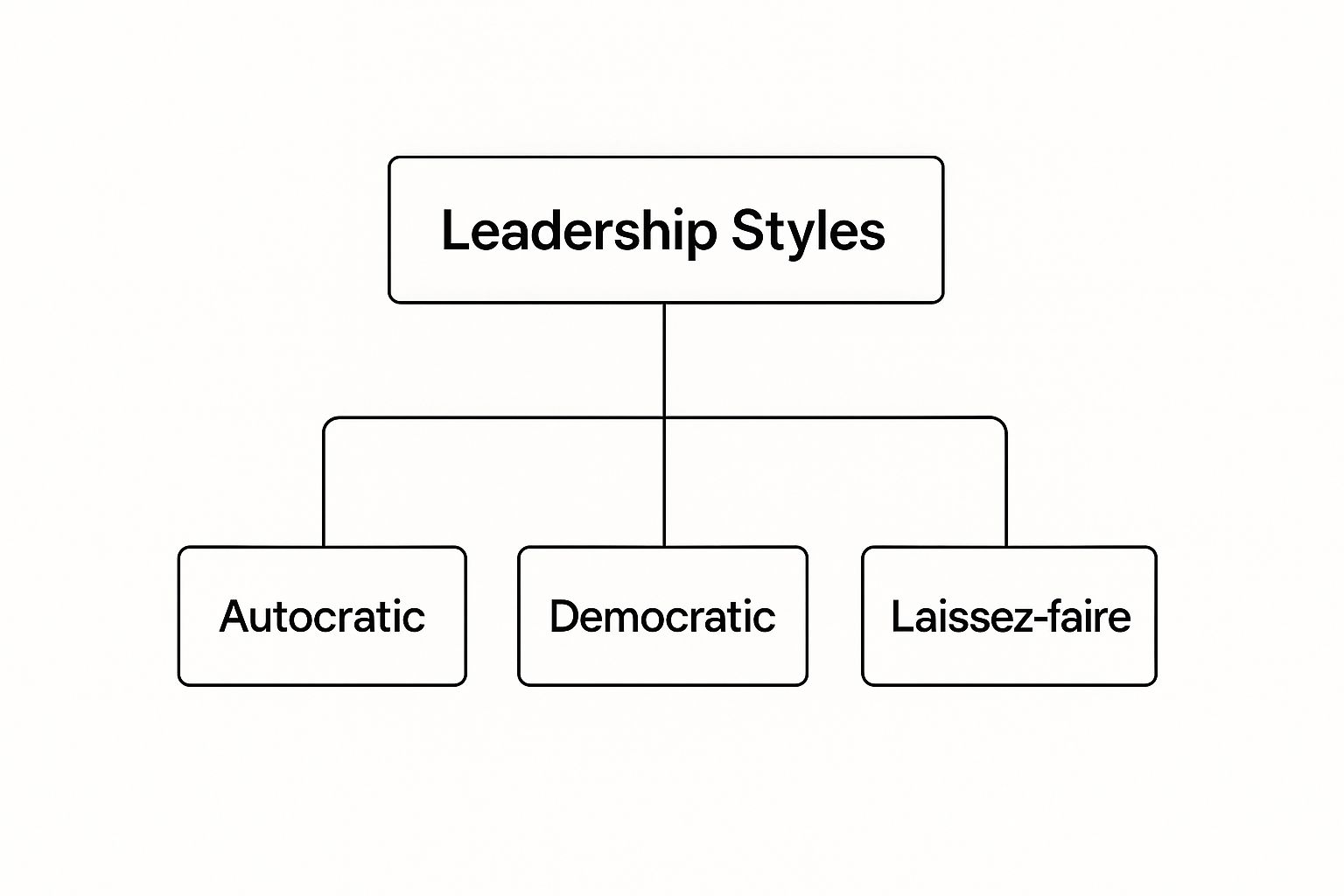
As you can see, leadership exists on a spectrum. It can range from highly controlling (Autocratic) to almost completely hands-off (Laissez-Faire), with a collaborative style (Democratic) sitting right in the middle.
The Foundation of Leadership Models
Every one of us has a natural, go-to leadership style. But in today’s fast-moving business world, relying on just one is a recipe for trouble. The data backs this up, showing that leaders who know themselves well enough to adapt their style get far better results. This flexibility impacts everything, from how engaged your employees feel to whether your projects hit their deadlines.
In fact, some studies show that managers are responsible for a staggering 70% of the variance in team engagement. That’s a huge number.
The goal isn’t to find the one “perfect” style, but to build a range of approaches you can call on when needed. To help you sort through this, I’ve put together a table for a quick overview of the most common leadership styles. It’s a cheat sheet, really, outlining the core idea behind each, where it shines, and what to watch out for.
Quick Guide to Key Leadership Styles
This table offers a comparative look at the most common leadership styles, breaking down their primary approach and ideal use cases in a business setting.
| Leadership Style | Core Principle | Best For | Potential Pitfall |
|---|---|---|---|
| Autocratic | Top-down control and fast decision-making. | Crisis situations or when teams lack experience. | Can stifle creativity and lower team morale. |
| Democratic | Collaborative decision-making and team input. | Fostering innovation and team buy-in. | Can be slow and inefficient for urgent tasks. |
| Laissez-Faire | Hands-off approach with high team autonomy. | Highly skilled, self-motivated expert teams. | Lack of direction can lead to chaos or missed goals. |
| Transformational | Inspiring vision and motivating change. | Driving significant organizational shifts. | May overlook details and risk leader burnout. |
| Transactional | Using rewards and punishments to meet goals. | Structured environments with clear tasks. | Can feel impersonal and discourage initiative. |
| Servant | Prioritizing team members’ needs and growth. | Building long-term loyalty and team capability. | Leader’s own needs may be neglected. |
Think of this table as the foundation for exploring each approach in more detail. As you get comfortable with these models, you can begin to build them into the operational frameworks your teams use every day.
For a head start, you can find proven templates in our collection of SaaS Operations playbooks, which are designed to help structure team processes and goals. Ultimately, mastering different leadership styles is what gives you the confidence and precision to handle any business challenge that comes your way.
When to Use Command and Control Leadership

While everyone talks about collaboration these days, let’s be honest: some of the most effective styles of leadership in business management are all about taking charge. These “command and control” approaches, like Autocratic and Transactional leadership, aren’t just relics from a bygone era. They’re powerful tools that, when used correctly, can be incredibly effective.
Think about an emergency room doctor. When a patient is crashing, there’s no time to huddle up and vote on the next move. This is the perfect scenario for the Autocratic style. The leader makes swift, confident decisions based on their expertise, and the team executes immediately. This top-down authority cuts through the chaos and gets things done fast.
Then you have the Transactional style, which works more like a clear-cut contract. It’s simple: hit these specific targets, and you get this specific reward. This is a go-to for roles where success is easy to track, like a SaaS sales team laser-focused on hitting its monthly recurring revenue (MRR) goal.
Finding the Right Moment for Directive Leadership
Knowing when to pull these styles out of your toolkit is a matter of reading the room—and the situation. An Autocratic approach can be a lifesaver when you’re dealing with an inexperienced team that needs clear, step-by-step instructions. It’s also your best bet when a project is on the brink of a time-sensitive disaster. You provide the stability and direction everyone needs to get back on track.
One study actually found this model is highly effective in high-risk environments where errors carry heavy consequences. It allows experienced staff to simply execute tasks without getting bogged down in meetings.
Transactional leadership, on the other hand, is all about maintaining the status quo and consistently hitting established benchmarks. It’s perfect for stable situations where the rules of the game are clear. For instance, a customer support team with performance bonuses tied to response times is a classic example of this style in action, ensuring service quality stays high.
But here’s the crucial part: these styles are situational plays, not a long-term strategy. Rely on them too heavily, and you’ll stifle creativity, discourage people from taking initiative, and eventually tank morale.
The trade-off is straightforward. You get speed and control, but you risk losing employee engagement and innovation in the process. The smartest SaaS leaders know exactly when to be directive—to pull a project out of a nosedive or enforce a critical process—and when to shift back to a more collaborative style that builds a strong, loyal team for the long haul.
How Collaborative Leadership Builds Strong Teams
While top-down leadership has its moments, some of the most effective styles of leadership in business management flip the script entirely. They put people first. Styles like Democratic and Affiliative leadership trade rigid instructions for shared ownership and genuine support, operating on the principle that a team’s collective brainpower is its greatest asset.
Think of a Democratic leader as a master facilitator. Picture a SaaS product team trying to nail down its next big feature. Instead of just handing down the roadmap from on high, this leader steers the brainstorming session, making sure everyone gets a word in. The final decision isn’t one person’s idea; it’s a mosaic built from the entire team’s expertise.
The Affiliative style is a bit different. It’s all about creating strong emotional bonds and a sense of harmony. This leader is the glue that holds the team together when things get stressful. Their main focus is boosting morale, smoothing over conflicts, and ensuring every single person feels seen and supported.
The Power of People-First Approaches
At their core, both of these styles run on emotional intelligence. They demand a leader who can tune into the emotional frequency of their team and respond with real empathy. In today’s world of hybrid work and constant change, that ability is more crucial than ever.
Recent analysis confirms that top-performing leaders frequently use visionary, coaching, affiliative, and democratic styles. In a world of digital transformation, leaders who show empathy and create psychological safety see stronger team engagement because employees need to feel valued and heard. You can discover more insights on how communication shapes modern leadership at ebwglobal.com.
The payoff for these collaborative approaches is huge. Teams led this way tend to have higher job satisfaction, deeper loyalty, and a much greater knack for true innovation. It makes sense—when people feel safe enough to share their thoughts, they don’t hold back their best ideas.
Balancing Collaboration with Progress
Of course, these styles aren’t a silver bullet. The biggest hurdle for Democratic leadership is often speed. Getting everyone’s input simply takes time, which can be a real problem when you need to make a call right now. If the team can’t find common ground, progress can grind to a halt.
Likewise, an Affiliative leader can sometimes be too focused on keeping everyone happy. They might shy away from giving tough but necessary feedback or making a hard decision that could rock the boat. Team harmony is great, but it can’t come at the cost of performance.
The trick is finding the right balance. A great leader knows how to nurture relationships while still pushing for results. Sometimes, this means leaning on structured processes to keep things moving. For instance, our guide on SaaS automation shows how clear workflows can support a collaborative culture without letting it lose momentum.
2. Inspiring Your Team with Visionary Leadership

Some leaders do more than just manage the day-to-day. They aim higher, working to spark a genuine movement within their company and build a motivation that goes far beyond a paycheck.
These visionary approaches, like Transformational and Servant leadership, are powerful long-term strategies. They are all about building resilient, loyal teams by focusing on the bigger picture and, most importantly, the people who will bring that picture to life.
The Visionary and the Supporter
A Transformational leader is a storyteller at heart. They don’t just hand out tasks; they paint a compelling picture of a future that everyone wants to be a part of. Think of a SaaS founder launching a product they believe will completely change an industry. Their passion is contagious, rallying the team to overcome hurdles and achieve what felt impossible.
This style is a game-changer when a company needs to pivot or go through a massive overhaul. By uniting everyone around a shared mission, these leaders forge strong bonds and give the work a deeper meaning.
Then you have another powerful style that leads from a completely different angle. Servant leadership flips the classic pyramid structure upside down. The leader’s main job is to serve their team by clearing obstacles and making sure everyone has the support and tools they need to shine.
Imagine a manager who acts less like a boss and more like a coach, whose primary focus is unlocking the potential in each team member. Their role isn’t to command but to empower. This “people-first” mindset builds an incredible amount of trust, respect, and psychological safety.
At its core, servant leadership is about ethical decision-making. When you follow this model, you are more likely to make choices based on what is right for everyone involved, rather than just benefiting a select few. This approach fosters an environment where creativity and problem-solving thrive.
Both of these styles of leadership in business management are fantastic for building lasting loyalty and driving sustainable growth. When people feel they are part of a compelling mission or are genuinely cared for, their commitment goes through the roof.
The Challenges of Leading with Vision
Of course, these inspiring styles aren’t without their pitfalls. A Transformational leader, laser-focused on the grand vision, can sometimes lose sight of the small but critical details needed to actually get there. Their constant high-energy drive also puts them at a serious risk of burnout.
Servant leaders face a different challenge. In putting their team’s needs first, they might neglect their own well-being or miss pressing business targets. It’s a tough balancing act. There’s a fine line between empowering your team and losing track of the bottom-line results that keep the lights on.
Successfully using these visionary styles means finding that sweet spot between inspiring the future and managing the reality of the present.
Adapting Your Leadership in the Modern Workplace
Relying on a single leadership style in today’s fast-paced business world is like trying to build a house with only a hammer. It just doesn’t work. The most effective styles of leadership in business management are fluid, not fixed. Truly great leaders are chameleons, able to shift their approach to fit the situation at hand.
This is the very heart of Situational Leadership. It’s the art of correctly reading a room, a project, or a person and then flexing your style to match what’s needed in that exact moment.
Matching Your Style to the Moment
Think of it this way: a master chef doesn’t use a meat cleaver to peel a grape. They instinctively know which tool is right for the job. A situational leader does the same thing, but their tools are their different management approaches. They know when to be directive, when to coach, when to offer support, and when to step back and delegate.
This kind of adaptability isn’t just a nice-to-have anymore; it’s a must-have skill. In fact, one of the biggest leadership trends right now is the massive demand for adaptable, tech-fluent leaders who can guide teams through constant change. You can read more about what’s shaping the future of leadership on kornferry.com. This signals a major departure from the old, rigid, top-down command structures.
The most effective leaders develop what researchers call “leadership agility”—the ability to recognize when their natural style may not be the best fit and consciously shift their approach. This flexibility allows them to meet their team’s needs while staying authentic.
Let’s make this practical. When a brand-new hire joins your team, you’ll probably lean into a directive or coaching style. You’ll give them clear instructions and check in frequently to make sure they’re on the right track.
But for a seasoned pro on your team who’s tackling a familiar project? A hands-off, delegative style is much more effective. It shows you trust their expertise and empowers them to own their work.
This is the kind of adaptability that separates good leaders from great ones, especially when managing hybrid teams, navigating tech disruptions, or just building a resilient company. Knowing how to apply the right style at the right time is also a critical piece of creating effective plans that get results. This skill connects directly to how you build both high-level strategies and day-to-day operational roadmaps. You can learn more about how these two planning types work together in our guide on strategic vs. operational plans.
Developing Your Personal Leadership Framework

It’s one thing to understand the different styles of leadership in business management, but putting them into practice is where the real work begins. This is where theory meets reality. Crafting your own leadership framework isn’t about picking a single style and sticking to it no matter what. Instead, think of it as building a versatile toolkit you can pull from depending on your team, the task at hand, and your own gut instincts.
Great leadership always starts with self-awareness. We all have a natural, go-to style, but the best leaders know their own tendencies and make a conscious effort to adapt. This demands a habit of continuous self-reflection.
Key Questions for Self-Reflection
To build your framework, get into the habit of asking yourself a few key questions before you act. It’s a simple practice that can make a huge difference in your effectiveness.
- What does my team need from me right now? Are they a fresh team needing clear, step-by-step direction? Or are they seasoned pros who just need you to get obstacles out of their way?
- What does this specific task require? Is this a crisis that needs a quick, decisive call? Or is it a creative project where you need to draw out every idea from every person in the room?
- Which approach feels most authentic to me? Forcing a style that isn’t you will come across as phony and can quickly erode trust.
By blending the leadership styles we’ve explored, you can consciously choose the right approach for any situation. That adaptability is what separates good leaders from great ones.
The Real Cost of Ineffective Leadership
Getting leadership right isn’t a “nice-to-have”—the stakes are incredibly high. The data paints a pretty stark picture: a staggering 77% of organizations say they’re struggling to find effective leaders. This isn’t just a problem for HR; it has a massive economic impact. Poor leadership costs businesses an estimated $550 billion every year in lost productivity. And with employee engagement sitting at a dismal 15%, it’s clear that bad leadership directly undermines a company’s ability to succeed. You can dig deeper into these surprising leadership statistics at elearningindustry.com.
Becoming a better leader is a continuous journey of learning and adaptation, not a destination. Your ability to flex your style will directly impact your team’s success and morale.
This mindset of constant improvement is everything. Sometimes, leadership isn’t about grand speeches; it’s about creating clear, supportive processes. A well-designed process can guide a team, set expectations, and build confidence, much like a great coach. For a tangible example of how structured processes can empower your teams, take a look at our guide on creating a customer success playbook. It’s a perfect illustration of turning leadership principles into practical, actionable steps.
Frequently Asked Questions About Leadership Styles
Let’s tackle some of the most common questions I hear from fellow operators about putting these leadership styles into practice. My goal is to give you clear, straightforward answers to cut through the noise and help you lead with more confidence.
Can a Leader Use Multiple Leadership Styles?
Absolutely. In fact, the best leaders I’ve ever worked with are chameleons. They don’t stick to a single style; they adapt based on the situation. This is often called “situational leadership.”
Think about it this way: you might use a democratic style when brainstorming new product features with your experienced engineering team. But if a critical server goes down, you’ll need to switch to a decisive, autocratic style to get the problem fixed immediately. It’s all about choosing the right tool for the job.
The most effective leaders develop what researchers call “leadership agility”—the ability to recognize when their natural style may not be the best fit for a particular situation and consciously shift their approach. This flexibility allows them to meet their team’s needs while staying authentic.
What Is the Best Leadership Style for a New Manager?
There’s no magic bullet here, but if you’re a new manager, I’d strongly suggest starting with a coaching or democratic approach. Why? Because your first priority is to build trust and really understand your team. These styles force you to listen and encourage the open communication you need to learn everyone’s strengths and weaknesses.
Once you have that foundation and have earned some credibility, you can start blending in other styles when the situation calls for it.
How Does Remote Work Affect Which Leadership Style I Should Use?
Remote work puts a massive premium on trust and crystal-clear communication. You can’t just rely on “management by walking around” anymore. For that reason, styles that create strong bonds and a shared sense of purpose—like Transformational and Affiliative leadership—are incredibly powerful for keeping a distributed team engaged and motivated.
Transactional leadership also has its place, especially for setting unambiguous goals and tracking progress from a distance. Data becomes your best friend here. If you’re looking for a solid framework, we’ve got a guide on setting up effective employee key performance indicators that can help. The real key with remote teams is being much more deliberate about check-ins and feedback, no matter which style you lean on.
Ready to implement battle-tested frameworks that drive growth? SaaS Operations provides plug-and-play playbooks, templates, and SOPs from operators who have built multiple 8-figure businesses. Save time and accelerate your success at https://saasoperations.com.