
When we talk about “lead generation SaaS,” we’re really talking about the entire system—both the software and the strategies—that a SaaS business uses to attract, capture, and nurture potential customers. It’s about so much more than just collecting email addresses. The goal is to build a systematic, predictable engine for growth that turns anonymous visitors into qualified prospects genuinely interested in what you have to sell.
What Is a Modern Lead Generation Playbook

It’s time to move past the old “spray and pray” mindset. A modern lead generation playbook is a living, breathing system that maps out exactly how your SaaS company will generate a consistent flow of high-quality leads. Think of it less like a static document and more like a dynamic framework that you constantly refine based on real-world market feedback and performance data.
This playbook is what connects your marketing activities directly to tangible business results. It ensures every blog post, every ad campaign, and every tool you use has a singular purpose: guiding the right person from their first point of contact all the way to becoming a paying customer.
The Core Pillars of a Successful System
Putting together a strong lead generation system isn’t about mastering a single tactic; it’s about how multiple strategies work in harmony. From my experience, the most successful systems are always built on two things: a deep understanding of the customer and clear, measurable goals.
Here are the essential pillars that hold it all together:
- Ideal Customer Profile (ICP) and Personas: This is your north star. You absolutely must define who you’re selling to—their job titles, company size, biggest challenges, and where they hang out online to find solutions.
- Multi-Channel Strategy: Putting all your eggs in one basket is a recipe for disaster. A smart playbook diversifies your efforts across channels like content marketing (SEO), paid ads (PPC), social media (LinkedIn), and strategic partnerships.
- High-Value Content and Lead Magnets: You have to give something valuable to get a prospect’s contact information. This isn’t just any content; it’s an in-depth ebook, a practical webinar, a detailed case study, or a helpful tool that solves a real problem for them.
- Automation and Nurturing: Capturing a lead is just the beginning. The real work starts with automated email sequences and workflows designed to educate prospects, build trust, and gently guide them toward a sales conversation when the time is right.
This isn’t just a niche strategy; it’s a massive market. The lead generation software market was valued at $5.39 billion in 2024 and is expected to climb to $5.92 billion by 2025. This growth is fueled by the relentless need for more efficient ways to acquire customers. You can dive deeper into these market trends over at TheBusinessResearchCompany.com.
Let’s break these pillars down into a more structured view.
Core Components of a Modern Lead Generation System
This table highlights the essential pillars required to build a successful and scalable lead generation strategy for any SaaS business.
| Component | Description | Key Metric |
|---|---|---|
| Customer Definition | A precise profile of your ideal customer, including demographics, firmographics, and psychographics. | Lead-to-Customer Rate |
| Multi-Channel Presence | Actively engaging prospects across a mix of relevant channels like SEO, paid media, and social platforms. | Cost Per Acquisition (CPA) |
| Valuable Content Offers | Gated assets (ebooks, webinars, tools) that solve a problem for your ICP in exchange for their info. | Conversion Rate |
| Nurturing Automation | Automated workflows that guide leads through the buyer’s journey with targeted, educational content. | Marketing Qualified Leads (MQLs) |
Each component builds on the others, creating a cohesive system that drives predictable results.
A great playbook doesn’t just list tactics; it defines the why behind each one. It should answer: Why are we targeting this audience? Why are we using this channel? Why is this content offer compelling? This clarity prevents wasted effort and aligns marketing and sales teams.
Ultimately, a well-crafted playbook transforms your lead generation from a series of disjointed activities into a predictable, scalable machine. It gives you the structure you need to test, measure, and optimize your efforts, ensuring your business always has a healthy pipeline of qualified prospects. This is the difference between hoping for leads and systematically engineering them.
How To Design Your Inbound Lead Capture Engine

Think of your website as more than just a digital brochure. It’s your 24/7 engine for turning anonymous visitors into actual, interested prospects. Building a system to capture these inbound leads is all about making it dead simple for your ideal customer to raise their hand. It’s about turning your passive content into an active lead-generating machine.
At the heart of this machine is the lead magnet—a valuable piece of content you offer in exchange for an email address. A simple “Contact Us” button just doesn’t cut it anymore. Experience and research both show that B2B buyers are much more likely to hand over their contact info if they’re getting something that solves a real problem for them. This is where your strategy gets smart.
Choosing Your High-Converting Lead Magnets
Not all content pulls its weight when it comes to capturing leads. Blog posts are great for building awareness, but to get that email, you need gated assets—content so valuable that visitors feel like they’re getting a steal.
I’ve seen what works for high-growth SaaS companies time and time again. These are the formats that consistently deliver:
- Interactive Tools: Think calculators, quizzes, or quick assessment tools. They offer instant, personalized value. For instance, a marketing analytics SaaS could build a simple “Marketing ROI Calculator” that lets people plug in their own numbers. It’s irresistible.
- Webinars: Perfect for showing off a complex product and seeing who’s genuinely interested. With a 48% average attendance rate, you know the people who show up are serious about finding a solution.
- Ebooks and Whitepapers: These are your go-to for establishing authority. They’re ideal for prospects who are deep in the research phase. A cybersecurity company, for example, might create a whitepaper on “The State of Small Business Data Breaches.”
- Detailed Case Studies: Nothing builds trust faster than proof. A solid case study showing a clear “before and after” is one of the most persuasive assets in your arsenal.
By offering a mix of these formats, you’ll have something for everyone, no matter where they are in their buying journey.
Optimizing Landing Pages and Forms
Okay, so you’ve got a killer lead magnet. Now you need a landing page that does it justice. One of the biggest mistakes I see is cluttering the page with distractions or using long, scary forms. The name of the game is frictionless.
This is where progressive profiling comes in handy. Instead of demanding ten fields of information on the first interaction, just ask for a name and email. The next time they visit, your forms can be smart enough to ask for their company name or job title. This lets you build a complete picture over time without chasing new leads away.
Your form is the final gateway between a visitor and a lead. Every field you add creates friction. My rule of thumb is to ask only for the absolute minimum information your sales team needs to qualify the lead. You can gather the rest later.
Ultimately, designing your capture engine is about creating a smooth, logical path from discovery to conversion. This covers everything—from the call-to-action (CTA) on your blog post to the thank-you page after the download. Every single step is a chance to build the relationship and nudge your prospect forward.
For a closer look at how all these systems connect, check out our complete guide on marketing automation for SaaS.
Setting Up Automated Lead Nurturing Workflows

Getting a new lead is just the first step. The real magic happens in the follow-up, and honestly, this is where most SaaS companies drop the ball. A great lead nurturing system is what separates the companies that scale from those that let good prospects go cold.
Automation is your engine for doing this right. I’m not talking about spammy, one-size-fits-all email blasts. This is about building intelligent, automated workflows that deliver the right message to the right person, right when they need it. When done well, you can educate prospects, build real trust, and guide them along their journey—all without your team having to manually track every single interaction.
Personalize Your Nurturing with Smart Segmentation
The foundation of any good automation strategy is segmentation. Think about it: a lead who grabbed an introductory ebook is in a completely different headspace than someone who just requested a one-on-one demo. Lumping them together is a huge missed opportunity.
Your nurturing has to match the lead’s original action. Here’s how I’ve seen this work best:
- Blog Subscribers & Ebook Downloaders: These are your top-of-funnel folks. The goal here is education and building authority. A simple workflow that sends them related articles, a relevant case study, or a webinar invitation over a few weeks works wonders.
- Webinar Attendees: These leads are warmer; they’ve already invested their time with you. The follow-up sequence should build directly on the webinar content. Send them the recording, maybe a Q&A summary, and then gently nudge them toward a low-commitment next step, like trying an interactive tool.
- Demo Requesters: These are your hottest leads. For them, it’s all about speed and getting them ready for the call. The workflow should immediately confirm their request, offer scheduling options, and send a “pre-demo primer” so they show up informed and excited.
This kind of strategic automation is a massive reason why the lead generation software market is projected to hit $3.83 billion by 2030. According to 360iResearch.com, it’s these sophisticated automation engines and deep CRM integrations that are making lead nurturing so much more powerful and efficient.
Use Lead Scoring to Bridge the Gap to Sales
So, how do you know when a lead is actually ready to talk to a salesperson? This is where lead scoring becomes your best friend. Lead scoring is simply an automated way to assign points to leads based on who they are and what they do.
For example, a lead from one of your target industries might get +10 points. Visiting the pricing page? That’s +5 points. Just opening an email might be +1 point. Once a lead’s score crosses a certain line—say, 50 points—the system flags them as a Marketing Qualified Lead (MQL).
A well-tuned lead scoring model is the bridge between your marketing and sales teams. It removes the guesswork and ensures that sales only spends time on prospects who have shown genuine interest and fit your ideal customer profile.
The moment a lead hits that MQL threshold, your system should trigger an automated handoff. This means instantly creating a task in your CRM for a sales rep to follow up, complete with all the lead’s activity history for full context. This creates a smooth, timely transition that dramatically increases your odds of closing the deal. If you want to get into the nitty-gritty of building these systems, our complete guide to workflow automation is the perfect place to start.
How To Build Your SaaS Tech Stack
Your tech stack is the engine powering your entire lead generation strategy. Get it right, and you’ll have a smooth, automated system that connects marketing actions directly to sales results. Get it wrong, and you’re stuck with data silos, frustrated teams, and a whole lot of friction.
Think of it this way: your tools aren’t just a random collection of software. They’re the foundation that allows your marketing and sales teams to speak the same language and work toward the same goal. The good news? You don’t need a massive, complex, or expensive setup to get started. You just need the right core pieces.
The Essential Tool Categories
A solid lead gen system needs to cover the entire journey, from the moment a person first lands on your site to when they’re handed off to sales. It’s all about how these tools work together.
Here are the four non-negotiable categories you’ll need in your stack:
- Customer Relationship Management (CRM): This is your command center. Everything flows into your CRM. It’s where you store all lead and customer data, track every interaction, and manage your sales pipeline. Think of platforms like HubSpot or Salesforce.
- Marketing Automation Platform: This is the workhorse. It handles the repetitive, time-consuming tasks of nurturing leads through automated email sequences, scoring them based on their engagement, and segmenting your audience for messages that actually resonate.
- Analytics Platform: You can’t improve what you don’t measure. A tool like Google Analytics is indispensable for seeing where your traffic comes from and what people do once they arrive. This data tells you what’s working and what’s not.
- Lead Capture Tools: These are the tools that turn anonymous visitors into actual leads. This includes everything from chatbots and pop-up forms to interactive content that engages visitors and captures their information.
I’ve seen so many teams make the same mistake: they buy the most powerful, feature-packed tool on the market, only to use about 10% of its capabilities. The best stack isn’t the one with the most bells and whistles; it’s the one your team can—and will—actually use every day. Always prioritize usability and smooth integration over a long, intimidating feature list.
Getting your tech right from the beginning pays off big time. The difference between a manual, patched-together process and a cohesive SaaS stack is night and day.
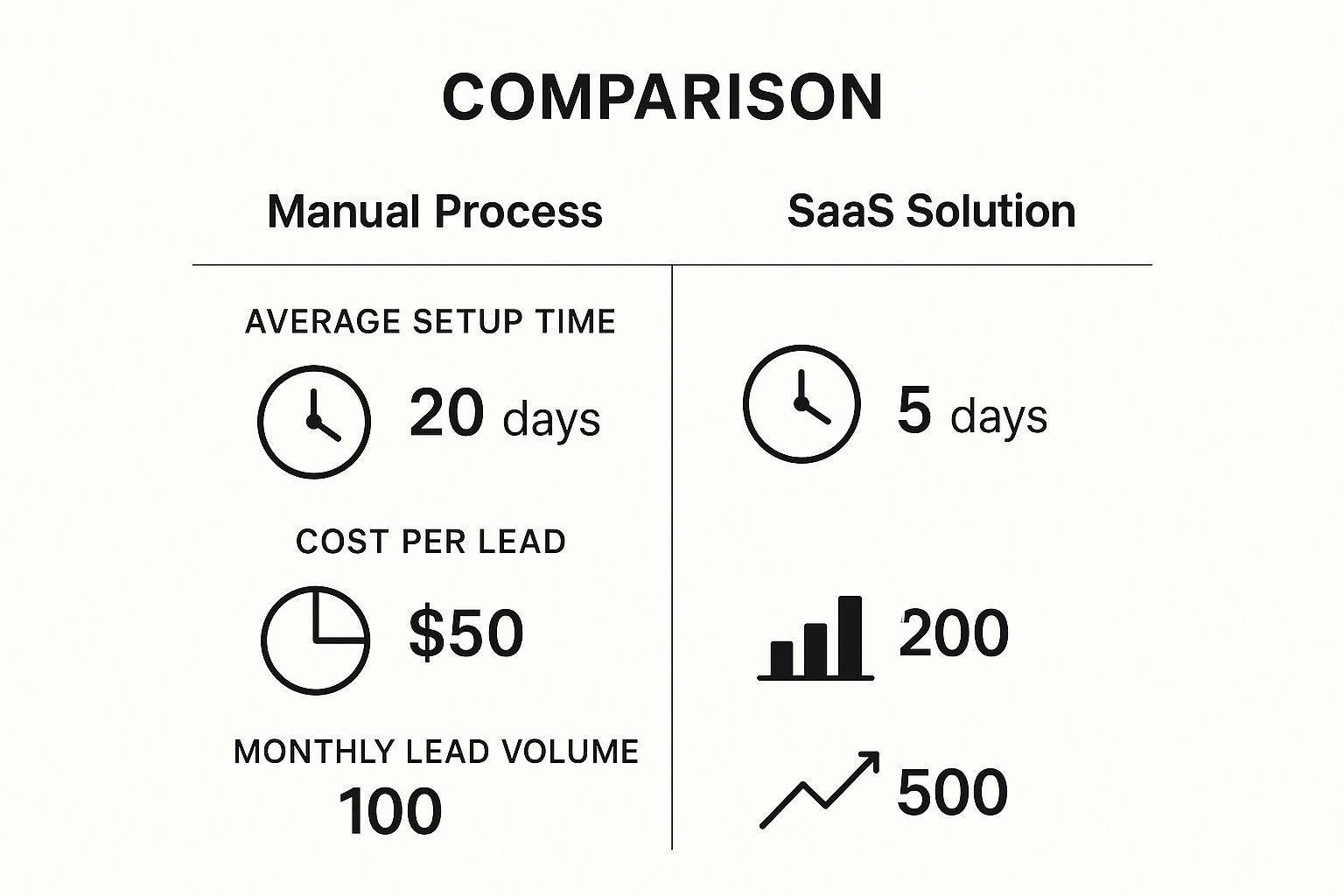
The numbers speak for themselves. A proper lead generation SaaS stack can cut your setup time by 75% and slash your cost per lead in half. The best part? It can also 5x your monthly lead volume. It’s a no-brainer.
Making the Right Choice for Your Business
When you’re looking at different tools, your number one priority should be seamless integration. If your chatbot can’t push new leads directly into your CRM, you’re just creating more manual work and opening the door for human error. The same goes for your CRM and marketing automation platform—they need to talk to each other effortlessly. Look for tools with native integrations or that connect easily with a service like Zapier.
To help you navigate the options, here’s a quick breakdown of the different types of tools and where they fit in.
Lead Generation SaaS Tool Comparison
| Tool Category | Primary Function | Example Platforms | Best For |
|---|---|---|---|
| CRM | Centralizing customer data and managing the sales pipeline. | HubSpot, Salesforce | Storing all lead/customer info and tracking interactions from first touch to close. |
| Marketing Automation | Nurturing leads with automated, personalized campaigns. | Marketo, Pardot, ActiveCampaign | Scaling communication with email sequences, lead scoring, and segmentation. |
| Data Enrichment | Appending missing company and contact data to leads. | Clearbit, ZoomInfo | Turning a basic email address into a full contact profile for better qualification. |
| Lead Capture | Converting website visitors into leads. | OptinMonster, Intercom, Typeform | Engaging visitors with pop-ups, forms, chatbots, and interactive quizzes. |
| Analytics & Tracking | Measuring traffic, conversions, and user behavior. | Google Analytics, Mixpanel | Understanding channel performance and optimizing the user journey. |
This table should give you a clearer picture of how each piece contributes to the whole system. The goal is to build a stack where data flows freely, empowering your teams to act quickly and effectively.
Of course, cost is always a factor. Don’t just look at the monthly subscription price; consider the total cost of ownership, including setup, training, and maintenance. We’ve got a whole guide on SaaS cost optimization that offers some great frameworks for keeping your tech budget under control. A well-chosen stack won’t just generate leads—it will deliver a clear and positive ROI.
Measuring Success With A Performance Scorecard
If you can’t measure it, you can’t improve it. It’s an old saying, but it’s the absolute truth in SaaS lead generation. A performance scorecard is what separates the pros from the amateurs, helping you move past fuzzy vanity metrics like website traffic and focus on what actually grows the business.
This is how you stop guessing and start knowing. It’s also how you walk into a meeting with stakeholders and confidently prove the ROI of your entire system.
Building Your Core Scorecard
The best scorecards are simple. The goal isn’t to track every data point imaginable; it’s to zero in on the handful of metrics that connect your marketing activities directly to revenue. This clarity is what allows you to make smart, data-backed decisions.
Based on my experience, these are the essential metrics every SaaS lead generation scorecard needs:
- Cost Per Lead (CPL): Your core efficiency metric. It tells you exactly what you’re spending to get a new lead in the door, making it easy to see which channels are pulling their weight and which are just draining your budget.
- Lead-to-Customer Conversion Rate: This is the ultimate bottom-line number. It’s the percentage of leads who actually sign up and become paying customers. This metric reveals the true quality of your leads and the effectiveness of your entire sales funnel.
- Customer Lifetime Value (CLV): This is the long-term view. CLV shows you the total revenue you can expect from a single customer over their entire relationship with you. When you stack this up against your acquisition costs, you get a crystal-clear picture of your profitability.
Think of a good scorecard as a diagnostic tool. If your CPL starts creeping up, that’s an early warning that a specific channel might be getting saturated. If your lead-to-customer rate suddenly drops, it could signal a mismatch between your marketing message and what people experience during onboarding.
This focus on measurement is a global trend. The lead generation market is expected to reach a massive $6.38 billion by 2025. Top-performing companies in North America and Europe are laser-focused on optimizing their strategies with better performance tracking. To stay in the game, you need a solid system. You can discover more about these global lead generation statistics on Scoop.market.us.
From Scorecard to Dashboard
Once you’ve locked in your core KPIs, the next move is to bring them to life in a dashboard. This doesn’t require a team of developers or a complex, custom-built tool. Most modern CRM and marketing automation platforms like HubSpot or Marketo have dashboard features baked right in.
By pulling your CPL, conversion rates, and CLV into a single, centralized view, you can spot trends at a glance. You’ll see which channels are your winners and which are lagging, allowing you to double down on what works and cut what doesn’t.
This is how raw data becomes actionable intelligence. For some great visual ideas, check out these top metrics dashboard examples to boost SaaS growth.
Common Questions About Lead Generation SaaS
When you’re building out a lead generation system, questions are going to pop up. It’s only natural. Getting straight answers is the first step toward building a strategy that actually moves the needle. Let’s tackle a few of the most common questions we get from SaaS pros.
MQLs vs. SQLs: What’s the Real Difference?
It’s easy to get lost in the alphabet soup of marketing acronyms, but this one is critical. Getting your teams aligned on the difference between a Marketing Qualified Lead (MQL) and a Sales Qualified Lead (SQL) can make or break your entire funnel.
An MQL is someone who’s shown interest in what you do. They downloaded your latest ebook, attended a webinar, or signed up for your newsletter. They’re curious, but they’re not ready to talk to a salesperson just yet.
An SQL, on the other hand, has raised their hand. They’ve moved past simple curiosity and are showing clear buying intent—like requesting a demo or visiting your pricing page multiple times. They’ve been vetted and are ready for a direct sales conversation. The goal of your automation is to intelligently nurture those MQLs until they become SQLs.
A lead’s journey from MQL to SQL is a critical handoff point. Without clear, agreed-upon definitions and an automated process, promising leads can easily fall through the cracks. This alignment prevents friction between marketing and sales.
How Long Until I Actually See Results?
This is the big one, right? The honest answer is: it depends. The timeline for seeing real results varies based on the channels you choose and your specific sales cycle.
- Paid Channels (PPC, Social Ads): If you’re looking for quick feedback, this is where you’ll get it. You can see your first leads coming in within days or a few weeks of launching a well-crafted campaign.
- Organic Channels (SEO, Content Marketing): Think of these as a long-term investment in your brand’s authority. It realistically takes 3-6 months to build up enough steam to see a consistent flow of high-quality leads.
The trick is to track leading indicators right from the start. Keep an eye on metrics like traffic growth and conversion rates on your landing pages. These early signals tell you if you’re on the right track, long before the revenue starts rolling in. For a deeper look at the systems behind this, learn more about what SaaS marketing automation can do.
What Are the Best Lead Generation Channels for B2B SaaS?
There’s no magic bullet, but for most B2B SaaS companies, the best channels are simply where your Ideal Customer Profile (ICP) hangs out online.
You can’t go wrong with a potent mix of content marketing (like insightful blog posts and expert-led webinars) that’s amplified by strong SEO. On top of that, targeted activity on LinkedIn and strategic PPC campaigns on platforms like Google Ads can deliver fantastic results.
At SaaS Operations, we provide the proven playbooks and templates to build these systems efficiently. Stop guessing and start building a predictable growth engine. Get started with our battle-tested frameworks today.