
So, what exactly is an LTV:CAC calculator? In simple terms, it’s a tool that pits the lifetime value of your customer (LTV) against the cost you paid to get them (CAC). It gives you a brutally honest look at whether your SaaS business is actually profitable in the long run.
Forget wrestling with complex spreadsheets. This calculator quickly tells you if your growth is built on a solid foundation or a house of cards. For a SaaS business to be in a good spot, you're looking for an LTV to CAC ratio of at least 3:1.
Why a Free LTV CAC Calculator Is Non-Negotiable
Running a SaaS business on gut feelings is a surefire way to burn through your cash. The LTV:CAC ratio isn't just another vanity metric; it's the single most important vital sign for your company's sustainable growth. It can literally predict your future, telling you when to hit the gas on marketing or when churn is quietly bleeding you dry.
To get why this matters so much, you have to embrace data-driven decision-making. This isn't a buzzword; it's a fundamental shift from guesswork to strategic, informed action. It answers the one question every founder loses sleep over: "Is my customer acquisition engine actually profitable?"
For those of us who've learned this the hard way, the LTV:CAC ratio becomes our North Star. It’s the difference between scaling intelligently and accidentally driving the business off a cliff.
The Compass for Sustainable Growth
Think of your LTV:CAC ratio as your business's financial compass. It points you toward sustainable growth or warns you when you're heading for trouble. A healthy ratio gives you the green light to invest more in what's working, while a poor one is an early-warning flare that something is fundamentally broken in your model.
SaaS operators have leaned on this metric for over a decade to gauge their efficiency. Benchmarks consistently show that a solid ratio falls somewhere between 3:1 and 5:1. In fact, a 2019 analysis of over 500 SaaS companies revealed a median LTV:CAC of 3.3:1, confirming that successful businesses generate at least three times more revenue from a customer than it costs to bring them on board.
Diagnosing Your Business Health at a Glance
Getting your ratio is the first step, but understanding what it’s telling you is where the magic happens. A low ratio could mean you're overspending on ads, your pricing is off, or your product isn't sticky enough to keep users around.
On the flip side, a very high ratio might surprisingly signal that you're underinvesting in growth and leaving a huge opportunity for competitors to swoop in. It’s one of the most critical numbers to track, right alongside other essential SaaS KPIs that paint the full picture of your company's performance.
To make it even clearer, here’s a quick cheat sheet to interpret your LTV:CAC ratio.
What Your LTV:CAC Ratio Is Really Telling You
| LTV:CAC Ratio | Business Health Status | What It Means in Plain English |
|---|---|---|
| < 1:1 | Critical | You're losing money on every single customer you acquire. This is not sustainable. |
| 1:1 | Warning | You're breaking even on acquisition, but have no profit left for anything else. |
| 3:1 | Healthy | This is the gold standard. You have a solid, scalable growth engine. |
| > 5:1 | Opportunity | You're very profitable, but you might be playing it too safe and could grow faster. |
This table helps you quickly diagnose where you stand. A ratio below 3:1 needs immediate attention, while a ratio above 5:1 suggests it's time to get more aggressive with your growth strategy.
"Forgetting about your LTV:CAC ratio is like a pilot ignoring their fuel gauge. You might feel like you're flying high, but you have no idea if you're about to run out of gas mid-flight. It's the ultimate reality check for your business model."
To help you skip the manual math and potential errors, we built a free LTV CAC calculator that gives you an instant, clear picture of your operational efficiency. It will even perform an AI analysis to turn your numbers into actionable next steps. You can find it here: AI-Powered LTV:CAC Ratio Tool.
Nailing Down the Numbers: How to Gather Your LTV and CAC Data
That old saying, "garbage in, garbage out," has never been truer than with SaaS metrics. Before you even think about plugging numbers into a calculator, you need to be dead certain those numbers are correct. A flawed LTV:CAC ratio isn't just a vanity metric; it's a compass pointing you in the wrong direction.
Let’s get our hands dirty and figure out where to pull the exact data you need.
Uncovering Your Real Customer Acquisition Cost (CAC)
Most operators get this wrong. They just look at their ad spend and call it a day. But your true CAC is the total cost of your entire sales and marketing operation, divided by the number of new customers you landed in that same timeframe. Forgetting a piece of the puzzle here leads to a dangerously optimistic ratio.
To get the real number, you have to track down and add up all of these costs:
- People Costs: This is the big one people miss. Add up the salaries, commissions, and bonuses for your entire marketing team, SDRs, and account executives.
- Ad Spend: The easy one. Pull the numbers directly from Google Ads, LinkedIn Ads, or wherever you're running campaigns.
- Tools & Tech: What’s your monthly bill for HubSpot, Salesforce, analytics software, and all the other tools that fuel your acquisition engine? Add it in.
- Creative & Content: Don't forget about that freelancer you paid for blog posts or the design agency that created your latest ad creative. Every dollar counts.
Think about it this way: if you spend $40,000 a month on a five-person sales team and they bring in 80 new customers, your CAC is already $500 per customer—and that's before you've spent a single penny on ads.
Demystifying Your Customer Lifetime Value (LTV)
Calculating LTV feels a bit more abstract, but it really comes down to just two things: how much a customer pays you on average and how long they actually stick around. You'll find this data hiding in your payment processor like Stripe or your billing platform.
First, you need your Average Revenue Per Account (ARPA). This is simply your total Monthly Recurring Revenue (MRR) divided by your total number of customers. So, if you're pulling in $50,000 in MRR from 500 customers, your ARPA is a clean $100.
Next up is your Customer Churn Rate. This is the percentage of customers who cancel their subscriptions each month. If you start a month with 500 customers and 25 of them leave, your monthly churn is 5%.
A Quick Tip from the Trenches: Don’t just calculate one "blended" churn rate if you have different types of customers. A massive enterprise client leaving is a five-alarm fire; a small startup churning is a paper cut. Segmenting your LTV calculations by customer type gives you a much clearer, more honest view of your business's health.
This infographic is a great way to visualize how your ratio acts as a diagnostic tool for your company's health—showing everything from a thriving growth engine to a serious warning sign.
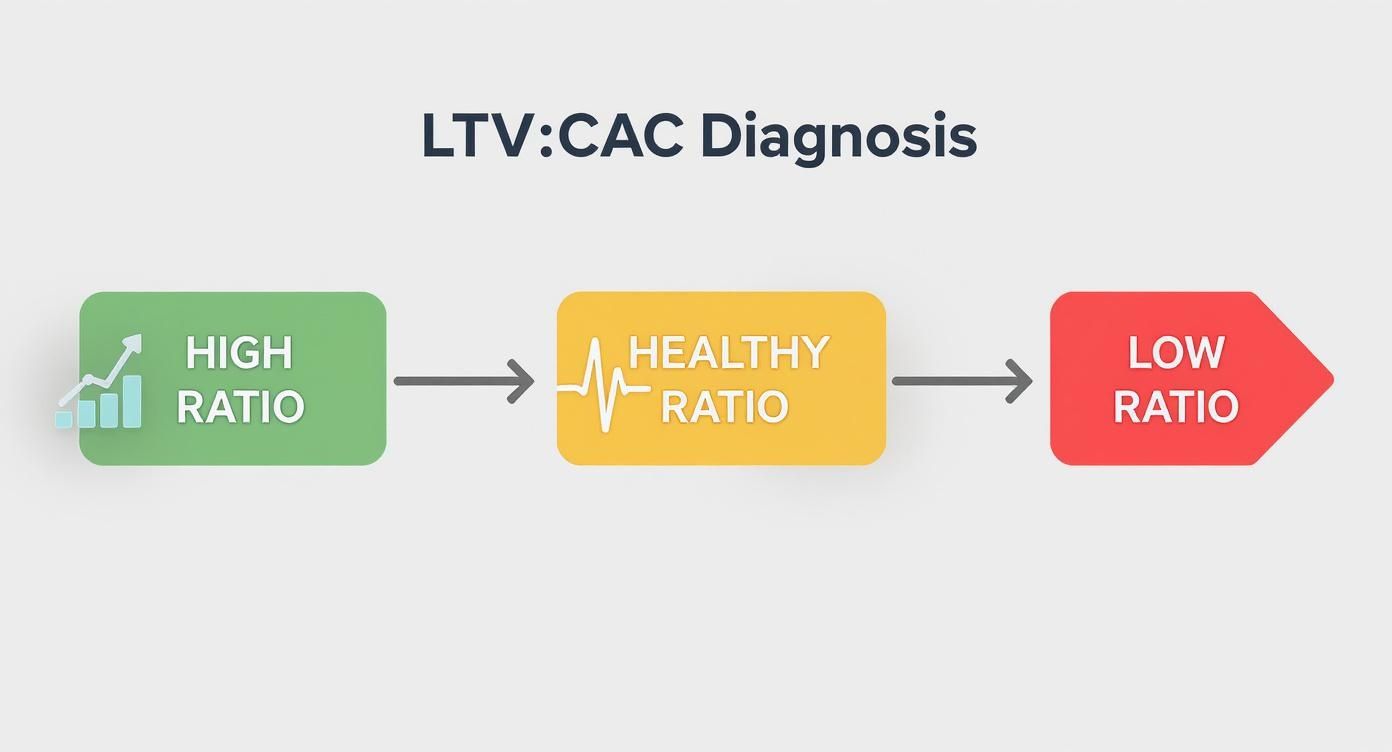
As you can see, a healthy ratio is like a strong, steady heartbeat. A low one is a clear signal that something is wrong and needs immediate attention. If you want to dive even deeper into the nuts and bolts, our guide on lifetime value calculation in SaaS breaks down the formulas in more detail.
With your ARPA and churn rate in hand, the LTV calculation is straightforward:
LTV = ARPA / Customer Churn Rate
Using the numbers from our example: $100 ARPA / 0.05 Churn Rate = $2,000 LTV.
And there you have it—both sides of the equation. Now that you have an accurate CAC and a realistic LTV, you’re ready to use a free LTV CAC calculator and get a ratio you can actually trust to make smart decisions.
Getting Your LTV:CAC Ratio and Making Sense of It
Alright, you've done the hard work of gathering your data. Now it's time to plug it in and see what story the numbers tell about your business. This is where a good LTV:CAC calculator becomes your best friend. Seriously, ditch the manual spreadsheets. Modern tools are not only faster but way more accurate.
A 2021 study of 200 mid-market SaaS companies found something pretty compelling: firms that used advanced calculator models for LTV forecasting tightened their accuracy from a wild ±25% down to a much more manageable ±10%. The result? They allocated capital more wisely and hit profitability 15–20% faster than their peers who were still stuck in spreadsheet land.
Plug In Your Numbers for an Instant Snapshot
I made sure our calculator was dead simple to use. You don't need to be a data scientist—the whole point is to get a clear, actionable number in seconds. Just pop in the core metrics you've already collected and it will perform an AI analysis of your metrics.

The interface is built for speed. You just need your ARPA, churn rate, and total acquisition costs. The tool instantly spits out your LTV, CAC, and of course, the golden LTV:CAC ratio.
So, What Does Your Ratio Actually Mean?
Getting a number like "3.4:1" is one thing. Knowing what to do with it is where the real work begins. Your LTV:CAC ratio isn't a static report card; it’s a living metric that tells you different things depending on where your company is in its journey.
- A 1:1 ratio is a huge red flag. It means you're basically running on a treadmill, spending a dollar to make a dollar. There's no room for error, profit, or paying your team.
- The sweet spot for most healthy, scalable SaaS businesses is 3:1 or higher. This shows you have a solid margin to cover your operating costs, reinvest in growth, and actually make a profit.
- But hold on—a ratio of 5:1 or higher isn't always the home run it seems. It could be a sign that you're being too conservative with your marketing and sales spend, leaving the door wide open for a more aggressive competitor to come in and steal market share.
Context is Everything: A Tale of Two Founders
The "ideal" ratio is completely dependent on your business model and, crucially, your funding situation. What’s fantastic for a bootstrapped founder could be a disaster for a VC-backed rocket ship.
- The Bootstrapper: For them, cash is king. Profitability isn't a long-term goal; it's a daily necessity. A bootstrapped founder is probably aiming for a 4:1 or even 5:1 ratio to make sure there's enough cash flow to fund growth without taking on debt. A 2:1 ratio would keep them up at night.
- The VC-Backed Blitz-scaler: This founder is playing a different game. In a land-grab for market dominance, they might intentionally run at a 2:1 ratio, burning through investor cash to acquire customers as fast as humanly possible. The goal isn't short-term profit, it's long-term market leadership.
"In our seed stage, a 2.5:1 ratio felt like a win because we were just trying to prove the model. But by our Series B, our board expected a consistent 4:1. They weren't just funding growth anymore; they were funding efficient growth. The ratio's meaning completely changed as we matured."
This shift in perspective is critical. Your interpretation of the numbers has to evolve as you scale. The ratio isn't just a number; it’s a direct reflection of your strategic priorities right now. Nailing the Customer Acquisition Cost side of this is fundamental, which is why we built a dedicated guide and a https://saasoperations.com/free-cac-calculator/ to help you get that number right.
To get started with your own analysis, check out our free LTV CAC calculator resource. It's the perfect way to put all this theory into practice.
Time for Action: Playbooks to Fix Your LTV:CAC Ratio
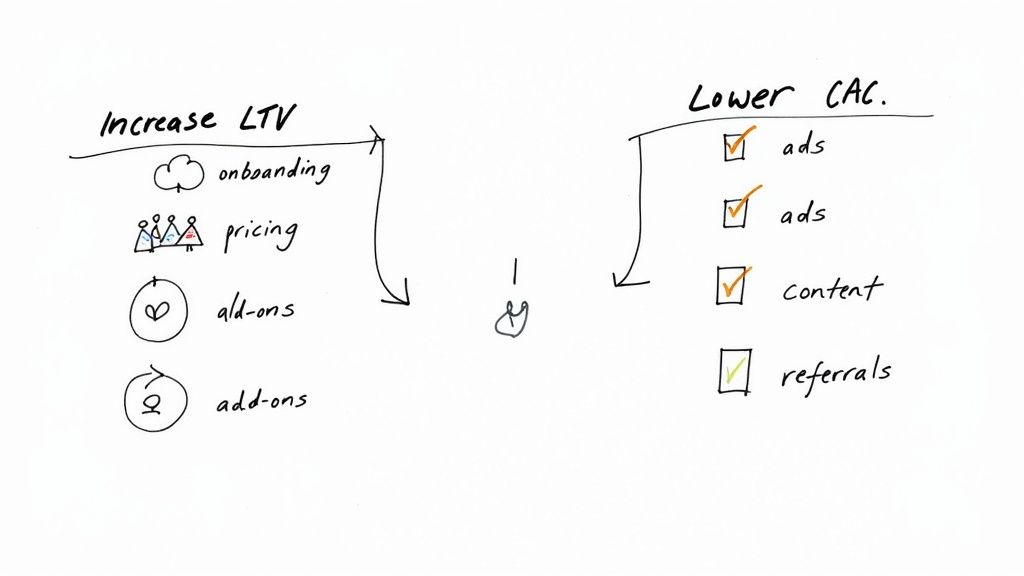
So, you've used a free LTV CAC calculator and the number staring back at you isn't pretty. Don't sweat it. An unhealthy LTV:CAC ratio isn't a dead end—it's a signpost telling you exactly where to focus your energy.
Forget vague advice. Let’s get into the specific, battle-tested playbooks that SaaS operators actually use to move the needle.
The game plan is simple, really. It boils down to two core missions: boost LTV (get more value from each customer) or lower CAC (spend less to acquire them). The real magic happens when you start doing both at the same time.
Playbooks for Boosting Customer Lifetime Value
Increasing LTV is all about turning a single transaction into a long-term partnership. You want customers to stay longer and spend more because you’re consistently delivering more value. It’s an art form, and we dive deep into it in our guide on understanding SaaS Lifetime Value.
Here are a few high-impact strategies to get you moving in the right direction.
Implement Value-Based Pricing Tiers
A lot of SaaS companies kick off with simple, feature-based pricing. That’s fine, but the real growth is unlocked with value-based pricing. This is where your tiers are directly tied to the tangible results and outcomes your customers achieve.
When you nail this, upgrading becomes a natural next step for your customers as their own business grows.
- Mini Case Study: HubSpot: HubSpot is the undisputed champion here. Their free tools are a brilliant hook, but their paid tiers (Starter, Professional, Enterprise) are engineered to scale alongside a business. As a company needs more contacts, advanced automation, or deeper reporting, they simply have to level up. HubSpot literally built LTV growth into their customers' own success stories.
Create Expansion Revenue with Add-Ons
Stop trying to cram every feature into one-size-fits-all plans. That's a recipe for overwhelming new users and leaving money on the table. Instead, unbundle some of your high-value features and offer them as optional add-ons.
This lets you capture more revenue from your power users without scaring away smaller customers with a high sticker price.
Pro Tip: Take a hard look at the features your highest-paying, stickiest customers use most. Is there anything in there you could package as a premium add-on? You might be sitting on a goldmine for expansion MRR. Things like advanced analytics, dedicated support, or API access are common winners.
Execute a High-Touch Onboarding Process
The first 30-60 days of a customer's journey are everything. This is where you win them for life or lose them forever. Early churn is a notorious LTV killer, so a solid onboarding process is your best defense. The goal is to get them to their "aha!" moment as fast as possible.
This doesn't mean you need a massive team holding every hand. You can automate a ton of it:
- Welcome Email Sequence: A drip campaign that guides users through critical setup steps and highlights your best features.
- In-App Walkthroughs: Use tools like Appcues or Pendo to build interactive tours that show, not just tell.
- Scheduled Check-ins: For your higher-tier plans, a quick 15-minute call with an onboarding specialist in the first week can make all the difference.
Playbooks for Lowering Customer Acquisition Cost
Bringing down your CAC is all about marketing efficiency. It’s about being smarter with your spend, not just throwing more money at the problem.
This metric can be all over the place. For B2B SaaS in North America, the average CAC was somewhere between $300 and $1,500 in 2023. And while burning cash to grab market share was trendy for a while, by 2022, 70% of Series A+ SaaS firms were focused on getting their LTV:CAC back to a healthy 3:1 within 18 months.
Here’s how you can start trimming the fat.
Aggressively Kill Underperforming Ad Campaigns
I see this all the time: marketers let unprofitable ad campaigns bleed money for months, hoping for a miracle. You have to be ruthless.
Set aside time every single week to review your campaign performance. If a campaign isn't hitting its target Cost Per Lead after a reasonable test, kill it. No emotion, just data.
- Real-World Example: I once worked with a project management SaaS whose LinkedIn ads had a staggering $750 CAC. At the same time, their Google Search ads were converting like crazy at $250. We reallocated 80% of their LinkedIn budget to search, and they dropped their blended CAC by nearly 40% overnight without losing a single lead.
Build a Content Engine for Organic Leads
Paid ads are like a sugar rush—fast energy, but it doesn't last. Organic content is the healthy, sustainable diet that builds a long-term, low-cost customer acquisition machine.
A content engine is more than a blog. It’s a system.
- Blog Posts: Target the long-tail keywords your ideal customers are actually typing into Google.
- Webinars: Solve a real problem for your audience and show them how your product is the solution.
- Free Tools: Just like our free LTV CAC calculator, these simple tools solve a small but painful problem and introduce your brand in a helpful way.
The beauty of content is its compounding effect. A blog post you write today can generate leads for years, effectively driving its acquisition cost down to almost nothing over time.
Scale a Customer Referral Program
Who is your best salesperson? Your happiest customer. A structured referral program takes that word-of-mouth goodness and turns it into a predictable, scalable channel.
The secret is making it an obvious win-win for everyone involved.
- Mini Case Study: Dropbox: The Dropbox referral program is legendary for a reason. They offered free storage space to both the person referring and the new user. This dual-sided incentive was the primary engine of their explosive early growth, leading to a mind-boggling 3900% user increase in just 15 months. Their CAC was dirt cheap because their users were doing all the marketing.
High-Impact LTV & CAC Improvement Strategies
Choosing where to start can be tough. This table breaks down some of the most effective strategies, giving you a sense of the effort, cost, and potential payoff for each.
| Strategy | Primary Goal | Implementation Effort | Typical Impact on Ratio |
|---|---|---|---|
| Value-Based Pricing | Boost LTV | High (Requires research, analysis, and communication) | Very High |
| Feature Add-ons | Boost LTV | Medium (Requires product & marketing alignment) | Medium-High |
| High-Touch Onboarding | Boost LTV | Medium (Can be partially automated) | High |
| Kill Bad Ad Campaigns | Lower CAC | Low (Requires discipline and regular review) | Medium-High |
| Build Content Engine | Lower CAC | High (Long-term commitment, slow to start) | Very High (over time) |
| Customer Referral Program | Lower CAC | Medium (Requires setup and promotion) | High |
Ultimately, the right strategy depends on your specific business, but this should give you a solid starting point for where to focus your resources for the biggest bang for your buck.
Common LTV:CAC Mistakes (And How to Stop Making Them)
https://www.youtube.com/embed/b6A_dNhcVso
Figuring out your LTV:CAC ratio is one thing. Actually trusting that number enough to steer your company with it? That's a whole different ballgame. I've seen too many SaaS founders fall into the same traps, turning what should be a powerful metric into a misleading vanity number.
The single biggest mistake I see is relying on one, all-encompassing, blended ratio for the entire business. This is a classic rookie error that hides the real story and can lead you to make some truly terrible decisions. You might be looking at a healthy-ish 3:1 ratio and feeling pretty good, but what if that's an average?
In reality, your enterprise customers could be crushing it at an 8:1 ratio, while your SMB segment is a cash-burning dumpster fire at 0.5:1. Without breaking it down, you'd have no idea where to invest more or where to cut your losses.
You're Blending Your Customer Acquisition Costs
Another common pitfall is lumping all your acquisition spending into one big bucket. This gives you a blended CAC that's practically useless because it tells you nothing about which channels are actually working.
I worked with a founder once who was ecstatic about his $400 CAC. On the surface, it looked great.
But when we peeled back the layers, we discovered his CAC from organic search was a mind-blowing $50. On the flip side, his paid social CAC was an eye-watering $950. He was unknowingly pouring cash into a channel that was killing his profitability, all because he was only looking at the average.
To fix this, you have to track your CAC for every single channel. No exceptions.
- Paid Search: Every dollar spent on Google Ads, Bing Ads, you name it.
- Content Marketing: Writer salaries, freelance budgets, any tools you use.
- Paid Social: Ad spend and creative costs for platforms like LinkedIn or Facebook.
- Sales Team: The fully-loaded cost, including salaries, commissions, and their software stack.
Getting this granular isn't optional. It’s the only way to find out which channels are your growth engines and which are just money pits.
"A blended CAC is a lie. It feels safe and simple, but it masks the winners and losers in your marketing mix. The moment we started tracking channel-specific CAC, we cut our overall acquisition cost by 30% in one quarter by just reallocating our existing budget."
You're Ignoring the Nuances of LTV
The same sloppiness often happens on the other side of the equation. Founders make some pretty damaging mistakes when calculating LTV, and one of the worst is using a single, average churn rate for all customers. Just like with CAC, different customer segments behave in totally different ways.
Think about it: an enterprise client with a 1% annual churn is worlds apart from an SMB client churning at 5% monthly. Averaging them together gives you a completely distorted view of reality. If you want to really dig into this, our guide on understanding the SaaS churn rate is the perfect place to start.
The Pitfall of Forgetting the Payback Period
Here's the kicker: even with a fantastic LTV:CAC ratio, you can still run your business into the ground if your payback period is too long. The payback period is simply how long it takes to earn back the money you spent to acquire a customer.
Let's say your ratio is a solid 4:1, but it takes you 24 months to recoup your CAC. You're in a cash-flow crunch, especially if you're bootstrapped.
A VC-backed company might have the runway to tolerate an 18-month payback period to grab market share. But a bootstrapped SaaS needs that cash back in under 12 months, and ideally, closer to 6. Forgetting this metric means you're chasing a pretty ratio instead of focusing on actual cash-in-the-bank health.
To make sure your numbers are telling the true story, you need a tool that can handle this kind of complexity. Our free LTV CAC calculator is built for this—it lets you run different scenarios and even provides an AI analysis to help you see beyond the surface-level numbers.
Got Questions About LTV and CAC? We’ve Got Answers.
We’ve dug deep into the mechanics of LTV and CAC, but let's be real—getting these metrics right in the wild can bring up some tricky questions. Here are the answers to the questions I get asked most often by SaaS founders and operators.
How Often Should I Be Looking at My LTV:CAC Ratio?
For most SaaS businesses, running the numbers monthly is the sweet spot. This gives you a regular pulse on your business health and lets you see the impact of your marketing efforts without getting bogged down in the day-to-day fluctuations.
Now, if you're in hyper-growth mode or A/B testing new acquisition channels like a mad scientist, you might want to peek at it weekly. The main thing is to be consistent. This is where a good free LTV CAC calculator comes in handy—it makes it easy to pop in the latest numbers and see where you stand.
What’s a Good Payback Period for a SaaS Business?
The LTV:CAC ratio is crucial, but the payback period—the time it takes to get your CAC back from a new customer—is where the rubber meets the road for cash flow. If you're a venture-backed SaaS, aiming for a payback period of under 12 months is a fantastic goal.
A payback between 12-18 months can still be healthy, especially if you're landing huge enterprise deals with sticky customers. But if you’re consistently creeping past the 18-month mark, that’s a red flag. It’s a sign that you’re either paying too much to acquire customers or not charging them enough.
A great LTV:CAC ratio doesn't mean much if your payback period is draining your bank account. Cash flow is king, especially for bootstrapped companies. Getting that acquisition money back quickly is what fuels your next wave of growth.
Can I Figure Out LTV:CAC if I Don’t Have Any Customers Yet?
Absolutely. You can't calculate it with historical precision, obviously, but you can—and should—project it. This is one of the most important things you can do as an early-stage founder to see if your business model actually holds water.
You'll have to rely on some smart assumptions and industry benchmarks to build your model.
- Estimate your CAC: Look up average cost-per-click and conversion rates for the channels you plan to use. Talk to other founders in your space.
- Project your LTV: This will be based on your proposed pricing and an assumed churn rate. If you're not sure where to start, a 3-5% monthly churn is a conservative (and safe) bet for many SaaS models.
Plug these estimates into a flexible free LTV CAC calculator and play around with the numbers. See what happens if churn is a little higher or your ad costs double. This kind of modeling shows you where your business is most vulnerable before you've even spent your first dollar. Just make sure to swap out those assumptions with real data as soon as you have it.
At SaaS Operations, we're all about giving you the frameworks to turn these numbers into smart decisions. To get an instant snapshot of your business health and AI-driven insights, give our free LTV CAC calculator a try today.