
Let's get straight to it: SaaS churn rate is the percentage of your customers who hit the cancel button during a set period.
Imagine your business is a bucket. You're working hard to fill it with new customers (water), but churn is the hole in the bottom. If you don't plug that leak, you'll be constantly scrambling to pour in more water just to keep the level from dropping.
Why Churn Is the Silent Killer of SaaS Growth

The leaky bucket analogy is a good start, but the reality of churn is much more damaging. It’s a quiet but deadly threat that undermines everything you're trying to build, from revenue projections to your team's spirit. A high churn rate is a flashing red light, signaling a serious disconnect between what your product promises and what your customers actually experience.
Getting a handle on your churn rate is the first real step toward building a business that lasts. It forces you to ask tough questions about your product, your pricing, and the entire customer journey. Ignoring it? That’s like trying to drive a car with the handbrake pulled. You might inch forward, but you’re burning fuel and going nowhere fast.
It's Not Just About Losing a Customer
Churn isn't a single event; it sends shockwaves through your entire company. When you're constantly losing customers, your acquisition team isn't focused on growth—they're just running on a hamster wheel, trying to replace who you lost last month.
This constant battle to stay afloat creates a cascade of problems:
- Stagnant Revenue: We all know it costs way more to land a new customer than to keep an existing one. High churn makes you overspend on marketing and sales, which eats directly into your profits.
- A Bruised Reputation: Unhappy customers don't just leave quietly. They talk. Negative reviews and bad word-of-mouth can make it incredibly difficult to attract new leads.
- Spooked Investors: If you're venture-backed, a rising churn rate is one of the biggest red flags for investors. It can put future funding rounds in serious jeopardy.
A high churn rate is the ultimate sign of a value gap. It's your customers telling you, loud and clear, that they aren't getting what they paid for and are going somewhere else to find it.
The Financial Stakes in a Competitive Market
The pressure is on. The global SaaS market is booming and is expected to reach $300 billion by 2025. With more competition than ever, keeping the customers you have is no longer a "nice-to-have"—it's a survival tactic.
For context, a "good" annual churn rate for a SaaS business is somewhere between 5% to 7%. But it’s not uncommon for smaller or newer companies to see rates as high as 20%. If you want to dig deeper, you can find more information about what is considered churn in SaaS. Understanding these benchmarks shows why getting a grip on customer attrition isn’t just a good idea; it's absolutely critical.
How to Nail Down Your SaaS Churn Rate
Calculating churn isn't as simple as plugging numbers into one formula. To get a real handle on the health of your business, you need to look at churn from two different angles: gross churn and net churn. Each one tells a vital, but very different, story about your customer base and revenue.
Think of it this way: Gross churn is like looking only at your monthly expenses—it shows you how much cash is going out the door, period. Net churn, on the other hand, is like factoring in your expenses and any extra income you earned from a side hustle. It gives you the full, more nuanced picture.
This is why getting the calculation right matters so much. The gap between an average SaaS company and a top-performer often comes down to just a few percentage points in retention.
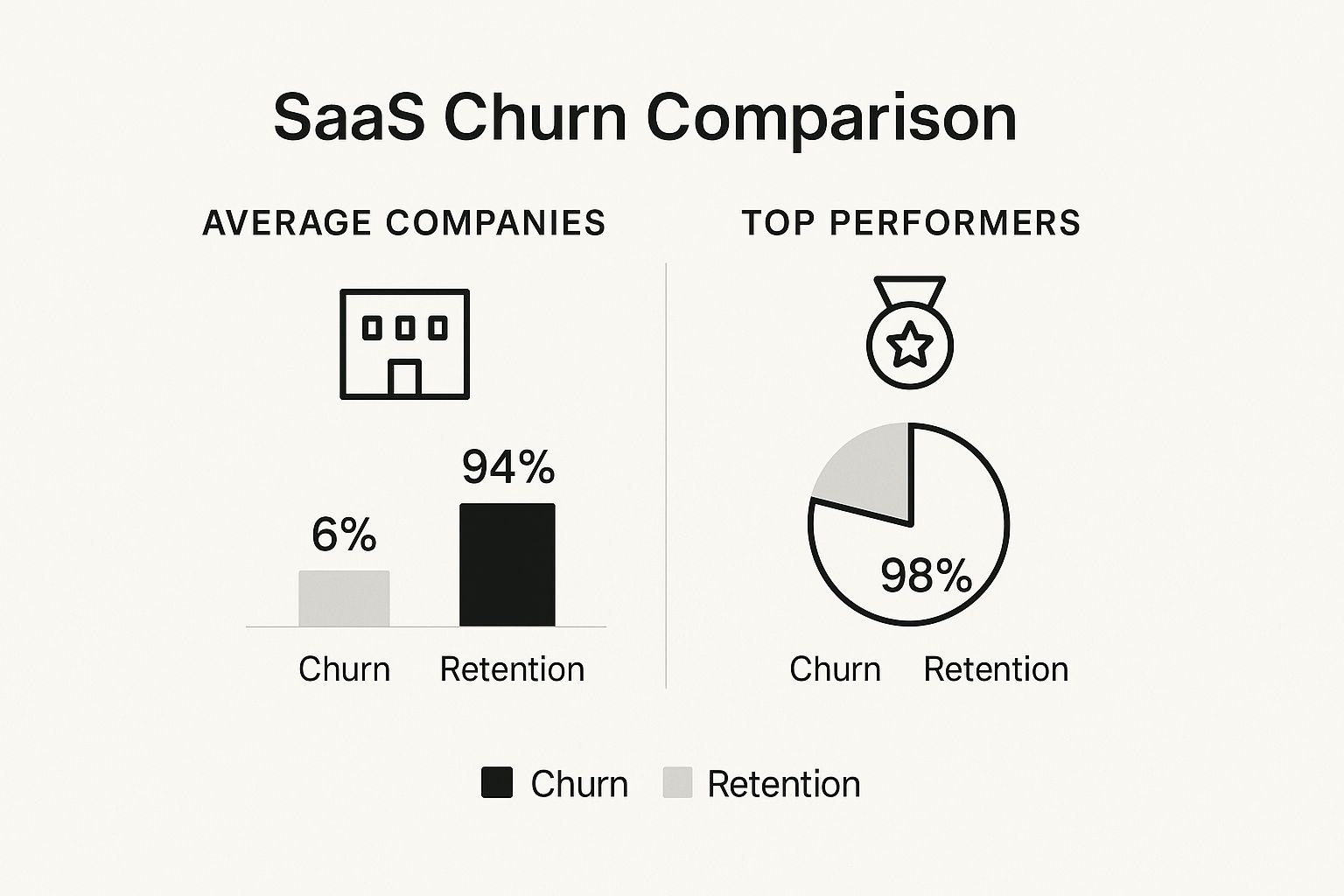
As you can see, even a small improvement from 6% to 2% churn has a massive compounding effect on growth and stability over time.
Calculating Gross Revenue Churn
Gross revenue churn gives you the unvarnished truth. It measures the total monthly recurring revenue (MRR) you lose when customers cancel or downgrade their subscriptions. It’s a pure measure of revenue leakage, completely ignoring any new sales or upgrades.
The formula is pretty straightforward:
Gross Revenue Churn Rate = (MRR Lost to Downgrades & Cancellations in a Period / MRR at the Start of the Period) x 100
Let’s walk through an example. Imagine a SaaS company, SyncUp, starts April with $100,000 in MRR.
During that month:
- They lost $4,000 in MRR from customers who canceled.
- They lost another $1,000 in MRR from customers downgrading to a cheaper plan.
Their total lost MRR for April is $5,000.
To get SyncUp's gross churn rate, we just plug those numbers in:
($5,000 / $100,000) x 100 = 5%
That 5% is your raw churn. It's a critical metric for gauging customer satisfaction and product-market fit. If that number starts creeping up, it’s a big red flag that your customers aren't finding enough value to stick around. High gross churn can seriously damage your company's financial health, which is why it’s so important to see how it connects to other key metrics. For a deeper look, our guide on the lifetime value calculation for SaaS shows just how much churn can impact long-term profitability.
Calculating Net Revenue Churn
Gross churn is essential, but it doesn't tell the whole story. What if your happiest customers are actually spending more money with you? That’s where net revenue churn comes in.
This metric gives you a more balanced view by factoring in expansion revenue—the extra MRR you earn from existing customers who upgrade, buy add-ons, or purchase more seats.
The formula just adds one piece to the gross churn equation:
Net Revenue Churn Rate = ([MRR Lost to Downgrades & Cancellations] – [Expansion MRR]) / MRR at the Start of the Period) x 100
Let’s check back in with SyncUp. We know they lost $5,000 in MRR during April.
But in that same month, they also generated:
- $3,000 in expansion MRR from existing customers upgrading to a higher-tier plan.
Now, let's calculate their net revenue churn:
([$5,000 Lost MRR] – [$3,000 Expansion MRR]) / $100,000) x 100 = 2%
Suddenly, the picture looks much better. SyncUp's 2% net revenue churn shows that while they are losing some customers, their most engaged users are making up for a big chunk of that loss.
Gross Churn vs Net Churn at a Glance
It can be easy to mix these two up, but they serve very different purposes. This table breaks down the key distinctions.
| Metric | What It Measures | Formula | Best For Understanding |
|---|---|---|---|
| Gross Revenue Churn | The total revenue lost from cancellations and downgrades. | (Lost MRR / Starting MRR) x 100 | The raw, unfiltered loss of customers and revenue. It's a direct signal of customer dissatisfaction. |
| Net Revenue Churn | The overall revenue change within your existing customer base. | ([Lost MRR – Expansion MRR] / Starting MRR) x 100 | The overall health and growth potential of your existing customer base. It shows if you're retaining and growing your best accounts. |
Ultimately, you need both metrics. Gross churn acts as your early warning system, while net churn reveals the bigger picture of customer loyalty and product stickiness.
Achieving a low—or even negative—net churn is the holy grail for any SaaS business. Negative net churn means your expansion revenue from happy customers is greater than all the revenue you're losing from churned ones. It’s the clearest sign you have a product people love and are willing to invest more in over time, letting you grow revenue without even acquiring a single new customer.
Understanding SaaS Churn Rate Benchmarks

So, you’ve calculated your churn rate. Now comes the inevitable question that keeps founders up at night: "Is my number any good?"
The honest answer? It depends. There’s no single magic number that defines a "good" churn rate. What’s considered healthy for a scrappy startup trying to find its footing would be a code-red emergency for a well-established enterprise.
Think of it like a runner's heart rate. A massive spike during a full-out sprint is perfectly normal. But if you saw that same heart rate during a leisurely walk, you'd know something was seriously wrong. Your churn rate works the same way—it needs to be judged against the right backdrop. To get a real sense of where you stand, you have to compare your numbers to relevant industry benchmarks.
How Company Size and Maturity Impact Churn
The biggest factor separating good and bad churn rates is your company's stage. Early-stage businesses and large, public companies are playing two completely different games, and their churn metrics show it.
Why the huge difference? For one, mature companies often serve enterprise clients on sticky annual contracts. They also have deeper pockets, allowing them to invest in dedicated customer success teams and polished onboarding experiences—luxuries a startup can't always afford.
Churn rates are tied directly to a SaaS company's size and revenue. For example, businesses with under $10 million in annual revenue often grapple with an annual churn rate of around 20%. Startups in this bracket can even see churn as high as 60% while they find their footing. In contrast, larger companies pulling in over $10 million typically have a much lower average churn of 8.5% annually.
This is a crucial reality check. If you're a young company with a 15% annual churn, don't panic. You aren't necessarily failing; you're just navigating the turbulent waters that come with growth.
Key SaaS Churn Benchmarks to Know
While context is everything, it helps to have some general numbers in mind. These benchmarks give you a solid starting point for setting internal goals and understanding if you're in a healthy range for your specific market.
Here’s a rough breakdown based on who you sell to:
- Small and Medium-Sized Businesses (SMBs): Expect higher churn here, typically 3-7% monthly. SMBs are more price-sensitive, have fewer resources, and are more likely to go out of business themselves. It’s a volatile market.
- Mid-Market: A monthly churn rate of 1-2% is a great target for companies serving mid-market clients. These businesses are more stable than SMBs but still more nimble than massive enterprises.
- Enterprise: This is the gold standard. SaaS companies focused on large enterprise customers should aim for a monthly churn rate below 1%. Switching costs are high, contracts are long, and these relationships are built to last.
Knowing these numbers is the first step. If you’re ready to dive deeper into keeping your best customers, our complete guide on customer retention for SaaS can help. Once you know where you stand, you can start building a targeted plan to fix the leaks and build a more resilient customer base.
The 7 Root Causes of Customer Churn
Calculating your churn rate is like getting a diagnosis from a doctor. The number tells you something is wrong, but it doesn't tell you why. To actually fix the problem and lower your churn, you have to dig deeper and find the root causes.
Churn rarely happens overnight. It's usually the final, predictable outcome of a string of small frustrations, unmet promises, and a slow, creeping feeling that your product just isn't worth it anymore. By pinpointing exactly where things are going wrong, you can stop just treating the symptoms and start curing the disease.
Let's break down the seven most common reasons customers decide to walk away.
1. Poor Onboarding Experience
You only get one chance to make a first impression, and in SaaS, that's onboarding. This is the most critical part of the customer journey. If a new user feels confused, overwhelmed, or frustrated in their first few sessions, you've likely lost them for good.
If they can't quickly find that "aha!" moment—the instant they see how your tool solves their problem—they'll assume it never will. A bad onboarding experience leaves users feeling like they’ve been dropped in the middle of nowhere without a map. They don't understand the key features, don't know how to set things up, and can't find help. That initial friction is incredibly hard to overcome.
2. Mismatch in Product-Market Fit
Sometimes, the problem isn't your product; it's who you're selling it to. A product-market fit mismatch happens when you bring in customers whose real-world problems don't quite line up with what your software actually does. This is a classic side effect of marketing messages that overpromise or target the wrong audience segment.
These customers were never going to be successful in the first place. They signed up expecting a fix for Problem X, only to find out your tool is a rockstar at solving Problem Y. Churn becomes inevitable because they quickly realize they bought the wrong solution for their specific job.
3. Ineffective Customer Support
When a user hits a snag, your support team is their lifeline. Slow responses, unhelpful answers, or a support portal that's impossible to navigate can turn a small question into a reason to cancel their subscription. People expect support that is fast, empathetic, and actually solves their problem.
Customer retention is a cornerstone of SaaS sustainability. In fact, 2025 statistics show that B2B SaaS companies have an average monthly churn rate of about 3.5%. This steady loss can compound significantly if left untreated. Since studies show almost 70% of new users abandon SaaS products within their first three months, the initial user experience, including first support interactions, is pivotal. Learn more about these SaaS statistics at Hostinger.com.
Bad customer service sends a clear message: "We don't value your business." If users can't get the help they need when it matters most, they'll go find a competitor who will provide it. For more ways to improve this, check out our guide on actionable customer success strategies.
4. Perceived Lack of Value
This is a quiet but deadly cause of churn. The customer isn't angry or frustrated. They just don't see a clear return on their investment anymore. If they aren't consistently reminded of the value your product provides, they'll start asking themselves why they're paying for it every month.
This often comes down to a few key issues:
- Underutilization: They're only using a tiny fraction of the features they're paying for.
- No Clear ROI: They can't draw a straight line from using your product to a positive business outcome, like saving time or making more money.
- Feature Fatigue: They've mastered the basics and aren't discovering new, powerful ways the product can help them grow.
When a customer logs in and thinks, "Am I really getting my money's worth?" the answer had better be a loud, obvious "yes." If not, you're at serious risk of losing them.
5. Strong Competitive Pressure
Let's be real—your customers are constantly being courted by your competitors. If another company pops up with a similar product that has more features, a slicker user interface, or a lower price, it gives your customers a very compelling reason to see if the grass is greener.
You can't operate in a vacuum. To stay competitive, you have to keep a close eye on the market, listen to your customers' feature requests, and make sure your pricing and value proposition can hold their own against the alternatives.
6. Pricing and Billing Issues
Price is always a factor, especially for startups and small businesses on a tight budget. If customers feel your product is overpriced for the value they get, they'll start looking for cheaper options. Unannounced or poorly communicated price hikes are also a classic trigger for a wave of cancellations.
But it's not just the sticker price. Frustrating billing experiences can kill a customer relationship. Things like complicated invoices, confusing subscription tiers, or a cancellation process that feels like a trap will sour their entire experience and push them out the door.
7. Involuntary or Passive Churn
Finally, not all churn is intentional. Involuntary churn is when a customer disappears because of a technical issue, usually a failed payment. The culprit is often an expired credit card, insufficient funds, or a bank that randomly decides to decline the transaction.
It might seem passive, but this sneaky type of churn can account for a staggering 20-40% of your total churn if you don't manage it. A simple dunning management process—which automatically emails customers about payment failures—can easily recover a huge chunk of this otherwise lost revenue.
Proven Playbooks to Reduce Your Churn Rate

Knowing why customers leave is only half the battle. The real work begins when you start doing something about it. To make a real dent in your churn rate, you need practical, battle-tested playbooks designed to tackle the specific reasons customers cancel.
These aren't just high-level ideas; they're structured strategies you can put into action today. Let's move from just diagnosing the problem to actively solving it, one playbook at a time.
Perfect The First Impression With Frictionless Onboarding
Your onboarding process is your single best retention tool. Period. It's the first real taste a customer gets of your product, and it's your one chance to guide them to that "aha!" moment where everything just clicks.
A clunky, confusing, or drawn-out setup is a recipe for early-stage churn. The goal here isn't to show off every single feature. It's to help new users score their first quick win and feel successful right away.
To build an onboarding flow that sticks, try this:
- Personalize the Welcome: Kick things off with a simple welcome survey. Ask about their role and what they hope to accomplish. Use that info to show them the exact tools they need, not the ones they don't.
- Guide With Interactive Walkthroughs: Ditch the boring, passive product tours nobody watches. Instead, build interactive guides that walk users through completing a key task. People learn by doing.
- Celebrate Early Wins: When a user finishes a critical step or gets their first positive result, celebrate it! A simple in-app high-five or congratulatory message goes a long way in building momentum and confidence.
A seamless onboarding experience can be the difference between a lifelong customer and one who disappears after a week. Those first few interactions are absolutely critical for setting the stage for long-term retention.
Implement Proactive Customer Success Check-Ins
Don't wait for a customer to send an angry support ticket. By the time they’re that frustrated, you're already on the back foot. The best customer success teams are proactive—they anticipate problems and reach out before things escalate into a cancellation risk.
This means you have to become a bit of a detective. Watch user behavior for quiet red flags. Are they logging in less? Have they stopped using a key feature? Are they ignoring new updates? These are the breadcrumbs that lead to churn.
Once you spot a disengaged user, trigger a check-in. It could be an automated, friendly email from their account manager asking if everything is okay, or a helpful in-app pop-up offering a quick tutorial. The point is to show you're paying attention and are genuinely invested in their success. For more ideas, you can explore various strategies to reduce churn rate and boost retention.
Systematically Gather And Act On Feedback
Your customers are constantly telling you why they're sticking around and what might push them to leave. You just have to create a system for listening.
Building a consistent feedback loop is the only way to find product gaps, service issues, and unmet needs before they fester and cause churn.
To get the full picture, use a mix of channels:
- In-App Microsurveys: Use quick, one-question surveys (like NPS or CSAT) that pop up right after a user tries a new feature or talks to support. The feedback is immediate and highly relevant.
- Churn Surveys: When a customer finally decides to cancel, make the offboarding process include one simple question: "What's the main reason you're leaving?" This data is pure gold for preventing others from following them out the door.
- Direct Outreach: For your most valuable customers, nothing beats a good old-fashioned phone call. Schedule regular check-ins to talk about their goals and see how you can help.
Remember, collecting feedback is pointless if you don't do anything with it. You need a real process to analyze what you've learned and turn it into actual product improvements. When customers see you're listening—and acting—it builds incredible loyalty. Our own guide on how to reduce churn rate goes deeper on this topic: https://saasoperations.com/reduce-churn-rate/
Establish An Effective Dunning Process
Believe it or not, a huge chunk of churn has nothing to do with customer unhappiness. It's involuntary churn, which happens when a subscription is cancelled because of a failed payment. The reason is usually something simple, like an expired credit card.
If you don't have a solid process for this, you could be losing 20-40% of your churned customers for no good reason at all.
This is where a dunning management system comes in. It’s an automated series of messages that alerts customers to a payment issue and makes it dead simple for them to fix it.
A smart dunning flow usually includes:
- An instant email notification the moment a payment fails.
- A few gentle follow-up reminders over the next week.
- In-app notifications that guide the user to update their billing info.
- One final warning before the account is suspended.
This simple, automated playbook can recover a shocking amount of revenue that would otherwise just disappear. It’s easily one of the highest-impact churn reduction strategies you can implement.
Churn Reduction Playbook
To tie it all together, here’s a quick summary of the core problems driving churn and the strategic playbooks you can run to solve them. Think of this as your cheat sheet for building a more resilient, retention-focused business.
| Churn Driver | Core Problem | Strategic Playbook | Key Metric to Track |
|---|---|---|---|
| Early-Stage Churn | Users don't experience the product's value quickly enough. | Frictionless Onboarding | Time to Value (TTV), Activation Rate |
| Disengagement | Customers lose momentum or aren't using key features. | Proactive Customer Success | Product Engagement Score, Login Frequency |
| Product Gaps | The product is missing features or has usability issues. | Systematic Feedback Loops | Net Promoter Score (NPS), CSAT |
| Payment Failures | Subscriptions are canceled due to billing problems. | Dunning Management | Involuntary Churn Rate, Payment Recovery Rate |
By focusing on these specific areas, you can move from reacting to churn to proactively preventing it, building a stronger foundation for sustainable growth.
Frequently Asked Questions About SaaS Churn
Churn can feel complicated, but it doesn't have to be. Let's break down some of the most common questions that come up when SaaS leaders start digging into their attrition numbers.
What Is the Difference Between Customer and Revenue Churn?
It’s easy to mix these two up, but they tell completely different stories about your business. Think of them as two sides of the same coin.
-
Customer Churn is pretty straightforward: it’s the percentage of customers (or logos) you lost in a given period. It answers the simple question, "How many customers walked away?"
-
Revenue Churn gets to the financial impact. It measures the percentage of monthly recurring revenue (MRR) you lost from those departing customers. This metric asks, "How much money did we lose?"
Imagine you lost six customers this month. On paper, that's a customer churn of six. But what if one of those was a massive enterprise account and the other five were small startups on your basic plan? The one big account could easily represent more lost MRR than the other five combined. That’s why you need to track both—one tells you who is leaving, and the other tells you what it's costing you.
How Often Should I Calculate My SaaS Churn Rate?
When it comes to tracking your churn rate for SaaS, consistency is everything. For most businesses, the sweet spot is monthly.
Calculating churn every month gives you a regular pulse on customer health. It’s frequent enough to catch problems early and make adjustments before they spiral, but not so frequent that you're just reacting to random noise.
Of course, you’ll also want to look at quarterly and annual trends. These longer timeframes smooth out the monthly bumps and show you the real impact of your bigger strategic plays. Early-stage startups, on the other hand, might even look at weekly cohort data to get super-fast feedback on things like a new feature launch.
Can a SaaS Company Have Negative Churn?
Absolutely. In fact, it's the holy grail for a scalable SaaS company. Hitting negative churn is a massive signal that you've found true product-market fit and are delivering incredible value.
Negative churn happens when the new revenue from your existing customers (from upgrades, add-ons, and new seats) is greater than the revenue you lose from customers who cancel.
Think about that for a second. It means your business is growing even if you don't sign a single new customer. Your current user base is so happy and successful with your product that they’re spending more and more over time. This creates a powerful, self-sustaining growth engine that investors love to see.
At SaaS Operations, we provide battle-tested playbooks and templates to help operators build more efficient and profitable businesses. Discover our proven frameworks to accelerate your growth.