10 Actionable Data Driven Decision Making Examples for SaaS Operators
 Published By: Alex
December 22, 2025
Published By: Alex
December 22, 2025
Gut feelings have their place, but elite SaaS companies run on data-backed playbooks. If you're tired of making high-stakes decisions based on intuition alone, this is your resource. We're moving beyond the buzzwords to give you a behind-the-scenes look at how top operators use data to solve critical problems, from slashing customer churn to optimizing infrastructure spend.
This isn't a theoretical guide. It’s a collection of battle-tested playbooks designed for immediate implementation. We’ll be showcasing specific data driven decision making examples that provide a clear roadmap for success. You won't find generic success stories here, only deep dives into replicable strategies used by other SaaS leaders.
For each of the 10 examples, we'll break down:
- The Problem: The specific business challenge they faced.
- The Scorecard: The exact metrics and KPIs they tracked.
- The Decision: The precise, data-backed action they took.
- The Outcome: The measurable impact on their business.
Most importantly, we're not just telling you what they did. We're showing you how to do it yourself. Each example comes with a plug-and-play SOP or a simple checklist, giving you the exact next steps to implement these strategies in your own operations. This article is your authority on turning raw data into tangible growth, leaving you with actionable insights to improve your SaaS business today. Let’s dive in.
1. Cutting Customer Churn with Predictive Analytics
Customer churn is the silent killer of SaaS growth. While every company tracks it, the best operators get ahead of it. This is a prime example of data-driven decision making where a mid-stage B2B SaaS company transformed its retention strategy from reactive to proactive, using data to predict who was about to leave and why.
The Problem: Stagnant Net Revenue Retention (NRR)
The company’s NRR had flatlined, indicating that revenue from existing customers wasn't growing. Generic email campaigns and discount offers to all "at-risk" customers were costly and ineffective. They needed a smarter way to focus their retention efforts on the accounts that truly needed intervention.
The Scorecard: Key Metrics for Churn Prediction
The team moved beyond simple churn rates and built a predictive model based on a health score. They analyzed user behavior data from the past six months, correlating specific actions (or inactions) with accounts that eventually churned.
- Login Frequency: A drop of more than 50% in weekly logins over a 30-day period.
- Key Feature Adoption: Accounts that hadn't adopted two or more core features after 90 days.
- Support Ticket Volume: A sudden drop to zero tickets from previously active accounts.
- Team Engagement: A decrease in the number of active users per account.
The Decision & Outcome
Instead of broad-stroke campaigns, the customer success team used the health score to create a tiered intervention plan. High-risk accounts received a personal call from their account manager to offer strategic support. Medium-risk accounts were enrolled in a targeted email sequence highlighting unused features relevant to their use case.
The outcome was a 15% reduction in monthly churn within the first quarter of implementation. NRR began to climb again as fewer customers left and the targeted support even uncovered upsell opportunities. This is one of the most powerful data driven decision making examples because it directly impacts the bottom line. For a comprehensive approach to combating customer churn, you can dive deeper into a guide to reducing churn in SaaS for more strategies on identifying and mitigating it.
How to Implement This: A Plug-and-Play SOP
- Identify Churn Indicators: Analyze historical data from your CRM and product analytics tools (like Mixpanel or Amplitude) to find behavioral patterns of churned customers.
- Build a Health Score: Assign a weighted score to each key metric. Keep it simple to start; you can refine it later. For example, login frequency might be weighted more heavily than support ticket volume.
- Set Intervention Triggers: Define thresholds. When an account's health score drops below a certain number, it triggers an automated alert to your customer success team.
- Create Your Playbooks: Develop specific, tiered actions. A low score might trigger a high-touch outreach, while a moderate score triggers an automated, educational email campaign.
- Measure and Iterate: Track the results. Did your interventions improve the health scores of at-risk accounts? Adjust your model and playbooks based on what works.
2. E-commerce Personalization and Recommendation Engines
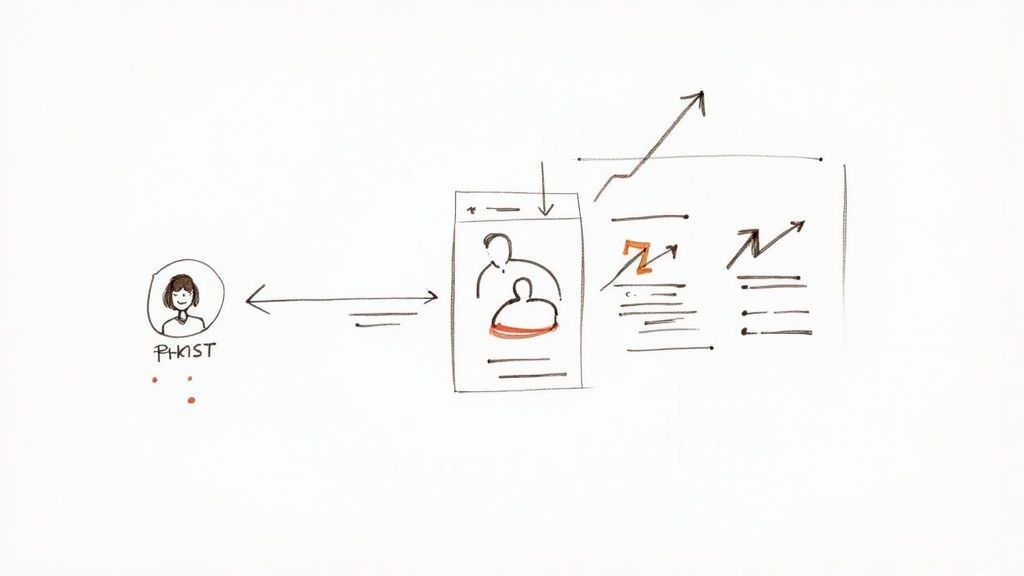
Generic storefronts are a thing of the past. Today's top online retailers treat every visitor like a VIP by tailoring the experience to their unique tastes. This is a classic example of data-driven decision making, where browsing history, purchase data, and user behavior are used to build powerful recommendation engines that drive massive revenue.
The Problem: Low Conversion Rates and Average Order Value (AOV)
An e-commerce platform selling niche hobbyist supplies was struggling with cart abandonment and a low AOV. Customers would buy their primary item but rarely discovered complementary products. Their marketing efforts were broad, failing to highlight the vast and relevant inventory available to different user segments, leading to missed revenue opportunities.
The Scorecard: Key Metrics for Personalization
The team decided to build a recommendation engine by tracking user interactions to predict future buying intent. They focused on a few core data points to create personalized product suggestions.
- Purchase History: Analyzing past orders to identify patterns and suggest re-orders or similar items.
- Browsing Behavior: Tracking which product pages a user views, how long they stay, and what they add to their cart (even if they remove it).
- On-Site Search Queries: Using the exact terms customers search for to recommend highly relevant products.
- Segmented User Data: Grouping users by the hobby category they engage with most (e.g., model trains vs. remote-controlled cars).
The Decision & Outcome
The company implemented a "Customers who bought this also bought…" widget on product pages and a "Recommended for You" section on the homepage. These were powered by an algorithm analyzing the scorecard metrics. For example, if a user bought a specific type of model paint, the engine would recommend compatible brushes and finishing sprays.
The result was an 18% increase in Average Order Value and a 12% lift in overall conversion rates within six months. This data-driven decision making example demonstrates how personalization directly translates to higher revenue by making the shopping experience more relevant and helpful for the customer.
How to Implement This: A Plug-and-Play SOP
- Collect Behavioral Data: Use tools like Google Analytics or a customer data platform (CDP) to track user clicks, page views, and purchase history.
- Start with Simple Logic: You don't need complex AI at first. Begin with rule-based recommendations like "Show other products from the same category" or "Show best-sellers."
- Implement Recommendation Widgets: Add sections for "Frequently Bought Together" on product pages and personalized recommendations on the homepage and in the shopping cart.
- A/B Test Your Algorithms: Test different recommendation types. Does a "trending products" widget outperform a "recommended for you" one? Let the data decide.
- Create Feedback Loops: Allow users to rate recommendations or explicitly state "I'm not interested in this." Use this feedback to continuously refine the algorithm's accuracy.
3. Sports Analytics and Performance Optimization
The world of professional sports has transformed from a gut-feel industry to a data-driven powerhouse. Teams now use advanced analytics to gain a competitive edge, a shift popularized by the "Moneyball" story. This is a fascinating example of data driven decision making where organizations like Liverpool FC and the Golden State Warriors use data to optimize everything from player acquisition to on-field strategy.
The Problem: Relying on Tradition and Intuition
For decades, scouting and coaching decisions were based on subjective observation and conventional wisdom. This led to undervalued talent being overlooked and inefficient game strategies that left wins on the table. Teams needed a more objective way to assess player value, prevent injuries, and optimize in-game tactics.
The Scorecard: Key Metrics for Gaining an Edge
Sports analytics teams built complex models by tracking a wide range of performance and biometric data. They moved beyond simple stats like goals or points to find metrics that were true indicators of on-field impact.
- Expected Goals (xG): In soccer, this metric measures the probability of a shot resulting in a goal based on historical data, providing a better measure of a player's offensive threat than just shot count.
- Player Load: Wearable GPS trackers measure the total physical stress on an athlete during a session, combining data on acceleration, distance, and changes in direction to manage fatigue and prevent injuries.
- Video Analysis: Tagging specific events in game footage (e.g., successful defensive plays, pass completion under pressure) to create quantifiable performance data.
- Recruitment Analytics: Using statistical models to project an amateur player's potential at the professional level, minimizing draft busts.
The Decision & Outcome
Instead of just signing the biggest names, teams like Liverpool FC invested heavily in their data science department. They used their models to identify undervalued players who excelled in key statistical areas that fit their high-press system. Coaches used in-game data to make real-time substitutions and tactical adjustments.
The outcome was revolutionary. Liverpool won the Champions League and their first Premier League title in 30 years, largely attributed to their data-first approach. This is one of the most compelling data driven decision making examples because it proves that objective analysis can outperform traditional intuition in a high-stakes environment.
How to Implement This: A Plug-and-Play SOP
- Define Key Outcomes: Start with the end goal. Do you want to reduce injuries, improve recruitment, or optimize a specific game strategy?
- Identify Correlated Metrics: Work backward to find the data points that have the strongest correlation with your desired outcome. Don't just track vanity metrics.
- Invest in Data Collection Tools: Implement tools to gather the necessary data, whether it's wearable tech for athletes, video analysis software, or statistical databases.
- Build Your Playbooks: Create clear, data-informed protocols. For example, if a player's "Player Load" score exceeds a certain threshold for three consecutive days, they are automatically given a lighter training day.
- Foster Collaboration: Ensure your data scientists and domain experts (coaches, scouts) work together. Data provides insights, but domain expertise is needed to apply them effectively.
4. Financial Risk Management and Fraud Detection
For fintech and SaaS companies handling transactions, fraud isn't just a risk; it's an existential threat. This is a classic case of data driven decision making where a payment processing SaaS uses machine learning not just to block fraud, but to do so without frustrating legitimate customers with false positives.
The Problem: Rising Chargebacks and High False Positives
A rapidly growing payment gateway was facing a dual crisis. Their fraud prevention system was too aggressive, leading to a high rate of false positives and angry customer support calls. Simultaneously, sophisticated fraudsters were slipping through, causing chargeback rates to creep dangerously close to the 1% threshold set by major card networks.
The Scorecard: Key Metrics for Fraud Detection
The team built a real-time risk scoring model that analyzed dozens of data points for every transaction. Instead of a simple "block or allow" rule set, they created a nuanced system that evaluated the probability of fraud based on behavioral and transactional data.
- Transaction Velocity: A sudden spike in the number of transactions from a single IP address or user account.
- Geographic Mismatch: The user's IP address location is far from the credit card's billing address.
- Atypical Purchase Size: An order value that is significantly higher than the user's historical average.
- Device Fingerprinting: Mismatches between device ID, browser type, and historical user data.
The Decision & Outcome
The company implemented a dynamic, three-tiered response based on the real-time fraud score. Low-risk transactions were approved instantly. High-risk transactions were automatically blocked. The crucial middle tier, "medium-risk," was routed for 2-Factor Authentication (2FA) via SMS, adding a layer of security without a hard rejection.
The outcome was a 40% reduction in successful fraudulent transactions and a 60% decrease in false positives within two months. This improved customer trust and stabilized their chargeback rate, safeguarding their merchant accounts. For a deeper look at building a resilient system, you can explore this guide to an operational risk management framework.
How to Implement This: A Plug-and-Play SOP
- Identify Fraud Vectors: Analyze historical chargeback data. What are the common characteristics of fraudulent transactions in your system? Look for patterns in location, time of day, and order value.
- Develop a Risk Score: Use a simple weighted model to start. Assign points for risky attributes (e.g., +20 for IP/billing mismatch, +15 for new device).
- Set Risk Thresholds: Define your scoring tiers. For example, 0-25 is low-risk (auto-approve), 26-60 is medium-risk (trigger 2FA), and 61+ is high-risk (auto-block).
- Create Response Playbooks: Define the exact action for each tier. Ensure your system can handle these automated responses in real-time.
- Measure and Refine: Continuously monitor your false positive rate and fraud detection accuracy. Use machine learning to identify new patterns and update your scoring model regularly as fraudsters change their tactics.
5. Marketing Campaign Optimization and Customer Attribution
Throwing marketing budget at different channels without knowing what works is a recipe for burning cash. True growth comes from understanding the entire customer journey, from the first ad they see to the moment they convert. This is a classic data driven decision making example where a B2C SaaS company used attribution modeling to slash customer acquisition costs (CAC) by reallocating its marketing spend.
The Problem: A Sky-High and Unpredictable CAC
The company was running campaigns across Google Ads, Facebook, LinkedIn, and content marketing channels. Their blended CAC was climbing, but they couldn't pinpoint which channels were delivering high-value customers versus which were just driving clicks. The marketing team was flying blind, making budget decisions based on last-click attribution, which gave all the credit to the final touchpoint and ignored the rest of the journey.
The Scorecard: Key Metrics for Attribution Modeling
To get a clearer picture, they moved to a multi-touch attribution model. They started tracking every interaction a lead had with their brand over a 90-day window before converting, focusing on the metrics that revealed the true influence of each channel.
- First-Touch Attribution: Which channel originally brought the prospect into their ecosystem?
- Weighted Multi-Touch: Assigning partial credit to each touchpoint (e.g., 40% to first touch, 40% to the converting touch, and 20% distributed among the middle touches).
- Channel-Specific Cost Per Lead (CPL): The actual cost to generate a lead from each channel.
- Lead-to-Customer Conversion Rate: The percentage of leads from a specific channel that became paying customers.
The Decision & Outcome
The data revealed a surprising insight: while Google Ads had the highest last-click conversions, their blog content (first touch) and LinkedIn ads (mid-funnel) were critical in nurturing leads that eventually converted. The team reallocated 20% of their Google Ads budget into top-of-funnel content and mid-funnel LinkedIn campaigns.
The outcome was a 25% reduction in blended CAC within six months. The quality of leads improved, and the sales cycle shortened because prospects were better educated before the final conversion click. This shift from a simplistic to a nuanced view of marketing performance is one of the most impactful data driven decision making examples for any SaaS company. To streamline these complex journeys, you can explore a guide to SaaS marketing automation for more powerful strategies.
How to Implement This: A Plug-and-Play SOP
- Unify Your Tracking: Ensure you have consistent tracking (like UTM parameters) across all marketing channels. Use a tool like Google Analytics, HubSpot, or a dedicated attribution platform to collect this data in one place.
- Choose an Attribution Model: Start with a simple model like linear or time-decay before moving to more complex weighted models. The goal is to move beyond last-click attribution.
- Map the Customer Journey: Analyze the paths your best customers take. Identify common sequences of touchpoints that lead to high-value conversions.
- Allocate Budget Based on Influence: Shift spend towards channels that prove influential at any stage of the funnel, not just the ones that get the final click.
- Test and Refine: Continuously monitor your CAC and LTV by channel. Your attribution model is not static; it should evolve as you test new channels and your customer behavior changes.
6. Supply Chain Optimization and Demand Forecasting
While SaaS businesses don't ship physical boxes, they absolutely have a supply chain. It's a digital one, composed of cloud infrastructure, third-party API dependencies, and customer support capacity. Mismanaging this digital supply chain leads to downtime, slow performance, and poor customer experiences, which is why data-driven demand forecasting is critical for scaling smoothly.

The Problem: Unpredictable Infrastructure Costs and Support Overload
A rapidly growing FinTech SaaS company faced spiraling cloud costs and a perpetually overwhelmed support team. During peak usage times, like the end of the financial quarter, their infrastructure would strain, leading to latency issues. Simultaneously, their support team was understaffed for these predictable surges, leading to long ticket resolution times and frustrated customers.
The Scorecard: Key Metrics for Demand Forecasting
The operations team developed a forecasting model to predict resource demand. They analyzed historical data to find leading indicators of upcoming usage spikes, moving from reactive scaling to proactive resource allocation.
- Active User Growth Rate: A week-over-week user growth rate exceeding 5%.
- API Call Volume: Tracking the average number of API calls per user session.
- Feature Adoption Velocity: How quickly new signups adopt high-computation features.
- Seasonal Usage Patterns: Identifying predictable usage spikes tied to business calendars (e.g., end-of-month reporting).
The Decision & Outcome
Based on the forecast, the engineering team began pre-scaling server capacity ahead of anticipated high-demand periods. The Head of Support used the same data to adjust staffing schedules, ensuring more agents were online during peak hours.
The result was a 30% reduction in peak-hour latency and a 40% decrease in average support ticket response time during the critical end-of-quarter period. This is one of the most vital data driven decision making examples for SaaS because it directly connects operational planning to customer satisfaction and cost management. For a deeper dive into planning, you can explore various revenue forecasting methods that complement this approach.
How to Implement This: A Plug-and-Play SOP
- Identify Demand Drivers: Analyze your product analytics to find what user behaviors correlate with high resource consumption (e.g., running reports, processing data).
- Establish Baseline Metrics: Use tools like Datadog or New Relic to track your infrastructure metrics (CPU load, memory usage, API response times) and correlate them with user activity.
- Build a Simple Forecast Model: Start with historical trends. If usage spikes 20% at the end of every month, plan for a 20-25% spike next month. You can layer in more complex variables later.
- Create Operational Playbooks: Define clear triggers. For instance, if the user growth forecast for next week is +10%, automatically trigger a resource scaling plan and a support schedule review.
- Review and Refine: Compare your forecasts to actual usage weekly. Use the variance to refine your model's accuracy over time.
7. Human Resources Analytics and Employee Performance Management
Gut feelings have no place in modern talent management. HR has evolved from an administrative function to a strategic powerhouse, and people analytics is its secret weapon. This is a classic example of data-driven decision making where companies like Google and Microsoft use data to build better managers, improve team collaboration, and reduce costly employee turnover.
The Problem: High Attrition and Ineffective Management
A fast-growing tech company was struggling with a high voluntary turnover rate, especially among junior engineers. Exit interviews frequently cited "poor management" and "lack of career growth" as primary reasons for leaving. The traditional annual performance review cycle wasn't providing actionable insights or identifying struggling managers before it was too late.
The Scorecard: Key Metrics for People Analytics
The HR team, partnering with operations, built a model to identify the characteristics of high-performing managers and at-risk employees. They analyzed data from performance reviews, employee surveys, and project management tools to uncover key behavioral patterns.
- 1-on-1 Frequency: Managers who held weekly or bi-weekly 1-on-1s had teams with 25% lower attrition rates.
- Feedback Quality: Teams where managers provided specific, constructive feedback (tracked via sentiment analysis in performance tools) showed higher engagement scores.
- Career Pathing: Employees who had a documented career path discussion with their manager in the last six months were 40% less likely to leave.
- Team Interdependence: Analysis of internal communication tools showed that high-performing teams had more cross-functional collaboration.
The Decision & Outcome
Based on these insights, the company ditched the annual review for a continuous feedback model. They implemented mandatory training for managers focusing on the high-impact behaviors identified in their analysis, like effective 1-on-1s and career coaching.
The outcome was a 20% reduction in voluntary employee turnover within nine months. More importantly, employee engagement scores rose by 12%, directly impacting productivity and innovation. This shows how data driven decision making examples in HR create a better work environment and protect the bottom line. For more on this, you can learn about tracking employee key performance indicators to build a robust system.
How to Implement This: A Plug-and-Play SOP
- Identify Your People Problem: Start with a specific, high-cost issue like turnover, low engagement, or slow hiring.
- Gather Your Data: Combine quantitative data (turnover rates, promotion velocity) with qualitative data (exit interview notes, engagement survey comments). Tools like Lattice or Culture Amp can centralize this.
- Find Correlations: Look for patterns. Do managers with specific training have higher-performing teams? Do employees who receive frequent feedback stay longer?
- Develop a Management Playbook: Create a simple guide for managers based on your findings. Focus on 2-3 high-impact behaviors you want to encourage.
- Measure and Reinforce: Track the metrics you identified. Publicly recognize managers who excel in these new behaviors to reinforce the cultural shift.
8. Manufacturing Quality Control and Predictive Maintenance
In the industrial world, equipment failure isn't just an inconvenience; it's a catastrophic cost that halts production. This is where predictive maintenance shines as a powerful data-driven decision making example. Instead of reacting to breakdowns, manufacturers like GE and Siemens use sensor data and machine learning to predict failures before they happen, turning costly reactive fixes into scheduled, low-impact maintenance.
The Problem: Unplanned Downtime and Inconsistent Quality
A major automotive parts manufacturer was plagued by unplanned downtime on its CNC milling machines. The traditional "run-to-failure" or calendar-based maintenance schedules were inefficient. One approach led to expensive, production-stopping failures, while the other resulted in unnecessary maintenance on perfectly healthy equipment, wasting time and resources.
The Scorecard: Key Metrics for Failure Prediction
To shift from reactive to predictive, the team installed IoT sensors on their most critical machines. They began tracking operational data to build a model that could forecast equipment failure by correlating specific indicators with historical breakdown events.
- Vibration Analysis: An increase in vibration levels beyond a set threshold, indicating mechanical wear.
- Thermal Monitoring: A consistent rise in operating temperature, often a precursor to motor or bearing failure.
- Power Consumption: Spikes in energy usage, suggesting the machine is working harder than normal to perform tasks.
- Acoustic Signatures: Changes in the machine's sound patterns, detected by specialized acoustic sensors.
The Decision & Outcome
The data from these sensors fed into a predictive model that generated a "health score" for each machine. When a machine's score dropped into a caution zone, an automated alert was sent to the maintenance team with a diagnosis of the likely issue. This allowed them to schedule repairs during planned downtime, armed with the right parts and information.
The result was a 30% reduction in unplanned downtime and a 20% decrease in annual maintenance costs. This data-driven strategy not only saved money but also improved product quality by ensuring machines were always operating within optimal parameters. Understanding these types of operational metrics is crucial, and you can explore more in this guide to key SaaS performance indicators.
How to Implement This: A Plug-and-Play SOP
- Identify Critical Assets: Start with the equipment whose failure causes the most significant production bottlenecks and financial loss.
- Collect the Right Data: Install IoT sensors to monitor key performance indicators like temperature, vibration, and power usage. Collect and centralize this data.
- Establish Baselines: Run the equipment under normal operating conditions to establish a baseline for each metric. This defines what "good" looks like.
- Develop Predictive Triggers: Use historical failure data to identify patterns that precede a breakdown. Set thresholds for your metrics that, when crossed, trigger a maintenance alert.
- Create Maintenance Playbooks: Define the specific actions your team should take for each type of alert. Automate the work order generation process to ensure a rapid response.
9. Optimizing Urban Mobility with Traffic Data
Gridlock isn't just a commuter's nightmare; it's a massive drain on a city's economy and environment. Municipal governments are now acting like savvy product managers, using real-time data to manage urban traffic flow. This is a powerful, large-scale example of data-driven decision making where cities like Singapore and Los Angeles are transforming urban mobility from a chaotic free-for-all into a managed, optimized system.
The Problem: Chronic Congestion and Inefficient Infrastructure
Cities faced growing populations and stagnant infrastructure, leading to crippling traffic congestion. The traditional approach of widening roads or building new ones was expensive, disruptive, and often just a temporary fix. They needed a smarter, more dynamic way to manage existing road networks and plan for future urban development without massive capital expenditure.
The Scorecard: Key Metrics for Traffic Flow
To get a real-time pulse on the city, planners integrated multiple data sources to create a comprehensive view of urban movement. They moved beyond simple car counts to a more holistic understanding of traffic dynamics.
- Real-Time Vehicle Density: Data from road sensors, GPS, and traffic cameras to measure vehicles per kilometer.
- Average Travel Time: Tracking commute times between key points to identify bottlenecks.
- Incident Detection Rate: AI-powered systems monitoring for accidents or breakdowns that disrupt flow.
- Public Transit Adherence: Monitoring bus and train schedules to ensure they are on time and integrated with traffic patterns.
The Decision & Outcome
Armed with this data, cities implemented dynamic traffic management systems. Los Angeles used AI to optimize over 4,500 traffic signals, adjusting timing in real-time based on traffic flow, reducing delays and vehicle stops significantly. Singapore implemented congestion pricing, using data to set variable tolls that discourage driving in peak areas and times.
The outcome was a 12-16% reduction in traffic congestion in pilot areas and a marked decrease in commute times. This is one of the most impactful data driven decision making examples because it improves daily life for millions while making cities more efficient and sustainable. The data also informs long-term urban planning, ensuring new developments don't create future bottlenecks.
How to Implement This: A Plug-and-Play SOP
- Integrate Data Sources: Start by consolidating data from existing infrastructure like road sensors, public transit GPS, and traffic cameras into a central dashboard.
- Identify Key Corridors: Focus on the 3-5 most congested routes in your city. Don't try to boil the ocean; start with a pilot project to prove the concept.
- Deploy a Dynamic Signal System: Implement an adaptive traffic signal control system in your pilot area that uses real-time data to adjust signal timing.
- Establish Alert Triggers: Set up automated alerts for your traffic management center when sensor data detects unusual congestion or an incident.
- Measure and Communicate: Track key metrics like average travel time and vehicle stops. Communicate the improvements to the public to build support for broader implementation.
10. Education Analytics and Personalized Learning
Personalized learning is no longer a futuristic concept; it's a reality powered by data. For EdTech platforms, leveraging analytics isn't just about improving course completion rates, it's about fundamentally changing educational outcomes. This is a powerful data driven decision making example where platforms like Khan Academy and Coursera use student data to create adaptive, individualized learning journeys.
The Problem: The "One-Size-Fits-All" Classroom Fails
Traditional education models struggle to cater to diverse learning speeds and styles. An EdTech platform offering standardized courses saw a high drop-off rate after the first few modules. Students either got bored because the material was too easy or frustrated because it was too difficult, leading to poor engagement and high churn.
The Scorecard: Key Metrics for Adaptive Learning
The team built an adaptive learning model by tracking micro-interactions within their platform. They analyzed data to understand not just if a student was progressing, but how they were learning.
- Time to Mastery: How long it takes a student to correctly answer five consecutive questions on a new topic.
- Hint & Resource Usage: High usage of hints or supplementary materials on specific concepts.
- Assessment Performance: Pinpointing specific question types or topics where students consistently struggle.
- Content Engagement: Tracking video re-watches, skipped sections, and time spent on interactive elements.
The Decision & Outcome
Based on this data, the platform's algorithm began personalizing the learning path in real-time. If a student struggled with a concept (high Time to Mastery), the system automatically served up a foundational video or a different style of practice problem. For advanced students, it unlocked more challenging modules to maintain engagement.
The result was a 40% increase in course completion rates and a 25% lift in student satisfaction scores. This data-driven approach transformed a static content library into a dynamic, personal tutor for every user, proving that a deep understanding of user behavior can redefine the product itself.
How to Implement This: A Plug-and-Play SOP
- Map Learning Objectives: Break down each course into core concepts and measurable skills.
- Tag Your Content: Tag every piece of content (videos, quizzes, articles) with the specific skill it addresses.
- Track Micro-Engagements: Use product analytics to capture data on quiz attempts, time on task, and resource usage at the individual user level.
- Define Mastery Thresholds: Set clear data points that define "mastery" for a skill (e.g., 90% on an assessment, successfully completing a project).
- Build "If-Then" Logic: Create simple rules. For example, IF a user fails a quiz on "Concept A" twice, THEN automatically serve them a "remedial video on Concept A". Start simple and build complexity as you gather more data.
Comparison of 10 Data-Driven Decision-Making Use Cases
| Title | Implementation Complexity 🔄 | Resource Requirements ⚡ | Expected Outcomes ⭐ | Ideal Use Cases 📊 | Key Advantages | Quick Tips 💡 |
|---|---|---|---|---|---|---|
| Healthcare Diagnostics and Treatment Optimization | High 🔄🔄🔄 | High ⚡⚡⚡ | ⭐⭐⭐⭐⭐ | Hospitals, oncology, chronic care | Personalized treatment; fewer medical errors | Start with high‑impact pilots; enforce strong data governance |
| E-commerce Personalization and Recommendation Engines | Medium 🔄🔄 | Medium ⚡⚡ | ⭐⭐⭐⭐ | Retail platforms, streaming services | Higher conversion & AOV; improved retention | Combine data sources; A/B test; respect privacy |
| Sports Analytics and Performance Optimization | Medium‑High 🔄🔄🔄 | Medium ⚡⚡ | ⭐⭐⭐⭐ | Pro teams, athlete development, scouting | Performance gains; injury prevention | Blend analytics with coaching; focus on actionable metrics |
| Financial Risk Management and Fraud Detection | High 🔄🔄🔄 | High ⚡⚡⚡ | ⭐⭐⭐⭐⭐ | Banks, payment providers, AML systems | Rapid fraud detection; reduced losses | Use multi‑layered systems; update models continuously |
| Marketing Campaign Optimization and Customer Attribution | Medium 🔄🔄 | Medium ⚡⚡ | ⭐⭐⭐⭐ | Multi‑channel marketers, growth teams | Better ROI; optimized budget allocation | Invest in unified data infra; combine attribution & incrementality |
| Supply Chain Optimization and Demand Forecasting | High 🔄🔄🔄 | High ⚡⚡⚡ | ⭐⭐⭐⭐ | Retailers, manufacturers, logistics | Lower inventory costs; improved fulfillment | Combine statistical & ML models; include external factors |
| Human Resources Analytics and Employee Performance Management | Medium 🔄🔄 | Medium ⚡⚡ | ⭐⭐⭐ | Large enterprises, talent management | Reduced turnover; better hiring decisions | Ensure transparency; audit models for bias |
| Manufacturing Quality Control and Predictive Maintenance | Medium‑High 🔄🔄🔄 | High ⚡⚡⚡ | ⭐⭐⭐⭐ | Factories, heavy industry, OEM maintenance | Less downtime; improved product quality | Start with critical assets; ensure sensor calibration |
| City Planning and Urban Traffic Management | High 🔄🔄🔄 | High ⚡⚡⚡ | ⭐⭐⭐⭐ | Municipal governments, smart‑city pilots | Reduced congestion; lower emissions | Protect location privacy; pilot in high‑impact areas |
| Education Analytics and Personalized Learning | Medium 🔄🔄 | Medium ⚡⚡ | ⭐⭐⭐⭐ | Schools, LMS platforms, online courses | Personalized learning; early risk detection | Prioritize student privacy; combine with teacher insight |
Make Your Next Decision Your Best Decision
We've journeyed through ten powerful, real-world examples of data-driven decision making, from optimizing e-commerce recommendations to predicting manufacturing failures. If there’s one golden thread tying all these case studies together, it’s this: data doesn’t just provide answers; it helps you ask smarter questions. It’s the difference between guessing what your customers want and knowing what they do.
The shift from gut-feel to data-backed strategy isn't a single leap. It’s a cultural evolution, built one small, successful decision at a time. The SaaS operators we've highlighted didn't start by trying to analyze everything at once. They started with a single, nagging problem, like "Why is our user churn spiking after 30 days?" or "Which marketing channel is actually driving high-LTV customers?"
From Theory to Actionable Strategy
The true value of these data driven decision making examples isn't just in seeing what's possible; it's in recognizing the replicable patterns behind each success. Each story followed a surprisingly simple, three-step rhythm:
- Isolate the Problem: They defined a specific, measurable question. Instead of a vague goal like "improve the product," they focused on a metric, like "reduce ticket resolution time by 15%."
- Build the Scorecard: They identified the handful of key metrics that directly measured the problem. This wasn’t about tracking every vanity metric under the sun but focusing on the vital few that indicated success or failure.
- Execute and Measure: They made a specific change based on the data and then, most importantly, they closed the loop by measuring the outcome. This final step is what turns a one-time guess into a repeatable, scalable process.
This process transforms data from a passive report into an active strategic partner. It’s how you move from merely collecting information to actively using it to steer your company toward predictable, sustainable growth.
Your First Step: Don't Boil the Ocean
Feeling overwhelmed? That's normal. The key is to start small. Don't try to implement a company-wide data initiative tomorrow. Instead, pick one single area of your SaaS business that feels like a black box.
Is it your onboarding flow? Your pricing tiers? Your feature adoption rates? Choose one. Apply one of the simple scorecard frameworks or SOP checklists we’ve provided. Run a small test, measure the result, and learn from it. That single, small win is the foundation for the next, and it builds the momentum you need to make data-informed choices a core part of your operational DNA.
To ensure your decisions are consistently your best, it's also crucial to have a structured approach. Exploring various effective decision-making frameworks can provide you with the mental models needed to interpret your data clearly and act decisively. A solid framework prevents analysis paralysis and ensures every insight leads to a concrete action.
Ultimately, mastering data-driven decision making is about reducing uncertainty. It’s about replacing "I think" with "I know." Every decision you back with data is a decision that de-risks your business, strengthens your market position, and brings you one step closer to building a truly exceptional SaaS company. The journey starts not with a massive database, but with a single, well-asked question. What will yours be?
Ready to stop reinventing the wheel and start implementing proven, operator-led processes? At SaaS Operations, we provide a library of battle-tested playbooks, scorecards, and SOPs designed to help you turn data into decisive action and accelerate your growth. Find the exact framework you need to solve your next challenge at SaaS Operations.