
An operational risk management framework is really the architectural blueprint for your business's resilience. Think of it as a structured system you build to consistently spot, measure, and control the everyday risks that pop up from your people, processes, systems, and even outside events. It’s all about getting ahead of problems before they can disrupt your service or hurt your reputation.
Building Your Business Blueprint for Resilience

Running a SaaS company without an operational risk management framework is like trying to navigate a ship in a storm without a map, a compass, or a trained crew. Sure, you might stay afloat for a while, but you’re just reacting to every wave instead of charting a clear course through the turbulence. This framework is your navigation system. It gives you the tools and processes to steer your business safely.
It’s a common mistake to think risk management is just about preventing huge, catastrophic failures. In reality, it’s much more about managing the small, everyday hiccups that can slowly eat away at your profits and customer trust. These are the internal, operational risks—the gears inside your business that can suddenly grind to a halt.
What Makes Operational Risk Different?
First things first, you have to understand what makes operational risk so unique. It’s not about the big-picture market shifts or financial gambles; it's rooted in the "how" of your business. It’s all about how you execute your daily activities.
To really get to the heart of it, let's look at the key areas it covers:
- People: This could be simple human error, a disgruntled employee, or even losing a key team member without a succession plan in place.
- Processes: Think poorly designed workflows, a lack of quality control, or process bottlenecks that slow everything down for your customers.
- Systems: This is the tech side—software bugs, server downtime, cybersecurity breaches, and data loss.
- External Events: This bucket includes disruptions from your vendors, sudden regulatory changes, or even natural disasters that mess with your operations.
To put this into perspective, it helps to see how operational risk stacks up against other types of business risks.
Operational Risk vs. Other Business Risks
| Risk Type | Focus Area | Example in a SaaS Context |
|---|---|---|
| Operational Risk | Internal processes, people, and systems. The "how" of doing business. | A critical software bug in your latest feature release causes widespread service outages for customers. |
| Strategic Risk | High-level business decisions, market position, and competitive landscape. | A new competitor enters the market with a disruptive pricing model, threatening your market share. |
| Financial Risk | Management of capital, cash flow, and financial market exposures. | A sudden increase in interest rates significantly raises the cost of your company's debt. |
This table shows that while strategic and financial risks are about the "what" and "why," operational risk is laser-focused on the "how."
This sharp focus on the internal mechanics is exactly what makes an operational risk management framework so critical. Without one, companies are often left scrambling when something inevitably goes wrong. Just look at the business failure rates—nearly 23.2% of private sector companies fail in their first year, and that number jumps to 48% after five years. As you can learn from business survival rate insights on piranirisk.com, this highlights just how vital it is to manage those daily operational threats—from tech disruptions to compliance shifts—that can derail even the most promising ventures.
A solid framework turns risk management from a reactive, fire-fighting exercise into a proactive, strategic function that actually supports sustainable growth and builds a trustworthy brand.
Ultimately, a well-implemented operational risk management framework isn't just a defensive shield; it's a genuine competitive advantage. It ensures your SaaS platform stays reliable, secure, and available—and that is the very foundation of customer trust and long-term success.
The Essential Components of Your ORM Framework
A solid operational risk management framework isn't just a document you file away; it's a living system built on four interconnected pillars. Think of it like building a house. You need a solid foundation (Risk Identification), strong walls (Risk Assessment), a protective roof (Risk Mitigation), and regular inspections to keep everything in order (Monitoring).
Each piece depends on the others to create a structure that can weather any storm. Once you understand these components, the abstract idea of an ORM framework becomes a practical toolkit for protecting your business.
Risk Identification: The Starting Point
You can't fix a problem you don't know exists. The first step is all about proactive discovery—scanning your business to find potential weak spots before they can cause any real damage. This isn't about gazing into a crystal ball; it's about getting an honest look at your operations as they are today.
This discovery process means looking into every nook and cranny of your business.
- Process Mapping: Literally walk through your key workflows, from how a new customer gets onboarded to how you deploy a new software feature. You’re looking for single points of failure and gaps that could trip you up.
- Team Workshops: Get your people in a room. Your engineers will see different threats than your customer support team, and their combined perspective is invaluable for brainstorming what could go wrong.
- Incident Analysis: Dig into past mistakes and near-misses. These are goldmines of information, pointing directly to underlying weaknesses in your systems or processes.
For a SaaS company, this means asking tough questions. What’s our plan if our primary cloud provider has a massive outage? What happens if a key engineer with specialized knowledge walks out the door tomorrow? The answers will start to reveal your operational vulnerabilities.
Risk Assessment: Sizing Up the Threat
Once you have a list of potential risks, you need to figure out which ones actually matter. Risk assessment is basically a filtering process. It helps you prioritize where to focus your energy by looking at two simple factors for each risk: likelihood and impact.
Likelihood is the chance of the risk actually happening, while impact measures how bad the fallout would be if it did. A risk with a high likelihood and a high impact (like a major data breach) shoots straight to the top of your list. Something with a low likelihood and low impact? You might just decide to live with it.
By putting numbers to these risks, you move from a vague sense of dread to a clear, data-driven action plan. This focus ensures you're aiming your resources at the threats that pose the biggest danger.
This visualization helps show where operational risk fits into the bigger picture of business threats.
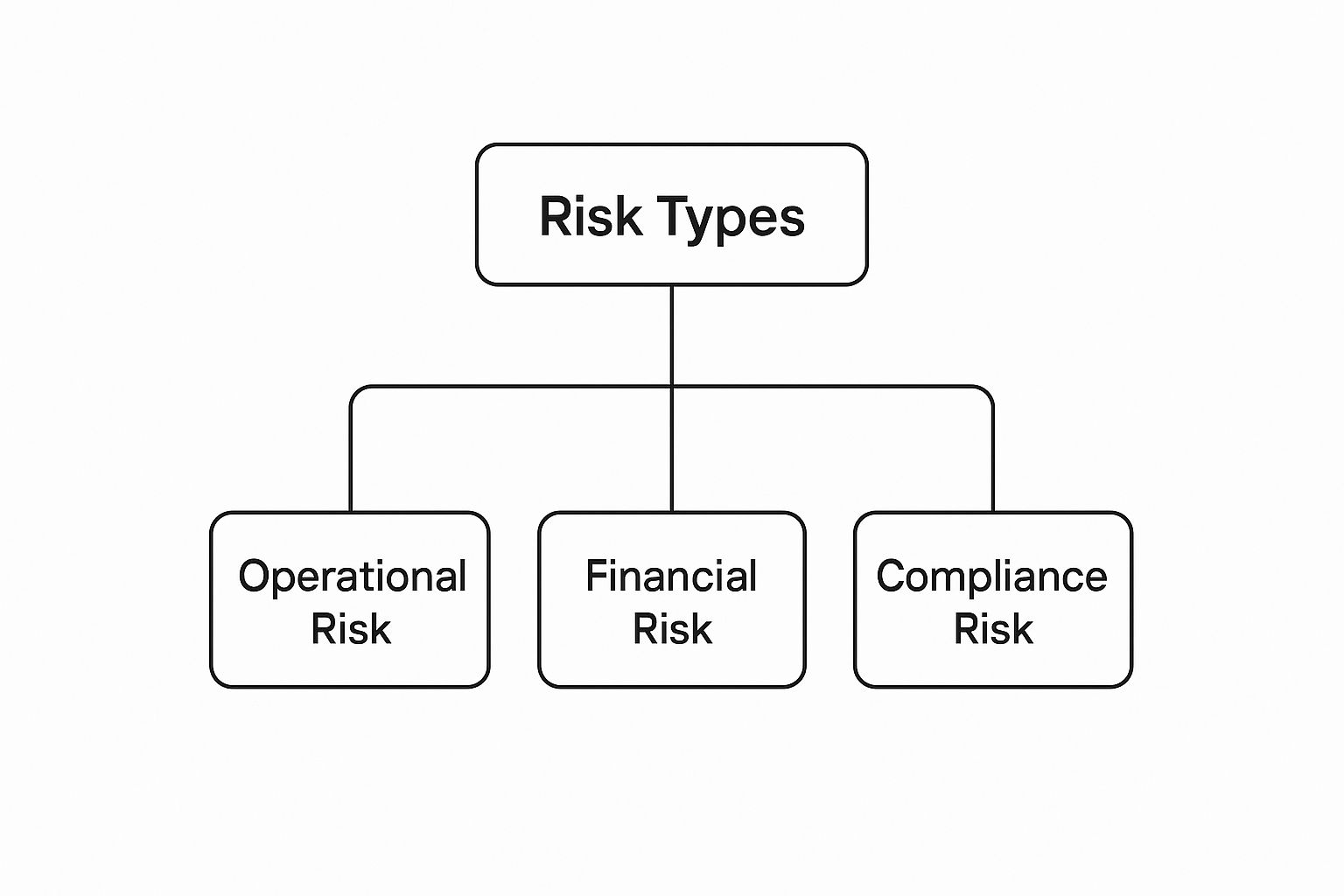
The diagram makes it clear: while financial and compliance risks are crucial, operational risk is all about the internal nuts and bolts of how your business runs day-to-day.
Risk Mitigation: Creating Your Action Plan
With your risks identified and prioritized, it’s time to do something about them. Risk mitigation is all about putting strategies in place to lower the chances or soften the blow of your most critical threats. You’ve got a few different moves you can make here.
- Avoid: Sometimes, the smartest play is to simply stop doing the thing that causes the risk. For example, you might discontinue an old, unstable feature that nobody really uses anyway.
- Transfer: This is where you shift the financial fallout of a risk onto someone else. The classic example is buying cybersecurity insurance to cover the potential costs of a data breach.
- Mitigate: This means taking direct action to make the risk smaller. Think implementing multi-factor authentication to reduce the odds of a security breach or cross-training your team so you’re not dependent on one person. One of the best mitigation tools is a strong process, and creating robust https://saasoperations.com/business-process-documentation/ is a great way to standardize your operations.
- Accept: For those minor risks with very low impact and likelihood, it might be more cost-effective to just accept them. You acknowledge they exist and are prepared to deal with the consequences if they ever actually happen.
Continuous Monitoring and Reporting
An ORM framework is not a “set it and forget it” project. The final pillar, continuous monitoring, makes it a living, breathing part of your business culture. Your risks will absolutely change as your company grows, technology evolves, and new threats pop up.
This means regularly reviewing your list of risks, checking in on your mitigation plans, and reporting key metrics to leadership. It’s a continuous loop that keeps your framework relevant and effective. A key piece of this puzzle for any resilient organization is solid Business Continuity Planning, which ensures you're truly prepared for disruptions.
By constantly watching and adapting, you keep your business ready for whatever comes next.
How to Build Your Framework Step by Step
Building an operational risk management framework from the ground up can feel intimidating. But it's really just a matter of breaking the project down into manageable pieces. Think of it less like writing a stuffy corporate manual and more like putting together a practical toolkit for your team.
This guide walks you through the process, step by step, so you can turn abstract concepts into a real asset for your SaaS business. Each step builds on the one before it, helping you create a framework that actually works and lasts.
Step 1: Secure Leadership Buy-In and Form a Team
Before you even think about listing risks, you need a champion. The very first move is getting your leadership team on board. This isn't just a formality. You have to clearly show them the value here, framing it as a strategic investment in the company's stability and customer trust—not just another expense.
Once you have that executive nod, it's time to build your team. Don't make this a one-department show. Pull in people from engineering, product, customer support, and sales. Everyone sees the business from a different angle, and those unique perspectives are gold when it comes to spotting potential problems.
Step 2: Run a Risk Identification Workshop
With your team assembled, it's time to start digging. The best way to unearth potential risks is to get everyone in a room for a structured workshop. The goal is simple: brainstorm a big, messy list of everything that could possibly go wrong with your people, processes, and systems.
Get the conversation flowing with a few good questions:
- What keeps you up at night? This question cuts through the jargon and gets right to the heart of people's biggest worries.
- What's our biggest single point of failure? This hones in on critical dependencies, whether it's one key engineer or a single cloud provider.
- Which of our processes are barely documented or all over the place? This targets the procedural weak spots that are just waiting to cause an error.
By the end of the workshop, you'll have a raw list of potential operational risks. This list is the foundation for everything that comes next.
An effective framework isn't about eliminating all risk—that's impossible. It's about understanding your specific vulnerabilities so you can make smart, informed decisions on where to focus your resources.
Step 3: Create Your Risk Register and Assess Risks
Okay, time to bring some order to the chaos of your brainstormed list. This is where a risk register comes in. At its simplest, it's a spreadsheet that tracks every risk you've identified. For each entry, you're going to assess two critical things: the potential impact it would have on the business and the likelihood of it actually happening.
A simple scoring system, like 1-5 for both impact and likelihood, works wonders here. Multiply them together to get a risk score. This simple math is what helps you prioritize, separating the minor annoyances from the genuine threats to your business. To make sure you're focusing on the right gaps, it can be helpful to learn how to perform a gap analysis and see where your current reality doesn't match your goals.
Step 4: Define Your Risk Appetite and Mitigation Strategies
You can't fix everything at once, and frankly, you don't need to. Every company has a risk appetite—the amount of risk it's willing to tolerate to achieve its goals. A fast-moving startup will likely have a much higher appetite for process-related risks than a large enterprise that handles sensitive financial data.
Once you're clear on your appetite, you can decide how to handle each high-priority risk:
- Avoid: Stop doing the thing that's causing the risk. Simple as that.
- Transfer: Offload the financial hit to someone else, usually through an insurance policy.
- Mitigate: Put controls in place to make the risk less likely to happen or less damaging if it does.
- Accept: Look the risk square in the eye and formally decide to do nothing, accepting the potential consequences.
Step 5: Assign Ownership and Establish a Review Cadence
A plan with no owner is just a document that gathers dust. For every single mitigation strategy, assign it to a specific person. That individual is now responsible for seeing it through and managing it long-term. This step is all about accountability; it's what keeps the momentum going.
Finally, set a schedule. This framework isn't a "one-and-done" project; it's a living part of your operations. Set up quarterly check-ins to go over the risk register, see how mitigation plans are progressing, and add any new risks that have popped up. This regular rhythm ensures your framework stays relevant and useful as your company continues to grow.
Weaving Risk Awareness into Your Company's DNA
An operational risk management framework is more than just a dusty binder on a shelf. It's a living, breathing part of your company's culture. A perfect framework is useless if your team doesn't understand it or, worse, is afraid to use it. The real goal is to move from a reactive, "fire-fighting" mentality to a proactive culture where everyone feels like a risk owner.
This kind of shift has to start at the top. When leadership consistently talks about risk, dedicates resources to fixing problems, and actually praises people for flagging issues early, it sends a clear signal. It tells the entire company that managing risk isn't just about compliance—it's about building a stronger, more resilient business.
A Simple Model for Clear Ownership
To make this cultural shift stick, you need a clear structure. Many companies use a model called the "three lines of defense." It sounds a bit formal, but the idea behind it is incredibly practical.
- First Line of Defense: These are your people on the front lines—the engineers shipping code, the support agents talking to customers, the sales team closing deals. They own the risks tied to their day-to-day work because they're the first to see when something might go wrong.
- Second Line of Defense: Think of this as your risk management or compliance team. Their job is to provide the tools, expertise, and oversight to help the first line succeed. They don't own the risks themselves, but they build and maintain the framework that keeps everything on track.
- Third Line of Defense: This is your internal audit function. They act as an independent check, making sure the whole system is working correctly and reporting their findings straight to the leadership team or the board.
For a growing SaaS company, you don't need to get bogged down in the jargon. The main principle is to separate the roles of owning, overseeing, and auditing risk. This prevents things from slipping through the cracks and ensures everyone knows exactly what they’re responsible for.
Putting It All into Practice
Turning theory into daily habit is where the real work begins. It’s all about consistent communication and practical training that makes risk awareness second nature for every single employee.
A robust risk culture is critical: firms deliberately balance the drive for returns with disciplined risk-taking, aiming to reduce material risk exposures and promote ethical conduct.
This means building risk discussions into your existing routines. During a sprint planning meeting, for instance, the dev team should spend five minutes talking about the operational risks of a new feature. And since security is such a huge part of operational risk, it's worth learning how to cultivate a security-aware-culture.
Reviewing your risk register regularly is also non-negotiable. A great way to do this is to tie it to your quarterly planning. Many teams use a https://saasoperations.com/quarterly-business-review-template/ to make sure risk conversations are a standard part of their strategic check-ins. This simple rhythm prevents your framework from becoming a static document that everyone forgets about.
Modern frameworks are getting smarter, blending hard data with qualitative insights. Companies are getting serious about their data strategies, using key risk indicators (KRIs) and running "what-if" scenarios to get ahead of threats. With risks like cybersecurity and global instability on the rise, investing in automation and solid employee training isn't just a good idea—it's essential for building a framework that can actually scale.
When everyone, from an intern to the CEO, understands their role in the operational risk management framework, it stops being a chore. It becomes a genuine competitive advantage that protects your company and fuels its growth.
Navigating Regulatory Compliance and Operational Risk

In the SaaS world, operational risk and regulatory compliance used to be two different conversations. Not anymore. Today, they are deeply connected. A solid operational risk management framework is no longer just a nice-to-have for making things run smoothly; it’s a must-have to prove to regulators that your business is stable, resilient, and worthy of trust.
Forget the days of compliance being a simple checklist you could tick off and file away. Now, regulators demand to see a living, breathing system for managing operational disruptions. They're looking past your balance sheet and focusing squarely on operational resilience—your ability to take a punch and get back up.
This fundamental shift means compliance is less about dodging fines and more about demonstrating that you're in control of your operational environment.
The New Standards for Operational Resilience
Regulators across the globe are raising the bar, and their expectations are bleeding into every industry. Frameworks that start in finance quickly become the gold standard for tech and SaaS, especially as enterprise clients begin demanding the same high level of assurance.
Take the direct impact of recent global mandates, for example. By 2025, regulatory bodies have put operational resilience in the spotlight. Rules like the UK's PS21/3 and Australia's Prudential Standard CPS 230 are forcing firms to identify their most critical services, set clear "impact tolerances," and run stress tests. This isn’t just a banking trend, either—the U.S. SEC’s priorities echo the same concerns. Yet, a huge gap exists: a staggering 52% of U.S. organizations still haven't connected their risk and resilience functions, highlighting a serious need for better frameworks. A failed software update in 2024 that brought industries from airlines to healthcare to a standstill is a powerful reminder of what’s at stake. You can get the full picture on this shift in this 2025 readiness report from The IIA.
Turning Regulatory Jargon into Action
This is where your operational risk management framework becomes your best friend—it helps you translate complex regulatory demands into concrete business actions. It gives you the structure to systematically meet, and even get ahead of, these expectations.
Think of it this way. Your framework helps you answer the big questions regulators are asking:
- What are your critical business services? Your risk identification process pins down the essential functions your customers can’t live without, whether it's the login system or payment processing.
- What is your acceptable downtime? Through risk assessment, you define clear impact tolerances. This isn't just a guess; it's a data-backed decision on how long a critical service can be down before it causes real harm to your customers and brand.
- How do you test your resilience? The mitigation and monitoring parts of your framework are perfect for running stress tests and incident simulations to prove your plans actually work under pressure.
A well-structured framework moves your company from a position of regulatory defense to one of operational confidence. It demonstrates that you have a deep, practical understanding of your own vulnerabilities and a clear plan to manage them.
Ultimately, a strong framework allows you to show, not just tell, regulators that your business is built to last. For a deeper look into building a comprehensive strategy, check out our guide on https://saasoperations.com/saas-risk-management/. It’s a powerful way to build trust with both customers and regulators alike.
Common Questions About ORM Frameworks
Even with a solid plan, building something as critical as an operational risk management framework is bound to bring up questions. Getting good answers to these common sticking points can clear up your strategy and help you keep moving forward. Here are the most frequent questions we hear from SaaS leaders.
How Is an ORM Framework Different from a Business Continuity Plan?
This is a great question, and the distinction is crucial.
Think of your operational risk management framework as your company's preventative medicine. It’s the daily system you use to spot and patch up weak points before they turn into a full-blown crisis. The whole point is to stop bad things from happening in the first place.
A business continuity plan (BCP) is completely different. That’s the emergency playbook you grab after disaster strikes. While the ORM framework is trying to prevent the fire, the BCP is the plan for putting it out and dealing with the aftermath.
Simply put, a good framework makes it far less likely you’ll ever need to use your BCP.
What Are the First Steps for a Small SaaS Startup?
If you're a small or early-stage startup, keep it simple. Seriously. Don't get bogged down trying to build a massive, enterprise-level system right out of the gate. Your first goal isn't perfection; it's just to start building the muscle memory for thinking about risk.
Here’s where to begin:
- Get the Team Together: Book a meeting and brainstorm your top 5-10 operational risks. What keeps you up at night? Think about a key engineer quitting, a security breach, or your main payment processor going down.
- Start a Simple Log: Open up a spreadsheet and list out those risks. That's it. You've just created your first risk register.
- Score and Solve: For each risk, give it a quick impact rating and then brainstorm one or two simple, practical things you can do to make it less likely to happen or less painful if it does.
How Often Should We Review Our Framework?
An ORM framework can't be a "set it and forget it" document. If it’s just sitting on a shared drive collecting digital dust, it’s useless. It has to be a living, breathing part of your operations that grows and changes right alongside your business.
A framework is only as good as its last review. Treat it as a dynamic tool that adapts to new challenges, technologies, and business goals to maintain its effectiveness.
You should plan on a deep, comprehensive review of the entire framework at least once a year. It's also smart to trigger a review anytime something big changes—like launching a new product, expanding into a new country, or migrating to a new cloud provider.
The heart of your framework, the risk register, needs more frequent attention. A quarterly check-in is a great rhythm. It gives you a chance to see how your mitigation plans are working and to add any new risks that have popped up. This regular cadence is what keeps your SaaS operations management sharp and relevant.
At SaaS Operations, we provide battle-tested playbooks and templates to help you build and maintain effective operational systems without starting from scratch. Save time and accelerate your growth with our proven frameworks.