A SaaS Operator’s Guide to Cross Functional Team Management
 Published By: Alex
December 29, 2025
Published By: Alex
December 29, 2025
Let’s be real. The idea of getting product, engineering, and marketing to pull in the same direction sounds great in a slide deck. But in practice? It’s often a mess.
We dream of a perfectly synced, high-performing team that ships incredible features at lightning speed. What we usually get is a mess of competing priorities, missed deadlines, and a whole lot of friction between people who are supposedly on the same team.
Why Most Cross Functional Teams in SaaS Are Broken
This isn't just an internal headache; it's a genuine threat to your company's growth. When teams stay stuck in their traditional silos, they chase their own department’s KPIs instead of focusing on what's best for the business.
Marketing is laser-focused on hitting their MQL number. Sales is pushing for that one niche feature they need to close a big deal this quarter. Meanwhile, engineering is just trying to carve out some time to tackle mounting tech debt. Everyone is working hard, but nobody is moving together.
The Real Cost of Dysfunction
This kind of friction has very real consequences. Product roadmaps turn into a tug-of-war. Launch dates get pushed back again and again. Critical customer feedback gets lost in the void between the support and product teams.
The end result is a company that moves too slowly and can't adapt to what the market—and your customers—are telling you.
It's a surprisingly common problem. Studies show that a staggering 75% of cross-functional teams are dysfunctional. That means three out of every four attempts to build these collaborative units are falling flat.
But here’s the flip side: companies that get this right see massive gains. Organizations with well-aligned teams are 1.9× more likely to outperform their peers on revenue growth. When these teams click, the impact goes straight to the top line. You can dig into more of the data on how healthy teams drive results in this McKinsey report on team health.
The biggest mistake I see is confusing proximity with collaboration. You can't just throw people from different departments into a "squad," give them a project name, and expect magic to happen. Without a shared scorecard, a clear decision-making process, and one place for all communication, you’ve just created the illusion of a team.
This is exactly where the traditional org chart fails modern SaaS companies. It’s built for top-down command and control, reinforcing those vertical silos. It makes working across departments feel like an uphill battle that takes a heroic effort every single time.
To fix this, you need a completely different playbook—one designed from the ground up for shared goals and crystal-clear processes.
The Real Impact of Siloed vs Integrated Teams
It's easy to talk about "friction" and "misalignment" in abstract terms. But let's look at what this actually means for the day-to-day reality of running a SaaS business. The difference between a siloed organization and one with truly integrated cross-functional teams is night and day.
| Metric | Siloed Teams (The Default) | Cross-Functional Teams (The Goal) |
|---|---|---|
| Time to Market | Launches are slow, often delayed by last-minute scrambles and rework. | Features ship faster with fewer surprises because everyone is involved from the start. |
| Product-Market Fit | Product decisions are based on gut feelings or the "loudest voice in the room." | The roadmap is directly informed by real customer feedback and market data. |
| Customer Experience | Inconsistent. Customers get different answers depending on who they talk to. | Seamless. The customer journey feels cohesive across product, support, and marketing. |
| Team Morale | High levels of frustration, blame games, and burnout are common. | People feel a sense of shared ownership and are motivated by collective wins. |
| Innovation | New ideas get stuck in departmental approvals and die on the vine. | Ideas flow freely and are evaluated based on their potential impact on the business. |
As you can see, this isn't just about making meetings more pleasant. The way your teams are structured directly impacts your ability to compete and win.
Moving from Theory to Action
The good news is that this is a solvable problem. It just requires you to get intentional about how your teams work together.
This means setting clear rules of engagement. It’s why understanding what is process documentation is such a critical first step. When things get stressful, people will always fall back on old habits. A well-documented process is your safety net.
In this guide, we're going to hand you that playbook. We’ll skip the high-level theory and give you the exact templates, frameworks, and hard-won advice you need to fix these issues for good. You'll leave with a clear action plan for building a cross-functional engine that actually works.
How to Design Your Cross Functional Team Structure
A brilliant strategy is worthless if your team isn't set up to actually execute it. In the fast-paced world of SaaS, the traditional, top-down org chart is a boat anchor. It actively works against the speed and collaboration you need, creating deep vertical silos where information gets trapped and priorities drift apart.
The result? Misaligned teams and projects that grind to a halt.
High-growth SaaS companies are tearing up that old playbook. They're intentionally designing their teams around outcomes, not just job functions, and embracing a much more fluid, integrated model.
This is the classic problem we've all seen before: Product, GTM, and Engineering teams operating in their own little worlds, with walls so high that communication becomes a game of telephone.

In this setup, even a simple request has to travel up one chain of command and down another, which is a perfect recipe for delay, frustration, and misinterpretation.
Embrace the Pod Model
So, what’s the alternative? The most effective structure I've seen for managing cross-functional teams is the pod model.
Think of a pod as a small, autonomous startup within your company. It’s built around a specific mission—maybe a customer segment, a product area, or a key business objective. The crucial part is that it contains all the skills needed to achieve its goal without constantly waiting on other teams.
A typical product-focused pod might look something like this:
- A Product Manager (driving the "why" and "what")
- An Engineering Lead and 2-3 Engineers (building the "how")
- A Product Designer (owning the user experience)
- A Product Marketing Manager (crafting the go-to-market plan)
This self-contained unit can move incredibly fast. Instead of getting stuck in another department's backlog, the pod has the expertise and authority to make its own decisions and get things done.
This isn't just a feel-good theory; it has a massive commercial impact. Pod-based GTM approaches have been shown to drive a 32% increase in pipeline and a 40% jump in average deal sizes for companies that ditched the silos.
Define Who Owns What with RACI
Of course, just throwing people from different departments into a "pod" doesn't magically solve everything. The next big hurdle is answering the age-old question: "Who actually owns this?"
Without crystal-clear roles, you either get people stepping on each other's toes and duplicating work, or critical tasks fall through the cracks entirely. The best tool I've found to prevent this chaos is a RACI matrix.
RACI is a dead-simple framework for clarifying exactly who is responsible for what on any given project. It's an acronym for:
- Responsible: The person (or people) who does the hands-on work.
- Accountable: The one person who owns the outcome and has the final say. This is the key—only one "A" per task.
- Consulted: Folks who provide input and expertise. This is a two-way conversation.
- Informed: People who just need to be kept in the loop on progress. This is a one-way street of information.
A classic mistake is to make multiple people 'Accountable.' When everyone is accountable, nobody is. The real power of RACI is that it forces the tough conversation to designate a single, undisputed owner for every key decision and deliverable.
Mapping this out before a project kicks off removes all that ambiguity and gives team members the confidence to take action.
Sample RACI Matrix For A New Feature Launch
Let's make this real. Imagine your pod is launching a new feature. A simple RACI matrix in a spreadsheet can prevent a world of pain by clarifying who does what. It’s a living document that aligns the entire team.
| Task/Decision | Product Manager | Lead Engineer | Marketing Lead | Head of Sales | Customer Support |
|---|---|---|---|---|---|
| Finalize feature scope | A | R | C | C | I |
| Develop technical specs | C | A | I | I | I |
| Create marketing assets | C | I | A | R | C |
| Set launch pricing | A | C | C | R | I |
| Train sales team | C | I | R | A | C |
| Write support documentation | C | I | C | I | A |
| Launch announcement blog post | C | I | A | I | I |
This simple chart makes it immediately obvious who needs to be in which meeting and who has the final call. No more guessing games.
Creating a RACI doesn't have to be some bureaucratic exercise. It’s a practical alignment tool that keeps everyone rowing in the same direction. When you clearly define ownership upfront, you replace confusion with clarity and set your team up to win.
The principles here are foundational for other teams, too. For example, clear ownership is vital when designing your customer success team structure, making sure reps know exactly who to pull in for different issues. And as teams become more distributed, these frameworks become even more critical. You can explore strategies for managing relationships and deals across international teams to see how these concepts apply on a global scale.
Goals and Scorecards: Getting Everyone to Row in the Same Direction
So, you’ve got a slick new team structure, maybe even a pod model. That’s a fantastic start. But a great structure with no shared direction is just well-organized chaos. This is precisely where most cross-functional initiatives stumble—they forget to tear down the old, siloed KPIs and build something new in their place.
If your marketing folks are still living and dying by MQLs while engineering is focused on story points, you're going to have a problem. They’ll naturally pull in opposite directions. The real trick to getting everyone aligned is to create a single source of truth for what "winning" actually looks like. It needs to be something that everyone, from the product manager to the GTM lead, not only understands but genuinely gets behind.
First, Find Your North Star
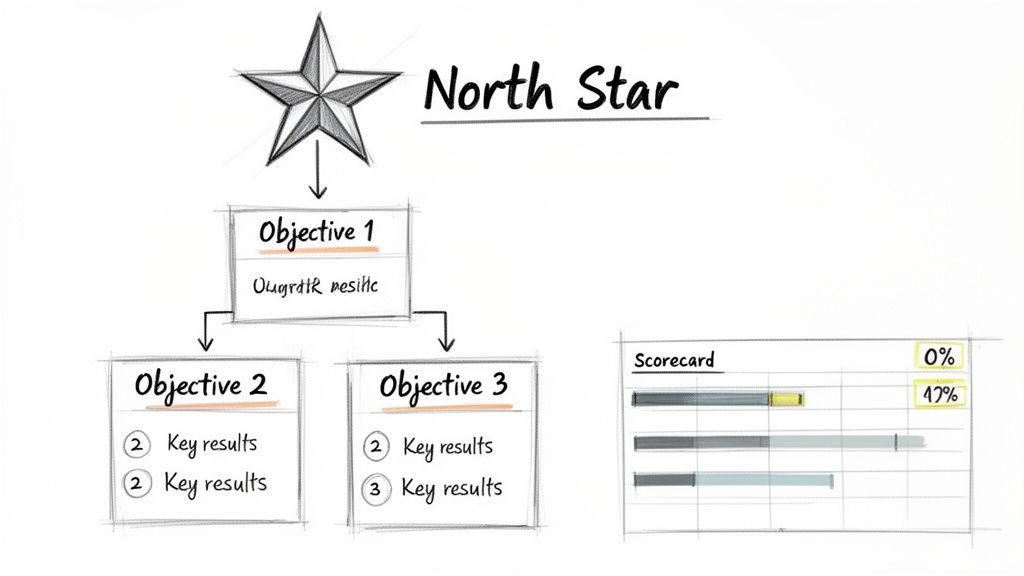
To get people paddling together, you need a shared destination. In the SaaS world, we call this the North Star Metric (NSM). This isn't some fluffy vanity metric like website traffic; it's the one number that best reflects the real value your customers get from your product.
Think about it: for Slack, it was "messages sent." For Airbnb, it was "nights booked." A solid NSM is a leading indicator of long-term success because it’s tied directly to customer value. It’s also the ultimate tie-breaker when priorities start to clash.
Your product lead wants to build a fancy new feature. Your marketing lead wants to simplify the onboarding flow. Who’s right? It’s simple: whichever one is more likely to move the North Star Metric.
The NSM becomes the guiding light for the whole company. But it’s a bit too high-level for a single pod to own directly. That’s where you need to break it down into something they can actually wrap their arms around.
Now, Cascade Goals with OKRs
This is the perfect job for the Objectives and Key Results (OKRs) framework. It’s a beautifully simple way to translate that lofty North Star into concrete, measurable goals your team can actually execute on.
Here’s the breakdown:
- Objective (O): This is the "what." It's a qualitative, ambitious, and inspiring goal for the team. Think, "What are we trying to accomplish this quarter?"
- Key Results (KRs): This is the "how." These are the quantitative outcomes that prove you hit your objective. They answer, "How will we know we got there?"
Let's imagine your company's North Star is "weekly active users." A pod focused on user activation might set an OKR for the quarter that looks like this:
Objective: Create a frictionless onboarding experience that gets new users to their "aha!" moment fast.
Key Results:
- Boost the new user activation rate from 25% to 40%.
- Slash the time-to-first-key-action from 48 hours to just 6 hours.
- Cut support tickets from new users in their first week by 50%.
See what’s happening here? The KRs are all about outcomes, not outputs. The team’s job isn't "launch a new tutorial." It's "increase the activation rate." This subtle shift gives them the autonomy to figure out the best way to hit the numbers.
Finally, Build a Scorecard Everyone Lives By
OKRs set the destination, but a good scorecard is the GPS telling you if you're on track week by week. The best scorecards for cross-functional teams are dead simple, highly visible, and reviewed religiously.
This isn’t about tracking a zillion different things. It’s about laser-focusing the entire team on the handful of numbers that truly matter. For our onboarding pod, the weekly scorecard would only track three things: activation rate, time-to-first-action, and support ticket volume. That’s it.
At HubSpot, they use their "flywheel" concept to track shared goals across marketing, sales, and service on unified dashboards. This transparency is key. If one team's numbers start to dip, everyone sees it and can swarm the problem together. It completely kills the blame game because you're all looking at the exact same data.
Building a powerful scorecard is a core discipline in SaaS operations. To really nail this, you can dive deeper with our guide on how to build a KPI and scorecard that genuinely drives accountability.
The real magic kicks in when this scorecard becomes the centerpiece of your weekly team meetings. Instead of a boring round-robin of status updates, the meeting becomes a dynamic problem-solving session centered on one question: "Why is this number red, and what are we going to do about it this week?" This rhythm transforms goal-setting from a once-a-quarter chore into a daily habit of focused execution.
Getting Your Communication and Meeting Cadence Right
Okay, you've got your team structure nailed down and everyone's looking at the same goals. That's the foundation. But the real work, the day-to-day grind, happens in the conversations, the meetings, and the endless project updates. Let's be honest, cross-functional communication doesn't just happen. If you don't design it with intention, you'll either drown in pointless meetings or get lost in a chaotic Slack vortex where nothing important ever gets decided.
The point isn't to talk more. It's to talk smarter. This means setting up a deliberate rhythm of interactions that keeps the team aligned without bogging them down. We're building a system where information flows predictably, from the big-picture strategy all the way down to who's doing what today.
Design a Meeting Rhythm That Actually Works
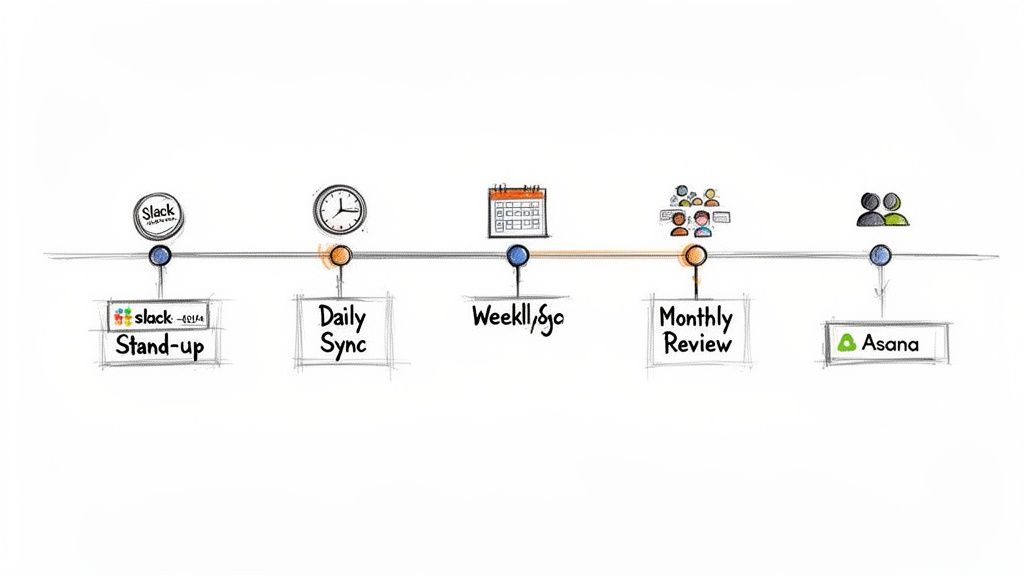
Over the years, I've found a battle-tested meeting cadence for cross-functional pods that just plain works. It boils down to three core touchpoints, each with a crystal-clear purpose. This setup makes sure you hit on tactics, weekly progress, and strategy without any frustrating overlap.
-
Daily Asynchronous Stand-up (in Slack): First thing's first: kill the daily 15-minute sync meeting. It’s a focus killer. Instead, have everyone answer three quick questions in a dedicated Slack channel each morning: What did I get done yesterday? What’s on my plate today? Any blockers? This keeps everyone looped in and flags problems immediately.
-
Weekly Tactical Sync (30 minutes, max): This is your most important meeting of the week, period. The only focus should be on your shared scorecard and solving problems. Don't let it become a round-robin status report—that’s what the async stand-ups are for. A solid weekly team meeting agenda centers on the question, "What's red, why is it red, and what experiment can we run this week to turn it green?"
-
Monthly Strategic Review (60 minutes): This is where you zoom out. You'll review progress against your quarterly OKRs, talk through what you learned from the last month's experiments, and tweak the plan for the month ahead. It’s all about connecting the weekly tactical grind back to the bigger picture.
Use Tools to Kill Unnecessary Meetings
So many meetings exist for one simple reason: information is siloed and hard to find. The secret to a leaner calendar is creating a single source of truth for everything project-related. This isn't just about writing things down; it's about making information flow automatically.
Tools like Asana, Jira, or Trello are your best friends here. When project status is transparent and accessible to everyone, the need for check-in meetings evaporates. When a marketer can see the exact status of a new feature without pinging an engineer, you've just saved everyone 30 minutes.
The folks at Zapier, a fully remote company, are absolute masters of this. Their operating principle is that everything is documented and accessible by default. This forces clarity and dramatically reduces the need for real-time meetings, which is a lifesaver for teams scattered across different time zones.
This helps build a culture of "async-first." Before anyone schedules a meeting, the first question should be: "Can this be a comment in Asana? A quick Loom video? A well-written doc?" This simple habit frees up hours of precious time for actual, deep work.
Intentionally Drive More Cross-Functional Interaction
When you create these structured channels for communication, something powerful happens as a side effect: you naturally get more interaction between different functions. Engineers, marketers, and product managers are suddenly in the same weekly sync, looking at the same metrics, and collaborating on tasks in Asana. They start to think and act like one team.
And this isn't just some fluffy "team-building" exercise. The data backs it up. Benchmarks show that when around 30% of an employee’s interactions are with colleagues outside their direct team, organizations see real results. Companies hitting that number report up to 40% faster problem-resolution rates and a noticeable jump in innovation. You can dig into the data on how Worklytics connects this to performance in their 2025 hybrid workforce report.
By designing a communication system that forces these cross-departmental touchpoints, you're literally building an engine for faster problem-solving and better ideas. Your meeting rhythm and toolset aren't just admin details—they're strategic assets.
Resolving Conflict and Making Decisions Without the Drama
Let's be real: when you throw a bunch of smart, passionate people from product, engineering, and sales into a room, you're going to get friction. It's not a bug; it's a feature. Conflict isn't a sign your team is broken. It’s a sign that people are engaged and care enough to have a strong opinion. The real measure of a great cross-functional team isn't avoiding disagreement, but having a solid game plan for navigating it.
Without a framework, simple disagreements can spiral into personal feuds or political turf wars. We’ve all seen it happen. Sales is pushing hard for a custom feature they need to close a whale of a deal this quarter. Meanwhile, product is freaking out because that same feature will add a mountain of tech debt and completely derail the long-term roadmap.
So, who gets their way?
Adopt the "Disagree and Commit" Mindset
This is where you pull out one of the most powerful tools in management: disagree and commit. It’s a concept that legends at places like Amazon and Intel built their cultures on, and for good reason. The idea is simple but has a massive impact.
It means creating a space where everyone is not just allowed, but encouraged, to voice their opinions and debate ideas—vigorously. But once a decision is made, that’s it. Everyone, especially the people who were on the losing side of the debate, gets behind that decision 100%.
There's no room for passive aggression. No "I told you so's" lurking around the corner. No subtle foot-dragging to prove you were right all along. The team's success hinges on everyone rowing in the same direction, even if they didn't all agree on the destination beforehand.
Your job as a leader is to foster an environment of psychological safety where healthy debate can thrive. People need to know they can challenge an idea, no matter whose it is. But you also have to be the one to draw the line and say, "The debate is over, now we execute."
This single principle is what separates the high-performers from the teams that just spin their wheels in endless meetings.
Have a Clear Escalation Path
"Disagree and commit" is your go-to for most day-to-day stuff. But what about those big, high-stakes deadlocks where the team is truly stuck between a rock and a hard place? You absolutely need a pre-defined escalation path. Winging it is a recipe for disaster, with people running to their department heads and turning a team-level issue into an executive-level firefight.
A simple and effective escalation process looks something like this:
-
Frame the Disagreement. The first move isn't to argue more. It's to open a shared doc and write it all down. What's the core issue? What are the different options on the table? What are the pros and cons of each, backed by whatever data you have? The act of writing it down forces clarity and often illuminates a solution you couldn't see in the heat of the moment.
-
Identify the Decider. Time to pull out that RACI matrix we talked about. Who is the single person Accountable (A) for this outcome? That person gets the final say. The rest of the team's job is to arm them with the best possible information to make a smart call.
-
Set a Deadline. Big decisions can't just hang in the air forever. The decider needs to commit to a final call by a specific date and time—usually within 24-48 hours. This injects urgency and snaps the team out of analysis paralysis.
This framework strips the emotion out of the process. It's no longer about who can argue the loudest or who has the most clout. It’s about a clear, transparent system for getting unstuck and moving forward.
Practical Scripts for Those Tough Conversations
Of course, having a framework is one thing, but actually navigating the conversation is another. More often than not, conflict comes from a simple miscommunication, not a fundamental disagreement on the goal. Using the right words can de-escalate a tense moment and turn it into a problem-solving session.
Keep a few of these phrases in your back pocket:
- To understand their side: "Help me understand your thinking here. What data or experience is leading you to that conclusion?"
- To find common ground: "It sounds like we both want to increase user retention, we just have different ideas on how to get there. Is that a fair summary?"
- To get unstuck and move forward: "We've heard some great points on both sides. To keep us moving, what's one small experiment we could run next week to test one of these assumptions?"
These aren't magic words, but they're incredibly effective. They shift the dynamic from a battle of wills to a collaborative search for the best path forward—turning potential roadblocks into opportunities for smarter, more thoughtful decisions.
Your Cross-Functional Team Management Playbook
Alright, we've talked strategy. Now it’s time to roll up our sleeves and get things done. This section is your tactical toolkit—a collection of resources you can put into action immediately.
Think of this as the operational heart of the guide. It’s all about having the right SOPs and templates ready to go when you need them. And if you're looking for more, we've got a whole library of battle-tested resources in our complete collection of SaaS playbooks designed to make your operations run smoother.
Your Execution Checklist and Templates
This isn't just a recap; it’s your command center for putting these ideas into practice. Below are the key plays we've discussed, with direct links to the tools you need. Whether you're fine-tuning an existing process or building one from scratch, this is your starting point.
- RACI Matrix Template: Grab our plug-and-play spreadsheet to map out who's Responsible, Accountable, Consulted, and Informed. This will kill the "who owns this?" debate before your next project even kicks off.
- Cross-Functional Scorecard: Use this sample scorecard to track the shared KPIs that actually matter. It’s designed to make your weekly meetings focused on outcomes, not just updates.
- Pre-Built Meeting Agenda: Just copy and paste this agenda to keep your tactical syncs on track, efficient, and—most importantly—under 30 minutes.
So many SaaS teams today are spread out across the globe. Getting alignment can be even tougher when you're not in the same room. For some great tips on that front, check out this guide on how to manage remote teams effectively to build a cohesive culture, no matter where your people are.
Got Questions? We've Got Answers
If you're wrestling with getting cross-functional teams right, you're not alone. We've seen a lot of SaaS operators run into the same hurdles. Here are a few of the most common questions that come up, along with some straight talk on how to solve them.
What’s the single biggest mistake people make with cross-functional teams?
The classic blunder is thinking that just because you put people from different departments in the same room (or Slack channel), they'll magically start collaborating. It just doesn't work that way.
Creating a "pod" without a shared playbook is just a cosmetic change. You get the illusion of a team, but underneath, everyone still has their old siloed mindset and competing priorities. It's a recipe for confusion and frustration.
Real cross-functional success has to be intentional. It means building the operational scaffolding: a clear team structure, shared scorecards that tie directly to what the business cares about, and a non-negotiable rhythm for communication. Without that framework, teams will always slide back to protecting their own departmental turf.
So, how do you actually measure if a cross-functional team is winning?
You have to get laser-focused on shared business outcomes, not departmental vanity metrics. It’s a huge mental shift from tracking outputs (like "number of features shipped") to measuring real-world impact (like "user adoption rate").
Think about a product launch pod. Their success isn't just about hitting the "go live" button. It’s about the revenue that feature generates in the first 90 days or the increase in user activation. A go-to-market team? They should live and die by metrics like pipeline velocity or customer acquisition cost.
The trick is to build a unified scorecard with just 3-5 KPIs that everyone on the team—from product to marketing to sales—is accountable for.
When every single person on that team wakes up obsessing over the same handful of numbers, you've nailed it. That's your measurement for success. It stops being about "my part" and becomes about our collective impact.
How can I get buy-in from leaders who are used to the old siloed way of doing things?
You have to start with the pain they're already feeling. Show them the data. Point to exactly how the current silos are slowing down product velocity, creating a clunky customer experience, or leaving money on the table.
Frame the move to cross-functional teams as the solution to hitting the company's biggest goals faster. This isn't about taking away anyone's authority; it's about making their part of the business more successful.
A great way to do this is to start small. Launch a single pilot "pod" and give them a critical, high-visibility project. Let them get a quick, undeniable win on the board. Honestly, success is the best argument you'll ever make. Once other leaders see that small team running circles around everyone else, they'll be lining up to get their own.
Ready to stop the departmental tug-of-war and build a truly aligned team? SaaS Operations provides the battle-tested playbooks, templates, and SOPs you need to implement these frameworks today. Save time, accelerate growth, and run a more efficient business with our plug-and-play resources.