Mastering SaaS Customer Acquisition Cost: An Operator’s Playbook
 Published By: Alex
December 17, 2025
Published By: Alex
December 17, 2025
Let's cut right to it. What's your SaaS Customer Acquisition Cost (CAC)? Simply put, it's the total amount of money you spend to land one new paying customer. This isn't just your ad budget; it's the whole shebang—every cent spent on sales and marketing, from salaries and commissions to the tools in your tech stack, all divided by the number of new customers you signed.
What SaaS Customer Acquisition Cost Really Means
Here’s a critical mindset shift: stop thinking of CAC as a simple expense. It’s an investment. Every dollar you put into acquiring a customer is capital you’re deploying to generate future, predictable recurring revenue. This simple switch changes the conversation from "How much are we spending?" to the much smarter question, "What's the return on our investment?"
Think of this metric as the pulse of your company’s financial health. It directly impacts your cash runway, your path to profitability, and the story you can confidently tell investors. A high CAC isn't necessarily a dealbreaker, but a high CAC that isn't backed up by a strong customer lifetime value (LTV) is a massive red flag signaling a broken business model.
Why This Metric Is Non-Negotiable
For any SaaS operator, obsessing over CAC is a matter of survival and scale. If you don't have a tight grip on this number, you're flying blind. You're making guesses instead of data-backed decisions about your growth engine.
Here’s exactly why it’s so critical:
- It Dictates Your Profitability: Your CAC determines your payback period—how long it takes for a customer to become profitable. A shorter payback period means healthier cash flow and a more resilient business.
- It Validates Your Go-to-Market Strategy: Tracking CAC by channel gives you a crystal-clear playbook. It shows you where to double down (like HubSpot discovered with content marketing) and which channels are just burning cash.
- It Influences Your Pricing and Positioning: Is your CAC uncomfortably high? That might be a signal to aim for higher-value customers or rethink your pricing tiers to ensure your unit economics work.
- It Is a Core Part of Your Financial Story: When you walk into a room with investors, they will scrutinize your CAC and how it stacks up against your LTV. This ratio is their shortcut to understanding if your business is viable and truly scalable.
In short, CAC isn’t just some vanity metric for the marketing team. It’s a core business metric that directly ties your spending to real financial outcomes. It answers the most important question: is your growth healthy, or are you just buying revenue at a price you can't sustain?
Getting this right is the foundation for understanding all the other critical https://saasoperations.com/saas-kpis/ that give you a complete view of your company's health. For a closer look at the mechanics, this guide on Customer Acquisition Cost for SaaS is a great resource. Mastering CAC is your first real step toward building a SaaS company that's predictable, scalable, and—most importantly—profitable.
Calculating Your SaaS CAC With Confidence
Getting your SaaS customer acquisition cost wrong isn't just a spreadsheet error—it's the kind of mistake that torpedoes your budget, hiring plans, and entire growth strategy. To scale without flying blind, you need to calculate your CAC with absolute confidence. That means ditching the back-of-the-napkin math for a number that’s actually useful.
Let’s walk through the three essential formulas every SaaS operator needs to know. We'll start with the basics and then build up to the more robust calculations that your board and investors will demand.
The Basic Formula For A Quick Snapshot
This is your starting point. Think of it as a quick health check to get a general feel for your acquisition efficiency over a specific period, like last month or the last quarter.
The formula itself is super simple:
Basic CAC = Total Marketing & Sales Expenses / # of New Customers Acquired
Let's imagine a startup called "SyncUp." They spent $10,000 on Google Ads and brought in 50 new customers last month. Their basic CAC would be $200 ($10,000 / 50). This number is easy to find, but it's dangerously incomplete because it leaves out a ton of very real expenses.
The Fully-Loaded Formula Investors Actually Care About
Okay, now for the real deal. The fully-loaded CAC gives you an honest, unvarnished look at what it truly costs to land a new customer. It includes all the hidden-in-plain-sight costs that the basic formula ignores—which is exactly what any savvy investor is going to look for.
A fully-loaded calculation rolls in everything:
- Salaries & Commissions: The full compensation for your entire marketing and sales crew.
- Tools & Software: Your CRM, marketing automation platform, analytics tools, and anything else used to win customers.
- Overhead: A fair portion of the office rent, utilities, and other general expenses allocated to marketing and sales.
- Ad Spend & Content: All direct campaign costs, plus any expenses for content creation or agency fees.
Let’s go back to SyncUp for the same month, but this time, we'll get the full picture:
- Marketing & Sales Salaries: $25,000
- Ad Spend: $10,000
- Tool Subscriptions (CRM, etc.): $2,000
- Overhead Allocation: $1,500
- Total Expenses: $38,500
They still acquired the same 50 new customers.
Fully-Loaded CAC = $38,500 / 50 = $770
That $770 is a much more sobering—and realistic—number than the quick $200 estimate. This is the figure you absolutely must use for financial planning and for calculating your LTV:CAC ratio. Making decisions based on the $200 CAC would trick you into thinking your growth engine is way more efficient than it really is.
The Channel-Specific Formula To Pinpoint Profitability
While your fully-loaded CAC is a fantastic top-level metric, it doesn't tell you where your best customers are coming from. Calculating CAC for each specific channel is how you find your goldmines and stop pouring cash into money pits.
The formula is just a more focused version of the basic calculation:
Channel CAC = Total Spend on a Specific Channel / # of New Customers from that Channel
Let's say SyncUp’s $10,000 ad spend was split between two platforms:
- Google Ads: Spent $7,000 and acquired 20 customers.
- CAC = $7,000 / 20 = $350 per customer.
- LinkedIn Ads: Spent $3,000 and acquired 30 customers.
- CAC = $3,000 / 30 = $100 per customer.
Boom. This simple breakdown shows that LinkedIn Ads are 3.5x more efficient for SyncUp than Google Ads. This is the exact playbook used by early-stage SaaS companies to find their growth loops. The next actionable step is to reallocate budget from Google to double down on what’s working, ultimately lowering their overall acquisition cost.
For SaaS operators, a solid grasp of these formulas is non-negotiable. It’s how you move from guessing to knowing, optimize your spending with precision, and build a truly efficient growth machine. The table below gives you a quick-reference guide to keep these crucial calculations handy.
Key SaaS CAC Formulas for Operators
| Formula Type | Calculation Breakdown | Primary Business Use |
|---|---|---|
| Basic CAC | Total M&S Ad Spend / New Customers | Quick, high-level pulse check on acquisition efficiency. |
| Fully-Loaded CAC | (Total M&S Salaries + Tools + Overhead + Ad Spend) / New Customers | Financial planning, investor reporting, and calculating LTV:CAC. |
| Channel-Specific CAC | Total Spend on Channel X / New Customers from Channel X | Optimizing budget allocation and identifying profitable marketing channels. |
By mastering these three views of CAC, you gain the clarity needed for smarter, more strategic growth. If you want to make this process even easier, you can plug your numbers directly into our pre-built customer acquisition cost calculator.
SaaS CAC Benchmarks: What Does "Good" Actually Look Like?
So, you've done the math and have a number for your customer acquisition cost. Now what? The million-dollar question every founder asks is, "Is my CAC any good?"
Knowing your number is step one. But the real magic happens when you understand how it stacks up against the rest of the market. Let's be clear: there's no single, magical CAC number. A "good" CAC is a moving target, completely dependent on who you sell to, your industry, and how you sell.
There’s just no universal standard for SaaS CAC. A B2B fintech company navigating complex enterprise deals will have a CAC that's easily 10x higher than a simple, self-serve project management tool for freelancers. And that's totally fine. The goal isn’t a race to the bottom; it's about building a growth engine that's both profitable and scalable.
This breakdown covers the essential formulas you'll need. Think of them as different lenses for viewing your acquisition costs, ensuring you're always comparing apples to apples.
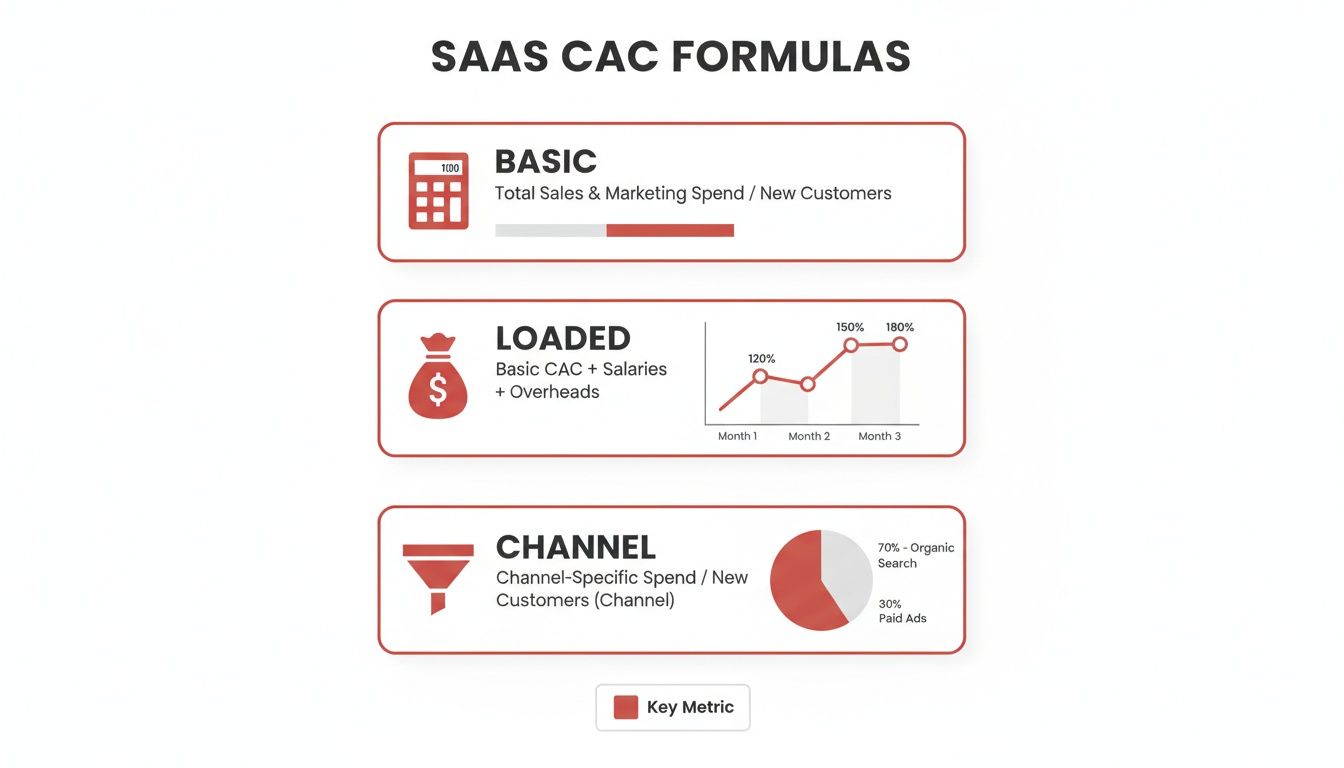
From a quick-and-dirty snapshot to a deep dive on channel performance, each formula gives you a piece of the puzzle.
How Your Target Market Changes the Game
The biggest lever on your CAC is, without a doubt, your ideal customer profile (ICP). Selling to a small business is a completely different world from selling to a Fortune 500 company, and your acquisition costs will absolutely reflect that.
- SMB-Focused SaaS: These companies live and breathe low-touch, automated funnels. Think of Basecamp or Mailchimp in their early days. The playbook involves SEO, content marketing, and paid social ads driving to a free trial. The sales cycle is fast—sometimes just hours—and the CAC is often under $500.
- Enterprise-Focused SaaS: This is Salesforce's playbook. Landing big fish requires a high-touch, human-powered approach: field sales teams, multiple demos, long-winded contract negotiations, and sales cycles that can last 6-18 months. Those costs—salaries, travel, commissions—drive the CAC into the thousands, sometimes tens of thousands of dollars.
The main takeaway is this: your go-to-market strategy dictates your cost structure. A product-led growth (PLG) model is built for low CAC at scale. A traditional sales-led motion is a big investment in landing high-value contracts. Neither is "better"—they just serve different markets with totally different economics.
The Reality of Industry-Specific CAC
On top of your target market, your industry plays a massive role. If you're in a highly regulated space like finance or healthcare, you can expect higher acquisition costs right out of the gate. Longer sales cycles, compliance hurdles, and the need for specialized sales reps all add up.
A B2B SaaS CAC report from First Page Sage really highlights these differences. The numbers are eye-opening. Aviation & Defense tops the charts, starting at $525 for small customers and soaring to $8,009 for enterprise, thanks to complex procurement processes.
Insurance is another shocker, with a $1,310 CAC for small businesses that balloons to $11,251 for enterprise. That's the cost of building trust and navigating heavy regulations. Medtech isn't far behind, ranging from $948 to $11,044, where high costs are justified by the massive lifetime value of mission-critical software.
Contrast that with leaner industries. eCommerce CAC runs from $299 to $2,206, showing how effective digital funnels can be. Legaltech starts low at $321 but still climbs to $6,477 for those larger, more complex deals.
At the end of the day, context is everything. Don't get fixated on a single number. The smartest operators benchmark their performance against similar companies and, more importantly, against their own customer lifetime value (LTV). That CAC-to-LTV ratio is the ultimate health metric for your business. Comparing your performance to other SaaS metrics benchmarks is how you get the full picture and start making truly smart decisions about growth.
LTV and CAC: Your SaaS Growth Engine's Two Most Important Gauges

Tracking your SaaS customer acquisition cost by itself is like staring at your car's speedometer without ever checking the fuel gauge. You know how fast you're going, but you have no idea if you're about to run out of gas.
CAC tells you what you spend. LTV (customer lifetime value) tells you what you get back. You need both to know if you're actually going anywhere.
This is where the LTV:CAC ratio becomes your North Star. It’s the single most critical metric for figuring out if your SaaS business has a viable future. It answers the one question that matters most: are the customers you're paying for actually going to make you money in the long run?
Think of it like stocking a vending machine. Your CAC is the all-in cost to buy a candy bar and get it into a slot. The LTV is the total cash you'll eventually collect from that one slot. If it costs you $1 to stock the item but you only ever sell $0.75 worth, you've got a failing business on your hands.
First, Nail Down Your LTV
Before you can get to the ratio, you need a solid LTV figure. A straightforward way to get a reliable estimate is by using your Average Revenue Per Account (ARPA) and your customer churn rate.
LTV = (Average Revenue Per Account / Customer Churn Rate)
Let's say your average customer pays you $300 a month and your monthly churn is 5%. Your LTV would be $6,000 ($300 / 0.05). This gives you the "value" side of the equation.
(If you want to go deeper, our guide covers all the nuances of a proper lifetime value calculation for SaaS.)
Once you have both LTV and CAC, the ratio is dead simple:
LTV:CAC Ratio = LTV / CAC
Back to our vending machine: if your LTV is $6,000 and your CAC is $2,000, you’ve got an LTV:CAC ratio of 3:1. And that, my friend, is where the magic happens.
What Your LTV:CAC Ratio Is Screaming At You
That 3:1 ratio isn't just a random number; it's the gold standard for a healthy, scalable SaaS business. It means for every dollar you put into the acquisition machine, you get three dollars back over the customer's lifetime.
But what if your ratio is off? Here's your action plan:
- 1:1 or less: Red alert. You're lighting money on fire. Every new customer is a net loss. Action: Freeze spending on underperforming channels immediately. Focus all efforts on customer retention to boost LTV while you diagnose the acquisition problem.
- 3:1: You're in the zone. This is the hallmark of a strong, sustainable business model. Action: Identify your top-performing channel and carefully scale the budget. Don't break what's working.
- 5:1 or more: This looks great, but it's a warning sign that you're not investing enough in growth. Action: It's time to get aggressive. You have a highly efficient engine. Pour more fuel on the fire by increasing ad spend and hiring more sales reps to capture market share faster.
Getting this ratio right is more critical than ever. Over the last five years, SaaS customer acquisition costs have shot up by a staggering 60%, putting huge pressure on unit economics. Top-tier companies are now spending $2.82 just to acquire $1 of annual recurring revenue (ARR).
A healthy LTV:CAC ratio is your best defense against these brutal market forces, ensuring every dollar you spend is a smart investment in a business that's built to last.
Actionable Playbooks to Lower Your SaaS CAC
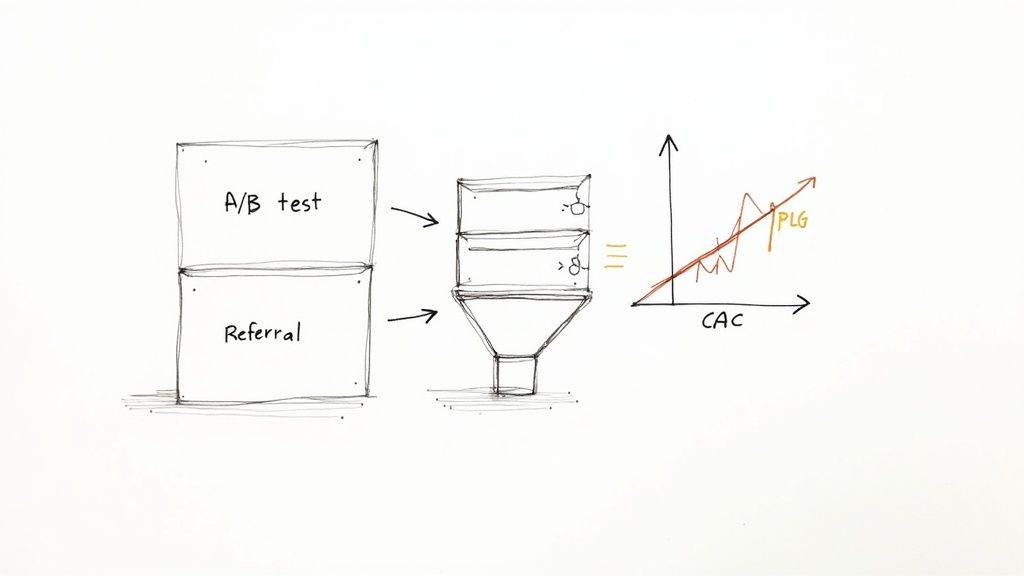
Knowing your numbers is one thing; actually changing them is a whole different ballgame. The fastest-growing SaaS companies don't just track their SaaS customer acquisition cost—they actively attack it with proven, repeatable strategies.
Forget the vague advice. This is your tactical guide for deploying battle-tested playbooks that will drive down your costs and improve your unit economics, starting today.
We're going to break down three of the most effective playbooks out there: fine-tuning your conversion funnel, building a referral program that actually works, and creating a low-cost acquisition loop with product-led growth (PLG). Each one is a mini-SOP you can adapt and run with.
Playbook 1: Optimize Your Conversion Funnel
Think of your website and pricing page as your best salespeople. If they aren't converting visitors, you're just lighting money on fire. The goal here is to methodically A/B test your way to a higher conversion rate, plugging leaks in your funnel and turning more browsers into buyers.
Why It Works: Small, incremental improvements in your conversion rate have a massive compounding effect on your CAC. Bumping your trial-to-paid conversion rate from 2% to 3% isn't a small win—it's a 50% improvement that can dramatically slash your acquisition cost.
Here’s your exact process:
- Find the Biggest Leak: Use tools like Google Analytics or Hotjar to pinpoint where people are dropping off. Is it the pricing page? The credit card form? Start your efforts at the point of greatest pain.
- Form a Smart Hypothesis: Don't just test random stuff. Create a clear "if-then" statement. For example: "We believe changing our pricing page headline from 'Our Plans' to 'Find the Right Plan for Your Team' will increase trial sign-ups because it’s more benefit-focused."
- Run a Clean A/B Test: Use a tool like Optimizely or VWO to show 50% of your traffic the original page (the control) and 50% the new version (the variant). Let it run until you have a statistically significant result—no peeking!
- Analyze and Iterate: Did the new version win? Awesome. Roll it out and move to the next hypothesis. If it lost or was inconclusive, try to figure out why and test a different approach.
For a real-world example, look at Groove. They famously tested their pricing page design and found that by simply adding customer testimonials right below the pricing tiers, they boosted sign-ups by 15%. One simple change made their entire funnel more efficient.
Playbook 2: Launch a High-Impact Referral Program
Your happiest customers are your best (and cheapest) sales team. A well-designed referral program isn't just a nice-to-have; it's a powerful acquisition channel with a built-in CAC advantage. Why? Because referrals come with pre-loaded trust, which means higher conversion rates and stickier customers.
Here’s the playbook that Dropbox and Uber perfected:
- Make It a Win-Win: Reward both the person referring and the new customer they bring in. Dropbox’s classic model is the gold standard here: the referrer gets extra storage, and the new user also starts with extra space. Everyone wins.
- Keep It Dead Simple: The process has to be frictionless. Give users a unique link that’s easy to find, copy, and share. If it takes more than two clicks for someone to refer a friend, you’ve already lost them.
- Promote It Shamelessly: Don't just build it and hope they find it. Plug your referral program inside the app, in your email signatures, and get your customer success team to mention it. Timing is everything—the best moment to ask is right after a customer has a great experience, like after they give you a high NPS score.
As you implement these playbooks, a key part of the puzzle is to optimize ad spend efficiency. Referral programs are a fantastic way to do this, creating an organic, word-of-mouth channel that reduces your reliance on paid ads.
Playbook 3: Leverage Product-Led Growth for a Viral Loop
Product-Led Growth (PLG) is all about using your product as the main engine for acquiring new customers. Think of companies like Slack, Calendly, or Miro. Their products are inherently viral—when one person uses it, they have to invite their team or clients, who then become new users. This creates a powerful, low-cost, and self-perpetuating acquisition machine.
This playbook works best for products built for sharing, but the core ideas can be applied to almost any SaaS model.
- Find a "Better with Friends" Feature: What's the one part of your product that becomes exponentially more valuable when used with other people? For a project management tool, it’s sharing a task list. For a design tool, it’s collaborating on a canvas. Double down on that feature.
- Build a Seamless Invitation Flow: Make it ridiculously easy for users to invite others directly from within the product. Pre-populate invitation messages and let them import contacts with one click.
- Lean into a Freemium or Trial Model: PLG runs on getting your product into as many hands as possible. A generous free tier or a no-hassle trial removes the biggest barrier to entry and lets your viral loop spin up.
By putting these playbooks into action, you're shifting from passively tracking CAC to actively driving it down. Pick one, start testing, and build from there.
Building a System to Track and Optimize CAC
Knowing your SaaS customer acquisition cost is a great start, but a number on its own is just trivia. If you want to build a business that grows profitably and consistently, you need a system for tracking, analyzing, and acting on your unit economics. This isn't about creating more reports that no one reads; it's about building a rhythm of accountability.
Flying blind on your acquisition spend is a surefire way to burn cash. A solid measurement framework makes sure every dollar you put into growth is working as hard as it can. The idea is to shift from looking at last month's numbers reactively to creating a culture where everyone on your team understands the financial impact of their work and can make smart decisions on the fly.
Setting Up Your CAC Dashboard
You don’t need a fancy business intelligence team or expensive software to get this done. A simple, well-organized dashboard in Google Sheets or Looker Studio can give you all the real-time visibility you need. This dashboard will become your single source of truth for everything related to customer acquisition.
Your dashboard should tell a complete story, not just show a single data point. Focus on these core metrics:
- Fully-Loaded CAC: Look at this monthly. It’s the high-level health check of your entire acquisition engine.
- Channel-Specific CAC: This needs a weekly check-in. It’s your early warning system for a paid ad campaign that's starting to go sideways.
- LTV:CAC Ratio: This is your north star for profitability. If this number starts to dip, it’s an all-hands-on-deck problem that needs immediate attention.
- CAC Payback Period: This tells you how fast you're getting your money back. It's a critical pulse check on your company's cash flow.
Building these kinds of tools is a cornerstone of operational excellence. To go deeper on this, check out our guide on building better business scorecards and dashboards.
Running a Monthly Unit Economics Review
A dashboard is just a pretty picture if you don't have a process for acting on what it tells you. That's where the Monthly Unit Economics Review comes in. This meeting is non-negotiable for any SaaS company that's serious about growth. And let's be clear—this isn't just a marketing meeting; it’s a strategic check-in on the very health of your business model.
The Point of the Meeting: The goal is simple: turn the data from your dashboard into smart, decisive actions. It’s where you figure out where to double down on your budget and where you need to pull back.
For this meeting to actually work, you need the right people in the room and a clear agenda.
Who Needs to Be There?
- Head of Marketing
- Head of Sales
- Head of Finance/CFO
- CEO/Founder
Key Questions to Ask Every Single Month:
- Did our overall CAC go up or down? Why?
- Which channels were our most and least efficient this month?
- Are we on track to hit our target LTV:CAC ratio? If not, what happened?
- How is our payback period trending? Is it getting longer or shorter?
- Based on this data, what is the single biggest change we need to make to our budget or strategy for next month?
This simple framework creates a powerful feedback loop. It forces your leadership team to look at the hard numbers, ask tough questions, and make agile decisions. This is how you stop guessing and start building a truly efficient acquisition engine.
A Few Common Questions We Get About SaaS CAC
We've been in the trenches and have heard just about every question there is when it comes to customer acquisition cost. Here are a few of the most common ones, along with some straight-up answers to help you sidestep the usual pitfalls.
How Often Should I Be Calculating My CAC?
For your big-picture, fully-loaded CAC, running the numbers monthly and quarterly is the sweet spot. This is the rhythm you'll want for strategic conversations with your leadership team and board meetings.
But for your channel-specific CAC? You need to be way more agile. We recommend tracking that weekly, or at the very least, bi-weekly. This gives you a tight feedback loop, letting you quickly adjust ad spend and marketing efforts before you waste a ton of cash on a channel that just isn't working.
What's the Biggest Mistake Founders Make When Looking at CAC?
Hands down, the single biggest mistake is looking at CAC in a vacuum. It’s so easy to do. A high CAC might seem like a disaster, but what if it’s for a massive enterprise client with an incredibly high LTV? Suddenly, it doesn't look so bad.
On the flip side, a super low CAC can be a total vanity metric if those customers churn out after a month or two. You’re just spinning your wheels.
The only way to get a real read on your acquisition health is by pairing CAC with its two best friends: your LTV:CAC ratio and your CAC Payback Period. Together, those metrics tell you the whole story.
How Do I Handle Freemium or Free Trial Users in My Calculation?
This is a classic head-scratcher. It’s actually pretty simple once you get the logic down. All the costs you incur to get those free users in the door—ad spend, content marketing, salaries, the works—get bundled into your total sales and marketing expenses for that period.
But—and this is the important part—when you get to the "New Customers Acquired" number in your formula, you only count the users who actually converted to a paid plan. This keeps you honest. It ensures you’re measuring the cost to acquire a paying customer, not just a free user who might never give you a dime.
Ready to stop guessing and start building a more efficient growth engine? SaaS Operations provides the proven playbooks, templates, and SOPs you need to optimize your acquisition strategy and scale your business with confidence. Get the frameworks from operators who have built multiple 8-figure businesses at https://saasoperations.com.