Job Description of Customer Success Manager: Roles, KPIs & Hiring Tips
 Published By: Alex
December 30, 2025
Published By: Alex
December 30, 2025
A well-written job description of a customer success manager is your secret weapon for finding candidates who know how to grow revenue by keeping customers happy and expanding their accounts. This isn't just a list of tasks; it's a strategic document that spells out exactly how this role will impact your bottom line. At its core, this job is about ensuring customers achieve their desired outcomes, transforming them from simple users into genuine, long-term partners who drive your Net Revenue Retention (NRR).
Your Go-To Customer Success Manager Job Description Template
If you want to hire a top-tier Customer Success Manager (CSM), you need a job description that sells the role and its value. The best CSMs aren't reactive support agents; they're strategic thinkers who own the entire customer relationship after the deal is closed. Their main job is to ensure customers extract maximum value from your product, which directly leads to lower churn, higher retention, and more expansion revenue for you.
A powerful job description positions the CSM as a vital part of your company's growth machine. It’s designed to attract candidates who understand their success is measured by their customers' success. That mindset is critical if you're serious about building a scalable, customer-first operation.
The Strategic Importance Of The CSM Role
In a high-performing SaaS business, the CSM is the critical link between the customer's business goals and your product's capabilities. They act as the customer's advocate to your internal teams and your product's champion to the customer. It's a unique, proactive role that demands a specific mix of skills to drive tangible business results.
Here’s an actionable breakdown of the CSM's function.
CSM Role At A Glance
| Component | Description | Primary Impact |
|---|---|---|
| Relationship Owner | The primary, post-sale point of contact who builds long-term trust and strategic alignment. | Increased Customer Loyalty and Net Promoter Score (NPS) |
| Value Driver | Ensures customers achieve their specific business goals using the product, measured by KPIs. | Reduced Churn and Higher Product Adoption |
| Revenue Generator | Identifies and acts on upsell/cross-sell opportunities based on customer needs. | Increased Net Revenue Retention (NRR) and CLV |
| Customer Advocate | Gathers data-driven feedback and communicates customer needs to the Product team. | Improved Product-Market Fit and Feature Prioritization |
| Onboarding Expert | Guides new customers through a successful implementation to achieve first value quickly. | Faster Time-to-Value (TTV) and Better Early Adoption |
Ultimately, this table shows how the CSM isn't just a "nice-to-have" but a central driver of sustainable growth.
A great CSM focuses on:
- Proactive Engagement: They don’t wait for trouble tickets. A CSM at a company like Gong, for example, might analyze usage data to see if a key feature is underutilized by a high-value account, then proactively schedule a workshop to demonstrate its ROI.
- Value Realization: Their mission is to ensure customers are hitting their business goals with the product. This means building and executing on a joint Success Plan with clear, measurable milestones.
- Revenue Growth: They are always on the lookout for opportunities to upsell or cross-sell in a way that genuinely helps the customer solve their next big problem.
One SaaS operator I know coaches their CSMs to think like consultants: "Don't just solve the problem they bring you. Use your expertise to identify the next problem they're going to have and position our solution as the answer before they even start looking."
To execute these responsibilities, a CSM needs a structured framework. For a deep dive into building that system, take a look at our complete customer success playbook. For more guidance on crafting compelling job posts, check out this guide on how to write a job description that attracts top UK talent.
Defining Core CSM Responsibilities and Outcomes
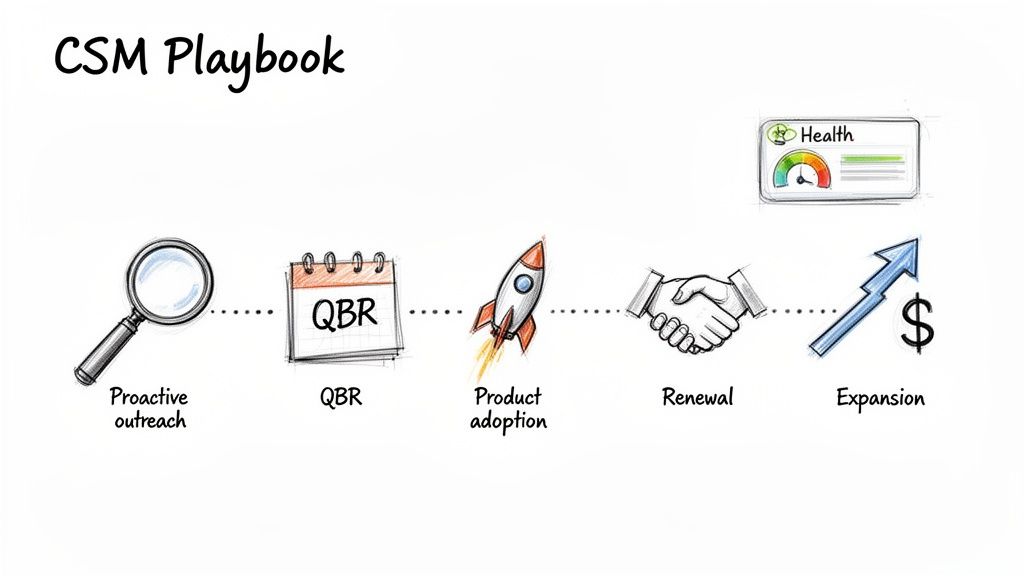
When writing a job description for a Customer Success Manager, avoid listing generic daily tasks. A great CSM is a strategic partner, and their responsibilities must be tied directly to revenue outcomes like retention and expansion. They aren't just putting out fires; they're actively building value for the customer and your company.
This means their role is inherently proactive, not reactive. A support agent solves today's ticket. A CSM anticipates next quarter's challenges and opportunities. They own the entire customer journey post-sale, ensuring every interaction steers the client toward achieving their business goals.
Proactive Account and Relationship Management
A huge part of the job is managing a portfolio of accounts with a strategic, forward-thinking approach. This is far more than a periodic check-in call. It's about becoming a trusted advisor who understands the customer's business almost as well as they do.
Top-tier CSMs are data-driven. They monitor customer health scores, watching for dips in product usage or sentiment before those issues can snowball into a churn risk. For example, a CSM might spot that a key feature is being ignored by a high-value client. Instead of waiting for a complaint, they'll proactively schedule a training session to demonstrate its value, tying product adoption directly to the customer's ROI. This is the difference between a vendor and an indispensable partner.
Driving Product Adoption and Value Realization
Getting a customer to log in is a low bar. A CSM's main objective is to ensure customers are hitting their desired outcomes with your product. This starts with a structured onboarding process. You can learn what that looks like by implementing these SaaS onboarding best practices.
This responsibility breaks down into a few key actions:
- Conducting Effective Quarterly Business Reviews (QBRs): These are not status updates. A solid QBR is a strategic meeting where the CSM uses hard data to prove the value delivered and aligns with the customer on future goals.
- Creating Success Plans: A CSM works with the customer to build a roadmap detailing exactly how the product will help them achieve specific business milestones.
- Translating Feedback into Action: They are the voice of the customer internally. They collect feedback and champion feature requests that will help their client and benefit the wider user base.
A CSM at a marketing automation platform noticed an account's health score drop. Instead of a generic "checking in" email, they analyzed the client's recent campaigns, identified a value gap in their lead nurturing sequence, and presented a 3-step playbook in their next QBR. The result: a saved renewal and a new opportunity for an upsell.
Managing Renewals and Identifying Expansion
While some companies have dedicated renewal managers, the CSM is always on the front line of retention. Their deep knowledge of the customer's business makes them the perfect person to handle the renewal process and—this is key—spot expansion opportunities.
They’re the first to notice when a customer’s needs have outgrown their current plan or when another product in your suite could solve a new problem they’re facing. By connecting a customer's evolving goals to a new feature or an upgraded plan, the CSM directly drives Net Revenue Retention (NRR)—a metric every SaaS business lives and dies by. This makes the CSM a direct contributor to the bottom line, proving their role is absolutely essential for growth.
Essential Skills and Qualifications for Your Next CSM
What truly separates a decent Customer Success Manager from a great one? It's a unique mix of technical acumen and genuine people skills. When writing this section of your job description of a customer success manager, you're looking for that rare individual who is both a data wizard and deeply empathetic.
The best CSMs I've worked with are strategic partners. They can skillfully de-escalate a tense customer call and then, without missing a beat, dive into a CRM to analyze usage data and identify the root cause. They don't just build relationships; they're problem-solvers who use technology to deliver real results for the customer.
Must-Have Hard Skills
In today's SaaS world, certain technical skills are non-negotiable. Your CSM needs to be comfortable with the tools of the trade and have an analytical mind to translate data into action.
- CRM Proficiency: Candidates absolutely need hands-on experience with a major CRM like Salesforce or HubSpot. This is their command center for tracking every interaction and maintaining a 360-degree view of the customer.
- Customer Success Platform Expertise: Experience with a dedicated CS platform is a massive plus. Think tools like Gainsight, ChurnZero, or Totango. A great CSM lives in these systems to monitor customer health, trigger automated outreach, and run proactive plays.
- Data Analysis Capabilities: This is critical. They must be able to analyze product adoption data, support ticket trends, and health scores to spot risks and opportunities. The real skill is turning that raw data into a concrete, actionable success plan for each customer.
Critical Soft Skills
While hard skills are the foundation, soft skills are what make the magic happen. These are the qualities that transform a vendor relationship into a trusted partnership.
"A propensity for relationship building, and doing it quickly, is [very] valuable," explains one SaaS leader. "The customer needs to trust your product and industry knowledge… It’s not enough to just have a knack for it; it’s important to really enjoy forming and maintaining relationships."
Here’s what you should be screening for:
- Empathy: The ability to put themselves in the customer's shoes and understand their frustrations and wins.
- Strategic Thinking: A top-tier CSM is always thinking a few steps ahead, connecting how the customer uses the product today to their bigger business goals tomorrow.
- Proactive Communication: They don't wait for fires to start. They're constantly in touch, sharing value, offering insights, and setting clear expectations.
- Project Management: Juggling a portfolio of dozens—or even hundreds—of accounts is a massive undertaking. Rock-solid organizational and time management skills are essential.
Of course, you need a way to measure these skills once they're on the team. To dig deeper, learn how to set up employee key performance indicators that directly connect these qualifications to your business goals.
As a general rule, look for candidates with 2-4 years of experience in a customer-facing role, preferably in a B2B SaaS company. That background ensures they can hit the ground running from day one.
Proven Job Templates for Every CSM Seniority Level
Using a generic Customer Success Manager job description is a classic misstep. You'll get flooded with the wrong applicants. A junior CSM learning the ropes has a completely different day-to-day than a senior CSM quarterbacking a multi-million dollar book of business.
To find the right person, you must tailor the job description to the seniority level. This sets crystal-clear expectations from the start. A level-specific template saves you time and acts as a natural filter, so junior candidates aren't scared off by enterprise-level demands and seasoned pros aren't bored by entry-level duties.
Junior Customer Success Manager Template (0-2 Years Experience)
This is the entry point for someone excited about helping customers and building a career in SaaS. The focus here is on learning the product inside and out, handling daily customer questions, and supporting the rest of the CS team.
Core Responsibilities:
- Field and resolve inbound customer questions and basic technical issues via our ticketing system.
- Support the new customer onboarding process by preparing materials and scheduling calls.
- Monitor customer health dashboards to identify and escalate early warning signs to mid-level or senior CSMs.
- Log all customer feedback and feature ideas in our product feedback tool.
- Maintain accurate customer records in our CRM (Salesforce).
Mid-Level Customer Success Manager Template (2-4 Years Experience)
This role is for a CSM who can confidently manage their own portfolio of accounts. The job shifts from reactive support to proactively driving product adoption, securing renewals, and building strategic relationships with key customer stakeholders. We expect them to work independently and have a direct impact on our retention numbers.
Core Responsibilities:
- Proactively manage a dedicated portfolio of mid-market accounts, ensuring they achieve their business goals with our product.
- Conduct regular check-ins and Quarterly Business Reviews (QBRs) to demonstrate value and maintain strategic alignment.
- Own the entire renewal process for your book of business, with a target of hitting a high gross retention rate.
- Identify and qualify expansion opportunities (upsells/cross-sells) for the Account Management team.
Senior Customer Success Manager Template (5+ Years Experience)
A Senior CSM is a strategic partner entrusted with our most valuable and complex enterprise accounts. This role demands deep industry expertise, a consultative mindset, and the finesse to navigate large, complex organizations. They also act as mentors to junior team members and are a major force behind driving Net Revenue Retention (NRR).
Building out a clear standard operating procedures template for your hiring process will streamline finding the right person for this and other roles.
When you get to the senior level in SaaS CS (think 4-7+ years of experience), you're dealing with enterprise clients. That commands a base salary from $100,000-$130,000, with on-target earnings pushing $125,000-$165,000 thanks to 20-25% bonuses. For founders obsessed with scorecards, these are the people who excel at data analysis—turning customer sentiment and usage stats into predictive insights that protect accounts worth millions in ARR. You can find more data on CSM compensation and responsibilities on Rework.
Building a CSM Scorecard with Actionable KPIs
To properly define the job description of a customer success manager, you must measure what matters. Vague metrics are useless. A solid CSM scorecard isn't about tracking busy work; it’s about measuring the tangible results that boost revenue and improve customer health. We're not just trying to keep customers happy—we're proving their success with cold, hard data.
A battle-tested scorecard links a CSM’s daily activities directly to the company's financial goals. It provides a clear, data-backed way to evaluate performance that everyone, from the CSM to the CEO, can understand. For any SaaS operator, this is how you transform your customer success team from a cost center into a reliable growth engine.
Core KPIs for a SaaS CSM Scorecard
Let's start with the metrics that directly impact the bottom line. These are the numbers that tell you if your CSM is successfully retaining and growing their customer portfolio.
- Gross Revenue Retention (GRR): This is your ultimate stickiness metric. It shows the percentage of revenue you’ve retained from your existing customer base over a set period, before counting any upsells or expansion. A high GRR is proof that your CSM is a churn-fighting expert.
- Net Revenue Retention (NRR): This is the holy grail in SaaS. NRR factors in both retained revenue and expansion revenue from upsells and cross-sells. An NRR over 100% means your CSM isn't just retaining customers; they are actively growing the value of their accounts.
- Customer Health Score: Think of this as your early-warning system. It’s a predictive score combining metrics like product usage data, support ticket volume, and NPS scores. A good health score system lets you spot at-risk accounts long before they think about churning, so you can intervene proactively.
- Product Adoption Rate: This KPI tells you how deeply customers are actually using your product. A great CSM doesn't just show off features; they connect those features to the customer's specific business goals, ensuring continuous value realization.
This infographic gives a good sense of how a CSM's responsibilities and the KPIs they're measured on tend to shift as they gain experience.
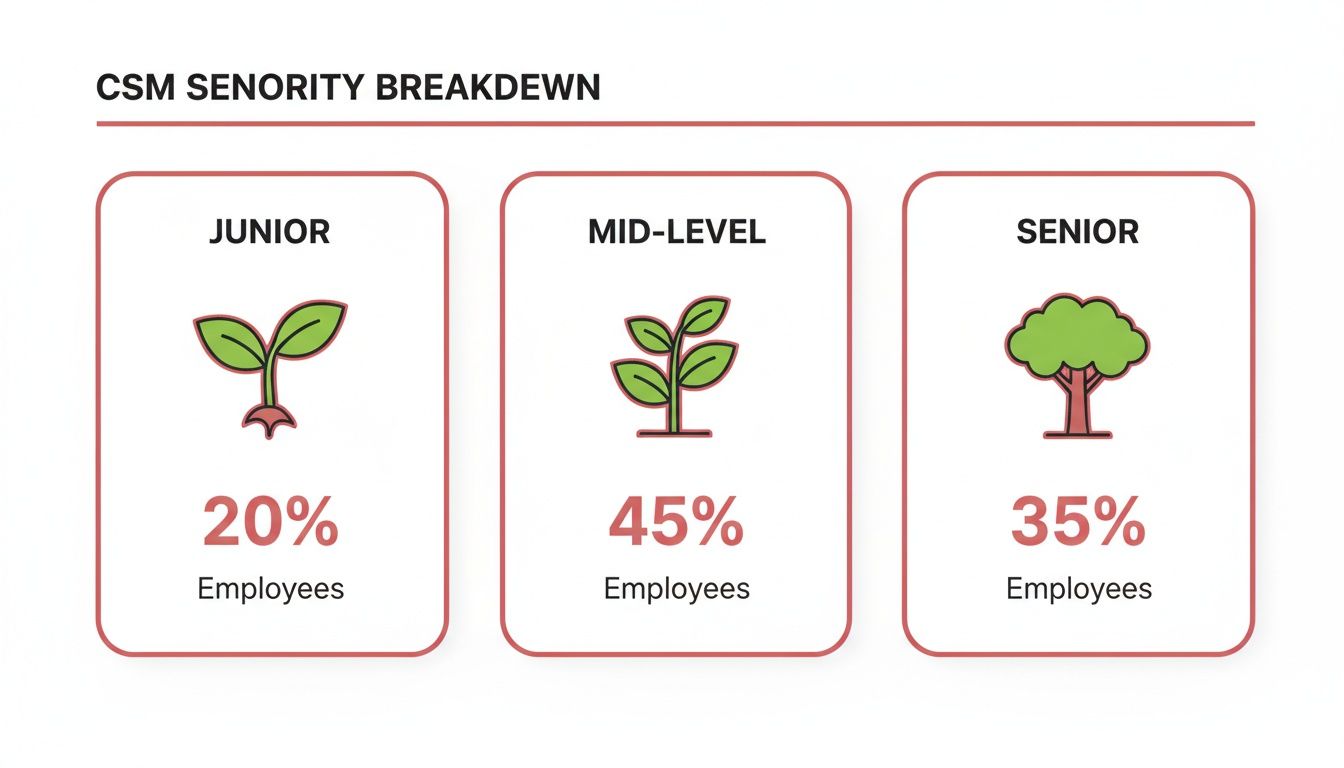
As CSMs become more senior, their focus naturally moves from basic support toward more strategic, revenue-generating activities, and their scorecard must reflect that shift.
Tying Actions to Outcomes
An effective scorecard doesn't just track outcomes; it connects them back to the CSM's actions. For example, a CSM who consistently runs strategic Quarterly Business Reviews (QBRs) should see a direct lift in their NRR. Why? Because those conversations are where expansion opportunities are uncovered and value is proven.
Today's CSM job description is jam-packed with metrics. We're talking about managing hundreds of accounts, living in CRMs like Salesforce, and being accountable for high CSAT and NPS scores. All of this happens while keeping churn below 5% and retention above 90%. For SaaS founders, this means finding CSMs who can quickly turn their product knowledge into real value for customers. You can see more about the data behind CSM job descriptions on Indeed to get a feel for the market.
Ultimately, you want to build a system that is fair, motivating, and transparent. It gives your CSMs a clear roadmap, showing them exactly how their hard work contributes to the company's bottom line. For a much deeper dive, check out our full guide on building a KPI and scorecard system that actually works.
CSM Compensation Benchmarks and Career Paths
To attract and retain top Customer Success Managers, you need two things: a competitive compensation package and a clear career path. Simply posting a salary number isn't enough. The best candidates want to know their next step. When you map out a career ladder in the job description of a customer success manager, you send a powerful signal that you’re invested in their future, not just filling a role.
Typically, CSM compensation is a mix of base salary and a variable bonus tied to hard metrics like Net Revenue Retention (NRR) or Gross Revenue Retention (GRR). This is a smart structure because it aligns their day-to-day work directly with the company's financial health, positioning the CSM as a true driver of revenue.
Typical CSM Salary Bands
CSM compensation varies significantly based on experience, company size, and location. For example, hiring in a major tech hub like the San Francisco Bay Area often commands a 25-30% premium over the national average. Mid-level CSMs there often see base salaries from $95,000-$125,000.
Across the country, those same mid-level roles usually fall in the $80,000-$100,000 base salary range. When you add a 15-20% performance bonus, their on-target earnings (OTE) can reach $95,000-$125,000. At this level, you’re looking for someone with a proven track record of managing over $1M in Annual Recurring Revenue (ARR) and keeping retention rates consistently above 90%. For more real-world data, the folks at CS Insider share some great CSM salary trends.
A good compensation plan is about more than just attracting talent—it's about encouraging the right actions. When you tie bonuses to NRR, you're not just asking CSMs to stop churn. You're motivating them to actively find and close expansion opportunities, which aligns their personal success directly with the company's growth.
A Clear Career Path For CSMs
One of your best retention tools is showing your team what’s next. When ambitious people see a clear path forward, they’re far more likely to stick around.
Here’s a standard career progression in Customer Success:
- Customer Success Manager (IC): The frontline role, mastering the fundamentals of managing a book of business, driving product adoption, and securing renewals.
- Senior Customer Success Manager: Seasoned pros who manage your most strategic accounts and mentor new team members.
- CSM Team Lead / Manager: The first step into leadership, responsible for coaching a small team and ensuring they hit their targets.
- Director of Customer Success: A strategic leader who oversees multiple teams or a whole customer segment, focusing on scaling processes and refining strategy.
- VP of Customer Success: The executive leader who owns the entire post-sale customer journey and reports directly to the CEO or CRO.
Laying out this path shows candidates you're a place where they can build a career, making your offer about much more than just the money.
Interview Questions That Identify Top CSM Talent
Nailing the job description of a customer success manager is a great start, but the interview process is what separates good candidates from great ones. You must ask questions that dig deeper than the surface to reveal how a person really thinks, solves problems, and connects with customers. The goal is to find a genuine strategic partner, not just a friendly relationship manager.
A solid interview strategy blends behavioral, situational, and technical questions to build a complete profile of a candidate. This approach gives you a view of their past performance, critical thinking skills, and practical know-how, helping you hire a CSM who will actually move the needle on your revenue and retention goals.
Behavioral Questions Probing Past Performance
Behavioral questions dig into past experiences and are fantastic predictors of future performance. They focus on what a candidate has actually done, not what they think they would do.
-
Question: “Walk me through a time you turned an at-risk customer into a success story. What specific steps did you take, and what was the outcome?”
- What to look for: The best answers follow the STAR method (Situation, Task, Action, Result). Listen for a clear description of the red flags they saw (the situation), their objective (the task), the specific, proactive steps they took (the action), and a tangible business result—like a boosted health score, a saved renewal, or an upsell (the result).
-
Question: “Describe a situation where you had to advocate for a customer’s needs to your product team. How did you build your case, and what was the resolution?”
- What to look for: A great CSM will talk about using data—like the number of support tickets on a specific issue or feedback from several key accounts—to build a compelling business case. It shows they know how to influence internal teams and get things done, not just pass along complaints.
For more ideas, you can find many common behavioral interview questions that can be adapted for a CSM role.
Situational Questions Testing Strategic Thinking
Situational questions present hypothetical scenarios to see how candidates think on their feet. These are perfect for revealing their problem-solving instincts and how they handle pressure without a clear playbook.
The best CSMs think beyond immediate customer needs. In fact, they think before customer needs — they anticipate challenges and opportunities before the customer does. This transforms them from support resources into trusted business advisors.
Here are a couple of my favorites to test that forward-thinking ability:
-
Scenario: “You’ve just been assigned a high-value account with low product adoption. You have your first call in one week. What is your exact preparation process?”
- What to look for: A top-tier candidate won't just say they'll "read the notes." A great answer involves a clear process: digging into the CRM for history, analyzing product usage data to pinpoint where the customer is struggling, researching their industry and recent news, and building a call agenda focused on their business goals, not just your product's features.
-
Scenario: “A key customer tells you they are not renewing their contract due to a competitor’s lower price. What is your immediate course of action?”
- What to look for: The ideal answer here has nothing to do with offering a discount. I’m listening for a focus on value. They should immediately talk about reinforcing the ROI the customer has already seen, asking smart questions to understand the competitor's offer (to highlight your unique differentiators), and pulling in the right internal people to build a powerful business case for why staying is the smarter move.
Interview Question Framework
To structure your interviews, categorize your questions to ensure you assess all the core competencies of a great CSM.
Here’s a quick framework to help you organize your questions and know what you're listening for in the answers.
| Question Category | Sample Question | What to Look For |
|---|---|---|
| Strategic & Business Acumen | "Describe how you'd create a success plan for a new enterprise customer." | A focus on business outcomes, not just product features. Look for mentions of KPIs, key milestones, and aligning with the customer's executive goals. |
| Problem-Solving & Proactivity | "Tell me about a time you identified a potential risk with an account before the customer did. What did you do?" | Evidence of data analysis (e.g., usage drops), critical thinking, and a proactive, not reactive, approach to account management. |
| Relationship & Influence | "How do you handle a difficult conversation with a customer who is frustrated with your product?" | Empathy, active listening, and the ability to de-escalate. They should talk about validating feelings while guiding the conversation toward a solution. |
| Data & Technical Aptitude | "What customer health metrics do you believe are most important and why?" | A clear understanding of leading vs. lagging indicators. They should be able to articulate why certain metrics matter for predicting churn or identifying growth. |
Using a mix of questions from these categories will give you a well-rounded view of any candidate and help you move past canned answers to the core of how they'll perform on the job.
Frequently Asked Questions About the CSM Role
Even with a solid job description, SaaS founders and hiring managers often have questions about the Customer Success Manager role. Getting the answers right is crucial for building a team that moves the needle on revenue through retention and customer loyalty.
Let's clear up some of the most common questions about hiring and structuring a high-performing CS function.
What Is the Biggest Difference Between a Customer Success Manager and an Account Manager?
The simplest distinction is proactive value vs. reactive sales. An Account Manager's world revolves around sales targets. Their primary goals are locking in renewals and landing upsells, and they're almost always measured by a sales quota.
A Customer Success Manager, in contrast, is a strategic partner. Their main job is to ensure the customer achieves the business results they were promised. This intense focus on value naturally leads to happy, loyal customers who renew and expand, but the revenue is an outcome of their success, not the primary objective.
When Should a SaaS Startup Hire Its First Customer Success Manager?
The time is right when the founders can no longer give every single customer the personal attention they need. This usually happens somewhere between 15-25 customers or as you're approaching the $500k to $1M ARR mark.
Look for these red flags:
- Onboarding has become messy and inconsistent.
- You are being blindsided by churn from customers you thought were happy.
- Founders are so busy putting out customer fires that proactive check-ins and strategy calls are falling through the cracks.
Hiring your first CSM early does more than just lighten the load. It embeds a customer-first mindset into your company's DNA and helps you build the repeatable processes needed to scale effectively.
What Tools Are Essential for a Customer Success Manager?
You can't expect a CSM to be effective without the right tech stack. They need a toolkit that provides a complete, real-time picture of the customer's journey.
A modern CS team can't run on spreadsheets and gut feelings. The core tech stack has to provide a single source of truth for all customer activity. Without it, you're just guessing about which accounts are at risk and where your best growth opportunities are.
Here are the absolute must-haves:
- A CRM: This is non-negotiable. Tools like Salesforce or HubSpot are the system of record for all customer history and communication.
- A Customer Success Platform: Purpose-built systems like Gainsight or ChurnZero are game-changers for monitoring customer health scores, automating outreach, and managing tasks at scale.
- Product Analytics Tools: You need to know what your customers are actually doing in your product. Platforms like Pendo show CSMs exactly how features are being used, flagging both adoption wins and critical gaps.
How Should a CSM's Bonus Be Structured?
A CSM's bonus or variable pay must be tied to outcomes they can directly influence. The most common and effective models are based on Net Revenue Retention (NRR) or Gross Revenue Retention (GRR).
Basing compensation on NRR is particularly effective. It motivates the CSM not only to prevent churn but also to actively identify and support expansion opportunities. Other solid options include bonuses for hitting specific product adoption goals across their book of business or maintaining their portfolio's average customer health score above a certain threshold.
At SaaS Operations, we build battle-tested playbooks and SOPs that help you scale a world-class customer success team. Stop reinventing the wheel and start using proven frameworks that drive real retention and growth. Check out our resources at https://saasoperations.com.