A Practical Framework for Decision Making in SaaS
 Published By: Alex
December 12, 2025
Published By: Alex
December 12, 2025
A framework for decision making is a structured playbook for your team to make high-quality, consistent choices. Instead of relying on guesswork or the loudest voice in the room, you get a repeatable process that clarifies who provides input, who makes the final call, and how that decision is communicated. It’s an operational upgrade designed to increase decision velocity and alignment.
Why Your SaaS Needs a Decision Making Framework Now
Ad-hoc decisions are the silent killer of momentum in a growing SaaS company. One week, a "gut-feel" choice from a founder sends the engineering team scrambling on a project that's deprioritized a month later. The next, a critical feature is endlessly debated in committee, missing its market window. This isn't just frustrating; it's incredibly expensive.
This chaos is a classic scaling pain. At a previous B2B SaaS I scaled, we hit this wall hard. Our product team wanted to build a highly requested integration, sales was screaming for an enterprise security feature to close a whale, and engineering was waving red flags about mounting tech debt. Without a framework, we were stuck in analysis paralysis, and our roadmap became a political battleground instead of a strategic document.

The Real Cost of Indecision
That exact scenario leads to measurable losses that hit both the bottom line and team morale. You burn expensive engineering cycles on features that don't move the needle, you cede market opportunities to faster competitors, and the trust between departments erodes.
Without a clear process, you get:
- Slower Time-to-Market: Debates drag on for weeks in endless meetings, pushing back critical launch dates.
- Reduced Team Morale: When decisions feel random or political, your top performers get disengaged and start polishing their resumes.
- Inconsistent Outcomes: With no standard process, decision quality is a coin flip. One choice is brilliant, the next is a total dud.
This is why a documented process isn't bureaucracy—it's the operational upgrade your team needs to scale effectively. It's a key milestone in the SaaS maturity model. You're not just making decisions; you're building a scalable, competitive advantage.
A documented framework transforms decision-making from an art into a repeatable science. It gives everyone on the team the clarity and confidence to move forward, knowing that choices are being made deliberately and strategically—not just based on who has the most influence that day.
The data backs this up. Leaders who use structured frameworks report up to a 10.3x higher ROI in their digital transformation efforts compared to those who don't. A decision-making framework is your playbook for turning chaos into clarity and converting slow, painful choices into swift, strategic wins.
Picking the Right Decision-Making Model
There’s no single “best” framework. The secret of elite operators is matching the model to the situation. A heavyweight process for a company-wide pricing change will grind your team to a halt if you apply it to a simple marketing copy tweak.
Seasoned SaaS leaders don't just pick one framework; they build a toolkit. This allows them to apply the right level of rigor—a robust process for big, risky decisions and a lighter touch for the small, reversible ones that need to happen fast.
The Go-To Models for SaaS Teams
Let's walk through the exact frameworks we see successful SaaS companies using. These are the core of your playbook for turning chaotic decision-making into a clear, repeatable process.
RACI: For Nailing Down Who Does What
RACI is not for making a single, tough call. It's an operational tool for clarifying roles and responsibilities within a recurring process. If you're mapping out a repeatable workflow, like your content publishing pipeline, RACI is your best friend.
It breaks down into four clear roles:
- Responsible: The person doing the hands-on work.
- Accountable: The single person who owns the outcome. Critical rule: only one "A".
- Consulted: Experts brought in for input before a decision is made.
- Informed: People who are kept in the loop after the decision is made.
Actionable Example: Imagine setting up your bug-fixing process. An engineer is Responsible for fixing the bug. The Engineering Manager is Accountable for the bug being resolved. The Product Manager is Consulted on priority, and the Customer Support team is Informed when the fix is deployed.
RAPID: For Your High-Stakes, Bet-the-Company Decisions
When a decision is complex, strategic, and has major consequences, you need a more robust framework. That’s where RAPID comes in. Developed by Bain & Company, this framework is a scalpel designed for making big, one-off choices without getting stuck in committee.
The roles are Recommend, Agree, Perform, Input, and Decide.
The game-changer is the "D" for Decide. It forces you to name a single person with the final say—the ultimate antidote to analysis paralysis.
Actionable Example: GitLab uses a variation of this for major decisions. When they considered a pricing overhaul, the Product Manager would Recommend a new structure after getting Input from sales, finance, and marketing. The CFO might need to formally Agree to the financial model. The engineering team would Perform the implementation. But ultimately, the CEO holds the Decide and makes the final call.
DACI: For When You Need Collaboration and a Clear Owner
DACI strikes a perfect balance between collaborative input and clear ownership. It’s ideal for cross-functional projects where you need diverse expertise but can't afford "design by committee."
The roles here are:
- Driver: The project lead corralling everyone and pushing the work forward.
- Approver: The one person who gives the final yes or no.
- Contributors: Subject matter experts who have a voice, but not a veto.
- Informed: Everyone else who gets the update once a decision is made.
Actionable Example: At Atlassian, a team planning a major product rebrand would have the VP of Marketing as the Approver, a brand manager as the Driver, and designers/copywriters as Contributors. The rest of the company is Informed once the new brand direction is locked in. When weighing different creative paths, using a decision tree template can be a fantastic tool for the Driver to present options to the Approver.
So, How Do You Choose?
Alright, you have the models. How do you pick the right one? Diagnose the decision. Ask these questions: How complex is it? How reversible is it? How many teams does it impact?
Your goal isn't to force every choice through a rigid, bureaucratic process. It's about applying just enough structure to the decisions that matter, empowering your team to move fast on everything else.
To make it actionable, use this cheat sheet.
Decision Making Model Selector for SaaS Teams
Choosing the right framework doesn’t have to be complicated. This table breaks down which model works best for common situations you'll face leading a SaaS team.
| Framework | Best For | Key Benefit | Potential Pitfall |
|---|---|---|---|
| RACI | Defining roles in repeatable, operational processes. | Creates extreme clarity on "who does what" for ongoing work. | Can become bureaucratic if applied to one-off decisions. |
| RAPID | Complex, high-stakes, strategic decisions with many stakeholders. | Forces a single decider, preventing analysis paralysis. | Can slow things down if too many people have "Agree" (veto) power. |
| DACI | Cross-functional projects that need collaboration but a clear owner. | Balances group input with a single point of approval. | The process stalls if the Approver is disengaged or a bottleneck. |
Once a decision is made, track its impact. Using a balanced scorecard helps you see if your choices are actually moving the needle. You can find excellent templates in our guide to balanced business scorecard examples.
Building Your Custom Decision Making Framework
Off-the-shelf templates are a starting point, but the real power comes from building a framework designed for your SaaS. This isn't about adding red tape; it's about engineering clarity. Think of it as installing an operating system for smart, fast choices.
The goal is a practical, documented system that eliminates ambiguity. When everyone—from a new hire to the C-suite—knows how decisions get made, they can act with confidence. Let's build your playbook.
Define Your Decision Making Roles
The biggest bottleneck in any decision is role confusion. You stop this by defining roles with absolute clarity.
We recommend starting with two core roles for most decisions:
- The Recommender: The point person responsible for pushing a decision forward. They do the research, gather feedback, weigh options, and present a clear recommendation with the "why" to back it up. This is usually a product manager, team lead, or project driver.
- The Decider: The single person with the final say. They can approve the recommendation, reject it, or ask for more information. The most critical rule: one Decider per decision. No committees. This is how you kill analysis paralysis.
For more complex decisions touching multiple departments, add a third role:
- Contributors: Subject matter experts whose input is crucial, but they don't get a vote or a veto. The Recommender is responsible for getting their perspective. This could be your head of engineering, a sales leader close to the customer, or someone from finance.
Defining roles upfront removes politics and ego. The conversation shifts from "who has power?" to "what's the right call for the business?"
Map Clear Escalation Paths
Even with clear roles, you'll hit deadlocks. A Recommender and a Decider might be at an impasse. A documented escalation path is the pressure-release valve that keeps things moving.
Your escalation path is a simple, pre-agreed process for what happens when a decision is gridlocked.
A good escalation path isn't a sign of failure. It's a feature of a healthy system. It gives your team a predictable way to resolve a stalemate without resorting to back-channeling or office politics.
Actionable Example: A typical escalation path at a growth-stage SaaS might look like this:
- Peer-to-Peer Resolution: The Recommender and Decider have one final 1:1 meeting to try and find common ground, with all data on the table.
- Managerial Tie-Breaker: If still stuck, they jointly present their cases to their shared manager (e.g., a VP or Director), who makes the final call within 48 hours.
- Executive Council: For company-altering decisions, the last stop is the executive team during their weekly leadership meeting.
Write this down in your company wiki. When your team knows there's a clear process for breaking a deadlock, they are less likely to let issues fester.
This flow is a great visual for putting these ideas into practice—assess the situation, pick the right tool, and then act.
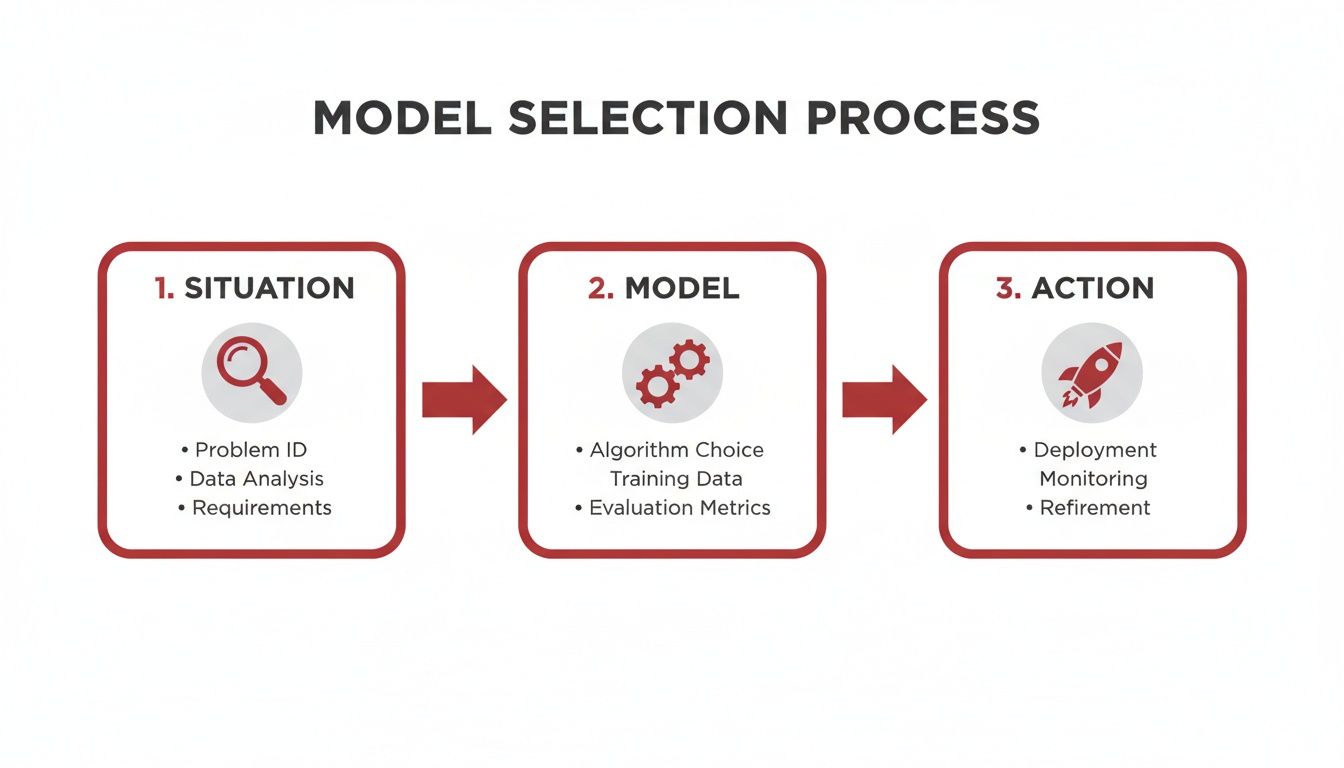
This nails the core logic: analyze the situation, choose the right model, and take decisive action.
Set Your Meeting and Documentation Cadence
A framework is useless if it just lives in a Google Doc. Weave it into your team's daily rhythm by being specific about the cadence for making and documenting decisions. You are building operational habits.
Decision Meetings
Not every decision needs a 60-minute meeting. Empower your team to make smaller, reversible ("Type 2") decisions asynchronously in Slack or Asana. Save synchronous meetings for the big, high-stakes, "Type 1" decisions.
When a meeting is necessary, the Recommender must send a 1-page decision brief 24 hours in advance, covering:
- The specific decision to be made (e.g., "Approve the Q4 marketing budget of $50k").
- The recommended path and supporting rationale.
- Other options considered and why they were rejected.
- Key data and input from Contributors.
This pre-read transforms a meandering debate into a focused session for clarification and a final call.
The Decision Log
This is one of the most valuable operational artifacts you can create. A decision log is a central, searchable place where you record every significant choice. It’s your company's institutional memory.
Actionable Next Step: Create a simple table in Notion or a Google Sheet with these columns:
| Field | Description |
|---|---|
| Decision | A clear, one-sentence summary of the choice. |
| Date | When the final call was made. |
| Decider | The name of the person who made the decision. |
| Status | e.g., Decided, In Progress, On Hold. |
| Rationale | The "why" behind it, with links to data. |
| Next Steps | Who owns execution and by when. |
This log is an absolute lifesaver for onboarding new hires and holding the team accountable. It’s a core component of operational excellence, much like the concepts in our guide on how to create standard operating procedures. For an advanced take, explore this guide on streamlining business processes with an AI automation framework.
So, How Do You Actually Roll This Thing Out?
A brilliant framework is worthless if it lives in a forgotten Google Doc. The hard part isn't designing the system; it's getting your team to adopt it. This is a change management exercise, and your goal is genuine buy-in, not reluctant compliance.
You can't just drop a new process on your team and expect adoption. A study found that only 20% of executives believe their organizations excel at decision-making. This means your team is likely feeling the pain of the old, chaotic way. Your rollout must connect your new framework directly to that pain.
It's All About the "Why," Not Just the "What"
Your team doesn't need more rules. They need solutions to their frustrations. Frame this framework as a tool to kill endless meetings, clarify ownership, and ship work faster.
Actionable Script: Instead of saying, "We're implementing the DACI model," try this in your next team meeting: "Remember how the Q3 roadmap debate dragged on for a month? We're piloting a new process so that never happens again. It gives every project a clear Driver to push for a decision, an Approver to make the final call, and a way for everyone to contribute without getting stuck in committee."
Your team will only embrace a new framework for decision making if they see it as something that's being done for them, not to them. Connect it directly to the bottlenecks and frustrations they already experience.
When you kick off the rollout, hammer home the benefits: fewer, more effective meetings; empowerment for individual contributors; and faster execution. Lead with value to get pull instead of pushback.
Start Small With a Pilot Program
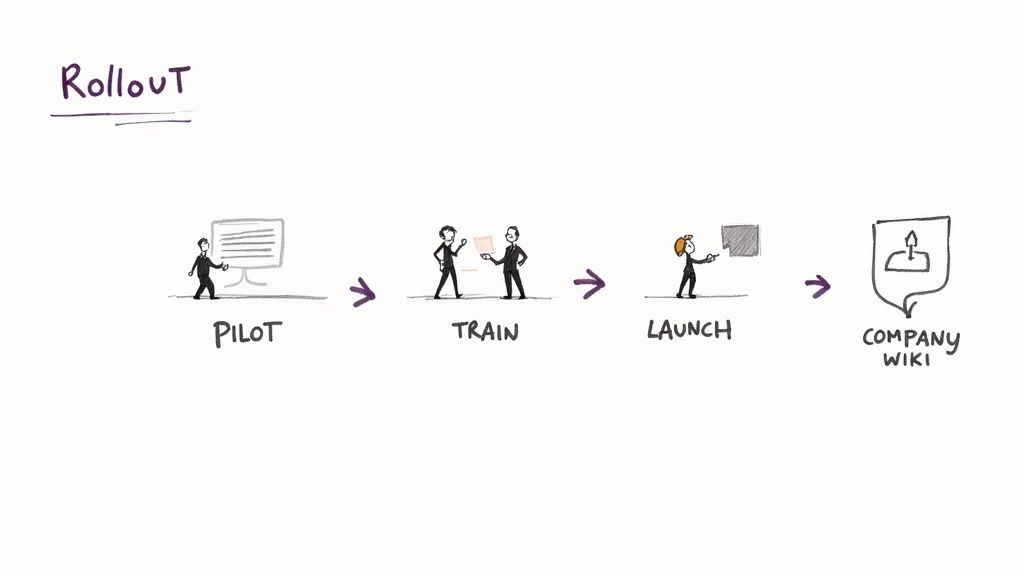
Do not attempt a company-wide, big-bang rollout. It’s too disruptive. Instead, pick one team that is receptive to change—a product pod or a marketing squad—and run a small pilot for 30 days.
This gives you two huge advantages:
- A Feedback Loop: You'll uncover kinks in your process on a small, manageable scale, allowing you to iterate before a wider launch.
- Internal Champions: Once the pilot team starts making decisions faster, they become your best advocates. Their success story is the social proof you need to get the rest of the company on board.
Actionable Next Step: Identify one upcoming, non-critical project. Assign a framework (like DACI) to it. Announce it as a pilot, define success metrics (e.g., "decision made within 5 business days"), and hold a retro at the end to gather feedback.
Your Rollout Checklist
Once your pilot is a success and you've refined the process, it's time for a broader launch. Use this checklist to ensure you don't miss any critical steps.
- Host a Kickoff Session: Hold a brief all-hands meeting (or record a Loom) to explain the "why" and walk through the framework. Keep it high-level.
- Run Manager-Led Training: Your managers are the key. Give them talking points and resources to coach their direct reports. They must model the new behavior.
- Update Your Company Wiki: This framework needs a permanent, easily accessible home. Document the roles, escalation paths, and templates in your central knowledge base.
- Integrate into Existing Rhythms: Weave the framework into your current operating cadence. For example, add a "Key Decisions Made (with link to log)" section to your existing meeting notes. See our guide for building an effective weekly team meeting agenda.
- Celebrate Early Wins: When a team uses the framework to resolve a tough decision quickly, shout it out in Slack or your company newsletter. Positive reinforcement builds momentum.
Measuring Success and Avoiding Common Pitfalls
You’ve rolled out a new decision-making framework. The work isn't over. How do you know if it's actually working? You must move past gut feelings and measure the impact.
Key Metrics to Track Your Framework's Health
Start with a few core metrics that tell a story about your decision-making health. These are the vital signs of your operational efficiency.
- Decision Velocity: How long does it take to go from "we need to decide on X" to a final call being logged? Track this in your decision log. Your goal is to see this time shrink.
- Decision Reversal Rate: How often is a major decision overturned within a quarter? A high reversal rate is an alarm that you're either missing key inputs or moving too fast without proper alignment.
- Team Alignment Score: After a big decision, send a quick pulse survey (e.g., in Slack). Ask: "On a scale of 1-10, how clear are you on the 'why' behind this decision?" A high average score means you’re nailing communication. You can dive deeper into which numbers matter in our guide to essential SaaS KPIs.
These data points provide real-time feedback on whether your framework is helping or hindering.
Dodging the Common Traps
Even with the best intentions, I’ve seen many teams stumble. Learn from their mistakes.
The biggest mistake is applying a heavyweight process to a lightweight problem. Your framework must differentiate between "Type 1" decisions (big, irreversible, strategic) and "Type 2" decisions (small, easily reversible).
Don't use a sledgehammer to crack a nut. Forcing a minor marketing copy change through the same RAPID process you use for a pricing overhaul will grind your company to a halt and destroy team morale. You have to explicitly empower your team to make those Type 2 calls on their own.
Another classic pitfall is letting a key role become a bottleneck. If your "Decider" is always swamped, the system collapses. This happens when a founder feels they need to sign off on everything. As you scale, you must ruthlessly delegate decision-making authority.
Finally, remember that context is everything. In Europe, data governance is the top priority for 62-65% of leaders due to massive regulatory fines. This context shapes their decision frameworks. Data shows that organizations building out comprehensive best practices see 3x higher success regardless of geography. Get more details on these global decision-making trends on edstellar.com.
Actionable Next Step: Schedule a recurring 6-month review of your framework. In that meeting, ask: What’s working? What’s slow? Where are people getting stuck? Then, iterate.
Got Questions? We’ve Got Answers.
Even the sharpest operators run into snags. Let's tackle the most common questions SaaS leaders face when implementing a decision-making framework.
How Do I Get My Team to Actually Use This?
Start with the "why." Frame it as the solution to problems they already have—endless meetings, unclear ownership. Involve team leads in the design process from the start. When people help build the boat, they're more likely to help row it. Then, run a small pilot with a receptive team. When other teams see them shipping faster with less drama, they’ll ask for it.
Getting buy-in comes down to leadership. Senior leaders must walk the walk. If they consistently use the framework for their own big decisions and reference the decision log, everyone else will follow suit. If they don't, the initiative is dead on arrival.
What’s the Real Difference Between RACI and RAPID?
Here's the operator's cheat sheet: RACI is for clarifying ongoing roles in a process, while RAPID is for making a single high-stakes decision.
- Use RACI to map repeatable workflows, like your content publishing process or bug escalation. It answers, "Who's on the hook for this on a regular basis?"
- Pull out RAPID for make-or-break strategic moves, like an acquisition or a major pivot. It forces crystal-clear alignment on who Recommends an action, who must Agree, and, most critically, who has the ultimate power to Decide.
Does Every Single Decision Need to Go Through This Process?
No. That's the fastest way to create the bureaucracy you were trying to escape. A solid framework explicitly distinguishes between two types of choices:
- Type 1 Decisions: Big, strategic, and tough to walk back (e.g., pricing overhaul, entering a new market). These must go through your formal framework.
- Type 2 Decisions: Small, everyday calls that are easily reversed (e.g., tweaking ad copy, changing a button color). You must empower and trust your team to make these calls quickly and autonomously.
The goal is to add rigor where it counts, not to grind everything else to a halt.
How Often Should We Revisit Our Framework?
Your framework is a living document. A process built for a 15-person startup will break at 100 people.
Actionable Next Step: Schedule a formal review on your calendar every six months or after any major company milestone (e.g., closing a funding round, launching a new product line). Run a retro with your leadership team and ask:
- Where did decisions get painfully slow last quarter?
- Which projects got stuck because of process confusion?
- Is decision-making authority still held by the right people for our current size?
Use that raw feedback to make smart adjustments. This keeps your framework a tool for speed, not a source of friction.
At SaaS Operations, we build battle-tested playbooks and templates that help you create efficient systems to fuel your growth. Our resources come straight from operators who've scaled multiple 8-figure businesses, giving you plug-and-play processes designed to win. Learn more about our proven frameworks at saasoperations.com.