How to Define an Operational Plan for Sustainable SaaS Growth
 Published By: Alex
December 24, 2025
Published By: Alex
December 24, 2025
So, what exactly is an operational plan in the SaaS world?
Let's cut through the business school jargon. Think of it this way: your strategic plan is your grand vision—the big, hairy, audacious goal. It's deciding you want to climb Mount Everest.
Your operational plan is the nitty-gritty, day-by-day guide for that climb. It’s the playbook that details who carries what gear, which routes to take, and what milestones you need to hit at each base camp. For a SaaS operator, it’s the "how" that makes the "what" and "why" of your strategy actually happen.
In SaaS, this isn't a document that collects dust. It's the living blueprint that connects your ambitious ARR targets to the daily tasks of your engineers, marketers, and sales reps. It’s about turning big ideas into a concrete, quarterly to-do list with clear owners.
While a strategic plan sets the destination for the next 3-5 years (like "Become the market leader in enterprise project management software"), an operational plan maps out the immediate journey—usually just for the next year or even the next quarter. If you want to dig deeper, we have a whole guide on the differences between strategic vs. operational plans.
The Bridge Between Vision and Reality
A great strategy without a solid operational plan is just a wish. The operational plan is the essential bridge connecting your 30,000-foot vision to the real-world execution happening on the ground.
Don't just take our word for it. Top-tier SaaS operators live by this. Mark Roberge, former CRO at HubSpot, didn't scale the sales team from $0 to $100M ARR by winging it. He built a data-driven, repeatable operational playbook for hiring, training, and managing reps. That operational rigor is what made HubSpot’s explosive growth predictable and scalable.
For a SaaS operator, a strategy without an operational plan is just a dream. It's the operational plan that forces you to confront the realities of your budget, team capacity, and timelines. It turns 'we should' into 'we will.'
An operational plan gets everyone rowing in the same direction. It ensures your teams aren't just busy, but busy working on the right things that actually move the needle.
Strategic Plan vs. Operational Plan in a SaaS Context
To make this crystal clear, here’s a breakdown of how these two plans differ in a typical SaaS company:
| Aspect | Strategic Plan (The 'Why') | Operational Plan (The 'How') |
|---|---|---|
| Time Horizon | Long-term (3-5 years) | Short-term (Quarterly or Annually) |
| Focus | Vision, market position, competitive advantage | Daily tasks, team activities, project management |
| Scope | Broad, company-wide goals | Narrow, department-specific actions |
| SaaS Example | "Achieve $50M ARR and expand into the EMEA market." | "Sales team will increase demo-to-close rate by 15% in Q3." |
| Metrics | High-level KPIs (e.g., Market Share, LTV, ARR) | Granular KPIs (e.g., MQLs, Churn Rate, Ticket Response Time) |
| Flexibility | Relatively stable, reviewed annually | Highly dynamic, adjusted quarterly or monthly |
This table shows how the operational plan breaks down the big-picture strategy into actionable, measurable steps that your teams can own.
Why It Matters for SaaS Operators
In the breakneck speed of SaaS, your operational plan is your anchor. It brings clarity and focus, preventing your teams from chasing shiny objects or getting pulled in a dozen different directions.
It forces the tough but critical conversations about resource allocation. Do we hire more SDRs or invest in product-led growth? An operational plan makes you answer those questions with data, not just gut feelings.
For example, a marketing team's strategic goal is to "Increase enterprise MQLs by 40%" this year. The operational plan would break that down into specific, quarterly initiatives:
- Q1: Launch an account-based marketing (ABM) campaign targeting 100 specific high-value accounts. Owner: Jane D. (Marketing Lead). Budget: $25k.
- Q2: Host two webinars with industry experts on topics relevant to enterprise buyers. Owner: Mark C. (Content Lead). KPI: 200 qualified registrants per webinar.
- Q3: Overhaul three key landing pages with new enterprise case studies and social proof. Owner: Sarah L. (Web Lead). KPI: 10% lift in conversion rate.
This level of detail transforms a lofty goal into a concrete action plan. It’s the difference between merely hoping for growth and deliberately engineering it.
The Building Blocks of a Powerful Operational Plan
A great operational plan isn't a fancy to-do list. It’s the detailed blueprint that turns your strategy into something your team can execute day in and day out.
Think of it like building with LEGOs. Your strategic vision is the cool picture on the box. Your operational plan is the step-by-step instruction manual that shows you exactly which bricks to connect to build the thing. Let’s break down the essential components.
From Vague Goals to Sharp Objectives
Clarity is everything. Move past fuzzy goals like "improve customer satisfaction" and get brutally specific. A solid operational plan is built on sharp, metric-driven objectives that leave zero room for guesswork.
For instance, that vague goal becomes a crystal-clear objective: "Reduce customer churn from 2.5% to 1.8% by the end of Q4." Now everyone knows the metric, the target, and the deadline. There's no ambiguity.
Choosing KPIs That Actually Matter
With clear objectives set, you need a dashboard to see how you're tracking. This is where Key Performance Indicators (KPIs) come in. The best operators obsess over leading indicators (which predict future outcomes) instead of just lagging indicators (which report on the past).
- Lagging Indicator: "Quarterly Revenue." It tells you what already happened. It’s the score at the end of the game.
- Leading Indicator: "Number of Qualified Demos Booked this Week." This predicts future revenue and lets you course-correct in real time.
Focusing on leading indicators lets you make adjustments mid-quarter, so you can actually hit your goals instead of finding out you missed them when it's too late. Tracking the right metrics is a huge part of this, which is why we've detailed the most critical SaaS KPIs your company should monitor.
A great operational plan is built on leading indicators. It's the difference between looking in the rearview mirror and looking at the road ahead through your windshield. One tells you where you've been; the other helps you steer.
Defining Ownership with a RACI Matrix
One of the fastest ways for a plan to fall apart is confusion over who owns what. A RACI matrix is a dead-simple tool for this:
- Responsible: The person doing the work.
- Accountable: The single person whose head is on the line for the outcome. This is the most critical role.
- Consulted: Experts you need input from.
- Informed: People who just need a heads-up on progress.
For example, when launching a new feature, the Product Manager is Accountable for the launch's success. An Engineer is Responsible for writing the code. The Head of Marketing is Consulted on the go-to-market plan, and the Sales team is Informed about the new functionality. This clarity prevents dropped balls and drives accountability. A solid plan also needs to empower the right teams, which is why smart companies weave in things like actionable sales enablement best practices to clarify roles and give the sales team what they need to win.
Budgeting for Outcomes, Not Activities
Finally, your resources—your money, your people, your time—have to be tied directly to the results you expect. Don't just "allocate" a budget; "invest" it.
This changes how you think about spending. Your budget line item shouldn't just read "$50k for marketing." It should be framed as an investment tied to a specific outcome: "Allocate a $50k marketing spend in Q2 to generate 500 enterprise-qualified MQLs at a cost of $100 per MQL."
This simple shift forces you to think about the tangible business impact of every dollar spent, making your entire budget accountable to a goal.
Building Your First SaaS Operational Plan Step by Step
Alright, let's move from theory to reality. This is your hands-on guide to building an operational plan from scratch—minus the usual headache. We're going to walk through a simple, step-by-step process that translates your strategy into a clear execution roadmap.
The goal isn't to create a stuffy document. It's about building a living playbook that connects everyone's daily grind to the company's most important goals.
Start with Your Strategic Anchor
Before you write a single task, anchor everything to your core strategic goals. What's the main mission this year? Are you gunning for market share? Is it all about hitting profitability? Or are you focused on building out the next big product feature?
Your answer sets the direction for the entire plan. Every single objective, KPI, and project you outline must ladder up to that primary strategic goal. Without this anchor, you'll end up with a plan full of busywork that doesn't push the business forward.
This first step also means getting brutally honest about your resources. What’s your team’s real capacity? How much cash do you have for new projects? What are the limitations of your current tech stack? A structured gap analysis template can bring a ton of clarity here and keep you from creating a plan that's dead on arrival.
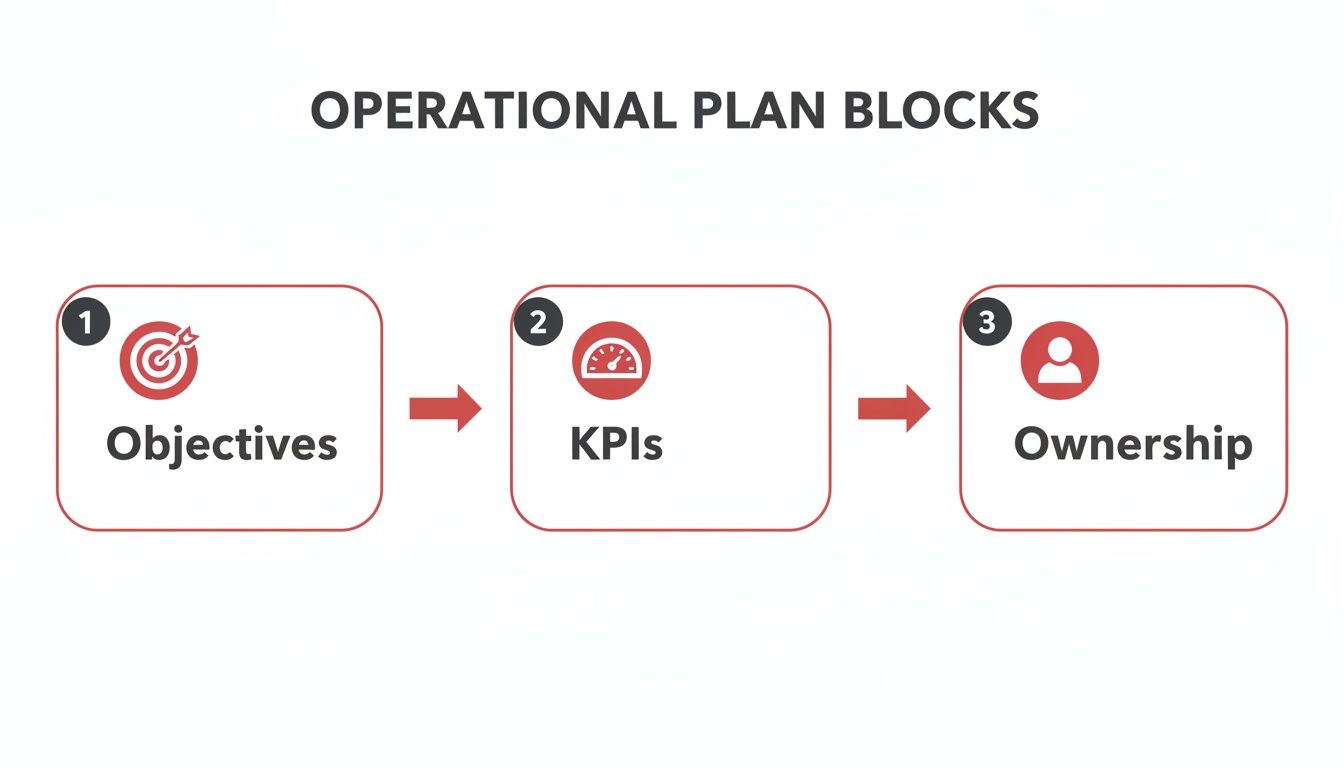
This simple flow is key: every objective needs to be measured by a specific KPI and have a clear owner to ensure it happens.
Deconstruct Annual Targets into Actionable Chunks
A big annual target like, "Increase ARR by $5 million," is way too massive to be actionable day-to-day. The magic of a good operational plan is breaking down those intimidating annual goals into achievable quarterly "rocks" and monthly sprints.
This is how you turn overwhelming numbers into manageable tasks.
- Annual Goal: Increase ARR by $5M.
- Quarterly Rock: Land 25 new enterprise customers in Q3.
- Monthly Sprint (July): Generate 150 qualified enterprise demos.
- Weekly Task (Week 1): SDR team to complete 500 cold outreaches to target accounts.
This cascade creates a straight line from a single cold call all the way up to the company's biggest revenue goal. Now everyone on the team can see exactly how their individual work fits into the bigger picture.
A Fintech Playbook for Slashing Onboarding Time
Let's make this real. A Series B fintech company had a strategic goal to boost customer retention. Their operational plan pinpointed a huge problem: a clunky onboarding process was causing a ton of customers to churn in the first 30 days.
Their operational objective was sharp and clear: "Reduce average customer onboarding time from 10 hours to under 7 hours (a 30% reduction) by the end of Q2."
This is a perfect operational objective. It's specific, measurable, ambitious but realistic, directly tied to the strategic goal of retention, and time-bound.
To get it done, they laid out specific initiatives with clear owners:
- Product Team Initiative: Redesign the in-app welcome tutorial to be more interactive. Owner: Head of Product. KPI: Increase tutorial completion rate from 40% to 70%.
- Success Team Initiative: Implement a proactive 14-day check-in call with all new customers. Owner: Head of Customer Success. KPI: Achieve a customer health score of 8/10 or higher for 90% of new accounts at day 30.
By breaking the problem down and giving people direct ownership of measurable outcomes, they crushed their goal. They didn't just "try to improve onboarding"; they ran a precise, measurable play that produced a real business result.
SaaS Operational Plan Examples You Can Steal
Okay, enough with the theory. Let's look at tangible blueprints you can use to stop guessing and start building a plan that actually gets results.
This is how you turn a big, lofty strategy into a dashboard your team can look at every day and know exactly what to do.
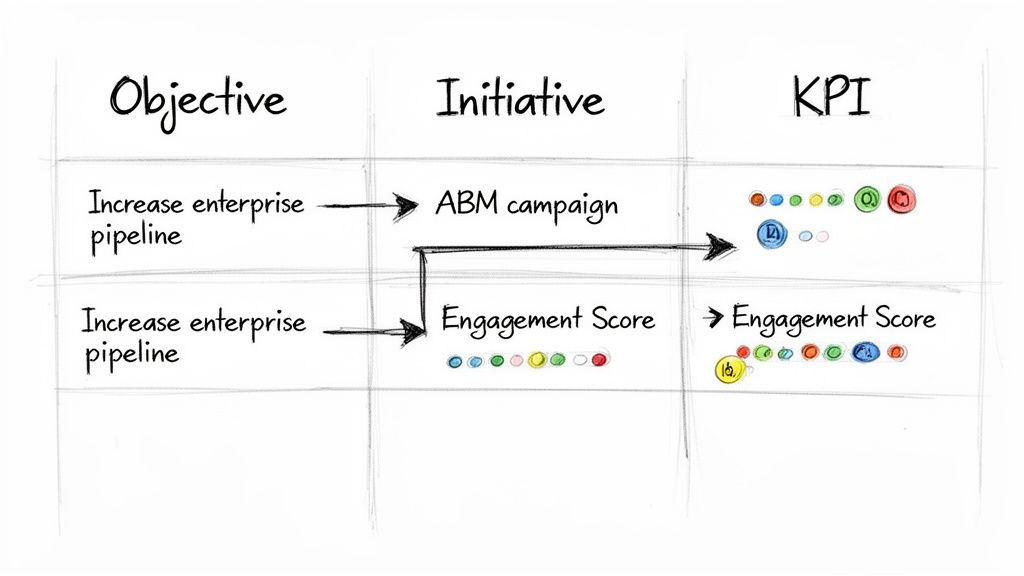
Marketing Team Example: Increase Enterprise Pipeline
Let's say a B2B SaaS company's strategic goal for the year is to dominate the enterprise market. An operational plan brings that dream down to earth.
Strategic Goal: Become the market leader in the enterprise segment.
Q3 Operational Objective: Increase new enterprise pipeline by 30% over Q2.
Boom. Now we have a number. The operational plan breaks this down into specific plays, each with a clear metric, a target, and someone's name next to it.
A great operational plan makes it impossible for anyone on the team to wonder how their work matters. It connects every task to a strategic outcome.
Here’s a snapshot of what their scorecard might look like for the quarter.
Sample SaaS Operational Plan Scorecard (Q3)
This table isn't just a to-do list; it's a performance contract. Each row represents a specific bet the team is making to hit their 30% pipeline growth target.
| Objective | Key Initiative | KPI | Target | Owner |
|---|---|---|---|---|
| Increase Enterprise Pipeline by 30% | Launch an ABM campaign for 100 F500 accounts. | Target Account Engagement Score | Achieve an average score of 75 | Jane D. |
| Increase Enterprise Pipeline by 30% | Host an executive webinar on "Scaling Operations." | Qualified Enterprise Registrants | 200 | Mark C. |
| Increase Enterprise Pipeline by 30% | Publish three enterprise-focused case studies. | Case Study Influenced MQLs | 50 | Sarah L. |
With a plan like this, there’s zero ambiguity. Jane knows her world revolves around that ABM campaign's engagement score. Mark is all-in on nailing that webinar. It’s this clarity and ownership that separates the most effective teams, and you’ll see this structure in many performance scorecard examples.
Product Team Example: Improve User Retention
Now, let's jump over to the product team. Their strategic mandate is to increase customer lifetime value (LTV). The operational plan hones in on retention.
Strategic Goal: Increase Customer LTV.
Q3 Operational Objective: Improve the 90-day user retention rate from 60% to 65%.
To hit this goal, the team can't just ship random features. The operational plan forces them to ask, "What work will have the biggest impact on keeping users engaged past that critical 90-day cliff?"
Here’s what their plan might look like:
- Initiative 1: Ship Top-Requested Feature "A"
- KPI: Feature Adoption Rate
- Target: 40% of active users adopt within 30 days of launch.
- Owner: Michael B. (Product Manager)
- Initiative 2: Redesign the User Onboarding Flow
- KPI: Week 1 User Activity Rate
- Target: Increase from 50% to 60%.
- Owner: Emily R. (UX Lead)
- Initiative 3: Reduce Critical Bugs by 50%
- KPI: Number of P1 Tickets Reported
- Target: Fewer than 5 per week.
- Owner: David S. (Engineering Lead)
Each one of these is a direct, measurable bet on improving retention. Michael isn't just shipping a popular feature; he's shipping it because the plan clearly connects that work to the goal of making users stick around. This is what it means to align the entire company.
How to Execute Your Plan and Avoid Common Failures
A brilliant operational plan is useless if it just collects digital dust. Execution is where most SaaS companies stumble. A plan doesn't fail because it was poorly written; it fails because it gets ignored the second things get busy.
The goal isn't just to create a plan but to weave it into the fabric of your company, shaping daily decisions and keeping everyone pulling in the same direction.
The Most Common SaaS Execution Traps
We've seen the same mistakes play out time and again. A team spends weeks crafting a perfect plan, only for it to fall apart by the second month of the quarter. Avoiding these common failures is your first step.
- The "Set It and Forget It" Plan: The plan is created in a flurry of workshops and then promptly forgotten until the end of the quarter, when everyone suddenly realizes they're way off track.
- Siloed Planning: The leadership team cooks up the plan in a vacuum without any input from the people who will actually have to do the work. This is a recipe for unrealistic goals and zero buy-in from your front-line teams.
- Fear of Adaptation: Some teams treat the plan like it’s set in stone, refusing to adjust it even when the market shifts or new data comes to light. A good plan is agile, not rigid.
Execution isn't a one-time event; it's a continuous process. Think of your operational plan as a compass, not a GPS. It gives you a direction, but you still need to steer around obstacles and adjust for changing winds.
Establish a Non-Negotiable Execution Rhythm
The antidote to these failures is a consistent, non-negotiable meeting rhythm. This creates a regular cadence for accountability and course correction, forcing the plan to stay front and center.
This structured approach is part of what makes an operational plan so powerful. When you detail daily functions like budgeting and team capacity, you can unlock serious cost savings—we often see between 15-25%. The best plans also include leading indicators for real-time monitoring, which can lead to 30% faster adjustments when things start to go sideways.
A strong execution rhythm usually looks something like this:
- Weekly Tactical Check-ins: Quick, 30-minute meetings focused purely on the week's progress. The agenda is simple: "What did we get done last week? What are the top priorities for this week? Where are we blocked?"
- Monthly Strategic Reviews: A longer, in-depth meeting to review progress against the quarterly KPIs. It’s not about individual tasks, but about the bigger picture: "Are our initiatives actually having the impact we hoped for? Do we need to shift resources?"
This rhythm creates a feedback loop that makes your plan dynamic and responsive. It also ensures potential problems are flagged early, a core part of a strong operational risk management framework.
Leverage Tools for a Single Source of Truth
Please don't try to manage execution in a messy web of spreadsheets and email chains. Use modern tools to create a single source of truth for your entire plan.
Platforms like Asana, Jira, or dedicated financial planning tools can automate your tracking and make progress visible to everyone in real-time. When every initiative, KPI, and owner is tracked in one place, it kills ambiguity and makes accountability almost effortless.
To get the most out of these systems, many operators also integrate workflow automation to handle repetitive tasks and ensure key processes are followed consistently. This combination of a clear rhythm and the right tools is what transforms your operational plan from a document into the true engine of your company's execution.
Frequently Asked Questions About Operational Plans
When you first sit down to hammer out an operational plan, questions are going to fly. You’re connecting an ambitious vision to the nitty-gritty, day-to-day work. Let’s tackle some of the most common questions we hear from SaaS operators.
How Is an Operational Plan Different from a Business Plan?
This is a classic point of confusion. A business plan is the big, glossy document you’d hand to an investor. It’s the whole story—market analysis, five-year financial projections, your grand mission. It argues for the very existence of your company.
An operational plan is your internal playbook. It's a focused, short-term guide—usually for the next quarter or year—that breaks down exactly how each department will hit its goals. It’s all about the "how," not the "what" or the "why."
- Business Plan: The complete pitch for your company's long-term potential.
- Operational Plan: The boots-on-the-ground execution guide for your team this quarter.
How Often Should We Update Our Operational Plan?
An operational plan can't be a "set it and forget it" document. The SaaS world moves too fast. The best operators treat it as a living guide with a steady rhythm for review.
For most SaaS companies, a quarterly cadence hits the sweet spot. You build a fresh plan each quarter, laddering up to your annual strategic goals. Then, you check in on progress weekly and do a deeper review monthly.
A quarterly operational plan is ideal. It's long enough to make a real dent in major initiatives but short enough to stay agile and react to new customer feedback, a competitor's move, or a shift in the market.
This rhythm gives you the best of both worlds: focus and flexibility. You're not chasing a new shiny object every week, but you're also not clinging to a plan that’s clearly out of touch with reality.
Who Is Actually Responsible for Creating the Plan?
A great operational plan is built together, not handed down from on high. While the executive team points the ship in the right direction (setting the strategy), the plan itself needs to be shaped by the department heads and team leads. These are the folks in the trenches who know what the team can handle and where the hidden roadblocks are.
A healthy breakdown of roles looks like this:
- Executive Leadership (CEO, COO): They set the big strategic objectives for the quarter, like "Increase enterprise ARR by 15%." They are ultimately accountable for the plan's overall success.
- Department Heads (VP of Sales, Marketing, Product): They take those high-level goals and translate them into specific projects and KPIs for their teams. They are responsible for building and executing their part of the plan.
- Team Members: They provide the crucial reality check on timelines and resources, making sure the plan is ambitious but achievable.
When your team helps build the plan, they feel a sense of ownership. That's how you get true commitment, not just compliance.
What Is the Single Biggest Factor for a Successful Plan?
If I had to boil it all down to one thing, it's unambiguous ownership. You can have the most brilliant objectives and perfectly crafted KPIs, but if it’s fuzzy who is accountable for what, the plan is doomed.
Every single key result, every project, every initiative needs to have one person's name next to it.
This doesn't mean that person does all the work. It means they are the single point of contact responsible for seeing that initiative across the finish line on time. When ownership is crystal clear, accountability just happens. There's no finger-pointing or "I thought they were handling that." This one principle is often the line between a plan that gets results and one that just creates noise.
How Does This Differ for an Early-Stage vs. a Growth-Stage SaaS?
The core idea of an operational plan doesn't change, but its complexity evolves as your company grows.
- Early-Stage (Seed/Series A): Your operational plan might live in a shared Google Doc. The game is all about speed and agility. You’ll have fewer, more critical goals, likely centered on nailing product-market fit or landing your first 50 customers. Your planning cycle might even be monthly, not quarterly.
- Growth-Stage (Series B and beyond): As you scale, your plan becomes more structured. You'll have multiple departments—Sales, Marketing, CS, Product—each with detailed plans that must be perfectly in sync. The plan will be heavily data-driven, probably managed in dedicated software, and tied directly to complex financial models. The goal shifts from scrappy survival to building a predictable growth engine.
The trick is to match the plan's complexity to your organization's complexity. Don't over-engineer things when you're a team of ten, but don't try running a 100-person company on a glorified to-do list, either.
At SaaS Operations, we provide the proven playbooks, templates, and SOPs to help you build and execute operational plans that drive real growth. Our frameworks are battle-tested by operators who have scaled multiple 8-figure SaaS businesses, saving you time and accelerating your results. Learn more about our plug-and-play solutions.