
Here it is—the free, no-fluff customer acquisition cost calculator you've been looking for. It's a Google Sheet, ready to download and put to work. Think of this less as a template and more as a battle-tested tool built for SaaS operators who are tired of guesswork and ready to make decisions based on cold, hard data.
Why Your SaaS Needs This Free CAC Calculator
Guessing your Customer Acquisition Cost (CAC) is a fantastic way to burn through your cash reserves and kill your growth momentum. If you don't have a laser-focused understanding of what it costs to land a new customer, you're flying blind on everything from marketing budgets to pricing and even hiring. This isn't just about calculating one number one time; it's about building a system for predictable growth.
This free CAC calculator is your first step. It’s built specifically for the nuances of SaaS, making sure you account for all the relevant costs—not just ad spend, but the prorated salaries of your sales and marketing teams, too.
More Than Just a Spreadsheet
Look, a simple (Cost / New Customers) formula isn't going to cut it. True operational excellence comes from weaving this metric into the very rhythm of your company. This tool is designed to help you do just that.
You'll be able to:
- Get Crystal Clear: Finally see an accurate, detailed picture of your acquisition expenses.
- Plug the Leaks: Quickly spot the inefficient channels that are quietly draining your budget.
- Spend Smarter: Make confident, data-backed decisions about where to double down and where to pull back.
The impact of this kind of clarity is huge. With acquisition costs climbing everywhere, efficiency is your new competitive advantage. For example, the average CAC for e-commerce businesses jumped by a staggering 62.5% in just two years. But here's the flip side: companies that actually track this stuff see real results. Shopify found that brands using their CAC calculator tools improved marketing efficiency by 15-20% just by shifting budget away from channels that weren't pulling their weight.
As a SaaS operator, your job isn't just to track CAC—it's to weaponize it. This number should drive every conversation about growth, from your weekly team huddles to your quarterly board meetings. It's how you turn marketing from a cost center into a predictable revenue engine.
Building Your Growth Engine
This calculator is the cornerstone. I've personally seen countless founders and operators go from a vague, "I think our marketing is working," to a confident, "I know our Google Ads channel acquires customers for $450 with a six-month payback period." That level of specificity changes the entire game. It's not just a metric anymore; it’s a lever you can pull to scale your business predictably and profitably.
When you grab this tool, you're not just downloading another file. You're adopting a core piece of the operational playbook that high-growth SaaS companies live by. For more frameworks like this, check out our full suite of SaaS operator tools.
Now, let’s get your copy and start plugging in the numbers.
Getting the Right Numbers Into Your CAC Calculator
A tool is only as good as the data you feed it. That’s especially true for our free customer acquisition cost calculator. The most common mistake I see SaaS operators make is just plugging in their ad spend. This gives you a wildly optimistic number that can lead to some really bad decisions down the road.
Let's fix that.
Imagine you're running a typical B2B SaaS company. You're spending money on LinkedIn Ads and Google Ads, but you've also got a couple of people working on SEO in-house. To get your true CAC, you have to look way beyond the ad platform dashboards.
This is the path from messy, raw data to clear, actionable insights—turning a simple spreadsheet into a powerful decision-making tool.
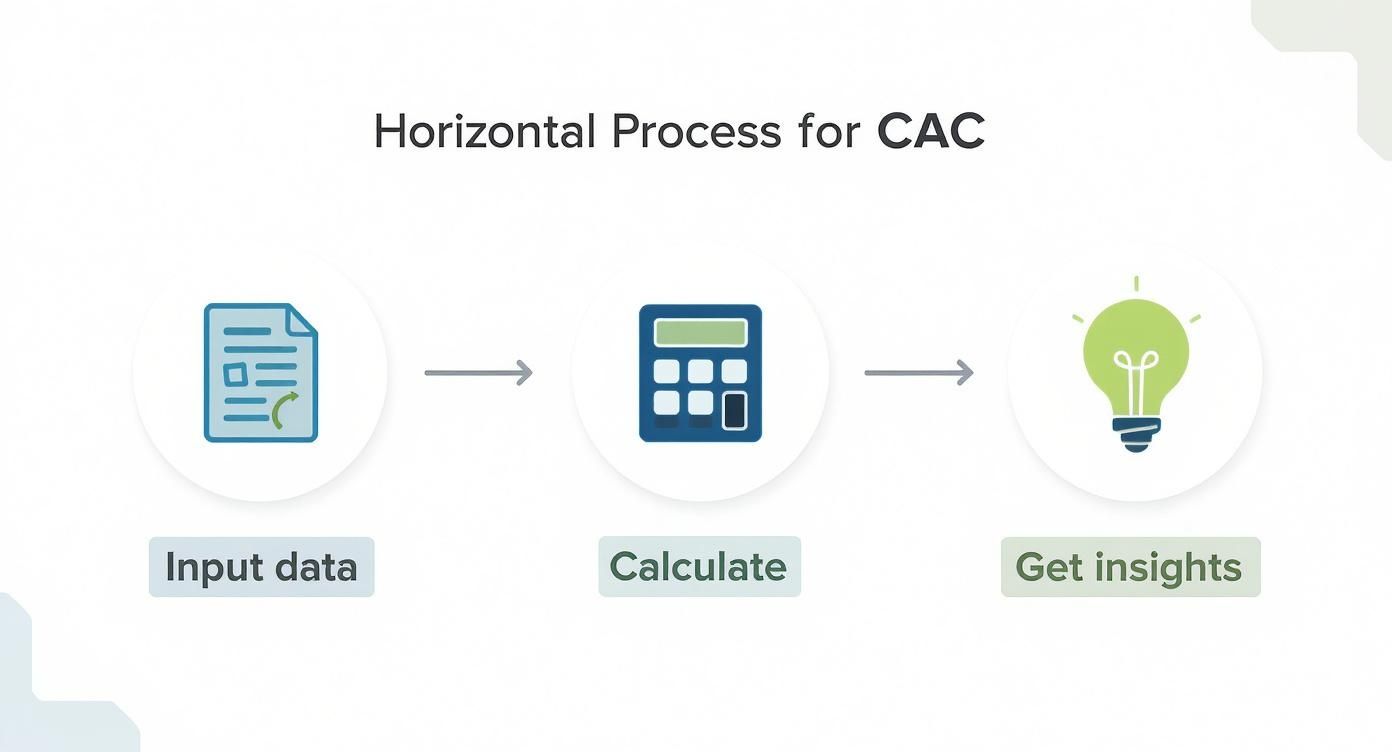
The whole game is about systematically tracking your full costs and customer counts. Do that, and you'll unlock the insights that actually move the needle.
Tallying Up Your Total Sales and Marketing Spend
Seriously, the biggest pitfall is undercounting your costs. To calculate a CAC you can actually trust, you need to account for every single dollar spent on landing new customers. This goes way beyond your advertising budget.
Here’s a practical checklist of what you need to round up:
- Salaries and Wages: This is the big one. You need the fully-loaded cost—that’s salary plus benefits and payroll taxes—for everyone in a sales or marketing role. Think Head of Marketing, content writers, SDRs, and your account executives. All of them.
- Ad Spend: This one's easy. Just pull the total spend from all your paid channels for the period you're measuring. That means Google Ads, LinkedIn Ads, Capterra, you name it.
- Commissions and Bonuses: Don’t let sales commissions slip through the cracks. They are a direct cost of acquiring a customer and absolutely must be in your calculation.
- Software and Tools: Add up the monthly or annual costs for your entire sales and marketing tech stack. We're talking your CRM, marketing automation platform (like HubSpot), SEO tools (Ahrefs or Semrush), and any other software these teams use to do their jobs.
- Content and Creative Costs: Did you hire a freelance writer for blog posts? A designer for new ad creative? Those are acquisition costs. Make sure you include any payments to contractors or agencies.
For a deeper dive, this comprehensive guide to customer acquisition cost calculation offers some great insights on defining and gathering these inputs.
Your "blended" CAC, which includes all these costs, is your source of truth. It tells you how healthy your overall acquisition engine is. Once you have this number nailed down, you can start slicing it by channel to find your most efficient growth levers.
Counting Your New Customers the Right Way
The other side of the equation is just as important and, believe it or not, just as easy to mess up. The key here is consistency. You have to decide what a "new customer" means for your business and then stick to that definition every single time you run the numbers.
For most SaaS businesses, a new customer is a new logo that has signed a contract and made its first payment during the period you're measuring. It's not a free trial user or a lead from a webinar. It's a paying customer who adds to your Monthly Recurring Revenue (MRR).
Clean, consistent inputs are everything. They let the calculator do the heavy lifting and give you a clear, period-over-period view of how you're doing.
A Quick Word on Timing and Attribution
Choosing the right timeframe is crucial. For most SaaS companies, calculating your CAC monthly is the perfect starting point. It gives you a frequent enough signal to spot trends without getting lost in the noise of daily ups and downs.
Attribution can get messy, I know. A customer who signed in March might have first discovered you through marketing efforts back in January. For the sake of simplicity and consistency, it’s best to use a cash-basis approach.
Here’s the simple formula: Sum up all sales and marketing expenses from a period (e.g., March) and divide by the number of new customers acquired in that same period (March).
Sure, it's not a perfect attribution model, but this method is straightforward, repeatable, and gives you a reliable trendline over time. As you grow, you can explore more complex models. For now, this approach is the best way to build the muscle of regularly tracking your CAC.
Just remember, CAC is only one piece of the puzzle. It's one of several SaaS key performance indicators you need to keep an eye on to truly understand the health of your business.
Moving Beyond a Simple CAC Number
A single, blended CAC number is a good start, but let's be honest—it's mostly a vanity metric. It tells you what you're spending on average, but it completely misses the why and the where.
The real story, the kind of actionable insight that actually lets you scale efficiently, is buried in the details. The best SaaS operators I know don't just track their blended CAC; they get out their scalpels and dissect it. This is where you graduate from basic tracking to making sharp, data-driven decisions that can change the trajectory of your business.
The single most important step is to break down your CAC by acquisition channel. Your blended CAC might be sitting at a respectable $500. Looks okay, right? But what if hidden inside that average is an incredibly profitable SEO channel bringing in customers for $50 a pop, while a cash-hemorrhaging paid social campaign is bleeding you dry at $1,200 per customer? Without that channel-level data, you’re essentially flying blind. You can't see your best growth levers.
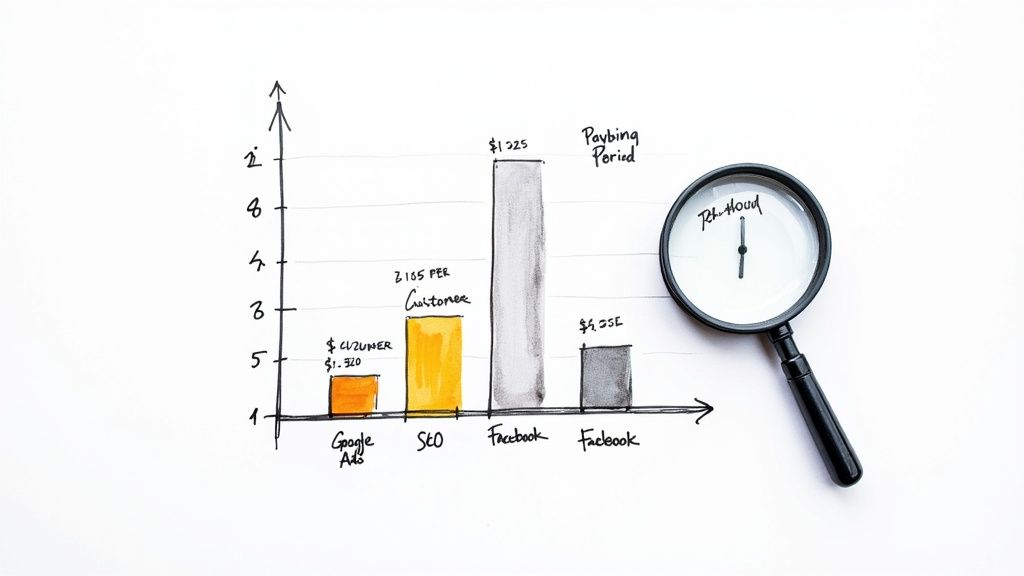
This just means you need to segment your sales and marketing costs and pin each new customer to their original source. It's the same logic we used for the blended calculation, but now you run it for each channel individually in our free customer acquisition cost calculator to see how they truly stack up.
Calculating Your CAC Per Channel
Getting this granular view takes a bit more diligence, but trust me, the payoff is huge. You’ll need to allocate every single marketing and sales cost to a specific channel.
Here’s a quick rundown on how you might approach it for a few common SaaS channels:
- Google Ads CAC: This one is usually the most straightforward. Tally up your total Google Ads spend for the month. Then, add a prorated chunk of the salary for anyone managing those campaigns (like your PPC manager or your agency's retainer). Divide that total by the number of new customers you can directly attribute to Google Ads in that period.
- SEO/Content CAC: This can feel a little murkier, but it’s absolutely essential. Sum the fully-loaded salaries of your content team and any SEO folks. Toss in any costs for freelance writers, content tools, and your SEO software subscriptions (think Ahrefs or Semrush). Divide all that by the number of new customers who came from organic search.
- Outbound Sales CAC: Calculate the fully-loaded salaries and commissions for your SDRs and Account Executives. Don't forget to add the costs of their tools—your CRM, sales engagement platforms, and any data providers. Divide this sum by the number of new customers your outbound team closed.
When you pit these numbers against each other, the truth about your acquisition engine starts to emerge. You might discover that while paid ads bring in customers faster, your long-term bet on SEO is yielding a far more profitable customer. That kind of insight is pure gold. It tells you exactly where to put your next dollar and who to hire next.
Introducing the Critical CAC Payback Period
Knowing your CAC is only half the battle. The other, equally important question is: How long does it take to earn back the money you spent to acquire a customer?
This is your CAC Payback Period, and it’s a non-negotiable metric for capital efficiency. A low CAC is great, but if it takes you 24 months to recoup that cost, you have a serious cash flow problem. In the world of SaaS, cash is king, and a shorter payback period is your best friend.
Key Takeaway: The CAC Payback Period measures the number of months it takes for a customer's cumulative gross margin to equal their acquisition cost. For most SaaS businesses, anything under 12 months is considered excellent.
Figuring this out is pretty simple once you have the right inputs. The formula looks like this:
CAC Payback Period (in months) = CAC / (ARPA x Gross Margin %)
Let's quickly break down the components:
- CAC: Your Customer Acquisition Cost for a specific period.
- ARPA: Your Average Revenue Per Account (or customer) per month.
- Gross Margin %: The percentage of revenue left after you've paid your cost of goods sold (COGS). For SaaS, this typically includes things like hosting, customer support, and third-party data fees.
This one metric connects your acquisition spend directly to your unit economics and profitability timeline, giving you a much richer picture than CAC alone.
A Real-World Pivot Driven by Payback Period
I once advised a B2B SaaS company that was absolutely thrilled with its Facebook Ads performance. Their CAC was a lean $350, way lower than their blended average of $600. On the surface, it looked like a home run. They were ready to double down and pour more budget into the channel.
But I asked them to pump the brakes and calculate the payback period first.
It turned out that while the CAC was low, the customers coming from Facebook were all signing up for their lowest-priced plan ($49/month) and had a much higher churn rate. Their ARPA from this channel was tiny, and their gross margin was about 80%.
Here’s how the math shook out:
- CAC: $350
- ARPA: $49
- Gross Margin: 80%
- Payback Period: $350 / ($49 * 0.80) = 8.9 months
Meanwhile, their LinkedIn Ads channel had a much higher CAC of $900, and management was highly skeptical of it. But the customers from LinkedIn were enterprise clients signing up for a $299/month plan.
Let's run those numbers:
- CAC: $900
- ARPA: $299
- Gross Margin: 80%
- Payback Period: $900 / ($299 * 0.80) = 3.7 months
All of a sudden, the "expensive" channel looked like the smartest investment in the room. It returned their acquisition cost more than twice as fast, freeing up cash to plow back into growth. This one insight led to a complete strategic pivot, shifting budget from Facebook to LinkedIn and dramatically improving their capital efficiency. This is the power of moving beyond a simple CAC number.
Focusing on these deeper metrics is what separates the good operators from the great ones. In fact, recent research shows that companies using advanced calculators are 30% more likely to achieve a healthy LTV:CAC ratio. The ideal target is at least 3:1, meaning a customer’s lifetime value should be at least three times what it cost to acquire them. To get a better handle on this crucial relationship, check out our detailed guide on SaaS lifetime value calculation.
Common CAC Calculation Mistakes Most Founders Make
It’s shockingly easy to calculate a CAC that looks fantastic on a slide deck but is completely wrong. Getting this number right isn't just an accounting exercise—it's the bedrock of a scalable growth strategy. An inaccurate CAC can trick you into pouring money down the drain on channels that are secretly sinking your business.
I've seen hundreds of SaaS operators make the same few critical errors. Think of this section as your safety net. We're going to walk through the pitfalls that show up time and time again so you can sidestep them.
Ignoring the 'Hidden' Costs of Acquisition
The most frequent and dangerous mistake is only counting your ad spend. Your true CAC is so much more than what you pay Google or LinkedIn. It includes every single dollar that contributes to landing a new customer.
Founders consistently forget to include:
- Prorated Salaries: The fully-loaded cost (salary + benefits + taxes) of your marketing team, SDRs, and a slice of your sales team's time. If someone’s job is to acquire customers, their compensation is a cost of acquisition.
- Software and Tools: All those monthly subscriptions for your martech and sales stack really add up. Your CRM, marketing automation, SEO tools, and sales engagement platforms all belong in the calculation.
- Freelance and Agency Fees: Any payments to freelance writers, designers, or marketing agencies are direct acquisition costs.
Forgetting these gives you a dangerously optimistic CAC. You might think a channel is profitable when, in reality, it's a cash bonfire once you factor in the full operational overhead.
The Sales Commission Story
I once worked with a Series A startup celebrating their "incredibly low" $800 CAC on a product with a $4,000 ACV. Based on that number, they were getting ready to massively scale their outbound sales team.
The problem? They completely forgot to include sales commissions.
Once we added the 15% commission paid to their account executives, their true CAC shot up by $600, landing at $1,400. Their real acquisition cost was 75% higher than they thought. This discovery didn't just tweak a spreadsheet; it completely upended their hiring plan and forced them to rethink their entire commission structure to make the unit economics viable.
Don't let this be you. A proper CAC calculation includes every expense that goes into acquiring a new customer. No exceptions. This rigor is what separates guessing from operating.
Misattributing Customers in Long Sales Cycles
Another common trap is using inconsistent timeframes, especially for B2B SaaS where sales cycles can drag on for months. A customer who finally signs the contract in April might have started their journey with a whitepaper your team created back in January.
If you attribute that new customer solely to your April marketing spend, you're not seeing the full picture. The marketing efforts that nurtured them for months get ignored, making your recent April activities look way more effective than they actually were.
To fix this, it’s best to use a consistent, rolling average—like a 90-day window. This approach smooths out the month-to-month swings and gives you a much better sense of the relationship between your sustained marketing efforts and the customers they eventually bring in.
Relying Only on a Blended CAC
Finally, operating with just a single, blended CAC for your entire business is a recipe for mediocrity. As we've touched on, this blended number hides the incredible performance of your best channels while masking the budget-draining failures of your worst.
You might have one channel bringing in customers for $200 and another costing you $2,000. Your blended CAC of $1,100 tells you absolutely nothing about this critical difference. Without channel-level data, you can't make smart decisions about where to put your next dollar. If you're curious about how your numbers stack up, checking out some SaaS metrics benchmarks can provide valuable context.
Avoiding these common mistakes ensures the numbers you plug into the calculator reflect your business's true health, giving you the confidence to make bold, data-driven decisions.
Turning CAC Insights Into Action
Figuring out your CAC is a fantastic start, but let's be honest—that number is useless if it just collects dust in your customer acquisition cost calculator. The real magic happens when you weave this metric into the very fabric of your business. This is how you stop treating CAC as a static number in a spreadsheet and start using it as a living, breathing metric that actually guides your growth.
The whole point is to make CAC a regular part of your operational chatter. It shouldn't be something you look up once a quarter. It needs to be right there, influencing your marketing budgets, hiring plans, and even product roadmap. So, let's set up the systems to make that happen.
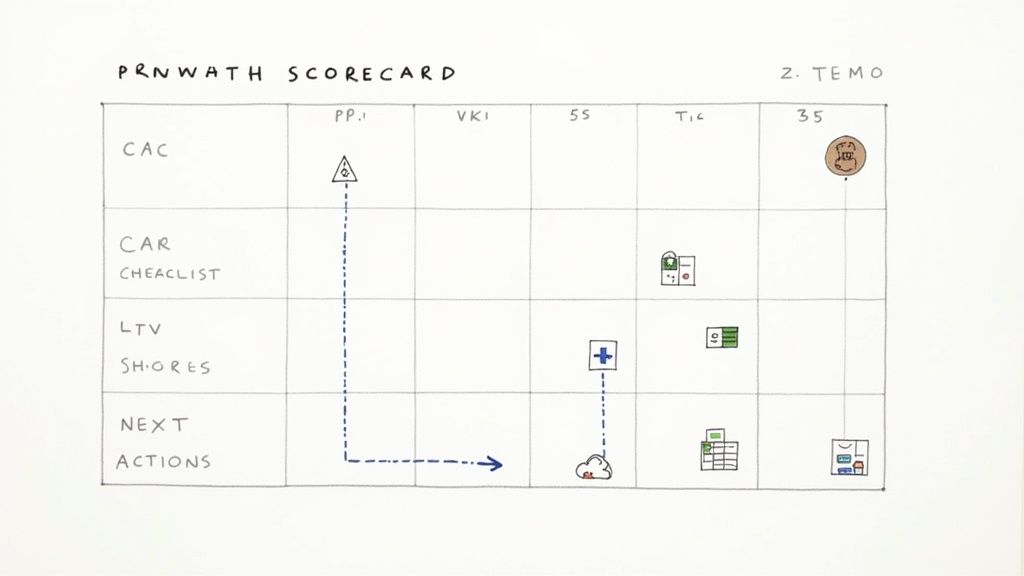
Build a Weekly Growth Scorecard
Your weekly leadership or growth meeting is the perfect arena to put CAC in the spotlight. A simple ‘Growth Scorecard’ forces everyone to look at CAC with the same intensity they give MRR or churn. This isn't about creating more paperwork; it's about laser-focusing the conversation on what drives sustainable growth.
And your scorecard doesn't need to be some complicated beast. Simpler is almost always better. Just track a few core metrics week-over-week. You'll start spotting trends and asking much better questions almost immediately.
Here's a little taste of what I mean. I recommend starting with a simple table that everyone can quickly digest in your weekly meeting.
Sample Weekly Growth Scorecard
| Metric | This Week | Last Week | WoW Change | Target |
|---|---|---|---|---|
| New MRR | $12,500 | $11,000 | +13.6% | $12,000 |
| New Customers | 25 | 22 | +13.6% | 24 |
| Blended CAC | $980 | $1,050 | -6.7% | <$1,000 |
| CAC Payback | 7.8 mos | 8.4 mos | -7.1% | <8 mos |
Putting these numbers side-by-side every single week builds accountability and forces you to be proactive. A rising CAC isn't just a red number anymore; it’s a trigger to ask, "Hey, what happened with our paid channels?" or "Did our sales team's close rate dip?"
Create a Monthly CAC Review SOP
If you want to get better at something, you need a process. A monthly CAC review, driven by a dead-simple Standard Operating Procedure (SOP), makes sure you're not just glancing at the numbers but are actively trying to make them better.
This SOP is what turns a reactive review into a proactive strategy session. Here’s a playbook you can steal to get started:
- Data Refresh: First things first, have your marketing ops or finance lead plug in all the sales and marketing spend and new customer numbers from last month into the calculator.
- Channel Deep Dive: Next, break down the CAC for each of your main acquisition channels (Google Ads, SEO, Outbound, etc.). It’ll become obvious pretty quickly which ones are your winners and which are bleeding you dry.
- Find the "Why": If CAC jumped or dropped significantly, dig in. Was it a big ad spend on a new campaign? Did a key landing page's conversion rate tank?
- Assign Actions: Based on what you find, create clear next steps with owners. For example, "Marketing team will shift $5,000 from LinkedIn to Google Ads" or "Sales will workshop their outbound script."
This kind of structured review is what separates the best operators from everyone else. You’re building a muscle for continuous optimization, constantly tweaking your acquisition engine. Once you have a clear picture of your CAC, the next logical step is to explore effective strategies to reduce customer acquisition costs and improve your overall ROI.
Automate Your Data for Real-Time Insights
Pulling data by hand every week is a solid start, but the end game is automation. When you connect your data sources directly to your Google Sheet, you get something close to a real-time pulse on your acquisition health.
I know, "automation" can sound intimidating, but tools like Zapier or Make make this surprisingly easy.
- Connect Your Ad Platforms: You can set up a simple workflow that automatically grabs your total monthly ad spend from Google Ads, LinkedIn, or Facebook and drops it right into your calculator.
- Link Your CRM: Do the same with your CRM. Create a zap that counts every new 'Closed-Won' deal in HubSpot or Salesforce and updates your 'New Customers' count automatically.
Automating the data flow is huge. It frees up your team from mind-numbing data entry and lets them focus on what matters: analysis and action. Your CAC calculator transforms from a historical report card into a forward-looking dashboard that helps you make smarter decisions on the fly. This is particularly crucial for improving your SaaS lead generation engine, giving you immediate feedback on which channels are actually delivering value.
Got Questions About CAC? We've Got Answers.
Even with the best calculator in hand, you're bound to have questions. Getting CAC right is a big deal for any SaaS company, so let's walk through some of the most common things people ask.
How Often Should I Be Calculating My CAC?
For most SaaS businesses, running the numbers on your CAC every month is the way to go. It’s the perfect cadence—often enough to catch trends and tweak your strategy, but not so often that you get lost in tiny, meaningless daily wiggles.
Now, if you're in the middle of a big product launch or pouring cash into a major marketing push, you might want to tighten that up and calculate it weekly. That gives you a much faster feedback loop to see if your big spend is actually working. On the flip side, waiting a full quarter to check in is just too slow. The SaaS world moves way too fast for that.
So, What's a "Good" CAC for a SaaS Business?
This is the question everyone asks, and the real answer is… it depends. Seriously. There’s no magic number that works for everyone. A $1,000 CAC might be an incredible deal for one company and a total disaster for another.
The only way to know if your CAC is healthy is to put it side-by-side with your Customer Lifetime Value (LTV). This brings us to the all-important LTV:CAC ratio.
The benchmark for a healthy, growing SaaS business is an LTV:CAC ratio of at least 3:1. This simply means for every dollar you put into getting a customer, you should expect to get at least three dollars back over their lifetime with you.
Think about it: a $500 CAC is a train wreck if your LTV is only $400 (a 0.8:1 ratio). But that same $500 CAC is a massive win if your LTV is $2,000 (a 4:1 ratio). It's all about the relationship between what you spend and what you earn.
My CAC Is Sky-High. What's the First Thing I Should Do?
Seeing a high CAC can definitely make your stomach drop, but don't hit the panic button just yet. It’s a sign that you need to dig in and figure out what’s really going on. Before you go cutting your entire marketing budget, here's a better plan.
First thing's first: break down your CAC by acquisition channel. Your overall, blended CAC is probably lying to you. More often than not, you'll find that one or two channels are dragging down your average.
Once you’ve found the problem areas, you can get to work:
- Shift Your Budget: Don't be afraid to pause or slash the budget for your most expensive, underperforming channels. Immediately move that money over to the channels that are already working well.
- Obsess Over Conversion: Get your team focused on Conversion Rate Optimization (CRO). Small tweaks to your key landing pages or signup flow can have a huge impact on your acquisition costs, often without needing to spend a dime more on ads.
- Nail Your Onboarding: Take a hard look at your customer onboarding. If you can reduce how many new customers churn in their first few months, you'll naturally increase your LTV. A higher LTV makes your current CAC look a whole lot better and gives you more room to invest in growth.
This isn't about guessing; it's about making smart, targeted moves based on what the data is telling you.
At SaaS Operations, we provide the battle-tested playbooks, templates, and SOPs you need to build a more efficient and predictable growth engine. Stop guessing and start operating with clarity. https://saasoperations.com