
When we talk about churn in the SaaS world, we’re talking about the rate at which customers cancel their subscriptions. It’s one of the most honest—and sometimes brutal—metrics you can track. Think of it as a silent leak that can slowly drain the life out of your business, no matter how hard you work to grow.
What Churn in SaaS Actually Means for Your Business
Picture your company as a bucket you’re working tirelessly to fill with water (new customers). Every sale you make pours more water in. But churn is a hole in the bottom of that bucket. At first, it might just be a small drip, but if you ignore it, that hole will drain your bucket faster than you can fill it.
This is the core problem with churn in SaaS. It directly cancels out your sales and marketing wins. A high churn rate is a flashing red light. It’s telling you that customers aren’t getting the value they hoped for, they’re running into roadblocks, or a competitor is doing a better job. Ignoring that signal puts you on a “customer acquisition treadmill,” where you have to run faster and faster just to stay in the same place.
The Two Faces of Churn: Intentional vs. Accidental
To really get a handle on churn, you have to realize that not all of it is the same. Customers leave for different reasons, and lumping them all together is a huge mistake. The strategies to fix one type of churn won’t work for the other.
This is a crucial distinction. Are your customers choosing to leave, or are they slipping away by accident?
Voluntary Churn: This is the one that stings. It’s when a customer actively decides to hit the ‘cancel’ button. Maybe they’re unhappy with the product, the price is too steep, or they’ve outgrown the need for it. This type of churn is a direct signal that something is wrong with your product, pricing, or overall customer experience.
Involuntary Churn: This is the frustrating, “accidental” kind of churn. It happens when a customer’s subscription ends unintentionally, usually because of a failed payment. Think expired credit cards, bank declines, or outdated billing info. They didn’t mean to leave, but your system let them go.
Figuring out which type of churn is your bigger problem is the first real step toward building a retention strategy that actually works. You can’t fix a fundamental product flaw by sending more “update your credit card” emails. Many teams use established frameworks to tackle these issues systematically. In fact, you can find a ton of ready-to-use templates and SOPs in these SaaS playbooks to help manage operational challenges like this.
A common mistake is treating all churn the same. In reality, voluntary churn tells you about your product’s value, while involuntary churn tells you about your payment and operational processes. Solving one won’t fix the other.
To make this crystal clear, let’s break down how these two types of churn impact your business in very different ways.
The Real Impact of Different Churn Types
This table breaks down the two primary types of churn and how they affect a SaaS business differently, helping you grasp the nuances of churn analysis.
| Churn Type | What It Measures | Primary Business Impact |
|---|---|---|
| Voluntary Churn | Customer dissatisfaction or lack of perceived value. | Erodes your product-market fit and indicates deeper strategic problems. Requires improvements to product, support, or onboarding. |
| Involuntary Churn | Inefficiencies in your billing and dunning processes. | Causes preventable revenue loss and creates a poor customer experience. Requires tactical, automated solutions to recover payments. |
At the end of the day, your churn rate is a measure of how well you’re keeping your promises. A low churn rate proves you’re delivering consistent value. A high one is a clear warning that something fundamental needs to change, and fast.
How to Confidently Calculate Your Churn Rate

Calculating churn shouldn’t feel like you need a finance degree. At its heart, it’s about answering two simple questions: how many customers did we lose, and how much revenue walked out the door with them?
Let’s break down the essential formulas without the jargon. The goal isn’t just to get a number, but to really understand what that number is telling you about your business. By separating customer churn from revenue churn, you get a much clearer, more honest picture of your company’s health.
Measuring Customer Churn The Simple Way
Customer churn, sometimes called logo churn, is the most straightforward calculation. It simply tells you the percentage of customers who canceled their subscriptions over a specific period, whether that’s a month, a quarter, or a year.
The formula is refreshingly simple:
(Customers Lost During Period ÷ Customers at Start of Period) x 100 = Customer Churn Rate
Let’s make this real. Imagine your SaaS company kicked off the month of May with 500 customers. Throughout the month, 20 of those customers decided to cancel.
Here’s how you’d crunch the numbers:
- Customers Lost: 20
- Customers at Start: 500
- Calculation: (20 ÷ 500) x 100 = 4%
Your customer churn rate for May is 4%. Think of this as your first warning light—it’s a signal that something might be causing friction for your users.
Calculating Revenue Churn for Deeper Insights
While customer churn is a great starting point, revenue churn often tells a much more revealing story about your financial stability. Why? Because not all customers are created equal. Losing one high-value enterprise client can sting a lot more than losing a handful of small startups on your basic plan.
Revenue churn, or MRR churn, measures the percentage of monthly recurring revenue you lost from those canceled accounts. The formula looks very familiar:
(MRR Lost from Churned Customers ÷ MRR at Start of Period) x 100 = Revenue Churn Rate
Let’s go back to our example. We know 20 customers churned. Let’s say those customers were contributing a total of $5,000 in monthly recurring revenue (MRR). At the start of May, your total MRR from all customers was $100,000.
- MRR Lost: $5,000
- MRR at Start: $100,000
- Calculation: ($5,000 ÷ $100,000) x 100 = 5%
Notice that your revenue churn is 5%, which is higher than your 4% customer churn. This is a critical insight. It tells you that you’re losing customers who are, on average, more valuable than the ones who are staying. That’s something you’d completely miss by only tracking customer churn.
Measuring both is essential for a complete financial picture, especially when you’re tracking key metrics like what is ARR.
The Holy Grail: Negative Churn
Now for the really exciting part. What if your revenue churn could be less than zero? It sounds like a trick question, but it’s not. It’s called negative churn, and it’s the ultimate growth engine for any SaaS business.
Negative churn happens when the new revenue you generate from your existing customers—through upgrades, add-ons, or expanded use—is greater than the revenue you lose from cancellations.
Think back to our example. You lost $5,000 in MRR from churned customers. But what if, during that same month, your happy, loyal customers upgraded their plans or bought new features, adding $7,000 in new MRR?
- Expansion MRR: +$7,000
- Churned MRR: -$5,000
- Net Revenue Change: +$2,000
You didn’t just cover your losses—you actually grew your revenue without signing a single new customer. That’s the magic of negative churn, and it’s the definition of sustainable success in the SaaS world.
Is Your Churn Rate Good or Bad?

So, you’ve calculated your churn rate. You have a number. Now what? A 5% churn figure staring back at you from a spreadsheet doesn’t tell you much on its own. Is that good? Bad? The honest answer is, it really depends.
Think of it like this: driving 70 mph is perfectly normal on the highway, but it’s a disaster in a school zone. Context is everything. A 5% monthly churn is a five-alarm fire for most SaaS businesses, but a 5% annual churn could be cause for celebration.
To get a real feel for your performance, you have to look beyond your own bubble and see how you stack up against relevant benchmarks. This is how a simple number transforms into a powerful insight that can actually guide your strategy.
It All Starts with Your Customer Base
One of the biggest factors that will shape what a “good” churn rate looks like for you is who you sell to. The type of customer you serve has a huge impact on how likely they are to stick around.
- Small and Medium-Sized Businesses (SMBs): These customers tend to be more volatile. They might go out of business, pivot their strategy on a dime, or simply have tighter budgets. For companies serving SMBs, a monthly churn rate of 3-7% is pretty standard.
- Enterprise Clients: Big companies are a different ballgame. They’re more stable and usually sign longer, more integrated contracts. Because they invest so much time and money getting set up, they’re far less likely to jump ship. An annual churn rate of 1-2% is considered top-tier here.
A high churn rate in the SMB world might just be the cost of doing business, especially if your customer acquisition cost is low. But even a tiny churn rate among enterprise clients can spell trouble because of how much each account is worth.
Annual vs. Monthly Contracts Matter
The way you bill customers also plays a massive role in churn. It’s not just about when the money comes in; it’s about the psychological commitment you’re asking for.
Think about it: a customer on a monthly plan gets twelve chances every year to second-guess their subscription. The barrier to leaving is low, which naturally leads to higher churn. On the other hand, someone who signs an annual contract only has to make that keep-or-cancel decision once a year, which almost always improves retention.
A common benchmark is that a “good” monthly churn rate is below 1%, while a solid annual churn rate is often somewhere between 5-7%. The trick is knowing these aren’t apples-to-apples comparisons without understanding the business model.
B2B SaaS companies focused on enterprise clients with annual deals often see incredibly low churn. But a startup selling a simple tool to other small businesses on monthly plans will naturally have a higher rate. For instance, B2B SaaS firms see an average monthly churn of around 3.5%, which adds up to a much scarier number when annualized. Smaller SaaS businesses can even see annual churn hit 20% simply because their customers are less stable and can cancel easily.
Ultimately, getting a handle on churn isn’t just about saving a few customers—it’s about protecting your bottom line. Bringing that number down directly boosts profitability and is a huge part of any solid SaaS cost optimization plan. Once you understand the benchmarks for your corner of the market, you can set goals that actually make sense.
Finding the Real Reasons Customers Leave
Knowing your churn rate is a lot like a doctor taking your temperature. It tells you a fever is present, but it doesn’t explain why you’re sick. To truly tackle churn in SaaS, you have to stop looking at the “what” and start digging into the “why.” It’s time to put on your detective hat and hunt for the root causes, not just the symptoms.
Customers rarely leave for random, unpredictable reasons. More often than not, their departure is the final step in a pattern that’s been hiding in plain sight—tucked away in your product usage logs, customer support tickets, and feedback forms. Finding these patterns is the only way to build a retention strategy that actually solves the core problems.
Digging for Clues in Your Data
The first place you should always look for answers is your own data. Customers often signal they’re on their way out with their actions long before they click “cancel.” The trick is knowing where to look.
A fantastic starting point is to compare the behavior of customers who recently churned with those who are still active and happy. Look for the differences.
- Feature Adoption: Did the customers who left ever use your “stickiest” features? A common reason for churn is when a user never finds the one or two key functions that deliver the most value.
- Usage Frequency: Look for a dip in activity. A user who once logged in every day but now only pops in once a week is waving a big red flag. Engagement is clearly dropping.
- Support Tickets: Do your churned customers come from a group that constantly filed support tickets about the same bug or confusing workflow? This points straight to friction in your product.
This chart tracks monthly churn, and you can see how it fluctuates. A spike, like the one from January to February, should immediately make you ask, “What changed?” and trigger an investigation.
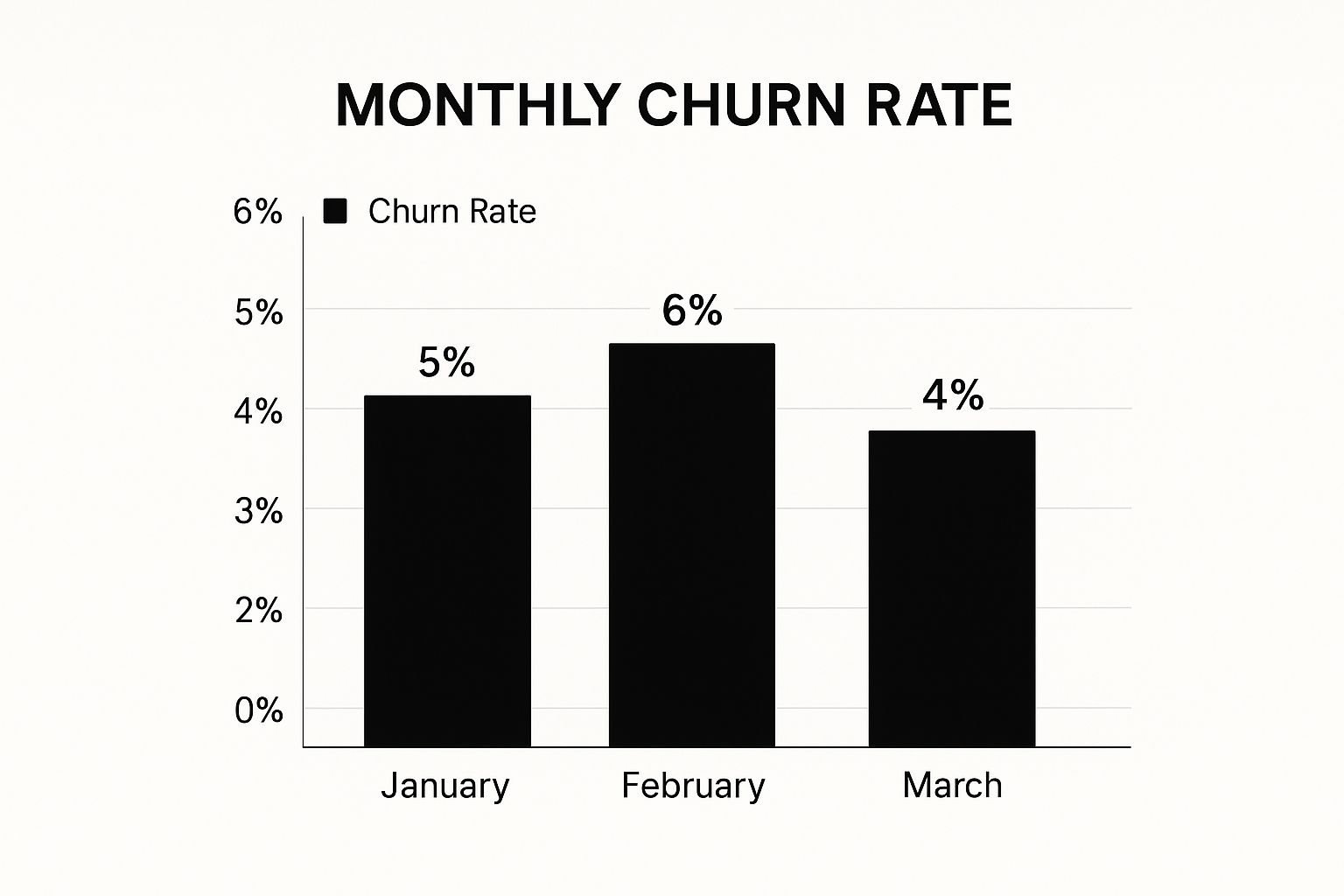
The drop in March suggests that whatever fixes were put in place might be working. This is why it’s so important to connect your actions to the metrics you’re tracking over time.
The Usual Suspects: Common Reasons for Churn
While every SaaS business is a little different, the reasons customers churn tend to fall into a few familiar categories. Figuring out which of these are hitting your business is the most critical diagnostic step.
To help you connect the dots, here’s a quick diagnostic table. Look for the symptoms you’re seeing in your business and see what underlying problems they might point to.
Common Churn Drivers and How to Spot Them
| Common Symptom | Potential Root Cause | Data to Analyze |
|---|---|---|
| High churn within the first 30 days | Poor Onboarding or Initial Setup Failure | First-week feature adoption rates, time-to-value metrics, completion rates of setup checklists. |
| Low engagement after several months | Perceived Value Mismatch | Usage of core vs. secondary features, session duration, competitor pricing comparisons. |
| Spike in cancellations after a price increase | Pricing Sensitivity or Lack of Justification | Direct feedback from exit surveys, support ticket volume mentioning price, feature usage of impacted plans. |
| Negative reviews mentioning customer service | Bad Customer Experience | Support ticket resolution times, first-contact resolution rate, Customer Satisfaction (CSAT) scores. |
| Customers leaving for a specific competitor | Product Gaps or Better Alternative | Feature comparison analysis, exit survey mentions of competitors, win/loss analysis from your sales team. |
This table isn’t exhaustive, but it’s a powerful tool to get you started. By linking what you see (the symptom) to what might be happening (the root cause), you can focus your investigation and find real solutions faster.
Learning how to effectively gather customer feedback is also non-negotiable, as it gives you qualitative data to back up your quantitative findings. Even a simple exit survey asking, “Why did you decide to cancel?” can give you invaluable clues directly from the source.
Proven Strategies to Reduce Customer Churn

Knowing why customers leave is one thing; actually stopping them is where the real work begins. There’s no single magic wand to wave here. Reducing churn is all about using a smart mix of proactive and reactive tactics to make the customer experience better at every single touchpoint.
Think of this as your game plan for turning churn data into decisive action. When you focus on both preventing customers from wanting to leave in the first place and rescuing those who are already wavering, you build a much stronger, more profitable company.
The financial impact is huge. Just think: trimming churn by a mere 5% can boost profits by as much as 95%. That’s a powerful reminder of why keeping customers is so crucial.
Proactively Delight Your Customers
Honestly, the best way to fight churn is to prevent it from ever happening. Proactive strategies are all about creating an experience where customers are so successful and happy with your product that the thought of leaving doesn’t even enter their minds.
This means delivering value from day one and constantly reinforcing it. You’re building a relationship, not just processing a transaction. Here’s how you can get ahead of the game.
- Master the Onboarding Experience: The first 30-60 days are make-or-break. A confusing or clunky onboarding process is a fast track to early churn. Your absolute goal should be to get new users to their first “Aha!” moment—where they truly grasp your product’s core value—as quickly as humanly possible.
- Track Customer Health Signals: Don’t wait for a cancellation email to tell you something’s wrong. Keep a close eye on your product analytics to see how people are using your tool. Look for warning signs like drops in login frequency, poor adoption of key features, or even a sudden silence in support tickets. These are red flags that a customer is drifting away.
- Communicate Value Consistently: Don’t assume customers remember why they signed up. You need to regularly remind them of the value they’re getting. You can do this with in-app messages highlighting new features, personalized emails that showcase their own usage stats, or case studies that prove how others are winning with your tool.
By taking these proactive steps, you stop playing defense and start playing offense, building a loyal base that sees your product as essential.
Reactively Save At-Risk Accounts
Even with the best game plan, some customers will still head for the door. That’s where your reactive strategies come in. Think of them as your safety net, designed to catch these customers and win them back. These tactics are usually triggered by a specific event, like a failed payment or a cancellation request.
A common mistake is letting involuntary churn just happen. Up to 40% of churn can be involuntary—caused by simple things like expired credit cards. A smart dunning process can recover a huge chunk of that revenue.
Here are some of the most effective reactive strategies you can put in place.
- Automate Your Dunning Process: Dunning is just a fancy word for trying to collect overdue payments. Instead of instantly cutting off a subscription after a credit card fails, set up an automated email sequence. These emails can gently nudge the customer to update their payment info over a grace period, which helps save the account without damaging the relationship.
- Use Exit Surveys to Make Last-Minute Offers: When a customer hits that “cancel” button, don’t just show them the door. First, show them a quick exit survey asking why they’re leaving. Their answer is gold. If they say it’s the price, you can offer a temporary discount. If they say it’s too complex, you can offer a free one-on-one training session. This is your last, best chance to change their mind.
- Build a Comprehensive Customer Success Playbook: Give your team a clear plan so they can act with confidence. A well-defined customer success playbook gives them step-by-step instructions for spotting at-risk accounts, reaching out with the right message, and tracking how well your save attempts are working.
For a deeper dive into these kinds of techniques, checking out a dedicated guide can help you build a solid program to reduce churn rate and cultivate customer loyalty.
By combining these proactive and reactive strategies, you create a powerful, two-pronged system for slashing churn and building a much healthier, more sustainable SaaS business.
Frequently Asked Questions About SaaS Churn
Even with a clear strategy in place, a few common questions always pop up when founders and operators start digging into the details of churn in SaaS. Let’s tackle some of the most frequent ones.
What Is the Difference Between Voluntary and Involuntary Churn?
The two main types of churn come from very different places.
Voluntary churn is exactly what it sounds like: a customer actively chooses to leave. They hit the cancel button. This decision usually points back to your business—maybe they’re unhappy with the product, found a better competitor, or their own needs have simply changed. It’s a direct signal you need to listen to.
Involuntary churn, on the other hand, is when a customer leaves for reasons outside of their control, almost always because of a payment failure. Think expired credit cards or insufficient funds. While you fix voluntary churn by improving your product and service, you can often solve involuntary churn with smart automation, like dunning emails that prompt customers to update their billing info.
It’s easy to overlook, but a surprising amount of revenue leaks out from involuntary churn. In fact, some research suggests a whopping 67% of customer churn is preventable if the initial problem, like a simple payment issue, is resolved right away.
Can You Ever Have a Zero Percent Churn Rate?
It’s a fantastic goal to have, but a sustained 0% churn rate is pretty much a myth in the SaaS world. Life just happens. Customers’ businesses might close down, their priorities can shift, or the internal champion who fought for your tool might move to a new company.
Instead of chasing the impossible “zero churn” dream, a much healthier and more powerful target is negative net revenue churn.
This is the holy grail. It happens when the new revenue you generate from existing customers (through upgrades, add-ons, and expansion) is greater than the revenue you lose from customers who cancel. Achieving this means your business can grow even without adding a single new customer. That’s the true mark of a sticky, valuable product.
How Can a Small Startup Tackle Churn with Limited Resources?
You don’t need a massive budget or a dedicated retention team to start fighting churn. The key is to focus on a few high-impact activities that don’t cost a fortune.
Here’s where to start:
- Launch simple exit surveys. When someone cancels, immediately ask them why. A single, open-ended question can give you a goldmine of honest, actionable feedback. This is the fastest path to understanding why people are leaving.
- Nail your onboarding. The first few interactions a new user has with your product are critical. A smooth, helpful onboarding process that guides them to their first “aha!” moment is one of your strongest defenses against early churn.
- Just talk to your customers. Seriously. Set aside a little time each month to have real conversations with a handful of users. You’ll uncover pain points and opportunities that you’d never find in a spreadsheet.
These simple steps are the building blocks of a powerful retention engine. For a deeper dive, our guide on customer retention in SaaS has more strategies you can put into action today.
At SaaS Operations, we provide battle-tested playbooks and templates to help you build efficient processes for reducing churn and accelerating growth. Stop guessing and start implementing frameworks that work. Get the proven SOPs you need to succeed.