10 Actionable Best Practices in Strategic Planning for SaaS Operators
 Published By: Alex
December 26, 2025
Published By: Alex
December 26, 2025
Running a SaaS business often feels like navigating a rocket ship in a meteor shower. One wrong move and you're off course, burning through cash and missing market windows. The difference between explosive growth and fizzling out isn't luck or a single brilliant idea; it's a disciplined, repeatable approach to strategy. But most strategic planning advice is academic, vague, and frankly, useless for operators in the trenches who need results now.
Forget the ivory tower theory. We're diving straight into 10 battle-tested, best practices in strategic planning used by top SaaS leaders to align their teams, accelerate growth, and build resilient companies. These aren't just high-level concepts. They are actionable playbooks, complete with the exact steps, frameworks, and meeting cadences you can implement today to connect your long-term vision to daily execution.
We'll cover everything from establishing OKRs and running effective Quarterly Business Reviews (QBRs) to implementing rolling forecasts and stress-testing your plans with scenario analysis. This guide is built to help you move beyond wishful thinking and create a clear, data-driven engine for growth. For a deeper dive into the fundamental concepts underpinning effective strategic planning, consider understanding the crucial distinction between strategy and tactics before you proceed. This foundational knowledge will help you better apply the frameworks that follow. Ready to trade chaos for clarity and start executing with precision? Let's get started.
1. OKR (Objectives and Key Results) and Strategic Alignment / Cascading Goals
If your company's strategic plan feels like a document that collects dust after Q1, you're not alone. The OKR (Objectives and Key Results) framework, popularized by tech giants like Google and Intel, is one of the most effective best practices in strategic planning for translating high-level vision into day-to-day execution. It connects your company’s ambitious goals directly to the work your teams are doing.
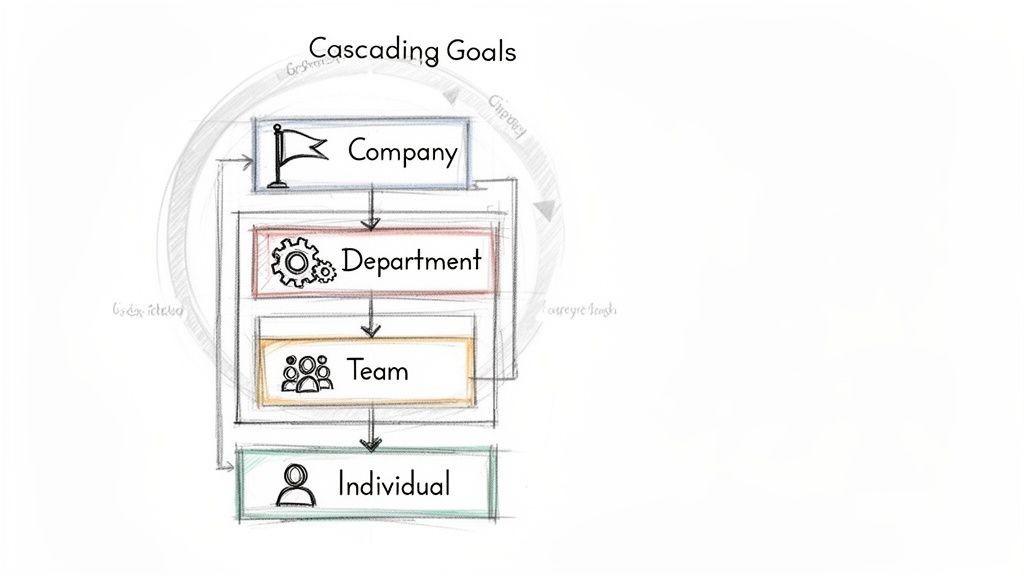
The magic happens when you combine OKRs with cascading goals. This means the C-suite sets company-wide objectives, which then "cascade" down, inspiring departmental, team, and individual OKRs that all align upwards. This creates a clear line of sight from an individual contributor’s tasks to the company's biggest priorities, ensuring everyone is rowing in the same direction.
Your Actionable Playbook for OKRs
Google maintains transparency by making everyone’s OKRs, from the CEO down, visible across the company. This fosters accountability and cross-functional alignment. For SaaS operators, this means the product team’s goal to reduce churn by 5% directly supports the company’s objective of increasing Net Revenue Retention (NRR) to 110%.
Your exact next steps:
- Define 3 Company-Wide Objectives: For the next quarter, leadership must define no more than three ambitious, qualitative objectives. Example: "Become the undisputed leader in our niche."
- Set Measurable Key Results: For each Objective, define 1-4 quantitative Key Results. For the objective above, a KR could be: "Increase market share from 15% to 20% as measured by G2."
- Run Departmental Workshops: Each department head runs a session where their team creates its own OKRs that directly support the company-level KRs. The Sales team might create an objective: "Dominate the enterprise segment," with a KR of "Increase enterprise new bookings by $500k."
- Decouple from Compensation: Explicitly state that OKR attainment (especially stretch goals) is not tied to bonuses. This encourages ambitious goals over sandbagging.
- Implement a Review Cadence: Use a tool like Lattice or even a shared spreadsheet to track progress. Review OKR progress in weekly 1-on-1s and monthly team meetings. While OKRs provide the goal framework, you'll still need a way to monitor key operational metrics. For a deeper dive into what that looks like, check out these examples of SaaS performance scorecards.
2. Balanced Scorecard Approach
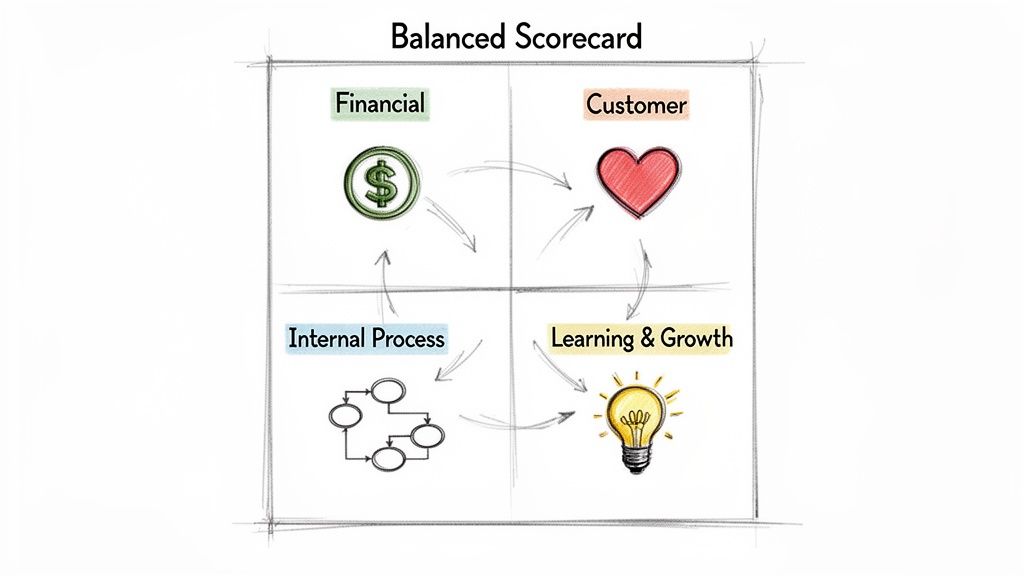
If your strategic plan is obsessed with MRR and CAC but ignores customer health or team development, you're flying with one eye closed. The Balanced Scorecard (BSC) is one of the most enduring best practices in strategic planning because it forces a holistic view of business performance. Developed by Robert Kaplan and David Norton, it translates vision into operational objectives across four interconnected perspectives: Financial, Customer, Internal Processes, and Learning & Growth.
This framework prevents the common SaaS pitfall of chasing revenue at the expense of sustainable, long-term health. It ensures that while you're hitting financial targets, you're also delighting customers, optimizing your internal operations, and investing in the team skills needed to innovate and scale for the future.
Your Actionable Playbook for a Balanced Scorecard
HubSpot tracks customer success metrics (like NPS) with the same rigor as its financial growth metrics, ensuring its customer-centric flywheel keeps spinning. Salesforce balances its intense focus on Annual Recurring Revenue (ARR) with key customer health scores, knowing that healthy customers are the foundation of future revenue.
Your exact next steps:
- Define 2-3 Metrics Per Perspective: In a leadership workshop, define a handful of critical metrics for each of the four quadrants.
- Financial: ARR Growth, LTV:CAC Ratio, Gross Margin.
- Customer: Net Revenue Retention (NRR), CSAT/NPS, Logo Retention Rate.
- Internal Process: Average Ticket Resolution Time, Product Uptime, Feature Adoption Rate.
- Learning & Growth: Employee Retention Rate, Internal Promotion Rate, Time to Productivity for New Hires.
- Establish Cause-and-Effect Hypotheses: Connect the dots between your metrics. State a clear hypothesis: "If we increase employee training hours by 10% (Learning), we will decrease bug resolution time by 15% (Internal), which will increase our CSAT score by 5 points (Customer)."
- Build Your Scorecard Dashboard: Use a BI tool like Tableau or Looker to create a one-page dashboard showing all scorecard metrics with clear red/yellow/green status indicators against targets.
- Assign Single-Threaded Ownership: Each metric on the scorecard must have one person who is accountable for reporting on it and driving the initiatives to improve it. For more specific examples, you can explore these SaaS balanced business scorecard examples.
3. Rolling Forecasts (Continuous Planning)
The traditional annual budget is a relic from a slower business era. In the fast-paced SaaS world, a static 12-month budget is often obsolete by the end of Q1. Rolling forecasts represent a modern, agile approach and are one of the most critical best practices in strategic planning for maintaining financial and operational alignment. This method replaces the rigid annual plan with a continuously updated financial projection, typically looking 12 to 18 months ahead.
The core idea is simple: each month or quarter, as actual results come in, you drop the past period and add a new one to the end of your forecast. This forces you to regularly re-evaluate your assumptions about MRR growth, churn, and spending based on real-time data, not year-old predictions. This continuous planning cycle keeps your financial outlook directly tied to your company’s current reality, enabling much smarter, more responsive decision-making.
Your Actionable Playbook for Rolling Forecasts
Spotify uses a rolling forecast model to manage its complex global operations, allowing teams to adapt quickly to changing market conditions and new strategic opportunities. For a SaaS operator, this means you can adjust hiring plans or marketing spend in May based on April's performance, rather than being locked into a plan made last November.
Your exact next steps:
- Select Your Cadence and Horizon: Start with a quarterly update cadence and a 6-quarter (18-month) forward-looking horizon.
- Automate Your Inputs: Use a tool like Planful or Vena to automatically pull actuals from your accounting system (e.g., QuickBooks, NetSuite) and CRM (e.g., Salesforce). This is non-negotiable; manual data entry will kill the process.
- Build a Driver-Based Model: Don't just forecast revenue. Build a model based on key drivers: MQLs x Conversion Rate = New Customers; New Customers x ASP = New MRR. This allows you to adjust assumptions, not just outcomes.
- Run a Monthly Forecast Review: The finance lead presents the updated forecast to the leadership team. The agenda is simple: 1) Review variance (plan vs. actuals) from the previous month, 2) Discuss updates to key assumptions for the forward-looking period, and 3) Make resource allocation decisions based on the new forecast.
4. Strategy Mapping and Cause-and-Effect Logic
If your strategic plan is just a list of initiatives without a clear story of how they connect, you're likely wasting resources. Strategy Mapping, popularized by Kaplan and Norton, is one of the most powerful best practices in strategic planning for visualizing the cause-and-effect relationships between your actions and your ultimate goals. It forces you to articulate how operational improvements will lead to desired business outcomes.
This framework helps you move beyond isolated departmental goals and see your business as an interconnected system. For a SaaS company, a strategy map can clearly illustrate how improving the onboarding experience (operational) leads to higher user activation (customer), which in turn reduces churn and increases Lifetime Value (financial). This visual clarity is crucial for aligning teams and making smarter resource allocation decisions.
Your Actionable Playbook for Strategy Mapping
HubSpot is a master at this, connecting everything from product development initiatives to customer success playbooks and showing how they all ladder up to revenue growth. GitLab publicly shares its strategy to show how different parts of its DevOps platform interconnect to drive value, clarifying dependencies for everyone.
Your exact next steps:
- Start with One Strategic Goal: Pick a single, critical outcome for the next six months, such as "Improve Net Revenue Retention."
- Workshop the Causal Chain: In a cross-functional leadership meeting, whiteboard the cause-and-effect chain backwards from the goal.
- Financial Outcome: Improve NRR from 95% to 105%.
- Customer Behavior: What drives this? "Customers adopt more features and upgrade tiers."
- Internal Process: What drives that? "Improve the in-app upgrade path" and "Proactively identify expansion opportunities."
- Learning & Growth: What enables that? "Train CS team on value-based selling" and "Hire a product manager for monetization."
- Identify Leading and Lagging Indicators: For each step in your map, define a metric. The lagging indicator is NRR. Leading indicators could be "upgrade conversion rate" or "number of CS-generated leads."
- Assign Ownership and Review: Assign a single owner to each initiative on the map. Review progress against the leading indicators in your monthly business review to see if your strategic hypothesis is proving correct.
5. Scenario Planning and Stress Testing
If the last few years have taught SaaS operators anything, it's that the future is anything but predictable. Relying on a single, linear forecast is a recipe for disaster. This is where scenario planning, a technique refined by giants like Royal Dutch Shell, becomes one of the most critical best practices in strategic planning for building resilience. It’s about creating a few plausible stories about the future-not just one-and preparing for each.
Instead of trying to predict the future, you develop a handful of distinct scenarios (e.g., downside, base case, upside) and define your strategic responses in advance. This proactive approach allows your company to pivot quickly and decisively when market conditions shift, rather than scrambling to react. It’s the difference between being a victim of circumstance and being prepared to seize opportunity, no matter what happens.
Your Actionable Playbook for Scenario Planning
During the sudden market shift of 2020, SaaS companies with pre-defined playbooks executed cost reductions or market accelerations decisively. Zoom, for instance, had to rapidly game out scenarios related to massive, unexpected growth and its impact on infrastructure, allowing them to scale through the chaos.
Your exact next steps:
- Define 3 Scenarios: In your next planning session, build out three financial models:
- Base Case: Your current operating plan.
- Downside Case: Assume a 30% drop in new bookings and a 20% increase in churn.
- Upside Case: Assume a 40% increase in inbound leads and a 50% improvement in sales cycle time.
- Identify Triggers: For each scenario, define the specific metric changes that would signal it is happening. A downside trigger might be "two consecutive months of negative net new ARR."
- Create Pre-Defined Action Playbooks: For each scenario, list the exact levers you will pull.
- Downside Playbook: 1. Freeze all T&E. 2. Pause non-essential hiring. 3. Cut bottom 10% of ad spend. 4. Reduce cloud infrastructure spend by 15%.
- Upside Playbook: 1. Pre-approve hiring for 3 new AEs. 2. Double ad spend on top-performing channels. 3. Fast-track infrastructure scaling project.
- Review Annually, Refresh Quarterly: Conduct a deep scenario planning exercise once a year and briefly review and update your triggers and playbooks as part of your QBR process.
6. Cadence-Based Execution Framework
If your strategic plan is a “set it and forget it” exercise, it’s already failed. A plan needs a pulse, and that’s where a Cadence-Based Execution Framework comes in. This is one of the most critical best practices in strategic planning because it creates a predictable rhythm of planning, reviews, and decision-making that transforms your strategy from a static document into a living, breathing operational process.
Popularized by thought leaders like Verne Harnish in his "Scaling Up" methodology, this framework establishes a structured cycle of meetings, from annual planning down to daily huddles. Each meeting has a specific purpose, agenda, and time horizon, creating a system that builds momentum and ensures accountability. This structure prevents strategic drift and keeps the entire organization aligned and focused on what matters most.
Your Actionable Playbook for an Execution Cadence
Amazon is famous for its strict meeting cadences, from weekly S-team meetings to its rigorous annual planning process. Salesforce embeds Quarterly Business Reviews (QBRs) deep into its organizational structure to ensure every department is aligned and accountable for its part of the strategic plan. This disciplined approach is the engine that drives consistent execution.
Your exact next steps:
- Implement This Meeting Rhythm: Schedule these recurring meetings immediately.
- Daily Huddle (15 min): Departmental teams review daily priorities and roadblocks.
- Weekly Tactical (60 min): Leadership team reviews KPI dashboard and progress on quarterly priorities.
- Monthly Strategic Review (2 hours): Leadership team reviews financial performance and discusses one or two deep-dive strategic topics.
- Quarterly Planning (1 Day): Offsite meeting to review the past quarter and set the next quarter's OKRs and priorities.
- Create Standardized Agendas: For each meeting, create a simple, repeatable agenda in a shared document (e.g., Google Docs, Notion). The weekly tactical agenda should be: 1. KPI Review (15 min), 2. Quarterly Priority Update (30 min), 3. Key Issues & Decisions (15 min).
- Use an Action Register: During each meeting, capture every decision and action item in a shared list (e.g., Asana, Monday.com) with a single owner and a due date. Review open items at the beginning of the next meeting.
7. Key Performance Indicators (KPI) Frameworks
If you can't measure it, you can't manage it. A disciplined KPI framework is one of the most critical best practices in strategic planning because it translates your strategy into a handful of numbers that signal business health. Instead of getting lost in dozens of metrics, this approach forces you to select a focused set of 8-15 core KPIs that truly matter.
This practice, championed by SaaS thought leaders like David Skok and Bessemer Venture Partners, involves organizing metrics by function and including both leading (predictive) and lagging (historical) indicators. This gives you a complete picture of not just where your business has been, but where it's going. It’s the difference between driving by looking in the rearview mirror versus looking at a GPS map.
Your Actionable Playbook for a KPI Framework
HubSpot famously tracks and publicly shares core KPIs like Customers, Revenue, CAC, LTV, and Net Revenue Retention, creating a culture of accountability. Segment built its growth engine by focusing intensely on retention and NRR as its north-star metrics. This means having a simple dashboard showing MRR growth alongside leading indicators like trial-to-paid conversion rates.
Your exact next steps:
- Select Your North Star Metric: Choose the one metric that best captures the value you create for customers. For many SaaS businesses, this is Annual Recurring Revenue (ARR) or Net Revenue Retention (NRR).
- Define Tier 2 Departmental KPIs: Have each department head define the 3-4 most important metrics they control that directly influence the North Star.
- Marketing: Marketing Qualified Leads (MQLs), MQL-to-Customer Conversion Rate, CAC.
- Sales: New MRR Bookings, Average Deal Size, Sales Cycle Length.
- Customer Success: Gross Revenue Retention, Net Revenue Retention, CSAT.
- Product: Feature Adoption Rate, Weekly Active Users, User Retention Cohorts.
- Build a Central KPI Dashboard: Use a BI tool or even a Google Sheet to create a single dashboard that tracks these 8-15 core metrics weekly. This becomes the central document for your weekly leadership meetings.
- Set Targets and Thresholds: For each KPI, set a quarterly goal and define what is "good" (green), "needs attention" (yellow), and "critical" (red). For a comprehensive list of essential metrics, explore these key SaaS KPIs.
8. Quarterly Business Reviews (QBRs) and Strategic Pivots
If your annual strategic plan feels too rigid and unresponsive to market changes, the Quarterly Business Review (QBR) is your solution. The QBR is a formal, recurring process designed to assess performance against goals, learn from results, and make necessary strategic adjustments. This practice transforms strategy from a static document into a living, iterative process, making it one of the most essential best practices in strategic planning for agile SaaS companies.
The core idea, popularized by thought leaders like Verne Harnish in "Scaling Up," is to blend retrospective analysis with forward-looking planning. Instead of waiting a full year to see if your plan worked, you create a disciplined quarterly rhythm. This allows you to identify what's working, what isn’t, and why, empowering your leadership team to make informed pivots or double down on successful initiatives.
Your Actionable Playbook for QBRs
Stripe relies on QBRs to review quarterly progress on its product roadmap and key financial metrics, ensuring its strategic direction remains in sync with market feedback and performance data. This prevents teams from continuing down a path that is no longer optimal.
Your exact next steps:
- Schedule and Prepare: Schedule a 4-hour QBR in the last week of each quarter. The CEO is the owner. Each department head must submit a 1-2 page pre-read 48 hours in advance, answering four questions: 1) What were our quarterly goals? 2) How did we perform against them (with data)? 3) What were the key learnings (successes and failures)? 4) What are our proposed goals for next quarter?
- Follow a Strict Agenda:
- (30 min) Review Company-Level Performance: CEO reviews top-line financials and company OKRs.
- (90 min) Department Deep Dives: Each leader briefly presents their key learnings and proposed plan. This is for discussion, not presentation of data already in the pre-read.
- (60 min) Identify Interdependencies & Conflicts: Discuss cross-functional issues and resource conflicts for the upcoming quarter.
- (60 min) Finalize & Commit: Finalize the company's top 3-5 priorities for the next quarter and confirm departmental alignment.
- Communicate Outcomes: The CEO sends a company-wide email within 24 hours summarizing the key takeaways, decisions, and top priorities for the upcoming quarter. To get started, you can adapt a proven structure using this Quarterly Business Review template.
9. Data-Driven Decision Making and Analytics Infrastructure
Relying on gut feelings to make strategic calls is a recipe for disaster in the SaaS world. A core tenet of effective strategic planning is grounding your decisions in hard data. Investing in a solid analytics infrastructure isn't just a "nice-to-have"; it's the engine that powers optimization, validates your product-market fit, and helps you fine-tune your unit economics with precision.
This practice, championed by data-centric companies like Amazon and Airbnb, involves building the systems and culture to collect, analyze, and act on quantitative insights. It moves your team from debating opinions to analyzing facts, ensuring that your strategic initiatives are based on what the numbers actually say, not just what a founder or executive thinks.
Your Actionable Playbook for Data-Driven Decisions
Stripe constantly runs A/B tests to optimize payment success rates, a key value driver for its customers. For a SaaS operator, this could mean A/B testing a new onboarding flow to see its direct impact on activation rates.
Your exact next steps:
- Create a Data Dictionary: In a shared document, define exactly how you calculate your top 10-15 core metrics (e.g., "An Active User is a user who has logged in and performed [key action] within the last 7 days"). This eliminates ambiguity.
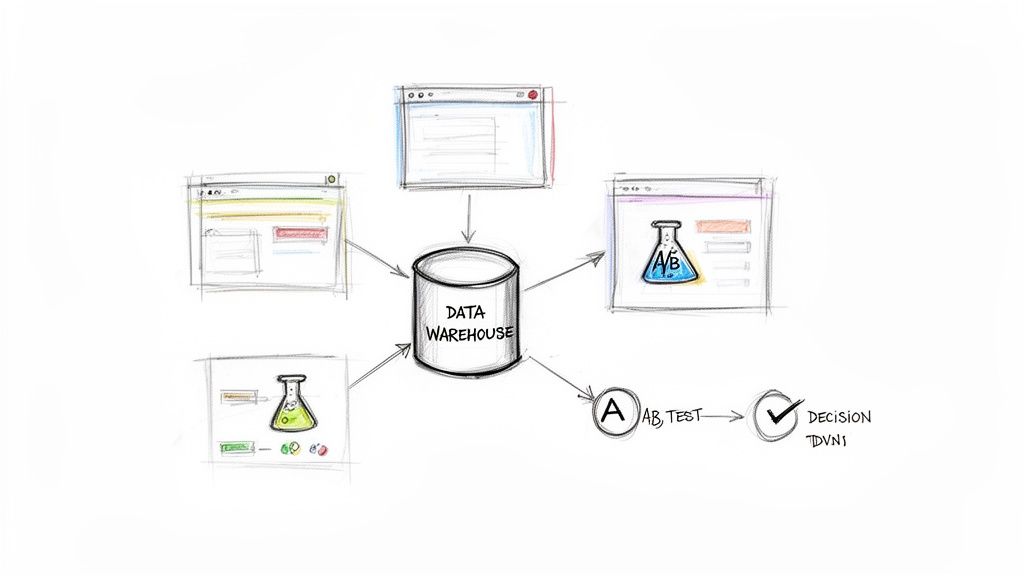
- Implement a Central Data Warehouse: Even at an early stage, use a tool like Snowflake, BigQuery, or Redshift to centralize data from your different systems (Stripe, Salesforce, product database). This creates a single source of truth.
- Run Your First A/B Test: Task the product or marketing team with running one simple, high-impact A/B test next month. Example: Test two different headlines on your pricing page and measure the impact on sign-ups. Use a tool like Optimizely or VWO.
- Schedule a Monthly Metrics Review: Add a 60-minute "Metrics Deep Dive" to your meeting cadence. Each month, one department head presents a deep dive on their KPIs, trends, and strategic insights. For a closer look at what this might involve, check out these examples of SaaS metrics dashboards.
- Leverage Advanced Analytics: As you mature, you can move beyond descriptive analytics. To enhance data-driven decision making, consider leveraging powerful predictive analytics software to forecast future trends and outcomes.
10. Cross-Functional Collaboration and Alignment Frameworks
If your product team ships a feature that sales doesn't know how to sell and support doesn't know how to troubleshoot, your strategic plan is failing in real-time. Silos are the silent killers of strategy. Implementing formal cross-functional collaboration frameworks is one of the most critical best practices in strategic planning because it forces alignment and breaks down the walls between departments like sales, marketing, product, and customer success.
This isn't about more meetings; it's about structured processes that ensure integrated planning and shared ownership. When every department understands its role in the larger customer journey and is measured on shared outcomes, execution becomes seamless. The goal is to create a system where collaboration is the default, not the exception, leading to faster decision-making and a superior customer experience.
Your Actionable Playbook for Cross-Functional Frameworks
HubSpot famously aligns its marketing and sales teams with a unified "Smarketing" SLA (Service Level Agreement). This SLA defines the quantity and quality of leads marketing must deliver and the speed at which sales must follow up, holding both teams accountable for the revenue pipeline.
Your exact next steps:
- Create a RACI Matrix for a Key Initiative: Pick one upcoming project, like a pricing change. Create a RACI (Responsible, Accountable, Consulted, Informed) chart. The Head of Product is Accountable. The pricing analyst is Responsible. Heads of Sales, Marketing, and CS are Consulted. The rest of the company is Informed. This clarifies roles instantly.
- Establish One Shared Metric: Identify one metric that requires cross-functional effort and make multiple department heads accountable for it. Example: Make both the Head of Sales and Head of Customer Success co-owners of the "90-day logo retention rate" KPI.
- Run a Go-to-Market (GTM) Sync: Implement a bi-weekly 30-minute GTM meeting with leads from Product, Marketing, Sales, and CS. The agenda is fixed: 1) Review product roadmap updates, 2) Align on marketing launch plans, 3) Share sales enablement needs, 4) Discuss customer feedback themes.
- Form a Deal Desk: For complex enterprise deals, create a virtual "Deal Desk" process. When a deal requires non-standard terms, the AE must get approval from a group including Finance, Legal, and Product. This prevents one-off deals that create long-term problems.
10-Point Strategic Planning Comparison
| Approach | Implementation Complexity 🔄 | Resource Requirements ⚡ | Expected Outcomes 📊 | Ideal Use Cases ⭐ | Key Advantages / Tips 💡 |
|---|---|---|---|---|---|
| OKR (Objectives & Cascading Goals) | Moderate — process discipline, leadership buy-in required | Low–Medium — routine check-ins + tracking tool | High alignment and measurable progress across levels | ⭐⭐⭐⭐ — scaling SaaS teams needing strategic alignment | Clear priorities, short cycles; limit to 3–5 objectives and 1–4 KRs per objective |
| Balanced Scorecard | High — multi-perspective mapping and stakeholder alignment | Medium–High — data tracking across four perspectives | Holistic view of business health beyond revenue | ⭐⭐⭐ — mature orgs needing balanced performance measures | Prevents metric tunnel vision; start with 15–20 metrics and map cause-effect |
| Rolling Forecasts (Continuous Planning) | Medium–High — cultural change to continuous updates | Medium–High — automation tools + finance collaboration | Improved financial agility and more accurate projections | ⭐⭐⭐⭐ — fast-changing markets, cash-sensitive SaaS | Automate monthly updates; maintain 12–13 month forward view and scenarios |
| Strategy Mapping & Cause‑and‑Effect | Medium — requires cross-functional strategic input | Medium — workshops and periodic updates | Clarifies how initiatives drive outcomes; reveals dependencies | ⭐⭐⭐⭐ — prioritizing product/ops investments tied to outcomes | Start with 1–2 critical hypotheses; use swimlanes and leading indicators |
| Scenario Planning & Stress Testing | High — time-intensive scenario development | Medium — executive time + analytical support | Increased resilience and faster responses to shocks | ⭐⭐⭐ — high-uncertainty environments or macro risk planning | Limit to 3–4 scenarios, define triggers, and stress-test key metrics |
| Cadence‑Based Execution Framework | Medium — set meeting rhythms and governance | Medium — recurring leadership time and prep materials | Predictability, accountability, faster issue resolution | ⭐⭐⭐⭐ — organizations needing operational discipline | Time-box meetings, require pre-reads, assign owners and publish action items |
| KPI Frameworks | Low–Medium — metric selection and ownership discipline | Low–Medium — dashboards and data ownership | Clear signal-focused measurement; faster problem identification | ⭐⭐⭐⭐ — monitoring SaaS unit economics and growth signals | Keep 8–15 focused KPIs; separate strategic vs operational metrics |
| Quarterly Business Reviews (QBRs) | Medium — structured analysis and facilitation | Medium — data prep and leadership participation | Regular course-correction and organizational learning | ⭐⭐⭐⭐ — quarterly cadence to assess OKRs and pivots | Require pre-reads, use a standard agenda, document pivot rules and decisions |
| Data‑Driven Decision Making & Analytics Infra | High — build data warehouse, governance, experimentation | High — data engineers, analysts, BI tools | Strong validation of strategy and rapid optimization | ⭐⭐⭐⭐⭐ — scaling product/marketing with experimentation needs | Start with 10–15 core metrics, invest in a data warehouse and A/B framework |
| Cross‑Functional Collaboration & Alignment | Medium — behavioral change and process design | Medium — steering groups, shared tooling, meetings | Reduced silos, aligned trade-offs, improved customer experience | ⭐⭐⭐⭐ — when multiple teams influence customer journey | Use RACI, shared metrics, and monthly cross-functional syncs |
Turn Your Strategy Into Your Competitive Advantage
You've made it through a deep dive into the best practices in strategic planning, and it’s clear that this isn't about creating a static, 50-page document that gets reviewed once a year. For a modern SaaS company, that approach is a recipe for irrelevance. Instead, think of your strategy as a living, breathing part of your company's operating system. It's the code that runs in the background, guiding every decision, every product release, and every marketing campaign.
The difference between a SaaS business that just survives and one that truly thrives often comes down to this distinction. A thriving business doesn't just have a strategy; it lives its strategy. It's a continuous, adaptive process woven into the very fabric of the organization. This is where the real magic happens, turning plans on paper into tangible market advantages.
From Theory to Daily Reality
We’ve covered a lot of ground, from the cascading logic of OKRs to the forward-looking agility of rolling forecasts and the tough-love honesty of scenario planning. Let's distill this down to the most critical, actionable takeaways you should focus on right now:
- Strategy is a Verb, Not a Noun: The most powerful shift you can make is treating strategic planning as an ongoing activity. Your Cadence-Based Execution Framework is the engine here. Those weekly check-ins, monthly reviews, and Quarterly Business Reviews (QBRs) are not just meetings; they are the drumbeat that keeps the entire company marching in the same direction, allowing you to pivot with intelligence and speed.
- Connect the Dots for Everyone: A brilliant strategy is useless if your team doesn't understand how their work contributes to it. This is why Strategy Mapping and cascading OKRs are so vital. When a junior developer can clearly see how their sprint goals roll up to a key result that impacts a company-wide objective, you unlock a powerful sense of purpose and alignment that supercharges productivity.
- Data Isn't Just for Dashboards: We talked about building a robust analytics infrastructure, but the goal isn't just to have beautiful charts. It's about fostering a culture of data-driven decision-making. Encourage your teams to ask "What does the data say?" before offering an opinion. Use your Balanced Scorecard and KPI frameworks to ensure you're measuring what truly matters, not just what's easy to track. This transforms your data from a vanity metric into a strategic asset.
Your Next Move: Make It Real
Reading about these best practices in strategic planning is the first step, but implementation is where the value is created. Don't try to boil the ocean. Pick one or two frameworks that address your company's biggest pain point right now.
Is your team misaligned? Start with implementing a simple OKR structure for the next quarter. Are you constantly surprised by market shifts? Begin with a basic scenario planning exercise. The key is to start small, build momentum, and prove the value of a more dynamic approach to strategy.
Ultimately, mastering this discipline is what separates the category leaders from the rest of the pack. It's how you build a resilient, anti-fragile organization that not only weathers storms but emerges from them stronger. It’s how you stop reacting to the market and start shaping it. Your strategy is your story, your roadmap, and your most powerful weapon. It's time to start wielding it like one.
Ready to implement these frameworks without starting from scratch? At SaaS Operations, we provide the battle-tested playbooks, templates, and SOPs that turn these best practices into your team's daily reality. Skip the trial-and-error and get straight to building a more strategic, high-growth SaaS business by visiting SaaS Operations today.