
A Balanced Scorecard (BSC) certification is a professional credential that shows you’ve mastered the art and science of connecting a company’s day-to-day work with its big-picture goals.
Think of it this way: a company without a good strategy is like a ship without a rudder. The Balanced Scorecard is that rudder, and getting certified means you’re the one qualified to steer. It proves you can build a system that measures what truly matters, far beyond just the financial numbers.
What a Balanced Scorecard Certification Really Means
At its heart, a BSC certification tells the world you’re an expert in a specific and powerful strategic management framework. It’s a formal stamp of approval on a very particular skill set—the ability to help an organization see its performance from all angles, not just from the finance department’s point of view.
This isn't just about adding a line to your resume. It's a signal to employers that you know how to guide a business in defining its strategy and, more importantly, in tracking its progress toward achieving it.
To get a clearer idea of what this certification covers, here's a quick overview.
Balanced Scorecard Certification At a Glance
| Aspect | Description |
|---|---|
| What It Is | A professional credential validating expertise in the Balanced Scorecard strategic planning and management system. |
| Who It's For | Managers, executives, strategy professionals, and consultants responsible for driving organizational performance. |
| Core Skills | Strategic planning, performance measurement, KPI development, strategy mapping, and aligning operations with vision. |
This table shows how the certification equips you with a holistic toolkit for strategic execution, moving you from simply managing to actively leading.
The Four Pillars of the Scorecard
The real magic of the Balanced Scorecard lies in its four interconnected perspectives. A certification proves you can juggle them all. This is what makes it so different from older management systems that were often obsessed with a single area.
- The Financial Side: This is the traditional bottom line. It answers, "How do our shareholders see us?" We're talking about classic metrics like revenue, profit margins, and return on investment.
- The Customer Side: This pillar flips the script and asks, "How do our customers see us?" It’s all about tracking customer satisfaction, loyalty, and your slice of the market pie.
- The Internal Process Side: Here, the question is, "What must we be exceptionally good at?" This involves looking inward at the efficiency and quality of the work you do, from developing new products to getting them out the door.
- The Learning and Growth Side: This final piece looks to the future, asking, "How can we keep getting better?" It covers everything from employee training and skills to company culture and technology.
A certified pro knows these four areas don't exist in a vacuum. They understand how to create a balance, ensuring a push for short-term profits doesn't sabotage long-term health. To see how this works in the real world, check out a few https://saasoperations.com/balanced-business-scorecard-examples/ to see these concepts in action.
Beyond Theory to Practical Application
Earning a BSC certification isn't some stuffy, academic exercise. It's intensely practical. The training focuses squarely on applying strategic principles in the real world. You learn how to run effective strategy meetings, develop Key Performance Indicators (KPIs) that actually mean something, and build "strategy maps" that draw a clear line from objectives to results.
The ultimate goal of the Balanced Scorecard is to translate strategy into action. Certification is the mark of a professional who can successfully build that bridge, ensuring that every department and individual understands their role in the bigger picture.
When you're weighing your options, it's useful to compare the BSC credential with other professional certifications, such as AI certifications. While specialized skills are always valuable, a BSC certification gives you a timeless strategic framework. It’s a foundational skill that makes you a more versatile and indispensable leader in any organization that’s serious about sustainable growth.
How a BSC Certification Can Fast-Track Your Career
Getting a Balanced Scorecard certification isn't just about adding another line to your resume. It fundamentally changes how you see and shape business strategy. It gives you the tools to become the person in the room who can take lofty, sometimes fuzzy, company goals and turn them into a clear, measurable action plan that everyone from the C-suite to the front lines can get behind.
This ability is more than just valuable—it's a serious career booster. You stop being someone who just manages projects and start becoming an architect of strategy. You learn to make sharp, data-driven decisions that actually move the needle on company performance.
From Tactical Manager to Strategic Leader
So many managers get caught in a reactive loop, putting out one fire after another. A Balanced Scorecard certification pulls you out of that daily grind and gives you a 30,000-foot view of the whole organization. You finally learn how to connect the dots.
For example, you’ll start to see how cutting the employee training budget (Learning & Growth) slows down internal processes, which then hurts customer satisfaction and, you guessed it, eventually tanks your financial results. Seeing the whole picture like this is what separates a good manager from a true strategic leader.
This shift in perspective opens doors to senior roles in areas like:
- Strategic Planning: You'll be qualified to lead the charge in creating and executing company-wide strategy.
- Performance Improvement: You'll know how to spot and fix the deep-rooted issues holding the business back.
- Corporate Development: You'll be able to assess new business ventures with a balanced, holistic view.
- Consulting: You'll have the framework to guide clients toward real, sustainable growth.
A Balanced Scorecard certification is a smart investment in your future, giving you practical skills that are often overlooked in even the most effective executive leadership development programs.
Gaining a Rare and In-Demand Skillset
In a world drowning in data, the ability to bring clarity from chaos is a superpower. Most companies have endless metrics but are starving for actual insight. A Balanced Scorecard certification teaches you the method to cut through that noise and craft a focused, compelling story.
You’ll get good at building visual "strategy maps" that show exactly how the company creates value. This skill alone makes you a huge asset, capable of getting entire departments aligned and pulling in the same direction. Plenty of people can track a KPI, but very few can design the entire system that connects all those KPIs back to the company's core mission.
Becoming a certified BSC professional transforms you from someone who simply reports on performance to someone who actively designs the system that drives it. You're no longer just reading the dashboard; you are the one building it.
Understanding how to build these systems is key. To get a better feel for the tools involved, you can learn more about the differences between business scorecards and dashboards and how they are used.
Turning Your Certification into Real-World Career Wins
The skills you pick up with a Balanced Scorecard certification lead directly to concrete career benefits that are much bigger than just a new job title. Companies are eager to pay for professionals who can deliver measurable results and get everyone on the same strategic page.
Here’s a look at the specific advantages you can expect:
| Career Outcome | How BSC Certification Helps |
|---|---|
| Higher Earning Potential | Certified pros often earn more because they have specialized skills in strategy execution—something every growth-focused company needs. |
| Access to Senior Roles | The certification tells employers you have the strategic mind for leadership positions where you'll be shaping the company's direction. |
| Increased Credibility | It’s formal proof that you can handle complex strategic projects, boosting your reputation with both your peers and company leaders. |
| Greater Job Security | When you can directly link your work to hitting key business goals, you become far more valuable and secure, especially when things get tough. |
At the end of the day, this certification shows you're serious about mastering the art and science of strategy. It positions you not just as an employee in the business, but as a key player in building its future.
Finding the Right Balanced Scorecard Certification Program
Think of choosing a Balanced Scorecard certification like picking the right guide for a tough expedition. Your success depends heavily on their experience, their map, and their ability to teach you the skills you'll need on the trail. Not all programs are created equal; some offer a quick overview, while others provide the deep, practical knowledge that truly sets you apart.
The world of professional certifications can feel a bit crowded, but when it comes to the Balanced Scorecard, a few names have rightfully earned their reputation as the industry standard. These are the organizations known for their robust training, seasoned instructors, and real-world results. Sticking with these respected providers is the surest way to know your new credential will be immediately recognized and valued.
The Gold Standard: The Balanced Scorecard Institute
When people in the performance management world talk about BSC training, one name almost always comes up first: The Balanced Scorecard Institute (BSI). Founded way back in 1997, BSI has essentially set the benchmark for what a comprehensive certification should be. They aren't just teaching theory; their entire approach is built on a structured, repeatable framework that's been proven in the trenches of countless businesses and government agencies.
At the heart of their program is the famous nine-step methodology for building and implementing a BSC system from the ground up. It’s a practical, step-by-step roadmap that takes you from a blank page to a fully functioning strategy management system. Having trained over 13,000 professionals from more than 80 countries, their certification is one of the most recognized on the planet. They also partner with George Washington University, which adds a layer of academic credibility to their hands-on approach. You can get more insights on BSI's global training programs on informaconnect.com.
This graphic gives a snapshot of how metrics from three of the four BSC perspectives work together.
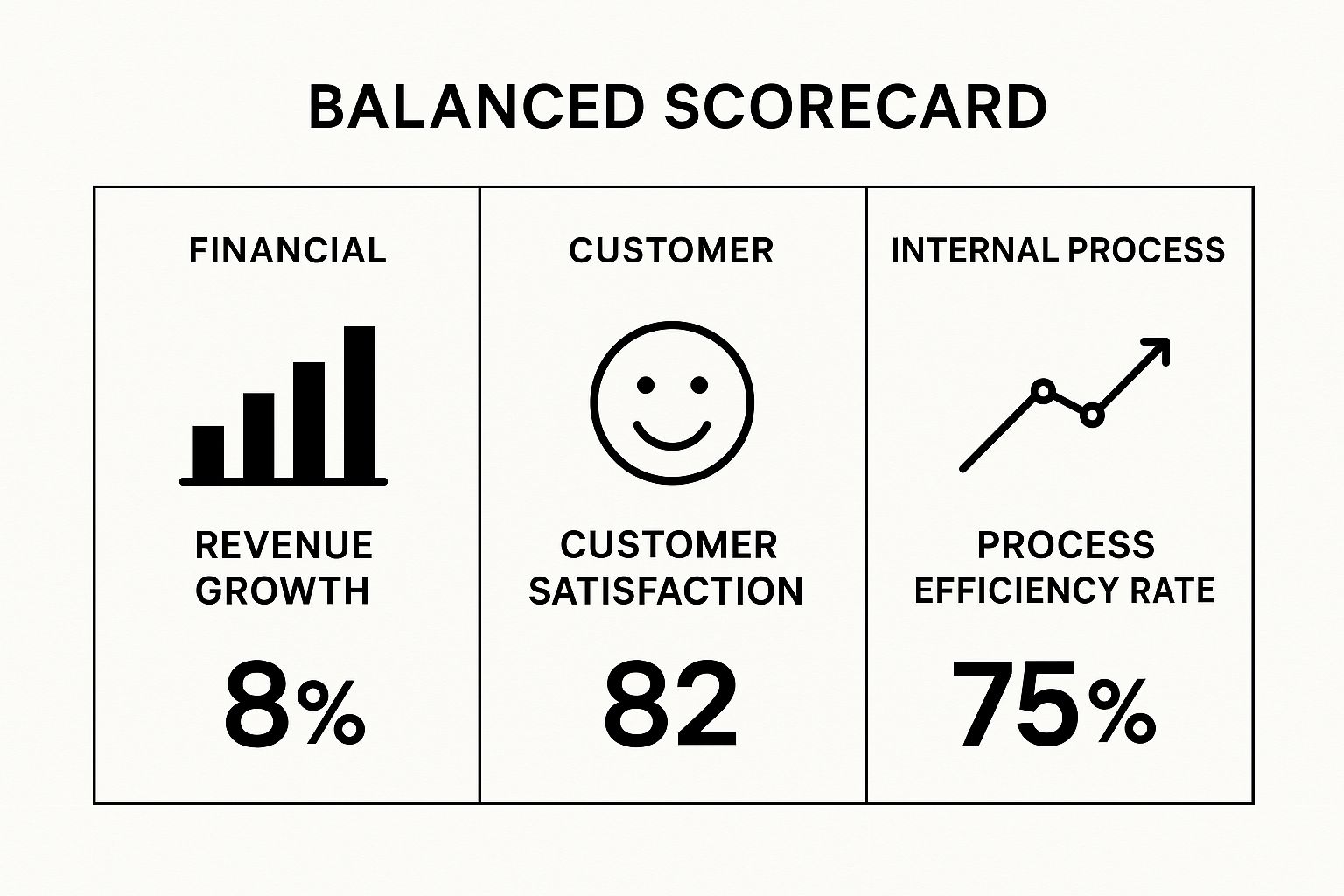
As you can see, it’s about bringing together distinct KPIs for finance, customers, and internal processes to get a complete picture of organizational health.
Comparing Top BSC Certification Providers
While BSI is a powerhouse, it’s not the only game in town. Other excellent organizations offer valuable certifications, each with a slightly different flavor. The table below breaks down some of the top players to help you see how they stack up.
| Provider | Key Feature | Best For |
|---|---|---|
| Balanced Scorecard Institute (BSI) | Comprehensive nine-step methodology and a global reputation. | Professionals seeking the most recognized, in-depth training for hands-on implementation. |
| Global Skill Development Council (GSDC) | Focus on validating core knowledge with globally accessible certification. | Individuals who need to certify their foundational BSC knowledge quickly and affordably. |
Ultimately, this isn't about finding the single "best" provider, but about finding the one that's the right fit for you. Your career goals, current experience, and how you learn best should guide your choice.
Key Factors for Comparing Providers
So, how do you make the final call? When you’re weighing your options, cut through the marketing noise by focusing on these core factors.
- Curriculum and Methodology: Does the program teach a proven, step-by-step framework? You want a course that gives you actionable tools and real-world case studies, not just abstract theories.
- Instructor Experience: Find out who's actually teaching. The best programs are led by seasoned pros who have spent years implementing the Balanced Scorecard in real companies, not just talking about it.
- Industry Recognition: How much weight does the certification carry? A credential from a globally known institution like BSI simply opens more doors.
- Program Format: Are you someone who thrives in an intense, week-long boot camp, or do you need the flexibility of a self-paced online course? Be honest about what fits your life and learning style.
- Cost and Value: Look beyond the price tag. The real question is about the return on your investment. Does the program's reputation, curriculum, and network justify the cost?
In the end, the right certification does more than just give you a piece of paper. It equips you with a practical toolkit and the confidence to walk into any organization and drive real strategic change.
Getting Through the Certification Process and Exam

Getting a balanced scorecard certification isn't about cramming for a single, high-stakes test. It's more of a guided journey. The whole process is designed to build your expertise step-by-step, so when exam day comes, you’re ready to apply what you’ve learned, not just spit back memorized facts.
First things first, you need to check the prerequisites. Don’t worry, it’s not like those highly technical certs that demand a specific degree. Most Balanced Scorecard programs are looking for professional experience. They’re built for managers, analysts, and leaders who have already dipped their toes into strategic planning or performance management. This ensures you have a real-world foundation to connect the concepts to.
The Application and Prep Work
Once you've picked a provider and made sure you qualify, the real work begins. This usually means enrolling in their required training course or boot camp. These programs are often intense and hands-on, built to get you from theory to practical application in a short amount of time.
This is your training ground. You'll get into the weeds of strategy mapping, learn how to develop meaningful performance measures, and figure out how to cascade goals down through an entire company. It’s where you build the mental muscle for both the exam and your career. Honing your study habits is a huge part of this, so it’s worth exploring some proven tips for effective studying to make the material stick.
What to Expect on Exam Day
The exam is the final hurdle. While the format can differ slightly between providers, they all aim to test two things: what you know and how well you can think on your feet.
Let's look at a concrete example. The Certified Balanced Scorecard Professional (BSP) from the Global Skill Development Council uses a multiple-choice exam with 40 questions. You have 90 minutes to finish and need a score of 60% to pass. It’s a closed-book test, but they do offer one free retake, which shows they care more about you mastering the material than just passing on the first try.
Knowing the exam structure is half the battle. With 40 questions in 90 minutes, you've got a little over two minutes for each one. That simple math helps you pace yourself and prevents you from getting bogged down on a tricky question.
Key Exam Rules to Remember
Beyond the question count and time limit, there are a few other rules you absolutely need to know before you start. These policies keep the playing field level for everyone.
- Closed-Book Format: This is standard. You can't bring in notes, books, or any study aids. The exam is meant to test what you’ve truly learned, not how quickly you can find an answer.
- Retake Policies: Wondering what happens if you don't pass? Most programs have a plan. The GSDC, for example, gives you one free retake for the BSP exam. It’s a nice safety net that takes some of the pressure off.
- Proctoring: To protect the value of the certification, exams are almost always proctored, whether you take them at a testing center or online.
Getting these details straight from the start means no nasty surprises on exam day. You can walk in (or log on) feeling prepared and ready to focus on one thing: proving you've got what it takes.
Understanding the Cost and Global Reach of Certification
Getting a balanced scorecard certification is a serious career move, so it’s smart to get a handle on the costs and what you’re really getting for your money. The price tag isn't just an arbitrary number; it’s a reflection of the training quality, the provider's credibility, and how the course is delivered.
Think of it like buying professional equipment. You can grab a cheap, generic wrench that might work for a simple task. But a high-quality, precision tool costs more because it’s built to deliver expert results reliably, every single time. Certification works the same way—you're investing in a proven methodology and a credential that people respect.
The cost can swing pretty dramatically, from a few hundred dollars for a basic online course to several thousand for an intensive, in-person workshop led by seasoned pros.
Breaking Down the Main Cost Factors
So, what actually determines the price of a certification program? A few key things come into play. Knowing them will help you understand where your money is going and pick a program that gives you the best bang for your buck.
- Provider Reputation: Well-known institutions like the Balanced Scorecard Institute usually charge more. Why? Because their name carries a lot of weight in the industry, and employers know it.
- Course Format: Live, in-person workshops are almost always more expensive than self-paced online courses. You're paying for the instructor's time, the venue, and physical materials.
- Program Inclusions: Does the program come with a ton of course materials, personal coaching sessions, or access to an alumni network? These extras add real value, and they also add to the cost.
- Geographic Location: The same course can have a different price depending on where it's held. The cost of living and local market rates in places like New York or London will naturally be higher than in other cities.
Getting a feel for the different performance measurement tools out there is a great first step. Our guide on business intelligence scorecards can help you see how everything fits together.
A Look at Real-World Pricing and Global Access
Let's talk real numbers. A top-tier program like the Balanced Scorecard Professional Certification Boot Camp in the USA runs at about $4,500. That price typically gets you several days of intense, hands-on training with an expert and includes all the materials you'll need.
And this isn't just a North American trend. The demand for balanced scorecard skills is truly global, which shows just how valuable the framework is to companies all over the world.
The fact that balanced scorecard certification is expanding globally is a huge sign of its importance in business today. When you see courses popping up in major cities on every continent, you know you’re investing in a skill that’s universally recognized and applied.
This worldwide adoption is proof that the principles you’ll learn aren't just academic theories; they're being put into practice by successful companies everywhere.
In fact, a quick glance at the 2025 schedule shows boot camps planned in places like Pretoria, South Africa; Lagos, Nigeria; and Dubai, UAE, in addition to courses in the United States. You can find more details on these global certification opportunities on balancedscorecard.org. This international reach means your certification will be understood and valued no matter where your career takes you.
Is a Balanced Scorecard Certification Worth It for You?

So, you're on the fence about getting a balanced scorecard certification. It’s a fair question. This isn't just another line item for your resume; it's a real commitment of time and money, so you need to know if the payoff matches your career goals.
Think of it this way: are you the kind of person who wants to move beyond just managing daily tasks? Do you want to be the one shaping your company's future? If the idea of turning a lofty vision into real, measurable action gets you excited, then you're probably in the right place.
Evaluating the Return on Your Investment
Let's be practical. To decide if it's worth it, you have to weigh the costs against the benefits. On one side, you have the course fees and the hours you'll spend studying. On the other side, you get a proven skillset that can open doors to new roles, boost your salary, and earn you a seat at the strategy table.
The real value here is learning how to be the person who connects the big-picture vision to the day-to-day results. A certified professional doesn’t just track metrics; they build the entire framework that makes those numbers matter. You can see just how critical this is in our guide to the relationship between KPI and scorecard systems.
A Balanced Scorecard certification isn't for someone who just wants to execute tasks. It's for the aspiring leader who wants to become an architect of growth—someone who can steer the whole organization toward its most important goals.
Who Benefits Most from Certification?
While almost anyone in a business role can find value in it, the certification really gives a career boost to a few specific groups. If you fit into one of these categories, the investment is almost certainly a smart move.
- Mid-Level Managers Eyeing the C-Suite: This certification gives you the strategic planning chops you need to make that jump from management to senior leadership.
- Strategy and Operations Professionals: It sharpens your expertise, making you the go-to person for performance management and corporate planning.
- Consultants and Business Advisors: Adding this respected framework to your toolkit allows you to deliver much more strategic value to your clients.
In the end, it comes down to this: if your goal is to lead an organization with clarity and purpose, this certification gives you the blueprint. You’ll walk away with more than just a certificate—you’ll have the confidence and skill to drive real, measurable success.
Got Questions About Balanced Scorecard Certification?
Diving into any new certification program always brings up a few questions. If you're thinking about getting certified in the balanced scorecard, you're probably wondering about the time commitment, prerequisites, and if it's even still a big deal today.
Let's clear up some of the most common questions people ask before they jump in.
How Long Does It Take to Get Certified?
This really depends on the program you choose and how you like to learn.
Some providers, like the Balanced Scorecard Institute, offer intense, "boot camp" style courses that get you through everything in just five days of live training. On the other hand, you can find self-paced online programs that let you chip away at the material over several weeks or months.
So, from start to finish, you could be looking at anywhere from one week to three months to get certified. It all comes down to the course format and how much time you can carve out to study.
Do I Need to Be a Finance Whiz?
Absolutely not. This is probably the biggest myth out there.
While the framework definitely includes a financial perspective—it has to—its real power comes from balancing that with three other critical areas: your customers, your internal processes, and your team's ability to learn and grow. The certification is built for people from all corners of a business, whether you're in operations, HR, IT, or marketing.
What you really need is a drive to connect high-level strategy to concrete, measurable actions. It's about understanding how everything in the business works together, including the vital role of employee key performance indicators.
The Balanced Scorecard is a framework for strategy, not just finance. It teaches you to see the interconnectedness of all business areas, making it valuable for leaders in any department.
Is BSC Certification Still Relevant Today?
Yes, more than ever. It's easy to get distracted by newer frameworks like OKRs (Objectives and Key Results), but they aren't competitors—they're partners.
Think of it this way: the Balanced Scorecard is your strategic roadmap. It helps you build a high-level plan that ensures you're not just focusing on money but on all the things that drive long-term success. OKRs are the turn-by-turn directions you use to execute that plan.
Getting a BSC certification gives you the skill to build a rock-solid strategic foundation. You can then use tools like OKRs to bring that strategy to life, making you a much more capable and well-rounded leader.
At SaaS Operations, we provide proven playbooks and templates to help operators build efficient and effective businesses. Accelerate your growth with battle-tested frameworks from industry veterans. Learn more at https://saasoperations.com.