
If you're in the SaaS world, you've heard the term Annual Recurring Revenue, or ARR, thrown around a lot. But what is it, really?
Think of ARR as the predictable, yearly heartbeat of your subscription business. It's the revenue you can confidently expect to bring in from your customers over the next 12 months, based on their current contracts. Crucially, this metric strips away all the one-time charges—like setup fees or special projects—to give you a crystal-clear picture of your company's stable, ongoing financial health.
What Annual Recurring Revenue Really Means for SaaS

Imagine your total revenue is a river. That river might have sudden floods from one-off consulting gigs or big implementation projects. ARR, on the other hand, is the steady, reliable current flowing underneath it all. It’s the number that tells you, your team, and investors what the business can truly count on, year after year.
This focus on predictability is precisely why the subscription model is so powerful. Unlike a business chasing one-off sales, a SaaS company with a solid ARR has a much clearer window into its future cash flow. That kind of stability is gold. It lets you budget more accurately, hire with confidence, and make smart, long-term bets on your product.
The Core Components of ARR
The whole point of calculating ARR is to filter out the financial "noise" and focus only on repeatable, contracted revenue. It’s all about what sticks.
To get a clean ARR figure, it's vital to know exactly what goes into the calculation and what stays out. This simple breakdown can save a lot of headaches down the road.
Key Components of Annual Recurring Revenue
| Component Type | Description | Example |
|---|---|---|
| Included | Recurring Subscription Fees: The core of ARR, this includes revenue from all active annual and multi-year customer contracts, normalized to a 12-month value. | A customer signs a $12,000 annual plan. |
| Included | Recurring Add-Ons/Upgrades: Revenue from existing customers who add seats, upgrade tiers, or purchase recurring feature add-ons. | An existing customer adds 5 new user seats at $100/year each (+$500 ARR). |
| Excluded | Churn & Downgrades: The value of recurring revenue lost from customers who cancel their subscriptions or downgrade to a lower-priced plan. | A customer on a $5,000/year plan cancels their subscription (-$5,000 ARR). |
| Excluded | One-Time Fees: Any non-recurring charges, which are not part of the predictable revenue stream. | A $1,500 fee for initial setup and data migration. |
| Excluded | Usage-Based Fees: Variable fees that fluctuate based on consumption, as they are not predictable. | Overage charges for exceeding API call limits. |
By sticking to these rules, you get a metric that truly reflects the ongoing value of your customer base. For instance, if a client signs a three-year contract for $150,000, you don’t book it all at once. Instead, you recognize $50,000 of that as ARR for each of the three years.
Why ARR Is a Critical Health Indicator
For anyone running a SaaS company, tracking ARR is simply non-negotiable. It’s the primary benchmark for measuring momentum and proves your business model is working. To learn more about how this works, you can find a deeper dive into what ARR is and why it matters so much.
A healthy, growing ARR is a powerful signal that tells you a few very positive things about your business:
- You've Found Your Fit: A strong ARR means customers see real, sustained value in your product. They aren't just trying it; they're committing to it.
- Your Retention Game is Strong: It shows your customer success and product teams are doing their jobs well, keeping customers happy, engaged, and subscribed.
- You Have a Scalable Model: This is what investors love to see. A predictable, growing revenue stream proves you have a business that can grow efficiently.
How to Calculate Your ARR with Confidence
Figuring out your Annual Recurring Revenue (ARR) is more than just a number-crunching exercise for your finance team. It's the heartbeat of your SaaS business, a true measure of your momentum and health. Nailing this calculation is absolutely critical for making smart, strategic decisions.
It all starts with a simple formula that tracks every recurring dollar coming in and going out over the course of a year.
The standard formula is surprisingly straightforward:
Beginning ARR + New ARR from New Customers + Expansion ARR – Churned ARR = Ending ARR
Let's unpack each piece so you can calculate your annual recurring revenue saas metric and trust the result completely.
The Foundational Formula for ARR
Think of your ARR at the start of the year as your baseline. From there, the number will rise and fall based on four key activities: landing new customers, getting existing ones to spend more, seeing them spend less, and losing them entirely.
-
Beginning ARR: This is your starting line. It’s the total annualized recurring revenue from all your active subscriptions on day one of the period (say, January 1st).
-
New ARR: This is the fuel for your growth. It’s all the new recurring revenue you brought in from brand-new customers over the year.
-
Expansion ARR: Many founders call this "negative churn" for a good reason. This is extra revenue you generate from the customers you already have. Think upgrades to a bigger plan, cross-selling other products, or adding more user seats.
-
Churned ARR: This is the money walking out the door. It’s the total value of recurring revenue you lost, which comes from customers who cancel (logo churn) and customers who downgrade to a cheaper plan (contraction or downgrade ARR).
By adding the good stuff (New and Expansion ARR) and subtracting the painful stuff (Churned ARR) from where you started, you get a crystal-clear picture of how fast you're growing.
Putting the ARR Calculation into Practice
Let's make this real. Imagine a SaaS company kicks off the year with $2,000,000 in ARR.
Over the next 12 months, here’s what happens:
- They land new deals: The sales team signs new clients, adding $500,000 in New ARR.
- They grow existing accounts: The customer success team drives $150,000 in Expansion ARR from upgrades.
- They lose a few customers: It happens. Some customers cancel, resulting in $100,000 in Churned ARR.
- Some customers downgrade: A few clients move to lower-tier plans, which creates $25,000 in contraction ARR.
Plugging this into our formula looks like this:
$2,000,000 (Beginning) + $500,000 (New) + $150,000 (Expansion) - $100,000 (Churn) - $25,000 (Contraction) = $2,525,000 (Ending ARR)
This level of detail is incredibly powerful. It shows that growth isn't just about new sales; it’s also about keeping existing customers happy and engaged. That insight tells you exactly where to focus your resources—is it time to hire more salespeople or invest in your customer success team?
This flow chart gives you a great visual of how these revenue streams feed your overall growth.
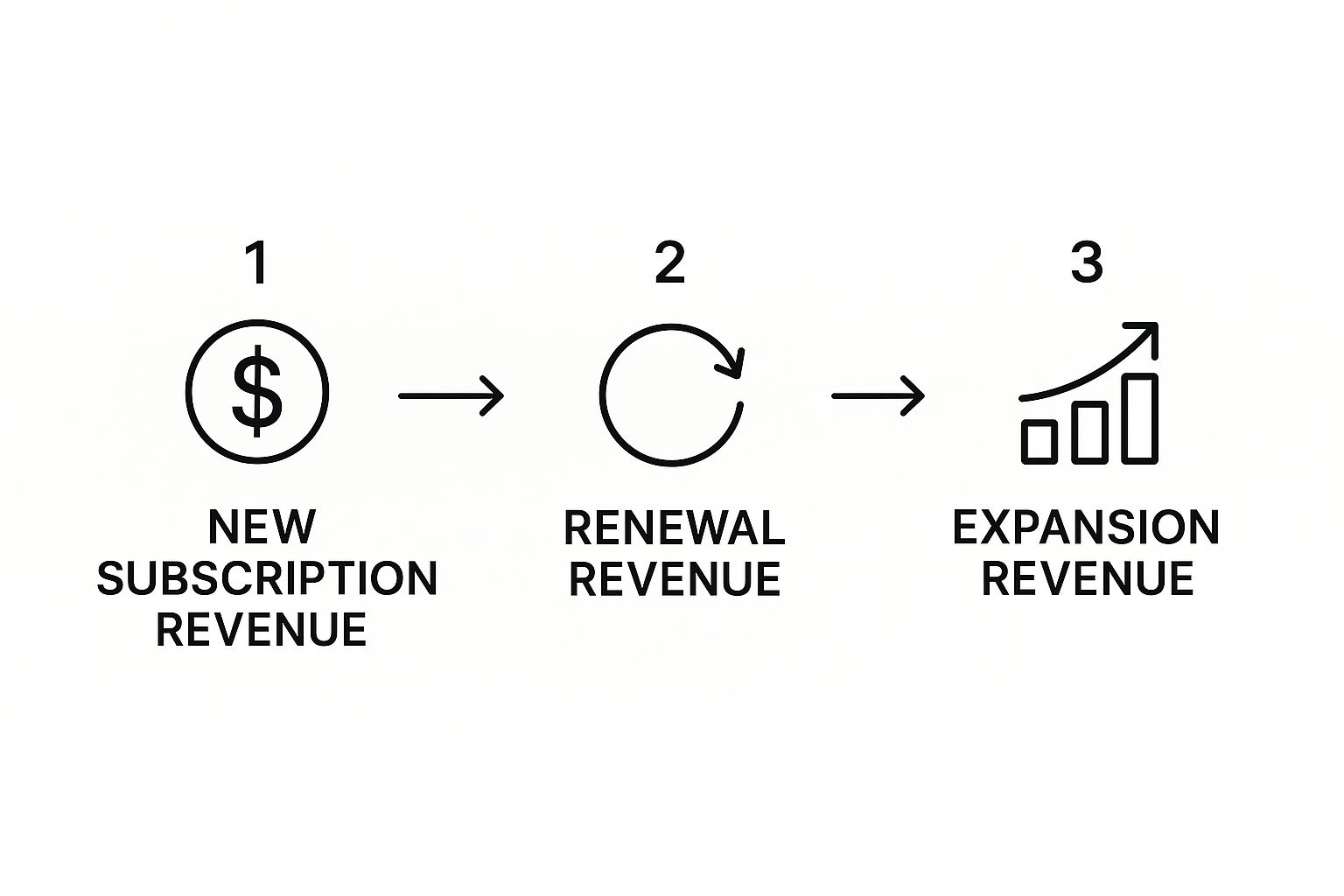
As you can see, a healthy SaaS business has to be strong across the board: winning new customers, keeping them around, and finding ways to grow those relationships over time.
Keeping Your ARR Metric Pure
One of the biggest mistakes I see companies make is muddying their ARR calculation with revenue that isn't truly recurring. You have to be disciplined here.
Key Takeaway: True ARR only includes predictable, repeatable revenue from subscriptions. Tossing one-time fees into the mix just inflates the number and gives you a false sense of security about your company's health.
Always make sure you exclude the following:
- One-Time Setup or Implementation Fees: These are one-and-done deals, not recurring revenue.
- Professional Services or Consulting Fees: Project work is great, but it’s not part of a subscription.
- Variable or Usage-Based Fees: These can swing wildly from month to month, so they don't fit into a metric designed to measure predictable income.
When you track these revenue streams separately, you gain a much deeper understanding of your business. For instance, strong Expansion ARR is a fantastic sign because it directly boosts your Customer Lifetime Value. Getting ARR right is the first step to mastering other critical health metrics. You can learn more about how to master the Lifetime Value calculation in SaaS to see how these numbers all connect.
Placing ARR in Your SaaS Metrics Dashboard

Annual Recurring Revenue is a fantastic metric, but on its own, it doesn't tell the whole story. To get a real sense of your company's health, you have to look at ARR as part of a bigger picture, alongside a handful of other key performance indicators (KPIs).
Think of your SaaS dashboard like the one in your car. ARR is the odometer—it shows you how far you've come and gives you that high-level, long-term view of your progress. But you wouldn't drive a car with just an odometer, right?
You still need a speedometer to check your current speed and a fuel gauge to see if you have enough gas in the tank to keep going. That's where other metrics come in, working with your annual recurring revenue saas figure to give you a complete, actionable view. Putting together effective business scorecards and dashboards is how you bring all this information together to make smart decisions.
ARR vs MRR: The Strategic Difference
One of the most common questions is how ARR relates to Monthly Recurring Revenue (MRR). While they're closely connected—at its simplest, ARR is just MRR multiplied by 12—they serve very different strategic roles.
-
MRR (Monthly Recurring Revenue): This is your speedometer. It gives you a real-time look at the predictable revenue you bring in each month. MRR is perfect for short-term operational planning, like seeing how a new marketing campaign performed or making quick, tactical adjustments to your sales strategy.
-
ARR (Annual Recurring Revenue): This is your odometer. It zooms out to give you a big-picture, annualized view of your recurring revenue. ARR is what you use for long-term strategic planning, setting annual budgets, and talking to investors. It smooths out the month-to-month bumps and shows your overall growth trajectory.
Generally, SaaS companies that focus on annual or multi-year contracts live and breathe ARR because it matches their sales cycle. On the other hand, businesses with lots of monthly, self-serve sign-ups tend to lean more heavily on MRR for their day-to-day operations.
Connecting ARR to Profitability and Sustainability
ARR becomes truly powerful when you pair it with metrics that measure your business's efficiency and customer value. The two most important partners for ARR are Customer Lifetime Value (CLV) and Customer Acquisition Cost (CAC).
A high and growing ARR is fantastic, but if it costs you more to acquire a customer than they will ever be worth to you, the business model is fundamentally broken. This is where the relationship between ARR, CLV, and CAC becomes the ultimate test of a sustainable SaaS business.
To make this crystal clear, let's put these key metrics side-by-side to see how they function.
Comparison of Key SaaS Financial Metrics
Looking at ARR, MRR, and CLV together helps clarify their distinct roles in guiding your business strategy. Each one tells a different part of your financial story.
| Metric | Primary Use Case | Calculation Basis | Best For |
|---|---|---|---|
| ARR | Long-term planning, valuation, and annual forecasting. | Annualized recurring revenue from all active subscriptions. | Companies with annual contracts and enterprise focus. |
| MRR | Short-term operational management and tactical adjustments. | Monthly recurring revenue from all active subscriptions. | Businesses with monthly plans and high-velocity sales. |
| CLV | Measuring the total net profit a customer brings over their entire relationship with your company. | Average Revenue Per Account (ARPA) divided by customer churn rate. | Understanding customer value and setting acquisition budgets. |
| CAC | Calculating the total cost to acquire a new customer. | Total sales and marketing spend divided by the number of new customers acquired. | Assessing the efficiency of your growth engine. |
A healthy SaaS business isn't just about a big ARR number; it's about the relationship between these metrics. A widely accepted benchmark, for instance, is having a CLV that is at least 3x your CAC. This simple ratio tells you that for every dollar you spend to get a new customer, you make three dollars back over their lifetime. That's a healthy, sustainable model.
When your high ARR is backed by a strong CLV:CAC ratio, you're showing investors the gold standard. It proves you've not only found product-market fit (that's your growing ARR) but have also built a profitable and scalable machine to keep growing. Without that context, ARR is just a vanity metric. With it, ARR becomes the bedrock of a financial narrative that proves your company is built to last.
Benchmarking Your SaaS ARR Growth Realistically
https://www.youtube.com/embed/_KMuHM6gWbs
Once you've got a firm grip on your Annual Recurring Revenue (ARR), the next question is always the same: "So… is our growth any good?" Without context, ARR is just a number on a spreadsheet. To really know how you're doing, you need to see how you stack up against the rest of the SaaS world—a world that's always in flux.
Comparing your company to others is the only way to set goals that make sense. What’s considered fantastic growth for a seed-stage startup with $500,000 in ARR is a completely different ballgame than for an established company cruising past the $50 million mark. Context is everything.
Early on, everyone expects you to grow like a weed, often doubling or even tripling your ARR every year. Later, the game shifts to steady, efficient growth. The market itself plays a huge role, too. We've seen a real shift lately; median growth rates have cooled to around 26% in 2024. That's a big drop from the 60% the top companies were hitting just a year ago. You can dig into the latest market dynamics on benchmarkit.ai to see the trends for yourself.
Growth Expectations at Different ARR Stages
Your current size is the single best predictor of your future growth rate. The law of large numbers is very real in SaaS; it’s a heck of a lot easier to double $1 million in ARR than it is to double $100 million.
Here’s a rough guide to what strong growth looks like at different milestones:
- Under $1M ARR: At this stage, you're looking for explosive growth. The goal is often 100%+ year-over-year as you nail product-market fit and get your first real traction.
- $1M to $10M ARR: The pace might cool off a bit, but top-tier companies are still aiming for 70-100% growth. This is the classic scale-up phase where you’re building out teams and repeatable processes.
- $10M to $50M ARR: Growth naturally starts to level out here. A healthy, impressive rate is in the 30-50% range. Predictability and efficiency start to matter just as much as raw speed.
- Over $50M ARR: At this scale, 20-30% growth is considered excellent. The focus shifts to defending your market position, driving profitability, and maximizing every dollar from your existing customer base.
Knowing these stages helps you set targets that are ambitious but still tethered to reality. Shooting for 200% growth when you're at $40M ARR is probably a fantasy, but settling for 30% at $800k ARR might mean you’re not pushing hard enough.
Beyond Top-Line Growth: New Metrics to Watch
In today's SaaS market, just growing your top-line ARR isn't enough to impress anyone. Investors and savvy operators are digging deeper to understand the quality and efficiency behind that growth. A couple of metrics, in particular, have moved to center stage.
Net Revenue Retention (NRR) has become a primary health indicator for a SaaS business. It answers a simple but powerful question: Can you grow even if you don't sign a single new customer? A high NRR shows your product is sticky and that you're successfully delivering more value to customers over time.
Alongside NRR, ARR per employee is a fantastic measure of your team's efficiency. It tells you how good you are at turning headcount into revenue. For example, it's common to see SaaS companies in the $50 million to $100 million ARR range pulling in about $200,000 ARR per full-time employee.
Finally, where your annual recurring revenue saas growth comes from is incredibly telling. Expansion ARR—the money you make from upselling and cross-selling existing customers—is no longer an afterthought. It now makes up 40% of all new ARR, and for companies over $50M ARR, that can climb past 50%. This proves that sustainable growth is built just as much on farming your existing accounts as it is on hunting for new ones.
Actionable Strategies to Increase Your SaaS ARR
Knowing your Annual Recurring Revenue (ARR) is one thing, but actually growing it? That’s a whole different ballgame. Sustainable growth in your annual recurring revenue saas metric doesn't happen by accident. It's the result of a focused, multi-pronged approach that goes way beyond just landing new logos.
True ARR momentum really comes down to mastering three core pillars. You have to consistently acquire new customers, systematically grow the revenue you get from existing ones, and relentlessly plug the leaks caused by churn. If you neglect any one of these, you'll feel the drag on your growth.
Attract and Acquire High-Value Customers
The bedrock of ARR growth is, of course, new business. But here's the catch: not all customers are created equal. The real key is to attract the right kind of customers—the ones who will stick around, grow with you, and ultimately become your most profitable accounts.
Start by getting laser-focused on your Ideal Customer Profile (ICP). Dig into your current customer data to see who has the highest lifetime value and the lowest churn rates. Once you know who they are, aim all of your sales and marketing firepower at acquiring more people just like them.
A few proven strategies to pull this off include:
- Tiered Pricing: Set up multiple pricing plans that serve different needs and budgets. This makes it easy for new users to get started and gives growing businesses a clear path to upgrade.
- Freemium or Free Trials: Let people experience your product's magic firsthand. This is one of the best ways to lower the barrier to entry and build a pipeline of leads who already understand your value.
- Content Marketing: Create genuinely helpful content that solves your ICP's real-world problems. This builds trust and naturally positions you as the best solution when they're ready to buy.
Expand Revenue from Your Existing Customer Base
Your current customers are your single biggest opportunity for ARR growth. Period. They already know and trust you, which makes selling to them far easier and cheaper than chasing down a brand-new prospect. This is where Expansion ARR becomes your most powerful lever.
The goal is to increase your average revenue per account (ARPA) by delivering more value over time. Think of it as growing with your customers. As their business gets more complex, you should be right there with a logical next step for them to invest more in your solution.
Your customer success team isn't just a support function; it's a revenue-generating engine. Proactively identifying opportunities for customers to get more value from your platform is the secret to world-class Net Revenue Retention (NRR).
Popular tactics for expansion include:
- Upselling: Nudge customers to upgrade to a higher-tier plan with more features, better support, or more capacity.
- Cross-selling: Offer complementary products or modules that solve adjacent problems for your customers.
- Usage-Based Add-ons: Bill for certain features based on consumption, like data storage or API calls. This allows accounts to grow their spending naturally as their usage increases.
While growing ARR is critical, it's also smart to delve into profitability strategies, as a healthy business needs both to succeed long-term.
Reduce Revenue Churn Aggressively
Every dollar you lose to churn is a dollar you have to earn all over again just to break even. This makes churn reduction one of the highest-impact activities you can focus on. Even a small improvement here pays massive dividends down the road.
Fighting churn means being proactive. Don't wait for a customer to tell you they're unhappy or on the verge of leaving. A solid customer success program is your best defense, focused on making sure your users are hitting their goals with your product.
Effective https://saasoperations.com/customer-retention-saas/ often involve regular check-ins, keeping an eye on product usage for any red flags, and simply building strong relationships. When you do this right, your service becomes less of a tool and more of an indispensable part of their daily workflow.
Common ARR Mistakes That Hurt SaaS Companies
Calculating Annual Recurring Revenue sounds simple enough on the surface, but tiny mistakes can snowball into massive problems. Get it wrong, and you could be misleading your team, creating a false sense of security, and ultimately damaging your credibility with investors. It's like building a house—if the foundation is just a little bit off, the entire structure becomes unstable down the line.
These aren't just minor accounting errors; they're strategic blunders that lead to bad decisions and painful corrections. Steering clear of these common pitfalls is the only way to ensure your annual recurring revenue saas metric is a true reflection of your company's health.
Mistake 1: Including One-Time Fees
The most common—and damaging—mistake is padding your ARR with revenue that isn't actually recurring. This means things like one-time setup charges, professional services fees, or training costs. Sure, that income is great to have, but it's not predictable and repeatable like a subscription.
When you mix these in, you inflate your ARR and make your business look healthier than it is. Imagine a startup reports $1 million in ARR but has included $200,000 in one-off implementation fees. The moment an investor realizes 20% of that "recurring" revenue isn't recurring at all, trust evaporates, and the company's valuation can take a serious hit.
Key Takeaway: Your ARR needs to be pure. Its entire value comes from its predictability. Always keep one-time charges separate from your recurring revenue streams to maintain an accurate and trustworthy metric.
Mistake 2: Mishandling Multi-Year Contracts
Another frequent slip-up is how companies account for multi-year deals. It's incredibly tempting to book the entire contract value upfront. When a customer signs a three-year contract for $36,000, it feels like a huge win.
But you can't count that full amount as ARR in the first year. The right way to do it is to normalize the total contract value over its term. For that $36,000 deal, it contributes $12,000 to your ARR for each of the three years. This gives you a stable, predictable view of your growth instead of a lumpy, misleading one.
Mistake 3: Ignoring Expansion and Churn Nuances
Finally, a lot of companies get tunnel vision, focusing only on landing new customers while underestimating what's happening with their existing ones. Your Expansion ARR—the revenue from upgrades and add-ons—is a massive growth engine. Ignoring it leaves you with a seriously incomplete picture of your success.
Just as important is understanding the two ways you can lose revenue:
- Logo Churn: This is when a customer cancels their subscription and leaves for good.
- Contraction ARR: This happens when an existing customer downgrades to a cheaper plan.
If you don't track these two separately, you're hiding crucial insights from yourself. For example, high contraction might mean your top-tier plans are overpriced or not delivering enough value—a totally different problem than just failing to retain customers. For ARR reporting to be truly useful, it has to be this detailed.
Answering Your Top Questions About Annual Recurring Revenue
Even after you've got the basics down, you'll probably still run into some tricky situations when you start using ARR in the real world. Let's clear up some of the most common questions that pop up so you can use this metric with confidence.
How Is ARR Different from Revenue or Bookings?
This is a big one, and it's easy to get these terms mixed up. Think of it this way: total revenue is the whole pie—it includes everything from one-time setup fees and consulting gigs to your core subscriptions. ARR, on the other hand, only cares about the predictable, recurring subscription revenue.
Bookings are another beast entirely. A booking is the total value of a new contract you just signed. So, if a customer signs a three-year deal for $300,000, that’s a $300,000 booking. But for ARR purposes, it only adds $100,000 to the current year. ARR gives you that stable, forward-looking view of your business health, while bookings can be much more up-and-down.
Can a Non-SaaS Business Use ARR?
Absolutely. While ARR is practically synonymous with SaaS, it’s not exclusive. Any company that runs on a subscription model can find value in tracking it.
We're seeing this more and more with media outlets, fitness studios with monthly memberships, and even traditional hardware companies that now offer their products "as-a-service."
The key isn't the industry but the business model. If you have predictable, recurring revenue from customers on long-term contracts, ARR is an essential metric for tracking the health and trajectory of your business.
Why Do Investors Care So Much About ARR?
For investors, ARR is king. Why? Because it screams two things they love to see: predictability and scalability.
A steadily growing ARR shows them you have a sticky product, a loyal customer base, and a reliable stream of income you can count on. It takes the guesswork out of forecasting and valuation, which is a lot more attractive than a business built on unpredictable, one-off sales. For a deeper dive into this key metric, check out our complete guide on annual recurring revenue.
A healthy ARR isn't just a number on a spreadsheet; it’s proof that you've built a scalable, repeatable engine for growth. That’s the kind of foundation that makes for a smart investment.
At SaaS Operations, we provide battle-tested playbooks and templates to help you streamline your processes and accelerate growth. Get the frameworks you need to build a more effective and efficient SaaS business.