The Ultimate Playbook for a SaaS Business Operating System
 Published By: Alex
December 25, 2025
Published By: Alex
December 25, 2025
A business operating system isn't an abstract concept; it's the actionable playbook your company executes daily to achieve repeatable, scalable success. Think of it as your company's central nervous system, connecting every person, process, and data point to a single, unified mission. It’s the framework that ensures everyone is rowing in the same direction, executing with precision.
What Is a Business Operating System, Really?
Imagine your SaaS company is a high-performance race car. You have a brilliant driver (your CEO), a powerful engine (your product), and a full tank of fuel (your funding). But without an operating system, you just have a collection of expensive parts that fail to work in concert.
The business operating system (BOS) is the integrated system—the chassis, the onboard computer, the communication radio—that transforms those parts into a cohesive machine engineered for one purpose: winning.
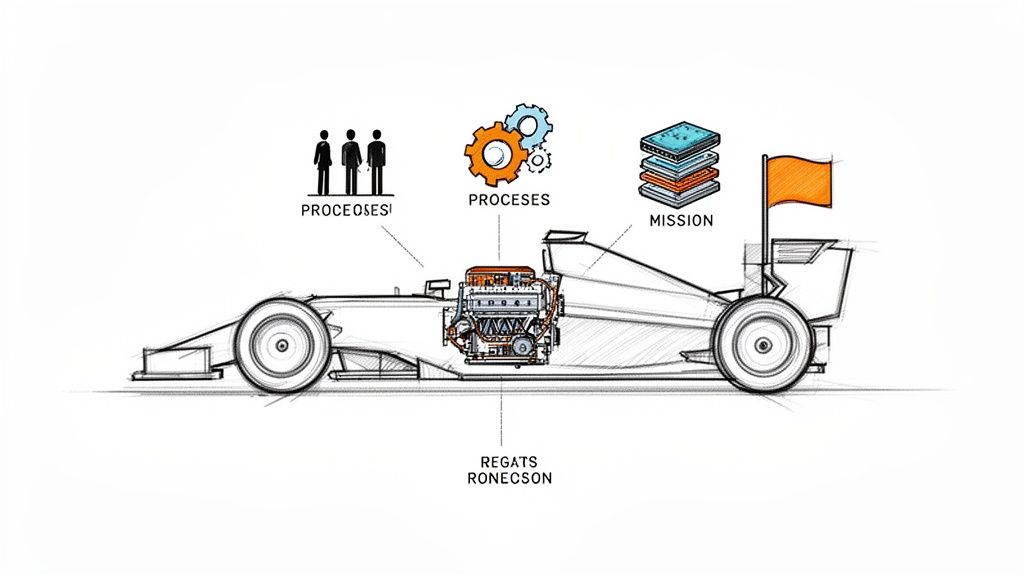
It is far more than a project management tool or a dusty binder of SOPs. It's the entire framework that defines how work gets done. A robust BOS brings clarity to everything, from high-level strategy down to a team member's daily to-do list.
This structure is what replaces chaotic, reactive firefighting with predictable, proactive execution. It's the core of smart operational planning that finally empowers founders and leaders to focus on strategic growth, not just surviving the day.
The Five Pillars of a SaaS Business Operating System
A strong BOS is built on five interdependent pillars. Mastering these is what separates SaaS companies that achieve escape velocity from those that remain stuck in the launch phase. This isn't just theory; it's the proven blueprint used by elite SaaS operators.
Here’s the actionable breakdown of the five pillars that form the foundation of an effective Business Operating System for a modern SaaS company.
| Pillar | What It Is | Your Immediate Action Step |
|---|---|---|
| Processes | Documented, repeatable playbooks for every key function (onboarding, sales, support). | Choose your single most chaotic process (e.g., customer onboarding) and create a simple, step-by-step checklist for it. |
| Automation | Leveraging technology to eliminate repetitive, manual tasks that drain team capacity. | Identify one manual task your team does daily (like sending welcome emails) and use a tool like Zapier or your CRM to automate it this week. You must automate business processes. |
| Meetings | A deliberate communication rhythm designed to solve problems and drive accountability. | Implement a 90-minute weekly leadership meeting with a strict, non-negotiable agenda focused on solving your top 1-3 issues. |
| People Management | A clear system for defining roles, setting expectations, and managing performance. | For your leadership team, define the 3-5 absolute outcomes each role is accountable for. No overlap. |
| Scorecards & KPIs | A curated set of 5-15 metrics that provide a real-time pulse on business health. | Define 5 leading indicators for your business (e.g., new trial signups, trial-to-paid conversion rate) and review them weekly. |
Mastering these five pillars provides the essential structure to scale without breaking.
This shift toward structured systems is accelerating. It’s predicted that by 2025, a staggering 85% of all business software will be part of a SaaS-powered operating system. This represents a fundamental move away from fragmented, legacy setups.
This is precisely why elite SaaS operators are obsessed with metrics like churn and customer retention—these KPIs are hardwired into their operational playbooks. Ultimately, your BOS is the engine that drives predictable, repeatable growth.
Why Your SaaS Needs an Operating System Now
Hustle and grit will get you to your first milestone. But attempting to scale a SaaS company on hustle alone is a recipe for a fiery crash. The early days of reactive firefighting are necessary, but that approach has a very low ceiling.
Eventually, it fails. Growth sputters and stalls, crushed under the weight of its own disorganization.
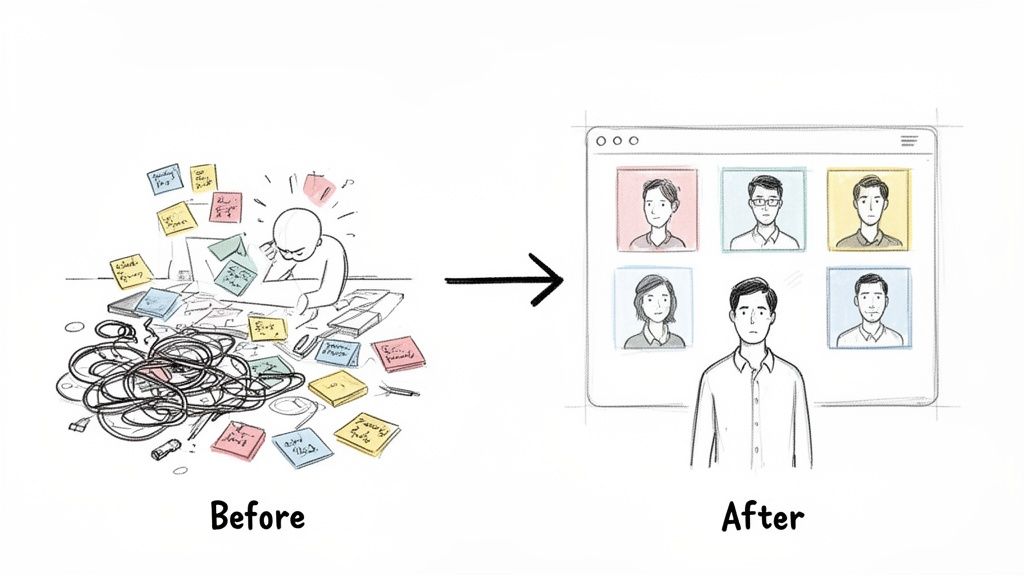
Consider the playbook of "Alex," a composite of founders we work with. After landing a major client, their company hits a massive growth spurt. Instead of celebrating, Alex is drowning. The sales team makes promises the product can't deliver. Customer support is overwhelmed. Engineering is building features based on the loudest, not the most strategic, customer voice. Alex has become the bottleneck for every decision, and burnout is imminent.
This is the exact moment an operating system in business transitions from a "nice-to-have" to a mission-critical necessity. For Alex, the first step is implementing a basic system. The action plan: document the sales-to-onboarding handoff, create a scorecard with five key metrics (like activation rate and time-to-first-value), and commit to one weekly leadership meeting with a strict problem-solving agenda.
From Chaos to Clarity and Control
With these steps, the chaos begins to recede. Salespeople sell what the product can deliver. The support team has a clear escalation path. Leadership starts making decisions based on data, not gut feelings.
The benefits are concrete and measurable:
- Radical Efficiency: Teams stop reinventing the wheel. With documented processes, everyone executes the proven "best way," eliminating redundant or conflicting work.
- Laser-Focused Alignment: With a shared scorecard and clear goals, every individual understands precisely how their work contributes to company-wide objectives.
- Freedom to Scale: The system empowers the team to manage day-to-day operations, freeing up leadership to focus on strategic growth initiatives.
Your first step is to diagnose your current state. Our guide on the SaaS maturity model provides a framework to assess where you are and what to do next.
An operating system turns your business from a collection of talented individuals into a high-performance team. It creates a common language and a shared playbook, enabling predictable growth instead of accidental success.
This is no longer optional. The global SaaS market is projected to explode from $315.68 billion in 2025 to an incredible $1,131.52 billion by 2032. North America already commands 47.85% of this market in 2024, signaling the intensity of the competition. You can explore the full SaaS market growth stats over at Fortune Business Insights.
Without a robust operating system, your SaaS will be outmaneuvered and left behind.
The Core Components of a Business Operating System
Think of a business operating system not as a vague philosophy, but as a high-performance engine with distinct, interconnected parts. When each component is designed and tuned correctly, your SaaS company moves with precision, speed, and predictability. Neglect one part, and the entire system sputters.
Let's examine the five essential pillars that make this engine run. These are the actionable areas where elite SaaS operators focus their energy to build a scalable growth machine.
Pillar 1: Processes and Playbooks
Processes are your company's documented, battle-tested workflows that eliminate guesswork. They are the "one best way" to handle everything from onboarding a new customer to closing the monthly books. Without them, your team constantly reinvents the wheel, leading to inconsistent results and wasted effort.
For a SaaS company, this is non-negotiable. An inconsistent customer onboarding process, for example, directly correlates with higher churn. A well-documented playbook ensures every user experiences the same high-quality "aha!" moment, dramatically improving retention. Your goal is to codify your wins into simple, repeatable steps.
The key is creating Standard Operating Procedures (SOPs) that are clear, concise, and accessible where your team actually works—not buried in a forgotten Google Drive folder. To get started, our guide on how to create standard operating procedures provides a framework you can implement immediately.
Pillar 2: Automation That Frees Up Your Best People
Once your core processes are documented, the next step is to automate the manual, low-value work. Automation is the ultimate force multiplier for your team. It removes repetitive tasks from your top performers' plates, enabling them to focus on what truly moves the needle: innovation, strategy, and solving complex customer problems.
Consider the hours your customer success team spends manually sending follow-up emails or your finance team sinks into chasing overdue invoices. These are prime candidates for automation. A playbook from an 8-figure B2B SaaS operator we advised involved automating the entire first 90 days of the customer journey.
Using triggers in their CRM, they automated:
- A personalized welcome video from the CEO sent upon signup.
- A 14-day check-in scheduled with a Customer Success Manager.
- A series of tips and best practices delivered based on user behavior within the app.
The results were transformative: they slashed manual onboarding tasks by over 60% and achieved a 15% lift in user activation within the first month.
Pillar 3: A Meeting Rhythm That Drives Decisions
Most meetings are a colossal waste of time. In a high-functioning BOS, meetings are not for status updates; they are for making decisions and solving problems. The key is to establish a deliberate meeting rhythm, where every meeting has a clear purpose, a strict agenda, and defined outcomes.
A common failure is using synchronous time for status updates that should have been an email or a Slack post. A world-class operating system reserves meetings exclusively for healthy debate, alignment, and firm commitments.
For instance, many elite SaaS companies operate on a weekly "Level 10 Meeting" cadence. This is a 90-minute, non-negotiable leadership meeting with a fixed agenda:
- Check-in (5 mins): Share a quick personal/professional win.
- Scorecard Review (5 mins): Review the 5-7 most critical KPIs. Are we on track?
- Rock Review (5 mins): Report on progress for 90-day priorities.
- Customer/Employee Headlines (5 mins): Share critical frontline feedback.
- To-Do List (5 mins): Review commitments from last week’s meeting.
- Issues List (60 mins): Identify, Discuss, and Solve (IDS) the most critical challenges.
- Conclude (5 mins): Recap decisions, clarify new to-dos, and rate the meeting.
This structure forces absolute focus and guarantees the most important conversations happen every single week.
Pillar 4: People Management with Radical Clarity
Your people are your greatest asset, but their potential can only be unlocked through a system of radical clarity and accountability. This part of your BOS ensures every person in the company knows exactly what they are responsible for and how their success is measured.
A powerfully simple tool for this is the Accountability Chart. Unlike a traditional org chart showing reporting lines, an Accountability Chart defines the 3-5 primary functions and measurable outcomes each seat is responsible for. It makes it crystal clear who "owns" marketing, who "owns" sales, and who "owns" product, eliminating ambiguity.
This clarity cascades down to individual performance. When people are accountable for specific outcomes, they take ownership. This ends finger-pointing and creates a culture where everyone is focused on delivering results for their area of the business.
Pillar 5: Scorecards That Predict the Future
You cannot manage what you do not measure. A scorecard isn't a massive spreadsheet with every metric imaginable; it's a curated set of 5-15 forward-looking KPIs that give you an honest, real-time pulse on the business. These are not vanity metrics like website traffic; they are the numbers that predict future revenue and growth.
A high-impact SaaS scorecard must track leading indicators such as:
- New product trial sign-ups
- Trial-to-paid conversion rate
- Product qualified leads (PQLs)
- Customer health score
- Net revenue retention (NRR)
The leadership team reviews this scorecard weekly. If a number is off track, it immediately becomes an "issue" to be solved in the meeting. This system functions as an early warning signal, enabling you to identify problems—and opportunities—long before they impact your monthly P&L statement.
Your Step-by-Step Implementation Roadmap
Building a business operating system sounds daunting, but it doesn't have to be. The most effective SaaS operators don't try to boil the ocean. They build their BOS incrementally, targeting the highest-impact areas first to generate quick wins and build momentum.
This is not theory. It’s a battle-tested, phased approach to move from chaos to clarity without overwhelming your team. We will install the core components that provide the most leverage, right from the start.
Phase 1: Tame the Chaos (First 30 Days)
Your first month is about triage and establishing a baseline. You cannot fix what you cannot see. The goal is not perfection; it's creating a starting point.
Here is your 30-day action plan:
- Run a Process Audit: Convene your team and identify the top 3-5 processes causing the most friction. Is it the marketing-to-sales handoff? Customer onboarding? The hiring process? Isolate the ones everyone agrees are broken.
- Document ONE Core Process: Select the single most broken process from your audit and map it out. Create a simple, step-by-step checklist—the "one best way" to execute it. This is your first Standard Operating Procedure (SOP).
- Establish a Weekly Leadership Meeting: Schedule a recurring 90-minute meeting for your leadership team. Be ruthless about protecting this time and adhering to a strict, problem-solving agenda. This meeting is the heartbeat of your new operating system.
The objective of Phase 1 is not to solve every problem. It is to stop the bleeding, establish a communication rhythm, and prove that a small amount of structure delivers immediate relief and clarity.
Phase 2: Build the Core Engine (Days 31-60)
With a meeting rhythm and your first process documented, it's time to build the engine that runs on data, not gut feelings. This is the shift from reactive firefighter to proactive pilot.
Here are your next actions:
- Build Your V1 Scorecard: Identify 5-7 key metrics that provide a real-time pulse on the business. These must be leading indicators—numbers that predict future results, like trial-to-paid conversion rates or product qualified leads (PQLs), not just lagging indicators like last month's revenue.
- Assign Owners: Every number on that scorecard needs one person's name next to it. That individual is solely accountable for that metric. This action alone creates a powerful culture of ownership.
- Start an "Issues List": During your weekly meeting, begin formally tracking every obstacle, problem, and idea. This list becomes your central repository for structured problem-solving, ensuring critical items are addressed systematically.
This entire methodology follows a simple, repeatable loop: audit the current state, document a better way, and then automate it.
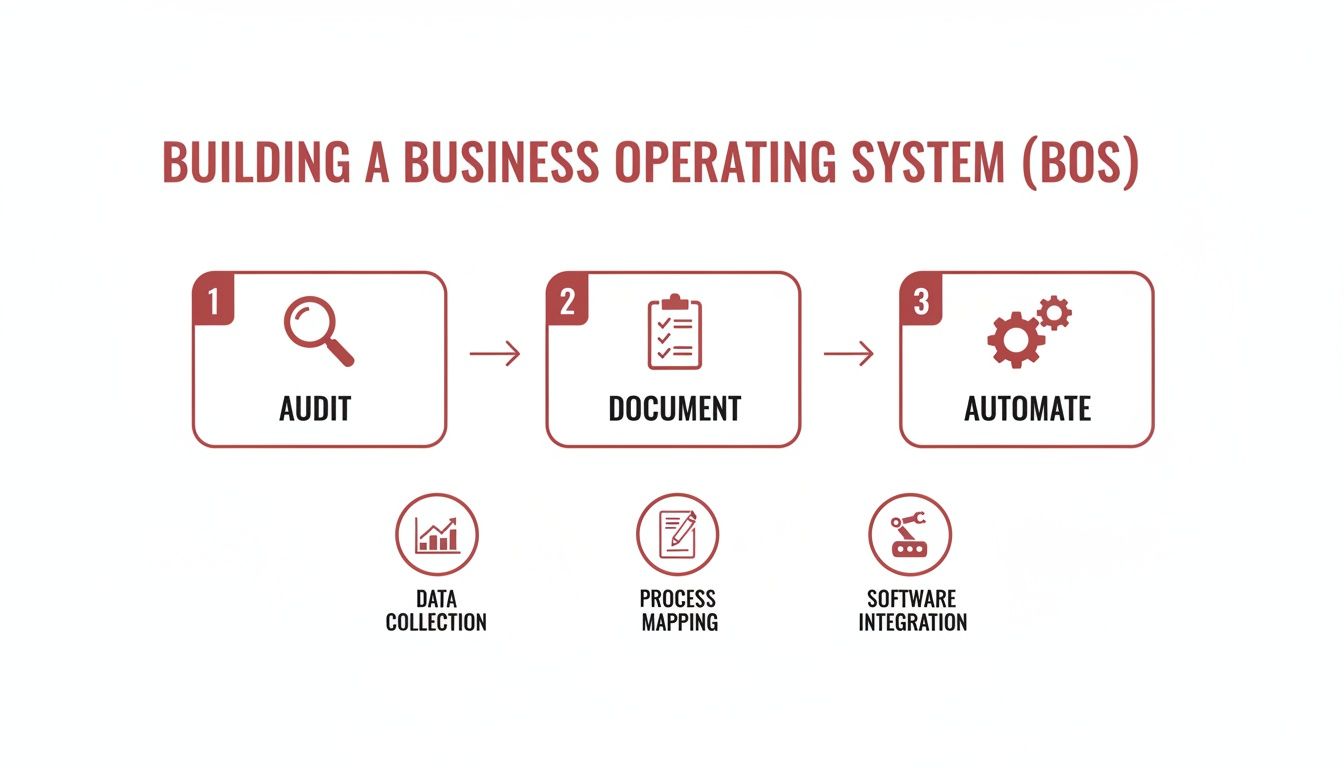
This Audit-Document-Automate framework is the engine of continuous improvement that will power your business operating system.
Phase 3: Scale and Automate (Days 61-90)
Now you have the data (scorecard) and the forum (meeting rhythm) to make smarter, faster decisions. This final phase of your initial rollout is about locking in your gains and amplifying your team's impact through technology.
Here is what you will tackle:
- Hunt for Automation Opportunities: Revisit your documented processes. Identify the manual, repetitive steps. These are your prime targets for automation. Start simply by setting up automated email follow-ups or using a tool like Zapier to connect two applications.
- Define Core Roles & Responsibilities: Create a simple Accountability Chart. For each key leadership role (e.g., Head of Marketing, Head of Sales), list the 3-5 primary functions they, and only they, are accountable for. This eradicates the "I thought you were doing that" confusion permanently.
As you master this, you can apply the framework department by department. Customer support is an excellent starting point; this AI Customer Service Automation Guide for Transforming Support is packed with actionable ideas that fit into a robust BOS.
We've laid out a simple 90-day plan to give you a clear path. Here is how it breaks down:
Your 90-Day BOS Implementation Plan
| Phase | Focus Area | Key Actions | Success Metric |
|---|---|---|---|
| Days 1-30 | Foundation & Triage | Audit top 3-5 processes. Document one core SOP. Start weekly leadership meeting. | First SOP is documented and used. Weekly meeting is held consistently for 4 weeks. |
| Days 31-60 | Data & Accountability | Build V1 Scorecard (5-7 metrics). Assign owners to each metric. Implement an "Issues List". | V1 Scorecard is reviewed weekly. Every metric has a clear owner. |
| Days 61-90 | Refinement & Leverage | Identify first automation opportunity. Create a simple Accountability Chart. | First automated workflow is live. Accountability Chart is complete for the leadership team. |
By executing this roadmap, you can install the foundational pillars of an operating system in business without slowing your company’s growth. To accelerate your progress, grab our detailed SaaS implementation checklist, which is full of templates and tools for each step.
Real-World Examples from Top SaaS Operators
Theory is useful, but seeing a finely tuned business operating system in action is where the concepts become real. The magic is in the execution—turning documented processes into measurable results on a dashboard. These are not just anecdotes; they are evidence of what happens when you commit to operational excellence.
Let's dissect how real SaaS companies have implemented these principles, focusing on the specific problems solved and the metrics moved.
How Process Automation Slashed Onboarding Time by 50%
A B2B SaaS company in the project management space was drowning in its own success. Their high-touch customer onboarding was effective but also a slow, manual process. It took a specialist an average of 8 hours of manual work to fully configure a single new account. As they scaled, this created a massive bottleneck, leaving new customers frustrated and waiting.
They knew this was unsustainable. Their action plan was to map every step of the process and relentlessly automate the repetitive tasks.
- Triggered Email Sequences: Instead of specialists sending manual check-in emails, they built automated email and in-app message flows triggered by user behavior.
- Self-Serve Resources: They created a library of short, actionable video tutorials and embedded them contextually within the app, empowering users to solve problems instantly.
- Automated Health Checks: The system was programmed to flag accounts with low engagement, allowing specialists to intervene proactively rather than monitoring every account.
The payoff was immediate and substantial. They cut manual onboarding time by 50%, freeing their team to focus on high-value, strategic customers. This single operational improvement enabled them to double their onboarding capacity without adding headcount.
Tripling MRR with a Simple Scorecard System
A fintech SaaS operator had the opposite problem: they were drowning in data but starved for insight. Their "scorecard" was a sprawling spreadsheet with over 50 metrics, making it impossible to distinguish signal from noise.
They decided to hit reset and adopt a disciplined approach, narrowing their focus to a handful of KPIs that were true leading indicators of success.
The purpose of a great scorecard is not to track everything; it is to track the right things. It should tell you where your business is going, not just where it has been.
Their new scorecard contained just seven numbers, including Weekly Trial Signups, Trial-to-Paid Conversion Rate, and Customer Health Score. Each metric was assigned to a specific leader with a weekly goal. This intense focus aligned the entire company. Marketing knew their number, sales knew theirs, and product knew theirs. Within six months, they tripled their Monthly Recurring Revenue (MRR) because, for the first time, everyone was executing against the same clear, measurable objectives.
Reclaiming Executive Time with a Better Meeting Rhythm
Picture a fast-growing HR tech company where the founder was trapped in back-to-back meetings, losing nearly 30 hours a week in discussions that lacked clear purpose or decisions. This wasn't just causing leadership burnout; it was grinding the entire company to a halt.
By implementing a formal operating system, they completely replaced their old meeting structure. They instituted a single weekly 90-minute leadership meeting with a strict, non-negotiable agenda focused on solving the company’s biggest challenges. This one change freed up 10 hours of executive time every single week and forced faster, higher-quality decisions on the issues that truly mattered. For more actionable ideas, explore our guide on designing effective SaaS playbooks.
AI is now putting these systems into overdrive. A recent study found that 95% of organizations are expected to adopt AI-powered SaaS applications by 2025. Over half are already using generative AI to create smarter automations and more predictive scorecards. This isn't a trend; it's a fundamental shift. Operators are taking note, with 92% planning to increase the use of AI in their products next year. Dive deeper into these trends and learn more about the rise of AI in SaaS operations.
Common Mistakes to Avoid When Building Your BOS
You're ready to build a business operating system. Excellent. But this journey has predictable traps. With the best intentions, it's easy to turn a tool designed for clarity into a source of frustration.
If you want your operating system in business to deliver results, you must know what not to do.
Too many operators identify a problem—like a messy sales handoff—and immediately try to architect a massive, all-encompassing system to solve it. This almost always backfires, resulting in a complex machine that the team resents and bypasses.
Over-Engineering Your Processes
This is the most common mistake. It’s the temptation to create a perfect, 100-page SOP for every minor task. The result is a system so rigid and complicated that your team actively avoids it.
- What Most People Do: They attempt to account for every edge case, creating a slow, bureaucratic process that stifles agility. They chase theoretical perfection over practical application.
- What Smart Operators Do: They apply the 80/20 rule. They document the core 20% of the process that delivers 80% of the value, keeping it lean, simple, and flexible.
A process is only valuable if it is used. If your playbook is collecting digital dust because it’s too complex, it has failed.
Automating a Broken Process
Automation can feel like a silver bullet, but here's the hard truth: automating a broken process only helps you create chaos faster. It’s like putting a powerful engine in a car with no steering wheel.
You will end up with automated systems sending the wrong information to the wrong customers or creating a flood of erroneous support tickets. You aren't solving the root problem; you're just amplifying its negative impact.
Before you automate anything, simplify and standardize it first. A clean, effective manual process is the prerequisite for any successful automation.
Smart operators map the workflow, run it manually to identify and fix kinks, and then leverage technology to accelerate it. This ensures technology supports a sound process rather than masking its flaws.
Ignoring Team Buy-In
You can design the most brilliant operating system in the world, but if your team doesn't understand the "why" behind it, they will not adopt it. Dropping a new scorecard in Slack or sending a calendar invite for a new meeting rhythm without context is a recipe for silent resistance.
Securing team buy-in is mission-critical.
- Explain the Pain: Start by articulating the problems everyone already feels—the endless meetings, the unclear priorities, the dropped projects. Frame the BOS as the solution to their daily frustrations.
- Involve Them in the Build: Do not build in a silo. Solicit input on processes from the people who execute the work. Let them help define the metrics for their team's scorecard. When they help build it, they become invested in its success.
- Celebrate Wins (Especially Small Ones): Did the new meeting format save everyone 30 minutes? Did the new onboarding checklist improve a customer's first week? Announce it. Demonstrate that the system works for them, not against them.
Got Questions? We've Got Answers
Let's address the most common questions SaaS founders ask when considering building a real operating system in business.
How Long Does This Actually Take to Implement?
While there's no magic number, you can achieve a significant, measurable impact in just 90 days. The key is to start small and build momentum with quick wins.
Avoid a "big bang" launch where you attempt to change everything at once—that approach is doomed to fail. Instead, for your first month, focus on one action from each pillar:
- Map out just one core process, such as customer onboarding.
- Establish one weekly leadership meeting with a strict, mandatory agenda.
- Define the 5-7 most critical KPIs for your first company scorecard.
This incremental approach allows you to build a solid foundation in weeks, not years, delivering clarity and relief almost immediately.
Wait, Isn't This Just a Project Management Tool?
Not even close. A tool like Asana or Jira is merely one component of your tech stack. It's excellent for managing tasks, but it lacks the strategic context of why those tasks matter.
Your business operating system is the playbook—the "how" and "why" behind the work. It defines your strategy, clarifies accountability, and dictates how you measure success. Your project management tool is simply where the day-to-day execution of that playbook is tracked.
Analogy: Your project management tool is the race car. Your BOS is the entire race strategy, the pit crew's synchronized plan, and the radio connecting the driver to the team. One is tactical; the other is strategic.
Is My Small SaaS Startup Too Early for This?
Absolutely not. In fact, implementing a simple BOS now is one of the most strategic decisions you can make. It instills good habits from day one and prevents the "organizational debt" that cripples so many scaling companies.
You don't need a complex system. Start with the fundamentals:
- A simple one-page strategic plan.
- A weekly scorecard with a handful of key metrics.
- A clear Accountability Chart for the founding team.
Doing this builds the machine correctly from the start, laying the groundwork for scalable, chaos-free growth.
Ready to move from the weeds to the strategic big picture and build a scalable growth engine? SaaS Operations provides the battle-tested playbooks, templates, and SOPs you need to install a powerful business operating system, fast. Explore our proven frameworks today.