
If you're in the subscription business, your Net Retention Rate (NRR) is one of the most honest metrics you can track. It’s like a vital sign for your company, telling you exactly how much your revenue from existing customers is growing—or shrinking—over time.
NRR looks beyond simple customer retention. It measures not just who sticks around, but also how their spending habits change, giving you a crystal-clear picture of customer health and satisfaction. A high net retention rate is the ultimate proof that you're delivering real, lasting value.
Why Net Retention Rate Is Your True Growth Metric

Let's cut through the buzzwords and get to what NRR actually tells you. Think of your customer base as a garden you’ve already planted. NRR doesn’t just count how many plants survive the season (retention); it measures how much they flourish, grow bigger, and spread (expansion).
This single number tells a powerful story. It combines the revenue you lose from customers who churn with the new revenue you gain from existing customers upgrading or expanding their use of your product.
The Power of Sustainable Growth
It's easy for SaaS companies to get obsessed with acquiring new customers. That’s an important piece of the puzzle, but it's also incredibly expensive. NRR flips the script and forces you to look at the massive growth potential hiding in plain sight: your current customers.
When your NRR climbs above 100%, you’ve hit a magical milestone called "negative churn." This means the new revenue from your existing customers is outpacing the revenue you’re losing from churn and downgrades. Think about that for a second. Your business can actually grow without signing a single new customer. That's a powerful place to be.
NRR is the ultimate indicator of product-market fit and customer satisfaction. A strong net retention rate proves that your product delivers so much value that customers not only stick around but are willing to invest more over time.
This creates a far more stable and predictable financial foundation for your business. New sales can be a rollercoaster, but revenue from a happy, loyal customer base is something you can count on. Investors love this kind of stability, and it’s essential for any serious long-term planning. You can see how this ties into the bigger financial picture in our guide on annual recurring revenue.
Unlocking Greater Profitability
Working to improve your NRR is one of the most direct routes to profitability. We all know it costs way more to land a new customer than to keep one you already have. By focusing on nurturing the relationships you've built, you create a much more efficient engine for growth.
The numbers don't lie. A seemingly small 5% increase in customer retention can boost profits by anywhere from 25% to 95%. Why such a dramatic jump? Because loyal customers buy more, cost less to support, and become your best salespeople through word-of-mouth referrals.
At the end of the day, NRR is more than just another number on a dashboard. It’s a direct reflection of your company's ability to keep its promises. It measures:
- Customer Satisfaction: Are your customers happy? If so, they’ll stay and spend more.
- Product Value: Is your product actually solving a painful problem?
- Sustainable Growth: Do you have a business model that can last?
How to Calculate Your Net Retention Rate
You don't need a Ph.D. in data science to figure out your net retention rate. It's a surprisingly straightforward formula that tells a powerful story about what’s really happening with your customers. At its heart, the calculation simply balances the revenue you've lost against the revenue you've gained from your existing customer base over a set period.
The formula itself is clean. You just take your starting recurring revenue, add any revenue from upgrades or add-ons, subtract revenue lost from downgrades and cancellations, and then divide that final number by where you started.
This flow chart gives a great visual breakdown of how all these pieces fit together.
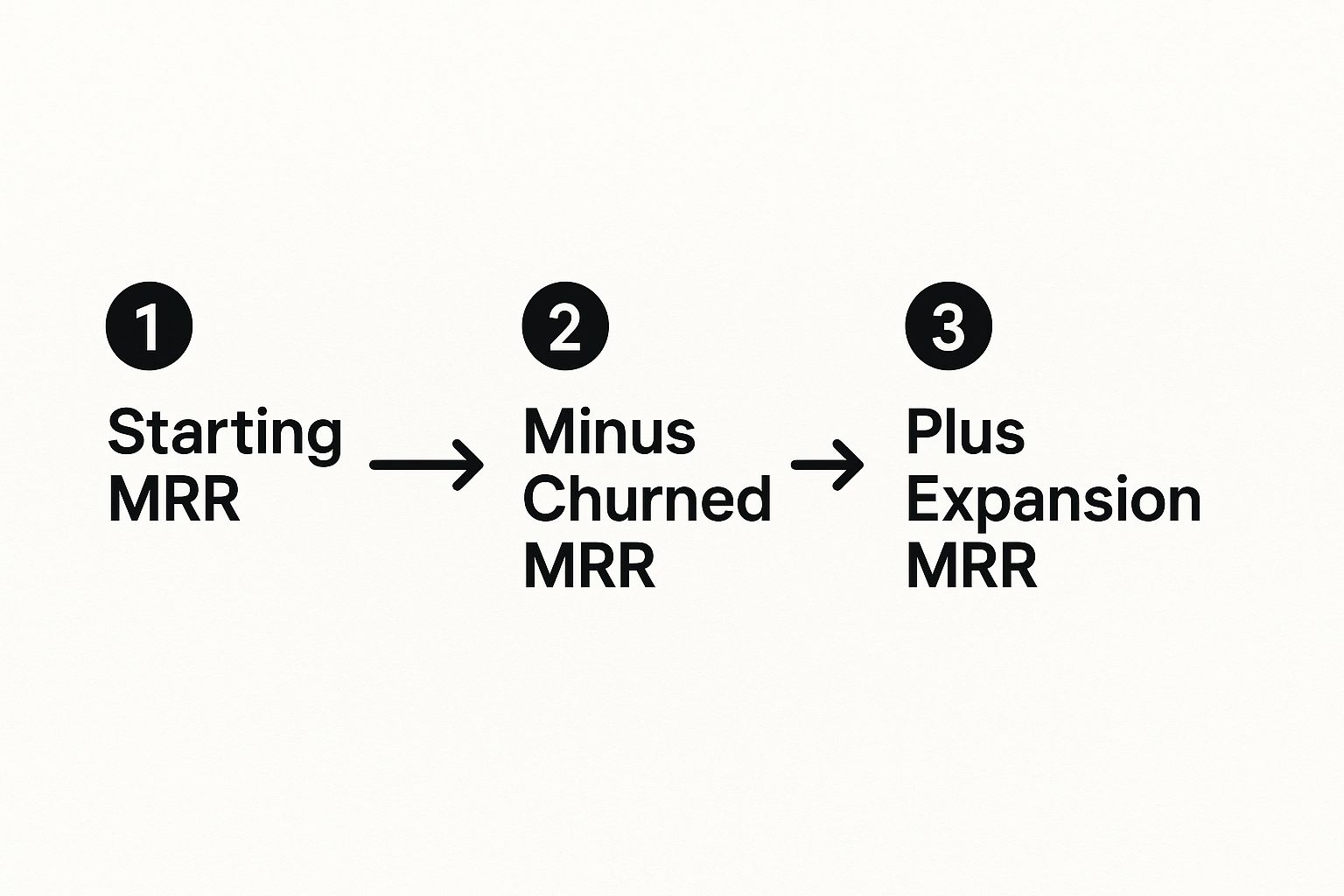
As you can see, calculating NRR is all about adjusting your starting revenue based on the ups and downs within your existing customer accounts.
Breaking Down the NRR Formula
To get a truly accurate NRR, you have to get each of the four key components right. Getting just one of these wrong can throw off your entire calculation and paint a misleading picture of your company's health.
Let's break them down:
-
Starting Monthly Recurring Revenue (MRR): This is your baseline. Think of it as the total predictable revenue you had from all your customers on day one of the period you're measuring (like the first of the month). Crucially, this number does not include any revenue from new customers you signed up during that month. NRR is all about the customers you already had.
-
Expansion MRR: Here's the good stuff—the growth. This includes all the extra recurring revenue you generated from your existing customers. This growth comes from a few places, like customers upgrading to a pricier plan, buying new add-on features, or adding more user seats.
-
Contraction MRR: This is the opposite of expansion, often called "downgrades." It represents the revenue you lost when existing customers scaled back their spending without leaving you completely. Maybe they moved from an enterprise plan to a business plan or cut back on their active licenses.
-
Churned MRR: This is the total revenue you lost from customers who cancelled their subscriptions entirely during the period. It’s a complete loss of that revenue stream and the one that stings the most.
When you put these elements together, you get a crystal-clear snapshot of your customer base's health. It shows you if the growth from your happiest customers is strong enough to outweigh the natural losses from churn and downgrades. A strong NRR is often a great sign of a high customer lifetime value, which is another cornerstone of sustainable SaaS growth.
A Practical Calculation Example
Let's walk through an example to see how the numbers play out in the real world. We'll use a fictional SaaS company called "ConnectSphere."
To make it concrete, let's look at the numbers for a single month.
| NRR Calculation Example for a SaaS Company |
| :— | :— | :— |
| Metric | Description | Example Value |
| Starting MRR | Total recurring revenue on the first day of the month. | $200,000 |
| Expansion MRR | New revenue from existing customers upgrading or adding services. | $15,000 |
| Contraction MRR | Lost revenue from existing customers downgrading their plans. | $5,000 |
| Churned MRR | Total revenue lost from customers who canceled their subscriptions. | $10,000 |
Now, let's plug these numbers into the formula:
NRR = [ (Starting MRR + Expansion MRR – Contraction MRR – Churned MRR) / Starting MRR ] x 100
Here’s the math for ConnectSphere's month:
[ ($200,000 + $15,000 – $5,000 – $10,000) / $200,000 ] x 100
= [ $195,000 / $200,000 ] x 100
= 0.975 x 100
= 97.5%
So, ConnectSphere's net retention rate for the month is 97.5%. What does that actually mean? It means for every dollar of revenue they started with from their customer base, they kept 97.5 cents after all the upgrades, downgrades, and cancellations shook out.
What a Good Net Retention Rate Looks Like

So you've calculated your net retention rate. The next question is always the same: "Is my number any good?"
The honest answer? It depends. There’s no single magic number that defines a “good” NRR. What’s fantastic for one SaaS company could be a red flag for another. It all comes down to context—your business model, who you sell to, and the industry you're in.
Benchmarks Across the SaaS Landscape
While a universal benchmark doesn't exist, we can look at general trends to see where you might fit. The biggest factor is usually the size of the customers you serve.
-
Small and Medium-Sized Businesses (SMBs): SaaS companies targeting SMBs often see NRR in the 90% to 100% range. This makes sense when you think about it. Smaller businesses are just more volatile—they might pivot, run out of cash, or simply outgrow a tool. A little churn is natural here.
-
Mid-Market: As you move upmarket, things get a bit stickier. A solid NRR for mid-market customers typically lands between 100% and 110%. At this point, you're starting to see expansion revenue from upgrades and add-ons outpace the revenue you lose from churn.
-
Enterprise: This is where the numbers get exciting. For companies focused on large enterprise clients, a good NRR starts around 120% and can soar past 130%. Enterprise customers churn far less often and have massive budgets for expansion, making them a powerful growth driver.
A net retention rate over 100% is the holy grail for any SaaS business. This is what's known as "negative churn." It means your existing customers are generating more revenue over time than you're losing, creating a powerful growth engine that fuels itself.
These benchmarks show why context is everything. A bootstrapped startup hitting 104% NRR is probably crushing it. But a VC-funded enterprise software company might see that same number and start asking some tough questions.
Factors That Influence Your NRR Target
Your target customer size is just one piece of the puzzle. A few other key factors will shape what a realistic NRR goal looks like for your business.
Product Complexity and "Stickiness"
Think about how deeply your product is woven into your customers' daily work. Is it a simple tool that could be swapped out tomorrow, or is it a complex platform that runs their entire operation? The more embedded your product is—the "stickier" it is—the higher your retention should be. The pain of switching is a powerful retention tool.
Business Model and Industry
The industry you operate in matters, too. Some sectors are just naturally more stable. For example, global data shows industries like media and professional services have high customer retention rates, averaging around 84%. On the other hand, a sector like hospitality hovers closer to 55% due to completely different market forces and customer behaviors. You can dig into more of this sector-specific retention data to see where you stand.
At the end of the day, a "good" net retention rate isn't a number you just grab from an article. It’s a goal you set after taking a hard look at who you sell to, what you sell, and the world you operate in. The real aim is consistent improvement that makes sense for your business, not just chasing someone else's metric.
The Three Pillars Driving Your Net Retention Rate
Your net retention rate isn't just another number on a spreadsheet; it’s the direct result of every single touchpoint a customer has with your business. While a lot of factors come into play, your NRR really stands on three core pillars: how much value your product delivers, how effective your customer success team is, and how smart your pricing is.
When you get these three things working in harmony, you create an experience that doesn't just convince customers to stay. It actually encourages them to spend more. That synergy is what turns your existing customer base into your most powerful and reliable growth engine.
Let’s break down how each of these pillars directly builds a healthier, stronger NRR.
The Foundation of Product Value
Everything begins and ends with the product. You simply can't build a strong net retention rate if your product doesn't solve a real, nagging problem for your customers. This is all about delivering undeniable value, day in and day out, to the point where your tool becomes essential to how they operate.
But product value isn't a "set it and forget it" kind of thing. It's a constant commitment to innovation. You have to keep improving features and adapting as your customers' needs change. This signals that you're in it for the long haul with them, making them far less likely to churn and more likely to view you as a strategic partner.
Your value proposition has to be crystal clear, too. A customer should instantly get the "why" behind your product.
When the value is obvious and consistently delivered, customers don't just stick around—they become advocates. Their reliance on your tool creates a natural path toward expansion, as they find new ways to integrate it into their workflows and grow their usage over time.
This foundation of value is the bedrock for everything else. Without it, even the most amazing customer service or pricing model will eventually crumble.
The Accelerator of Customer Success
A great product gets you in the game, but world-class customer success is the accelerator that pushes your NRR into the stratosphere. This pillar is all about making sure customers actually achieve what they set out to do with your product. It’s about being a proactive partner, not just a reactive help desk.
It all starts with a smooth, effective onboarding. Those first 90 days are absolutely critical. A seamless onboarding helps users hit that "aha!" moment fast, cementing the product's value and setting the stage for a long-term relationship. When customers feel capable right out of the gate, their odds of churning drop dramatically.
After onboarding, it's all about proactive support. This means:
- Monitoring Usage Data: Keep an eye out for customers who might be disengaged or getting stuck on certain features.
- Offering Timely Help: Reach out with helpful tips or resources before they even think to ask for help.
- Building Relationships: Every support ticket is a chance to better understand their goals and strengthen the partnership.
A strong customer success team is what transforms happy users into die-hard fans who are genuinely excited to check out premium features and invest more.
The Engine of Pricing Strategy
Finally, your pricing strategy is the engine that turns all that product value and customer success into real revenue growth, directly fueling your net retention rate. An intelligent pricing model doesn't just put a number on your service; it creates clear, compelling pathways for customers to grow alongside you.
This means your pricing tiers need to align with the value customers get. As they use the product more and unlock more benefits, there should be a logical next step for them to take. Maybe it’s upgrading to a higher plan, buying an add-on, or adding more seats.
These expansion paths need to feel like a win-win. The customer gets access to more powerful tools that help them succeed, and you generate the expansion revenue that drives your NRR sky-high. The key is to make upgrading feel intuitive, not like a penalty.
There's one final, often-overlooked driver behind all these pillars: your own team. Happy, engaged employees deliver better service. Recent data shows the risk of employee turnover is on the rise, with The Eagle Hill Consulting Employee Retention Index showing its steepest decline in two years. This is a big deal, because high employee turnover can kill service quality and drain institutional knowledge, which directly hurts the customer experience and your NRR. You can learn more about how employee turnover impacts business results here. Ultimately, investing in your team is an investment in your customers and one of the best things you can do to protect your NRR and other crucial SaaS KPIs.
Actionable Strategies to Boost Your NRR

Knowing your net retention rate is one thing, but actually improving it is where the magic happens for business growth. Boosting your NRR isn't about a single quick fix. It’s about a two-pronged attack.
You have to simultaneously plug the leaks in your revenue bucket while finding smart ways to get more revenue from the customers who already love you. This dual approach creates a powerful growth engine. Reducing churn stabilizes your revenue base, and driving expansion turns that stable base into a source of real, sustainable growth.
Let's dig into some practical, field-tested tactics you can use to make a real difference.
Fortifying Your Defense Against Churn
Before you can even think about expansion, you have to stop the bleeding. Churn is the enemy of a healthy NRR, and fighting it is all about being proactive. This isn't just about frantic last-minute calls to save a canceling account; it's about creating an experience so good that customers can't imagine leaving.
A great place to start is with your customer onboarding. A clunky, confusing first impression is a surefire way to lose customers before they even get started. Your job is to guide new users to that "aha!" moment as quickly as possible. Think interactive tutorials, clear documentation, and maybe even a personal check-in.
Another crucial tactic is to actively monitor customer health scores. By keeping an eye on product usage, support ticket trends, and overall engagement, you can spot the red flags of an at-risk account long before they hit the cancel button. A timely, helpful outreach can turn a potential churner into a loyal fan.
Key Takeaway: The best churn reduction strategy is proactive, not reactive. By the time a customer says they want to cancel, you've likely missed multiple opportunities to address their underlying issues.
Finally, treat every cancellation as a free lesson. Use exit surveys to find out exactly why people are leaving. Was it a missing feature? Pricing? A bad support experience? This feedback is pure gold for fixing the root causes of churn. For a deeper dive, check out our guide on how to https://saasoperations.com/reduce-churn-rate/.
Driving Growth with Expansion Revenue
Once you’ve shored up your defenses and have churn under control, it’s time to go on offense. This is where you focus on generating more revenue from your happiest customers, and it's how you can push your NRR past the coveted 100% mark.
Expansion revenue really boils down to two main plays: upselling and cross-selling.
- Upselling: This is all about getting customers to upgrade to a higher, more valuable tier of your product. The trick is to align your pricing with real value. As a customer’s business grows, moving to your next plan should feel like a no-brainer.
- Cross-selling: Here, you're offering complementary products or add-on features that make their main product even better. For example, if you sell project management software, you might offer a time-tracking module as a cross-sell.
To do this well, you need to understand the customer journey inside and out. Pinpoint the moments when a customer is most likely to need more seats, more features, or more power. Then, use in-app messages or targeted emails to show them exactly what they're missing. When exploring these strategies, you can find more modern approaches in discussions on AI strategies for customer retention.
Don't underestimate simple communication. When you launch a killer new premium feature, shout it from the rooftops! A well-timed announcement campaign can spark a wave of expansion revenue from customers who were just waiting for that one capability.
Comparing NRR Improvement Strategies
To help visualize these different approaches, let's break down the common strategies for boosting NRR. Each has its own goals, resource requirements, and potential payoff.
| Strategy | Primary Goal | Effort Level | Potential Impact |
|---|---|---|---|
| Improve Onboarding | Reduce early-stage churn by increasing initial user success. | Medium | High |
| Monitor Health Scores | Proactively identify and engage at-risk customers. | Medium | High |
| Strategic Upselling | Increase ARPU by moving customers to higher-value plans. | High | Very High |
| Feature Cross-selling | Increase ARPU by selling valuable add-on functionality. | High | High |
| Conduct Exit Surveys | Gather feedback to address core reasons for churn. | Low | Medium |
Ultimately, a balanced approach is best. Tackling churn creates a stable foundation, while focusing on expansion builds your growth story. By combining these efforts, you're not just selling more—you're deepening customer relationships and making your product an indispensable part of their success.
Common Questions About Net Retention Rate
Once you start digging into net retention, a few questions always seem to come up. It's a powerful metric, but some of the details can be tricky. Getting clear answers is the key to really mastering NRR and using it to grow your business.
Let's walk through some of the most common questions to clear up any confusion and make sure you've got a solid handle on this metric.
What Is the Difference Between Net and Gross Retention?
This is easily the most common point of confusion, but the difference is simple and incredibly important.
Think of it this way: Gross Retention Rate (GRR) is your defense. Net Retention Rate (NRR) is your defense and your offense, combined.
Gross Retention Rate (GRR) focuses purely on how well you hold onto your existing customers and their revenue. It looks at your starting revenue and only subtracts losses from churn or downgrades. The key thing to remember is that GRR completely ignores any new revenue from upgrades or expansions.
GRR can never top 100%. It answers one crucial question: "Are we keeping the revenue we already have?" A high GRR means your product is sticky and you have a stable customer base.
Net Retention Rate (NRR), on the other hand, gives you the full picture. It also starts with the revenue you've kept, but then it adds back all the expansion revenue you've generated from those same customers through upsells and cross-sells.
This means your NRR can—and absolutely should—go above 100%. It answers a much more strategic question: "Is our existing customer base actually growing in value over time?" It’s a true measure of the health of your customer relationships.
How Often Should I Track Net Retention Rate?
There's no single right answer here, but having a consistent rhythm is what really matters. For most SaaS companies, tracking it at different intervals for different reasons works best.
- Monthly: Calculating NRR every month is great for making quick, tactical decisions. You can see the immediate impact of a new feature launch or a pricing change and react before a small dip becomes a major problem.
- Quarterly: Looking at your NRR every quarter helps smooth out the month-to-month noise, giving you a more stable trendline for strategic planning. This is the perfect cadence for setting team goals or reporting to your board.
- Annually: Your annual NRR is the big-picture indicator of your company's long-term health. It’s a critical number for investor conversations and for comparing your performance year-over-year.
The trick is to just pick a schedule and stick with it. Doing so builds a reliable history that helps you accurately track your progress. Understanding these trends is fundamental to building a strong company, and you can learn more in our guide to customer retention in SaaS.
Can My Net Retention Rate Be Over 100 Percent?
Yes, absolutely! In fact, that should be your goal. An NRR over 100% is a massive signal that you've built a sustainable growth engine right into your existing customer base.
When your NRR is higher than 100%, you’ve hit a milestone often called "negative churn." It means the new revenue you've gained from existing customers (your expansion MRR) is greater than the revenue you've lost from customers who churned or downgraded.
Hitting negative churn is a huge win for any SaaS business. It proves that:
- Your product delivers so much value that customers want to spend more on it.
- Your customer success team is doing its job by creating loyal fans who want to grow with you.
- Your business can keep growing revenue even if you don’t sign up a single new customer.
This is why investors love this metric. It shows them a highly efficient and scalable business model. It's the clearest sign you've built something that customers don't just use, but truly value.
At SaaS Operations, we provide battle-tested playbooks and SOPs to help you master key metrics like NRR and build a more efficient, high-growth business. Check out our resources at https://saasoperations.com.