
If you’re serious about reducing customer churn, you have to stop thinking of it as an unavoidable cost of doing business. It’s not. Churn is a business problem with a solution.
The trick is to diagnose its root causes. Are you losing customers because of a clunky onboarding process? Is it a bad product fit? Or something as simple as failed payments? Once you pinpoint the why, you can build proactive systems to keep your customers engaged and successful. This simple shift in mindset turns churn from a lagging indicator into a powerful signal that tells you exactly where to improve your product and operations.
Why Your SaaS Lives or Dies by Its Churn Rate
Let's be blunt: churn is the silent killer of SaaS growth. We all love celebrating new logos and acquisition wins, but a leaky bucket of departing users can quietly sink your business, making any kind of sustainable growth impossible. It’s the ultimate drag on your momentum.
For any SaaS operator, getting a handle on churn is non-negotiable. It’s so much more than just lost revenue. Every customer who leaves represents a failure to deliver on your promise. It's a story of unmet expectations, a clear signal that something in your product, onboarding, or support process is broken.
The Alarming Math of Compounding Churn
The most dangerous thing about churn is how innocent it looks on a monthly basis. A few percentage points here and there might seem manageable, but that number compounds into a devastating annual figure that can completely dismantle your growth goals.
Take a look at this. A seemingly small 5% monthly churn rate doesn't stay small for long.
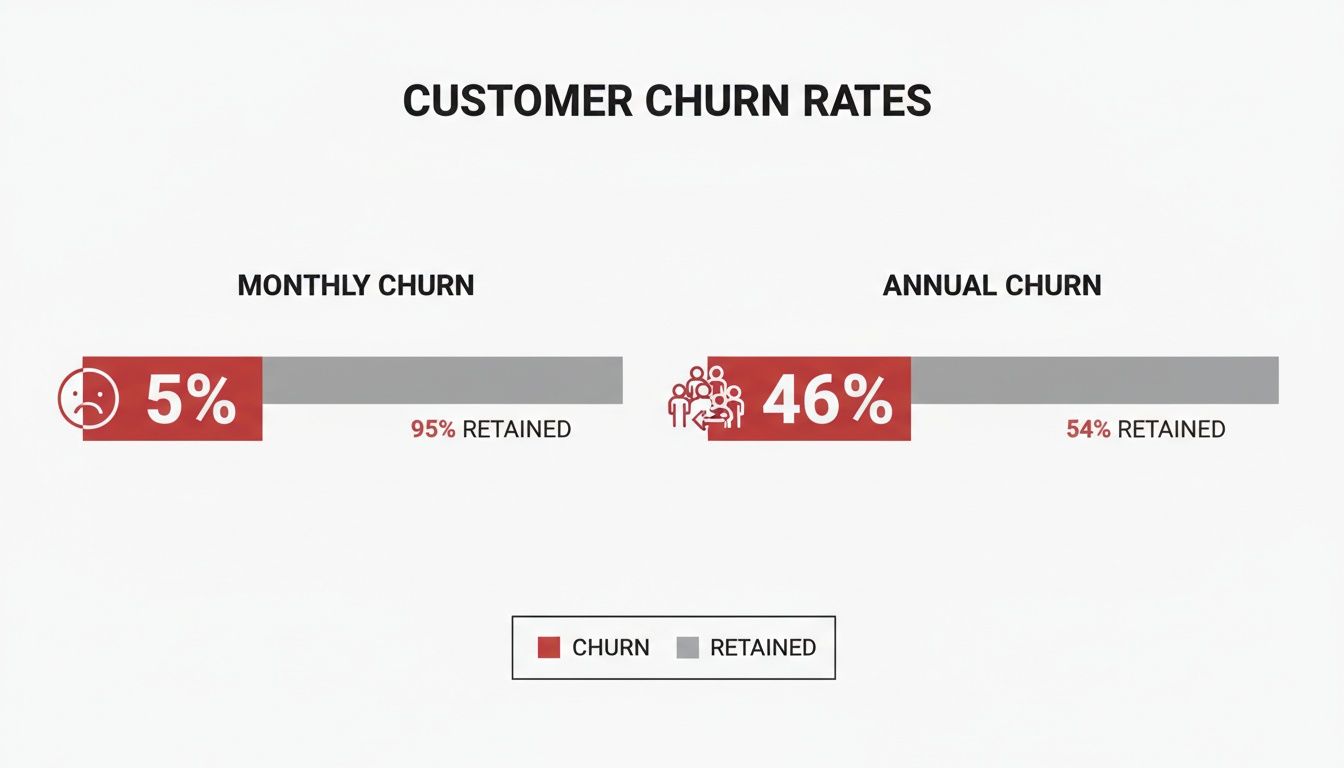
The real takeaway here is that those small monthly losses stack up, eroding your customer base way faster than you’d think. This compounding effect is precisely why the best operators I know are absolutely obsessed with churn reduction.
To put some hard numbers on it, analysts have shown that a 5% monthly churn rate balloons to a staggering 46% annual customer loss. Why? Because the attrition compounds month after month. The math gets even scarier from there. A monthly churn rate above 10% can lead to an annual churn of over 70%. You're basically turning over your entire customer base every year.
Here’s a quick breakdown to really let that sink in.
The Compounding Effect of Monthly Churn
This table shows how quickly those "small" monthly numbers become a massive annual problem.
| Monthly Churn Rate | Equivalent Annual Churn Rate |
|---|---|
| 1% | 11.4% |
| 2% | 21.5% |
| 3% | 30.6% |
| 5% | 46.0% |
| 8% | 63.0% |
| 10% | 71.8% |
Seeing it laid out like this really drives home the urgency. Even a "good" monthly churn rate can mean losing a significant chunk of your customers over the course of a year.
Distinguishing Good Churn From Bad Churn
Not all churn is created equal, and it's critical to know the difference. The founders who really master retention learn to separate the "good" churn from the "bad" churn that points to deeper issues.
-
Good Churn: This is when a customer who was never a good fit for your product leaves. Maybe they're in an industry you don't really serve, they're too small to get real value, or their needs are just totally outside what your product was designed for. While you never want to see someone leave, this type of churn actually helps you sharpen your Ideal Customer Profile (ICP).
-
Bad Churn: This is the churn that should keep you up at night. It comes from customers who should be successful but are leaving because of product gaps, a confusing onboarding experience, terrible support, or because a competitor is simply doing a better job. This churn is a direct reflection of your company's performance.
The goal isn't to get to zero churn—it's to eliminate preventable churn. By focusing on the 'bad' churn, you're not just saving customers; you're getting a free, high-priority roadmap for improving your product and services.
Treating churn as a solvable problem starts with a clear-headed diagnosis. You have to dig into the data, actually talk to the people who are leaving, and view every single cancellation as a learning opportunity. While you're tracking this, it's also crucial to see how it fits into the bigger picture with your other key metrics. To get a better handle on this, check out our comprehensive guide to SaaS KPIs.
Once you truly understand the compounding damage and pinpoint where it’s coming from, you can finally start building a business that not only brings in customers but actually keeps them around.
Pinpointing Exactly Why Your Customers Are Leaving
Let's be real: you can't fix a problem you don't understand. Guessing why customers are leaving is a fast track to wasting a ton of time and money on "solutions" that don't actually move the needle. The only way to really reduce churn is to stop making assumptions and start diagnosing the real reasons people are hitting that cancellation button.
This isn't about just firing off another generic exit survey. It's about digging in and combining two different kinds of data to get the full story of where your product is letting people down.

The operators who really nail this stuff are the ones who blend the numbers—the quantitative data—with the stories—the qualitative feedback. That’s how you find the exact moments your product fails to deliver on its promise.
Uncovering the "What" with Quantitative Data
First things first, you have to start with the hard numbers. Your product analytics and payment data are packed with clues about what customers were doing (or not doing) right before they churned. This data is your objective truth—it shows you what people actually do, not just what they say they do.
Start looking for patterns in a few key places:
- Usage Metrics: Which features were consistently ignored by churned users? Did their login frequency drop off a cliff in the 30 days before they canceled? Low engagement is almost always your first warning sign.
- Support Tickets: Are you seeing a flood of tickets from a certain group of users just before they disappear? If you have recurring complaints about the same confusing workflow or a stubborn bug, that's a huge red flag.
- Onboarding Completion: What percentage of churned users actually made it all the way through your onboarding? If a huge chunk of them bailed halfway through, you know your retention problem starts on day one.
This is how you build your hypotheses. For instance, maybe you discover that 75% of users who churned in their first month never even touched a key feature. That’s a powerful insight, but it doesn't tell you why. For that, you need to talk to them.
Finding the "Why" with Qualitative Feedback
Once the data gives you a few solid theories, it’s time to get on the phone. This is where you uncover the frustration, the unmet expectations, and all the context that analytics can't possibly give you. To really figure out why customers are leaving, you have to implement effective methods for collecting customer feedback.
Sure, a simple, open-ended exit survey is a decent starting point. But the real gold is in the direct conversations. The best operators I know will personally email or even call recently churned customers with a simple, honest request.
Don't make the call about winning them back. That's not the goal here. The goal is to learn. Frame it as, "You're no longer a customer, so you can be completely honest with me. I'm just trying to make the product better, and your perspective would be incredibly valuable."
This approach completely disarms people. It leads to candid, unfiltered feedback you’d never get otherwise. You might find out the one feature they desperately needed was buried three menus deep, or that a competitor offered a workflow that saved them hours every week. These conversations are what turn your messy data into a clear, prioritized list of problems you can actually go and solve.
Segmenting Churn to Find Actionable Patterns
Finally, don't make the mistake of treating all churned users as one big, faceless group. They’re not. Segmenting them is how you uncover the hidden patterns that point to specific weaknesses in your onboarding, product, or marketing.
Start slicing your churn data by different attributes to see what jumps out:
- Time-Based Cohorts: Are people leaving within 7, 30, or 90 days? Early churn almost always signals a problem with onboarding or a fundamental product-market fit issue. Later churn might point to a lack of advanced features or poor ongoing customer support.
- User Persona or Firmographics: Are you losing a lot of customers from a specific industry or company size? This could mean your marketing is attracting the wrong crowd, or your product just isn’t a good fit for that particular use case.
- Acquisition Channel: Do users from a specific ad campaign churn at a much higher rate? Your ad copy might be setting expectations that your product can't meet.
- Pricing Tier: Is your lowest-priced plan a revolving door? It might be attracting low-commitment users, or maybe the feature set is just too limited for anyone to see long-term value.
By breaking down your churn this way, you can stop fighting fires everywhere at once and start focusing your efforts on the specific areas that will make the biggest difference.
Building an Onboarding Experience That Prevents Churn
Let's be honest, the fight against churn is usually won or lost in the first few weeks, not months down the road. If your onboarding is confusing, clunky, or just plain uninspired, you're practically showing new users the door. They signed up excited, with a real problem they need to solve. If you don't quickly show them how your tool is the solution, that excitement dies, and so does their subscription.
The best SaaS operators I know get this. They don't just ship features; they design experiences. They're absolutely obsessed with those first few moments a user spends in their product because they know that's the window that determines long-term loyalty. This isn't about throwing a feature tour at them. It’s about a laser focus on getting them to that first "aha!" moment.

That's the instant a user really gets why your product is valuable. It’s when they do something and the outcome makes them think, "Yes! This is exactly what I was looking for." Your number one goal during onboarding is to get them to that point as fast as humanly possible.
Rush Users to Their First Quick Win
Think about a tool like Asana. They don’t start with a lecture on Gantt charts and portfolio management. Nope. Their onboarding gently pushes you to do one simple thing: create your first task. The second you do that and check it off, you get that little dopamine hit. You’ve just had a small, but very real, win.
This taps into some powerful psychology. Progress, even tiny bits of it, creates momentum. The whole point is to string together these small victories so the user starts feeling capable and successful right out of the gate.
Your onboarding isn't a product manual. Think of it as a guided tour to the user's first victory. Pinpoint the single most important action they need to take to see value, then ruthlessly eliminate every obstacle in their path.
Personalize the Path to Value
A one-size-fits-all onboarding flow is a surefire way to lose people. A marketing manager using your tool has totally different goals than a software developer. Smart companies figure this out by asking a couple of quick questions during signup to tailor the journey.
For instance, an email marketing platform might ask a new user:
- What’s your main goal? (e.g., Grow my list, Sell products, Send a newsletter)
- How big is your audience? (e.g., Just starting, 1-1,000 subscribers, 1,000+)
Based on those answers, the platform can roll out a personalized track. The person who wants to sell products is immediately pointed toward e-commerce integrations. The one who wants to grow their list gets a tutorial on creating a signup form. This simple step makes the product feel instantly relevant, which massively increases the chances they'll stick around.
Use Checklists and Welcome Emails to Drive Action
Never, ever underestimate the power of a simple checklist. They are brilliant. Onboarding checklists gamify the setup, give a clear visual of progress, and spell out exactly what to do next. It breaks down what could be an overwhelming process into a few manageable steps.
A good checklist might include things like:
- Create your first project
- Invite a team member
- Integrate your calendar
- Watch a 2-minute intro video
Back up your in-app guidance with a welcome email series that actually helps. Ditch the generic "Welcome to the family!" email. Instead, create a 3-5 part series where each email teaches them how to solve one specific problem with your tool. Every email needs a single, clear call to action that pulls them back into the product to take that next step. For a much deeper dive, our guide on SaaS onboarding best practices has proven templates you can steal.
When it's all said and done, a great onboarding experience makes every new user feel like they made a smart choice. By helping them get a critical win fast, you aren't just teaching them how to use your software—you're building the confidence that turns them into a loyal, long-term customer.
Proactive Strategies to Keep Customers Engaged
Great customer success isn't about firefighting. It's about fire prevention. The best SaaS operators I know have all learned the same hard lesson: by the time a customer tells you they're unhappy, you’re already behind the eight ball.
The real secret to killing churn is to get ahead of it. This means shifting your entire company mindset from reactive problem-solving to proactive value creation. It's about building systems that keep your customers winning long before they ever dream of canceling.
This is how you spot that quiet, disengaged user and re-ignite their interest with a perfectly timed tip or a webinar invite. It’s about constantly proving your product’s value, not just fixing it when something breaks.
Develop a Customer Health Score
You can't be proactive if you're flying blind. This is where a customer health score becomes your secret weapon. It’s a simple, data-driven system that acts as an early-warning signal when an account is starting to drift. No more guesswork.
A health score boils down a bunch of different data points into one straightforward metric—like a score from 1-100 or a simple red, yellow, or green status. The magic isn't in any single metric, but in how you weave them together to get a holistic view of a customer's real relationship with your product.
From what I’ve seen work, here are the vital signs every SaaS company should be tracking:
- Product Usage Depth: Are they just scratching the surface, or are they using your stickiest, most valuable features? High-value feature adoption is a huge indicator of long-term success.
- Usage Frequency: How often are their key people actually logging in? A sudden nosedive in activity is one of the biggest red flags you'll ever see.
- Support Ticket Volume: This one's tricky. A sudden spike can signal deep frustration. But complete silence can be just as bad—it often means they've given up.
- Key Contact Changes: Did their main champion or power user just leave the company? This is a massive churn trigger that’s so easy to miss if you're not paying attention.
By combining these signals, you create a predictive model. When an account's health score dips below a certain threshold, it automatically triggers an alert for your customer success team to step in before the customer has a chance to churn.
This shift from firefighting to prevention is critical. Industry data consistently shows that improving the customer experience is one of the most direct ways to cut churn. We're talking about a potential 15% decrease in churn, yet so many companies are still losing billions to problems that were entirely avoidable.
With 73% of consumers ready to jump ship to a competitor after just a few bad experiences—and 56% who won't even bother to complain before they leave—you simply can't afford to wait for them to raise their hand.
Master Proactive Outreach That Works
Okay, so your health score just flagged a customer as "at-risk." Now what? The absolute worst thing you can do is fire off a generic, robotic email asking, "Is everything okay?" That just screams, "We have no idea what's happening with your account."
Effective proactive outreach is all about adding value. It has to feel personal, genuinely helpful, and perfectly timed. To keep your customers engaged and sticking around, digging into proven customer retention strategies is a non-negotiable part of the playbook.
Let's look at how this changes your team's day-to-day.
Proactive vs. Reactive Customer Success Tactics
This table really drives home the difference between playing defense and playing offense. It’s a complete strategic shift from putting out fires to delivering continuous value.
| Reactive Tactic (Firefighting) | Proactive Tactic (Churn Prevention) |
|---|---|
| Answering a support ticket about a confusing feature. | Sending a targeted guide on that feature to users who haven't adopted it. |
| Responding to a cancellation request due to price. | Offering a success review to demonstrate ROI before renewal. |
| Hearing about a key contact leaving in an exit survey. | Getting alerts for role changes on LinkedIn to build new relationships. |
| Waiting for a customer to complain about a bug. | Announcing a bug fix and thanking the users who reported it. |
A well-timed tip, an invite to a webinar on a feature they haven't used yet, or a quick check-in to share a new best practice can completely change a customer's trajectory. These small, value-added touchpoints are constant reminders that you're invested in their success, not just their subscription fee.
For a deeper dive into building out these kinds of initiatives, take a look at our complete guide on customer success strategies.
The goal here is simple: make yourself indispensable. When your team is actively helping customers crush their goals, your product becomes more than a tool—it becomes a true partnership. And partners don't churn.
Turn Your Cancellation Flow into a Retention Tool
Look, no matter how great your product is or how killer your support team is, some customers are going to leave. It's just a fact of life in SaaS. But that cancellation page? It's not just a digital dead-end. It's your last, best chance to keep them.
Smart operators don't see the offboarding flow as a failure. They see it as a powerful tool for retention and learning. Think about it: this is the one moment you have their complete, undivided attention. They're actively telling you something isn't working for them. This is your chance to listen, react, and maybe, just maybe, turn things around.
Build a Dynamic Offboarding Flow
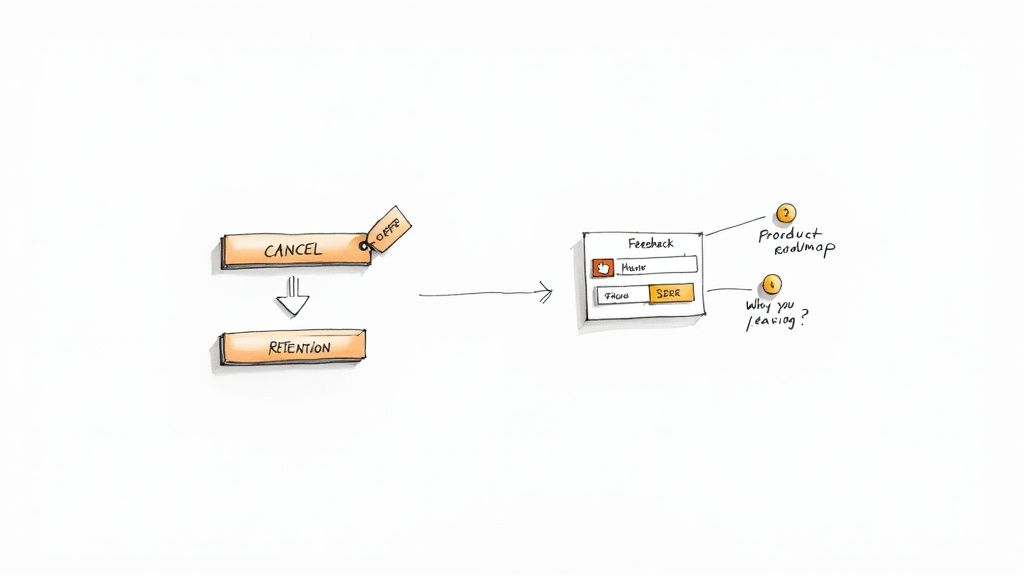
A static "Are you sure you want to cancel?" button is a massive missed opportunity. A dynamic offboarding flow, however, starts with one simple question: "Why are you leaving?" This question is the key to everything.
Once you have their answer, you can present a targeted, automated offer that directly addresses their specific reason for bailing. You're meeting them exactly where they are, in the moment they need it most.
Companies like Churnkey have practically built their entire business around this idea. When a user selects their reason for canceling, the system can instantly fire off a relevant offer.
For example:
- They say: "It's too expensive."
- You offer: A pop-up with a one-time deal for 30% off their next three months.
- They say: "I'm missing a key feature."
- You offer: A direct link to your public roadmap. Let them see the feature is already in the works and even vote on its priority.
- They say: "I'm running into technical issues."
- You offer: A prompt to book a free, immediate call with a senior support specialist who can actually help.
- They say: "I'm just taking a temporary break."
- You offer: The ability to pause their subscription for 1-3 months instead of canceling altogether.
This isn't about desperately throwing discounts at everyone who tries to leave. It’s a precise, surgical approach that solves the customer's stated problem at the most critical moment possible.
Capture Honest Feedback for Product Improvement
Even when you can't save a customer, the cancellation flow is your final opportunity to learn from them. The feedback you get here is pure gold. Why? Because there’s absolutely no incentive for them to be polite. You're getting their honest, unfiltered take on your product's biggest flaws.
So, beyond the multiple-choice question, add an optional open-ended text box. Ask something simple, like, "What could we have done better?"
This feedback is one of the most valuable data sources in your entire company. It’s a direct, prioritized list of your product’s biggest weaknesses, straight from the people who were motivated enough to pay you but ultimately decided it wasn't worth it.
Make it a non-negotiable ritual for your product and leadership teams to review this qualitative data every single week. This is your roadmap for reducing churn in the future by fixing the core issues that are pushing people out the door today.
Tackle Preventable Involuntary Churn
Finally, let's talk about the churn you don't even see coming: involuntary churn. This is the silent killer of SaaS revenue. It happens when a customer's payment fails—an expired credit card, a bank block, not enough funds. The crazy part is, the customer didn't choose to leave, but they churned anyway.
This is often the lowest-hanging fruit in your entire churn-reduction strategy. In fact, industry data shows that involuntary churn can account for 20% to 40% of your total churn. But here's the good news: up to 70% of it is recoverable if you have the right systems.
Here’s a simple playbook to fight back:
- Use a Smart Dunning System: "Dunning" is just the fancy term for hounding customers about failed payments. Don't just send one passive-aggressive email. Set up an automated sequence of 3-5 emails over a couple of weeks, gently reminding them to update their billing info.
- Implement Smart Retries: Don't just hammer the card a dozen times in one day. Configure your payment processor to retry the payment at strategic times, like a few days later when a paycheck might have landed.
- Enable a Card Updater Service: This is a game-changer. Services like Stripe's automatic card updater work with major card issuers to automatically update expired card details. The customer doesn't have to lift a finger.
By building a smarter cancellation experience and plugging the holes from involuntary churn, you can turn what was once the end of the customer journey into a powerful engine for retention and product improvement.
Your Churn Questions, Answered
Let's cut through the noise. When you're trying to nail down your churn strategy, you'll run into a lot of the same questions. Here are the straight answers I've learned from years in the trenches, designed to help you take action right away.
What’s a Good Monthly Churn Rate, Really?
Everyone wants a magic number, but the honest answer is: it depends entirely on who you sell to.
If your customers are small and medium-sized businesses (SMBs), you’re looking at a different ballgame than an enterprise-focused company. For SMB SaaS, a monthly churn rate of 3-5% is a pretty standard benchmark. SMBs just tend to come and go more often.
Now, if you're selling big-ticket contracts to enterprise clients, the expectation is way, way lower—ideally less than 1% a month. The key is to stop worrying about a universal "good" number and start benchmarking against your own history and your direct competitors.
The ultimate goal isn't just a low churn number. It's to get to negative net revenue churn. That’s the holy grail where the expansion revenue from your happy, existing customers is greater than the revenue you lose from the ones who cancel.
How Do I Tell the Difference Between Voluntary and Involuntary Churn?
Knowing why a customer leaves is everything because the fix is completely different. You have to separate them.
-
Voluntary Churn: This is when a customer makes a conscious choice to leave. Maybe the price was too high, they found a better tool, or they just weren't getting the value they expected. You tackle this by improving your product and beefing up your customer success efforts.
-
Involuntary Churn: This is the silent killer. A customer churns by accident, almost always because their payment failed. Think expired credit cards, declined bank transactions, or insufficient funds. This is a systems problem, and you solve it with dunning management and smarter payment recovery tools.
The best way to spot involuntary churn is by digging into the failure codes from your payment processor. Once you see the patterns, you can set up automated emails and payment retries to fix the issue before the customer even knows there was one.
What's the Fastest Way to Make a Dent in Churn?
If you're looking for the single biggest lever to pull for a quick win, look no further than your onboarding process. Seriously.
A customer who signs up and doesn't experience the core value of your product—that "aha!" moment—within their first couple of sessions is a goner. They are overwhelmingly likely to churn, and fast.
Your job is to engineer an onboarding experience that practically shoves them toward that first moment of success. Guide them, show them the ropes, and get them to a win as quickly as humanly possible. A strong start creates the momentum you need for long-term retention. If you want to see exactly how your onboarding improvements are affecting your numbers, you can track it with our free churn rate calculator.
At SaaS Operations, we provide battle-tested playbooks and SOPs to help you build a more efficient and profitable business. Stop guessing and start implementing proven frameworks today at https://saasoperations.com.