
Tired of guessing what your SaaS business is worth? Let's get you a real number in minutes. The quickest way to get a solid baseline is with a free SaaS valuation calculator. It uses your key metrics—like Annual Recurring Revenue (ARR) and growth rate—to give you an instant, data-backed estimate. This gives you a credible starting point, whether you're fundraising, planning an exit, or just benchmarking your progress.
Your First Step to Financial Clarity
Figuring out your company's value can feel like a shot in the dark, but it doesn't have to be. At its core, a valuation is just a snapshot of your company’s current financial health and its potential for future growth. Think of it as a report card that investors, potential buyers, and even your own team can easily understand. For any SaaS business, that story always starts with Annual Recurring Revenue.
But before you can calculate anything, you need to have your financial house in order. It's a non-negotiable first step. Make sure you're comfortable with understanding your core financial statements before you dive in. Once you have that solid foundation, you can zero in on the specific metrics that truly drive a SaaS company's value.
Gathering Your Core Metrics
The numbers you'll need for a valuation aren't just random data points; they're the vital signs of your business. Each one tells a critical part of your company's story. Getting a quick, reliable estimate is all about having these key figures at your fingertips.
To make this super clear, here’s a quick rundown of what you'll need to plug into our calculator and why each piece of data is so important.
Key Inputs for Our SaaS Valuation Calculator
| Metric | What It Measures | Why It Matters for Your Valuation |
|---|---|---|
| Annual Recurring Revenue (ARR) | The predictable revenue from all active subscriptions over a one-year period. | This is the bedrock of your valuation. It shows your company's current scale and baseline performance. |
| ARR Growth Rate (%) | The percentage increase in your ARR, typically measured year-over-year. | High growth is a huge magnet for investors. It signals strong product-market fit and future potential. |
| Net Revenue Retention (NRR %) | How much revenue you keep and grow from your existing customer base. | An NRR over 100% proves your product is sticky and that you can grow without only relying on new sales. |
| Gross Margin (%) | Your revenue minus the direct costs of delivering your service (COGS). | This reveals your operational efficiency. High margins mean your business is more scalable and profitable. |
These four metrics give a surprisingly complete picture of your business's health and trajectory. They’re the first things any serious investor or buyer will ask for.
Getting Instant Insights
Once you have these numbers, you’re ready to go. Our free SaaS valuation calculator takes these inputs and uses AI to give you an instant analysis based on your data, running it against current market data and industry benchmarks to deliver a realistic estimate.
"The first time we plugged our numbers into the calculator, it was an eye-opener. Seeing that initial valuation gave us the confidence to start conversations with investors and a clear benchmark to work towards improving." – Founder of a B2B SaaS company
Here’s a sneak peek at the simple interface you’ll be working with.
As you can see, we've kept it clean and focused on the metrics that actually move the needle. This isn't some mysterious black box. It’s a straightforward tool designed to translate your hard-earned operational success into a tangible financial figure, giving you a powerful starting point for your next big move.
What Are SaaS Valuation Multiples?
Ever heard someone say a SaaS company is worth "10x ARR"? That’s a valuation multiple in action. Think of it as a quick way to gauge a company's health, where the "multiple" is applied to its Annual Recurring Revenue (ARR). It’s the market’s shorthand for saying how much each dollar of your recurring revenue is truly worth.
A high multiple tells investors they’re looking at a healthy, fast-growing, and efficient business. A low one? It might signal some underlying issues that are holding back its potential. At its core, this simple multiplier is what turns your ARR into an actual valuation number.
This concept map breaks it down visually, showing how metrics like your ARR and growth rate are the essential ingredients a calculator uses to spit out a final valuation.
As you can see, your valuation isn't just some number pulled out of thin air. It’s a direct reflection of how well your business is actually performing.
The Key Drivers Behind Your Multiple
So, what’s the difference between a business that gets a 5x multiple and one that gets a 15x? It all boils down to a handful of critical metrics that tell the story of your company's health and where it's headed. These are the levers you can actually pull to influence what your company is worth.
The idea of 'SaaS multiples' is what powers any free SaaS valuation calculator. These multipliers are always shifting based on things like growth rate, how well you keep your customers, your margins, and where you sit in the market. As the data consistently shows, a faster growth rate almost always earns a higher ARR multiple because investors are betting on that explosive future revenue. Likewise, strong retention shows your customers are loyal and happy.
Here are the four drivers that matter most:
- ARR Growth Rate: This one is the undisputed king. A company growing at 80% year-over-year is building value way faster than one chugging along at 20%, and its multiple will absolutely reflect that.
- Net Revenue Retention (NRR): If your NRR is over 100%, you're literally making more money from existing customers than you're losing. It’s a powerful sign that your product is sticky and that happy customers are spending more over time.
- Gross Margin: This number shows how efficiently you can deliver your service. For SaaS, a high gross margin (think 75% or more) proves your business model is scalable and ready to print cash.
- Customer Churn: The evil twin of retention. Churn is the rate you lose customers or revenue, and it’s a massive red flag. High churn eats away at your ARR and tanks your multiple.
How These Metrics Work in Practice
Let's look at a tale of two SaaS companies, both sitting at $5 million in ARR.
Company A:
- ARR Growth: 15% YoY
- NRR: 95%
- Gross Margin: 65%
- Multiple: This company might get a 4x – 6x multiple, giving it a valuation between $20M – $30M.
Company B:
- ARR Growth: 60% YoY
- NRR: 115%
- Gross Margin: 80%
- Multiple: This one could easily command an 8x – 12x multiple, putting its valuation at $40M – $60M.
See the difference? Even with the exact same revenue, Company B is worth double. Its metrics just tell a much, much better story about its growth, efficiency, and customer love.
Balancing Growth and Profitability
Lately, investors and buyers have shifted their focus. They don’t just want growth; they want efficient growth. This is where the Rule of 40 enters the chat. It's a go-to benchmark for checking the health of a SaaS business.
The formula is super simple: Your growth rate + your profit margin should add up to 40% or more.
Nailing this balance sends a powerful message that you have a sustainable business. If you’re growing at 30% with a 10% profit margin, you’re hitting the mark. The same goes for a company growing at a blistering 50% but running at a -10% margin. For a deeper look, check out our guide on how to apply the Rule of 40 in your business.
Getting a handle on these multiples is the first real step toward taking control of your company's financial story. When you focus on improving these core drivers, you’re not just making your product better—you're actively building a more valuable company.
How to Use Our Free AI-Powered SaaS Valuation Calculator
Alright, theory is one thing, but let's get down to brass tacks and figure out what your business is actually worth. I'll walk you through how to use our free SaaS valuation calculator to get a real number in about two minutes.
This isn't just about plugging in numbers. Our calculator uses AI to give you an analysis based on your data. When you understand the "why" behind your valuation, the calculator stops being a simple tool and becomes a strategic weapon. You'll see exactly how the operational improvements you make every day translate directly into a higher company valuation.
Getting Your Key Numbers Ready
Before you jump in, you'll need four key metrics. Think of these as the vital signs of your SaaS business; they give our calculator's AI the essential data it needs to do its job.
- Annual Recurring Revenue (ARR): This is the bedrock of your valuation. The easiest way to get this is to take your current Monthly Recurring Revenue (MRR) and multiply it by 12. If you're a bit fuzzy on the details, we have a complete guide on what is Monthly Recurring Revenue.
- YoY Growth Rate: Plain and simple, how fast are you growing? Just calculate the percentage increase in your ARR from this time last year. This is probably the biggest signal of your future potential that investors look at.
- Net Revenue Retention (NRR): This little number tells a big story about how happy your customers are. It shows how much money you’re keeping and growing from your existing customer base, factoring in both upsells and churn.
- Gross Margin: This one's all about efficiency. Calculate it by taking your total revenue, subtracting the cost of goods sold (COGS), and then dividing that by your total revenue.
Once you have these numbers, pop them into the calculator. Our AI then crunches your data, comparing it against thousands of data points from both private and public SaaS companies. This means you’re not getting some generic guess; you’re getting a valuation that reflects what’s happening in the market right now.
As you can see below, the interface is dead simple. No fluff, no confusion.
The goal here is speed and clarity. Accurate inputs lead to a reliable output you can actually use for planning your next move.
Putting It to the Test: A ConnectSphere Example
Let's make this real. Imagine a fictional SaaS company called 'ConnectSphere,' a communications platform prepping for their next board meeting. They need a solid valuation, fast.
Here are the numbers their team pulls together:
| Metric | ConnectSphere's Data | Why It's a Big Deal |
|---|---|---|
| ARR | $3,000,000 | This shows they have real traction and have found a solid customer base. |
| YoY Growth Rate | 65% | An incredible growth rate that screams strong product-market fit. |
| Net Revenue Retention | 110% | This is the gold standard. It proves customers love the product and are spending more over time. |
| Gross Margin | 82% | A fantastic margin that points to a highly scalable and profitable model. |
The ConnectSphere team plugs these metrics into the calculator. The AI immediately recognizes that their 65% growth and 110% NRR are blowing past the industry averages for a company their size.
Based on these killer metrics, the calculator lands on a valuation of roughly $27 million. This works out to a 9x ARR multiple—a premium valuation they've earned thanks to their impressive growth and sticky customer base.
But the tool does more than spit out a number. It highlights their NRR as a major strength. Now, the ConnectSphere team can walk into that board meeting armed with more than just a valuation. They have a clear story: "Our value is driven by an incredible expansion engine, and that’s where we should double down on our investment."
So, What Does Your Valuation Number Really Mean?
You’ve plugged your numbers into a SaaS valuation calculator, and it spit out a figure. Great! But a number on its own is pretty useless. It’s like knowing your GPS coordinates without having a map—you know where you are, but you have no idea how it relates to anything else.
To make that number mean something, you have to put it into context by benchmarking it against the rest of the SaaS world.
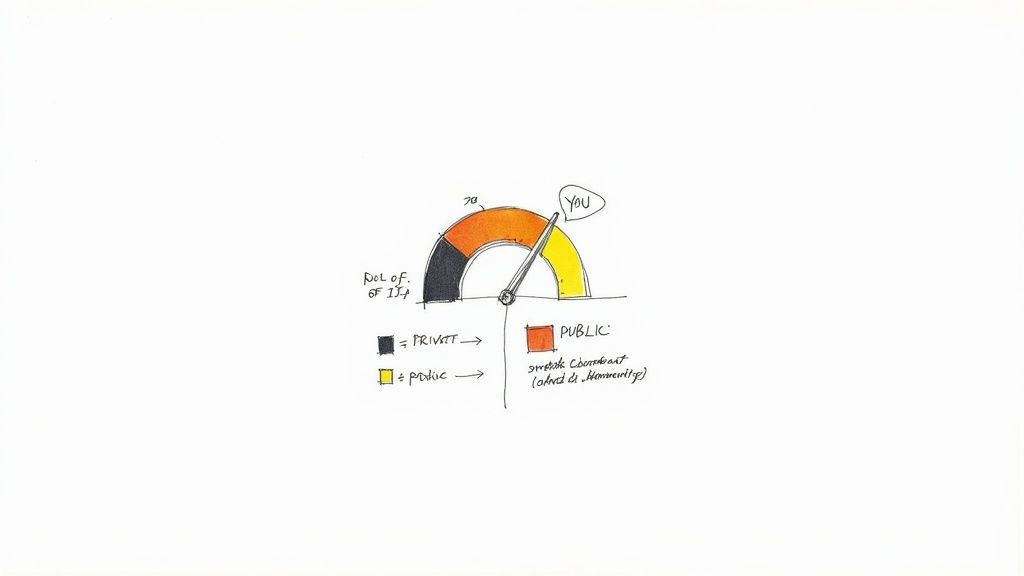
This is the part where you go from a simple calculation to a strategic conversation. When you can say, "Our valuation is X, which puts us in the top tier for a company with our growth rate and size," you’re suddenly speaking the language of investors and potential buyers. It shows you’re not just a founder who knows their own business, but one who understands the entire market.
How Do You Stack Up? Benchmarking Against the Market
A smart way to get this context is by looking at market multiples. Think of it like selling a house—you’d never set a price without checking the "comps," or what similar homes in your neighborhood have sold for. For SaaS companies, our "neighborhoods" are the public and private markets, and they each play by slightly different rules.
Even if you’re a private startup, the public SaaS companies provide an essential yardstick. As of early 2025, the median public SaaS company is trading at a multiple of roughly 6.1x their revenue. Private SaaS deals, on the other hand, are averaging closer to 4.7x.
Why the gap? Public companies are usually bigger, more stable, and their financials are an open book, which investors reward with a premium. You can dig deeper into these numbers by checking out various SaaS metrics benchmarks to see where you might fit.
Let's break down how these multiples look side-by-side.
SaaS Valuation Multiples for Public vs Private Companies
This table gives you a quick snapshot of how key metrics differ between public and private SaaS companies, helping you see where your own business stands in the grand scheme of things.
| Metric | Public SaaS Median | Private SaaS Average | Key Takeaway |
|---|---|---|---|
| EV/Revenue Multiple | 6.1x | 4.7x | Public companies get a premium for their scale and predictability. |
| Annual Growth Rate | 22% | 35% | Private companies are expected to grow faster, justifying the investment risk. |
| Gross Margin | 78% | 72% | High margins are a hallmark of mature, public SaaS businesses. |
| Rule of 40 Score | 42% | 38% | Both markets heavily prize a balance of growth and profitability. |
Seeing these numbers helps you understand the expectations. If your private company has public-company-level margins and a solid growth rate, you’re in a strong position to argue for a higher valuation.
The Rule of 40: A Quick Litmus Test for Health
Investors love shortcuts that signal a company’s health, and in the SaaS world, the Rule of 40 is king. It’s a simple, back-of-the-napkin test to see if a company’s growth is both impressive and efficient.
The formula couldn’t be easier:
Growth Rate (%) + Profit Margin (%) = 40% or more
If your company hits or beats that 40% threshold, you're considered a top-tier operator. It’s proof that you’ve found the sweet spot between aggressively growing your market share and running a sustainable, profitable business. You aren't just burning through cash to get bigger.
For instance, a startup growing like a weed at 50% year-over-year but with a -5% profit margin scores a 45. Meanwhile, a more established company growing at 25% with a solid 20% profit margin also scores a 45. In an investor's eyes, both are healthy, well-run businesses.
This isn’t just a vanity metric; it has a real impact on your valuation. The market has seriously shifted to reward efficient growth, and your Rule of 40 score is the clearest signal of that. In fact, every 10-point improvement in your Rule of 40 score can lead to a 1.5x bump in your revenue multiple. That's a huge lift.
Turning Your Numbers into a Compelling Story
Once you have your valuation, your market comps, and your Rule of 40 score, you’ve got everything you need to build a powerful narrative.
Instead of just dropping a number, you can frame it with intelligence and confidence.
- Pitching to Investors: "We're valued at $20M, which reflects a 7x multiple. This is directly tied to our 115% Net Revenue Retention and a Rule of 40 score of 52, putting us well ahead of the curve on efficiency."
- Reporting to Your Board: "Our valuation is up 30% this year. The main driver was improving our gross margin by 8 points, which had a direct, positive impact on our multiple."
See the difference? This approach transforms your valuation from a static data point into a dynamic tool. It shows you know exactly where you stand and, more importantly, which levers you need to pull to make your company even more valuable.
Actionable Strategies to Increase Your Valuation
So you've plugged your numbers into a free SaaS valuation calculator. What now? Your valuation isn't a static number set in stone; think of it as a live scorecard reflecting how well your business is actually running. The real work starts now. This is your playbook for systematically and purposefully driving that number up.
These aren't just high-level theories. They’re battle-tested tactics that successful SaaS operators use to move the needle on the metrics that investors and potential buyers really care about. We’ll focus on the big three levers: hitting the gas on ARR growth, supercharging Net Revenue Retention (NRR), and plugging the leaks by slashing customer churn.
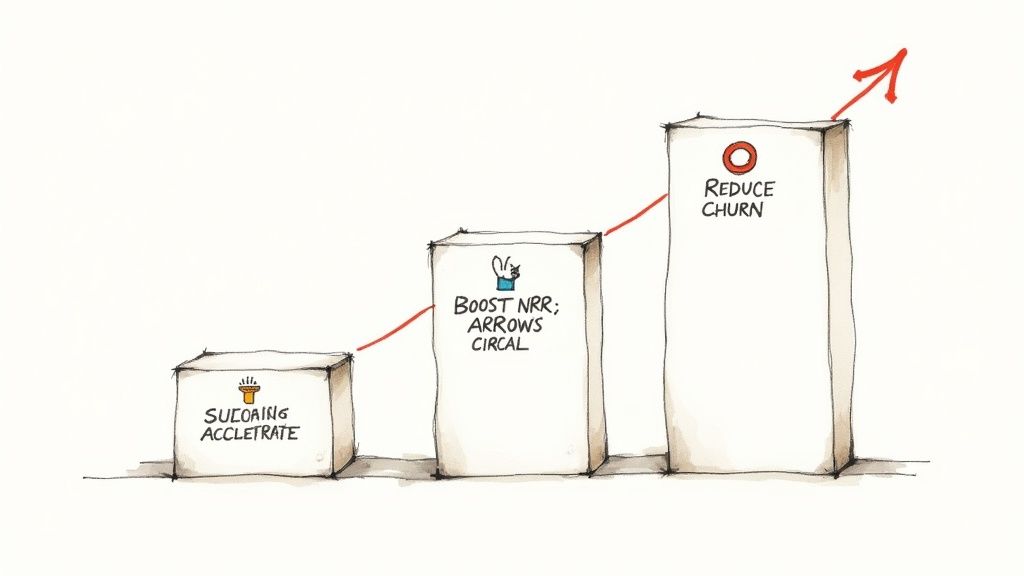
By the end of this section, you'll have a clear, prioritized list of things you can start doing today to build a more valuable company.
Double Down on Net Revenue Retention
Bringing in new customers gets all the glory, but the real secret to a premium valuation is keeping and growing the customers you already have. Net Revenue Retention (NRR) is arguably the most powerful lever you can pull. When your NRR is above 100%, it's proof that your business can grow even if you don't sign a single new logo.
To put this into perspective, recent analysis shows NRR is one of the three core variables driving private SaaS valuations, right alongside ARR growth and public market multiples. While the median valuation multiple for private SaaS companies is hovering around 7.0 times ARR, a killer NRR is what separates the good from the great and allows some companies to command much higher multiples. Investors see it as a powerful signal of future stability and built-in growth. You can dig into more insights on private SaaS company valuations from SaaS Capital.
One of the most direct ways to boost your NRR? Launch a dedicated customer success program.
Here’s a simple 3-step playbook to get started:
- Segment Your Customers: Not every customer is the same. Group them by ARR, growth potential, or strategic importance. Your top-tier accounts deserve a white-glove, high-touch approach, while your smaller accounts can be managed effectively with automated check-ins and tech-touch workflows.
- Define the Customer Journey: Map out the key milestones for a customer, from the moment they sign up to their first renewal. Pinpoint the potential roadblocks and the "aha!" moments. The goal here is to make sure they’re getting real value and achieving what they set out to do with your product.
- Implement Quarterly Business Reviews (QBRs): For your most important customer segments, get regular QBRs on the calendar. This isn't a sales pitch. It’s a strategic conversation where you review their progress, prove the value you've delivered, and uncover new ways they can use your product—which naturally opens the door for upsells and cross-sells.
Systematically Reduce Customer Churn
Customer churn is the silent killer of SaaS valuations. It’s like trying to fill a leaky bucket; it constantly drains your ARR and forces you to sprint just to stay in the same place. Even a tiny reduction in churn can have a massive, compounding effect on your company's worth.
"We cut our monthly logo churn from 2.5% to 1.5% over six months. That single percentage point drop added millions to our valuation because it fundamentally changed our growth trajectory and the long-term value of our customer base." – COO, Series B SaaS Company
Tackling churn begins with a simple question: why are people really leaving?
Here are a few actionable steps to find out:
- Conduct Rigorous Exit Interviews: Don't just let a customer disappear after they click "cancel." Have a senior team member pick up the phone and call them. The goal isn't necessarily to save the account (though that can happen), but to hunt for the root cause of why they left.
- Analyze Product Usage Data: Your data holds clues. Look for warning signs of disengagement. Are users logging in less? Have they abandoned key features? These are red flags. Proactively reach out to these at-risk accounts before they churn.
- Improve Your Onboarding: So many customers churn simply because they were never set up for success in the first place. A world-class onboarding experience that delivers a quick, tangible "win" is one of your best defenses against churn.
Accelerate Efficient ARR Growth
Growth is still king when it comes to valuation multiples, but the game has changed. These days, investors are demanding efficient growth. You can't just burn through cash to buy customers at any cost; you need to prove your growth engine is sustainable.
A huge part of this is mastering your Customer Lifetime Value (LTV) to Customer Acquisition Cost (CAC) ratio. A healthy LTV/CAC ratio, typically 3:1 or higher, is the proof in the pudding that you've built a scalable business model. To get a better handle on this, check out our deep dive into calculating and improving SaaS Lifetime Value.
Once you've got your unit economics dialed in, you can confidently pour fuel on the fire. Consider these growth tactics:
- Pricing & Packaging Optimization: Are you leaving money on the table? Make it a habit to review your pricing tiers. Maybe it's time to introduce a true enterprise plan or add-on features that your best customers would gladly pay a premium for.
- Channel Partnerships: Stop trying to do everything yourself. Build an ecosystem around your product by partnering with complementary software companies, agencies, or consultants who already serve your ideal customer. It’s a fantastic way to acquire qualified leads at scale.
By focusing intently on these three areas—NRR, churn, and efficient growth— you're no longer just a passive observer of your valuation. You're actively managing the inputs that feed any free SaaS valuation calculator. You're not just hoping for a better number; you're building the operational habits that guarantee it.
Got Questions About SaaS Valuations? We've Got Answers.
Even with a great tool in hand, getting a valuation number often sparks more questions. It’s one thing to see a figure on a screen, but it’s another thing entirely to feel confident about what it means and how you got there.
So, let's dive into some of the most common questions that come up when founders and operators use a free SaaS valuation calculator for the first time. Think of this as a quick debrief to clear up any lingering confusion and make sure you can talk about your company's value with real authority.
How Accurate Is a Free SaaS Valuation Calculator, Really?
This is always the first question, and for good reason. A quality free SaaS valuation calculator isn't just pulling a number out of thin air. It's giving you a data-driven estimate based on established industry benchmarks.
Our AI-powered tool, for instance, crunches your key inputs—like ARR, growth rate, and NRR—and weighs them against a massive dataset of current market multiples and trends. The result is a solid, directional understanding of what your business is worth today.
Think of it as a highly educated estimate. It's perfect for strategic planning, internal check-ins, or kicking off early talks with investors. When it's time for a formal sale or a major funding round, this estimate becomes the crucial baseline you'll work from before the deep-dive due diligence begins.
What if I Don’t Know My Exact Net Revenue Retention?
Don't worry, that's a common spot to be in, especially for earlier-stage companies. If you don't have a precise NRR figure ready to go, you can start by plugging in an industry average. For a healthy SaaS business, that often hovers around 100%.
That said, you should absolutely make calculating your actual NRR a top priority. It’s one of the single most powerful metrics you have at your disposal.
To get the number, you just compare the recurring revenue from a specific group of customers at the start of a period (say, January 1st of last year) to the recurring revenue from that exact same group of customers today. This calculation naturally includes any upsells and expansion revenue while also factoring in any churn from that cohort. Honestly, improving your NRR is one of the fastest ways to juice your valuation, so get it on your dashboard.
Can I Use a Calculator if My SaaS Is Pre-Revenue?
Great question. Most ARR-based calculators are built for companies that already have paying customers and a predictable revenue stream. If you're still pre-revenue, the valuation game is a bit different—it leans much more towards art than science.
At this early stage, investors are placing their bets on other things:
- The Team: Do the founders have the experience and grit to pull this off?
- The Market: How big is the Total Addressable Market (TAM), and how painful is the problem you're solving?
- Early Traction: Is there any proof of product-market fit, like a buzzing beta user base or impressive engagement metrics?
While our ARR-based calculator isn't the right tool for you just yet, your main goal should be crystal clear: land those first paying customers. That will give you the initial ARR baseline you need to start tracking the metrics that will truly drive your valuation down the road.
How Often Should I Re-Evaluate My Company's Valuation?
It’s a smart move to check in on your valuation quarterly, or at a minimum, twice a year. The SaaS market moves fast, and hopefully, so does your business. Every improvement you make in your product, your sales process, or your customer success team can have a real, tangible impact on what your company is worth.
Running the numbers regularly helps you connect the dots between your hard work and your company's bottom-line value. It turns an abstract number into a real measure of your progress.
Even more importantly, you should always recalculate your valuation before any major event—like gearing up for a fundraising round, exploring a potential acquisition, or setting up an employee stock option plan (ESOP). Walking into those conversations with a current, data-backed valuation means you're always negotiating from a position of strength.
Now that you have the full picture, it’s time to get your own data-backed valuation. The SaaS Operations team has developed an AI-powered tool to give you an instant, insightful analysis based on your key metrics. Stop guessing and start knowing.
Get your free, instant valuation with our AI-powered SaaS Valuation Calculator.