
Relying on a single cold email is a bit like buying one lottery ticket and hoping for the jackpot. It's a gamble, not a strategy. A cold email sequence generator, however, is a systematic engine designed to start conversations, turning one-off messages into automated, multi-step campaigns that are essential for any modern SaaS growth plan.
Why a Sequence Beats a Single Email Every Time
Let’s get straight to the operational reality. A single email gets buried in a crowded inbox, swiped away, or forgotten. A sequence, on the other hand, creates multiple, thoughtful opportunities to connect.
This isn’t just theory; it’s a core principle that top-tier SaaS operators swear by. Mark Roberge, when he was building HubSpot's sales machine, didn't scale the team with one-off emails. He built a repeatable, scalable process. A sequence is that process in action. The follow-up often lands at just the right moment or offers a new angle that finally gets a reply.
Modern tools give you a clear view of how your entire campaign is performing, focusing on the metrics that actually matter for SaaS growth.
A dashboard like this is your command center. It shows you how engagement plays out across multiple steps, making it easy to see which messages are resonating and which ones are falling flat.
The Power of Persistent Value
The genius of a sequence isn't about inbox-hammering. It's about strategic persistence. Each follow-up must have a clear purpose, building on the one before it.
- Email 1 (The Opener): The hook. Sharp, personalized, and focused on a specific pain point.
- Email 2 (The Gentle Nudge): A simple, polite reminder that respects their time. Nothing pushy.
- Email 3 (The Value-Add): Offer something genuinely useful—a case study, a tactical blog post, or a quick insight relevant to their role.
This multi-touch approach is critical for warming up a cold prospect and guiding them into your pipeline. To see how this fits into the bigger picture, check out our deep dive on building a high-performing SaaS sales funnel.
The goal isn't to annoy a prospect into submission. It's to stay top-of-mind by consistently providing value until the timing is right for them. That operational shift changes everything.
Let's Look at the Data
The numbers don't lie. SaaS teams that adopt a sequence-based approach see a massive lift in their outreach results. Let’s compare the two methods directly.
Single Email vs Sequence Performance
Here’s a look at how a multi-step sequence outperforms a single cold email across key metrics.
| Metric | Single Email Shot | Automated Sequence |
|---|---|---|
| Reply Rate | Extremely low (often <1%) | Significantly higher (5-12%+) |
| Lead Quality | Unpredictable, often low-intent | Higher-intent leads who engage |
| Scalability | Manual, time-consuming, not scalable | Fully automated and scalable |
| Insight | Limited data (just open/click) | Rich data on drop-off points & engagement |
For example, campaigns with 4 to 7 emails have been shown to get three times more replies than those with only 1 to 3 emails. This huge difference is exactly why smart sales teams have moved away from one-and-done messaging.
A cold email sequence generator does more than just send follow-ups. It frees your sales reps from the mind-numbing task of manual chasing. Instead of guessing if they should send another email, they can focus on what they do best: having real conversations with qualified prospects who are ready to talk.
Picking the Right Generator for Your SaaS
The market is jammed with tools promising to be the silver bullet for outreach. But the one with the slickest landing page isn't always the one that will actually work for your operations. Choosing the right cold email sequence generator is less about a flashy feature list and more about how it integrates with your team's daily workflow and growth stage.
Your first job is to cut through the marketing noise. So many of these platforms look the same on the surface, but small differences under the hood can make or break your outreach strategy. Ignore the fluff and focus on the features that will genuinely move the needle for your SaaS.
What Actually Matters (Beyond the Basics)
When you're demoing tools, look past the simple "send and reply" features. The real value is in the operational details that power your sales process. Here are the non-negotiable features for any serious SaaS operator:
- Deep CRM Integration: Your sequence tool can't just be connected to your CRM; it needs to feel like a native part of it. Look for deep integrations with platforms like Salesforce or HubSpot that offer true two-way data syncing. When a lead replies, the sequence must stop instantly, and a task should be created for a rep right inside the CRM. No manual data entry.
- Deliverability Guardrails: Amazing copy is worthless if it ends up in spam. The best tools have built-in features to protect you: automated email warm-ups for new inboxes, custom tracking domains to protect your sender reputation, and A/B testing for send times to find the optimal window for opens.
- Real Personalization: I'm not just talking about
{{first_name}}. A powerful cold email sequence generator must handle custom fields and conditional logic (if/then statements) within your templates. This is how you drop in hyper-relevant snippets about a prospect's industry, their specific job title, or a pain point you’ve researched. It’s what makes your outreach feel 1-to-1.
I once worked with a B2B SaaS company that was using a cheap, basic email tool and booking maybe 3-4 demos a week. They switched to a more robust platform with a deep CRM integration and solid deliverability features. A month later, without even touching their copy, they were booking 10-12 demos per week. The difference? Their emails were actually hitting the primary inbox, and the follow-up workflow was completely seamless.
A Real-World Scenario: From Silo to Seamless
That SaaS team's first tool was an operational silo. Sales reps had to remember to manually go into the CRM and update a lead's status every time they got a reply. It was a disaster. Follow-ups were missed, reps were frustrated, and sometimes leads would get another automated email after they had already booked a demo.
Switching to an integrated platform was a game-changer for their operations. The new system automatically paused a sequence the moment a reply came in and logged every email touchpoint on the contact's record in their CRM. This single change shaved nearly a week off their sales cycle because the handoff from automation to a live salesperson became instant and foolproof. Lead quality also improved because the team could finally focus on engaging warm prospects instead of managing data.
Your Quick-and-Dirty Evaluation Checklist
Before you sign on the dotted line, run any potential tool through this simple checklist. It’s designed to help you make a decision based on real operational needs, not just marketing promises.
- Workflow Automation: Can it automatically pause a sequence on a reply, a click, or an out-of-office message?
- Reporting and Analytics: Does it track what matters—like reply rates, positive sentiment, and meetings booked per campaign? Or just vanity metrics like open rates?
- Team Collaboration: Is it easy to share templates, see how the whole team is performing, and manage who's sending from which inbox?
- Scalability and Pricing: How does the pricing work as you grow? Does it scale fairly, or are you going to get hit with a massive bill the second you start seeing success?
When you’re looking at options for your cold email sequence generator, it really helps to compare the top players side-by-side. Using resources that break down the best cold email software platforms can be a huge time-saver for seeing how different tools measure up on these critical features. For a more curated rundown, you can also check out our own guide on the top tools for cold email sequences.
Remember, choosing the right tool is an investment in your entire sales engine. Don't just pick something that sends emails—pick something that makes your whole team smarter and more efficient.
Crafting Your High-Converting Email Sequence
An amazing tool with a weak message is just a fast way to get ignored. Now that you've picked your cold email sequence generator, it’s time to build the emails that get replies. We're not talking about those generic, robotic templates everyone hates. The goal is to create a sequence that feels personal and makes prospects genuinely curious.
Think of a great sequence as a conversation spread out over time, not just blasting the same pitch five times. Each email needs its own job, building on the last one to gently guide your prospect toward a real conversation. This is a non-negotiable part of solid SaaS lead generation.
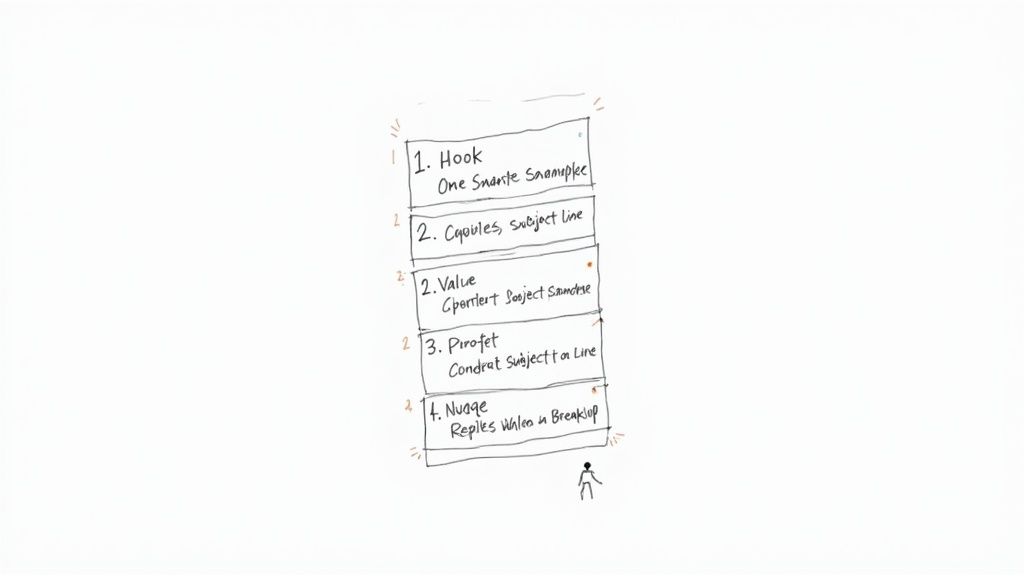
Deconstructing A Proven 5-Step Sequence
Let's pull back the curtain on a battle-tested 5-step sequence that a fast-growing B2B SaaS company I know uses to consistently book meetings. This isn't just theory; it's a playbook you can put to work immediately. We’ll look at the ‘why’ behind every step, from the first hello to the final goodbye.
The whole idea is to be helpful, not just salesy. You have to remember that 70% of responses come from the 2nd to 4th email. Persistence pays off, but only if you're bringing value each time.
The best email sequences feel less like a sales pitch and more like a series of helpful, relevant nudges from a real person. Each touchpoint is a new opportunity to provide value, not just ask for their time.
Here’s a look at how to structure your own sequence, including the thinking behind each email.
The 5-Step Sequence Blueprint
I've put together this table to break down the structure of a winning 5-step sequence. It maps out the goal, tone, and what you should focus on in each email.
| Primary Goal | Subject Line Strategy | Key Content Point | |
|---|---|---|---|
| Email 1 | Spark Curiosity | Personalized & Intriguing | A hyper-relevant opening line about them, a clear pain point, and a soft CTA. |
| Email 2 | Provide Context | Follow-Up Tone | A gentle bump, rephrasing the core value prop from a slightly different angle. |
| Email 3 | Build Credibility | Value-Oriented | Share a relevant case study, a helpful resource, or a quick tip. No direct ask. |
| Email 4 | Introduce Social Proof | Question-Based | Mention a similar company you helped and ask a simple question. (e.g., "Is this a priority?") |
| Email 5 | The Breakup | Closing the Loop | A polite, no-pressure email to close the loop. Gives them an easy "out" or a final chance to engage. |
Following this blueprint gives you a solid foundation, but the magic really happens when you write copy that actually connects with a real person.
Writing Copy That Actually Connects
Okay, let's turn that blueprint into words. The secret sauce is writing like a human, not a marketing bot. Keep your sentences short, use simple language, and always write from their perspective ("you") instead of yours ("we").
Email 1: The Hook (Day 1)
The only job of this first email is to get a reply or at least avoid the trash bin. Your subject line is 90% of the battle here.
- Bad Subject: "Revolutionary Solution for [Their Industry]"
- Good Subject: "Quick question about [Their Company]'s [Specific Initiative]"
For the body, your first line absolutely must be personalized. Mention something specific you saw—a LinkedIn post, a project they just launched, anything. Then, smoothly connect that observation to the problem your product solves.
Email 2: The Gentle Nudge (Day 3)
Most people are busy and will miss your first email. This follow-up is just a simple, polite bump. Send it as a reply to the first email to keep the whole story in one thread.
- Example Copy: "Hi {{FirstName}}, just wanted to make sure this didn't get buried. Is solving [Pain Point] on your radar at all right now?"
Email 3: The Value-Add (Day 7)
Time to switch gears. Stop asking for their time and start giving them something useful. This is where you share a valuable piece of content like a blog post, a short video tutorial, or a one-page case study.
- Example Copy: "Thought you might find this interesting. We recently put together a guide on how teams like yours are tackling [Challenge]. No pitch, just thought it might be helpful."
Email 4: The Social Proof Angle (Day 12)
Here's where you tap into the power of "hey, we've helped someone just like you." Mentioning how you've helped a similar company or even a competitor can be incredibly compelling.
- Example Copy: "We recently helped {{Similar_Company}} achieve {{Specific_Result}}. Curious if improving your {{Metric}} is a priority for your team this quarter?"
Email 5: The Breakup (Day 18)
This one works surprisingly well because it takes all the pressure off. You're just politely closing the loop. It often gets a response from people who were interested but just got swamped.
- Example Copy: "Hi {{FirstName}}, I haven't heard back, so I'll assume this isn't a priority right now. I'm closing your file for now, but please feel free to reach out if anything changes."
If you're looking to explore more tools to power your outreach, check out this comprehensive guide to outbound sales software. It gives a great lay of the land. Remember, your cold email sequence generator is the engine, but thoughtful, human-centric copy is the fuel that makes it go.
Using AI for Hyper-Personalization at Scale
Let's be blunt: generic cold emails are dead. The only way to get noticed is with personalization that proves you've done your homework. But doing that manually for hundreds of prospects is a recipe for sales team burnout. This is exactly where the AI features in a modern cold email sequence generator become your operational advantage.
This isn't about having a robot write your entire sequence. Think of AI as a world-class research assistant—one that can instantly scan a prospect's LinkedIn, check recent company news, and spot relevant job postings to find the perfect icebreaker. The entire point is to make your first two sentences so spot-on that the prospect has to keep reading.
From Template to Tailored
The difference between a generic template and an AI-personalized email is stark. It's the difference between "Dear Sir/Madam" and "Hey, saw your team just launched its new integration—congrats!" That level of detail used to take hours of manual research for a single campaign.
Now, AI does the grunt work. The best tools can analyze dozens of data points per prospect in seconds. We're seeing this drive a massive 32% increase in response rates over old-school, static templates. Some SaaS operators using deep AI personalization are even hitting response rates as high as 35%.
The magic of AI isn't that it writes for you; it's that it finds the "why you, why now" so you can write a better, more relevant message. It turns a cold outreach into a warm conversation starter.
Let's break down what this actually looks like.
Before AI (The Standard Template):
"Hi {{FirstName}},
I saw you're the {{Title}} at {{Company}} and wanted to reach out. We help companies like yours solve {{Pain Point}}…"
It’s not terrible, but it's bland. It screams "automation" and could have been sent to a thousand other people.
After AI (The Personalized Hook):
"Hi {{FirstName}},
Saw your post on LinkedIn about scaling your engineering team. It sounds like you're tackling some big projects over at {{Company}}, especially with the new product launch."
The difference is night and day. The second version is timely, specific, and shows you've paid attention. That’s how you earn a reply.
Putting AI Into Practice
Good AI-powered tools don't just generate a random sentence. They surface several options and provide context, letting your sales rep pick the angle that makes the most sense. If you're looking to weave this into your wider tech stack, our guide on AI automation strategies has some great pointers on making it all work together.
Here’s a look at how a tool can generate these personalized lines for you.
As you can see, the tool can pull out key events—like recent funding or a new partnership—and draft ready-to-use opening lines. The real power here is that it gives the sales rep the final say, letting them choose the most compelling hook. It's the perfect blend of automation and human insight.
This isn't about replacing salespeople. It's about making them smarter and faster. By equipping your team with a cold email sequence generator that has powerful AI, you let them stop digging for data and start doing what they do best: building relationships and closing deals.
How to Automate Your Entire Outreach Workflow
Your cold email sequence generator is a powerhouse, but if you're running it in a vacuum, you're leaving revenue on the table. To truly scale outreach, you need to turn that tool into the central hub of your tech stack. When it’s isolated, you’re just creating more manual work and letting good leads fall through the cracks.
The magic happens when your tools talk to each other automatically. This is about building a workflow where data flows seamlessly—from your lead source, through your email tool, and right into your CRM without anyone lifting a finger. Getting this right is a huge part of smart SaaS automation, and it’s what separates a list of manual tasks from a predictable growth machine.
Building Smart Triggers and Connections
The goal is to create a series of "if this, then that" rules that run your outreach for you. Instead of a sales rep needing to remember to update a contact’s status in the CRM, the system just does it the second a prospect takes an action. This frees up your team to have great conversations, not drown in data entry.
Here are a few automations that every SaaS team should have running, no exceptions:
- Auto-Enroll New Leads: The second a new lead list hits your CRM or a prospect gets tagged for outreach, they should be automatically pushed into the right email sequence. This closes the gap between finding a lead and actually contacting them.
- Instantly Pause on Reply: This one is non-negotiable. The moment a prospect replies to any email in your sequence, the automation must stop all future follow-ups. It’s the single best way to avoid the cringe-worthy mistake of sending a canned follow-up to someone who already responded.
- Create CRM Tasks for Hot Leads: When a prospect shows buying intent—they clicked a specific link, replied with a question, or checked your pricing page—an automation should fire off a task in your CRM and assign it to the right sales rep. Instantly.
This is where the process really starts. AI-driven tools can take a generic template and give it a personal touch before it even gets loaded into your automated workflow.
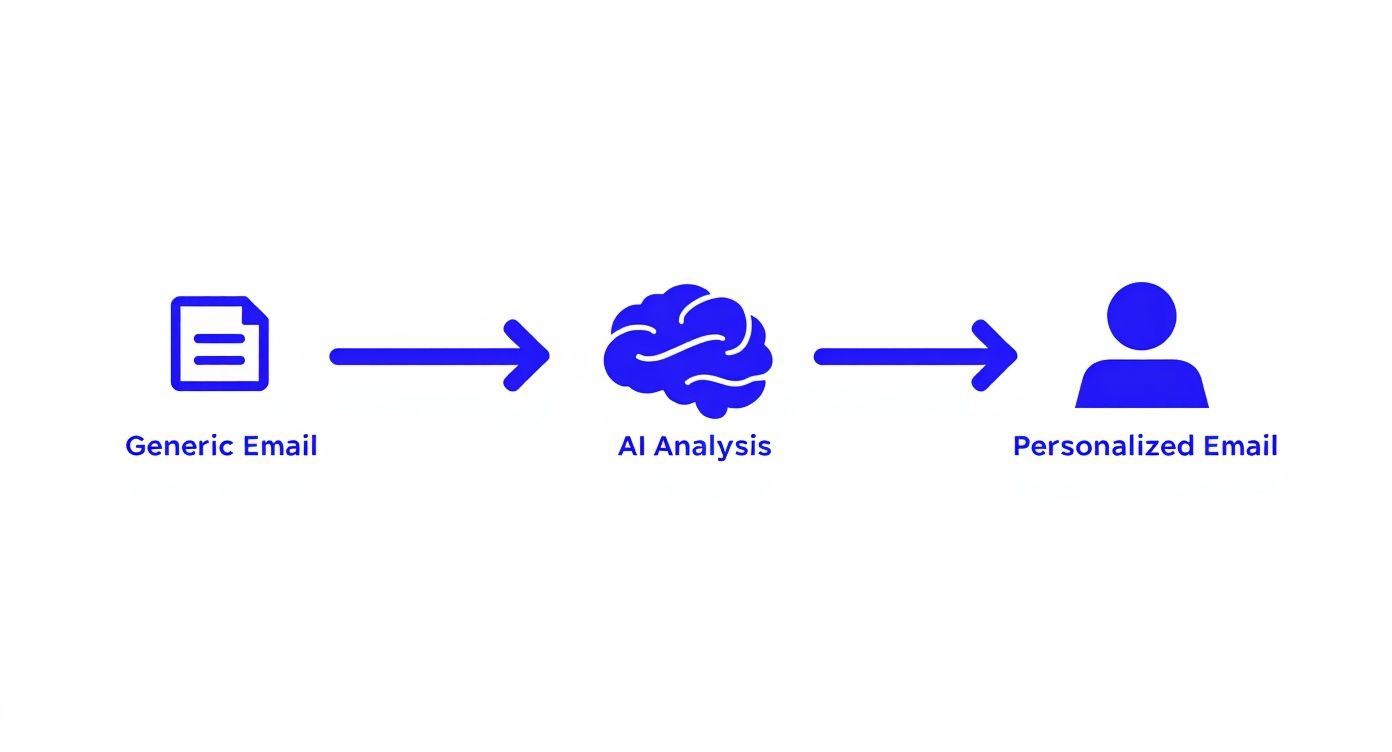
Starting with an AI-analyzed, personalized email right out of the gate makes every automated step that follows so much more effective.
A Sample Workflow You Can Steal
Let’s make this concrete. Think of your cold email sequence generator as the quarterback, calling the plays between your lead sources and your CRM.
The Trigger: Someone uploads a new list of 100 qualified leads to your CRM and tags it "Q2 Tech Outreach."
- Enrollment: An automation tool (like Zapier or a native integration) sees that new tag. It immediately grabs all 100 contacts and enrolls them in your email tool under the "Q2 Tech – 5 Step Sequence."
- Engagement: A lead named Jane opens Email #2 and clicks the link to a case study on your site. The system tracks that click.
- Action: That single click sets off two automations at once. First, a task pops up in your CRM for her account owner that says, "Clicked case study link – follow up." Second, Jane's contact record gets updated with a new tag, something like "Engaged – Clicked Content."
- Reply: A couple of days later, Jane replies to Email #3 with, "This sounds interesting, can you send over pricing?"
- Handoff: The sequence tool detects the reply and immediately stops sending any more automated emails to Jane. At the same time, a second task is created in the CRM: "Positive Reply Received – Book Meeting." The sales rep gets a notification right away.
This entire process unfolds without a single manual click from the sales rep until the exact moment they're needed for a human-to-human conversation. This is how you build a scalable, mistake-proof sales operation.
This automated handoff is crucial. It guarantees no warm lead is ever left hanging and ensures your sales team spends their valuable time only on prospects who have clearly raised their hands. That’s the difference between just having an outreach tool and running a fully integrated growth engine.
Measuring and Optimizing Your Sequences
If you're not tracking your campaigns, you're guessing. Firing off sequences without a solid plan to measure what’s working is the fastest way to burn through your lead list with nothing to show for it. This is where we turn cold outreach from a shot in the dark into a predictable growth engine for your SaaS.
Forget vanity metrics like open rates. They don't put money in the bank. The numbers that really move the needle are the ones that signal buying intent and directly feed your pipeline.
The Metrics That Actually Drive Revenue
To get a real sense of your campaign’s health, you need to track the right Key Performance Indicators (KPIs). These numbers tell the true story of how your sequence is performing.
- Reply Rate: Your north star for engagement. If this rate is low, it's a huge red flag that your targeting, offer, or messaging is off.
- Positive Reply Sentiment: Not all replies are created equal. You must separate the "Sounds interesting, tell me more" from the "Take me off your list." Tracking sentiment reveals if your copy is truly resonating.
- Meetings Booked: For most SaaS companies, this is the whole point. It's the clearest signal that your sequence turned a cold prospect into a warm conversation.
- Pipeline Generated: This is where the rubber meets the road. Tying your outreach efforts directly to new opportunities created in your CRM proves the real-world ROI of your campaigns.
Your cold email sequence generator has to make tracking these core metrics simple. If it doesn’t, you're flying blind. The goal is to build a dashboard that gives you an at-a-glance view of performance, letting you make quick, data-backed decisions.
A Simple Framework for A/B Testing
Once you have your baseline numbers, it's time to start optimizing. A/B testing is your secret weapon. The key is to test one variable at a time—if you change the subject line, the CTA, and the body copy all at once, you'll have no idea which change actually made a difference.
Here’s a practical roadmap for your next test:
- Start with the Subject Line: This has the single biggest impact on whether your email gets opened. Test a direct, benefit-focused subject line against a more curious or question-based one.
- Move to the Call-to-Action (CTA): Once you have a winning subject line, focus on your "ask." Compare a hard CTA (e.g., "Got 15 minutes to connect next week?") against a soft, interest-based one (e.g., "Worth a look?").
- Experiment with Sequence Structure: Finally, play with the flow itself. Does a punchy, 4-step sequence outperform a more comprehensive, 7-step sequence that includes more value-add content? Only testing will tell you.
I saw this firsthand with a SaaS founder I know. They were pulling a decent 5% reply rate but booking almost no meetings. They decided to A/B test their CTA. Version A asked for a demo, while Version B simply asked if the prospect was struggling with a specific problem.
The result? Version B doubled their positive reply rate and led to a 30% jump in booked meetings. Why? Because it started a conversation instead of demanding a commitment. That's how you stop just hoping for replies and start building a real revenue engine.
Let's Tackle Some Common Questions
Alright, let's get into the nitty-gritty. When you start building out automated outreach, a handful of questions always pop up. Here are the straight-up answers to the ones I hear most often from SaaS ops folks just like you.
How Many Follow-Ups Should I Actually Send?
There's no single perfect number, but the data is clear: the sweet spot is usually between 4 to 7 emails.
If you stop after one or two tries, you're throwing away leads. Research consistently shows that a whopping 70% of responses happen between the 2nd and 4th email. Giving up early is a massive, unforced error.
My rule? Don't stop the sequence unless you get a clear "no" or your system flags them as unresponsive after the full sequence. Smart persistence, packed with value, is what gets deals done.
What's The Right Cadence Between Emails?
You want to be persistent, not annoying. It's a fine line.
A good starting point is to wait 2-3 days between your first few emails. After the third or fourth touchpoint, you can space it out a bit more, maybe to 4-5 days. This keeps you on their radar without clogging up their inbox. It's respectful of their time but still makes sure you're not forgotten.
How Do I Stay Out Of The Spam Folder?
This is the big one. Deliverability can make or break your entire effort.
First, never skip the warm-up process. If you're using a new domain, you must use an email warm-up service before you go big. Second, dig into the settings of your cold email sequence generator and set up custom tracking domains. Third, double-check that your SPF and DKIM records are configured correctly—this isn't optional, it's essential for proving to email providers that you are a legitimate sender.
Ready to stop guessing and build a revenue engine that actually works? SaaS Operations gives you the playbooks and templates we've used to scale outreach time and time again. Get proven frameworks from operators who have already made the mistakes so you don't have to. See how it works at SaaS Operations.