Business Operating System: Your Playbook for Building a Scalable SaaS Machine
 Published By: Alex
December 13, 2025
Published By: Alex
December 13, 2025
Ever feel like you're constantly fighting fires instead of building your SaaS? It's a classic founder trap. You mistake pure hustle for real progress, but the truth is, you're just reacting. The problem isn't a lack of effort—it's the absence of a central "brain" to run the company. This is where a business operating system changes everything.
What Is a Business Operating System?
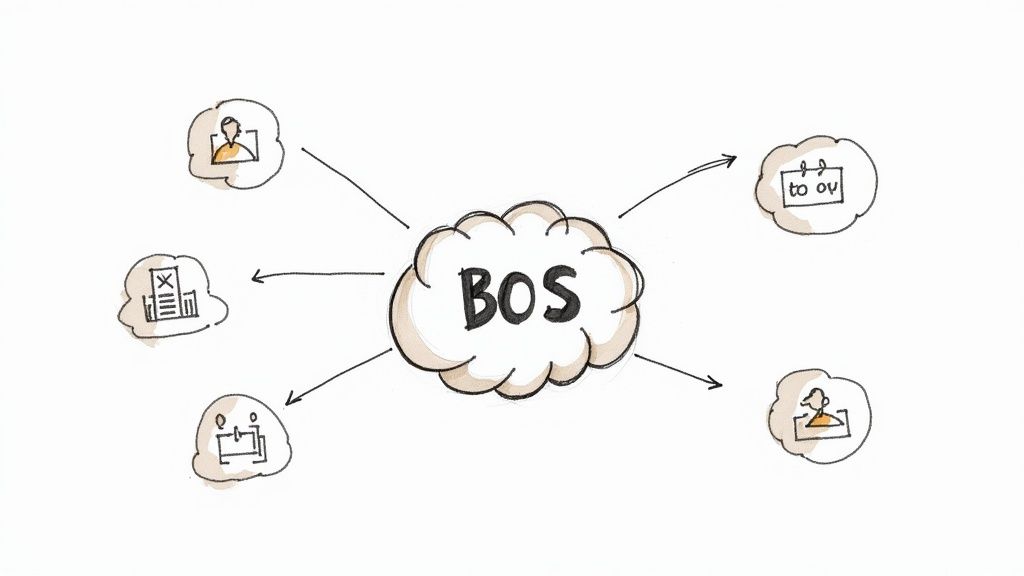
Think of it like the OS on your computer. You don't actually see macOS or Windows, but it's humming along in the background, coordinating all the essential functions—memory, processing, storage. It's the silent force that lets your applications (your teams) run smoothly. Without it, you’d just have a jumble of hardware and software—pure chaos.
A business operating system (BOS) does the same thing for your company. It’s the complete framework of processes, tools, and rhythms that turns your big-picture vision into consistent, daily action. It’s not just about software; it’s the human algorithm that gets your entire team aligned and executing with precision.
The Antidote to Operational Chaos
For a SaaS company, a solid BOS is the bridge between having a great product and building a great business. It's how you finally stop lurching from one crisis to the next and start building a predictable, scalable machine. It codifies everything—from how you run meetings and set goals to how you track performance and manage people.
Zack Swire, the founder of Top Teams, nails why this is so critical for SaaS operators. He points out that without a documented game plan, even a successful company can "fall apart pretty easily." Your BOS gives everyone confidence and a clear path forward, no matter what the market throws at you.
A well-designed business operating system creates clarity and predictability by defining:
- Your Vision: Where are you going, and why should anyone care?
- Your Processes: The specific, repeatable steps for everything from sales calls to customer onboarding.
- Your Data: The vital signs of your business—the handful of metrics that truly matter, tracked on a simple, transparent scorecard.
- Your People: Who owns what? How are roles defined, and how is performance measured?
Ultimately, a BOS isn't about adding red tape or bureaucracy. It’s about removing friction. By getting the "how" down to a science, you free up your team’s brainpower to focus on what really moves the needle: innovation and growth. For a deeper dive, exploring the fundamentals of SaaS operations management is a fantastic next step.
The Core Components of a SaaS Operating System
A business operating system isn't some abstract theory; it's a practical framework made of a few distinct, interconnected parts. For a SaaS company, this system is what translates your big-picture goals into daily, repeatable actions. It's the engine that powers predictable growth by making sure everyone is on the same page and executing flawlessly.
Think of these components as the five core functions of your company's brain. Each one has a specific job, but they all need to work together to run the whole operation. If you're missing even one, you'll end up with gaps that lead to confusion, wasted effort, and stalled growth.
Let's break down the five pillars that hold up a strong SaaS operating system.
The table below gives you a quick snapshot of these five essential components, what they do, and how they directly impact the metrics that matter most in a SaaS business.
The 5 Pillars of a SaaS Business Operating System
| Component | Purpose | Key SaaS Metric Impacted |
|---|---|---|
| Unified Vision | Establishes a clear, shared "North Star" for where the company is headed and why. | Customer Lifetime Value (LTV) |
| Meeting Pulse | Creates a consistent communication rhythm to keep teams aligned and information flowing freely. | Employee Engagement & Retention |
| Transparent Scorecard | Tracks a handful of key metrics to provide an honest, at-a-glance view of business health. | Net Revenue Retention (NRR) |
| Core Process Playbooks | Documents the essential workflows to ensure consistent, repeatable results as the company scales. | Customer Acquisition Cost (CAC) |
| People Framework | Defines clear roles, responsibilities, and accountability to ensure the right people are in the right seats. | Team Productivity & Velocity |
Each of these pillars builds on the others, creating a powerful, self-reinforcing system. Now, let's dive into what each one looks like in practice.
1. Unified Vision: The North Star
Your Unified Vision is the foundation of everything. It's the gut-check that answers the big questions: Where are we actually going? And why should anyone care? This goes way beyond a generic mission statement hung on a wall; it's a crystal-clear picture of the future that every single person in the company can see and get behind.
This isn't just fluffy, feel-good stuff. In SaaS, your vision directly shapes your product roadmap, your marketing copy, and who you hire. For instance, if your vision is to "democratize data analytics for small businesses," you’ll naturally prioritize features that are simple and affordable, not clunky, enterprise-grade tools.
When your vision is clear, your teams in engineering, marketing, and sales will instinctively make decisions that steer the ship in the same direction, even when no one is looking over their shoulder. It’s the ultimate filter for every strategic move you make.
2. Meeting Pulse: The Communication Rhythm
Inconsistent communication is the silent killer of fast-growing SaaS companies. The Meeting Pulse fixes this by setting up a predictable rhythm of communication that keeps information moving and teams in sync. It's a structured series of meetings—daily, weekly, monthly, and quarterly—each with a razor-sharp purpose and agenda.
A fantastic example is the "Level 10 Meeting" from the Entrepreneurial Operating System (EOS). It's a highly disciplined, 90-minute weekly meeting for the leadership team that cuts through the noise to focus on reviewing key numbers, solving real problems, and staying on track with quarterly goals.
"When organizations don’t run meetings consistently, when they operate in silos, or when they come to accept that this is just how they’ve been running things, you can feel the pain. There's a better way."
— Zack Swire, Founder and Coach, Top Teams
This pulse doesn't just stop with leadership. It cascades down through the whole company. A weekly sync at the top ensures department heads are aligned, and they carry that clarity into their own team meetings. This simple rhythm prevents ugly surprises and gets rid of the dreaded "I had no idea that was happening" problem for good.
3. Transparent Scorecard: The Health Monitor
You can't fix what you can't see. The Scorecard is a simple, high-level report that tracks the vital signs of your SaaS business. This isn't some monster spreadsheet with hundreds of vanity metrics. It’s a focused dashboard with just 5-15 key numbers that give you an honest, at-a-glance look at the company’s real-time health.
For a SaaS operator, this means tracking leading indicators, not just lagging ones. Instead of just staring at last month's MRR, a smart scorecard might include things like:
- Product Engagement Score: A combined metric that shows which customers are actually getting value and are less likely to churn.
- Sales Qualified Leads (SQLs) Generated: A forward-looking number that gives you a glimpse into your future sales pipeline.
- Customer Health Score: An automated score based on support tickets, usage, and NPS data that flags at-risk accounts before they leave.
This data-driven approach shifts you from guessing to knowing. It helps you spot problems weeks or even months before they start eating into your revenue. To get this right, you can learn more about crafting effective business scorecards and dashboards that actually drive action.
4. Core Process Playbooks: The Repeatable Success Formula
Scaling a SaaS business comes down to one thing: your ability to deliver consistent results over and over again. Core Process Playbooks are simple, documented guides for the most critical workflows in your company. We're not talking about creating a massive, bureaucratic manual nobody reads. It’s about nailing the 20% of processes that drive 80% of your results and making them standard practice.
In a SaaS company, your must-have playbooks usually cover:
- Customer Onboarding: The step-by-step journey to get a new user to their "aha!" moment as fast as possible. This is your best weapon against early churn.
- Sales Handoff to Customer Success: A simple, checklist-driven process to make sure no customer details get lost and the success team is set up for a win from day one.
- Bug Reporting and Prioritization: A clear workflow for how bugs get reported, triaged, and slotted into the dev queue, so chaos doesn’t take over.
With solid playbooks, your quality stays high even as you hire fast. A new sales rep or customer success manager can pick up the playbook and start delivering a great experience from their very first day.
5. People Framework: The Structure for Growth
Finally, the People Framework organizes your most important asset: your team. This component defines crystal-clear roles and responsibilities, ensuring that every critical function in the company is owned by a specific person. It answers the simple but profound question: "Who does what?"
This is often visualized with an accountability chart, which maps out the essential seats needed to run the business, separate from the people currently in them. Each seat has just 3-5 core responsibilities. This structure creates massive clarity, puts an end to turf wars, and makes sure nothing important falls through the cracks.
It’s the blueprint that allows you to scale your team with purpose, adding the right people to the right seats at exactly the right time.
Designing Your BOS Architecture for Scale
You don't accidentally build a SaaS company that can scale. It’s done by design. Far too many founders think they can just hire more people or throw money at more software to fuel growth. Spoiler alert: that's a recipe for chaos.
The real foundation for sustainable growth is your business operating system architecture. Think of it as the intentional blueprint that combines your technology and your processes, making sure they can handle the pressure as your company gets bigger and more complex.
This isn't about chasing the latest shiny project management tool. It’s about building a solid structure where your tools actually serve your processes, not the other way around. Get this right, and everything from aligning a remote team to managing your cloud costs becomes predictable and a whole lot smoother.
This diagram shows how a well-built Business Operating System (BOS) is like the company's brain, connecting your high-level vision, your day-to-day data, and your people into one cohesive unit.
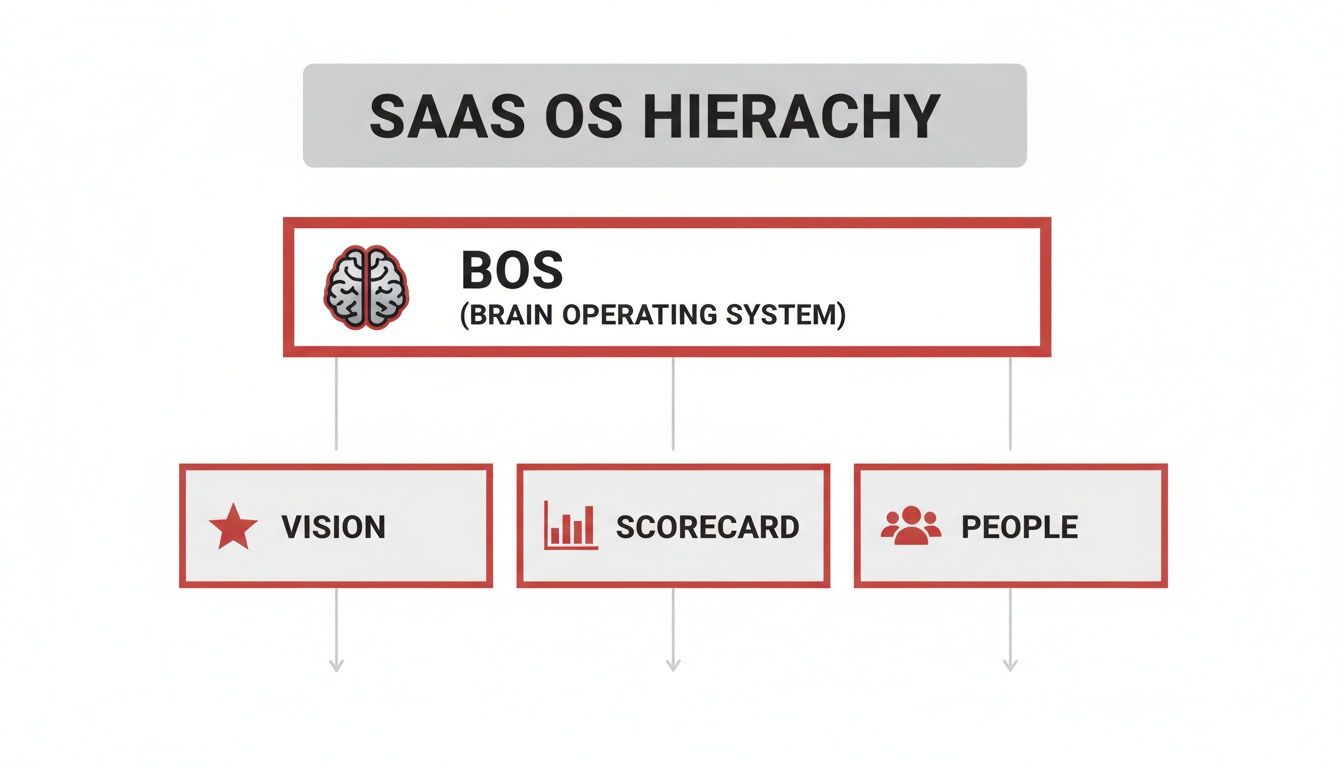
The big takeaway here? These parts aren't supposed to live on their own islands. They're deeply connected, and the BOS is the thing that makes them all pull in the same direction.
Processes First, Technology Second
I've seen so many SaaS leaders make this classic mistake: they pick their tools before they've even defined their workflows. This backwards approach leads to a messy, Frankenstein-like tech stack where the software’s limitations dictate how you work. You end up with clunky workarounds and bottlenecks that only get worse as you grow.
The smart way to build your architecture is to start with your core processes. First, actually map out how work should get done. How does a new customer get onboarded? How does a feature go from an idea to live in the product? Get that on paper. Only then should you start looking for tech that can support and automate that ideal flow.
Your tech stack should be a reflection of your operational strategy, not a random collection of subscriptions. A tool's purpose is to make a well-defined process more efficient, not to create the process for you.
Standardizing Your Tech Stack to Prevent Data Silos
As you grow, teams will naturally start using whatever tools they like best. Marketing grabs Asana, engineering is deep in Jira, and customer success is tracking everything in Trello. It seems fine at first, but it quickly creates crippling data silos.
Suddenly, getting a clear picture of anything that requires cross-functional work becomes a nightmare. Standardizing your tech stack isn't just a nice-to-have; it's a must-do for scaling. This means picking a primary tool for key functions and making sure it plays well with everything else.
- Project Management: One single source of truth for all projects and tasks (think ClickUp, Monday, or Asana).
- Internal Communication: A central place for all conversations, both real-time and async (like Slack or Microsoft Teams).
- Knowledge Management: A central library for all your process docs, SOPs, and playbooks (Notion or Confluence are great for this). To really get ahead, understanding knowledge management and artificial intelligence can offer huge advantages in how you organize and use company information.
When everyone works from the same playbook and the same set of data, you have the foundation for a scalable operating system.
Aligning Architecture with Future Capacity Needs
Your architecture can't just solve for today; it has to be ready for tomorrow. This is especially critical for the technical backbone of your SaaS product. Just look at the server market—the global server OS market volume hit 26,389 thousand units in 2024 and is expected to jump to 66,853 thousand units by 2032. That's a massive expansion, all driven by companies needing more power and more complex cloud setups.
For your SaaS, this means your BOS architecture needs a clear strategy for technical scale. You have to ask: how will our systems handle 10x the users? 10x the data? This means thinking about server management, database optimization, and knowing the breaking points of your infrastructure.
This isn’t something you can just wing. It requires a proactive approach to what is known as capacity planning (you can learn more about what is capacity planning) to make sure you can keep your customers happy without your app slowing to a crawl. Your operational architecture is what determines whether you can scale smoothly or if you’ll just break under the pressure.
Real-World Playbooks From Top SaaS Companies
Theory is one thing, but what does a business operating system actually look like in the wild? The best way to understand is to see how elite SaaS companies put these ideas to work. It’s their playbooks—the real-world documents and routines—that separate them from the companies that never quite get off the ground.
These operators aren't just winging it. They’ve built systems to make success repeatable.
By looking at their specific playbooks, you can grab proven ideas and plug them straight into your own company, whether you're a team of five or five hundred.
Atlassian: The Team Playbook for Getting Everyone on the Same Page
Think about Atlassian, the powerhouse behind Jira and Confluence. With thousands of employees across the globe, alignment could be a nightmare. Their solution is the Atlassian Team Playbook. This isn't a stuffy manual; it’s a collection of simple, practical workshops anyone can run to fix common team problems and drive results.
This playbook is a core part of their operating system, giving every team a shared language for solving problems. It’s packed with specific "plays" for critical moments:
- Project Kickoffs: A structured workshop to ensure every new project starts with clear goals, defined roles, and a shared vision of what "done" looks like.
- Team Health Monitors: A quick self-assessment for teams to spot issues with communication or decision-making before they become major roadblocks.
- Customer Interviews: A standardized process for gathering customer feedback so it actually gets used to improve the product, instead of getting lost in a spreadsheet.
What makes this so brilliant is its flexibility. It provides a framework but empowers teams to adapt the plays to fit their own unique challenges. It’s a perfect example of building a system that creates alignment without crushing autonomy.
HubSpot: The Culture Code as a People Operating System
HubSpot’s legendary Culture Code isn't just a fancy PowerPoint presentation. It’s the core of their people operating system and a key piece of their overall BOS. It’s a living document that spells out the exact behaviors, values, and expectations for every single person at the company.
This goes way beyond feel-good mission statements. It’s a tool they use every day to make hard decisions.
The HubSpot Culture Code is all about playing the long game. It acts as a filter for hiring the right people, a guide for promoting top performers, and a transparent rulebook for making tough calls. It gets specific, with lines like "We favor autonomy and accountability" and "We're unreasonably picky about our peers," setting a clear, high standard for everyone.
This playbook gives every manager a north star. When they have to make a difficult decision or give critical feedback, they can point directly to the Culture Code. It removes guesswork from people management and ensures decisions are based on a consistent set of principles—absolutely critical for scaling a healthy culture.
Bootstrapped Founders: Building Lean and Mean Operating Systems
You don’t need a giant budget or a dedicated Ops team to build a solid business operating system. Just look at the countless bootstrapped SaaS founders who have built incredibly effective systems using simple, everyday tools.
For them, a BOS isn't some complex framework. It’s a lean combination of documented processes and the right tools to bring order to the chaos of a small, fast-moving team.
Here’s what their playbook usually looks like:
- A Central Brain (Notion/Confluence): They create a single source of truth for everything important. This is where you find the company vision, Standard Operating Procedures (SOPs) for key tasks like handling a support ticket, and all meeting notes.
- Clear Task Ownership (Asana/ClickUp): They pick one project management tool and stick to it religiously. This creates total transparency around who is doing what and when it’s due, killing the "I thought you were doing that" problem for good.
- A Simple Weekly Rhythm: They lock in a non-negotiable weekly team meeting. The agenda is always the same: review the scorecard, identify key roadblocks, and set the top 3 priorities for the week ahead.
This proves that an effective BOS is about discipline and consistency, not complexity. You can start building your own version today with tools you're probably already using. A simple system that people actually follow will crush a complicated one that just collects dust.
Your Step-by-Step Playbook for Building a Business Operating System
So, you're ready to build your own business operating system? I get it—the idea can feel massive. But the reality is much more manageable. Forget about overnight perfection. This is all about taking small, smart steps that build on each other.
The whole point here is to get early wins, build momentum, and create a system that actually grows with your company. We're not adding red tape; we're adding clarity. You can start this process today with tools you already have.
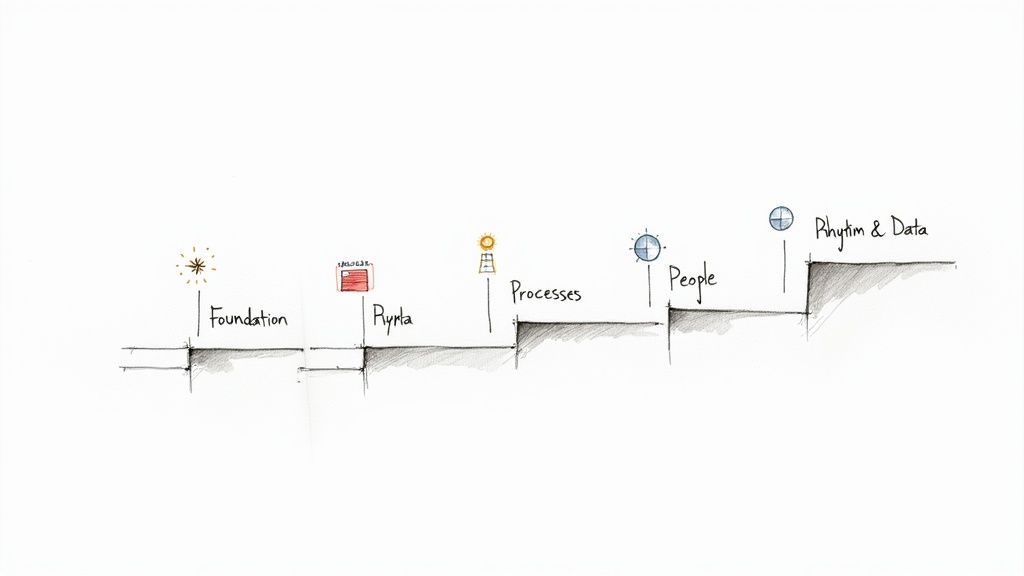
This entire approach is designed to be lean. You don't need to hire expensive consultants or buy some complicated enterprise software. All you need is a commitment to consistency and a clear plan of attack—which I've laid out for you right here.
Phase 1: Lock in Your Vision (The Foundation)
Before you touch a single process, you must lock in your company’s North Star. This is the bedrock. Without it, you’re just getting better at organizing chaos.
Action Item: Schedule a 4-hour workshop with your leadership team. Your only mission is to answer these three questions with total clarity and write them down.
- What are our 3-5 Core Values? These are the non-negotiable principles that guide how you behave.
- What is our Core Focus? A simple statement defining your purpose (why you exist) and your niche (what you do better than anyone).
- What is our 1-Year Goal? Pick one single, measurable target you want to hit in the next 12 months. Example: "Hit $2M ARR with less than 2% monthly churn."
Post these answers where everyone can see them daily. This clarity becomes the filter for every decision you make from here on out.
Phase 2: Install Your Rhythm & Scorecard
With your foundation solid, it’s time to install two powerful habits: a consistent meeting pulse and an obsession with real data. This phase is about creating predictability and making the invisible, visible.
Action Item 1: Start a weekly leadership team meeting. Put a recurring 90-minute block on the calendar. Use the same agenda every single time. This meeting becomes the heartbeat of your organization.
Action Item 2: Build your first company scorecard. Don't overthink it. Identify 5-7 vital metrics that give you a true, at-a-glance health check. For a SaaS company, start with: MRR, Net Churn, Customer Acquisition Cost (CAC), and a key product engagement metric (e.g., weekly active users).
The scorecard’s job is to tell you the truth, even when it’s uncomfortable. It instantly shifts your conversations from being based on feelings and stories to being driven by cold, hard facts.
Phase 3: Document Your Core Processes
Now you can start taming the operational dragons. Instead of trying to document everything, focus on the 20% of processes causing 80% of the headaches.
Action Item: Ask your team, "What is the most inconsistent or frustrating part of how we get work done?" Pick the top 3 friction points. It might be:
- The messy handoff from sales to customer success.
- The inconsistent way you onboard new customers.
- The chaotic mess of how bugs get reported and prioritized.
Your job is simple: get the current process out of people’s heads and onto a simple checklist or step-by-step guide in Notion. That's a huge win. For more guidance, our detailed SaaS implementation checklist is a great resource for standardizing your workflows.
Phase 4: Build the People Framework
Finally, you can bring structure to your team. A solid people framework ensures you have the right people in the right seats, and everyone is crystal clear on their responsibilities.
Action Item: Create an Accountability Chart. This isn't an org chart; it defines the key roles (or seats) needed to run the business and the 3-5 things each role truly owns. It kills confusion and clarifies ownership. Then, introduce simple quarterly check-ins focused on how everyone is performing against their goals and living the core values.
This phased approach is about stacking small, consistent wins. The broader market for operating systems is forecast to hit about USD 52.4 billion by 2034, showing how critical these underlying structures are. By building your BOS one piece at a time, you ensure it becomes a supportive framework that helps you scale, not a restrictive cage that holds you back. You can dig into the growth of the operating systems market on MarketResearch.com if you're curious.
Common BOS Implementation Mistakes to Avoid
Putting a business operating system in place can be the single best move you make for your company, but it's no silver bullet. I’ve seen so many SaaS leaders start with the best intentions, only to watch their efforts completely fizzle out. Why? It almost always comes down to a few common, and totally avoidable, mistakes.
The good news is, once you know what these traps are, you can navigate right around them. It all comes down to being deliberate and focusing on the right things in the right order. Let's walk through the classic blunders that can turn a powerful system into dead weight.
Choosing Tools Before Processes
This is the big one. It's so easy to get dazzled by a shiny new piece of software before you’ve even defined the workflow it’s supposed to improve. It's like buying a bunch of fancy kitchen gadgets before you even know what you want to cook for dinner. You end up with a messy, expensive tech stack that forces you to work its way, not the way your business actually needs to run.
Solution: Start with a simple doc or a whiteboard. Map out your core processes first. Once you have a crystal-clear picture of your ideal workflow, then go find the technology that fits it perfectly.
Over-Engineering From Day One
Another classic trap is trying to build the perfect, all-in-one system from the very beginning. The desire for perfection often creates a bloated, bureaucratic monster that nobody on the team understands or wants to use. Your BOS should start lean. It should solve your single biggest pain point first, not try to boil the ocean.
A good way to keep your BOS from becoming an unmanageable burden is to think of it like software development. You have to actively avoid building up "organizational debt." For a deeper look at this concept, exploring strategies for managing technical debt offers some great parallels. This mindset keeps your system agile and focused on getting real results.
Lacking True Leadership Commitment
A business operating system is not a project you can just hand off to a junior manager and then forget about. It's a fundamental change in how the company runs. If the leadership team isn’t living and breathing the system—running the meetings, obsessing over the scorecard, and holding people accountable—it's dead on arrival. It’ll just become "another initiative" that everyone forgets about by next quarter.
- Appoint a BOS Champion: You need one person on the leadership team who owns the health and adoption of the system. Their job is to keep it on track.
- Lead by Example: Founders and executives have to be the most disciplined users of the BOS. Period. If you don't follow the rules, no one will.
Don't forget that the operating systems your team uses every day also play a role in your BOS design. With Android holding 37–38% of the global market (mostly mobile) and Windows at 32–33% (mostly desktop), your choices around application compatibility and security are directly affected. Checking out these global OS market share trends on StatCounter can help you make smarter tech and policy decisions for your company.
Got Questions About Business Operating Systems?
Even with the best roadmap, you're bound to have questions as you start building your own business operating system. Let's tackle some of the most common ones I hear from SaaS founders. My goal here is to give you the clarity and confidence to dive in.
Should We Use a Custom BOS or Just Go with EOS?
Look, frameworks like the Entrepreneurial Operating System (EOS) are popular for a reason—they give businesses a solid, off-the-shelf structure. And that can be great. But for a SaaS company, a custom business operating system almost always wins.
Why? Because a custom system lets you build processes that are native to your product, your go-to-market strategy, and your customer's journey.
EOS gives you a fantastic starting point. You can absolutely borrow battle-tested ideas like the Level 10 Meeting. But a custom approach means you can prioritize things that are uniquely critical to SaaS, like nailing your customer onboarding playbook or building a rock-solid product feedback loop. You end up with a system that fits your business like a glove, instead of trying to jam your business into a pre-made box.
When Is the Right Time to Get a Formal Operating System?
The simple answer? You're ready the second you feel like you’re spending all your time putting out fires instead of building what's next. The most obvious sign is when the founder can no longer be in the loop on every single decision.
A few other tell-tale signs you’ve hit the tipping point:
- Wildly Inconsistent Results: Your sales team in one region is crushing it, while another struggles, even though they're running the same "play." That's a process problem.
- Constant Surprises: You keep hearing things like, "Wait, we launched that feature? I had no idea," in your team meetings.
- Painful Onboarding: Bringing on new hires is a chaotic mess, and it takes them forever to actually start contributing.
If any of this sounds painfully familiar, now's the time. Don’t wait until the chaos becomes the norm.
What Are the Best Tools to Get Started?
You really don't need a suite of expensive, complicated software to build your BOS. In fact, starting simple is the best way to go. You can always upgrade later as your processes get more dialed in. Most bootstrapped founders I know get by with a surprisingly simple stack:
- A Brain for the Business: A central place to document everything. Notion or Confluence are perfect for this. This is where you'll house your vision, your playbooks, and all your meeting notes.
- A Project Hub: You need a single source of truth for who’s doing what by when. Tools like Asana, ClickUp, or even Trello work beautifully.
The trick is to choose one tool for each job and get everyone on the team to actually use it. Consistency beats complexity every time.
How Do I Actually Get My Team to Use the New Processes?
This is the million-dollar question, isn't it? Getting people to adopt new habits is tough. It's not about just sending out a memo and hoping for the best. It comes down to leadership, repetition, and proving it's worth their time.
First off, the leadership team must walk the walk. If you're not following the new weekly meeting format, why would anyone else? You set the standard.
Second, don't try to boil the ocean. Introduce one small change at a time, like a new weekly meeting pulse. Run it consistently for a few weeks until it just becomes "the way we do things." Once your team sees firsthand how that single change cuts down on confusion and helps them get more done, they'll be way more excited about whatever you introduce next.
Ready to stop the operational chaos and start building a predictable, scalable SaaS machine? The playbooks and templates at SaaS Operations are battle-tested frameworks from operators who have built multiple 8-figure businesses. Skip the trial and error and plug in what works. Accelerate your growth today by visiting us at SaaS Operations.