
Building real, effective leadership in your business isn’t about finding a magic formula or reading a few management books. It’s about creating a practical, scalable framework that everyone in the company can understand and follow. This system is designed to bring clarity, hold people accountable, and drive consistent results.
Essentially, you’re building a practical operating system for your SaaS company.
The Foundation of Modern Business Leadership Building

If you’re leading a team in a fast-growing SaaS company, you know the feeling of chaos. It’s easy to get stuck in a reactive mode, constantly putting out the same fires day after day. You’re so busy fighting the immediate battles that there’s no time left for actual strategic thinking.
The common response is to think, “We just need better leaders.” But the real solution is to build a system that creates them.
This means getting intentional about how you run the business. Instead of relying on a few star players, you install a framework that embeds best practices across the entire organization, making success repeatable and scalable.
The Pillars of an Operating System
This kind of operating system is built on a few core components that work together to keep everyone aligned and focused on what matters. Think of them as the fundamental building blocks for a company that runs smoothly.
- Meeting Rhythms: A predictable schedule of meetings, from quick daily huddles to deeper strategic reviews. This consistent rhythm ensures information flows freely and problems get tackled before they spiral out of control.
- Leadership Scorecards: Simple, data-backed scorecards that track a handful of critical metrics. No fluff—just an honest, at-a-glance look at the health of the business.
- People Management: Clear, structured processes for everything from one-on-ones and performance reviews to career pathing. This is how you foster growth and genuine accountability.
- Playbooks and SOPs: Documenting your core processes is a game-changer. It ensures everyone executes key tasks the same way, every time, without needing constant hand-holding.
Bridging the Leadership Gap
The truth is, great leadership is in short supply. While the global leadership development market is enormous, a huge talent gap remains. In fact, a staggering 77% of organizations admit they don’t have the leadership depth they need to succeed. That’s a massive problem.
Effective leadership doesn’t just happen. It’s the direct result of intentional design, consistent execution, and a deep commitment to creating clarity at every level of the business.
This guide is designed to give you a practical, step-by-step framework to build that very system. We’re going to skip the vague theories and dive right into the tangible tools and processes that successful SaaS operators use every day.
No matter your personal approach, the different styles of leadership in business management all thrive when supported by a strong operational backbone. This framework provides exactly that.
Find Your Leadership Rhythm with Meetings That Actually Work
Let’s be honest: most meetings are a waste of time. They’re seen as interruptions, not opportunities. But what if they could be the very heartbeat of your organization? When you get it right, a structured meeting rhythm is what transforms chaotic energy into focused, tangible progress. It’s a cornerstone of building real business leadership.
The trick is to stop using meetings for simple status updates. Instead of asking, “What did you do?” the conversation needs to become, “What’s blocking us, and how do we clear the path?” This simple change keeps your entire leadership team locked in on what truly matters. Getting this right means you have to feel the pulse of your team. You can get a better handle on this by understanding team rhythm and what makes it tick.
This isn’t just a new fad; it’s about adapting to a faster-moving world. Leadership skills are evolving. In fact, recent research from Korn Ferry shows that by 2025, a huge majority of top executives (71% of CEOs and 78% of senior leaders) expect AI to significantly sharpen their effectiveness. This points to a future where data-driven, quick decision-making in meetings is no longer optional.
Designing Your Meeting Cadence
A powerful meeting rhythm isn’t complicated. It usually boils down to three core meeting types, each with its own specific job and schedule. This approach creates a predictable flow of information and keeps everyone accountable.
- Daily Huddles: Think quick, 10-15 minute stand-up meetings. These are purely tactical. The only goals are to align on daily priorities and flag any immediate roadblocks. No deep dives here.
- Weekly Tactical Meetings: This is your 60-90 minute session where the leadership team digs in. You’ll review key metrics, check progress on quarterly goals, and tackle team-level problems head-on.
- Monthly & Quarterly Strategic Reviews: These are the longer, deep-thinking sessions. Here, you zoom out to review the bigger picture, assess performance against long-term goals, and make course corrections to keep the ship pointed in the right direction. If you need a starting point, our guide on building a quarterly business review template offers a solid framework.
The point of a meeting rhythm isn’t to cram more meetings onto the calendar. It’s to make the time you spend together more focused and impactful, turning talk into decisions and decisions into action.
The Weekly Tactical Meeting Agenda
Of all these meetings, the weekly tactical is arguably the most critical. It’s where your high-level strategy meets the day-to-day grind of execution. A tight agenda is non-negotiable; it stops the conversation from wandering and keeps everyone laser-focused on solving problems.
Here’s a simple but incredibly effective agenda I’ve seen work wonders for SaaS leadership teams:
| Section | Time Allotted | Purpose |
|---|---|---|
| Good News | 5 minutes | Kick things off on a high note. Share quick personal or professional wins. |
| Scorecard Review | 5 minutes | A rapid-fire review of your top 5-15 KPIs. Only discuss the numbers that are off track. |
| Quarterly Goal Review | 5 minutes | A quick status report on the company’s most important quarterly goals. |
| Roadblock Discussion | 60 minutes | The main event. Identify, discuss, and solve the most critical issues facing the business. |
| Wrap Up | 5 minutes | Recap what was decided and assign action items with clear owners and deadlines. |
This structure is brilliant in its simplicity. It forces the team to spend the vast majority of its time—over 75%—on actually solving problems, not just reporting on them. It’s a small shift that delivers massive results and builds a culture of effective, action-oriented leadership.
2. Drive Accountability with Leadership Scorecards
There’s an old saying in business that’s as true today as ever: you can’t improve what you don’t measure. Gut feelings and intuition are valuable, but when it comes to building a high-performing SaaS operation, they’re no substitute for hard data. This is where a leadership scorecard comes in—it provides a clear, objective, real-time snapshot of the business’s health for everyone to see.
The trick is to keep it simple and forward-looking. I’ve seen too many leaders get bogged down in massive spreadsheets with dozens of metrics. The most effective scorecards I’ve built and used focus on just 5 to 15 key numbers that truly predict where the business is heading, not just where it’s been.
Shift Your Focus from Lagging to Leading Indicators
One of the most common pitfalls is loading up a scorecard with lagging indicators like Monthly Recurring Revenue (MRR) or customer churn. These metrics are crucial, of course, but they tell you what already happened. By the time your churn rate spikes, the damage is already done.
Great scorecards prioritize leading indicators—the day-to-day activities and inputs that directly influence your future results. Think of them as your early warning system.
Let’s take a typical SaaS marketing team. Their ultimate goal is revenue, a classic lagging indicator. But their scorecard shouldn’t just track that. Instead, it should measure the predictive actions that get them there.
For instance:
- The number of qualified demo requests booked this week.
- The percentage of new trial users who complete a key onboarding step.
- The volume of high-quality leads generated from a specific campaign.
When you track numbers like these, you can spot trouble brewing. If demo requests dip for two weeks straight, you know you have a problem at the top of your funnel that needs fixing before it torpedoes next month’s sales figures. For a deeper dive into choosing the right metrics, check out our guide on KPIs and scorecards.
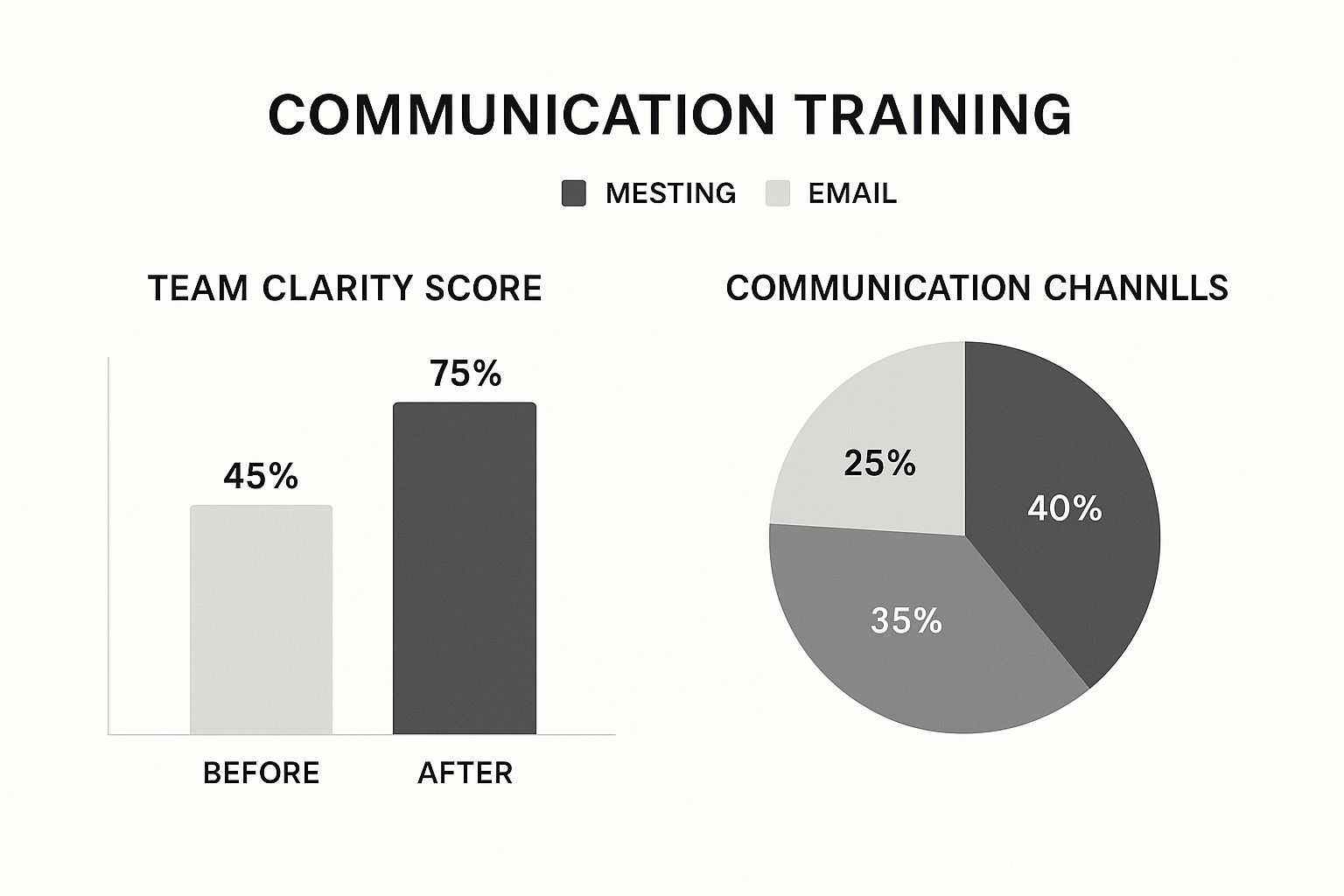
The data above shows just how much targeted efforts can pay off. After specific communication training, team clarity can jump by over 30%. It also highlights that meetings are still the main way leaders get their message across, making these focused data reviews even more critical.
Building a Simple Scorecard
To make this tangible, here’s a simplified look at how leading and lagging indicators work together on a scorecard. The goal is to set weekly targets for the activities you can control (leading) to influence the outcomes you want (lagging).
Example SaaS Leadership Scorecard
| Metric Category | Leading Indicator (Example) | Lagging Indicator (Example) | Weekly Goal |
|---|---|---|---|
| Sales | # of Demos Completed | New MRR | > 15 demos |
| Marketing | # of Qualified Leads (MQLs) | MQL-to-Customer Conversion Rate | > 100 MQLs |
| Product | % of Users Engaging with New Feature | Feature Adoption Rate | > 25% |
| Customer Success | # of Proactive Check-in Calls | Net Revenue Retention (NRR) | > 50 calls |
This simple structure keeps the team focused on the actions that drive results week in and week out.
The Weekly Scorecard Review
Just having a scorecard isn’t enough. The real power comes from reviewing it consistently. This shouldn’t be a long, drawn-out analysis. It’s a fast, focused check-in that should be a fixture of your weekly leadership meeting.
The routine is quick and effective:
- Review the numbers: Quickly go down the list of metrics.
- Spot what’s off: Is anything red or trending the wrong way?
- Ask “Why?”: The person who owns that metric gives a brief, no-fluff explanation.
- Create an action item: If it’s a real issue, you officially add it to your list of problems to solve during the meeting.
By committing just five minutes each week to this review, you turn abstract data into a productive conversation. It stops feeling like a report card and starts feeling like a team huddle focused on solving problems together. That shift is the bedrock of accountability.
This simple, repeatable rhythm ensures small issues get flagged and handled before they grow into major crises. It fundamentally changes leadership from a reactive, firefighting mode into a proactive, strategic function.
Mastering People Management and Development

Even with the best scorecards and meeting rhythms, it’s the people who make or break your operations. Effective business leadership isn’t just about hitting targets; it’s about building up your team. I’ve always believed that a leader’s most important job is to develop other great leaders and high-performers.
This all starts with crystal-clear expectations. Every single person on your team must know their exact role, what they’re responsible for, and what a “win” looks like for them. Get this wrong, and you end up with chaos, wasted effort, and zero ownership.
Clarifying Roles and Responsibilities
You can cut through the ambiguity with a surprisingly simple approach. Forget long, formal job descriptions. Instead, define each role’s core purpose and expected key results on a single page. This document becomes your anchor for every performance conversation.
This clarity is vital for building a diverse leadership team. Consider this: in 2023, women made up about 41.9% of the global workforce but held only 32.2% of senior leadership roles. This isn’t just an equity issue; it’s a performance issue. Companies with gender-diverse leadership are known to outperform their competitors by roughly 21%. Clear, fair development paths are not just nice to have—they are a competitive advantage.
The Power of Effective One-on-Ones
Once roles are clear, your one-on-one meetings become your single most important management tool. These aren’t just status updates. They are dedicated, protected time for coaching, untangling roadblocks, and talking about career growth.
I’ve found the most effective one-on-ones focus on three things:
- The Person: Start here. How are they doing? What’s going on in their world, both at work and outside of it?
- The Performance: Next, talk about the work. How are they tracking against their scorecard? Celebrate the wins and dig into what’s holding them back.
- The Path: Look ahead. What are their long-term career goals? How can you, as their manager, help them gain the skills to get there?
This structure transforms a tactical check-in into a genuine coaching session, which is one of the best ways to be the best people manager you can be.
Real-World Scenario: I once managed a sharp engineer whose output suddenly dropped. Instead of immediately calling out the missed deadlines, I used our one-on-one to ask how things were going. I found out he was completely burnt out from fixing legacy bugs and felt his skills were stagnating.
We came up with a plan on the spot. We agreed he’d spend 80% of his time on new feature development, which he was passionate about, and just 20% on the old tech debt. We then set a new, exciting goal for him using https://saasoperations.com/employee-key-performance-indicators/ tied to those new features. His motivation and productivity shot back up almost overnight. That’s what structured, human leadership does—it turns a retention risk into a re-energized contributor.
Scaling Excellence with Playbooks and SOPs

If you want to grow, you have to figure out how to clone your best practices. This isn’t about building a rigid, bureaucratic machine or micromanaging your team. It’s about codifying your core processes into simple playbooks and Standard Operating Procedures (SOPs).
Think of it this way: you’re giving your team a proven, efficient recipe for getting things done right, every single time. It builds consistency, which frees you up from fighting the same fires over and over again. That’s when you can finally focus on strategy.
The 80/20 Rule of Process Documentation
The thought of documenting everything is paralyzing. So don’t. Just lean on the Pareto Principle. Pinpoint the 20% of actions that drive 80% of your results and start there. It’s the path of least resistance for the biggest impact.
Take customer onboarding, a classic example. You don’t need a 50-page manual detailing every click. Instead, what are the make-or-break moments?
Your onboarding playbook should focus on the essentials:
- The script for that critical first kickoff call.
- A simple checklist for configuring the most important account settings.
- Email templates for the three most crucial follow-ups.
This gives your team a clear path to follow without getting lost in the weeds. If you’re looking for a deeper dive, our guide on building effective https://saasoperations.com/saas-playbooks/ is a great place to start.
Making Your Documentation a Living Resource
Here’s where most leaders drop the ball: they create SOPs, file them away, and forget they exist. These documents aren’t one-and-done projects; they must be living resources that grow with your business.
The ultimate purpose of a playbook is not to create rules, but to create consistency. It captures your “best way” of doing things right now, making excellence repeatable and training much simpler.
To get a head start, using well-structured Standard Operating Procedure templates can save you a ton of time and ensure you’re building on a solid foundation from day one.
Storing and Updating Your Playbooks
How you store your documentation is just as important as what’s in it. If your team can’t find what they need, or if the information is old, they’ll just ignore it.
Here’s how to keep your playbooks useful and relevant:
- Centralize Everything: Pick one spot and stick to it. A company wiki like Notion or Confluence, or even a well-organized Google Drive, works perfectly. The key is a single source of truth.
- Assign Clear Ownership: Every playbook needs an owner—someone responsible for keeping it fresh. This simple step creates accountability and prevents things from getting stale.
- Schedule Regular Reviews: Set a recurring calendar invite—maybe quarterly—to review your most critical playbooks. Processes change, tools get updated, and your documentation needs to reflect that reality.
When you build and maintain a library of simple, effective playbooks, you’re essentially bottling the magic that makes your business work. It’s how you make great results the standard, not the exception.
Got Questions About Building Your Leadership System?
It’s one thing to read about a framework, but putting it into practice in your own SaaS company? That’s where the real questions come up. Let’s dig into some of the most common hurdles I see operators face when they start building a real leadership system.
How Do I Get My Team on Board with This?
You can’t just drop a new system on your team and expect them to love it. Buy-in isn’t about top-down mandates; it’s about showing them what’s in it for them.
My advice? Start small. Don’t try to boil the ocean by rolling everything out at once. Pick one thing—maybe the weekly tactical meeting—and commit to doing it right for a solid month.
Once your team realizes these meetings are shorter, more focused, and actually solve the annoying problems that get in their way, they’ll start to see the light. Success creates its own momentum. Their good experience will make introducing scorecards or playbooks down the line feel like a natural next step, not another corporate chore.
Does This Actually Work for a Company My Size?
Yes, absolutely. Whether you’re a scrappy 10-person startup or a 500-person company hitting its growth stride, the core ideas are the same: clarity, accountability, and a predictable rhythm.
- If you’re small: Your “leadership team” might just be… everyone. That’s fine. Your scorecard might only have five key numbers on it. The goal is to build the muscle memory for clear communication and data-backed decisions from day one.
- If you’re bigger: You just scale the system. The sales leadership has their meeting rhythm and scorecard. Marketing has theirs. Product has theirs. Each team’s scorecard then rolls up to a high-level executive view.
The tools don’t change, just the scope.
The biggest mistake I see is companies waiting until they’re “big enough” for a leadership system. The truth is, installing these habits when you’re small is what allows you to grow without everything falling apart.
How Do I Know If This Is Actually Working? What’s the ROI?
It’s easy to think of leadership development as “soft stuff,” but you can absolutely measure its impact. In fact, the tools you’re implementing are the very things that will give you the data to prove it.
Look for direct changes in your scorecard metrics. Are you hitting your goals more often? Is that key feature adoption metric finally moving up and to the right? According to research from Harvard Business School, getting your team involved in decisions—which is central to this system—drives better strategic results.
You can also track things like employee engagement and retention. When people feel heard and empowered, they stick around. Lower turnover isn’t just a nice-to-have; it has a very real, and very positive, impact on your bottom line.
At SaaS Operations, we’ve built a library of battle-tested playbooks, templates, and SOPs you can put to work immediately. Stop reinventing the wheel and start building a more effective business. Check out our resources at SaaS Operations.