7 Actionable Bootstrapped SaaS Success Stories & Playbooks for 2025
 Published By: Alex
December 7, 2025
Published By: Alex
December 7, 2025
Forget motivational quotes. Real growth is built on the specific, tactical decisions that turn a side project into a profitable, self-sustaining business. We're moving past generic inspiration to deliver a tactical playbook, dissecting the resources that profile impressive bootstrapped saas success stories to uncover the exact frameworks, metrics, and processes they used to win.
This isn't just a list of who succeeded. It's a deep dive into how they did it, using real examples from SaaS operators. We'll break down the nitty-gritty details, from go-to-market motions to the operational scorecards that kept them lean. A cornerstone of bootstrapped success is rigorous financial discipline, which often involves implementing smart strategies to reduce operational costs without sacrificing momentum. You'll get behind-the-scenes insights into their playbooks, giving you a clear roadmap of replicable steps for your own SaaS.
Each example below is a mini-masterclass, complete with direct links and screenshots, designed to give you actionable takeaways you can implement today. We’re focusing on the resources that provide the most depth: platforms where founders like Pieter Levels (Nomad List) and Arvid Kahl (FeedbackPanda) share raw data, and curated vaults from operators who have been in the trenches. Let's get to the actionable part.
1. Indie Hackers
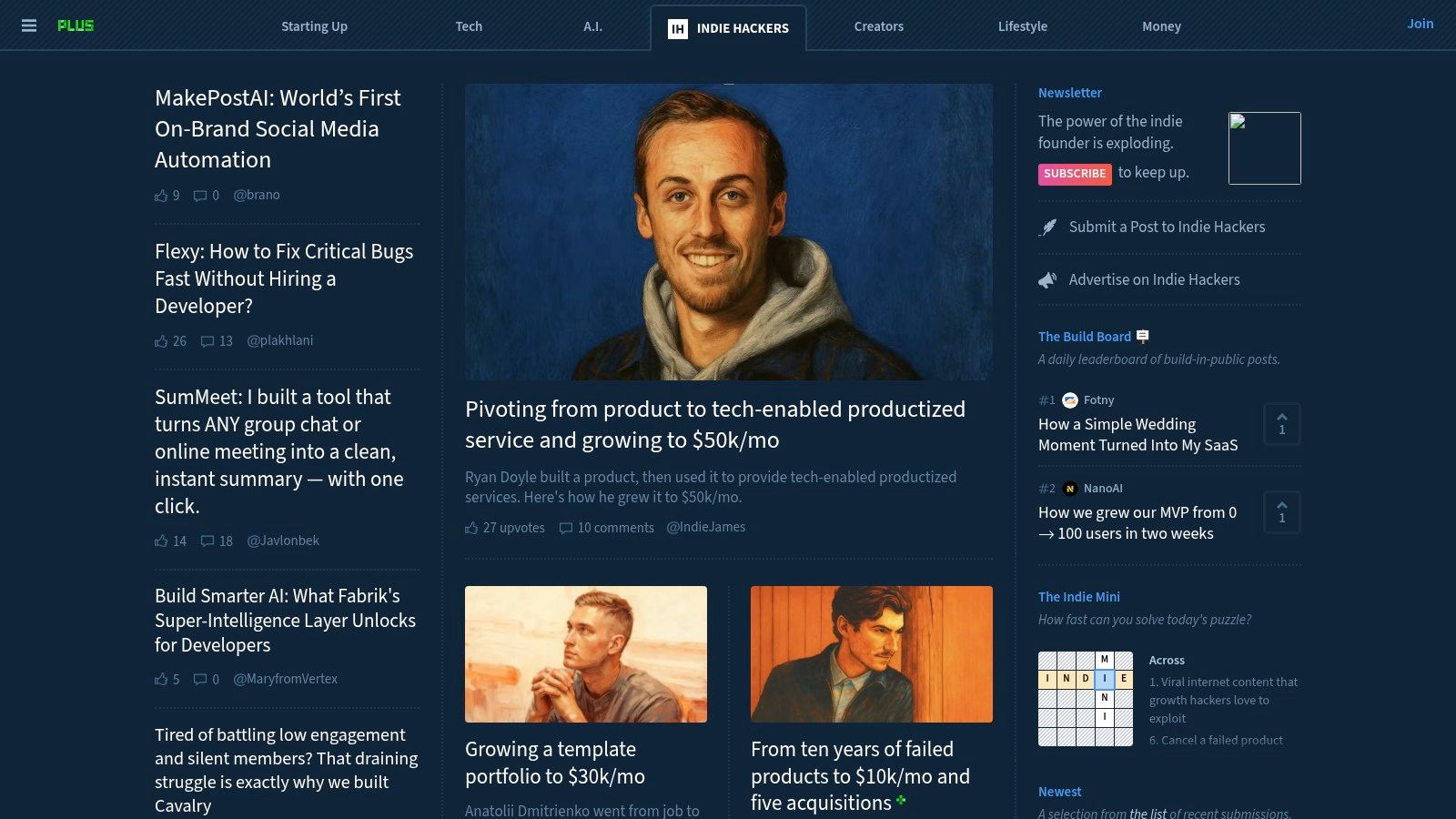
If you're looking for raw, unfiltered bootstrapped SaaS success stories, Indie Hackers is ground zero. It’s less of a curated library and more of a living, breathing community where founders document their entire journey, from the first line of code to their first $10k in Monthly Recurring Revenue (MRR) and beyond. The platform's core value is transparency, with founders openly sharing revenue numbers, marketing tactics, and even their biggest failures.
What makes Indie Hackers unique is the sheer volume of real-time case studies. Instead of polished "how I did it" articles written years later, you get to see the messy middle. For example, you can follow a founder's exact process of validating an idea, getting the first 10 customers through direct outreach, and A/B testing their pricing—all documented with real numbers. This creates an unparalleled resource for seeing what’s actually working right now in the bootstrapped world.
Why It’s a Goldmine for SaaS Founders
Indie Hackers isn't just a place to read stories; it's a playbook generator. You can filter posts by revenue, product type (like SaaS), or technology stack to find founders with journeys similar to your own. The platform is completely free to use, making it an accessible resource for anyone starting out. The content is user-generated, which is both a pro and a con: the quality varies, but the authenticity is unmatched.
Many of the stories you'll find on Indie Hackers focus on building a bootstrapped Micro-SaaS, which offers a more manageable entry point for new founders.
How to Use Indie Hackers Effectively
To get the most out of the platform, don't just be a lurker.
- Filter Smartly: Use the product directory and filter by "Bootstrapped" and "SaaS." Sort by revenue or recent activity to find relevant stories.
- Study the Milestones: Pay close attention to the "Milestones" section. This is where founders post specific updates like "Hit $1k MRR" or "Acquired our first 100 users," often detailing the exact tactics used, such as the cold email template that worked or the SEO strategy that ranked a key landing page.
- Engage with the Community: Ask specific, tactical questions. Instead of "How do I grow?", ask "For those who hit $5k MRR, what was your most effective customer acquisition channel in the first year?".
- Follow Inspiring Founders: Find a few founders whose journey resonates with you and follow their progress. It’s like having a real-time mentor.
Indie Hackers provides the granular, tactical details that are often missing from high-level success stories, making it an essential tool for any aspiring bootstrapped SaaS founder.
| Feature Analysis | Strategic Value for SaaS Founders |
|---|---|
| Transparent Revenue Data | See real-world MRR, churn, and user growth figures to benchmark your own progress. |
| Founder Interviews & AMAs | Get direct answers to your tactical questions from founders who have "been there, done that." |
| Topical Groups | Join groups like "SaaS" or "Marketing" to find focused discussions and peer support. |
| Milestone Posts | Learn the specific actions that led to tangible results, like hitting a revenue goal. |
Website: https://www.indiehackers.com
2. Starter Story – SaaS Success Stories
Where Indie Hackers is a real-time community stream, Starter Story is a meticulously curated library of founder interviews. It’s an essential resource for finding detailed bootstrapped SaaS success stories that have been structured for easy digestion. The platform excels at breaking down complex entrepreneurial journeys into skimmable, data-rich case studies, complete with revenue figures, startup costs, and key marketing channels.
What sets Starter Story apart is its structured, interview-based format. Each story follows a consistent Q&A pattern, guiding you through the founder’s ideation process ("Describe the process of designing, prototyping, and manufacturing your first product"), launch strategy ("Describe the process of launching the business"), and growth engine ("What has worked to attract and retain customers?"). This makes it incredibly efficient to compare different SaaS businesses and identify replicable tactics.

Why It’s a Goldmine for SaaS Founders
Starter Story is a playbook for idea validation and go-to-market strategy. You can see what it really costs to start a similar business and how long it took others to find product-market fit. For instance, you might discover that three different successful CRM SaaS for dentists all got their first 50 customers by attending the same two industry conferences. While some of the deepest content requires a free signup or paid membership, the sheer volume of free, high-quality summaries provides immense value upfront.
The content covers a wide spectrum, from small side projects generating $1k MRR to multi-million ARR businesses. This variety is perfect for founders at any stage, whether you are just starting your bootstrapped SaaS journey or looking to scale an existing product.
How to Use Starter Story Effectively
To get the most out of the platform, approach it like a researcher.
- Filter with Purpose: Use the dedicated "SaaS Company" filter and then narrow down by revenue, business model, or niche to find the most relevant case studies.
- Analyze the Numbers: Pay close attention to the structured data points: startup costs, MRR/ARR, and team size. Use these to benchmark your own plans and set realistic goals.
- Deconstruct the "How You Grew" Section: This is often the most valuable part. Founders detail their top marketing channels and specific tactics that worked. Look for patterns across multiple successful SaaS companies.
- Study the "Advice for Other Entrepreneurs": This section contains hard-won lessons. It’s a great place to find non-obvious tips on everything from product development to mental resilience.
Starter Story transforms inspirational stories into actionable data, making it a crucial tool for any founder who wants a strategic blueprint based on proven success.
| Feature Analysis | Strategic Value for SaaS Founders |
|---|---|
| Structured Data Fields | Easily compare ARR, startup costs, and team size across hundreds of SaaS businesses. |
| Dedicated SaaS Category | Quickly access a filtered database of relevant case studies without noise. |
| Consistent Interview Format | Find specific information (e.g., launch strategy) in the same place for every story. |
| Marketing Channel Breakdowns | Discover which channels are driving growth for SaaS companies in your niche. |
Website: https://www.starterstory.com/ideas/saas-company/success-stories
3. MicroConf Video Vault
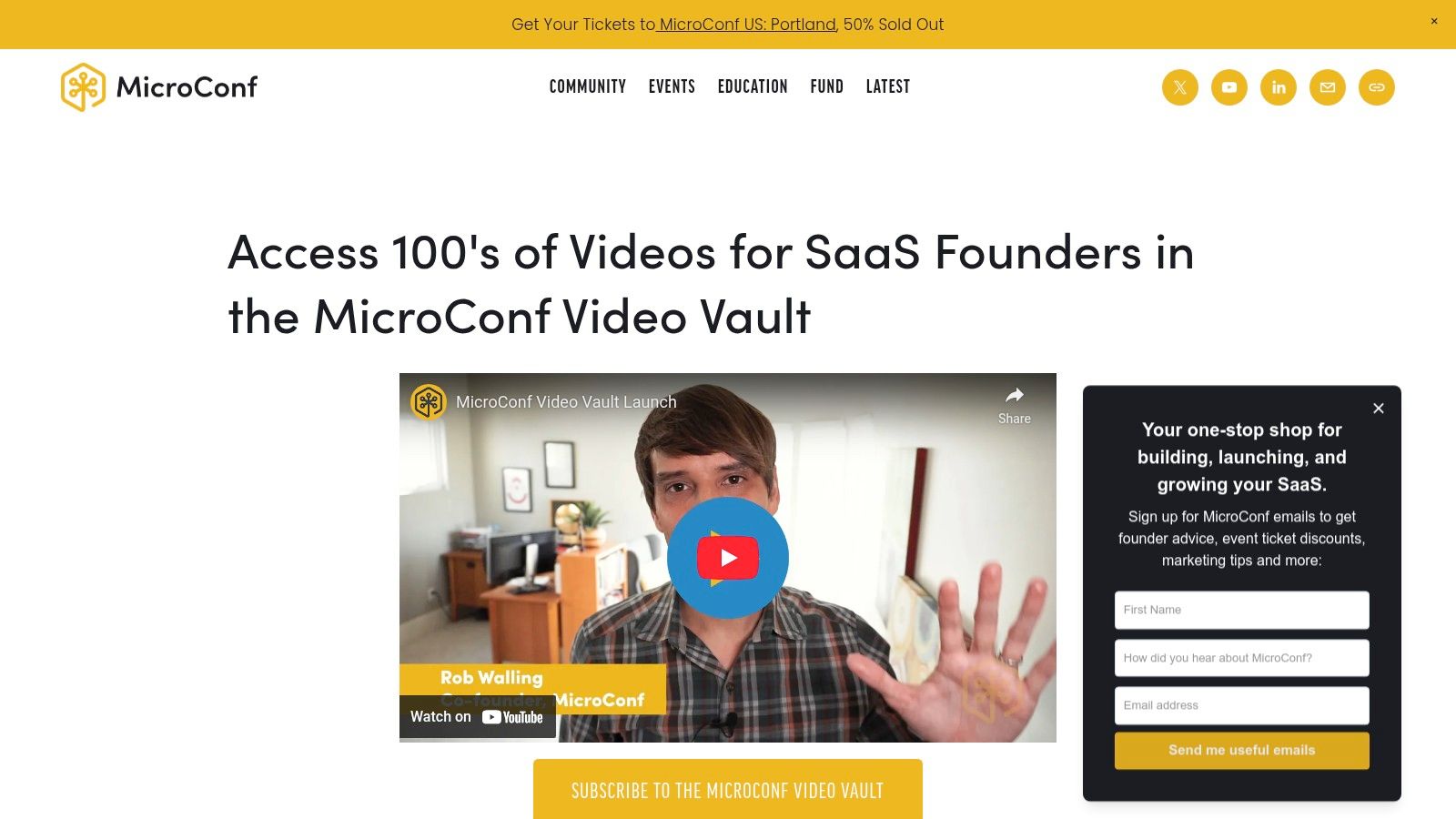
Where Indie Hackers gives you the raw, real-time journey, the MicroConf Video Vault offers the curated, distilled wisdom from those who have already reached the finish line. This is a free library of conference talks from some of the most respected and successful bootstrapped founders in the world. Instead of a forum, you get polished, high-impact presentations on everything from pricing and positioning to scaling and selling your SaaS.
What makes the MicroConf Vault so powerful is the quality of the content. These aren't just motivational speeches; they are tactical, in-depth breakdowns of the strategies that built profitable, self-funded companies. Listening to a talk from a founder like Rob Walling or Rand Fishkin is like getting a masterclass in building a sustainable business, making it a key resource for finding actionable bootstrapped SaaS success stories. For example, a talk on pricing won't just say "value-based pricing is good"; it will walk you through the exact survey questions to ask customers and how to translate their answers into specific pricing tiers.
Why It’s a Goldmine for SaaS Founders
The MicroConf Video Vault is a treasure trove of battle-tested strategies, completely free of charge. The speakers are practitioners, not just theorists, sharing the exact frameworks and mental models they used to grow their businesses. The content is hyper-focused on the unique challenges of self-funded and indie founders, so you won't find any irrelevant advice about raising venture capital.
Many of the presentations are essentially pre-packaged SaaS playbooks, giving you a step-by-step guide to tackling a specific problem, whether it's setting your first pricing tier or hiring your first employee. While some talks are high-level, most are packed with actionable insights you can apply immediately.
How to Use the MicroConf Video Vault Effectively
To avoid getting lost in over 170 hours of content, a focused approach is key.
- Follow the "Paths": MicroConf has curated learning paths like "Build & Launch Your First SaaS." Start with these to get a structured education on a specific topic.
- Search by Problem: Have a specific challenge, like churn or product positioning? Use the search function to find talks that directly address your current roadblock.
- Focus on Practitioners: Look for talks by founders who have built companies similar to what you're trying to build. Their advice will be the most relevant and tactical.
- Take Actionable Notes: Don't just watch passively. For each video, write down one to three specific actions you can take in your business in the next week. For instance, after watching a talk on SEO, your action item might be "Implement the 'spoke-and-hub' content model for our top 3 features."
The Vault is the perfect complement to the real-time chaos of forums, offering structured, expert-led guidance for every stage of the bootstrapped journey.
| Feature Analysis | Strategic Value for SaaS Founders |
|---|---|
| Curated Expert Talks | Learn proven frameworks directly from successful founders, saving you from costly trial and error. |
| Bootstrapper-Specific Focus | All content is tailored to the unique constraints and opportunities of self-funded businesses. |
| Themed Learning Paths | Get a structured, step-by-step education on core SaaS topics like launching or marketing. |
| Free, High-Quality Content | Access conference-level insights and strategies without the high cost of a ticket. |
Website: https://microconf.com/latest/microconf-video-vault
4. Bootstrappers (Bootstrappers.com)
If Indie Hackers is the raw, real-time feed, Bootstrappers.com is the polished, editorially curated documentary. This online publication focuses exclusively on bootstrapped saas success stories and other founder-led businesses, presenting them as well-crafted narratives. Instead of sifting through forum posts, you get a collection of in-depth case studies that read like magazine features, complete with timelines, key metrics, and hard-won lessons.
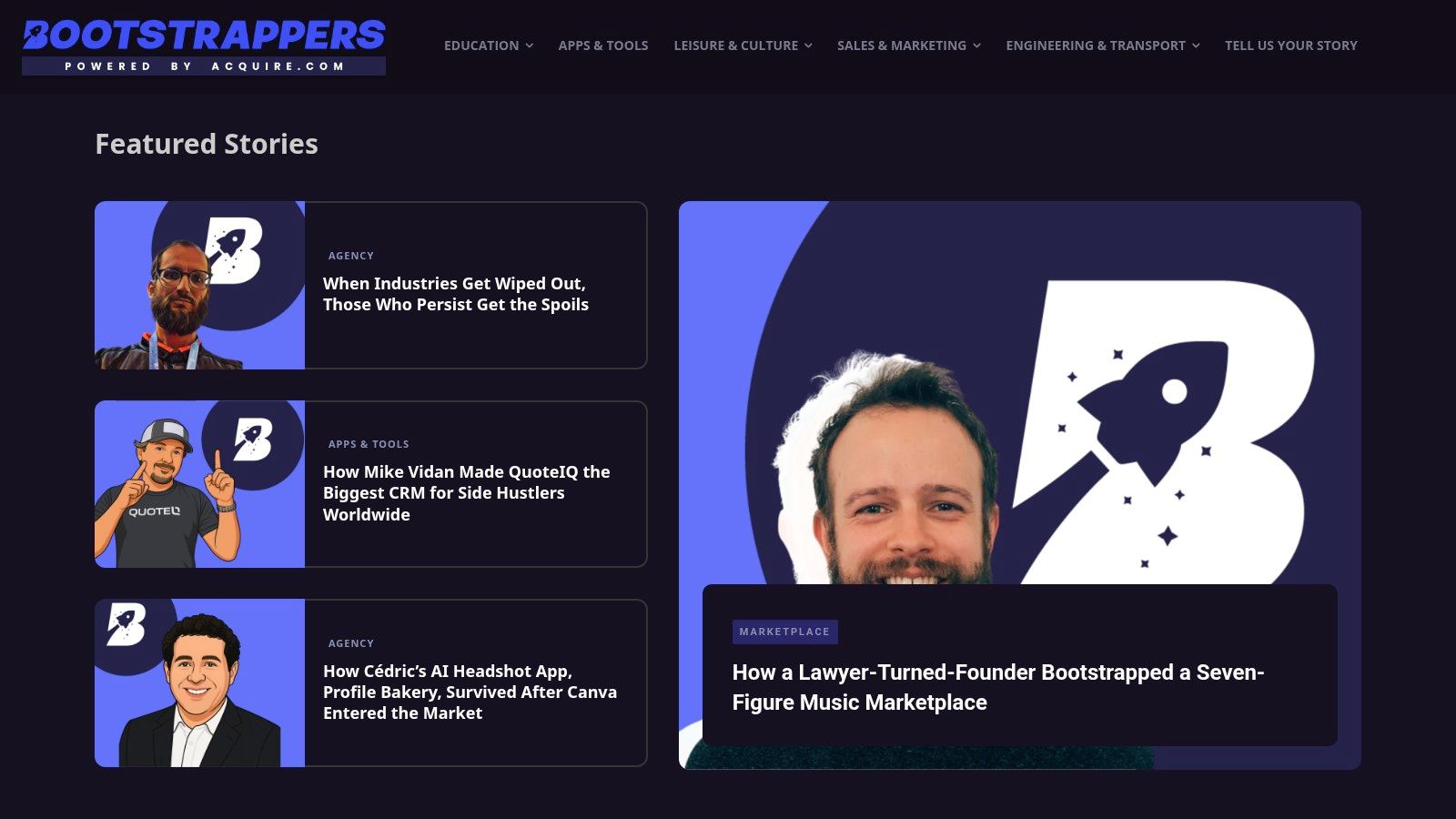
What sets Bootstrappers apart is its focus on the story behind the numbers. Each article digs into the founder's journey, highlighting the critical pivots, the "aha!" moments, and the specific strategies that led to breakthroughs. For example, a story might detail how a founder transitioned from a services business to a SaaS product, including the exact scripts they used to convert their first service clients into recurring software customers. The content is designed for easy consumption and sharing, making it a great resource for motivating your team or studying a specific growth model. It’s completely free to access all the articles.
Why It’s a Goldmine for SaaS Founders
Bootstrappers.com excels at turning complex founder journeys into digestible, actionable playbooks. The narrative style makes the lessons more memorable, and the editorial curation ensures you’re only reading high-quality, insightful content. While it includes stories from marketplaces and agencies, the SaaS case studies are rich with detail, covering everything from initial product-market fit to scaling past seven figures in revenue.
The platform provides a different learning experience: it’s less about community interaction and more about deep, focused learning from a single, well-told story. This makes it an excellent source for strategic inspiration when you’re planning your next major move.
How to Use Bootstrappers.com Effectively
To extract the most value, treat each story like a blueprint you can deconstruct.
- Read for Patterns: Since the stories are editorially consistent, look for recurring themes in marketing channels, pricing strategies, or customer acquisition tactics across different SaaS businesses.
- Study the Timelines: Pay close attention to the timelines provided in many articles. They reveal the often-slow, non-linear path to success and help set realistic expectations for your own journey.
- Subscribe to the Newsletter: This is the best way to get new, high-quality case studies delivered directly to you, ensuring you don’t miss out on the latest insights.
- Focus on the "Lessons Learned": Each article typically summarizes the key takeaways. Use these as a checklist to audit your own strategies. For example, if a lesson is "We niched down to serve only accountants," ask yourself if your own target market is specific enough.
Bootstrappers.com offers a high-signal, low-noise environment for learning from those who have successfully navigated the challenging path of building a business from the ground up.
| Feature Analysis | Strategic Value for SaaS Founders |
|---|---|
| Editorially Produced Case Studies | Get high-quality, well-structured narratives that are easy to digest and share. |
| Narrative-Style Articles | Learn the "why" behind the "what," making the strategic lessons more memorable and applicable. |
| Founder Journey Timelines | Gain a realistic perspective on growth, seeing the actual time it takes to hit major milestones. |
| Focus on Practical Takeaways | Each story concludes with clear, actionable lessons you can apply to your own SaaS operations. |
Website: https://bootstrappers.com
5. TinySeed – Case Studies & TinySeed Tales
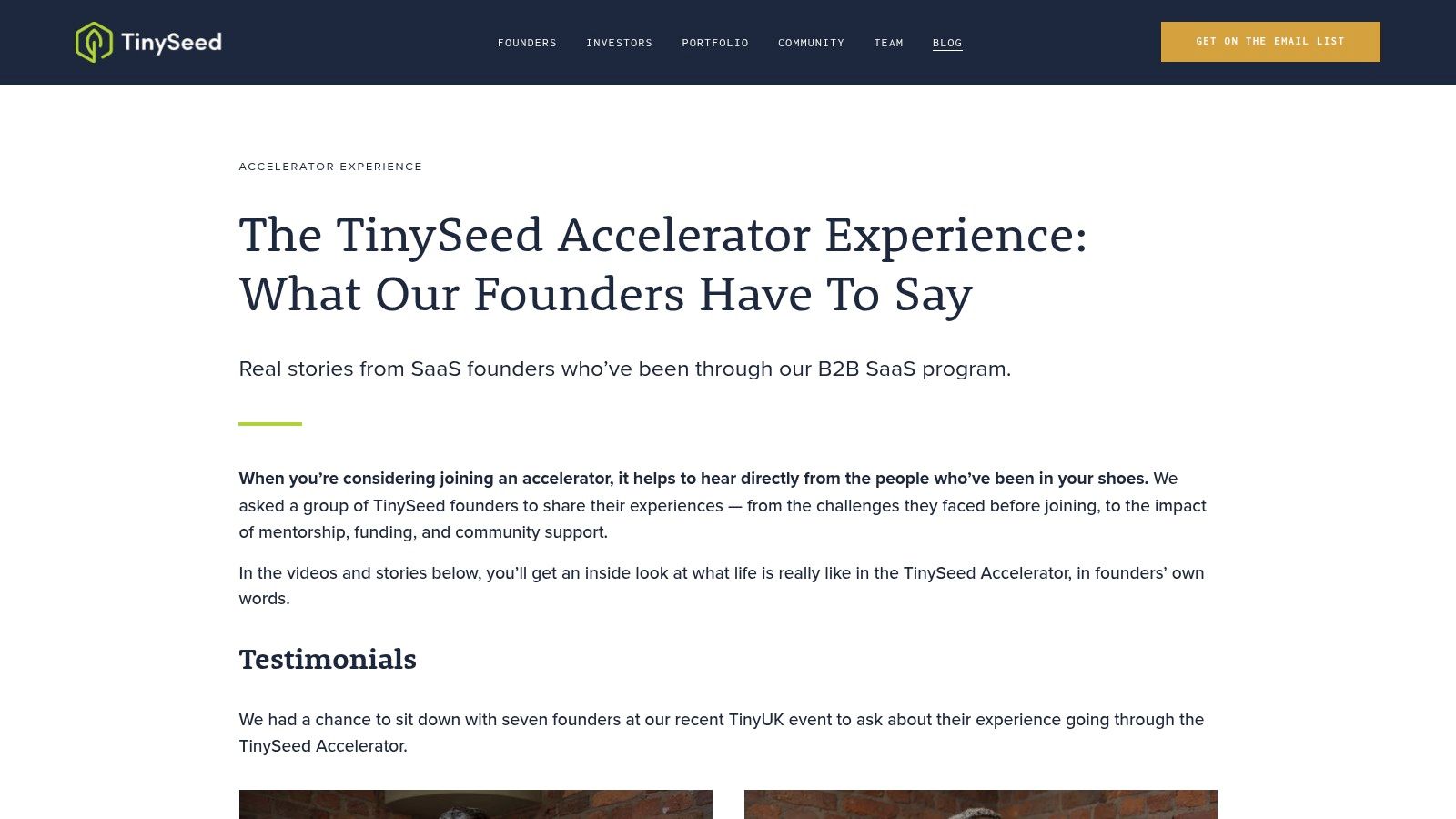
While communities offer breadth, TinySeed provides curated depth. As an accelerator designed for B2B SaaS bootstrappers, their content functions as a masterclass in calm, sustainable growth. Their blog and TinySeed Tales podcast aren't just one-off interviews; they are longitudinal studies that follow founders over months, documenting the real struggles and breakthroughs on the path to product-market fit and beyond.
What makes TinySeed’s content unique is its focus on the "post-launch, pre-scale" phase of a SaaS business. This is where many founders get stuck, and TinySeed’s case studies offer a guided look at navigating this critical period. You get to hear founders wrestle with pricing ("We increased prices by 30% and churn stayed flat"), marketing channels ("LinkedIn ads were a bust, but cold email to a specific persona worked"), and hiring decisions in near real-time, providing a rare look into the strategic thinking required to build a lasting company.
Why It’s a Goldmine for SaaS Founders
TinySeed offers a filtered, high-signal resource for serious B2B SaaS founders. The stories are less about flashy growth hacks and more about building solid operational foundations. All content is free to access, though it naturally highlights the journeys of founders who have been through their accelerator program. This focus ensures the advice is pragmatic, tested, and directly relevant to founders aiming for sustainable profitability.
The case studies and podcast seasons are particularly useful for understanding the nuances of growing B2B SaaS, from nailing a niche to managing the slow ramp of increasing your Annual Recurring Revenue.
How to Use TinySeed’s Content Effectively
To extract the most value, treat their content like a strategic course.
- Listen to Full Podcast Seasons: Instead of cherry-picking episodes, listen to a full season of TinySeed Tales to follow one founder’s complete arc. This reveals the non-linear path of progress.
- Analyze the Case Studies: Read the in-depth articles on their alumni. Pay attention to not just what they did, but why they made certain decisions.
- Connect the Dots: Notice the recurring themes across different stories, such as the importance of community, niching down, and patient capital.
- Study the Accelerator Model: Even if you don't plan to apply, understanding the TinySeed thesis can help you think more like a strategic, long-term operator.
TinySeed provides a curated collection of bootstrapped SaaS success stories that prioritize sustainable growth over venture-backed speed, making it an invaluable resource for founders building for the long haul.
| Feature Analysis | Strategic Value for SaaS Founders |
|---|---|
| Longitudinal Narratives | See how strategies evolve over months, not just in a single "success" snapshot. |
| B2B SaaS Focus | Get highly relevant advice on B2B-specific challenges like sales cycles, pricing, and integrations. |
| Podcast & Blog Content | Absorb insights in your preferred format, whether you’re reading or listening on the go. |
| Accelerator Case Studies | Learn from a curated group of founders who have received mentorship and funding to scale. |
Website: https://tinyseed.com/latest/the-tinyseed-accelerator-experience
6. Baremetrics – Open Startups
If Indie Hackers provides the stories, Baremetrics' Open Startups initiative provides the hard evidence. This is where transparency goes from qualitative to quantitative. The platform is a collection of SaaS companies that have chosen to make their key business metrics completely public, from Monthly Recurring Revenue (MRR) and churn to customer lifetime value (LTV). It strips away the narrative to show you the raw, unfiltered data behind bootstrapped SaaS success stories.
What makes Open Startups so powerful is its focus on real-time, verifiable data. Instead of relying on a founder's recollection of their growth journey, you can see the numbers as they are, right now. It allows you to analyze growth trajectories, understand the impact of seasonality, and see what healthy (or unhealthy) churn rates actually look like in the wild. This data-first approach provides an objective lens through which to view a company's health.

Why It’s a Goldmine for SaaS Founders
Baremetrics – Open Startups is essentially a free benchmarking tool. Wondering if your 5% monthly churn is normal for a B2B SaaS at $10k MRR? You can find a similar company on the list and compare their data. It grounds your ambitions in reality and helps you set more realistic goals. The directory is completely free to browse, making it one of the most valuable resources for data-driven founders.
The data here is perfect for understanding key performance indicators and seeing how they interconnect. For a deeper dive into what these numbers mean, you can learn more about SaaS metrics benchmarks.
How to Use Baremetrics – Open Startups Effectively
To leverage this data, you need to be an analyst, not just a spectator.
- Find Your "Startup Twin": Look for a company in the directory that is similar to yours in terms of business model, target audience, or price point. This makes for the most relevant comparison.
- Analyze Trends, Not Snapshots: Don't just look at today's MRR. Use the historical data to see how metrics like ARPU (Average Revenue Per User) and LTV have evolved over time. What caused spikes or dips?
- Study the "Leaky Bucket": Pay close attention to churn metrics. Seeing real-world user and revenue churn rates can help you understand how critical retention is for long-term growth.
- Cross-Reference with Stories: Pair the data you find here with founder interviews or blog posts from that same company. The numbers from a company like ConvertKit tell you what happened; Nathan Barry's blog posts tell you why.
Baremetrics – Open Startups provides the quantitative backbone that gives context to the qualitative stories you'll find elsewhere, making it an indispensable resource for any founder who wants to build their business on a foundation of solid data.
| Feature Analysis | Strategic Value for SaaS Founders |
|---|---|
| Public SaaS Metrics | Access real-time MRR, churn, LTV, and customer counts for direct comparison. |
| Historical Data Dashboards | Analyze growth trends over months or years to understand long-term business trajectory. |
| Diverse Company Profiles | Find bootstrapped SaaS companies at various stages of growth to benchmark your own KPIs. |
| Free to Access | Gain invaluable competitive and market insights without any financial investment. |
Website: https://baremetrics.com/open-startups
7. The SaaS Playbook (by Rob Walling)
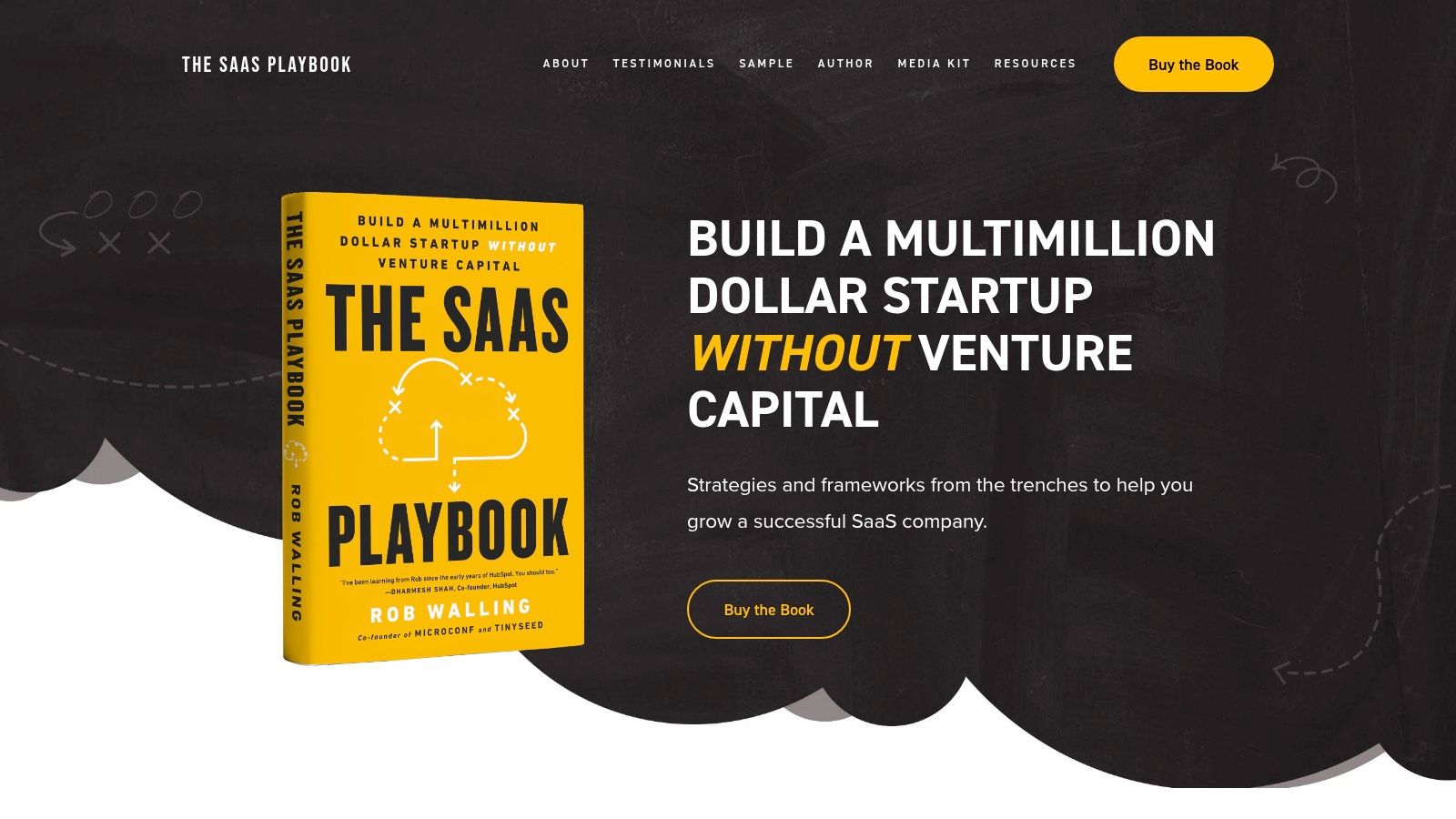
While not a platform in the traditional sense, Rob Walling's The SaaS Playbook is a foundational resource that encapsulates decades of bootstrapped SaaS success stories into one concise guide. Walling, a veteran bootstrapper and founder of TinySeed, has distilled the essential frameworks for building and scaling a B2B SaaS business without venture capital. It's a strategic map drawn from his own experiences and those of hundreds of founders he's advised.
This book cuts through the noise and provides a step-by-step guide to the most critical stages of a SaaS journey. It focuses on the non-obvious hurdles that trip up founders, like finding the right market, pricing effectively, and knowing which metrics to ignore. Instead of abstract theory, it offers concrete, battle-tested advice for making decisions that lead to sustainable, profitable growth. For example, it provides a specific framework for validating an idea with pre-sales before writing any code.
Why It’s a Goldmine for SaaS Founders
The SaaS Playbook acts as a mentor in a book, providing a reliable framework you can return to at every growth stage. Walling's perspective is deeply rooted in the bootstrapped ethos of capital efficiency and long-term thinking. The book is available directly from its website in digital (PDF, ePub, Mobi), audiobook, and hardcover formats, with team pricing available, making it an affordable and accessible asset. The content is designed to be immediately applicable, giving you an operational playbook rather than just high-level inspiration.
Many of the concepts address common failure points for bootstrappers, such as premature scaling or getting stuck on a product with no real market demand. It’s the kind of guide that saves you years of trial and error.
How to Use The SaaS Playbook Effectively
To get the most value, treat it as an active workbook, not a passive read.
- Read Before You Build: Go through the sections on market selection and idea validation before writing a single line of code to avoid building a "solution in search of a problem."
- Revisit for Each Stage: Use the pricing chapter when you're setting initial prices or considering a price change. Refer to the metrics section when building your first dashboard.
- Apply the Frameworks: Don't just read the advice. Actively use Walling's frameworks, like the "Stair Step Method," to map out your own entrepreneurial path.
- Discuss with Your Team: Use the book as a basis for strategic discussions with your co-founder or early hires to ensure everyone is aligned on the bootstrapping philosophy.
This book provides the strategic clarity that many founders lack, making it an indispensable resource for building a SaaS business on your own terms.
| Feature Analysis | Strategic Value for SaaS Founders |
|---|---|
| Actionable Frameworks | Provides clear, step-by-step models for market selection, pricing, and growth. |
| Focus on Bootstrapped Metrics | Helps you focus on key KPIs like LTV:CAC and payback periods, not vanity metrics. |
| Lessons from Experience | Offers distilled wisdom from decades of building, advising, and investing in SaaS companies. |
| Sustainable Scaling Advice | Teaches you how to grow methodically without relying on external funding. |
Website: https://saasplaybook.com
Comparison of 7 Bootstrapped SaaS Success Stories
| Resource / Source | Complexity 🔄 | Resource needs ⚡ | Expected outcomes 📊 | Ideal use cases 💡 | Key advantages ⭐ |
|---|---|---|---|---|---|
| Indie Hackers | Low — browse & post; user-curated | Low — free; time to read/curate | Current founder journeys with granular revenue & tactics | Discover tactics, peer feedback, niche case studies | Large free community; many real-world revenue reports |
| Starter Story – SaaS Success Stories | Moderate — searchable database & filters | Low–Moderate — mostly free; some gated content | Structured case studies with ARR/MRR, costs, channels | Idea validation, channel research, quick comparisons | High-readability summaries with concrete numbers |
| MicroConf Video Vault | Moderate — watching & following learning paths | Moderate — time investment to watch talks | In-depth tactical talks on pricing, positioning, growth | Deep learning from practitioners; guided skill development | High-quality, curated talks targeted to bootstrappers |
| Bootstrappers (Bootstrappers.com) | Low — editorial reading & newsletters | Low — free articles; subscribe for updates | Narrative case studies highlighting lessons & pivots | Team sharing, practical lessons, broad founder stories | Well-edited stories with actionable takeaways |
| TinySeed – Case Studies & TinySeed Tales | Moderate — longitudinal reads & podcasts | Moderate — fewer but deeper pieces, podcasts | Longitudinal build-in-public narratives tracking PMF | Follow multi-month founder journeys; B2B SaaS focus | In-depth, time-series founder stories; accelerator insight |
| Baremetrics – Open Startups | Low — view live dashboards & profiles | Low — free public dashboards (participation varies) | Real-time KPIs (MRR, churn) for benchmarking | KPI benchmarking, retention & growth pattern analysis | Hard numbers for benchmarking; data-first transparency |
| The SaaS Playbook (by Rob Walling) | Low — read and apply frameworks | Low — affordable book/digital purchase | Actionable frameworks for building/scaling bootstrapped SaaS | Convert guidance into an operational playbook for teams | Concise, tactical guidance from a trusted bootstrapped voice |
Turn These Stories Into Your Standard Operating Procedure
We've just walked through a goldmine of resources, from the raw journeys on Indie Hackers to the transparent data in Baremetrics' Open Startups. Inspiration doesn't pay the bills. The gap between reading about someone else's seven-figure exit and building your own sustainable business is a bridge made of systems and processes.
The founders behind successful bootstrapped companies like Carrd, SavvyCal, and Basecamp didn't just stumble upon product-market fit. They meticulously built, tested, and refined operational playbooks for every part of their business. They didn't have a massive venture-backed war chest, so they had to be smarter and more efficient. Their success is a testament to the power of methodical execution.
The real magic isn't in the initial idea; it's in the repeatable systems that allow you to acquire customers, onboard them effectively, and keep them happy, all while you, the founder, build a scalable business instead of a high-stress job.
From Inspiration to Implementation: Your Action Plan
So, how do you turn these case studies into your company's reality? You stop admiring the stories and start dissecting the playbooks. The next step is to translate the patterns you’ve seen into a concrete operational framework for your own SaaS.
Here are the exact next steps you can take, based on the playbooks of successful founders:
-
Start with One Painful Problem: Don’t try to build a massive, all-in-one solution. Identify a niche, underserved audience (e.g., "podcast editors," not "creators") and solve one specific, high-value problem for them. This focus is your biggest advantage.
-
Obsess Over Early Customers: The founders in these stories didn't hide behind analytics dashboards. They were in the trenches, talking to every single user, doing manual onboarding, and using that direct feedback to shape their roadmap. Your first 100 customers are your R&D department.
-
Build in Public (Strategically): Sharing your journey, metrics, and milestones, like the companies in Baremetrics, builds trust and a community around your product before you have a large marketing budget. A simple monthly update email or tweet thread detailing revenue, user count, and one key learning can be incredibly powerful.
-
Embrace Lean Tooling: You don't need a complex and expensive tech stack. Successful bootstrappers leverage simple, effective tools and focus on automation to create leverage. Ask yourself: "Can a Zapier workflow replace this manual task?" before hiring or buying new software.
Building Your Operational Flywheel
The common thread connecting all of these bootstrapped saas success stories is the shift from founder-led hustle to process-driven growth. The goal is to build a business that runs on systems, not on your personal burnout.
This starts by documenting everything. What is your exact process for handling a new support ticket? How do you follow up with a trial user who is about to churn? Writing these things down is the first step toward creating a scalable operation. To effectively implement the lessons from these founders into your own business, a solid framework for repeatable processes is essential. You can learn more about how to create standard operating procedures that work. This isn't about creating corporate bureaucracy; it's about creating clarity and consistency so you can delegate and automate with confidence.
These stories prove that you don't need millions in funding to build a wildly successful SaaS company. What you do need is a relentless focus on solving a real problem and the discipline to build the operational systems that will carry you from your first dollar to your first million and beyond. Your journey starts now. Go build your playbook.
Tired of trying to reinvent the wheel? The founders we covered built their success on proven systems, and at SaaS Operations, we've turned those exact strategies into plug-and-play playbooks and templates for you. Stop guessing and start implementing the battle-tested processes that drive efficient, bootstrapped growth by visiting us at SaaS Operations.