
So, what exactly is a bootstrapped micro-SaaS? Think of it as a small, focused software business that you fund yourself. It’s built to solve one very specific problem for a very specific group of people. This approach isn’t about chasing explosive growth like venture-backed startups. Instead, it’s all about creating sustainable profit and giving the founder freedom—a perfect fit for indie hackers and solopreneurs who want to build on their own terms.
Embracing the Bootstrapped Micro-SaaS Mindset

Running a bootstrapped micro-SaaS is less of a business model and more of a philosophy. It’s about building a lean, efficient, and profitable company without having to answer to investors. The whole idea is to find a nagging, painful problem that a niche group faces and then craft a simple, elegant software solution that fixes it.
Forget about building a massive, all-in-one platform that tries to do everything. Your strength lies in doing one thing exceptionally well.
- Laser-Focused Niche: Real success in this space comes from serving a small, clearly defined market. Maybe it’s a project management tool just for freelance illustrators, or a social media scheduler designed specifically for local bakeries.
- Lean and Mean Operations: As a founder, you’ll wear a lot of hats. You’re the developer, the marketer, and the customer support team all rolled into one. The goal is to keep your costs rock-bottom and automate everything you possibly can.
- Profit from Day One: Unlike startups that can afford to burn through cash to get users, a bootstrapped business needs to make money early on to survive. Profit isn’t just a goal; it’s your lifeline and the truest measure of success.
By choosing this path, you’re swapping the high-risk, high-reward world of venture capital for a more measured and sustainable journey. You keep 100% ownership and creative control, letting you steer the ship based on what your customers actually want, not what a boardroom dictates.
Bootstrapped vs. Venture-Backed SaaS At a Glance
To really get a feel for this model, it’s helpful to see it side-by-side with its venture-backed cousin. One is a marathon built on endurance and steady profit, while the other is an all-out sprint fueled by outside money.
This table offers a quick look at the fundamental differences to help you decide which path makes sense for you.
| Attribute | Bootstrapped Micro SaaS | Venture-Backed SaaS |
|---|---|---|
| Primary Goal | Sustainable Profit & Freedom | Rapid Growth & Market Share |
| Funding Source | Founder’s Own Capital/Revenue | Venture Capital, Angel Investors |
| Target Market | Niche, Underserved Audience | Broad, Large-Scale Market |
| Decision Making | Founder-Controlled | Investor & Board-Influenced |
| Pace of Growth | Slow and Steady | Aggressive, “Blitzscaling” |
| Success Metric | Profitability & Lifestyle | Valuation & Exit (IPO/Acquisition) |
Ultimately, neither path is inherently better—they just serve different goals. The right choice depends entirely on what you want to build and the kind of life you want to lead as a founder.
The Quiet Power of Sustainable Growth
Going the bootstrapped route doesn’t mean your growth will be slow or insignificant. In fact, these businesses often prove to be incredibly resilient. Recent data shows that bootstrapped SaaS companies grow at a steady median rate of around 20% annually. The top performers? They can hit growth rates as high as 51%, proving that you can build a seriously substantial business without taking a dime of outside investment. You can find more benchmarks for bootstrapped SaaS businesses to see how they stack up.
The real engine of a bootstrapped micro-SaaS is customer loyalty. Since you don’t have a massive marketing budget, keeping your existing customers happy is everything. This makes focusing on product quality and outstanding support non-negotiable.
Choosing to build a bootstrapped micro-SaaS is a conscious decision. It’s a vote for financial independence, close relationships with your customers, and the pure satisfaction of creating something valuable from scratch. This long-term focus is why strong customer retention in a SaaS business isn’t just another metric—it’s the very foundation of your success.
Finding an Idea People Will Pay For
The biggest mistake you can make as a founder? Building something nobody wants. For a bootstrapped micro-SaaS, where every dollar and every hour is precious, that mistake is a killer. Before you even think about writing a line of code, you need hard proof that your idea solves a real, painful problem that people are willing to open their wallets to fix.
This isn’t about asking your friends if they think your idea is cool. It’s about systematically taking the risk out of your venture. The goal is to go from a fuzzy concept to a validated solution with a clear line to your very first customers.
Start by Hunting for Pain
Your future customers are already out there, talking about their problems online. You just have to know where to listen. So, forget about brainstorming in a vacuum. Instead, become an expert observer in the communities where your target audience hangs out.
- Reddit & Niche Forums: Dive into subreddits or forums dedicated to a specific job or hobby. Search for phrases like “how do I,” “annoyed by,” “is there a tool for,” or “I wish I could.” These are absolute goldmines of unsolved problems.
- Social Media Groups: Groups on Facebook and LinkedIn are packed with professionals asking for tool recommendations and complaining about gaps in their workflow. Keep an eye out for questions and frustrations that pop up again and again.
- Product Reviews: Go read the reviews for existing software in your target market. What features are users practically begging for? What are the most common complaints in the one-star reviews? This gives you a direct roadmap to building something better.
For example, if you’re thinking about a tool for freelance writers, you might see endless complaints in a Reddit community about the nightmare of tracking invoices across a dozen clients. That recurring pain point is a very strong signal.
A great idea for a bootstrapped micro-SaaS usually sits at the intersection of a problem you understand, a market you can actually reach, and a solution you can realistically build. Don’t chase trends; solve a real, recurring headache.
Talk to Real People
Once you’ve spotted a potential pain point, it’s time to get some real-world feedback. This means running short, focused customer discovery interviews. Your goal isn’t to sell them on your idea—it’s to learn about what they’re doing now and why it’s so frustrating.
Find 5-10 people from your target audience and just ask open-ended questions. Sticking with our invoice tracker for writers, you might ask:
- Can you walk me through how you currently manage your client invoices?
- What’s the most time-consuming or frustrating part of that process for you?
- Have you tried using any tools for this? What did you like or dislike about them?
- If you could wave a magic wand and fix one thing about invoicing, what would it be?
Listen for emotional words—”hate,” “annoying,” “time-suck.” Those emotions are what people pay to get rid of. This process is a core part of so many successful SaaS playbooks because it forces you to ground your assumptions in reality. For more on this, our collection of SaaS playbooks offers frameworks that can help you structure this early-stage validation.
Create a Smoke Test
Alright, now it’s time to see if people will actually take action. The best way to do this is with a “smoke test”—a simple landing page that describes your solution and asks for some form of commitment.
The page needs to nail the value proposition. For our writer tool, it might be something like: “The Simple Invoice Tracker for Freelance Writers That Saves You 5 Hours a Month.” The most crucial part is the call-to-action. Don’t just ask for an email. Ask them to pre-order or join a private beta waitlist. This tests for actual buying intent, not just casual curiosity. A pre-order button (even if it just leads to a “coming soon” page) is a much stronger signal than a simple email signup. Keep an eye on your conversion rate—if 2-5% of visitors sign up, you’re on the right track.
This simple sequence—from idea to confirmed market need—is how you de-risk your venture from the start.
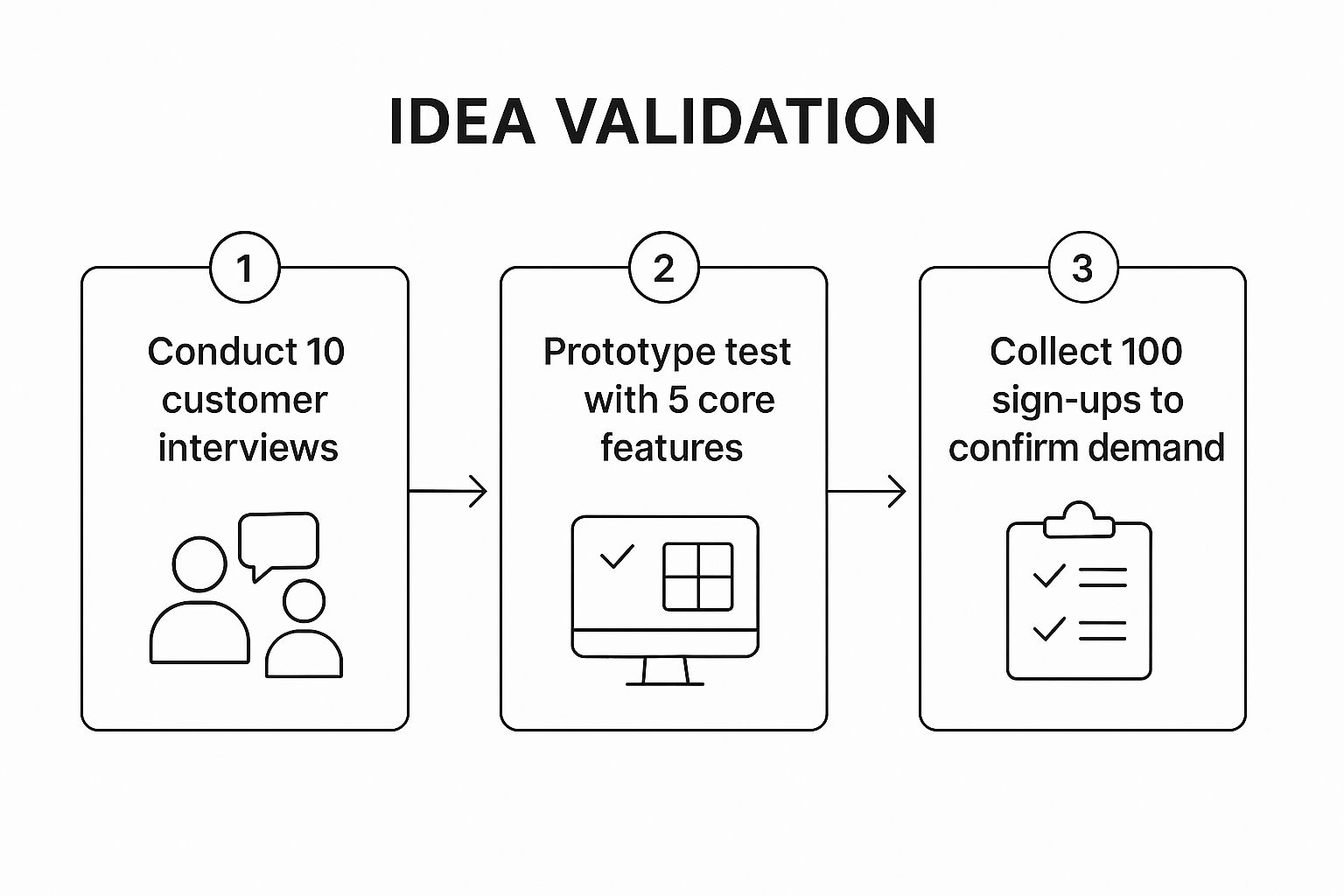
The key takeaway here is that gathering real-world data through interviews, simple tests, and sign-ups is the foundation for building something people will actually pay for.
Building Your First Product on a Budget
Alright, this is where your idea starts to take shape and feel real. Let me put your mind at ease: you absolutely do not need a team of developers or a fat bank loan to get your first product off the ground. The modern founder’s toolkit is packed with powerful, affordable options that make building and launching faster and cheaper than ever before.
The whole game here revolves around one concept: the Minimum Viable Product (MVP). An MVP isn’t a half-baked version of your product; it’s the most focused version. It should only contain the absolute essential features needed to solve that one critical pain point for your ideal customer. Everything else is just noise. You have to be ruthless about cutting it out for your first launch.
Choosing Your No-Code or Low-Code Platform
The rise of no-code and low-code platforms has been a complete game-changer for bootstrappers. These tools let you build surprisingly complex web apps with visual, drag-and-drop editors, cutting down what used to be months of development into just a few weeks.
Here are a few of my go-to recommendations:
- Bubble: This is a beast. If your idea needs user accounts, complex databases, or custom workflows, Bubble is the powerhouse for building data-driven web apps without touching code.
- Webflow: Fantastic for creating beautiful, content-heavy sites that have some app-like features. If design and a slick user interface are at the heart of your product, this is a great choice.
- Softr or Pory: These are perfect for spinning up apps directly from spreadsheets. If you’re already organizing your data in Airtable or Google Sheets, you can transform it into a working app in a couple of hours.
These platforms are the bedrock of a lean micro-SaaS. They empower you to build, test, and iterate on your own, no technical co-founder required. It’s why so many founders I know have managed to build a functional MVP in just a matter of weeks.
Defining Your One Core Feature
This is the most common trap for first-time founders: feature creep. It’s that nagging voice telling you to add “just one more” cool thing. Your mission is to ignore that voice. Seriously. Go back to your notes from those customer validation interviews. What was the single, most frustrating problem they kept bringing up? That’s it. That’s your core feature.
A successful MVP isn’t about having the most features; it’s about solving one problem exceptionally well. If you’ve built more than the absolute minimum needed to solve that core pain point, you’ve built too much.
For example, say you’re building an invoice tracker for freelance writers. The MVP isn’t a massive accounting suite. The one core feature is simply the ability to create, send, and track the status of an invoice. That’s it. Things like time tracking, expense reports, and tax calculators can all come later. This tight focus gets you to launch quickly and starts the flow of invaluable user feedback.
Assembling a Lean and Mean Tech Stack
Your tech stack is just the collection of tools that makes your micro-SaaS run. As a bootstrapper, your goal is to keep this stack as simple, affordable, and automated as humanly possible. You can build a surprisingly robust business with just a handful of services working in harmony.
Here’s what a typical lean stack might look like:
| Component | Tool Example | Role in Your Business |
|---|---|---|
| Frontend/App Builder | Bubble or Webflow | The user interface your customers actually see and use. |
| Payment Processing | Stripe | Securely handles all your subscriptions and payments. |
| Automation Glue | Zapier or Make | Connects your tools to automate all the boring tasks. |
| User Communication | MailerLite | Manages your email lists and automated onboarding flows. |
Let’s picture it in action with our invoice tracker. A new writer signs up. Stripe processes their payment instantly. That payment triggers a Zapier workflow, which automatically adds them to your MailerLite welcome email sequence and creates their user profile in your Bubble app. This all happens while you sleep, freeing you up to focus on your customers instead of mind-numbing admin work.
This lean approach is incredibly effective. In fact, many bootstrapped micro-SaaS companies are hitting profitability way faster than traditional ventures. Data shows they often break even within 10 to 12 months of launch, a feat made possible because no-code allows for MVP development cycles as short as 4 to 8 weeks. You can read more about these trends in the micro-SaaS space to see just how fast you can move.
The goal of this phase isn’t to build a perfect, feature-loaded application. It’s to get a working product into the hands of real users as quickly and cheaply as you can. This is how you kickstart that all-important feedback loop that will guide your product’s growth and lead you to your first paying customers.
Launching and Getting Your First Customers
Alright, you’ve done the hard work. Your idea is validated, and you’ve got a lean, functional MVP ready to go. Now for the fun part—getting your creation into the hands of real people and landing those first paying customers.
There’s a common misconception that you need a huge email list or a fat marketing budget for a successful launch. For a bootstrapped micro-SaaS, that’s just not true. Forget the big, flashy explosions. A great launch is more about building steady momentum, getting priceless feedback, and starting to bring in revenue. It’s about being personal and targeted, not loud and expensive.
Start with a Private Beta
Before you go shouting from the rooftops, start small. Your waitlist is a goldmine. These are people who have already raised their hand and said, “I’m interested!” They are your perfect first users.
Invite them personally. A simple, direct email explaining that you’re opening up early access just for them works wonders. Don’t send a generic marketing blast.
- Be upfront. Let them know the product is still a work in progress and that their feedback is what will make it great.
- Make feedback easy. Set up a dedicated place for them to report bugs and share ideas. A private Slack channel, a Trello board, or even just your personal email is perfect. The key is to make it frictionless for them.
- Act on what you hear. When someone finds a bug, jump on it. Fast. If they have a great idea, seriously consider it. This shows you’re listening and builds an incredible amount of loyalty.
This stage isn’t really about sales. It’s about refining your product with a small, focused group of people who want you to succeed. Their insights and eventual testimonials will be your secret weapon for the public launch.
The Targeted Product Hunt Launch
Once you’ve smoothed out the rough edges with your beta crew, it’s time for a more public debut. For a lot of B2B and prosumer tools, Product Hunt is the place to be. A good launch there can send thousands of people your way and land you your first paying customers, sometimes all in one day.
But you can’t just throw your product up and hope for the best. You need a game plan.
Your Product Hunt submission isn’t a feature list. It’s a story. Your story. What problem drove you so crazy that you had to build a solution for it? People, especially in the bootstrapper world, connect with the founder’s journey.
Tell a simple, compelling story about the pain point you’re solving. Use great visuals—GIFs that show your product in action are absolute gold. Have your first comment ready to go, one that adds more personal context and kicks off the conversation. And be ready to engage with every single person who comments. This is your chance to talk directly with potential customers.
Getting Your First 50 Customers by Hand
While a platform launch gives you a fantastic boost, the real grind—and the real learning—happens with direct, personal outreach. I truly believe you should aim to manually onboard your first 50 customers. It’s a hands-on process that gives you an unbelievable amount of insight into what they need and how to talk about your product.
Direct Outreach That Actually Works
| Tactic | How to Execute It | Why It’s Effective |
|---|---|---|
| Personal Emails | Email every single person who signs up. Thank them, ask what they’re trying to do, and offer to help them get set up. | This creates a real connection and proves you’re invested in their success, not just their credit card. |
| Community Help | Go back to the online communities (Reddit, forums) where you first validated your idea. Don’t spam your link. Find people with problems you can solve and offer genuine help. Mention your tool only when it’s a perfect fit. | This builds your reputation as an expert, not a salesperson. People trust recommendations from helpful peers. |
| Leverage Your Fans | Ask your happy beta testers for a testimonial or if they’d be open to a short case study. Put these on your homepage and share them. | Social proof is powerful. A positive quote from someone just like your target customer is more convincing than any ad you could run. |
This manual, high-touch work doesn’t scale. That’s the entire point. The deep understanding you get from these early conversations is priceless. It will shape your product roadmap, your marketing copy, and your entire strategy. These first relationships are the foundation of a solid, bootstrapped business.
Later on, you can start automating some of this. Our guide on marketing automation for SaaS can show you how to scale up while keeping that personal touch you worked so hard to build.
Growing Without Burning Out

Alright, you’ve landed your first customers. That’s huge. But now the real work begins. The initial frantic sprint to launch is over, and you’re settling in for the marathon of sustainable growth.
As a bootstrapped founder, your biggest enemy isn’t a lack of things to do—it’s burnout. It sneaks up on you and can completely derail a promising business. The only way to win this fight is by building systems that work for you, so you can scale the business without scaling your own workload into oblivion.
Automate Your Customer Experience
It’s tempting to personally welcome every new user and answer every support ticket. That hands-on approach is fantastic at the start, but it quickly becomes a massive bottleneck that chokes your growth. The real goal is to automate the repetitive stuff so you can save your energy for high-impact conversations.
Start by thinking through a new user’s first week. What do they really need to know to get that “aha!” moment and stick around? You can map that out in an automated email onboarding sequence.
- Day 1: Send a warm welcome that points them to the single most important feature they should try first.
- Day 3: Follow up with a pro-tip or a quick tutorial for a secondary feature that adds even more value.
- Day 7: Check in. A simple “How’s it going?” and a link to your help docs can work wonders.
This simple sequence gives every user a consistent, helpful start without you lifting a finger. Another game-changer is setting up a basic helpdesk with a searchable knowledge base. Every time you answer a support question, ask yourself: “Can this be an article?” Over time, you’ll build a self-service library that handles common queries for you.
Key takeaway: The point isn’t to avoid talking to customers. It’s to automate the predictable questions so you have more time for the strategic conversations—the ones that spark product improvements and lock in renewals.
Focus Your Marketing on One or Two Channels
Marketing can feel like a black hole that sucks up all your time and energy. If you’re trying to post on every social platform, run ads, and launch a podcast all by yourself, you’re on a fast track to burnout.
Pick one or two channels that fit your product and your personality, and go all-in.
For many a bootstrapped micro SaaS, content is the winning play. Writing detailed blog posts that solve the exact problems your ideal customers are Googling is a powerful long-term strategy. It builds your authority and delivers a steady stream of highly qualified leads.
Another great angle is to “build in public.” Share your journey on a platform like X (formerly Twitter) or LinkedIn—the revenue numbers, the setbacks, the wins. People love a good story, and this approach turns followers into genuine fans who will champion your product.
Retention Is Your Growth Engine
In the VC-funded world, growth often means burning cash on customer acquisition. As a bootstrapper, you can’t afford to play that game. Your real growth engine is keeping the customers you’ve worked so hard to win.
Solid retention is the bedrock of a healthy micro-SaaS. A happy customer doesn’t just keep paying you; they become your best salesperson through word-of-mouth referrals. This creates a powerful, self-sustaining growth loop. For a deeper dive, our guide on SaaS growth strategies explains how to balance this with acquisition.
This steady, profitable growth might feel slower, but it’s infinitely more durable. And it might not be as slow as you think. The top 25% of bootstrapped SaaS companies hit $1 million in ARR in about two years, which is only four months slower than their VC-backed counterparts. You can discover more about these SaaS statistics and see just how potent self-funded growth can be.
It just goes to show you don’t need a massive war chest to build something incredible. You just need a great product and happy customers.
Common Questions About Building a Micro SaaS
Even with a solid plan, taking the leap into the micro SaaS world can feel daunting. It’s a unique path for every founder, but you’d be surprised how many of us share the same core worries and questions. Let’s dig into some of the most common ones I hear from people just starting out.
How Much Money Do I Really Need to Start?
This is usually the first question on everyone’s mind, and the answer is probably a lot less than you think. Thanks to the amazing no-code tools and lean strategies available today, you can get a real product launched for under $500.
What does that cover? Just the bare essentials to get you off the ground:
- Your domain name: Claiming your little piece of the internet.
- Basic hosting: A simple place for your landing page and app to live.
- Core tool subscriptions: A month or two for a no-code builder like Bubble or a payment processor like Stripe.
The trick isn’t having a mountain of cash; it’s proving your idea works before you pour money into building it. Your time is always your biggest investment. The real goal is to sign up your first few paying customers as quickly as possible, letting the business start paying for itself instead of draining your bank account.
Do I Have to Be a Coder?
Absolutely not. This is probably the biggest game-changer for founders in the last ten years. The explosion of powerful no-code and low-code platforms has opened the doors for non-technical people to build incredible software.
Tools like Bubble, Softr, and Webflow let you build complex, working web apps with visual, drag-and-drop editors. Sure, having a technical background helps, but it’s no longer a deal-breaker. Honestly, a deep obsession with your customer’s problem and the willingness to learn these new tools are far more important for success.
Your expertise should be in the problem you’re solving, not the code used to solve it. A genuine passion for your customer’s pain point will take you much further than technical skill alone.
What’s a Realistic Revenue Goal for Year One?
It’s crucial to set expectations that keep you motivated, not discouraged. For a solo founder bootstrapping a micro SaaS, hitting $1,000 to $5,000 in Monthly Recurring Revenue (MRR) in the first year is a fantastic goal.
This level is what many call “ramen profitability”—enough cash flow to cover your business costs and maybe even your own basic living expenses. Reaching this milestone is huge. It proves you’ve found a real problem people will pay you to fix, validating your entire business model. From there, you have a stable foundation to build on. A good way to track this is by understanding the fundamentals of annual recurring revenue.
How Can I Possibly Compete with Big Companies?
Simple: you don’t play their game. Large, established companies have to build one-size-fits-all products for a massive audience. Because of this, their features are often a mile wide and an inch deep, leaving tons of smaller, specific needs completely unmet.
Your focus is your superpower.
- Carve out a tiny niche. Find a specific type of user whose needs are being ignored by the big players.
- Solve one problem perfectly. Go deep and create an elegant solution for a single, painful issue.
- Offer amazing, personal support. Be the founder who actually answers emails and listens to what your users are saying.
By zeroing in on an overlooked niche with a killer solution and incredible service, you can build a fiercely loyal following that a big corporation could never dream of. You’re faster, more connected to your customers, and can pivot on a dime. Those are your weapons. You aren’t just a tiny fish in their big pond; you’re the shark in your own.
At SaaS Operations, we provide the battle-tested playbooks and processes you need to run a more effective and efficient business. Our templates and SOPs are plug-and-play, helping you save time and accelerate growth on your bootstrapped journey. Find out more at https://saasoperations.com.