
So, what's an ARR valuation calculator? Simply put, it's a tool that spits out a solid, data-driven estimate of what your SaaS company is worth. It takes your Annual Recurring Revenue (ARR), year-over-year growth rate, and net revenue retention (NRR), and turns those core metrics into a real dollar figure. It gives you a clear, tangible starting point for figuring out where you stand financially.
Calculate Your SaaS Valuation Instantly
Alright, let's get straight to it. You're here because you want to know what your SaaS business is worth, and you don't want to mess around with complex spreadsheets to get a ballpark figure. The whole journey starts with just three numbers—three metrics that tell the real story of your company's health and future potential.
I've put together this interactive ARR valuation calculator to give you that answer right away. Think of it as your financial starting line. Just plug in your current ARR, growth rate, and retention numbers, and you’ll get a valuation you can actually work with.
Your Key Valuation Inputs
To get started, you just need three key pieces of data. Each one is a critical lever that directly impacts your company's final valuation:
- Current Annual Recurring Revenue (ARR): This is the predictable revenue you can count on from your subscribers over the next 12 months. It's the foundation of your valuation.
- Year-over-Year (YoY) Growth Rate: This shows investors just how fast you're expanding. It's one of the first things they look at to gauge your momentum.
- Net Revenue Retention (NRR): This metric is all about customer love. It shows how good you are at keeping customers and getting them to spend more over time, proving your product is sticky.
Here’s a quick look at the calculator in action.
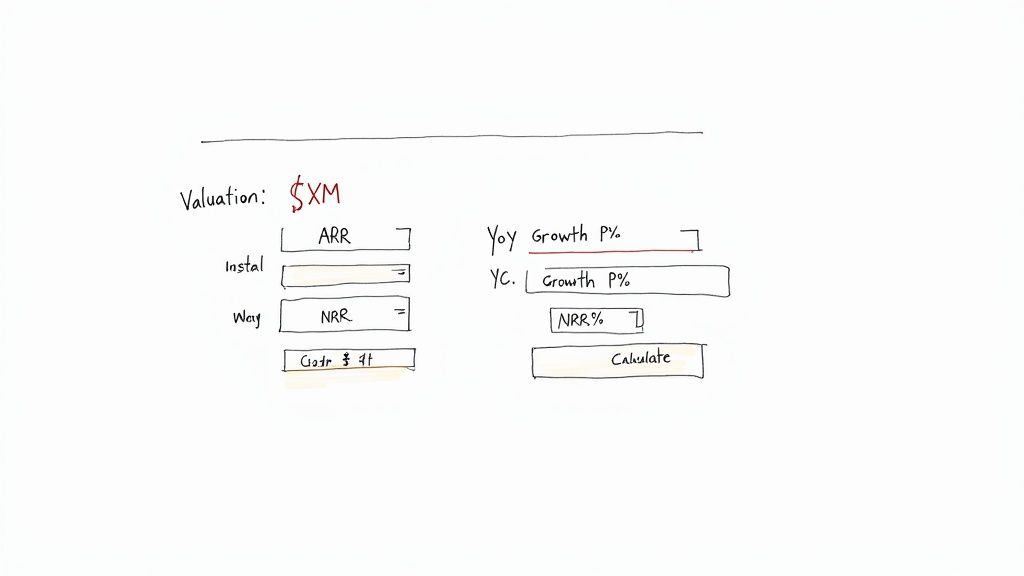
As you can see, the tool immediately connects your day-to-day operational performance to a concrete valuation number. No guesswork needed.
From Calculation to Action
The number this calculator gives you is way more than just a vanity metric; it’s a diagnostic tool. It shines a light on what you're doing well and pinpoints where you have room to grow. As we go through this guide, we'll break down exactly how each of these inputs drives your final number.
The whole point here is to demystify valuation from the very first click. I want you to walk away with a baseline number you can actually use and, more importantly, a plan to make it bigger.
Of course, a calculator is just the beginning. Having a robust startup financial projections template is essential for accurately forecasting the revenue and growth figures that feed into this calculation.
This first step is all about getting your benchmark. From here, we’ll dive into the "why" behind the numbers and give you some actionable playbooks to really drive your valuation sky-high.
Why ARR Is the North Star for SaaS Valuation
Before we dive into the multipliers that turn your revenue into a valuation, we need to get crystal clear on the foundation. For any SaaS business, Annual Recurring Revenue (ARR) isn't just another line item on a P&L—it's the company's heartbeat. It tells everyone, from your own team to potential investors, a story about your health, predictability, and potential to scale.
Think of it this way: a one-time sale is like a single movie rental. It’s nice, but it’s over. A subscription is a predictable, reliable stream of income that shows up month after month. Investors love that kind of predictability. It strips out a huge amount of risk and signals that your business is built to last.
It's More Than Just a Simple Formula
At its core, Annual Recurring Revenue (ARR) is the predictable revenue a subscription business can expect to bring in over a year. A lot of people start with the back-of-the-napkin formula: Monthly Recurring Revenue (MRR) x 12. But honestly, that barely scratches the surface.
A real SaaS business is a living, breathing thing. New deals are closing, customers are churning, and existing accounts are upgrading or downgrading. A much more accurate picture of ARR needs to account for all these moving parts. If you want to go deeper, we've broken down the nuts and bolts in our guide on what ARR is and how to calculate it.
When you factor in the revenue from new logos alongside the expansion and contraction from your existing base, ARR stops being a static number. It becomes a dynamic metric that tells a story about your growth and how happy your customers are.
Seeing ARR in Action
Let's make this real with an operator's playbook. A B2B SaaS company we'll call "SyncUp" starts the year with $1,000,000 in ARR.
Here’s a look at their operational results for the year:
- New Bookings: The sales team brings in $300,000 in new annual contracts.
- Expansion Revenue: The customer success team nurtures existing clients, who upgrade their plans or add seats, generating another $150,000 in ARR.
- Churn: It happens. A few customers leave, resulting in a $50,000 loss in ARR.
To get their end-of-year ARR, the formula is straightforward:
Starting ARR + New Bookings ARR + Expansion ARR – Churned ARR = Ending ARR
For SyncUp, that math looks like this: $1,000,000 + $300,000 + $150,000 – $50,000 = $1,400,000.
That final number, $1.4M, isn't just revenue. It’s powerful proof that SyncUp isn't just signing new customers—it's keeping and growing the ones it already has. That’s the story that gets investors excited and builds the bedrock for your entire valuation. Without a solid handle on this North Star metric, any ARR valuation calculator is just guessing in the dark.
Decoding the ARR Multiple That Defines Your Worth
Alright, let's get to the part where the real magic—and the math—happens. Your SaaS valuation isn't just your raw ARR figure. It's your ARR times a certain number, what everyone calls the ARR multiple.
Think of this multiple like a scorecard for your entire business. It’s how investors and buyers grade your company's health and, more importantly, its future potential. It all gets boiled down to one number.
This isn't just some figure pulled out of thin air. It’s a direct reflection of your performance. A fast-growing, efficient, and sticky business gets a high grade (and a high multiple). A slower, leakier business? It gets a much lower one. Understanding the levers that move this number is the key to truly understanding—and boosting—your company's value.
The parts that make up your ARR tell a story about where your revenue is really coming from. This map below shows how new sales, expansion revenue from existing customers, and churn all feed into your total ARR.
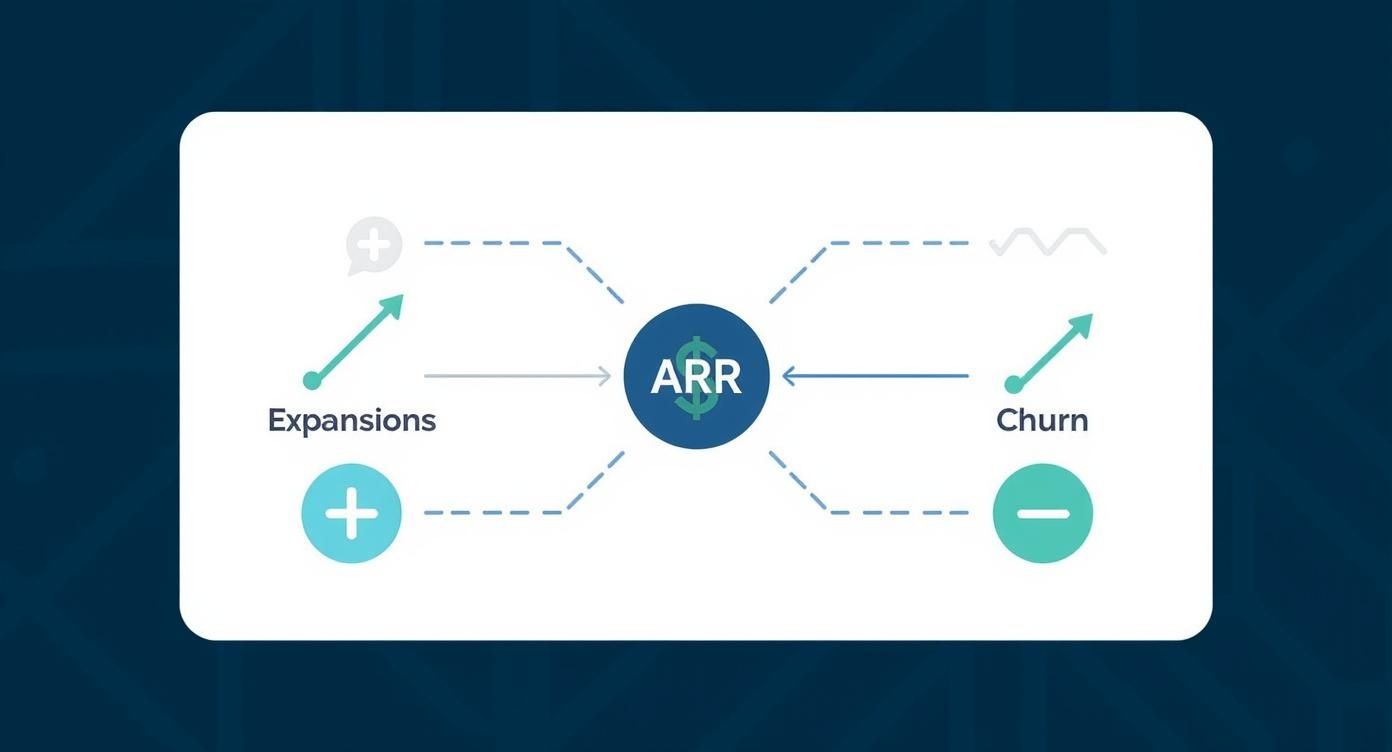
As you can see, a healthy ARR isn't just about landing new logos. It's just as much about keeping the customers you have and getting them to spend more. Now, let’s dig into the three core metrics that directly pump up (or deflate) the multiple applied to that ARR.
The Three Levers of Your Valuation Multiple
When investors or potential buyers look under the hood, they’re searching for signals of a durable, scalable business. They find those signals by zeroing in on three primary metrics. For any SaaS operator aiming for a top-tier valuation, mastering these is non-negotiable.
-
Growth Rate (YoY): This is the big one. It's the most straightforward and powerful driver of your multiple. A high year-over-year growth rate just screams momentum and market demand. It’s hard proof that your product is hitting the mark and that you’ve built a repeatable engine for bringing in new customers.
-
Net Revenue Retention (NRR): This metric tells the story of how sticky your product is. Is it a nice-to-have or a can't-live-without-it tool? An NRR over 100% is the holy grail. It means your existing customers are spending more with you over time, creating a powerful "growth from within" engine that compounds your revenue even if you don't sign a single new customer.
-
Gross Margin: This number shows how profitable your core service is before you even start paying for sales, marketing, and R&D. A high gross margin, typically 75% or more for a software business, signals that your model is efficient and built to scale profitably.
These aren't just abstract concepts from a business textbook; they are the battleground where valuations are won and lost. Strong performance here gives you concrete proof that your business isn't just growing, but growing in a healthy, sustainable way.
Real-World Benchmarks and Their Impact
The difference a strong multiple makes is staggering. For instance, high-growth SaaS companies with ARR growth rates over 40% can see valuation multiples anywhere from 8x to 15x their ARR. Meanwhile, slower-growing companies might find themselves in the 3x to 5x range.
A business with stellar growth and retention isn't just seen as a better business—it’s seen as a fundamentally less risky investment. That confidence is what you’re getting paid for with a higher multiple.
To see this play out, let's look at a table comparing two hypothetical SaaS companies. Both have $5M in ARR, but their performance metrics are worlds apart. This really highlights how much those internal numbers can swing the final price tag.
How Key Metrics Impact Your ARR Valuation Multiple
This table shows just how dramatically growth and retention can change the valuation game for a company with $5M in annual recurring revenue.
| Growth Rate (YoY) | Net Revenue Retention (NRR) | Typical ARR Multiple Range | Valuation on $5M ARR |
|---|---|---|---|
| 20% | 90% | 3x – 5x | $15M – $25M |
| 60% | 115% | 8x – 12x | $40M – $60M |
As you can see, Company B could be worth more than double Company A, even though they have the exact same top-line revenue. This is precisely why obsessing over your core operational metrics is so critical. They don't just make your business better; they fundamentally change what it's worth.
For a deeper dive into how your metrics stack up against the competition, check out our complete guide on essential SaaS metrics benchmarks.
The Hidden Factors That Influence Your Valuation
Your core metrics tell a huge part of the story, but seasoned investors and savvy buyers always read between the lines. An ARR valuation calculator gives you a powerful baseline, but the truly premium multiples are won or lost based on factors that don't fit neatly into a formula.
These are the qualitative signals that prove your business isn't just growing—it's durable, defensible, and built for the long haul.
Think of it like this: your ARR, growth, and retention are the engine of your car. They show how fast you can go. But these hidden factors? They're the chassis, the safety features, and the brand reputation—they show how well-built the car is and whether it can handle a few bumps in the road. This is your checklist for strengthening the story your numbers can't tell alone.
Beyond the Spreadsheet: The Story Your Metrics Tell
Investors are pattern-matchers. They’ve seen hundreds of SaaS companies and know that the quality of your revenue is just as important as the quantity. A few key areas always come under the microscope, and shoring them up can add millions to your final valuation.
Let's break down the critical elements they'll dig into:
-
Churn Rate and Customer Stickiness: Low churn is the ultimate vote of confidence from your customers. While it's related to NRR, gross churn specifically signals strong product-market fit and solid operations. A business with high churn is like a leaky bucket; you have to run faster and faster just to stay in the same place.
-
Total Addressable Market (TAM): A massive TAM gives investors confidence that you have a long runway for growth. If you're a big fish in a small pond, your growth will eventually hit a ceiling. Demonstrating a clear path to capturing a large, expanding market can justify a much higher multiple.
-
Capital Efficiency (LTV to CAC Ratio): How much does it cost you to acquire a dollar of revenue, and how much is that dollar worth over time? A strong Lifetime Value to Customer Acquisition Cost (LTV:CAC) ratio, ideally 3:1 or higher, proves you have a sustainable and profitable growth engine. It shows you aren't just buying growth at any cost.
These factors provide the context around your core numbers. A company with moderate growth but an ironclad competitive moat and stellar capital efficiency can often command a higher multiple than a "growth at all costs" competitor.
The Quality of Your ARR Matters
Not all recurring revenue is created equal. The makeup of your ARR sends powerful signals about your business's stability and predictability.
For instance, a business with 80% of its ARR locked into annual or multi-year contracts is seen as far less risky than one where most customers are on monthly plans. Annual contracts reduce churn risk and dramatically improve cash flow.
"A dollar of ARR from an enterprise customer on a three-year contract is fundamentally more valuable than a dollar from a small business on a month-to-month plan. The commitment signals deep integration and dependency on your product, which is a powerful indicator of future stability."
This stability is a key reason why lower churn is so highly valued. Industry data from 2023 shows that churn rates average around 5-7% annually for SaaS businesses, with lower churn correlating strongly with higher ARR growth and valuation multiples. In fact, you can discover more insights about these revenue trends from Salesforce. Firms that keep churn under 5% per year often see ARR expansion rates of over 40%.
Another critical factor is customer concentration. If a single customer makes up 20% or more of your ARR, that's a major red flag for investors. The risk of that one customer churning creates huge instability. A diversified customer base, with no single account representing more than 5% of your revenue, de-risks the business and strengthens your valuation.
Understanding the health of your customer base is key, and you can learn more about this by exploring how to calculate your net retention rate in our detailed guide.
A Founder's Playbook to Increase Your SaaS Valuation
Alright, enough with the theory. Knowing the number from an ARR valuation calculator is just the starting line. The real magic happens when you start pulling the levers that actually move that number. Think of this section as your tactical playbook, filled with specific, road-tested strategies you can put into action to boost your company's worth.
We're going to zero in on the two big kahunas we've been talking about: Net Revenue Retention and Growth Rate. These aren't just fluffy concepts; they're your new to-do list, and you can start on them today.

Driving Net Revenue Retention Above 100%
Think of Net Revenue Retention (NRR) as your secret weapon for creating compound growth. When your NRR tips over 100%, it means you're growing even before signing a single new customer. It’s the loudest signal you can send that your product is sticky and indispensable—and investors will absolutely pay a premium for that.
Here’s the operator's playbook for getting there.
1. Turn Customer Success into a Revenue Engine
Your Customer Success team must be an expansion revenue engine, not just a support line. The goal is to proactively identify ways for customers to get even more value from your product.
- Run Quarterly Business Reviews (QBRs): Don't just "check in." Use QBRs to understand your customer's latest business goals. Then, strategically demonstrate how premium features or higher-tier plans will get them there faster. Frame the upgrade as a solution to their problem.
- Set Up Usage-Based Triggers: Create automated alerts for your CS team. When a customer is approaching their plan limits or is a power user of a feature with an upgrade path, that's your cue for a proactive conversation about expansion.
2. Create and Sell Add-On Modules
Unbundle valuable, non-core features into optional, paid add-ons. This is a brilliant way to capture more revenue from your power users without raising prices for everyone.
A classic example is an advanced analytics or reporting module. Not every user needs it, but the ones who do are often more than happy to pay extra for those deeper insights.
This approach lets your product scale alongside your customers. As their business gets more complex, you're right there with a solution, turning their success into your expansion revenue.
Pouring Gas on Your Growth Rate
A high growth rate is like rocket fuel for your valuation multiple. It screams market demand and paints a picture of a massive future for your company. To really understand what gets investors excited, it's also smart to look into the strategies of top venture capital firms, as they're the ones setting the bar.
Here are two actionable steps to take now.
1. Systematically Shrink Your Sales Cycle
Every day you shave off your sales cycle brings in revenue faster and improves capital efficiency. Start by mapping your entire sales process from the first touchpoint to "closed-won."
- Find the Bottlenecks: Identify where deals get stuck. Is it the demo stage? Legal review? Focus your energy on removing friction from that specific step.
- Build a Real Sales Playbook: Equip your reps with competitor battle cards, scripts for handling common objections, and case studies for specific buyer personas. Consistency is key to shortening the sales cycle.
This obsession with efficiency directly juices your LTV to CAC ratio—a metric every investor will ask about. A better ratio proves you’re not just growing, but growing profitably. If you want to dive deeper into this crucial metric, you might be interested in our guide on how to calculate and improve SaaS Lifetime Value.
2. Open Up New Go-to-Market Channels
If you rely on just one channel—like paid ads or content marketing—you're leaving growth on the table. It’s time to diversify your acquisition strategy.
- Launch a Partner Program: Find other SaaS companies that serve a similar customer profile but aren't direct competitors. A simple referral or reseller program can become a steady stream of warm, high-converting leads.
- Tap into Niche Communities: Where do your ideal customers spend their time online? Find them in Slack groups, industry forums, or specific subreddits. Show up, provide genuine value, and become a trusted expert—the sales will follow.
This playbook isn't about chasing empty numbers. Every one of these moves is designed to strengthen the core metrics that drive your valuation. By methodically improving NRR and accelerating growth, you turn your good business into a truly valuable asset.
Costly Valuation Mistakes and How to Avoid Them
Valuation is a minefield. It's so easy to make a wrong move that can tank your credibility and, frankly, your bottom line. An ARR valuation calculator gives you a fantastic starting point, but any serious investor is going to dig a lot deeper. Nailing how you present your numbers isn't just about accuracy; it's about building trust from the first conversation.
Let's walk through the most common traps founders fall into and the exact steps to sidestep them.
Mistake 1: Muddying Your ARR with One-Time Fees
This is the fastest way to lose an investor's trust. It's tempting to lump one-time setup fees, consulting projects, or training revenue into your Annual Recurring Revenue. Don't do it.
The whole reason ARR is so valuable is right in the name: it's recurring. Mixing in one-time revenue inflates your most important metric and signals that you either don't understand your own numbers or you're trying to pull a fast one. Both are massive red flags.
The Fix: Be surgical with your financial reporting. Create separate line items for pure SaaS ARR and professional services revenue. This transparency shows operational maturity and builds instant credibility.
Mistake 2: Underestimating the Impact of Churn
Ignoring or downplaying your churn rate is like pretending a small leak in your boat doesn't exist. Sooner or later, you're going to sink. A monthly churn of 3% will chew through nearly a third of your customer base in one year.
A classic scenario is a founder who proudly touts 20% year-over-year growth while glossing over a 15% annual churn rate. Investors see right through this. It looks like you're running on a treadmill—working furiously just to stay in the same place. It proves your growth engine is incredibly leaky and will kill your valuation multiple.
The Fix: You need to become obsessed with your churn numbers—both customer churn (logos) and revenue churn.
- Track It Religiously: Monitor it monthly and quarterly. No excuses.
- Conduct Exit Interviews: Get on the phone and find out exactly why customers are leaving.
- Report It Transparently: Show investors you're aware of the problem and have a real plan to fix it. Owning the problem is half the battle.
Mistake 3: Relying on Vanity Metrics
Focusing on numbers like total sign-ups or website traffic without tying them directly to revenue is a rookie move. Experienced investors see them for what they are: fluff.
The metrics that actually matter are the ones that feed directly into your ARR valuation calculator: things like net new ARR, net revenue retention (NRR), and customer lifetime value (LTV). These are the numbers that prove you have a healthy, scalable business.
The Fix: Connect every single metric back to revenue and retention. Instead of saying, "We got 10,000 new users," frame it as, "We drove a 15% increase in paid conversions, which added $50k in new ARR." That’s speaking the language of valuation.
Got Questions About ARR Valuation? Let's Get Them Answered.
Alright, let's clear up some of the common questions that pop up when you're digging into ARR valuation. Think of this as a quick FAQ to make sure we're all on the same page.
What's a Good ARR Multiple for a SaaS Company?
This is the million-dollar question, isn't it? There's no magic number, because the "right" multiple is completely tied to your company's performance.
That said, for a solid, growing B2B SaaS business, a multiple somewhere in the 5x to 10x ARR range is a pretty common ballpark.
Now, if you're a company that's just on an absolute tear—we're talking >80% year-over-year growth and a net revenue retention of >120%—then you're in a different league. Those kinds of metrics can fetch premium multiples of 15x or even more. It's all about showing investors that your growth engine is not just fast, but built to last.
How Exactly Do I Calculate Net Revenue Retention?
Net Revenue Retention, or NRR, is your secret weapon for proving your product's stickiness. It tells you if you're making more money from the customers you already have.
Here’s how you break it down: Pick a group of customers from the start of a period (say, a year ago). Take their starting ARR, add any expansion revenue they generated, and subtract any revenue you lost from them through churn or downgrades.
The formula is simple: (Starting ARR + Expansion – Churn/Contraction) / Starting ARR. If you land over 100%, you've hit the gold standard. It means your business can grow even without acquiring a single new customer.
Should I Sneak Services Revenue into My ARR Calculation?
Nope. Don't do it. This is a huge red flag for investors and a fast way to lose credibility. ARR must only include predictable, recurring revenue from your software subscriptions.
One-off revenue streams are totally different and need to be kept separate. They don't have that sweet, predictable quality that makes ARR so valuable. This includes things like:
- Setup fees
- Consulting or implementation packages
- One-time training sessions
Lumping these in will artificially inflate your ARR, and any savvy investor will spot it in a heartbeat. It’s an easy way to damage trust right out of the gate.
Ready to stop guessing and start improving your valuation? The playbooks and scorecards from SaaS Operations are designed to help you systematically boost the metrics that matter most. Take the next step and see our proven frameworks.