A Guide to Types of Leadership in Business Management
 Published By: Alex
July 25, 2025
Published By: Alex
July 25, 2025
Leadership isn’t about having a single, fixed playbook. It’s about knowing which approach to use for different people and different situations. While there are many theories out there, most leadership styles fall into a few key categories, like autocratic, democratic, laissez-faire, and transformational. Each one offers a unique way to guide a team.
Why Your Leadership Style Is the Secret to Team Success
A title on an org chart doesn’t make someone a leader. Real leadership is the engine that drives a team’s performance, creativity, and overall morale. In today’s fast-moving business world, figuring out which leadership style works best isn’t just a nice-to-have—it’s essential. The right approach can light a fire under your team, while the wrong one can bring everything to a grinding halt.
This isn’t just a hunch; the numbers back it up. A staggering 77% of organizations report that they’re currently experiencing a leadership gap. This isn’t a small problem. It carries a massive price tag, costing companies an estimated $550 billion a year in lost productivity across the globe.
But when leadership works, it really works. Employees who have a high degree of trust in their leaders are 14 times more likely to be fully engaged. These are some pretty eye-opening leadership statistics that paint a clear picture of what’s at stake.
The Clear Link Between How You Lead and What You Achieve
Great leadership isn’t just about good vibes; it translates directly into real, measurable results. It’s what separates a team that just checks boxes from one that constantly innovates and pushes for growth. A strong leader cultivates an environment where people feel safe enough to speak up, contribute, and even fail without fear.
This kind of positive atmosphere leads to:
- Deeper Engagement: When people feel their work actually matters, they bring more energy and creativity to the table.
- Better Retention: It’s an old saying because it’s true: people don’t quit companies, they quit managers. Good leadership inspires loyalty and cuts down on the high cost of turnover.
- More Innovation: A culture built on trust gives people the confidence to take smart risks and share new ideas.
Think of it this way: a leader is like a pilot. You wouldn’t fly through a thunderstorm using the same instruments and approach you’d use on a calm, sunny day. It’s all about awareness and adaptability.
To truly get the best from your team, it’s critical to continuously improve leadership skills. By learning to flex between different styles, you can build a team that’s not just productive, but resilient enough to handle whatever comes its way.
2. Understanding Command and Control Leadership Styles
When you start digging into the different styles of leadership in business management, it’s best to begin with the most traditional, top-down models. These are often called “command and control” styles, and they’re all about structure, clear direction, and predictable results.
You’ll find these approaches in environments where consistency and precision are non-negotiable. Two of the most common examples are autocratic and transactional leadership. While both are directive, they motivate teams in very different ways.
The Autocratic Leader: The Decisive Captain
An autocratic leader is the classic “boss.” Think of a ship’s captain navigating through a sudden, violent storm—they have absolute authority and make all the critical decisions. The crew doesn’t vote on which way to turn; they receive clear, direct orders and execute them immediately.
This top-down approach can be a lifesaver. In a crisis, you need someone to make a quick, decisive call without getting bogged down in committee meetings. Imagine a major server outage at a SaaS company. An autocratic leader can step in, assign tasks, and get the system back online fast. The priority is speed and alignment, not consensus.
This image really captures the essence of that top-down flow, where a single leader sets the course for the entire team.
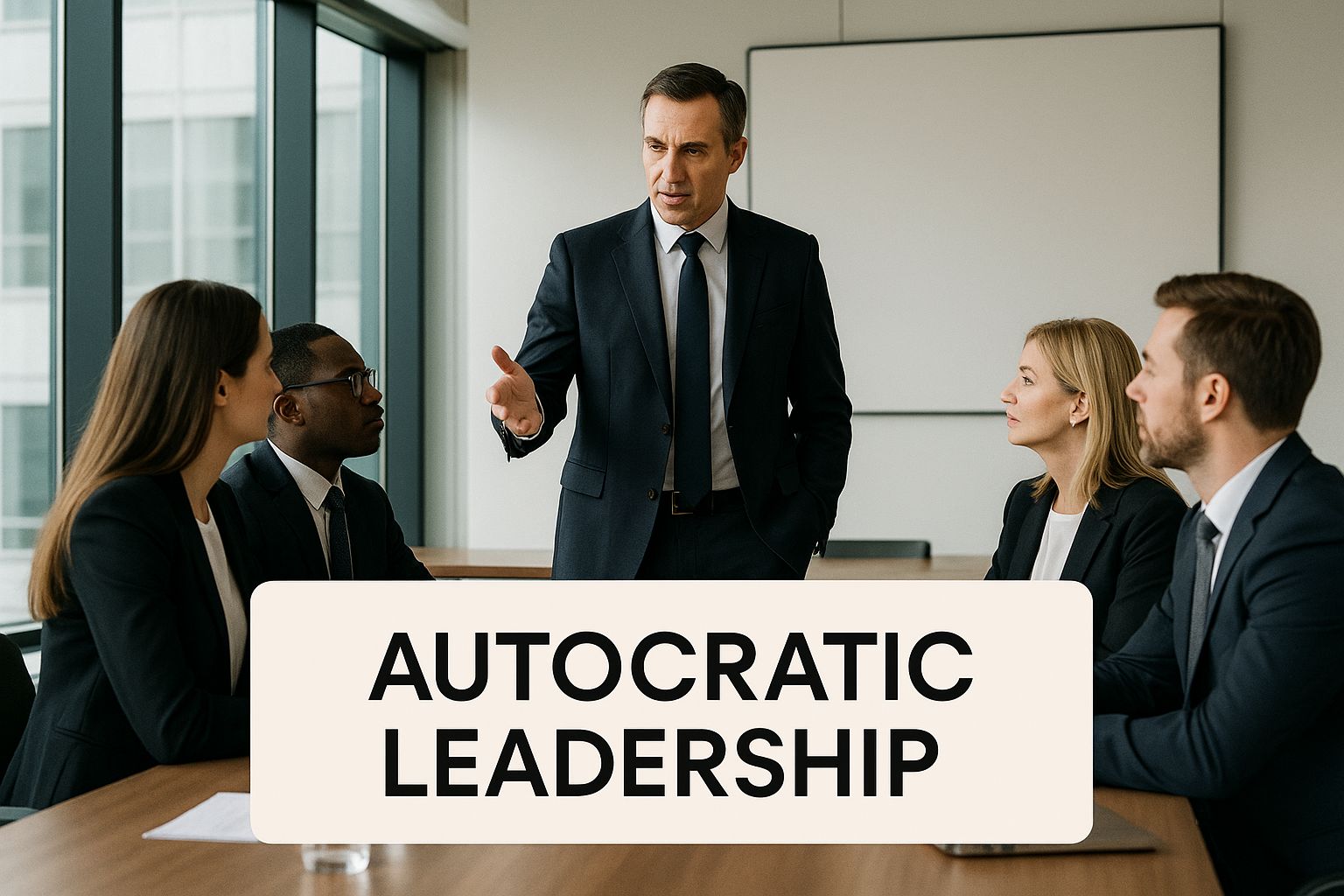
Of course, there’s a trade-off. While it’s efficient for emergencies, this style can easily suffocate creativity and morale in the long run. If team members feel like their expertise isn’t valued, they’re likely to disengage.
The Transactional Leader: The Playbook Coach
A transactional leader is also highly structured, but their approach is more like a coach who runs the team strictly by the playbook. They set clear, measurable goals and motivate people with a straightforward system of rewards and punishments.
It’s a simple, direct bargain: hit your targets, and you get a bonus; miss them, and there are consequences. This style is incredibly effective when you need to maintain standards and consistency.
You see this a lot in certain SaaS functions:
- Sales Teams: A transactional leader might set monthly recurring revenue (MRR) goals. Exceed your quota, and you get a commission boost. Fall short, and you might land on a performance improvement plan.
- Customer Support: This works perfectly for managing teams with tight service-level agreements (SLAs). Agents who consistently hit their response time targets are rewarded, ensuring the company meets its promises to customers.
The philosophy is simple and direct: “You do this for us, and we’ll do this for you.” It’s great for getting the job done right, but it rarely inspires people to think outside the box or give that extra discretionary effort.
While both autocratic and transactional styles have their moments, today’s fast-moving business world often requires a more flexible approach. Building a team that can adapt and innovate means understanding that these command-and-control methods are just two tools in a much larger leadership toolkit.
Empowering Teams With Collaborative and Hands-Off Leadership

As we move away from top-down directives, some of the most effective leadership styles in business management are the ones that focus on empowering teams. These collaborative and hands-off approaches place a ton of trust in employees, letting them bring their own expertise to the table. This often results in more creative solutions and a genuine boost in job satisfaction.
Two of the best examples here are democratic and laissez-faire leadership. While both give teams far more freedom than old-school command-and-control styles, they’re built on very different ideas about trust and involvement. One leader acts as a guide, while the other steps back entirely.
Democratic Leadership: The Workshop Facilitator
Think of a democratic leader as the facilitator of a creative workshop. Instead of just telling everyone what the final product will be, they guide the conversation, pull ideas out of people, and help the group agree on the best way forward. It’s a powerful way to show that every single voice in the room matters.
The upsides are huge. When people feel like their opinions are actually heard and valued, you see morale and engagement go through the roof. Research consistently shows that bringing more people into the decision-making process sparks more creative solutions by tapping into different points of view. In a SaaS company, a democratic leader might get developers, marketers, and customer support reps in a room together to brainstorm a new feature, making sure it’s built right and actually solves customer problems.
Of course, this approach has its drawbacks. Building consensus takes time, so it’s not the best fit for those moments when you need a decision right now.
Laissez-Faire Leadership: Trusting the Experts
On the far end of the hands-off leadership spectrum, you’ll find the laissez-faire leader. The name is French for “let them do,” and that sums it up perfectly. Imagine a leader who hires a team of world-class pilots, hands them the flight plan, and then trusts them to get the plane to its destination without meddling.
This style demands an incredible amount of faith in your team’s skills and self-discipline. It really only shines in environments full of highly skilled, experienced professionals who don’t need—or want—someone hovering over their shoulder. For example, a laissez-faire approach would be ideal for a senior engineering team at a SaaS company tasked with architecting a complex new API.
The core idea behind laissez-faire leadership is simple: if you hire true experts, the best thing you can do is get out of their way. This level of autonomy creates a profound sense of ownership and can lead to some truly amazing breakthroughs.
The danger, of course, is that things can descend into chaos. If you don’t have the right people on board, this style can lead to a lack of clear direction, missed deadlines, and unresolved team conflicts. It only works when you’ve set clear goals and guardrails from the start. Learning more about the various styles of leadership in business management can help you figure out exactly when to use this high-trust model.
Inspiring Growth with Visionary Leadership
Beyond just giving orders or taking a completely hands-off approach, two of the most powerful styles of leadership in business management are all about inspiring teams to see and reach their true potential. These visionary styles, Transformational and Servant leadership, foster cultures built on growth, purpose, and real commitment. They don’t just manage tasks; they motivate people from the inside out.
First, let’s talk about the Transformational leader. Think of this person less as a manager and more as a visionary who paints a vivid, compelling picture of a future worth building. They don’t just give you a map; they make you want to go on the journey. They rally their teams around a shared mission, pushing everyone to achieve more than they ever thought possible by questioning the old ways of doing things and sparking creativity.
At its core, this style is about challenging people intellectually while also caring for them as individuals. A transformational leader in a SaaS company might push the engineering team to completely reimagine a core feature—not just for a minor upgrade, but to fundamentally shift how users engage with the software. If you want to dig deeper into this, understanding what is transformational leadership shows just how it can ignite a team’s inner drive.
The Power of a Shared Vision
The real magic of transformational leadership happens when daily tasks are connected to a bigger, more meaningful purpose. It’s not just about hitting metrics; it’s about being part of something important. This has a direct, measurable impact on company culture and, ultimately, the bottom line.
The image below shows how some of the world’s top CEOs, like Microsoft’s Satya Nadella, use this forward-thinking style to breathe new life into their organizations and drive innovation.

What we see here is that leadership styles centered on growth and learning are fantastic fuel for motivation and productivity. Satya Nadella’s shift at Microsoft toward a “growth mindset”—where failure is a learning opportunity—is a perfect example and is widely credited with the company’s incredible comeback. This isn’t just an isolated case; it reflects a broader truth that authentic, people-focused leadership is crucial for keeping teams engaged, especially in markets that change in the blink of an eye.
The Servant Leader: The Dedicated Gardener
Now, let’s switch gears to the Servant leader, who operates from a completely different, yet equally powerful, philosophy.
Imagine a master gardener. Their primary focus isn’t on the final harvest, but on tending to the plants themselves. They work tirelessly to make sure the soil is rich, the sunlight is just right, and each plant has exactly what it needs to flourish. That’s the servant leader.
Their main goal is to serve their team by removing roadblocks, finding resources, and providing the support each person needs to do their best work and grow professionally.
A servant leader’s core belief is simple: “If my team succeeds, I succeed.” This “people-first” mindset builds incredible levels of trust, loyalty, and psychological safety.
In a practical SaaS setting, a servant leader would be the one who:
- Guards the development team’s time during a critical sprint, shielding them from distractions so they can stay in the zone.
- Fights for a bigger training budget for the customer success team, not just for company benefit, but to help them advance their own careers.
- Publicly takes the blame when a project fails but gives the team all the credit when it succeeds.
This approach cultivates a deeply committed and resilient culture where people feel genuinely valued and supported. While both transformational and servant leaders put people first, they offer two distinct paths to unlocking a team’s full potential.
Choosing the Right Leadership Style for Any Situation
Great leadership isn’t about sticking to a single playbook. It’s about knowing when to be a coach, when to be a commander, and when to be a cheerleader. The most effective leaders are adaptable, almost like chameleons, changing their approach to fit the team, the task, and the specific circumstances. This is the heart of what’s known as situational leadership.
Think of it like this: your team is a crew on a boat. On a calm, sunny day with seasoned sailors, you can afford to be collaborative and let them handle their roles. But if a sudden storm hits and you’re with a team of rookies, you need to be direct and decisive to navigate the rough waters safely. One situation calls for a democratic hand, the other for a firm, autocratic one.
This ability to pivot isn’t just a nice-to-have skill anymore; it’s critical for staying afloat. Today’s business environment changes fast, with new technologies constantly reshaping jobs and expectations. In fact, productivity is on track to become a top-five business priority by 2025 precisely because of this dynamic. To keep up, leaders must be flexible enough to steer their teams through whatever comes next.
Matching Your Style to the Scenario
So how do you know which style to use and when? It really boils down to a quick, honest assessment of three things: your team’s experience, the complexity of the job, and how much time you have. Thinking through these factors helps you shift between different types of leadership in business management smoothly.
Let’s walk through a few common SaaS scenarios:
- Crisis Mode: Your main server just crashed. Every second of downtime is costing you revenue and eroding customer trust. This isn’t the time for a team huddle to brainstorm solutions. You need to use an autocratic style. Jump in, give clear, direct orders, and get that system back online fast. The priority here is decisive action.
- New Product Launch: You’re building a groundbreaking new feature and need all the creative juice you can get. Your team is a mix of skilled developers, marketers, and designers. This is the perfect time for a democratic or transformational style. Run brainstorming sessions, encourage healthy debate, and work together to build a powerful, shared vision.
- Routine Maintenance: Your senior engineering team is performing its quarterly security audit. They’re pros who have the process down to a science. Your best move? A laissez-faire style. Give them the objective and the deadline, then step back and let them do their work. Micromanaging here would just get in their way and signal a lack of trust.
The most effective leaders don’t have a default setting. They have a dashboard. They constantly read the situation and adjust their controls to get the best performance from their team and deliver results.
Becoming a More Fluid Leader
Getting comfortable with this kind of flexibility takes self-awareness and practice. Start by making it a habit. Before jumping into a new task or project, pause and ask yourself: What does my team need from me in this specific moment?
Sometimes they’ll need a visionary to paint a picture of the future. Other times, they’ll need a coach to help them improve. And sometimes, they just need you to get obstacles out of their way so they can do their best work.
By learning to adapt, you move beyond just being a manager and become a genuine strategic partner for your team and company. For a complete overview of the different approaches, check out our full guide on the styles of leadership in business management and how to apply them.
Finding Your Authentic Leadership Style
It’s one thing to learn about different leadership styles, but it’s another thing entirely to weave those ideas into an approach that feels true to you. The best leaders aren’t just copying a method from a textbook; they’re leading authentically. This final step is all about taking what you’ve learned and building a leadership philosophy that is genuinely your own.
This journey starts with a bit of honest self-reflection. What are your core values? What are your natural strengths? Maybe you’re a fantastic communicator who excels at building consensus. Or perhaps you’re a strategic thinker who can see the whole chessboard while everyone else is focused on a single piece.
Understanding your natural tendencies gives you a solid foundation to build upon. From there, you can start layering in new skills by exploring various styles of leadership in business management.
Practical Steps to Cultivate Your Approach
Developing an authentic leadership style isn’t a one-and-done task; it’s a continuous journey of growth. It’s about becoming the most effective version of the leader you already are.
A great place to start is by mastering the best practices for one-on-one meetings. These conversations are the bedrock of trust and the primary way you can help your team members grow individually.
The goal isn’t to become someone else but to become a more effective version of yourself. True authenticity builds the trust necessary to drive exceptional results.
Make it a habit to ask for candid feedback from your team and your peers. Adopt a mindset of continuous improvement by experimenting with different approaches in low-stakes situations. The more you practice, the more natural it will become.
Alright, you’ve learned about the different leadership styles out there. But knowing the theory is one thing; putting it into practice is a whole different ball game. You probably still have some questions about how this all works in the real world. Let’s dig into some of the most common ones I hear from managers.
Can a Leader Use Multiple Leadership Styles?
Yes, and honestly, you should. The best leaders I’ve ever worked with are like chameleons. They don’t just stick to one style because it’s their default. They adapt. They look at the situation, the people involved, and the goal, and then they choose the right approach for that specific moment.
This is often called situational leadership, and it’s what separates good managers from great ones. Think about it: during a full-blown crisis, you might need to be directive and make quick, autocratic decisions. But when you’re kicking off a new project and need fresh ideas, you’d shift gears and use a democratic style to get everyone’s input.
What Is the Most Effective Leadership Style?
This is the million-dollar question, but there’s no silver bullet. Anyone who tells you there’s one “best” style is selling you something. The most effective style is simply the one that works for the challenge in front of you.
- Autocratic: Perfect for when the building is on fire (literally or figuratively) and you need immediate action.
- Democratic: Your go-to for building consensus and getting your team truly invested in a new idea.
- Laissez-Faire: Works like a charm when you’re managing a team of seasoned pros who know their stuff and don’t need hand-holding.
- Transformational: The right choice when you need to rally the troops around a big, bold vision and drive major change.
The goal isn’t to find a single style and stick with it. It’s about building a leadership toolkit. In fact, a 2019 study found that leaders who tailor their style to their team’s needs can improve performance by as much as 30%.
A classic mistake is trying to force a style that doesn’t fit you or the situation. Being authentic and flexible will get you much further than rigidly following a textbook definition.
How Can I Identify My Own Leadership Style?
Figuring out your natural style starts with a bit of honest self-reflection. Pay attention to how you act without even thinking about it.
- When a decision needs to be made, is your first instinct to make the call yourself or to huddle up with the team?
- Do you naturally gravitate toward setting up processes and checking off tasks, or do you spend more time trying to energize and inspire people?
- What happens when the pressure is on? What’s your gut reaction?
After you’ve done some self-assessment, get an outside perspective. Ask your team, your boss, and even your peers for feedback. They see you in action every day and will notice things you miss. Once you know your default setting, you can start intentionally practicing other types of leadership in business management and become a more well-rounded, effective leader.
At SaaS Operations, we’re all about giving you the proven playbooks and templates you need to get better at managing people and building teams that win. Our resources come straight from operators who’ve been in the trenches and scaled 8-figure businesses. We provide the frameworks to help you fast-track your own leadership growth. Explore our solutions today.