
At its heart, SaaS marketing automation is like giving your marketing team a powerful sidekick. Instead of manually handling every single email, social media post, and customer follow-up, an automated system steps in to do the heavy lifting. It helps create smart, responsive conversations that guide people from their first click all the way to becoming loyal fans.
What Is SaaS Marketing Automation, Really?
Imagine you’re trying to personally welcome every single person who walks into a massive, bustling store. You’d race around, trying to shake hands, answer questions, and point people in the right direction. Eventually, you’d get overwhelmed, and new customers would walk out unnoticed. This is exactly what manual marketing feels like for a growing SaaS company—it’s a chaotic mix of spreadsheets, forgotten follow-ups, and missed chances.
SaaS marketing automation swaps that chaos for a smooth, well-oiled machine. It’s not just about scheduling a few emails ahead of time. True SaaS marketing automation uses cloud-based software to build intelligent “if this, then that” workflows that react to what your users do in real-time.
For example, when someone signs up for your free trial, an automation platform can immediately:
- Send a personalized welcome email.
- Start a “drip” campaign that introduces them to key features over the next 7 days.
- Tag them as a “Hot Lead” if they watch your main product demo video.
This creates a seamless and personal experience that can grow with your business. It doesn’t matter if you get ten new sign-ups or ten thousand; each person gets the right message at the right time, nudging them along their journey. Trying to do this by hand just isn’t an option if you’re serious about growth.
The Engine Behind Modern Marketing
Ultimately, SaaS marketing automation is all about working smarter, not harder. It takes all those repetitive, time-consuming tasks off your team’s plate. This frees them up to focus on the big picture—strategy, creativity, and building a better product—instead of getting buried in administrative busywork.
The proof is in the numbers. The global marketing SaaS market was valued at around $69.65 billion in 2024 and is expected to climb to an incredible $280.67 billion by 2033. This massive growth, detailed in a market analysis by Business Research Insights, shows just how vital these tools have become.
Key Takeaway: SaaS marketing automation doesn’t replace marketers; it gives them superpowers. It provides the tools to run sophisticated campaigns at scale, turning marketing from a series of one-off tasks into a predictable, revenue-generating engine.
Manual vs. Automated Marketing Tasks
To really see the difference, let’s look at a few common marketing tasks. The “before” and “after” picture is pretty stark. Without automation, your team spends most of its time on manual execution. With it, they’re free to think strategically.
| Marketing Task | Manual Approach (Without Automation) | Automated Approach (With a SaaS Platform) |
|---|---|---|
| Lead Nurturing | Manually sending individual follow-up emails from a spreadsheet. Inconsistent and hard to track. | Automatically sending a pre-built sequence of emails triggered by user actions (like a sign-up). |
| Lead Scoring | Guessing which leads are most interested based on gut feelings or incomplete data. | Automatically assigning points to leads based on their behavior (e.g., visited pricing page, opened 5 emails). |
| Onboarding New Users | Sending a generic “welcome” email and hoping they figure out the product on their own. | Triggering a personalized onboarding series that guides users through key “aha!” moments. |
| Social Media Posting | Logging into each platform daily to post content manually. Repetitive and time-consuming. | Scheduling all social media content in advance across multiple platforms from a single dashboard. |
| Reporting & Analytics | Pulling data from 5+ different tools into a spreadsheet and trying to connect the dots. | Viewing a unified dashboard that shows exactly how marketing efforts are impacting revenue. |
As you can see, the shift is from being a doer of repetitive tasks to being the architect of a system. Automation handles the what and when, so you can focus on the why and how.
Why Automation Is a Game Changer for SaaS

Sure, SaaS marketing automation helps you get organized. But its real power lies in how it fundamentally changes the way you find and keep customers. This isn’t just about saving a few hours here and there; it’s about freeing up your team to focus on the work that actually moves the needle—like strategy, talking to customers, and making your product even better.
Think about your marketing team’s day-to-day. How much time gets eaten up by repetitive tasks? Sending follow-ups, managing contact lists, pulling reports… it’s all necessary, but it’s hardly inspiring work. Automation takes these soul-crushing tasks off their plate, acting as a force multiplier for your team. Suddenly, your smartest people are tackling creative challenges instead of getting bogged down by administrative drag.
This shift has a massive financial impact. The marketing automation market was valued at $6.65 billion in 2024 and is expected to climb to $15.62 billion by 2030. That growth is no accident; companies are seeing a clear return, earning an average of $5.44 for every dollar spent on these tools. If you want to dive deeper into the data, you can check out more marketing automation statistics and findings.
Achieve Personalization at Scale
One of the biggest hurdles for any growing SaaS company is keeping that personal touch as your user base explodes. It’s one thing to have real conversations with your first 100 users, but what happens when you hit 10,000? This is where automation really shines.
Instead of blasting the same generic message to everyone, you can build automated workflows that send the right message at the right time, based on what each user actually does.
- New Trial User: Someone signs up but hasn’t used a key feature yet? Send them an automated email with a quick tutorial video.
- Engaged Prospect: A lead keeps checking your pricing page? Automatically flag them for a sales rep to reach out personally.
- Potential Churn Risk: A paying customer hasn’t logged in for 30 days? Trigger a friendly check-in email to ask for feedback or offer help.
This kind of responsiveness makes every user feel seen and understood, even when you have thousands of them. It turns your marketing from a loudspeaker shouting one message into thousands of helpful, individual conversations happening all at once.
Key Insight: True personalization isn’t just dropping a
{{first_name}}into an email. It’s about delivering the right help or information at the exact moment a user needs it. Automation makes that possible, no matter how big you get.
Build a Predictable Engine for Growth
When you get right down to it, the most important benefit of SaaS marketing automation is its ability to create scalable growth. When you connect your automated workflows to your business goals, you’re no longer just using a tool—you’re building a predictable revenue engine.
By automating how you nurture and score leads, you ensure your sales team only spends their valuable time on prospects who are actually ready to buy. This move alone can dramatically improve your sales efficiency and conversion rates. In the same way, an automated onboarding sequence can guide new users straight to that “aha!” moment, boosting activation and stopping early churn in its tracks.
Each automated workflow becomes a small, reliable machine working toward the bigger goal of sustainable growth. By connecting these dots, you shift from the rollercoaster of campaign-based marketing to a system that consistently delivers better leads, higher conversions, and more revenue, month after month.
Automation Strategies for the Full Customer Journey
Great SaaS marketing automation isn’t about setting up a single, isolated campaign. It’s about weaving a connected experience that guides people from their first flicker of interest all the way to becoming loyal, long-term customers.
Think of it like building a city’s transit system. You don’t just have one bus route from A to B. You have multiple lines—subways, buses, streetcars—all interconnected to help people get where they need to go, smoothly and efficiently. Your automation “playbooks” should work the same way, with specific strategies for each stage of the customer journey.
Let’s walk through some practical, proven workflows for the four key stages: attracting new users, engaging prospects, converting them to customers, and keeping them around for the long haul.
Attracting Users with Automated Content Promotion
The journey always starts with awareness. You just spent hours creating an amazing blog post, case study, or webinar. But hitting “publish” is just the beginning. An automated promotion workflow makes sure that valuable content actually reaches the right people without you having to manually push it every time.
For instance, the moment a new blog post goes live, an automation can kick in and:
- Instantly share the post on your key social channels, like LinkedIn and X.
- Schedule a couple more posts over the next week, maybe using a different pull-quote or angle to keep it fresh and maximize views.
- Send a “new content” email to a specific segment of your list—people who’ve shown interest in that topic before.
This simple automation turns a one-time publishing event into a small, sustained promotional campaign that drives a steady stream of traffic back to your site.
Engaging Prospects with Lead Nurturing
Okay, so someone has raised their hand. They downloaded your ebook or signed up for your newsletter. Now what? This is where you need to nurture that spark of curiosity. Lead nurturing sequences are your best friend here. The goal isn’t to sell hard, but to build trust and educate them, gently showing how your product could be the answer they’re looking for.
A classic lead nurturing workflow might look something like this:
- Instant Gratification: The second they sign up, an email hits their inbox with the resource they asked for and a warm welcome.
- Helpful Follow-Up: A couple of days later, another automated email arrives with a related blog post or case study, adding more value on the same topic.
- Connecting the Dots: About four days after that, an email might talk about the common problems your software solves, helping the prospect connect their own pain points to your solution.
- The Gentle Nudge: Finally, the sequence can wrap up with a low-pressure invitation, like joining a webinar or watching a quick product demo.
Key Insight: Real lead nurturing is about being consistently helpful, not pushy. When you provide value upfront, you earn the right to be seen as a trusted advisor. This makes the eventual move to a sales conversation feel like a natural next step, not an interruption.
This infographic breaks down what a simple sequence looks like in practice.
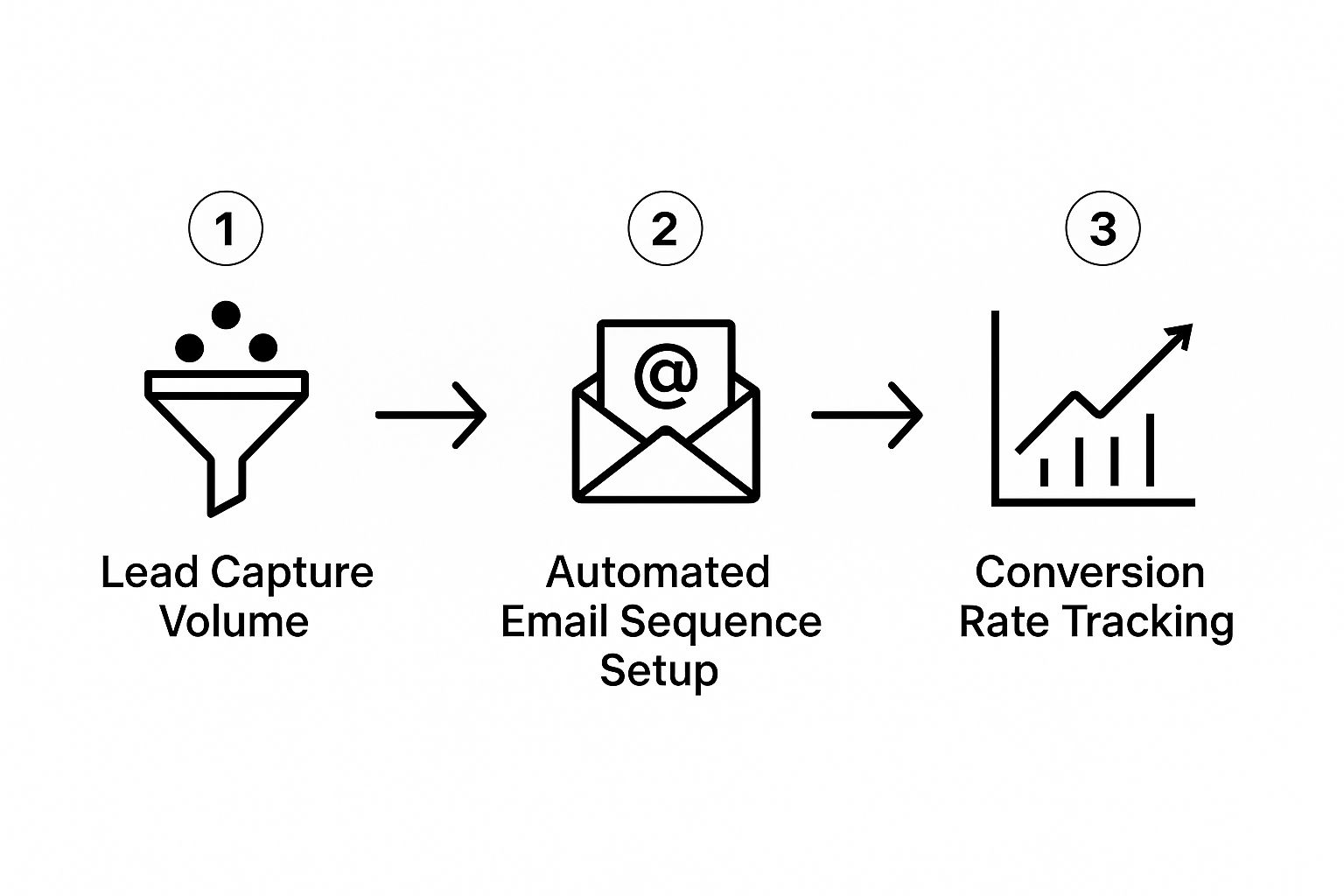
As you can see, it’s all about a logical flow: capture the lead, put them into an automated email series, and keep a close eye on your conversion rates to see what’s resonating.
Converting Trials and Retaining Customers
For any SaaS business, the real money is made when trial users become paying customers and then stick around. SaaS marketing automation plays a huge role in both. A smart user onboarding sequence can dramatically boost the odds that a trial user will truly understand your product’s value and decide to convert. This means sending emails based on their behavior, nudging them toward that “aha!” moment.
The same goes for retention. You can automate your efforts to build loyalty and spot churn risks before they become problems. These workflows could include:
- Automated Check-Ins: Send a friendly email 30 days after signup to ask for feedback.
- Usage-Based Tips: If a customer hasn’t touched a key feature, trigger a helpful email showing them how to use it.
- Renewal Reminders: Automatically send reminders as a customer’s subscription renewal date gets closer.
These simple, automated touchpoints make sure no customer slips through the cracks or feels ignored. To go deeper on building these kinds of strategies, this ultimate customer success playbook is a fantastic resource. By putting these thoughtful automations in place, you’re not just building a machine to get customers—you’re building one to keep them.
How to Choose the Right Automation Platform
Choosing a SaaS marketing automation platform feels a lot like picking a co-founder for your growth team. This isn’t just another software subscription; it’s a long-term partnership that can make or break your strategy. The market is packed with options, all shouting about their game-changing features, and it’s easy to get overwhelmed.
Let’s cut through the noise. To make the right call, you need to step back from the flashy feature lists and start with what your business actually needs. This isn’t about finding the single “best” platform out there—it’s about finding the one that’s the right fit for you.
The stakes are pretty high. Getting this right can seriously boost your efficiency. In fact, the marketing automation software market was valued at USD 5.72 billion in 2024 and is expected to rocket to USD 13.51 billion by 2033. This explosion shows just how vital these tools have become. If you’re curious about the details, you can explore the full market analysis from Straits Research.
Start with Scalability and Integration
Your SaaS is built to grow, so your automation tool has to be ready to grow with you. A platform that runs smoothly with your first 1,000 contacts could easily choke when you hit 100,000. Don’t be afraid to ask vendors direct questions about how their system handles scale.
Just as important is how the platform plays with the other tools in your tech stack. Your automation software shouldn’t be a silo. It needs to talk effortlessly with the systems you and your team rely on every single day.
Think about these key connections:
- Customer Relationship Management (CRM): Does it offer a native, two-way sync with your CRM? This is critical for keeping sales and marketing aligned with the same, up-to-the-minute customer data.
- Help Desk Software: Can you trigger automations from support tickets? Imagine automatically sending a feedback survey the moment a ticket is resolved.
- Product Analytics Tools: Can you feed user behavior data from your app directly into the platform to trigger perfectly timed, relevant messages?
A platform that doesn’t integrate well just creates more manual work—and that defeats the entire purpose of automation. Always prioritize tools that offer solid, native integrations with the software you already use.
Evaluate Usability and Support
A tool packed with powerful features is worthless if your team finds it too complex to use. The best SaaS marketing automation platforms manage to balance deep functionality with a user-friendly interface. If it takes an engineering degree to build a simple workflow, your team will simply avoid it, and you’ll never see a return on your investment.
Always insist on a live demo, and if you can, get a free trial. Let your team get their hands dirty. Can they put together a basic email sequence without needing hours of training? Is the reporting dashboard clear and easy to grasp?
Beyond the software, look at the people behind it—the support team. What happens when you hit a critical problem on a Friday afternoon?
- What kind of support do they offer? (Email, chat, phone)
- What are their typical response times?
- Do you get a dedicated account manager?
Solid support isn’t a bonus; it’s a necessity. You’re buying into a partnership, not just a piece of software.
Assess the True Cost and Business Fit
Finally, you need to look past the sticker price. Pricing models are all over the map, from contact-based tiers and feature gates to pay-per-email plans. You have to understand the total cost of ownership as your business scales. Will your bill suddenly double after you pass a certain number of contacts? It’s crucial to model these costs. You can even use our customer acquisition cost calculator to help you put your budget into perspective.
Also, think about the platform’s focus. Some tools are designed for B2B SaaS companies with long, complex sales cycles. Others are built for high-volume B2C businesses. Choosing a platform that aligns with your business model means its features and workflows are already tailored to solve the kinds of problems you face every day. By asking these tough questions upfront, you can find a true partner for your growth journey.
Your Step-by-Step Implementation Plan
Diving into SaaS marketing automation can feel overwhelming, like you’re staring at a giant box of machine parts with no instructions. But here’s the secret: you don’t have to build the entire machine on day one. The smart move is to start small with a single, high-impact project, get a win under your belt, and then build on that momentum.
We’ll walk through this process in five manageable steps. This is your roadmap to getting your first automated workflow up and running, so you can see real results without getting lost in endless planning.
Step 1: Define Your Goals and KPIs
Before you even think about building a workflow, you need to know what you’re aiming for. What does “success” actually look like for your business? Answering this question first ensures your entire automation strategy is grounded in tangible outcomes. Don’t start with the tool; start with the goal.
Your goals need to be specific, measurable, and tied to a real business problem. A vague goal like “get more leads” is useless. A much better goal is, “Increase our trial-to-paid conversion rate from 3% to 5% in the next quarter.” See the difference?
With a clear goal in hand, you can define your Key Performance Indicators (KPIs). These are the specific numbers you’ll track to see if you’re making progress. For the goal above, your KPIs might include:
- Email Open Rates: Are people actually opening your onboarding emails?
- Key Feature Adoption: What percentage of trial users complete the three most important setup steps?
- Conversion Rate: This is the ultimate measure of success for this particular goal.
Setting clear goals and KPIs from the start turns automation from a “nice-to-have” into a focused, results-driven initiative.
Step 2: Segment Your Audience
Now you know what you want to achieve. Next up is who you’re talking to. Blasting the same generic message to every single user is a fast track to the spam folder. This is where segmentation comes in—it’s all about grouping your users based on shared characteristics or behaviors so you can send them messages that actually matter.
For a SaaS company, a great starting point is to segment based on what users are doing (or not doing) in your app. For instance, you could create simple groups like:
- “New Trial Users” who just signed up.
- “Activated Users” who have completed a key action, like creating their first project.
- “At-Risk Users” who haven’t logged in for 14 days.
By creating these basic segments, you can tailor your automated messages to what each group needs to hear at that specific moment in their journey.
Step 3: Map Content to the Journey
With your goals set and your audience segmented, it’s time to map your content to the user’s path. The good news is you probably don’t need to create everything from scratch. You likely already have a library of blog posts, help articles, and videos that can be put to work in your automation workflows.
For a new trial user, your content plan could look something like this:
Day 1: Send a welcome email linking to your “Getting Started” guide.
Day 3: Follow up with a short video tutorial on the product’s most powerful feature.
Day 5: Share a case study that shows how a similar customer achieved success.
This approach delivers value at every touchpoint, guiding users toward that “aha!” moment with helpful, relevant information when they need it most.
Step 4: Build Your First Workflow
Okay, it’s time to get your hands dirty and actually build something. Resist the urge to automate the entire customer lifecycle at once. Pick one high-impact workflow to start with. A welcome series for new subscribers or a trial user onboarding sequence are both fantastic choices because they can produce measurable results fast.
Let’s imagine you’re building a welcome series for new newsletter subscribers. It could be a simple three-email sequence:
- Email 1 (Immediate): Delivers the lead magnet they signed up for and sets expectations.
- Email 2 (2 days later): Shares one of your most popular blog posts or a valuable tip.
- Email 3 (4 days later): Gently introduces your product and suggests a next step, like watching a demo.
Building this first, simple workflow will teach you a ton about how your automation tool works and give you the confidence to tackle more complex projects down the road.
Step 5: Test, Launch, and Optimize
Before you flip the switch and set your automation live for everyone, you have to test it. Meticulously. Send test emails to yourself and a few teammates to check for typos, broken links, or weird formatting. Make sure the workflow logic is firing correctly—are the triggers and delays working exactly as you intended?
Once you’re confident it’s running smoothly, launch it! But your job isn’t over. The final, ongoing step is to monitor your KPIs and constantly look for ways to improve. Maybe your subject lines aren’t grabbing enough attention, or your call-to-action is a bit confusing. Use A/B testing to experiment with small tweaks and continuously optimize your workflow for better results. For a more detailed guide on rolling out a project like this, a SaaS implementation checklist can be an invaluable resource.
Alright, let’s get down to how you actually measure and refine your marketing automation. It’s one thing to get everything set up, but the real magic happens when you start treating it like a living, breathing part of your strategy.
Think of your automation as a system you need to tune, not a machine you just turn on and walk away from. The goal isn’t just to do more marketing; it’s to get better results from the marketing you’re doing.
It’s easy to get caught up in vanity metrics. Things like email open rates or social media likes feel good, but they don’t pay the bills. They can offer some clues, sure, but they don’t tell you if your efforts are actually moving the needle on what matters: revenue and growth. True optimization starts when you shift your focus from “busy” metrics to business metrics.
Focus on Metrics That Matter
So, what should you be tracking? You need to look at the numbers that tell a clear story about business impact. These are the metrics your leadership team actually cares about because they directly reflect the health of the company.
Forget the surface-level fluff and dig into the data that connects your marketing campaigns to real dollars and cents.
Here are the heavy hitters:
- Lead-to-Customer Conversion Rate: This is the big one. What percentage of the leads your automation touches end up becoming paying customers? It’s a direct grade for your entire funnel’s performance.
- Marketing-Generated Revenue: How much cash can you directly attribute to your automated campaigns? Most good marketing platforms can track this, giving you a crystal-clear picture of your ROI.
- Customer Lifetime Value (CLV): Are your automated onboarding and engagement sequences creating stickier customers? A rising CLV is a fantastic sign that your automation is helping people get more value and stick around longer.
- Customer Churn Rate: If you see churn drop after launching a new retention campaign, that’s a massive win. It’s direct proof that your automation is successfully keeping customers happy.
Tracking these core numbers lets you have much more powerful conversations. Instead of saying, “Our welcome email got a 40% open rate,” you can say, “Our new automated onboarding sequence boosted our trial-to-paid conversion by 23% last quarter.” See the difference?
Getting a handle on these numbers is non-negotiable for running a successful SaaS business. If you want to dive deeper, our guide on the most important SaaS KPIs is the perfect place to start.
Use A/B Testing to Find What Works
Once you’re tracking the right things, you can start making them better. The most reliable way to do this is with disciplined A/B testing. It sounds technical, but the concept is simple: change one thing at a time and see what performs best.
You can A/B test pretty much anything in your automated flows. Here are a few high-impact ideas to get you started:
- Email Subject Lines: Pit a simple, direct subject line against one that asks a provocative question.
- Calls-to-Action (CTAs): Does “Start Your Free Trial” outperform “Request a Live Demo”? Test it and find out for your audience.
- Timing and Cadence: Maybe sending that follow-up email three days after signup is the sweet spot. Or maybe it’s four. Only a test will tell you for sure.
The trick is to be methodical. Test one variable at a time, and let the test run long enough to get data you can trust. This approach takes the guesswork out of optimization and replaces it with cold, hard facts. It’s how you turn your automation engine into a system of constant, sustainable improvement.
Frequently Asked Questions About SaaS Automation
Diving into SaaS marketing automation for the first time can feel a bit overwhelming, and it’s totally normal to have a few questions. Getting a handle on this stuff can seem complex, but once you clear up the common sticking points, you’ll be ready to move forward.
Let’s walk through some of the most common questions we hear from SaaS leaders just like you.
How Much Technical Skill Do I Really Need?
This is probably the number one thing that holds people back. There’s a persistent myth that you need to be a developer to get started, but modern automation platforms are built for marketers.
Honestly, if you can sketch out a flowchart on a whiteboard, you have what it takes to build an automated workflow. Most tools today use simple drag-and-drop interfaces. You’re focused on the why—the marketing logic—not the how of writing code.
Your most valuable skill here isn’t technical, it’s strategic. Knowing your customer’s journey and what they need to hear at each step is infinitely more important than knowing a programming language.
When Is the Right Time to Start?
So many SaaS founders put this off, thinking they need a massive list of users before it’s worthwhile. The truth? The best time to start is right now, even if you’re just getting off the ground.
Setting up simple automations from day one, like a basic welcome email for new sign-ups, helps you build a solid foundation. You get to test and tweak your approach on a smaller, more manageable scale. That way, when you hit that big growth spurt, you’ll have a well-oiled machine ready to go instead of scrambling to build one from scratch.
What’s the Difference Between Email Marketing and Marketing Automation?
This is a great question because the two are often confused. Think of traditional email marketing as a megaphone—you’re blasting the same message, like a newsletter or a sale announcement, to your entire list at once.
SaaS marketing automation is more like having a personal conversation with each user, but at scale. It sends messages triggered by what an individual user does (or doesn’t do). For example, it can automatically send a helpful video to someone who just signed up for a trial but hasn’t activated a key feature yet. It’s all about creating a personalized, one-to-one experience, which is crucial for a great user journey. This idea is central to the concepts we cover in our guide on SaaS onboarding best practices.
Ready to stop wasting time on repetitive tasks and start building a real growth engine? SaaS Operations gives you the battle-tested playbooks and SOPs to roll out effective automation, fast. Skip the painful trial-and-error and plug our proven frameworks straight into your business. Start accelerating your growth by visiting https://saasoperations.com.