7 Actionable Performance Management System Examples for SaaS Teams in 2025
 Published By: Alex
December 28, 2025
Published By: Alex
December 28, 2025
Stop running performance reviews that feel like a waste of time. For SaaS operators, a disconnected or poorly implemented performance management process doesn't just demotivate your team—it directly kills momentum and erodes key metrics like MRR and NRR. The right system turns your team into a high-output machine by aligning individual effort with strategic company goals. But sifting through endless options to find the perfect fit is a full-time job.
That’s where this playbook comes in. We’ve done the heavy lifting, curating a list of proven performance management system examples built for SaaS operators. Forget generic descriptions. We’re breaking down exactly how each system works, who it’s for, and the specific KPIs you can track. Each example includes operational workflows and exact next steps to get started immediately. This isn’t a list; it’s a deployment guide for building a high-performance engine. To fully leverage these systems, you must understand modern approaches; explore more about continuous performance management before you begin. Let's find the system that will actually work for your team.
1. The Operator's Playbook: The SaaS Operations Scorecard System
Kicking off our list is not a software tool, but a comprehensive, operator-tested framework. The SaaS Operations Scorecard System is a battle-tested playbook designed for implementation, not just theory. It provides plug-and-play scorecards, SOPs, and meeting rhythms for managing performance across critical SaaS functions like marketing, sales, and customer success.
This system stands out because it was built by operators who have scaled multiple 8-figure SaaS businesses. Instead of focusing on vanity metrics, it prioritizes the leading indicators that actually drive growth and profitability. It’s a complete performance management system example that you can deploy immediately.
Why It's Our Top Choice
This framework earns the top spot for its sheer practicality and actionable depth. It bypasses the common pitfalls of overly complex software by providing a clear, streamlined process that emphasizes accountability and results. The guidance is deployment-focused, removing the guesswork from building a high-performance culture.
SaaS Operator Insight: The system's power lies in its "first principles" approach. It forces teams to track the inputs that directly influence outcomes—like
Marketing Qualified Leads (MQLs)leading toSales Qualified Leads (SQLs)—rather than just the finalRevenuenumber. This creates a proactive, forward-looking operational rhythm instead of a reactive, backward-looking one.
System Breakdown & Analysis
| Feature | Description |
|---|---|
| Purpose | To install a data-driven performance management rhythm focused on leading indicators and clear accountability. |
| Who It's For | SaaS Founders, COOs, and department heads (Marketing, Sales, CS) at companies scaling from $1M to $30M+ ARR. |
| Key Focus Areas | Go-To-Market (GTM) engine efficiency, departmental accountability, and predictable revenue growth. |
| Meeting Cadence | Weekly departmental check-ins and monthly leadership reviews focused on scorecard metrics. |
Example Scorecard & Workflow
Here’s a snapshot of what a Marketing Scorecard might look like using this system:
Mock Screenshot/Layout:
| Marketing Department – Weekly Scorecard |
| Metric | Goal | Actual | % |
|---|---|---|---|
| Website Traffic (Unique) | 10,000 | 11,500 | ✅ |
| MQLs (New Leads) | 250 | 220 | ❌ |
| SQLs (Sales Accepted) | 50 | 55 | ✅ |
| MQL-to-SQL Conv. Rate | 20% | 25% | ✅ |
| ————————————————– | |||
| Owner: CMO | Review Date: Weekly Monday Sync |
Workflow Summary:
- Define: Leadership and the department head agree on 4-6 critical leading indicators.
- Assign: A single owner is assigned accountability for each scorecard.
- Track: The owner updates the scorecard weekly before a standing review meeting.
- Review: During the meeting, the team focuses only on the "red" or "yellow" metrics, discussing roadblocks and action items.
This disciplined process ensures that conversations are always focused on what matters most. For a forward-thinking strategy in ensuring operational consistency and scalability, explore these efficient process documentation strategies to complement your scorecards.
How to Deploy This System
You can begin implementing this framework immediately without any financial investment.
- Access the Tools: Visit SaaS Operations to access free resources like their growth ceiling calculator, LTV:CAC model, and NRR calculators. Use these to establish your baseline metrics.
- Download the Templates: Grab the plug-and-play scorecard templates for Marketing, Sales, and Customer Success. SaaS Operations provides several in-depth performance scorecard examples to guide your setup.
- Schedule the Rhythm: Implement the recommended weekly meeting cadence with your team leads. Use the first meeting to customize the scorecard metrics for each department.
- Execute & Iterate: Run the process for one month, then gather feedback to refine your metrics and improve the workflow.
This approach offers the structure of a sophisticated performance management system with the flexibility of a framework, making it an exceptional choice for any SaaS team serious about operational excellence.
2. G2 – Performance Management Software category
Instead of a single tool, our second example is a process: using a software marketplace like G2 to build your shortlist. G2’s performance management category is your command center for market research. It’s a meta-tool that lets you see what systems other SaaS operators are actually using, loving, or ditching.
G2 is indispensable for SaaS operators because it aggregates verified user reviews, allowing you to filter out marketing fluff and see how a platform performs in the wild. Its comparison tools let you line up your top three or four contenders side-by-side, creating a data-driven analysis before you even book a demo.
Strategic Analysis: How SaaS Operators Use G2
The real power of G2 isn't just reading reviews; it's strategic filtering. For a SaaS context, you can slice the data in ways that are directly relevant to your own company's stage and needs.
- Filter by Company Size: Start by filtering for "Small-Business" or "Mid-Market" to see what your peers are using. An enterprise-grade system is overkill for a 50-person startup.
- Check Integration Capabilities: A critical step for any SaaS is ensuring a new tool integrates with your existing tech stack (e.g., Slack, Jira, HubSpot). G2 lists key integrations on each product page.
- Analyze Recent Reviews: Sort reviews by "Newest" to gauge current sentiment. A platform that was a leader two years ago might be falling behind in customer support or feature velocity today.
Actionable Next Steps: The "G2 Shortlist" Method
Here’s a simple, repeatable process to turn G2 browsing into a concrete action plan.
- Define 3-5 "Must-Have" Features: Before you visit G2, list your non-negotiables (e.g., OKR tracking, 360-degree feedback, continuous feedback channels).
- Build a Filtered List: Go to the G2 performance management category and apply filters for your company size, highest user satisfaction, and "High Performer" or "Leader" status.
- Cross-Reference Your "Must-Haves": Scan the top 5-7 results. Use their feature lists to see which ones meet all your criteria.
- Create a Comparison Table: Use G2’s compare feature (or a simple spreadsheet) to map your top 3 candidates against each other on features, pricing indicators, and integration support. You now have a data-backed shortlist to present to your leadership team.
This "G2 Shortlist" method transforms a generic search into one of the most effective performance management system examples of a selection process, ensuring you only spend time demoing tools that are a proven fit for companies like yours.
Website: https://www.g2.com/categories/performance-management
3. Capterra – Performance Management (Performance Appraisal) category
Similar to G2, our third example is a process: leveraging the software marketplace Capterra to discover and vet potential tools. Capterra’s performance appraisal category serves as a high-level research hub, offering a broad view of the market with a slightly different lens. It’s an excellent starting point for SaaS operators who want a quick, comprehensive market scan before diving into deeper analysis.
Capterra stands out by packaging data into user-friendly "Shortlist" reports, which can save you hours of preliminary work. For a SaaS founder or HR lead, this means you get a curated look at the most popular and highly-rated tools, framed with helpful context around buyer trends and key features. It helps you quickly move from a wide-open search to a manageable list of contenders.
Strategic Analysis: How SaaS Operators Use Capterra
Capterra's strength lies in its filtering and comparison capabilities, which are crucial for SaaS teams needing to find a tool that fits their specific ecosystem.
- Filter by Deployment and Features: Use the filters to narrow down by "SaaS/Web/Cloud" deployment. Then, select your critical features like OKR/goal management, 360-degree feedback, and continuous performance tracking.
- Leverage Side-by-Side Comparisons: Once you have a few options, use the comparison tool to see a direct feature-to-feature breakdown. This is perfect for identifying gaps in a platform’s offering before you get on a sales call.
- Evaluate Vendor Shortlists: Pay attention to Capterra’s curated reports. These often highlight tools with high user ratings and popularity, giving you a solid, data-backed starting point for your own evaluation.
Actionable Next Steps: The "Capterra First-Pass" Method
Use this process to quickly build a foundational list of viable performance management software options.
- Identify 3 Core Integration Needs: List the absolute must-have integrations for your SaaS stack (e.g., Slack, Google Workspace, your HRIS). Capterra’s research notes often cover common integrations.
- Apply Your Core Filters: Go to the Capterra performance appraisal category. Filter by SaaS deployment, your company size, and your top three "must-have" features.
- Create a "Viability" Shortlist: From the filtered results, select your top 4-5 platforms. Look for those with transparent feature lists and a high number of recent, positive reviews.
- Cross-Reference with a Template: Use your shortlisted tools as a reference while refining what you need. A well-structured framework, like these performance review templates, can help you define the exact workflows you'll want the software to support.
This "Capterra First-Pass" method is one of the most efficient performance management system examples for a selection process, ensuring your initial research is broad yet targeted, and grounded in what other SaaS teams are successfully using.
Website: https://www.capterra.com/performance-appraisal-software/
4. Lattice – Performance Management platform
Lattice is a dedicated people management platform designed to connect performance, engagement, and employee development. For scaling SaaS companies, Lattice provides the infrastructure to move beyond ad-hoc check-ins and formalize processes like 1:1s, goal setting (OKRs), and performance reviews. It’s built to help managers become better leaders and align individual effort with company objectives.
What makes Lattice a strong contender for tech companies is its modular approach and deep integration into the typical SaaS workflow. You can start with just their Performance module and then expand as your people operations mature. Its user interface is clean and intuitive, reducing the friction for both managers and employees to adopt new feedback habits.
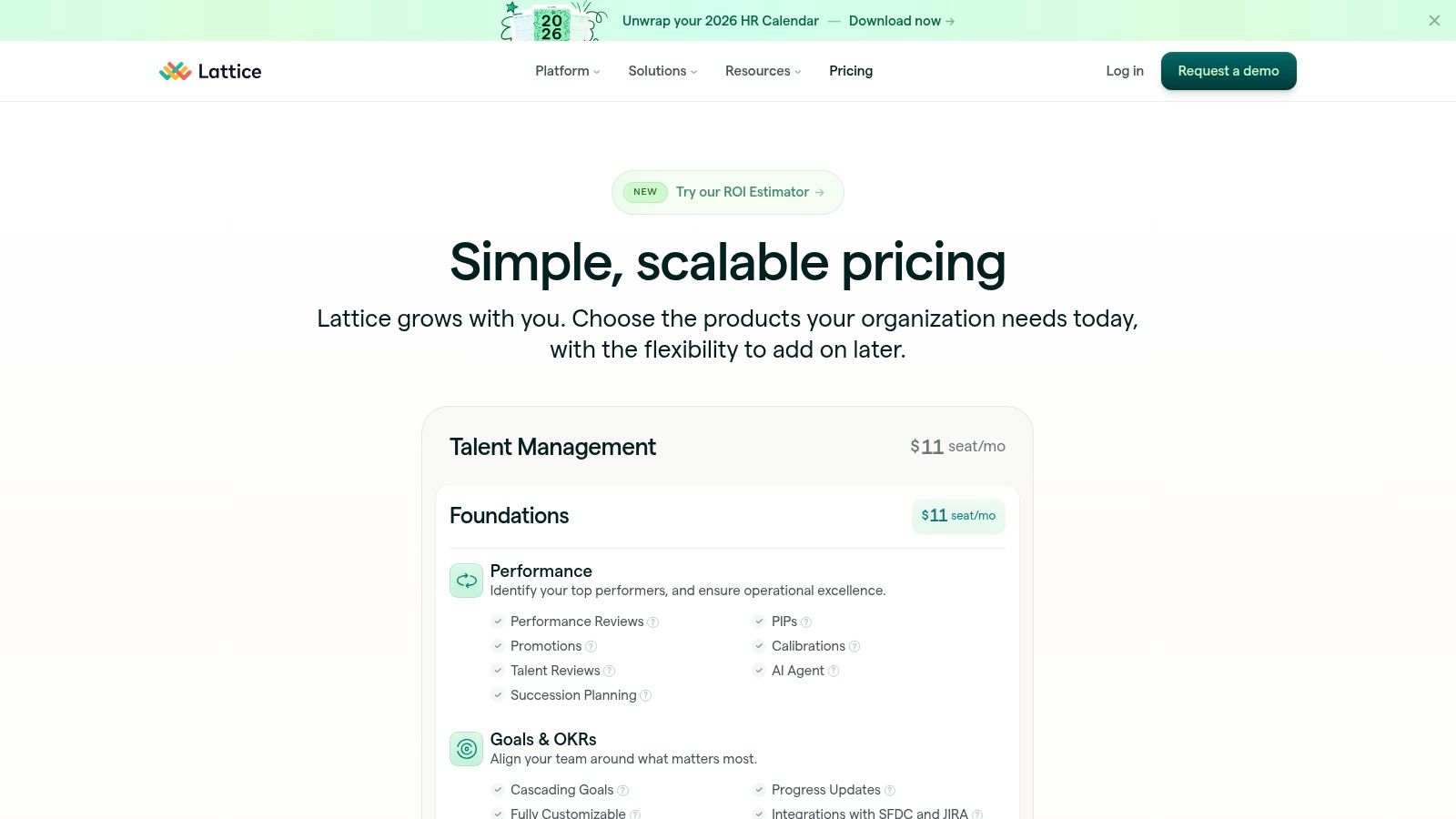
Strategic Analysis: How SaaS Operators Use Lattice
The real value of Lattice for a SaaS team lies in turning performance conversations into data. It creates a centralized hub for all performance-related activities, ensuring nothing gets lost in email threads or forgotten docs.
- Connect Goals to Performance: Use the Goals (OKR) module to set company-wide objectives and have teams and individuals align their goals directly to them. During performance reviews, managers have a clear, data-backed view of an employee’s contributions against those specific targets.
- Leverage 1:1 Agendas: The 1:1 tool is more than a calendar invite. Managers use the shared agenda feature to track talking points, action items, and long-term development goals. This turns a simple meeting into a continuous performance-coaching session.
- Integrate with Your Workflow: Connect Lattice to Slack. This simple step turns performance management from a "once-a-quarter" event into a daily habit by enabling real-time feedback and praise directly within the communication tools your team already uses.
Actionable Next Steps: The "Integrated Feedback Loop" Method
Here’s a practical process to implement Lattice and build a culture of continuous feedback, a hallmark of high-performing SaaS teams.
- Start with the Performance Module: Begin with the core module, which includes reviews, 1:1s, and feedback. Onboard your managers first, training them on how to use the 1:1 agenda templates to structure their check-ins.
- Launch a Company-Wide "Praise" Campaign: Use the public praise feature and its Slack integration to encourage peer-to-peer recognition. This is a low-stakes way to get the entire company comfortable with giving and receiving feedback in the platform.
- Run Your First Review Cycle: Use a simple performance review template for your first cycle. Focus on manager-employee reviews before introducing more complex 360-degree or upward feedback.
- Analyze the Data: After the cycle, use Lattice’s analytics to identify high-performers, spot management trends, and find skill gaps across the organization. This data becomes the foundation for your next-quarter talent strategy.
This approach makes Lattice one of the most practical performance management system examples for creating a connected and data-driven people strategy.
Website: https://lattice.com/pricing
5. 15Five – Performance + Engagement platform
15Five stands out by tightly bundling performance management with employee engagement, built on a philosophy of manager enablement. It’s designed for SaaS teams that believe great managers are the key to high performance, offering tools like OKRs and 360-degree feedback alongside manager training add-ons.
This platform is a strong contender for scaling SaaS companies who want a holistic system that not only measures performance but actively develops the managers responsible for it. Its transparent pricing tiers provide a clear growth path from foundational performance tools to advanced talent management.
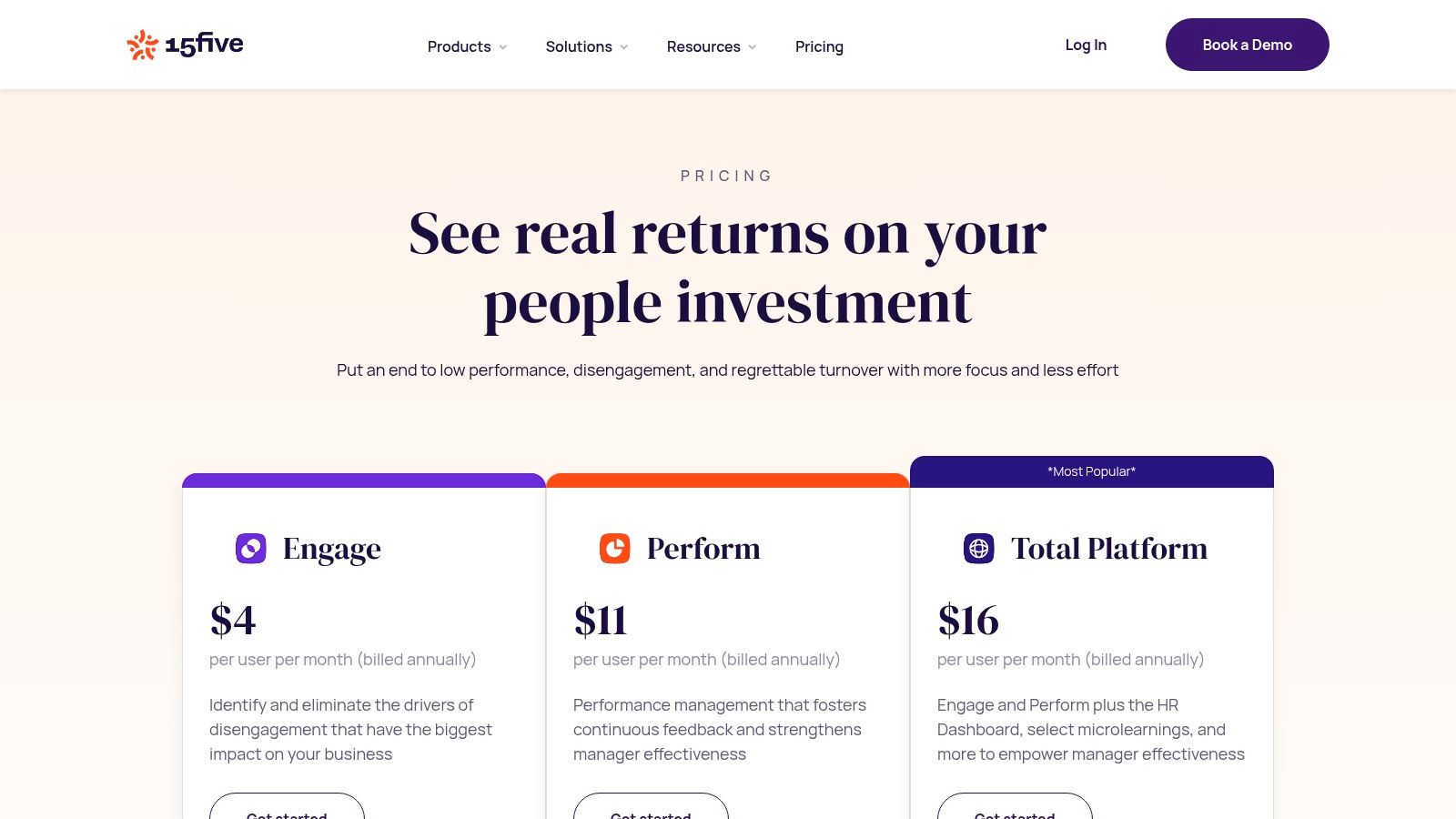
Strategic Analysis: How SaaS Operators Use 15Five
The true advantage of 15Five is leveraging its integrated approach to connect manager actions directly to team outcomes. It moves beyond just tracking goals and into understanding the "why" behind team performance.
- Connect Engagement to Performance: Use the HR Outcomes Dashboard to correlate engagement survey results with performance review data. Are your lowest-engaged teams also the ones missing their OKRs? This provides a data-backed reason to focus management coaching on specific leaders.
- Leverage the Talent Matrix: During calibration cycles, use the 9-box style Talent Matrix to identify high-performers who are flight risks or promising talent needing development. This visual tool helps leadership make objective decisions about promotions and succession planning.
- Focus on Manager Training: If you opt for the training add-ons, treat them as a core part of your performance process. Ensure new managers complete the training modules before they run their first performance review cycle in the platform.
Actionable Next Steps: The "Manager Enablement" Rollout
Use 15Five not just as an HR tool but as a system for upskilling your entire management layer. This makes it one of the most practical performance management system examples for growing teams.
- Start with the "Perform" Plan: Implement the core features first, such as OKRs and check-ins, to establish a baseline rhythm for performance conversations.
- Define Core Manager KPIs: Before launching, establish clear expectations for managers within the tool. Explore a variety of employee key performance indicators on saasoperations.com to guide your strategy.
- Layer in Engagement Surveys: After one or two quarters, introduce the "Engage" features. Use the initial performance data as a benchmark to see how engagement initiatives impact team output.
- Pilot the Add-Ons: Select a small group of new or developing managers to pilot the AI coaching (Kona) or formal training modules. Measure their teams' performance and engagement against a control group to prove ROI before a company-wide rollout.
This phased approach prevents overwhelm and allows you to build a culture of effective management, powered by the platform’s integrated toolset.
Website: https://www.15five.com/pricing/
6. Culture Amp – Engage + Perform suite
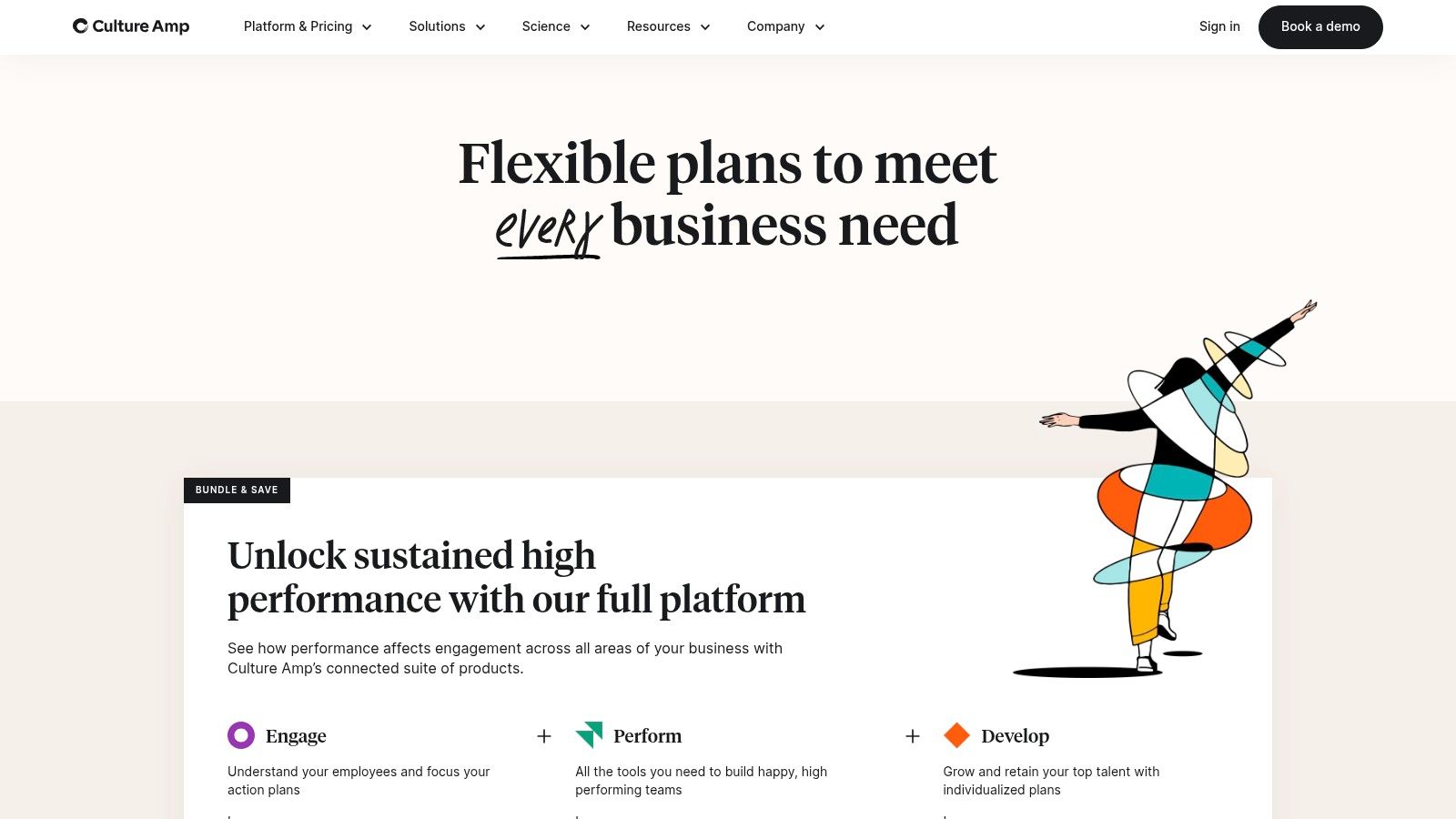
Culture Amp positions itself as an employee experience platform. For SaaS teams scaling globally or with a distributed workforce, it combines deep engagement analytics with a robust performance management suite. This integration is its key differentiator; it directly connects employee sentiment to performance outcomes, helping you answer why performance is what it is.
It’s ideal for high-growth SaaS companies that have moved beyond basic check-ins and need a configurable system to handle complex review cycles, 360-degree feedback, and goal-setting (like OKRs) across different departments. The platform's extensive template library significantly reduces the administrative burden of launching a new performance program from scratch.
Strategic Analysis: Connecting Engagement to Performance
Culture Amp’s power lies in its ability to correlate data points that are often siloed. This allows operators to create a more holistic and proactive performance strategy.
- Link Feedback to Turnover Risk: The platform can identify if negative feedback trends in a specific team correlate with higher attrition rates. This data-driven insight is crucial for understanding how to reduce employee turnover.
- Use Calibration Tools for Fairness: For SaaS companies with multiple managers, ensuring consistent performance ratings is a huge challenge. Culture Amp’s calibration features provide a structured workflow to normalize ratings, which is vital for maintaining trust in the review process.
- Leverage Templates for Speed: Instead of building review questions from scratch, you can use evidence-based templates for manager reviews, self-reflections, and peer feedback. This ensures you're asking the right questions from day one.
Actionable Next Steps: The "Diagnose and Develop" Workflow
Use Culture Amp to create a repeatable cycle for identifying and addressing team performance issues before they escalate.
- Launch an Engagement Survey: Start with a targeted survey from the Engage module focused on manager support, career growth, or role clarity.
- Analyze Performance Cycle Data: As you run your performance reviews in the Perform module, cross-reference the survey results. Look for managers whose teams reported low engagement but also have surprisingly high performance ratings (a potential sign of burnout).
- Identify Skill Gaps: Use the 360-degree feedback data to pinpoint common development themes, such as a need for better project management or communication skills across the engineering team.
- Assign Development Resources: Leverage the "Develop" module (or your own L&D resources) to create targeted growth plans for individuals or teams based on the combined engagement and performance data.
This workflow makes Culture Amp one of the most strategic performance management system examples for SaaS operators who want to build a culture of continuous improvement, not just run annual reviews.
Website: https://www.cultureamp.com/platform/plans-and-pricing
7. PerformYard – Purpose-built performance management
PerformYard is for SaaS teams that need a dedicated performance management tool without the complexity of a full-blown HR suite. It focuses purely on reviews, goals, and feedback, making it a streamlined solution for companies that want to formalize their performance process without getting bogged down in unnecessary features.
Its main appeal is its simplicity and predictable cost. For operators who want to implement a robust system for check-ins, reviews, and goal alignment quickly, PerformYard offers a clear path with strong implementation support, which is often included in its straightforward pricing.
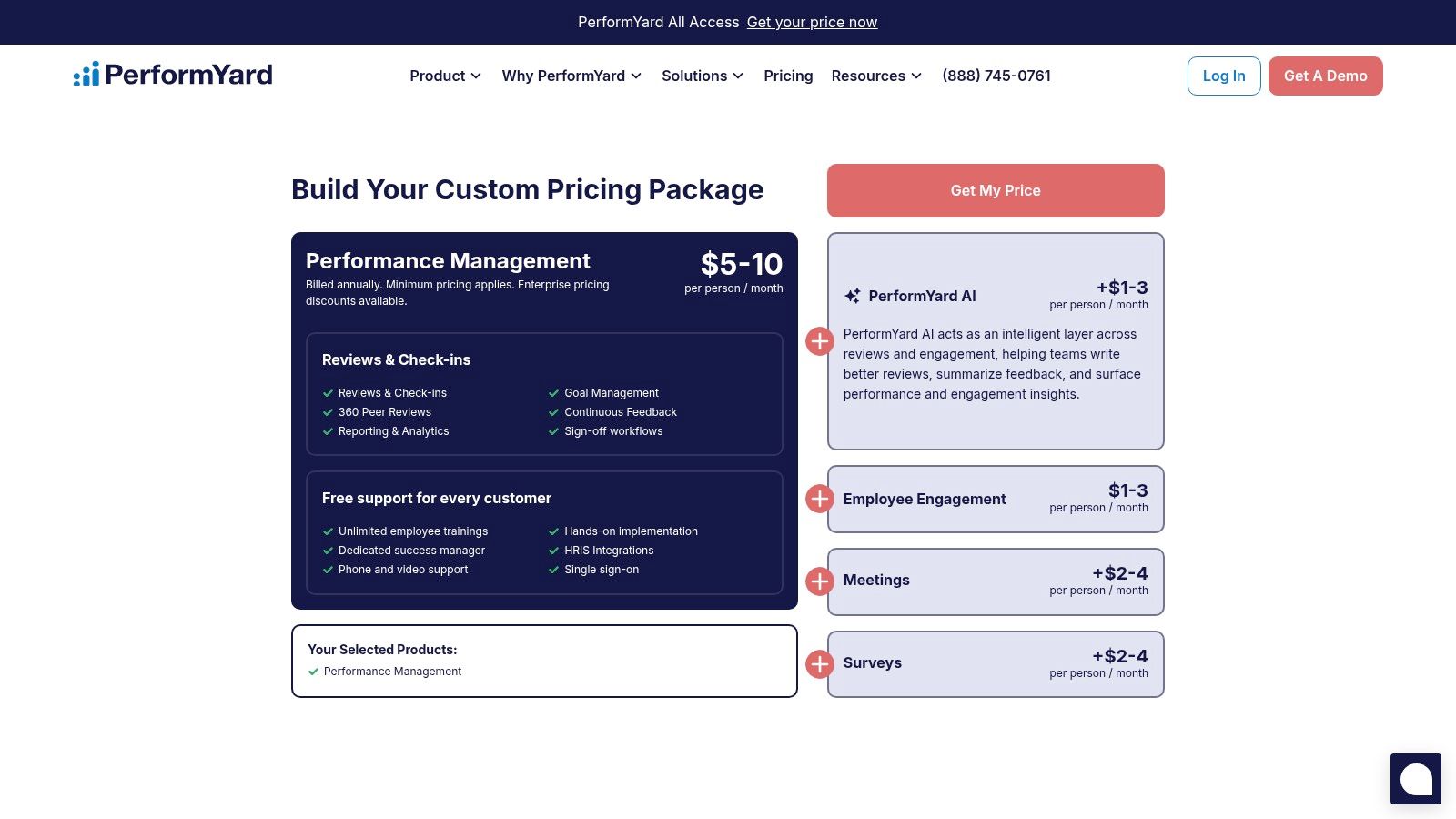
Strategic Analysis: How SaaS Operators Use PerformYard
PerformYard shines when you leverage its customization to build a performance cycle that mirrors your company's unique cadence. It isn't a one-size-fits-all tool; it’s a framework to build upon.
- Design Custom Review Templates: Go beyond a generic annual review. Build separate templates for 30-60-90 day onboarding check-ins, quarterly performance snapshots, and project-based retrospectives. This creates a continuous feedback loop.
- Automate the Entire Cycle: Use the automation features to schedule and send reminders for self-assessments, manager reviews, and 360-degree feedback requests. This removes the administrative burden from HR and managers, ensuring consistency.
- Integrate with Your Communication Hub: Connect PerformYard to Slack. This turns performance management into an ongoing conversation by allowing employees to give real-time feedback and praise directly from the tools they use daily.
Actionable Next Steps: The "Simple Stack" Implementation
Use PerformYard to create a powerful yet uncomplicated performance stack that focuses on core outcomes.
- Map Your Ideal Review Cadence: Before implementation, decide on your cycle: will it be quarterly goal-setting, bi-annual reviews, and continuous feedback? Have this blueprint ready.
- Build Your Core Templates: Start by creating just three essential templates: a quarterly goal-setting form, a manager-employee 1:1 meeting agenda, and an annual performance summary. Check out these performance scorecard examples for inspiration.
- Launch with Manager Training: The included support is a key benefit. Run a mandatory training session for all managers on how to use the system to facilitate meaningful conversations, not just "fill out the form."
- Connect to Your HRIS: Integrate PerformYard with your primary HRIS (like Gusto or Rippling) to automate user provisioning, ensuring your data is always in sync.
This approach makes PerformYard one of the most practical performance management system examples for SaaS teams that value efficiency and focus.
Website: https://www.performyard.com/pricing
Top 7 Performance Management Systems Comparison
| Solution | 🔄 Implementation complexity | ⚡ Resource requirements | 📊 Expected outcomes | 💡 Ideal use cases | ⭐ Key advantages |
|---|---|---|---|---|---|
| SaaS Operations | Low–Medium — plug‑and‑play playbooks; minimal setup | Low — free calculators and templates; operator time for tailoring | Faster time‑to‑value, clearer KPIs, fewer bottlenecks | Early–mid stage SaaS needing repeatable ops and rapid deployment | ⭐⭐⭐⭐ Practical, battle‑tested playbooks + free tools |
| G2 – Performance Management category | Very Low — research platform, no implementation | Very Low — time to review filters and ratings | Shortlist vendors with verified user feedback | Vendor discovery and comparative research across segments | ⭐⭐⭐ Verified reviews, broad market coverage |
| Capterra – Performance Appraisal category | Very Low — marketplace browsing and comparisons | Very Low — time to shortlist and follow vendor links | Quick market scan and narrowed vendor list | Buyers seeking a fast shortlist and basic research notes | ⭐⭐⭐ Wide listings, side‑by‑side filters |
| Lattice – Performance Management platform | Medium–High — configuration, onboarding and annual agreement | Medium — minimum annual spend (~$4k) plus admin effort | Improved manager effectiveness, goal alignment, analytics | Scaling SaaS needing manager tools, OKRs, and integrations | ⭐⭐⭐⭐ Modular buying, strong integrations, manager tools |
| 15Five – Performance + Engagement | Medium — standard onboarding; optional training/AI add‑ons | Medium — transparent tiers; add‑ons increase cost | Better engagement and manager enablement; holistic reviews | Teams focused on manager development and engagement metrics | ⭐⭐⭐ Transparent tiers, strong manager enablement |
| Culture Amp – Engage + Perform suite | High — deep configuration, phased feature rollouts | High — quote‑based pricing and sales engagement | Scalable insights, large template libraries, multilingual support | Large or globally distributed orgs needing configurable systems | ⭐⭐⭐⭐ Extensive templates and enterprise scalability |
| PerformYard – Purpose‑built performance mgmt | Low–Medium — focused setup with included implementation | Low–Medium — predictable per‑user pricing ($5–$10/mo) | Straightforward, predictable performance processes | Teams wanting a simple, cost‑predictable performance stack | ⭐⭐⭐ Clear pricing, included implementation, simplicity |
Your Next Move: From Examples to Execution
We’ve just walked through a deep dive into some of the most effective performance management system examples tailored for the high-velocity world of SaaS. From Lattice's focus on holistic employee development to PerformYard's flexible, purpose-built approach, the common thread is clear: modern performance management is no longer a top-down, once-a-year chore. It's a continuous, data-driven conversation that fuels growth, engagement, and operational excellence.
The biggest takeaway? The "best" system isn't a one-size-fits-all solution. It's the one that aligns perfectly with your company's unique culture, stage, and strategic goals. A lean startup might thrive on a simple, agile goal-setting framework, while a scaling enterprise needs the robust, multi-faceted features of a platform like Culture Amp or 15Five.
Key Insights for SaaS Operators
As you move from inspiration to implementation, keep these core principles at the forefront of your strategy:
- Clarity Over Complexity: The goal is to drive performance, not get lost in a sea of features. A system that's confusing or cumbersome for your team will fail, no matter how powerful it is. Prioritize user experience and intuitive design.
- Integration is Non-Negotiable: Your performance management tool must seamlessly connect with your existing tech stack, especially your HRIS and communication platforms like Slack. This integration prevents data silos and makes performance tracking a natural part of the daily workflow.
- Adaptability for the Win: The SaaS landscape changes fast, and your team structure will evolve with it. Choose a system that can adapt, whether that means customizing review cycles, building unique scorecards for different roles, or scaling your processes as you grow.
Your Actionable Playbook for Implementation
Ready to deploy? Don't just pick a tool and hope for the best. Follow this strategic playbook to ensure a successful rollout.
- Define Your "Why": Before you look at another demo, get crystal clear on what problem you're trying to solve. Is it employee engagement? Goal alignment? Manager effectiveness? Document your top three objectives.
- Audit Your Current Process (or Lack Thereof): Map out what you're doing now. What works? What's broken? Getting feedback from managers and individual contributors at this stage is crucial—it builds buy-in from the start.
- Shortlist and Scorecard: Based on the performance management system examples in this article and your "why," create a shortlist of 2-3 platforms. Build a simple scorecard to grade them on criteria like ease of use, integration capabilities, and pricing.
- Launch a Pilot Program: Don't roll out a new system to the entire company at once. Select a single, tech-savvy team to run a 90-day pilot. This allows you to work out the kinks, gather real-world feedback, and create internal champions before the full launch.
Ultimately, implementing a performance management system is about more than just software; it's about codifying your culture and creating a shared language for success. The right tool acts as a catalyst, turning abstract goals into tangible results and empowering every single person on your team to do their best work.
Ready to move beyond theory and build a rock-solid operational foundation for your performance management strategy? At SaaS Operations, we provide the exact playbooks, templates, and SOPs you need to implement systems like these flawlessly. Stop reinventing the wheel and start executing with proven processes by visiting SaaS Operations today.